The search for the best quality espresso machine often gets lost in flashy marketing and misleading pressure claims. The real difference between a drinkable shot and a transcendent one comes down to thermal stability, pump integrity, and a brew group built for consistent extraction—not just the price tag or the number of buttons on the front panel.
I’m Mohammad Maruf — the founder and writer behind AirfryerBite. My market research focuses on decoding industrial-grade hardware specs, from PID-controlled boilers and E61 group heads to OPV over-pressure valves and thermoblock materials, helping buyers cut through the noise and find genuine long-term performers.
This guide evaluates eleven machines spanning commercial heritage, super-automatic convenience, and enthusiast-driven semi-automatics. Every model here has been judged on its brew boiler integrity, pump pressure consistency, steaming capability, and the quality of its group head components to help you identify a truly best quality espresso machine for your counter and your daily routine.
How To Choose The Best Quality Espresso Machine
Choosing a quality espresso machine is not about chasing the highest wattage or the most presets. It is about understanding how heat, pressure, and water flow interact within the brew group. A well-built machine delivers stable water temperature at the group head (within a few degrees Fahrenheit), maintains 9 bars of consistent pressure, and uses a stainless steel or brass boiler that resists scale and corrosion. These three pillars—thermal stability, hydraulic pressure, and material integrity—determine whether your daily shot will taste balanced or bitter.
Boiler Architecture and Temperature Stability
The boiler is the heart of any espresso machine. Single boiler designs force you to choose between brewing and steaming, making them best for pure espresso drinkers. Heat exchanger (HX) systems use a single steam boiler that heats brew water on the fly, allowing simultaneous brewing and steaming, though they require a slight cooling flush to avoid overheating the puck. Dual boiler machines dedicate separate boilers for brew and steam, offering precision PID control on the brew side and unlimited steam power simultaneously. For milk-based drinks, a dual boiler or a well-tuned HX is essential.
Pump Pressure and the OPV Valve
A vibratory pump alone is not enough. The machine must have an over-pressure valve (OPV) that limits the maximum pump pressure to around 9 bars during extraction. Many budget machines ship with 15-bar pumps and no adjustable OPV, which can cause channeling and over-extraction. An adjustable OPV lets you dial in the pressure to match your coffee’s roast level and grind size, directly improving crema quality and flavor clarity.
Portafilter Size and Basket Quality
The industry standard for quality espresso is a 58mm portafilter. This size allows for proper dose distribution (18-22 grams), a flat puck surface, and compatibility with precision baskets and bottomless portafilters. Machines that use 51mm or 54mm portafilters limit your upgrade path and often produce a thinner crema. Look for a machine that includes both single-wall (non-pressurized) and dual-wall (pressurized) baskets, giving you the option to use fresh grounds or pre-ground coffee while you refine your technique.
Quick Comparison
On smaller screens, swipe sideways to see the full table.
| Model | Category | Best For | Key Spec | Amazon |
|---|---|---|---|---|
| Breville Dual Boiler BES920XL | Dual Boiler | Precision PID and simultaneous steam | PID with ±2°F stability | Amazon |
| Rancilio Silvia | Single Boiler | Long-term reliability and modding | Brass boiler / 58mm group | Amazon |
| Gaggia Classic Pro | Single Boiler | Entry-level enthusiast platform | 9-bar / 58mm commercial | Amazon |
| De’Longhi Magnifica Evo Next | Super-Automatic | Push-button convenience | 13 grind / 13 recipes | Amazon |
| KitchenAid KF6 KES8556PL | Super-Automatic | Metal-clad build and quiet operation | 15 recipes / 2.2L tank | Amazon |
| De’Longhi Dinamica Plus | Super-Automatic | 24 recipes and 4 user profiles | 3.5″ TFT / 13 grind | Amazon |
| Bosch VeroCafe 800 TPU60309 | Super-Automatic | 35 drinks with app control | Ceramic grinder / 5″ display | Amazon |
| Ascaso Steel DUO PID | Dual Thermoblock | Fast heat-up and modern design | Dual thermoblock / PID | Amazon |
| Diletta Bello+ | HX / E61 | Traditional E61 lever with PID | E61 / PID / 3L boiler | Amazon |
| Rocket Appartamento TCA | HX / E61 | Italian craftsmanship and style | HX / E61 / 2.5L boiler | Amazon |
| Breville Oracle Touch BES990 | Super-Auto Dual Boiler | Fully automated cafe-quality drinks | Dual boiler / auto-tamp | Amazon |
In‑Depth Reviews
1. Breville Dual Boiler BES920XL

The Breville Dual Boiler BES920XL is a serious contender for anyone who values thermal precision and simultaneous steaming. Its dual stainless steel boilers—one dedicated to brew, one to steam—are regulated by a PID controller that keeps water temperature within ±2°F of your target, which is the kind of stability usually found in commercial machines. The 58mm portafilter with 19-22 gram dose capacity gives you full control over puck prep, and the over-pressure valve limits pump pressure to prevent bitter extraction.
The steam wand is powerful enough to texture milk for latte art, and the integrated tamper and Razor dosing tool assist with consistency. The 84 oz water tank is generous, and the LCD display includes a shot timer for tracking extraction time. The machine weighs 28 pounds and feels dense and solid on the counter, though the brushed stainless steel cladding is thinner than on Italian rivals and can dent if handled roughly.
Owners report consistent shots and excellent crema over multiple years of daily use. The dual boiler setup means you can steam milk immediately after brewing without waiting for temperature recovery. Some users noted the portafilter can loosen during extraction if not locked in firmly, and the water filters are slightly more expensive than generic options. Breville’s customer service has been responsive for many, replacing parts even out of warranty in some cases.
Why it’s great
- Dual boilers with PID deliver unmatched temperature stability in this price tier
- 58mm commercial portafilter with 19-22g basket for full extraction
- Integrated tamper and Razor tool streamline puck prep
- Strong steam wand for latte art microfoam
Good to know
- Metal cladding is relatively thin and can dent easily
- Portafilter may loosen mid-pull if not locked tightly
- Replacement water filters are pricey
- Some reports of steam boiler leaks after extended use
2. Rancilio Silvia

The Rancilio Silvia has been a benchmark for home espresso for over two decades, and the V6 iteration refines the formula without abandoning its commercial DNA. At its core is a 12-ounce brass boiler that serves both brew and steam, paired with a 58mm commercial group head and a three-way solenoid valve that prevents portafilter sneeze and enables backflushing. The all-metal construction—stainless steel body with brass, copper, and steel internal components—feels built to survive decades of heavy use.
Temperature surfing is part of the workflow with a single boiler: you wait for the ready light, then flush briefly to bring the group head to brew temperature before locking in the portafilter. Many owners add a PID controller as a mod to eliminate this ritual entirely. The steam wand is powerful but requires practice to produce microfoam, and the small drip tray and 0.3-liter boiler capacity mean frequent refills if you are pulling multiple shots or steaming milk for guests.
Customers who have owned the Silvia for a decade or more praise its repairability and parts availability. The machine is simple enough for a home enthusiast to service, and third-party upgrade parts (flat shower screen, PID kits, precision baskets) are abundant. The portafilter handle feels lightweight, and the top panel can be thin, but the core internals are robust. For someone who wants a machine that will last 15 years and grow with their skills, this is a solid foundation.
Why it’s great
- Brass boiler and 58mm commercial group head are built for longevity
- Three-way solenoid valve enables backflushing for easy maintenance
- Highly moddable with aftermarket PID, shower screen, and basket kits
- Simple architecture makes it repairable for home mechanics
Good to know
- Single boiler requires temperature surfing between shots
- Small 0.3L boiler limits multi-shot and steam capacity
- Drip tray is shallow and water tank is small
- Steam wand is powerful but not beginner-friendly
3. Gaggia Classic Pro RI9380/47

The Gaggia Classic Pro is the definitive entry-level platform for the aspiring home barista. Its solid steel housing and Made in Italy heritage are backed by a 58mm commercial stainless steel portafilter, a three-way solenoid valve, and a commercial steam wand. The machine delivers true 9-bar espresso extraction right out of the box, which is a genuine step up from the 15-bar unregulated pumps found in most budget machines.
Like the Silvia, this is a single boiler design, so temperature management requires some attention. Many owners install an OPV spring mod (the standard 12-bar spring can be swapped for a 9-bar version) and eventually add a PID for precise control. The steam wand is a commercial-style ball joint that pivots freely, but the single-hole tip produces good microfoam once you learn the technique. The included tamper is functional but lightweight, and the portafilter comes with both pressurized and non-pressurized baskets.
Reviews consistently highlight the Classic Pro’s sturdy build and upgradeability as its strongest assets. Owners who invest in a quality grinder, a bottomless portafilter, and a PID mod report pulling shots that rival machines costing twice as much. The machine is not designed for push-button convenience—it demands some practice and willingness to mod—but for the enthusiast on a tighter budget, it is arguably the best starting point in the category.
Why it’s great
- True 9-bar extraction with commercial 58mm portafilter
- Solid steel housing and Made in Italy construction
- Highly upgradeable with OPV springs, PID, and bottomless portafilter
- Commercial steam wand with excellent articulation
Good to know
- Single boiler requires temperature surfing without a PID mod
- Stock OPV spring is set to 12 bar, needs adjustment for optimal shots
- Included tamper is lightweight and not ideal
- Not a set-and-forget machine; requires practice and gear investment
4. De’Longhi Magnifica Evo Next

The De’Longhi Magnifica Evo Next is a super-automatic machine built for the household that values speed and consistency over hands-on craft. It integrates a conical burr grinder with 13 settings, a 2.4-inch TFT color display, and the LatteCrema Hot System for automatic milk frothing. You select from 13 one-touch recipes including espresso, latte, cappuccino, americano, and even iced coffee, and the machine handles the grinding, dosing, brewing, and milk texturing automatically.
The grinder delivers a consistent dose across grind sizes, and the machine supports three user profiles for personalized drink settings. The 60-ounce water tank is front-accessible, and many components—including the drip tray and milk carafe—are dishwasher-safe, which simplifies daily maintenance. The machine uses a bypass doser for pre-ground coffee, giving you the option to use decaf or a different roast without emptying the bean hopper.
Customer feedback highlights the machine’s well-engineered build and repeatable results. The front-access layout makes refilling and emptying convenient, and the automatic milk system produces creamy foam with minimal effort. A few owners reported leak issues from the water tank seal, and one experienced a defective unit immediately. Overall, for someone who wants high-quality espresso drinks without the learning curve, this is a strong super-automatic choice.
Why it’s great
- Built-in conical burr grinder with 13 settings for fresh coffee
- LatteCrema Hot System textures milk automatically
- Three user profiles for personalized drink preferences
- Dishwasher-safe parts for easy cleaning
Good to know
- Some units experience water tank seal leaks
- No low-water warning before running dry mid-pull
- Painted plastic body with metal details may not feel as premium as steel
- Automatic milk system can occasionally fail to read the carafe
5. KitchenAid Fully Automatic KF6 KES8556PL

The KitchenAid KF6 KES8556PL is a super-automatic machine that focuses on build quality and quiet operation. The body is clad in metal, giving it a weighty, premium feel that most plastic-bodied super-automatics lack. It offers 15 recipe options including espresso, americano, latte, and cappuccino, with automatic smart dosing that adjusts the grind volume for each drink type. The 2.2-liter water tank is side-mounted, and the bean hopper is removable for easy refills or bean swapping.
Milk drinks are handled via a separate milk hose that draws from any container you choose, and the automatic frothing and heating system delivers a consistent milk texture. The machine includes a water filter, so descaling frequency is reduced, and the interface is straightforward with a touchscreen and soft-touch buttons. The brew group is accessible for rinsing, and the cleaning cycle is simple to run.
Reviews note that the coffee is not very hot straight out of the spout—some owners microwave their milk or preheat the cup to compensate. The machine is noticeably quieter than many rivals, and the removable hopper makes it easy to switch between beans. A small number of buyers reported catastrophic failures after a few weeks, including water leaks and loud mechanical noises. KitchenAid’s customer service response was slow in these cases, which is a concern for a machine at this price point.
Why it’s great
- Metal-clad construction feels more durable than plastic super-automatics
- Removable bean hopper allows quick bean changes
- Quiet operation compared to many competitors
- Side-mounted 2.2L tank saves counter space
Good to know
- Brew temperature is lower than ideal for some drinkers
- Cannot double-tap to brew two cups simultaneously
- A few reports of early mechanical failure and poor support
- Milk hose system requires a separate container
6. De’Longhi Dinamica Plus
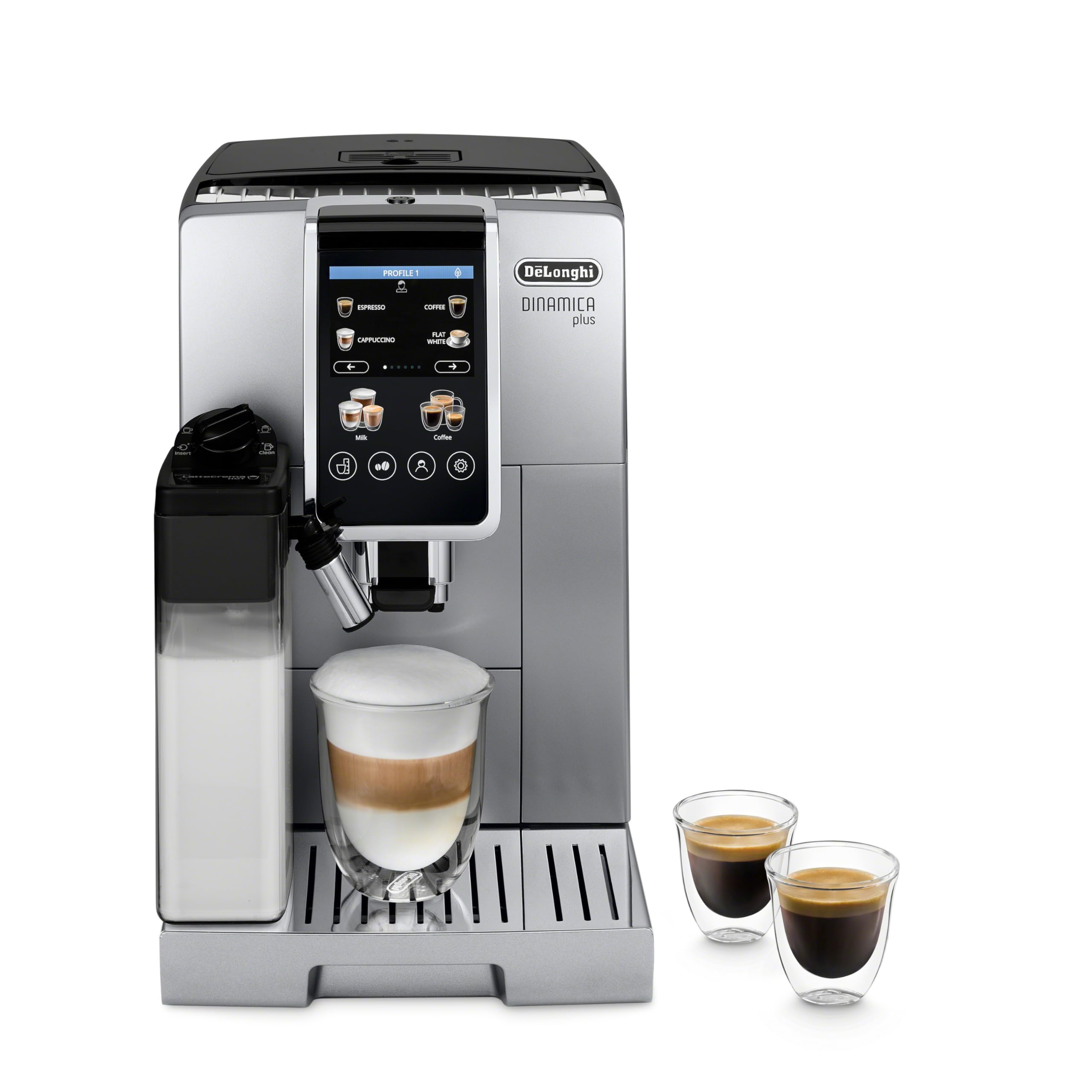
The De’Longhi Dinamica Plus is a fully automatic machine that leans heavily into personalization. It features a 3.5-inch TFT full-touch color display, a conical burr grinder with 13 settings, and the LatteCrema Hot System for milk. With 24 one-touch recipes including iced coffee, flat white, and espresso macchiato, and support for up to four user profiles, it is one of the most configurable super-automatics on the market. The Smart One-Touch system learns your most frequent selections and surfaces them first.
The build quality is solid, with a metal frame that feels substantial. The milk carafe uses a tight seal that can make it difficult to remove at first, and some owners note that the machine purges a significant amount of water between cycles, which impacts the waste tray capacity. The grinder is consistent, and the pause after grinding helps develop flavor before extraction. The steam wand on the LatteCrema system produces dense foam with a creamy texture.
Customer reviews are largely positive, with many users reporting excellent daily performance and a noticeable improvement over their previous super-automatic machines. The dual purge cycle can be wasteful, and the milk carafe port seal is very tight, but the coffee quality and the breadth of drink options outweigh these issues for most buyers. A small number of users received defective units that failed to prime or leaked internally, underscoring the importance of checking the return policy.
Why it’s great
- Massive 24-recipe library with iced coffee and flat white options
- Smart One-Touch system learns and prioritizes your favorites
- Four user profiles for a multi-person household
- LatteCrema system produces consistently creamy milk foam
Good to know
- Excessive purge cycles waste water and fill the drip tray quickly
- Milk carafe port seal is very tight and hard to remove
- Some units have been DOA with priming failures
- Learning curve for the extensive touchscreen menu
7. Bosch VeroCafe 800 TPU60309
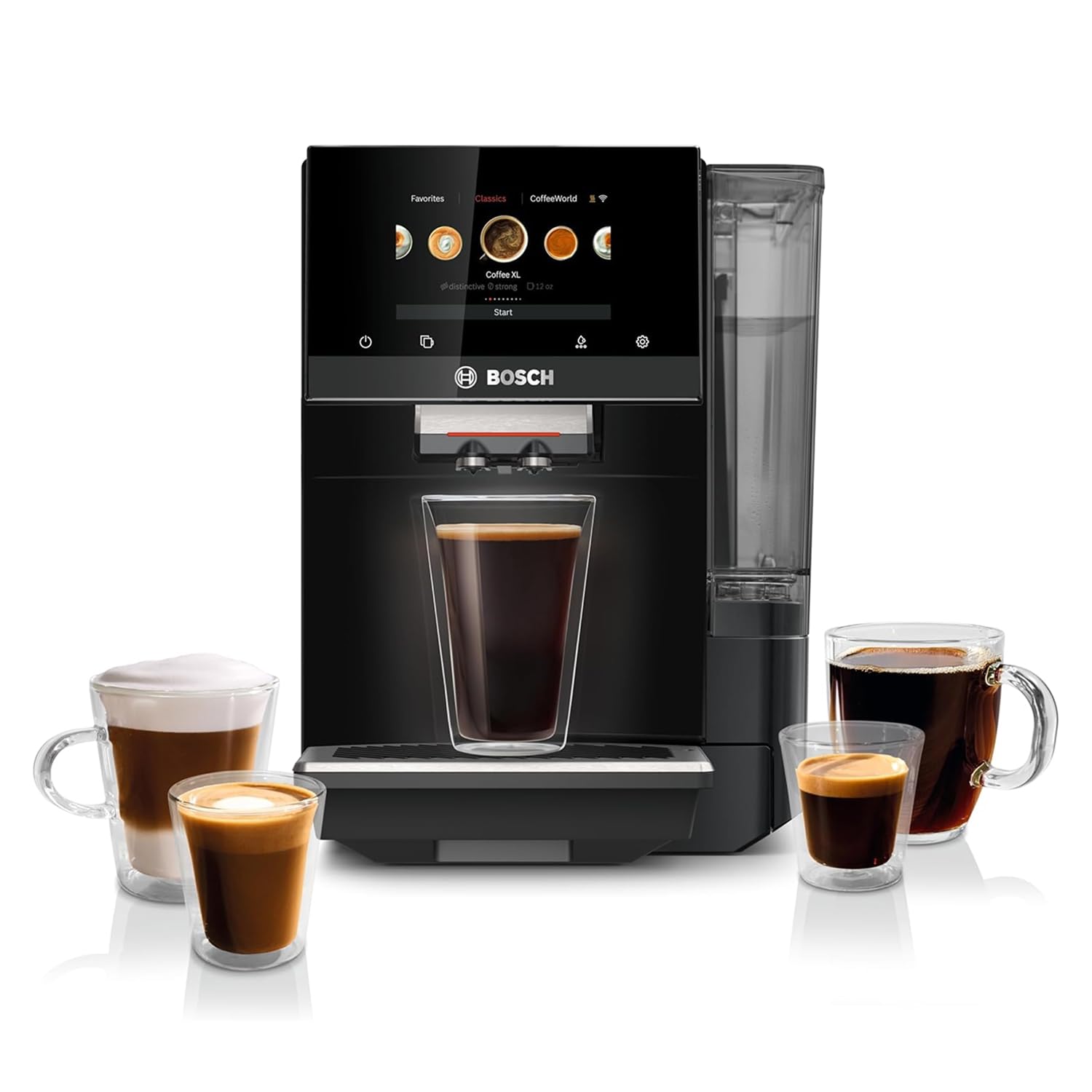
The Bosch VeroCafe 800 Series is a fully automatic machine that delivers the widest drink library in this roundup—35 beverages—alongside a 5-inch Active Select color touchscreen. The ceramic conical burr grinder is quieter and more durable than steel burrs, and it produces a consistent grind across all settings. The Milk Express Plus system uses a hose that connects directly to the milk carton, eliminating the need for a separate carafe and reducing cleanup time.
The machine supports remote brewing via the Home Connect app, allowing you to start a drink from the couch or as you head home. Personalization controls include strength, size, milk ratio, and even aroma level. The combined cleaning and descaling program walks you through maintenance step by step with animations on the screen, and the machine includes a Mavea water filter to reduce descaling frequency. The modular internal construction makes the machine serviceable if a part needs replacement.
Users praise the coffee quality, the intuitive interface, and the quiet grinder. A common complaint is that the brew temperature is too low—around 129°F for some drinks—though the temperature is adjustable. The milk ratio cannot be set below 30%, which limits very light milk drinks. A few owners reported major defects such as dispensing warm water instead of coffee or broken internal parts. Despite these quality control concerns, the majority of owners are highly satisfied after extended use.
Why it’s great
- 35-drink library is the largest among super-automatics reviewed
- Ceramic burr grinder is quieter and more durable than steel
- Home Connect app allows remote drink customization
- Milk Express Plus connects directly to a milk carton for less cleanup
Good to know
- Brew temperature is relatively low; may need cup preheating
- Milk ratio cannot be set below 30%
- Some units have had serious defects like warm water output
- Self-cleaning cycles consume a significant amount of water
8. Ascaso Steel DUO PID

The Ascaso Steel DUO PID breaks from the brass-boiler tradition by using two independent thermoblocks—one for brewing and one for steam. The aluminum and stainless steel thermoblock design heats up in under five minutes, uses less energy than a traditional boiler, and eliminates the risk of limescale buildup in the water circuit. The PID controller is digitally displayed and adjustable in one-degree increments, giving you precise control over brew temperature.
The machine features a 58mm professional portafilter with a real walnut wood handle, volumetric controls for preinfusion and shot volume, and an adjustable over-pressure valve. The steam wand is electronic with an advanced no-burn design, and it produces continuous, stable steam pressure. The body is built from powder-coated carbon steel and polished stainless steel, giving it a visual weight that matches its performance profile. The 48-ounce water tank is top-fill and accessible without moving the machine.
Reviews highlight the Ascaso’s fast heat-up time, beautiful aesthetics, and excellent steam wand for latte art. The PID interface can be somewhat confusing to navigate initially, and the brew switch does not remember custom shot times after the machine is turned off. The bright LED indicators are noticeable in a dim kitchen. Overall, it is a well-engineered machine that appeals to those who value modern materials and quick thermal response over traditional boiler mass.
Why it’s great
- Dual thermoblocks heat up in under five minutes with no limescale risk
- PID control adjustable in 1°F increments for precise brewing
- Walnut-handled 58mm portafilter and beautiful stainless/powder coat body
- Electronic steam wand with no-burn tip and continuous steam pressure
Good to know
- PID interface can be confusing to program initially
- Brew switch does not retain custom shot times after power-off
- Bright LED indicators may be distracting in low-light kitchens
- Requires a dedicated 20A outlet for full performance
9. Diletta Bello+

The Diletta Bello+ is a heat exchanger espresso machine built around the classic E61 brew group, hand-assembled in Milan. It features a front-mounted PID controller that displays and adjusts steam boiler temperature, and doubles as a shot timer during extraction. The heat exchanger design means a single large boiler heats both steam and brew water on the fly, enabling simultaneous brewing and steaming after a brief cooling flush. The programmable preinfusion allows up to 10 seconds of passive water pressure before full extraction.
The stainless steel case, frame, and boiler are built for longevity, and the large drip tray has been deepened by an inch compared to earlier models for better clearance. The machine includes a low-power eco mode that reduces boiler temperature when idle to save energy while maintaining faster recovery to brew temps. The all-manual controls—toggle switches for brew and steam—force you to develop your barista skills, which is exactly what the target user wants.
Owners upgrading from machines like the Breville Barista Express or Gaggia Classic report a significant jump in shot quality and consistency. The E61 group provides excellent thermal stability after a warm-up of 10-15 minutes, and the PID allows fine-tuning by single degrees to adjust flavor profiles. The steam wand is powerful and cool-touch, and the hot water cycle is convenient for americanos. The small drip tray and initial factory smell are minor complaints. This is a machine for those who view espresso as a craft, not a chore.
Why it’s great
- E61 group head with PID provides exceptional thermal stability
- Heat exchanger design allows simultaneous brew and steam
- Handmade in Milan with stainless steel boiler and frame
- Programmable preinfusion up to 10 seconds
Good to know
- Requires a 10-15 minute warm-up for thermal equilibrium
- Small drip tray fills quickly during backflushing
- Steep learning curve for users new to E61 machines
- Manual controls mean no automatic shot settings
10. Rocket Espresso Appartamento TCA
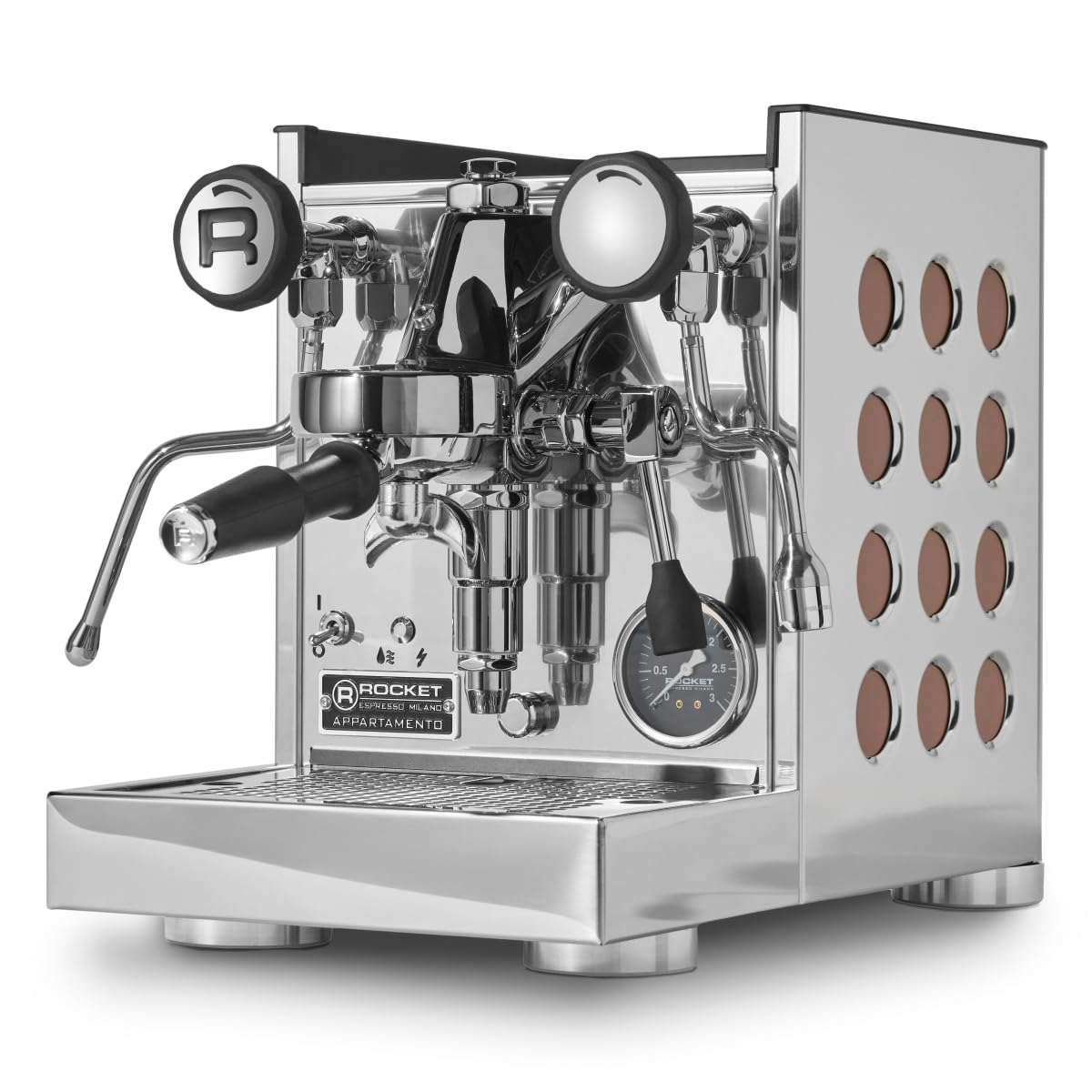
The Rocket Appartamento TCA is a heat exchanger machine that combines Italian craftsmanship with a compact footprint. It uses a 2.5-liter copper boiler, an E61 brew group, and a unique hybrid PID system that lets you adjust brew temperature by selecting one of four boiler pressures (0.9 to 1.2 bar) without adding extra screens or buttons. The redesigned frame, case, and control board are all upgrades from the original Appartamento, and the machine is available with white, black, or copper side panels.
The RGB indicator light provides at-a-glance alerts for water level and heating status, and the optional 30-minute standby mode reduces energy consumption when idle. The commercial-grade E61 group delivers excellent thermal stability after a 15-20 minute warm-up, and the steam wand is powerful enough for milk texturing during a cooling flush. The stainless steel body and copper boiler are both durable and visually distinctive, especially with the copper side panel option.
Owners praise the Appartamento TCA for its compact size, build quality, and consistent shot quality. The hybrid PID pressure adjustment system is intuitive once you understand the relationship between boiler pressure and brew temperature. The heat exchanger design requires a cooling flush before brewing to avoid overheating the puck, which is standard for this type of machine. A few buyers reported receiving units with cosmetic damage or manufacturing defects, and customer service has been inconsistent in resolving those issues.
Why it’s great
- Handcrafted in Italy with a copper boiler and E61 group
- Compact footprint saves counter space without sacrificing performance
- Hybrid PID adjusts brew temperature via 4 boiler pressure settings
- Interchangeable side panels (white, black, copper) for customization
Good to know
- Long warm-up time of 15-20 minutes before stable extraction
- Requires cooling flush before brewing to prevent overheating
- Some units arrived with cosmetic damage or defects
- Customer support responsiveness has been inconsistent
11. Breville Oracle Touch BES990BSS

The Breville Oracle Touch is the most automated machine in this review, combining dual boilers with an integrated conical burr grinder that automatically grinds, doses, and tamps 22 grams of coffee into the 58mm portafilter. The PID-controlled dual boilers provide independent temperature management for brew and steam, and the machine includes an over-pressure valve and low-pressure preinfusion for balanced extraction. The touchscreen interface lets you select from five pre-programmed recipes or save up to eight personalized profiles.
The automatic steam wand uses a dedicated boiler to produce microfoam at the touch of a button, and it self-cleans after each use. The 67-ounce water tank is top-fill, and the machine includes a Razor dosing tool, dual-wall filter baskets, and a stainless steel milk jug. The 1800-watt heating system brings the dual boilers to temperature in about 7-8 minutes, and the integrated tamper eliminates one of the most variable steps in puck prep. The machine weighs nearly 36 pounds and feels extremely solid on the counter.
Users who value consistency and ease of use find the Oracle Touch transforms their morning routine. The auto-tamping mechanism produces a level puck every time, and the steam wand delivers cafe-quality foam. However, the touchscreen can feel slightly slow, and the pump struggles with very fine grind settings. A significant number of owners report long-term reliability issues including boiler leaks and pump failures, often outside the warranty period. Breville’s customer service has been criticized for slow responses on complex repairs.
Why it’s great
- Integrated grinder auto-doses and tamps 22g for hands-free puck prep
- Dual boilers with PID deliver precise brew and steam temperatures
- Automatic steam wand produces microfoam with one touch and self-cleans
- Touchscreen interface with 8 customizable drink profiles
Good to know
- Pump can struggle with very fine grind settings
- Touchscreen is not as responsive as modern tablets
- Reliability concerns with boiler leaks and pump failures over time
- Customer service response times can be slow for complex repairs
FAQ
What is the practical difference between a single boiler and a heat exchanger for daily use?
Why do so many quality espresso machines use a 58mm portafilter instead of a smaller size?
What is an over-pressure valve (OPV) and why does it matter for shot quality?
Is a dual boiler machine always better than a heat exchanger for home use?
Final Thoughts: The Verdict
For most users, the best quality espresso machine winner is the Breville Dual Boiler BES920XL because it combines dual boiler precision, commercial-sized components, and PID temperature control at a price that undercuts most E61 rivals while still delivering third-wave-quality shots. If you want uncompromising Italian craftsmanship and an E61 group, grab the Diletta Bello+ for its hand-built Milanese construction and programmable preinfusion. And for those who need fully automated convenience without sacrificing dual boiler thermal stability, nothing beats the Breville Oracle Touch at automating dose, tamp, and milk texture while maintaining pro-grade temperature control.