There is a uniquely satisfying feeling when a knife glides through a ripe tomato skin without any pressure. The problem is that most home cooks settle for dull blades simply because they are intimidated by water stones or electric grinders. A pull-through knife sharpener removes the guesswork, replacing manual angle control with fixed guides that do the tricky part for you.
I’m Mohammad Maruf — the founder and writer behind AirfryerBite. I’ve spent over a decade analyzing the hardware specifications and real-world performance of kitchen gear, from sharpening abrasives to motor-driven appliances.
This guide isolates the five models that actually deliver on their promise of restoring a razor edge, so you can confidently choose the best pull-through knife sharpener that matches your blade collection and daily cooking habits.
How To Choose The Best Pull-Through Knife Sharpener
A pull-through sharpener simplifies the entire process, but not every model treats your knife the same way. Understanding the abrasives, the number of stages, and the angle design helps you avoid the models that remove too much steel or leave a ragged edge.
Stage Count: Two, Three, or Four Slots
Two-stage sharpeners (coarse then fine) are fast but often skip the final polish. Three-stage sharpeners add a ceramic honing slot that refines the edge after coarse grinding. Four-stage versions like the ZWILLING include separate coarse and fine slots for each side of the blade, plus a scissor slot. More stages give you more control over the final sharpness.
Abrasive Type: Diamond vs. Ceramic vs. Tungsten Carbide
Diamond-impregnated discs cut hard steel quickly and last through hundreds of sharpenings. Ceramic wheels or rods hone the edge without removing much metal. Tungsten carbide blades, common in cheap sharpeners, gouge steel and shorten blade life. Look for diamond coarse stages paired with ceramic finishing stages for the best balance of speed and edge quality.
Sharpening Angle: 15° vs. 20°
Japanese-style knives (Shun, Global, Miyabi) typically have a 15° edge angle, while Western knives (Wusthof, Zwilling, Victorinox) use 20°. Some sharpeners offer a single fixed angle, which works fine if you own only one style. Dual-angle sharpeners, such as the ZWILLING with 15° and 20° slots, accommodate mixed collections without guesswork.
Scissor and Serrated Blade Support
Not all pull-through sharpeners handle curved or serrated edges. Dedicated scissor slots use a pivoting mechanism that matches the blade curve. Straight pull-through slots can sharpen serrated knives only if you use very light pressure and follow the scalloped edge profile. If your household uses sewing scissors or kitchen shears, prioritize models with a designated shear slot.
Quick Comparison
On smaller screens, swipe sideways to see the full table.
| Model | Category | Best For | Key Spec | Amazon |
|---|---|---|---|---|
| ZWILLING Razor-Sharp 4-Stage | Premium | Mixed blade collections & scissors | 4 stages, 15° & 20° angles, scissor slot | Amazon |
| Work Sharp Pull Through | Mid-Range | Quick daily touch-ups | Diamond & ceramic wheels, 8.25″ length | Amazon |
| Kai Ceramic Diamond Pull Sharpening System | Mid-Range | Japanese 16° knives | 3 slots, diamond plates, ceramic rods, 16° V | Amazon |
| Bogoni Rolling Knife Sharpener | Premium | High-hardness blades & strop finish | 15° & 20° magnetic guides, leather strop | Amazon |
| The Edgemaker Knife Sharpener Pro 331 | Budget | Simple 2-stage on a tight budget | Crossed steel rods, 0.26 lb, high-impact plastic | Amazon |
In‑Depth Reviews
1. ZWILLING Razor-Sharp 4-Stage Pull Through Knife Sharpener

The ZWILLING Razor-Sharp pack s five slots into a compact body: two coarse ceramic slots and two fine ceramic slots arranged by angle, plus a fifth slot for scissors. Each side of the sharpener corresponds to a specific angle—15° for Japanese blades and 20° for Western blades—so there is no ambiguity about which channel to use. The rubberized base grips the counter firmly, and the safety grip ring keeps your fingers clear during each pull.
Users consistently report that the labeled slots make it impossible to accidentally use the wrong angle, and the coarse ceramic removes edge damage quickly while the fine ceramic polishes the burr away. The scissor slot accepts both kitchen shears and sewing scissors, which is rare in this price tier. A single set of pulls—about five to eight per slot—restores a tomato-slicing edge to most domestic knives.
The main tradeoff is that the ceramic discs are non-replaceable; once the grit wears down after several years of heavy use, the whole unit must be replaced. Some users also note that the 20° slot removes metal slightly faster than expected on very hard steel. For a mixed collection of Western and Japanese knives paired with household shears, this is the most versatile pull-through sharpener available.
Why it’s great
- Separate 15° and 20° slots for a mixed knife collection
- Dedicated scissor slot for shears and kitchen scissors
- Non-slip rubber base and safety grip design
Good to know
- Ceramic discs are non-replaceable over the long term
- Coarse 20° slot can remove metal aggressively on thin blades
2. Work Sharp Pull Through Kitchen Knife Sharpener

The Work Sharp Pull Through uses rotating diamond and ceramic wheels instead of fixed rods or stones. The diamond wheel performs coarse edge restoration while the ceramic wheel refines and hones the blade in the same pull motion. At just 8.25 inches long and 8 ounces, it slides into a crowded drawer easily, and the large rubber handle provides a comfortable grip even during repeated passes.
Customer feedback highlights that this model brings dull knives back to life in under a minute, with the diamond wheel cutting quickly through even heavily blunted edges. The 3-year warranty from Work Sharp adds confidence that the rotating mechanism will hold up. Many users mention that the compact footprint makes it an ideal companion for outdoor cooking kits or RV kitchens where space is at a premium.
The biggest limitation is the single fixed sharpening angle. The design does not offer separate slots for 15° versus 20° edges, so it works best for households that primarily use Western-style knives. Additionally, the rotating wheels are not replaceable. For cooks who want a fast, no-fuss touch-up sharpener for standard kitchen knives and value the compact drawer-friendly size, this is a strong contender.
Why it’s great
- Rotating diamond and ceramic wheels for quick results
- Compact 8.25-inch design fits in small drawers or BBQ kits
- 3-year manufacturer warranty included
Good to know
- Single fixed angle is best for Western 20° blades only
- Rotating discs are not user-replaceable
3. Kai Ceramic Diamond Pull Sharpening System

The Kai PRO sharpener uses three distinct stages: a diamond-plated slot for coarse edge restoration, a ceramic wheel slot for honing, and a set of ceramic rods for final polishing. The 16-degree V-angle is specifically designed for double-bevel straight-edged knives, which covers most Japanese and many German blades. The retractable cover keeps the unit compact when stored and protects the abrasive surfaces from dust.
Owners of Shun and other premium Japanese knives report that the diamond stage removes damaged steel efficiently while the ceramic rods leave a polished, shaving-sharp edge. The non-slip feet hold the unit steady during pulls, and the shielded surface prevents accidental contact with the abrasives. Several users noted that the ceramic rods and diamond plates can be rotated or inverted to extend service life, which is a rare feature in this category.
The 16° angle is slightly narrower than the common 20° Western standard, so heavy German blades may not reach their full potential through this sharpener. The plastic housing also flexes slightly under heavy downward pressure, which can affect consistency. For owners of Japanese-style knives who want a dedicated three-stage system that preserves the original edge geometry, the Kai PRO delivers excellent results.
Why it’s great
- Three dedicated stages: diamond, ceramic wheel, ceramic rods
- Rotatable/invertible abrasives extend product lifespan
- Retractable cover for compact storage
Good to know
- 16° V-angle is best for Japanese knives, less ideal for Western 20°
- Plastic housing flexes slightly under heavy pressure
4. Bogoni Rolling Knife Sharpener
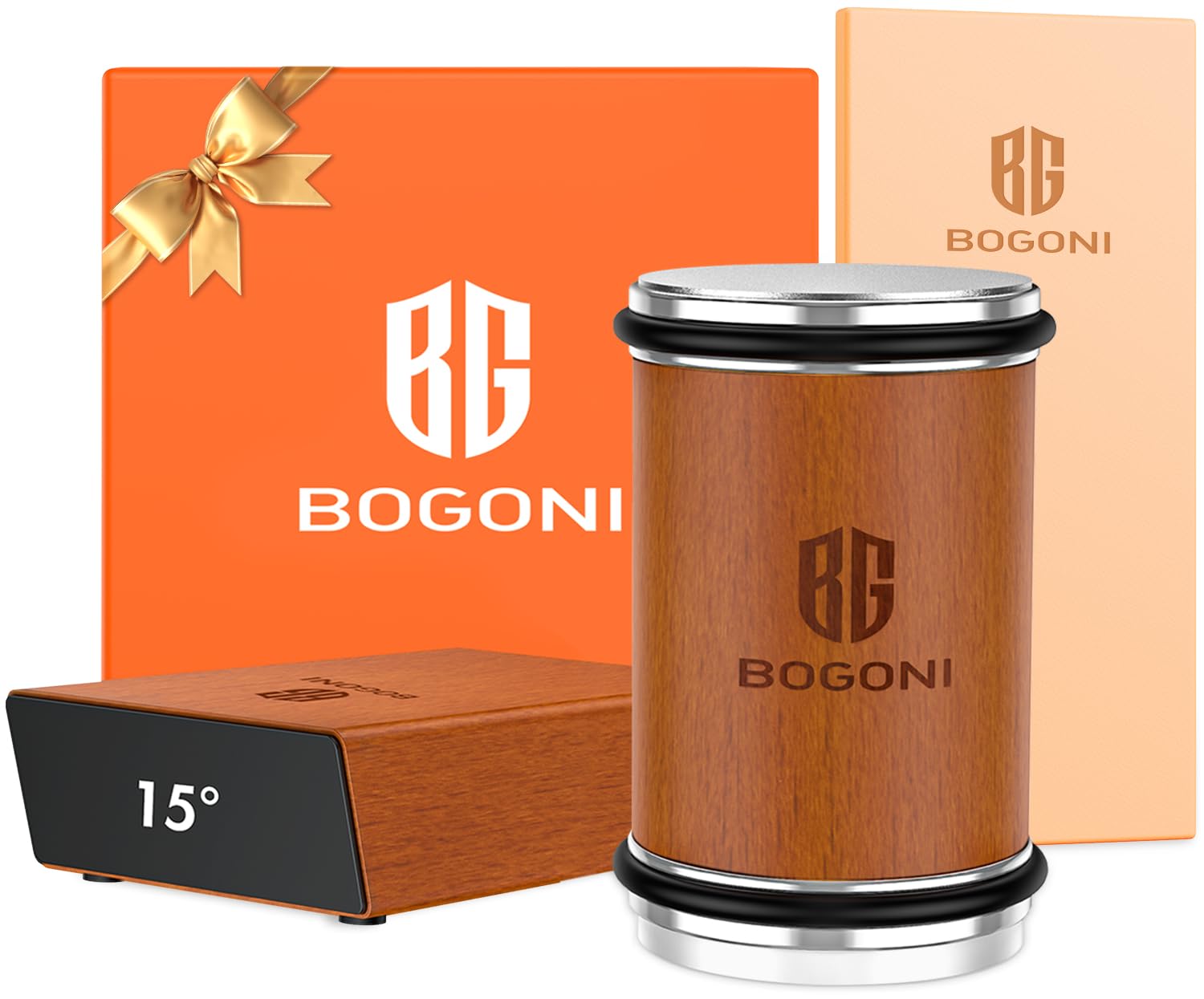
The Bogoni Rolling Knife Sharpener breaks the pull-through mold by using a rolling mechanism guided by magnetic angle blocks. The set includes a 400-grit diamond disc for reshaping dull edges and a 3000-grit ceramic disc for ultra-fine polishing, plus a genuine leather strop for the final edge alignment. Two magnetic angle guides—15° for ultra-sharp geometry and 20° for durable everyday edges—lock onto the blade spine so you never deviate from the preset angle.
Professional chefs with wrist issues report that the rolling action eliminates the repetitive wrist strain of traditional pull-through sharpeners. The N52 neodymium magnets hold the knife firmly in place during the stroke. Users also praise the included leather strop, which is normally absent from pull-through kits, for removing the micro-burr left by the ceramic disc. The natural wood body adds heft and stability on the counter.
The learning curve is slightly steeper than a fixed-slot pull-through because you must align the magnetic guide each time. The roller mechanism also requires a clean, flat surface to track smoothly. For cooks who want a sharpening system that combines the safety of magnetic guidance with the finish quality of a strop, the Bogoni offers an upgrade path without moving to loose stones.
Why it’s great
- 400-grit diamond and 3000-grit ceramic discs cover coarse to polish
- Magnetic 15° and 20° angle guides eliminate guesswork
- Leather strop refines the edge beyond ceramic polishing
Good to know
- Magnetic angle setup takes slightly more time than fixed slots
- Roller mechanism needs a clean, flat counter for smooth tracking
5. The Edgemaker Knife Sharpener Pro 331

The Edgemaker Pro 331 is the simplest design in this lineup: two crossed tungsten-carbide steel rods mounted in a high-impact plastic handle. You draw the blade through the V formed by the rods, which simultaneously sharpens both sides of the edge. The rods can be pulled out, rotated to a fresh surface, and reinserted, extending the usable life significantly.
Long-term users report that this sharpener outperforms many similarly priced models across 8 to 35 years of use. The tactile feedback through the handle lets you feel when the knife is sharp, which prevents over-sharpening. The 0.26-pound weight and 11-inch length make it easy to store in a utensil drawer. It works on wavy and serrated blades as well, which most fixed-angle sharpeners cannot handle.
The main drawback is that tungsten-carbide rods remove more steel than diamond or ceramic abrasives, so frequent use wears down blade thickness over time. It also lacks any angle guide, so results depend on how consistently you hold the knife upright. For an entry-level price, the Edgemaker delivers functional sharpness quickly, but cooks with expensive thin-blade Japanese knives should stick to the diamond-based models in this guide.
Why it’s great
- Rotatable steel rods extend the sharpener’s usable life
- Works on serrated and wavy blades
- Extremely compact at 0.26 pounds and 11 inches
Good to know
- Tungsten-carbide rods remove more steel than diamond or ceramic
- No fixed angle guide; consistency depends on user technique
FAQ
Will a pull-through sharpener ruin my expensive Japanese knife?
How many pulls does it take to sharpen a very dull knife?
Can I sharpen serrated bread knives with a pull-through sharpener?
How often should I replace the abrasive discs or rods?
Final Thoughts: The Verdict
For most users, the best pull-through knife sharpener winner is the ZWILLING Razor-Sharp 4-Stage because it supports both Japanese and Western blade angles in a single unit, includes a scissor slot, and provides clear stage labels that prevent mistakes. If you want rotating diamond and ceramic wheels in a drawer-friendly size, grab the Work Sharp Pull Through. And for a magnetic-guided rolling system that finishes with a leather strop, nothing beats the Bogoni Rolling Knife Sharpener.