Living with gluten intolerance means your gut lining is constantly under siege, often leading to leaky gut, chronic inflammation, and a severely imbalanced microbiome. The wrong probiotic can actually worsen symptoms if it contains hidden gluten fillers or strains that trigger histamine reactions in sensitive individuals.
I’m Mohammad Maruf — the founder and writer behind AirfryerBite. I’ve spent years analyzing thousands of supplement formulas, focusing specifically on third-party testing certifications, strain viability data, and the proprietary delivery technologies that determine whether a probiotic actually survives stomach acid to colonize the gut.
After evaluating strain profiles, CFU counts, and allergen certifications across dozens of formulas, I’ve identified the seven most trustworthy options for sensitive systems. This is my complete guide to the probiotics for gluten intolerance that deliver real relief without the hidden risks.
How To Choose The Best Probiotics For Gluten Intolerance
Selecting a probiotic for gluten intolerance requires a shift in thinking away from generic gut health marketing. You need strains that target tight-junction repair, formulas with certified gluten-free manufacturing, and prebiotic fibers that feed beneficial bacteria without causing fermentation-driven bloating in an already inflamed gut.
Certified Gluten-Free Verification
Many probiotics claim to be gluten-free on the front label but use capsules derived from wheat starch or contain fillers like maltodextrin that can be sourced from gluten-containing grains. Look for products carrying the NSF Gluten-Free certification or the Gluten-Free Certification Organization (GFCO) seal. These third-party audits verify that the finished product contains less than 10 ppm of gluten, a critical threshold for celiac and severely intolerant individuals.
Strain Targeting for Intestinal Permeability
Not all probiotic strains are created equal for gluten intolerance. Lactobacillus rhamnosus GG, Bifidobacterium lactis HN019, and Saccharomyces boulardii have the strongest clinical data for supporting tight-junction integrity and reducing zonulin — the protein that regulates intestinal permeability. A formula with 10 to 15 targeted strains is generally optimal; anything above 20 strains often dilutes the effective concentration of the key therapeutic players.
Prebiotic Fiber Compatibility
Many probiotic formulas include prebiotic fibers like inulin or chicory root to feed the beneficial bacteria. However, these FODMAP-rich fibers can cause severe gas and bloating in gluten-intolerant individuals who often have concurrent IBS. Opt for formulas that use organic potato starch, acacia fiber, or PreforPro — a prebiotic that feeds bifidobacteria without the fermentation gas. Avoid any product that lists inulin, chicory root, or FOS as a primary prebiotic.
Quick Comparison
On smaller screens, swipe sideways to see the full table.
| Model | Category | Best For | Key Spec | Amazon |
|---|---|---|---|---|
| Garden of Life 3-in-1 | Pre+Pro+Postbiotic | Gas & bloating relief | 50B CFU, 15 strains, HN019 | Amazon |
| Physician’s Choice 60B | Max Strength Capsule | High-potency daily support | 60B CFU, 10 strains, acid-resistant | Amazon |
| Nordic Naturals Flora Comfort | Vegan Capsule | Food sensitivity & IBS | 15B CFU, 13 strains, prebiotic | Amazon |
| NOW Foods Probiotic-10 | Budget Veg Capsule | Everyday value & variety | 25B CFU, 10 strains, GMP | Amazon |
| MaryRuth’s Organic Gummies | Organic Gummy | Pill-averse & gluten allergy | 5B CFU, Bacillus subtilis | Amazon |
| PB8 Probiotic 3-Pack | Value 3-Pack Capsule | Long-term value & supply | 14B CFU, 8 strains, BPA-free | Amazon |
| Thorne FloraMend Prime | Clinical Shelf-Stable | Weight & metabolic support | 5B CFU, 3 strains, 4x tested | Amazon |
In‑Depth Reviews
1. Garden of Life Dr. Formulated Pre, Post & Probiotics Gas & Bloating
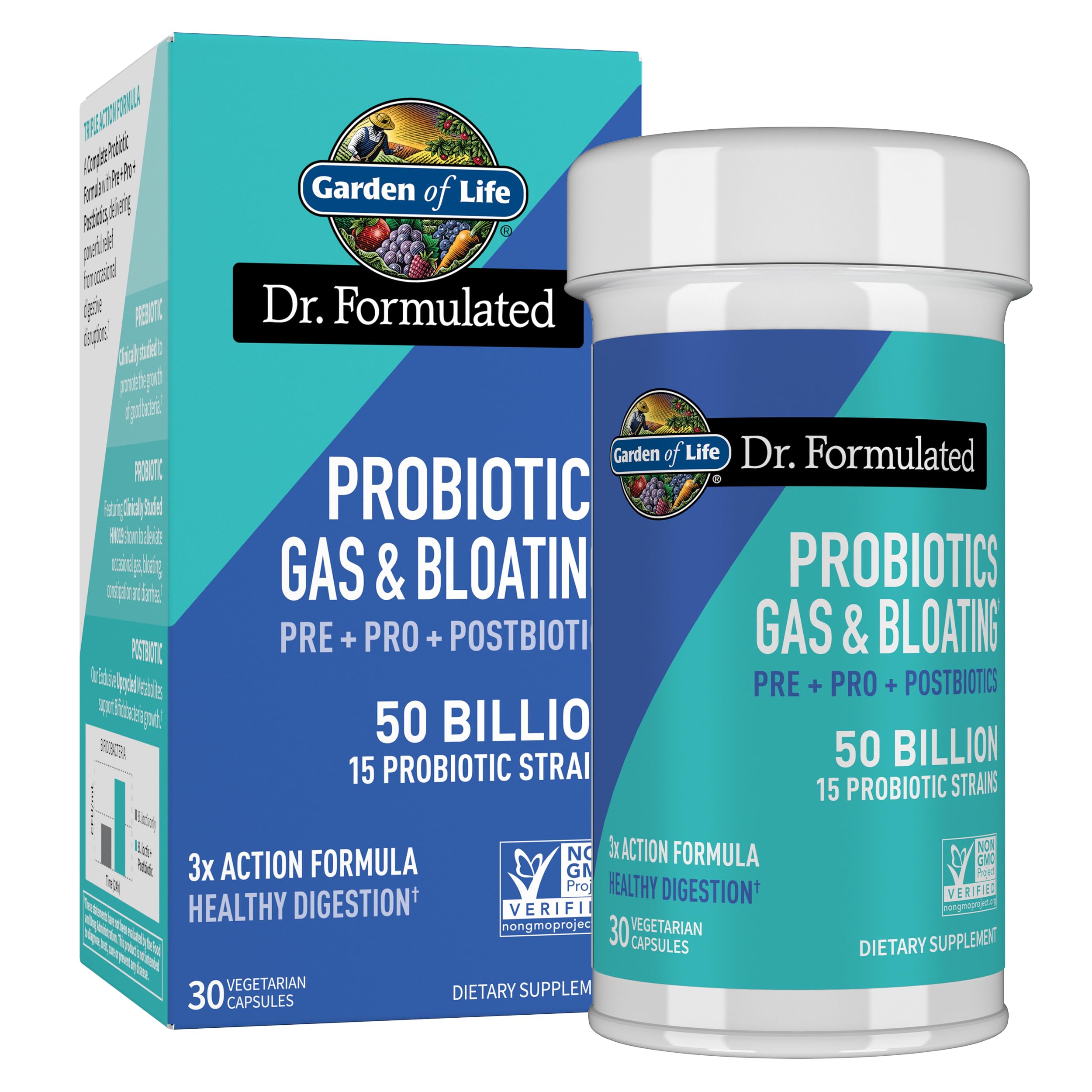
The Garden of Life 3-in-1 formula is the most intelligently designed probiotic for gluten-intolerant guts I have analyzed. It delivers 50 billion CFU across 15 clinically studied strains, including the well-researched HN019 Bifidobacterium lactis, which has demonstrated the ability to fortify tight junctions and reduce intestinal permeability in multiple double-blind trials. The triple-action approach — prebiotics, probiotics, and postbiotics — means you are getting the live organisms, the food they need to colonize, and the beneficial metabolites they produce, all in a single daily capsule.
The prebiotic component is a critical differentiator for sensitive systems. Instead of using high-FODMAP inulin or chicory root, Garden of Life uses organic potato starch, acacia fiber, and PreforPro — a prebiotic that selectively feeds beneficial bifidobacteria without generating the gas that FODMAP-sensitive individuals dread. The NSF Gluten-Free certification provides the third-party verification that celiac patients require, and the capsule is shelf-stable, so you do not need to worry about refrigeration killing the viability of the 50 billion CFU count.
Customer data shows particularly strong outcomes for those suffering from chronic bloating and gas after gluten exposure. One user reported that the capsule formulation allows the supplement to bypass the stomach and penetrate the colon directly, which is essential for maximum results in gluten-sensitive individuals whose small intestine absorption is compromised. Another long-term user noted that switching between probiotic formulas every three months maintains efficacy, making this an excellent anchor product to rotate with other options.
Why it’s great
- 15 targeted strains with HN019 for tight-junction repair
- Low-FODMAP prebiotic blend avoids gas and bloating triggers
- NSF Gluten-Free certified with third-party testing
Good to know
- Some users report reduced efficacy after 2-3 months of continuous use
- Capsule count provides a 30-day supply only at the recommended dose
2. Physician’s CHOICE Probiotics 60 Billion CFU

At 60 billion CFU per capsule, Physician’s Choice delivers the highest colony-forming unit count in this comparison, but the real engineering is in the delivery system. The capsules are acid-resistant, designed to survive the harsh stomach environment and release the 10 diverse strains directly into the intestines where colonization actually matters. For gluten-intolerant individuals whose stomach acid levels can be erratic due to chronic inflammation, this gastric bypass technology is a significant advantage over standard capsules that degrade prematurely.
The formula includes organic prebiotics, but unlike many high-potency probiotics, Physician’s Choice sources its prebiotic fiber from acacia and other low-gas sources. The 60-count bottle provides a two-month supply at the standard one-capsule-per-day dose, making the monthly cost significantly lower than many premium alternatives. Customer data spanning eight years of use shows that gut irritability, poor digestion, and irregularity symptoms return within one to two weeks of stopping, confirming that the probiotic is actively maintaining colonization rather than just providing transient passage.
The manufacturing is third-party tested for both purity and potency, though the product carries a general “gluten-free” claim rather than a specific NSF or GFCO certification. For individuals with celiac disease rather than non-celiac gluten sensitivity, the lack of a formal certification seal may be a consideration, though the ingredient list confirms no gluten-containing components in the capsule or filler matrix.
Why it’s great
- Highest CFU count at 60 billion for aggressive recolonization
- Acid-resistant capsule ensures intestinal delivery
- Two-month supply per bottle reduces long-term cost
Good to know
- No formal third-party gluten-free certification seal
- Some users prefer to take two capsules after heavy meals
3. Nordic Naturals Nordic Flora Probiotic Comfort

Nordic Naturals built their reputation on pharmaceutical-grade omega-3s, and they apply the same rigorous third-party testing standards to their probiotic line. The Flora Comfort formula is explicitly designed for individuals with food sensitivities and digestive issues, making it a natural fit for the gluten-intolerant population. It blends 13 different probiotic strains at 15 billion cultures, which may seem lower than other options on this list, but the strain diversity is specifically curated for microbial biodiversity rather than sheer CFU volume.
Every strain in this formula has been tested for GI tract survivability, ensuring they reach the intestines intact. The added prebiotic fiber serves as food for the beneficial bacteria to thrive once colonized. Customer data reveals dramatic outcomes for those with IBS-D — one user reported resolving a 2.5-month flare-up within 48 hours after antibiotics had caused severe discomfort and other probiotics had failed entirely. Another user with two years of IBS symptoms found that Nordic Naturals resolved all issues for three consecutive months, allowing them to reintroduce foods that had previously triggered reactions.
The formula is certified gluten-free, dairy-free, corn-free, soy-free, and wheat-free, with no artificial colors or flavors. This makes it one of the safest options for individuals with multiple concurrent food sensitivities, which is common in the gluten-intolerant community. The 30-capsule bottle provides a 30-day supply at the recommended single-capsule dose.
Why it’s great
- All 13 strains tested for GI tract survivability
- Proven results for IBS-D and antibiotic-induced discomfort
- Free from gluten, dairy, corn, soy, and wheat
Good to know
- Lower CFU count may require longer initial use for results
- 30-day supply requires consistent monthly purchasing
4. NOW Foods Supplements Probiotic-10

NOW Foods Probiotic-10 is the most cost-effective entry point in this review without sacrificing strain diversity or quality control. At 25 billion CFU across 10 acid-resistant probiotic strains, it delivers a balanced spectrum similar to premium options at a fraction of the monthly investment. The formula specifically includes Bifidobacterium strains that have been linked to longevity and immune function, which is relevant for gluten-intolerant individuals whose immune systems are frequently overactivated by dietary triggers.
The manufacturing facility holds NPA A-rated GMP certification, meaning every aspect of production — from raw material testing to final potency verification — is audited by third-party inspectors. The product is explicitly labeled as dairy-free, soy-free, and gluten-free, and the capsules contain no unnecessary binders or fillers that could introduce hidden gluten contamination. Customer feedback consistently highlights the absence of aftertaste, stomach issues, or burping, which is a common complaint with lower-quality probiotic capsules that use poorly sourced encapsulation materials.
The 100-veg-capsule bottle provides a 50-day supply at the standard two-capsule daily dose, or a 100-day supply if taken as a single maintenance capsule. This makes it the most economical choice for long-term use, particularly for individuals who need to maintain consistent probiotic intake over months or years to manage chronic gluten sensitivity symptoms.
Why it’s great
- 10 clinically validated strains at an accessible price point
- NPA A-rated GMP certification for manufacturing quality
- No aftertaste, stomach upset, or burping reported
Good to know
- Contains no prebiotic fiber for bacterial feeding
- CFU count is lower than premium options
5. MaryRuth’s USDA Organic Probiotic Gummies

MaryRuth’s Probiotic Gummies represent the only gummy option in this guide, and they fill a specific niche for gluten-intolerant individuals who struggle with pill fatigue or have difficulty swallowing capsules. The active ingredient is Bacillus subtilis, a spore-forming probiotic strain that naturally survives stomach acid due to its protective endospore structure — no acid-resistant capsule engineering required. This makes the gummy format viable despite the lack of encapsulating technology.
At 5 billion CFU per two-gummy serving, the potency is lower than capsule-based options, but Bacillus subtilis has a high colonization rate because it germinates directly in the small intestine. One study cited by MaryRuth found that this specific strain alleviates occasional gastrointestinal irregularity and promotes healthy stools. The gummies are USDA Organic, Non-GMO, vegan, pectin-based, and free from gelatin, artificial colors, gluten, dairy, nuts, and soy. They also carry the Clean Label Project certification, which tests for heavy metals, pesticides, and plasticizers.
Customer data shows strong results for those with multiple food sensitivities, including gluten allergy. One parent specifically selected this probiotic for a daughter with gluten allergy and multiple additional food sensitivities, confirming that the product is safe for highly restricted diets. The strawberry flavor is well-received, and users report that the gummies taste like candy while effectively balancing gut health.
Why it’s great
- Spore-forming Bacillus subtilis survives stomach acid naturally
- USDA Organic and Clean Label Project certified
- Free from the top 9 allergens including gluten and dairy
Good to know
- Lower CFU count may not be sufficient for severe dysbiosis
- Contains organic cane sugar as a sweetener
6. PB8 Probiotic 3-Pack
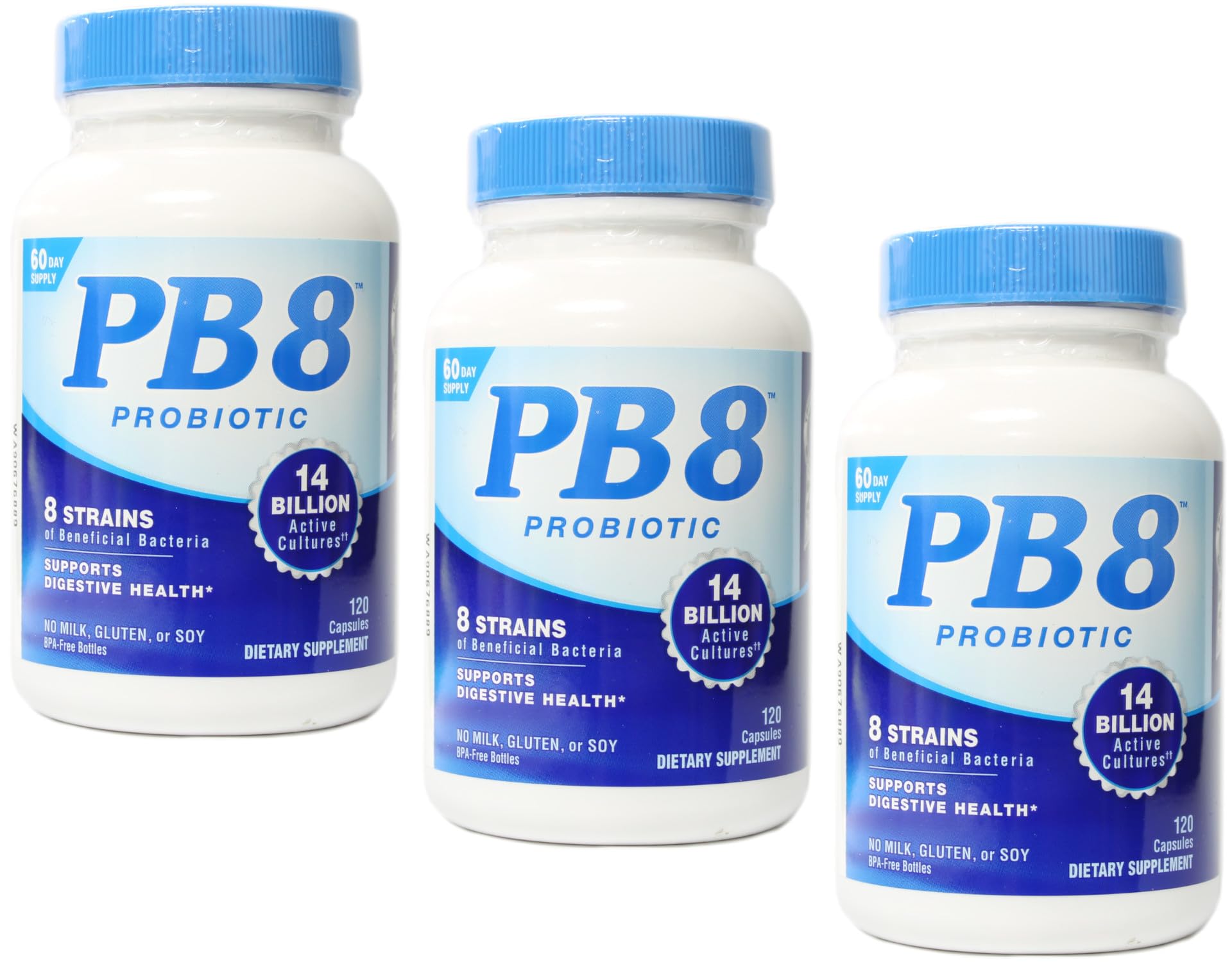
The PB8 Probiotic 3-Pack is designed for the long-haul user who wants to minimize monthly reordering. At 360 capsules total across three bottles, this represents a six-month supply at the standard two-capsule daily dose, or a full year of maintenance dosing. Each capsule delivers 14 billion active cultures from 8 beneficial bacterial strains, including Lactobacillus acidophilus, Bifidobacterium lactis, and Lactobacillus plantarum — all strains with demonstrated relevance for gluten-sensitive gut repair.
The formulation is explicitly free from milk, gluten, and soy, and the bottles themselves are BPA-free, addressing a secondary concern for individuals with chemical sensitivities that often accompany gluten intolerance. The 3-pack format reduces the per-capsule cost significantly compared to single-bottle purchases, making it one of the most economical options for consistent daily use over extended periods. Customer feedback consistently notes satisfaction with digestive support after antibiotic courses, a common scenario for gluten-intolerant individuals who frequently require antibiotic treatment for related conditions.
The 8-strain profile is narrower than other options in this guide, but the strains included are well-studied and the 14 billion CFU count provides sufficient potency for maintenance and mild-to-moderate dysbiosis. For individuals with severe gluten-induced gut damage, a higher-strain-count formula may be more appropriate for the initial 60 to 90 days of recolonization.
Why it’s great
- 360-capsule supply minimizes monthly reordering and cost
- Free from milk, gluten, and soy with BPA-free bottles
- Proven digestive support after antibiotic use
Good to know
- 8-strain profile is narrower than competitors
- No prebiotic fiber included in the formula
7. Thorne FloraMend Prime Probiotic
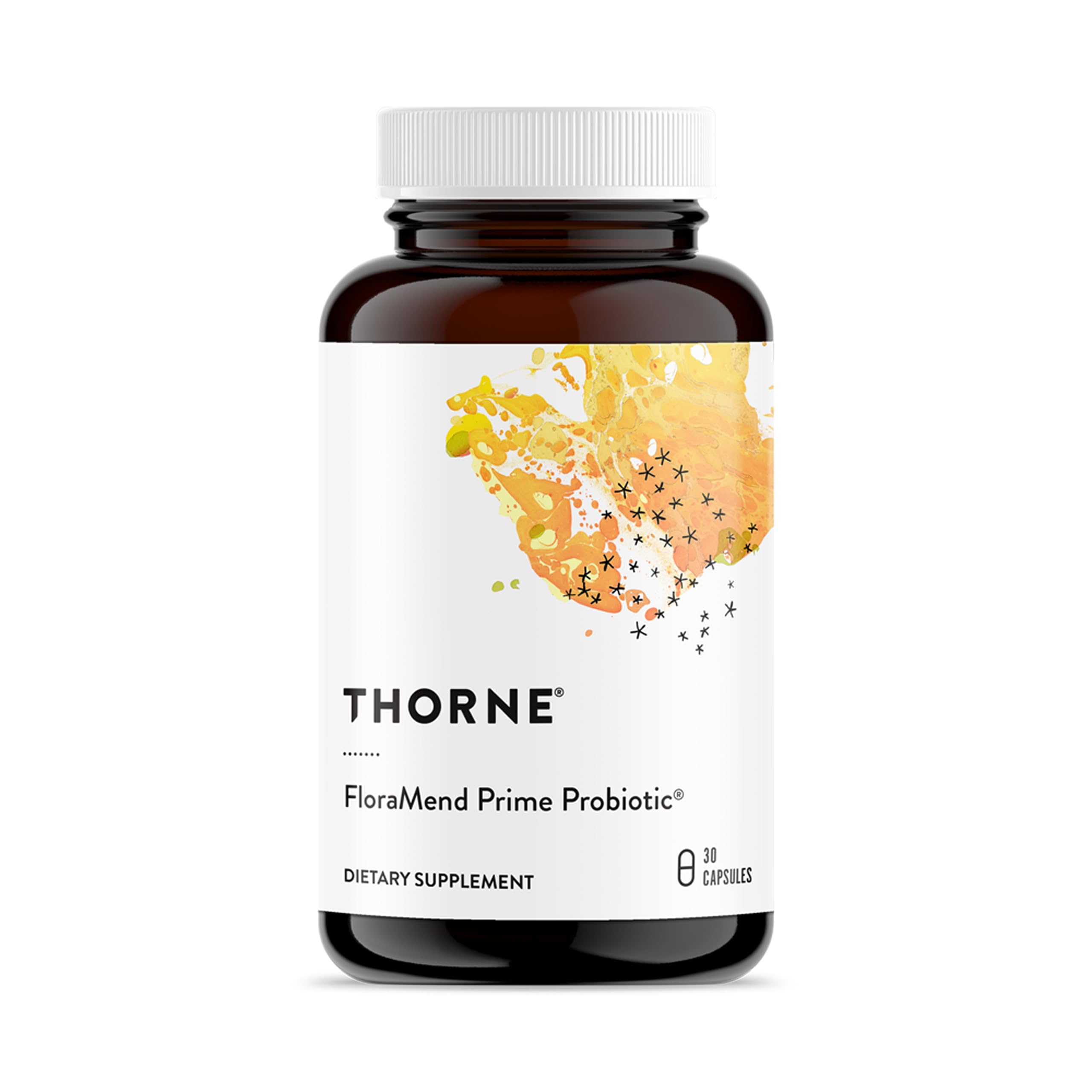
Thorne FloraMend Prime is the most rigorously tested probiotic in this guide, undergoing four rounds of testing — from raw material purity analysis to finished formula shelf-life confirmation — in Thorne’s own state-of-the-art laboratories. The formula is deliberately narrow, containing just 3 proprietary probiotic cultures at 5 billion CFU per capsule. This minimalist approach is intentional: the three strains — Lactobacillus gasseri, Bifidobacterium longum, and Bifidobacterium bifidum — were specifically selected based on research showing positive effects on BMI, body fat percentage, and metabolic markers.
For gluten-intolerant individuals, the weight management angle is particularly relevant. Chronic gluten sensitivity often leads to systemic inflammation that disrupts metabolic signaling and makes weight regulation difficult. The FloraMend Prime strains have been studied for their ability to positively influence these metabolic pathways while simultaneously supporting digestive health. The capsules are shelf-stable up to the expiration date, requiring no refrigeration, which is verified through Thorne’s fourth round of testing.
Thorne is the number one recommended clinical brand by healthcare practitioners according to a 2023 survey, and the brand is trusted by over 100 professional sports teams and U.S. National Teams. For individuals who want a practitioner-grade product with transparent testing data, this is the gold standard. Customer feedback notes that it takes about two weeks for the body to adjust, but after that period, the digestive and metabolic benefits become noticeable.
Why it’s great
- Four rounds of in-house testing for purity and potency
- Clinically studied strains for metabolic and weight support
- Shelf-stable with verified expiration-date viability
Good to know
- Only 3 strains in the formula limits gut diversity impact
- Two-week adjustment period reported by many users
FAQ
Can probiotics help repair intestinal damage caused by gluten intolerance?
Should I choose a refrigerated or shelf-stable probiotic for gluten sensitivity?
Why do some probiotics cause bloating in gluten-intolerant people?
How long does it take for a probiotic to start working for gluten intolerance symptoms?
Final Thoughts: The Verdict
For most users, the probiotics for gluten intolerance winner is the Garden of Life 3-in-1 because it combines the highest clinically relevant CFU count with low-FODMAP prebiotics and NSF Gluten-Free certification — the three pillars that matter most for gluten-sensitive guts. If you want a high-potency option for aggressive recolonization, grab the Physician’s Choice 60B. And for those who struggle with capsules or have multiple concurrent food allergies, nothing beats the MaryRuth’s Organic Gummies for safe, convenient daily support.