Selecting a probiotic for digestion is less about grabbing the bottle with the highest number on the label and more about matching the right strains and CFU count to your specific digestive complaints — bloating, irregularity, or immune support.
I’m Mohammad Maruf — the founder and writer behind AirfryerBite. I’ve spent thousands of hours analyzing supplement formulations, customer feedback patterns, and third-party testing data to understand what makes a digestive probiotic truly effective for daily use.
After evaluating dozens of options based on strain diversity, CFU potency, prebiotic inclusion, and shelf stability, I’ve narrowed the field to the most reliable candidates for what I consider the probiotic for digestion that actually delivers real gut health support without unnecessary additives.
How To Choose The Best Probiotic For Digestion
Not all probiotics work the same way. The right formula for your gut depends on three main factors: the number of live organisms (CFU), the variety of bacterial strains, and whether the product includes prebiotics to feed those bacteria. Ignoring these can lead to wasted money and zero symptom relief.
Match CFU Strength to Your Needs
CFU stands for colony-forming units — the count of live bacteria in each dose. A general wellness probiotic often ranges from 3 billion to 30 billion CFU, while targeted digestive support formulas may go up to 200 billion CFU. Higher CFU is not always better, but for addressing bloating, gas, or constipation, a potency of at least 15-20 billion CFU is a solid starting point. Overdoing it with excessive CFU can sometimes cause temporary gas or discomfort as your gut adjusts.
Check for Clinically Studied Strains
Look for strains like Lactobacillus rhamnosus GG (LGG) or Bifidobacterium lactis BB-12, which have decades of research backing their safety and effectiveness for digestive health. A blend of 10 to 15 different strains can offer broader coverage, but the specific presence of well-documented strains matters more than sheer variety. Strains like HN019 or BB-12 specifically target regularity and occasional constipation.
Evaluate the Full Formula: Prebiotics and Postbiotics
Prebiotics are indigestible fibers that feed your probiotic bacteria, helping them colonize the gut more effectively. Postbiotics are beneficial compounds produced by probiotic bacteria. A three-in-one formula that includes prebiotics, probiotics, and postbiotics can provide more comprehensive relief for gas and bloating than a standalone probiotic. An organic prebiotic source like acacia fiber or chicory inulin is a clean addition.
Quick Comparison
On smaller screens, swipe sideways to see the full table.
| Model | Category | Best For | Key Spec | Amazon |
|---|---|---|---|---|
| Physician’s Choice 60B | Multi-Strain | Gas and bloating relief | 60 Billion CFU, 10 Strains, Organic Prebiotics | Amazon |
| Garden of Life Dr. Formulated | 3-in-1 Formula | Triple-action digestive support | 50 Billion CFU, 15 Strains, Pre/Postbiotics | Amazon |
| Micro Ingredients 200B | High Potency | Intensive digestive and immune health | 200 Billion CFU, 40 Strains, With Enzymes | Amazon |
| Culturelle Pro Strength | Clinically Studied | Reliable daily digestive balance | 12 Billion CFU, LGG Strain, With Prebiotic | Amazon |
| Phillips’ Colon Health | Gentle Formula | Occasional constipation and gas | 3 Billion CFU, LGG + BB-12 Strains | Amazon |
In‑Depth Reviews
1. Physician’s Choice Probiotics 60 Billion CFU

The Physician’s Choice 60 Billion CFU is a mid-range powerhouse that combines 10 diverse probiotic strains with organic prebiotics to tackle occasional constipation, diarrhea, gas, and bloating. Acid-resistant capsules and a shelf-stable bottle ensure the bacteria survive stomach acid and reach the intestines alive — a critical detail many lower-potency formulas overlook. At 60 billion CFU, it delivers more than enough live organisms for general digestive maintenance and targeted relief.
User feedback consistently highlights reduced bloating within the first week and improved regularity after a month. One long-term user reported eight years of consistent results, noting that stopping the supplement caused gut irritability and irregularity that resolved within two weeks of restarting. The capsules are easy to swallow and require no refrigeration, making them convenient for travel or daily desk use.
The formula is manufactured in the USA under strict quality controls and is third-party tested for purity and potency. For a balanced probiotic with a proven track record, this is the most reliable entry-level-to-mid-range option on the market. The 30-count bottle offers a one-month supply at a daily cost that remains affordable for most budgets.
Why it’s great
- High 60 billion CFU survives stomach acid
- 10 diverse strains plus organic prebiotics
- Third-party tested for purity and potency
Good to know
- 30-day supply may require reordering monthly
- Some users report need for consistent daily use
2. Garden of Life Dr. Formulated Pre, Post & Probiotics
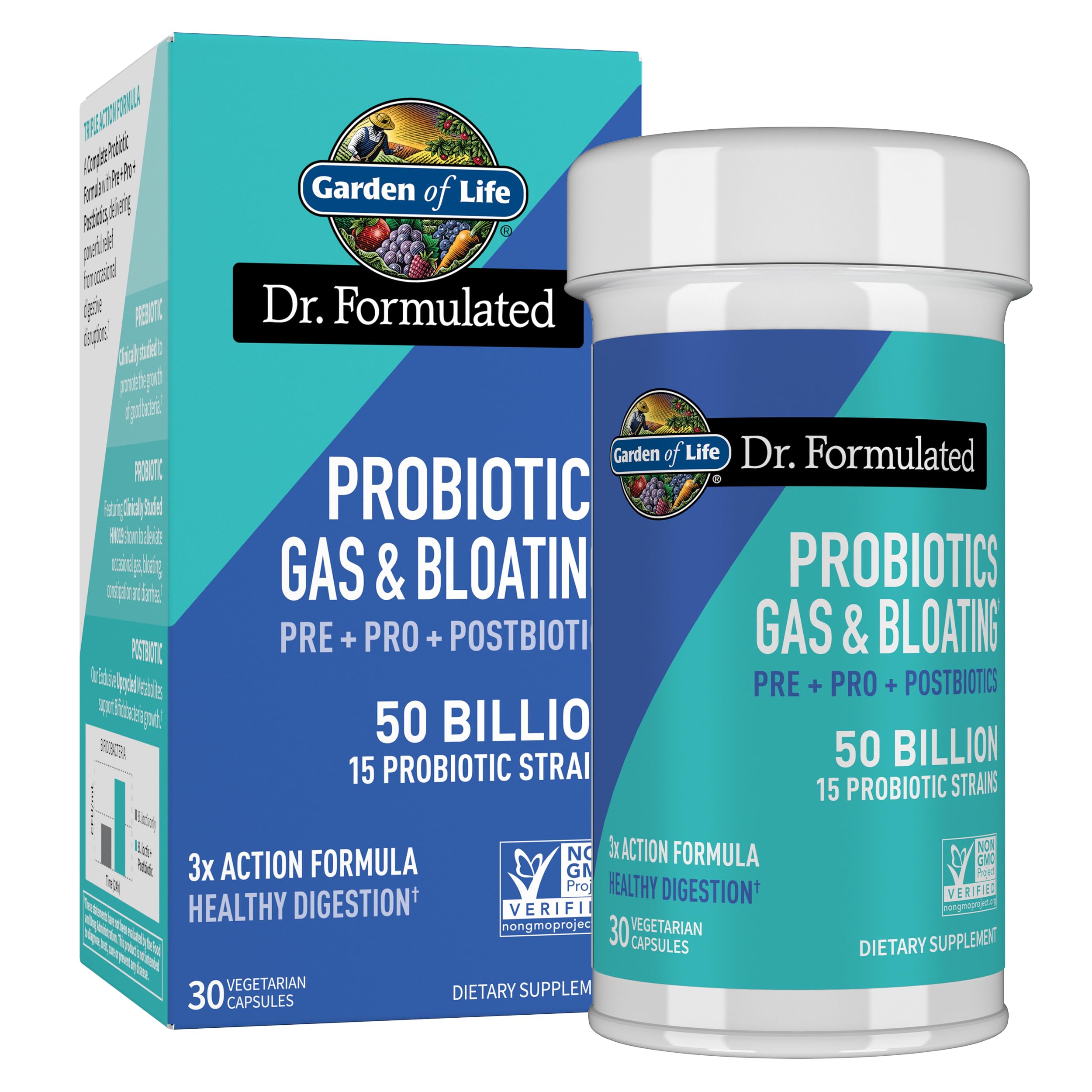
Garden of Life’s Dr. Formulated formula takes a three-in-one approach, combining 50 billion CFU of probiotics with prebiotics and postbiotics in a single vegetarian capsule. The inclusion of the clinically studied HN019 strain alongside 14 other strains targets occasional gas and bloating specifically. This is a premium choice for those who want a complete gut health ecosystem without needing to buy separate prebiotic or postbiotic supplements.
Users report noticeable relief from bloating and gas within a short period, with several reviewers mentioning the need to rotate probiotics every few months to maintain effectiveness — a strategy recommended to prevent the body from becoming too accustomed to a single strain profile. The formula is Non-GMO Project Verified, NSF Certified Gluten-Free, and vegan, making it clean enough for strict dietary preferences. Shelf-stable packaging means no refrigerator space required.
At a mid-range price point, it offers strong value for a 30-day supply of a comprehensive formula. The single-capsule daily dose simplifies compliance, and the clean ingredient list avoids artificial dyes, fillers, and common allergens. For women and men seeking a straightforward way to address occasional digestive upset, this is a well-researched contender.
Why it’s great
- Triple action with pre, post, and probiotics
- Clinically studied HN019 strain for gas relief
- Non-GMO, vegan, and NSF Gluten-Free certified
Good to know
- Some users find rotating strains necessary after 3 months
- 30-day supply means consistent reordering
3. Micro Ingredients Probiotics 200 Billion CFU

Micro Ingredients pushes the potency ceiling with 200 billion CFU per serving and 40 different strains, making it the strongest formula in this lineup. It also includes digestive enzymes like amylase and bromelain, plus prebiotic fibers from chicory inulin and acacia fiber, creating a multi-angle approach to gut health. This is a premium-tier product designed for those who need aggressive support for chronic bloating, irregularity, or immune function.
User reviews are emphatic about its speed — some report relief from bloating and constipation overnight. Beyond digestion, customers have noted improvements in skin conditions like Keratosis Pilaris and stronger immune resistance. The 120-count bottle provides a long-lasting supply compared to standard 30-count containers, reducing the frequency of reordering and lowering the per-dose cost significantly over time.
Micro Ingredients maintains a non-GMO formula that is free from soy, dairy, gluten, fish, shellfish, peanuts, and tree nuts, with third-party lab testing for purity. The capsules are odorless and easy to swallow. For experienced probiotic users who feel their current 30-60 billion CFU formula is no longer cutting it, this mega-potency option is a logical upgrade.
Why it’s great
- Massive 200 billion CFU and 40 strains
- Includes digestive enzymes and prebiotic fibers
- 120-count bottle offers excellent long-term value
Good to know
- May be too potent for beginners to probiotics
- High CFU can cause initial adjustment gas
4. Culturelle Pro Strength Daily Probiotics

Culturelle Pro Strength is built around Lactobacillus rhamnosus GG (LGG), one of the most extensively studied probiotic strains in the world, with over 1,000 scientific studies backing its safety and efficacy. At 12 billion CFU per capsule, it sits at a moderate potency level, but the strain-specific research makes it a reliable choice for daily digestive maintenance and immune support. It also includes inulin as a prebiotic to nourish the bacteria.
Users report noticeable improvements in constipation, gas, bloating, and even acid reflux within the first week of use. The capsule is tasteless, odorless, and easy to swallow, which improves compliance. Many travelers specifically use Culturelle on vacation to avoid gut issues from unfamiliar food or water. The formula is gluten-free, soy-free, and vegetarian, with no refrigeration required.
The two-month supply (60 capsules) offers decent value for a brand with such deep clinical backing. Some users note that the price is higher per dose compared to generic alternatives, but the consistency and doctor recommendations often justify the premium. If you want a probiotic with decades of research and a predictable track record, Culturelle remains a top-tier choice.
Why it’s great
- Clinically proven LGG strain with decades of research
- Works fast — many users report relief within a week
- Gluten-free, soy-free, and vegetarian friendly
Good to know
- Higher cost per dose than some competitors
- Only 12 billion CFU may be low for severe symptoms
5. Phillips’ Colon Health Daily Probiotic

Phillips’ Colon Health uses a straightforward 4-in-1 symptom defense formula combining Lactobacillus rhamnosus LGG and Bifidobacterium BB-12 — two strains with strong clinical support for colon health. At 3 billion CFU at time of expiry, this is the most gentle potency in this list, making it an ideal entry-level probiotic for those new to supplementation or with sensitive digestive systems. The 60-count bottle provides a two-month supply.
Reviewers report effectiveness for occasional constipation and diverticulitis management, with many citing the brand’s long-standing reputation and doctor recommendations. The capsules are unflavored, gluten-free, dairy-free, and soy-free, accommodating most dietary restrictions. No refrigeration is needed, and the price point makes it one of the most budget-friendly options for maintaining basic colon health.
The lower CFU count means it may not be sufficient for those with chronic or severe digestive issues, as some users noted it was not strong enough for their needs. However, for general maintenance and mild symptom prevention, Phillips’ delivers reliable results without overwhelming the gut. It is a no-frills, trusted brand that does exactly what it promises at a very accessible price.
Why it’s great
- Clinically studied LGG and BB-12 strains
- Gentle on sensitive stomachs — ideal for beginners
- Affordable two-month supply per bottle
Good to know
- Low 3 billion CFU may not help severe symptoms
- Some users find it less effective than higher potency options
FAQ
Should I take my probiotic with food or on an empty stomach?
Why do some people need to switch probiotics every few months?
Final Thoughts: The Verdict
For most users, the probiotic for digestion winner is the Physician’s Choice 60 Billion CFU because it combines a high CFU count with 10 diverse strains and organic prebiotics at a mid-range price that works for both beginners and experienced users. If you want a triple-action formula that includes prebiotics and postbiotics in one capsule, grab the Garden of Life Dr. Formulated. And for someone needing maximum potency to combat chronic bloating or immune weakness, nothing beats the Micro Ingredients 200 Billion CFU.