That first cup of coffee in the backcountry shouldn’t take ten minutes, and searing a steak at the tailgate shouldn’t require a campfire. A portable gas stove delivers restaurant-quality heat wherever you are, but the market is flooded with burners that sputter, wind-blasted flames, and regulators that fail after three trips. The right stove changes your entire outdoor cooking rhythm — the wrong one leaves you eating cold oatmeal.
I’m Mohammad Maruf — the founder and writer behind AirfryerBite. I’ve spent years analyzing outdoor cooking hardware, parsing burner orifice sizes, regulator pressure curves, and canister compatibility across dozens of brands to separate the units that perform from the ones that frustrate.
Whether you need a lightweight pack stove for solo treks or a dual-burner beast for family car camping, this guide breaks down the specifications that actually matter. My goal is to help you confidently pick the best portable gas stove for your specific outdoor cooking needs.
How To Choose The Best Portable Gas Stove
A portable gas stove isn’t a one-size-fits-all purchase. The weight you carry, the meals you make, and the weather you face all dictate which design wins for you. Focus on these four factors to avoid wasting money on a burner that can’t handle your actual conditions.
Fuel Type: Butane vs. Propane vs. Isobutane
Butane stoves are popular for indoor tabletop cooking and tailgates because the fuel canister is cheap and widely available, but butane stops vaporizing below around 32°F. Propane stoves perform reliably in freezing temperatures and deliver higher BTU output, but the green 1-lb cylinders are bulky. Isobutane blends (isobutane/propane mixes) offer the best cold-weather performance in a lightweight canister — ideal for backpacking. If you cook in winter or at altitude, avoid pure butane.
BTU Output and Burner Design
BTU (British Thermal Units) measures raw heat potential, but a high number doesn’t guarantee even cooking. A single burner pushing 15,000 BTU can boil water fast, but two burners splitting 20,000 BTU total might struggle with large pots. Look at the burner head design — a wider burner with more flame ports distributes heat better than a narrow jet that creates a hot spot. For most car camping, 10,000-15,000 BTU per burner is plenty. For backpacking, 6,000-10,000 BTU with a regulated flame is more efficient.
Regulator Control and Simmer Performance
The regulator is the heart of any portable gas stove. A standard on/off valve offers a roaring high flame and a weak low — fine for boiling, terrible for simmering sauces. A four-turn regulator or precision valve gives you incremental flame adjustments, letting you dial in a gentle simmer without the flame sputtering out. If you plan to cook anything beyond boil-and-add-water meals, invest in a stove with a quality regulator. Jetboil’s four-turn design and the Iwatani magnet-style lock system are examples of engineering that matters.
Portability, Wind Resistance, and Build
Weight and packed size dictate which stove goes on which trip. Backpackers need sub-4-ounce models like the Jetboil MightyMo. Car campers can handle 4-5 pound dual-burner units. Wind resistance is non-negotiable outdoors — look for integrated windshields or three-sided guards rather than relying on your pack to block the breeze. Build quality matters in corrosion resistance: stainless steel or cast-aluminum burners last years; cheap zinc-alloy parts rust quickly. A good carry case protects the stove and keeps your gear clean.
Quick Comparison
On smaller screens, swipe sideways to see the full table.
| Model | Category | Best For | Key Spec | Amazon |
|---|---|---|---|---|
| Cofiyard 20,000 BTU 2-Burner | Dual-Burner | Compact car camping & tailgating | 20,000 BTU combined output | Amazon |
| Jetboil MightyMo | Backpacking | Ultralight solo hiking | 3.36 ounces total weight | Amazon |
| Fire-Maple Saturn | Single Burner | Cold-weather & high-altitude cooking | 4,400W (15,000 BTU) remote canister | Amazon |
| Chef Master 15,000 BTU Combo | Butane Single | Indoor tabletop & wok cooking | 15,000 BTU with double wind-guard | Amazon |
| Camp Chef EX60LW Explorer | Heavy-Duty Dual | Basecamp cooking & pressure canning | 60,000 BTU total (2×30,000) | Amazon |
| Iwatani 35FW | Butane Premium | Precise simmer & Japanese hot pot | 15,000 BTU brass burner, magnetic lock | Amazon |
| Jetboil MicroMo | Integrated System | Lightweight backpacking with simmer | 0.8L FluxRing pot, 12 oz system weight | Amazon |
In‑Depth Reviews
1. Cofiyard 20,000 BTUs 2 Burner Propane Camping Stove
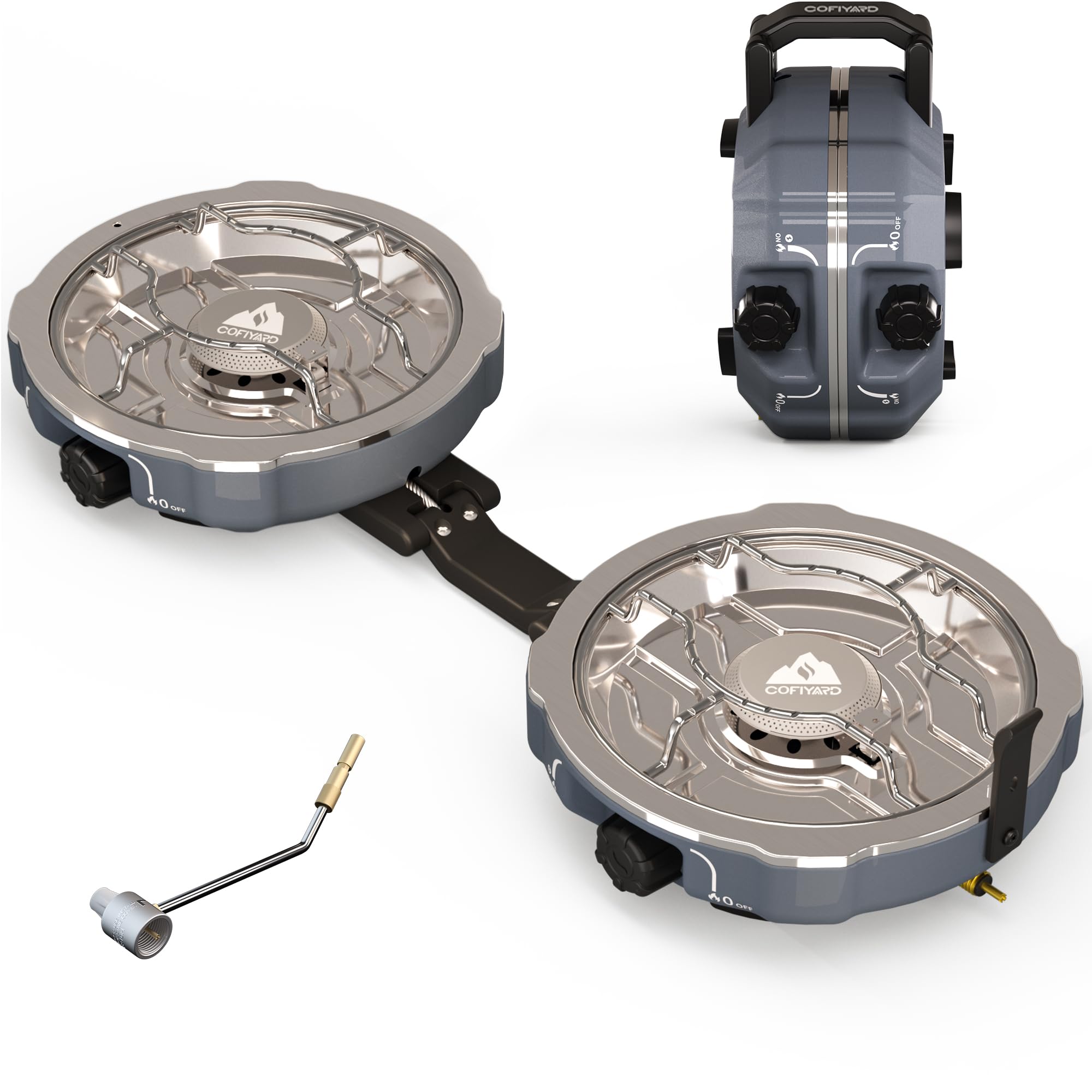
The Cofiyard delivers the strongest value proposition in the dual-burner portable gas stove segment. Its 20,000 BTU total output comes from two independently adjustable burners, a design choice that allows you to run a simmer on one side while boiling on the other — uncommon at this tier. The foldable frame collapses to a compact 10.5x9x6-inch footprint, and the included woven carry bag keeps the stove, regulator, and hoses organized during transport. The built-in piezoelectric ignition fires reliably when you turn the gas fully on, and the rivet reinforcement upgrade addresses the one common wear point earlier models faced.
Customer feedback consistently praises the build quality and burner spacing: two 12-inch cast iron skillets sit side by side without overlap, and the 20,000 BTU combined output brings a 4-quart pot to a rolling boil in under four minutes. The independent burner operation is a significant advantage over classic Coleman designs where both burners share a single control circuit. At roughly , this stove matches or exceeds the performance of units costing twice as much.
The main compromise is the regulator tube geometry. When using a 1-lb propane cylinder, the rigid hose creates a tipping hazard on uneven ground — placing a flat support under the tank stabilizes the setup. The exposed gas connector tip when stored is vulnerable to damage; users have crafted simple plastic shields. These are minor ergonomic issues in an otherwise outstanding portable gas stove.
Why it’s great
- Compact foldable design with durable carrying bag
- Two independent burners for simultaneous simmer and boil
- Excellent value — performance rivals + competitors
Good to know
- Rigid regulator tube creates tipping risk on uneven ground
- Exposed gas connector tip vulnerable when stored
2. Jetboil MightyMo Ultralight and Compact Camping and Backpacking Stove

The MightyMo weighs just 3.36 ounces — lighter than a tennis ball — making it the smallest and most packable canister-top stove in this roundup. What sets it apart from other ultralight burners is Jetboil’s four-turn regulator, which gives you actual incremental flame control instead of the typical high/off binary. You can simmer a sauce without scorching it, then crank the dial to full-blast for a fast boil. The push-button piezo igniter works reliably even in misty conditions, eliminating the need to carry a lighter.
Fuel efficiency is the MightyMo’s headline: Jetboil claims it uses half the fuel of traditional systems while hitting a rolling boil in roughly three minutes for 16 ounces of water. Real-world field use confirms the efficiency — multiple reviewers note getting significantly more meals per canister compared to stoves like the MSR PocketRocket. The open-platform design accepts any pot or pan, but the small burner head means large pans can feel slightly unstable without the included pot support.
The biggest limitation is wind resistance. The exposed burner flame extinguishes easily in even light breezes, so you must bring a separate windscreen or find a natural windbreak. The included fuel can stabilizer helps with balance on uneven ground, but this stove is clearly optimized for weight savings over weather protection. It’s the best choice for ultralight backpackers who prioritize grams over gusty conditions.
Why it’s great
- Extremely light at 3.36 ounces for minimal pack weight
- Four-turn regulator enables true low simmer
- Incredibly fuel-efficient — cuts fuel canister weight on multi-day trips
Good to know
- Poor wind resistance — flame extinguishes in light breeze
- Small burner head can feel unstable with large pots
3. Fire-Maple Saturn Camping Stove with 4400W High Efficiency

The Fire-Maple Saturn is engineered for the conditions that stop most canister-top stoves cold. Its remote canister cable design lets you invert the fuel canister, feeding liquid gas instead of vapor — a critical advantage when temperatures drop below freezing and standard stoves lose pressure. The integrated fuel pre-heat tube vaporizes the liquid before it hits the burner, preventing the flame sputtering that plagues other cold-weather stoves. With a maximum output of 4,400W (roughly 15,000 BTU), it rivals much larger burners in raw power.
Build quality is a clear step above typical budget options. The stainless steel burner head and flip-out pot supports feel substantial, and the compact 3x3x3-inch closed size fits easily inside a pot. The flame control is genuinely impressive — reviewers consistently highlight the ability to dial in a low, stable simmer for delicate dishes like rice or sauce reduction. The wind-resistant burner design holds flame stability better than the MightyMo in light breezes, though heavy wind still requires a barrier.
The main trade-off is weight and fuel-specific compatibility. At 1.34 kilograms (roughly 3 pounds), the Saturn is heavy for backpacking — it’s best suited for car camping or canoe trips where every ounce isn’t scrutinized. The included hard case adds durability but also bulk. Some users report a stiff gas valve on first use that loosens after several cycles. For cold-weather and high-altitude cooking, the Saturn’s remote canister design is a genuine performance differentiator.
Why it’s great
- Remote canister allows inverted fuel for sub-freezing cooking
- Excellent low flame control for genuine simmering
- Stainless steel construction with durable flip-out pot supports
Good to know
- Heavier than typical backpacking stoves at 1.34 kg
- Valve can be stiff initially before breaking in
4. Chef Master 15,000 BTU Butane Portable Camp Stove + 4x 8oz Butane Canisters
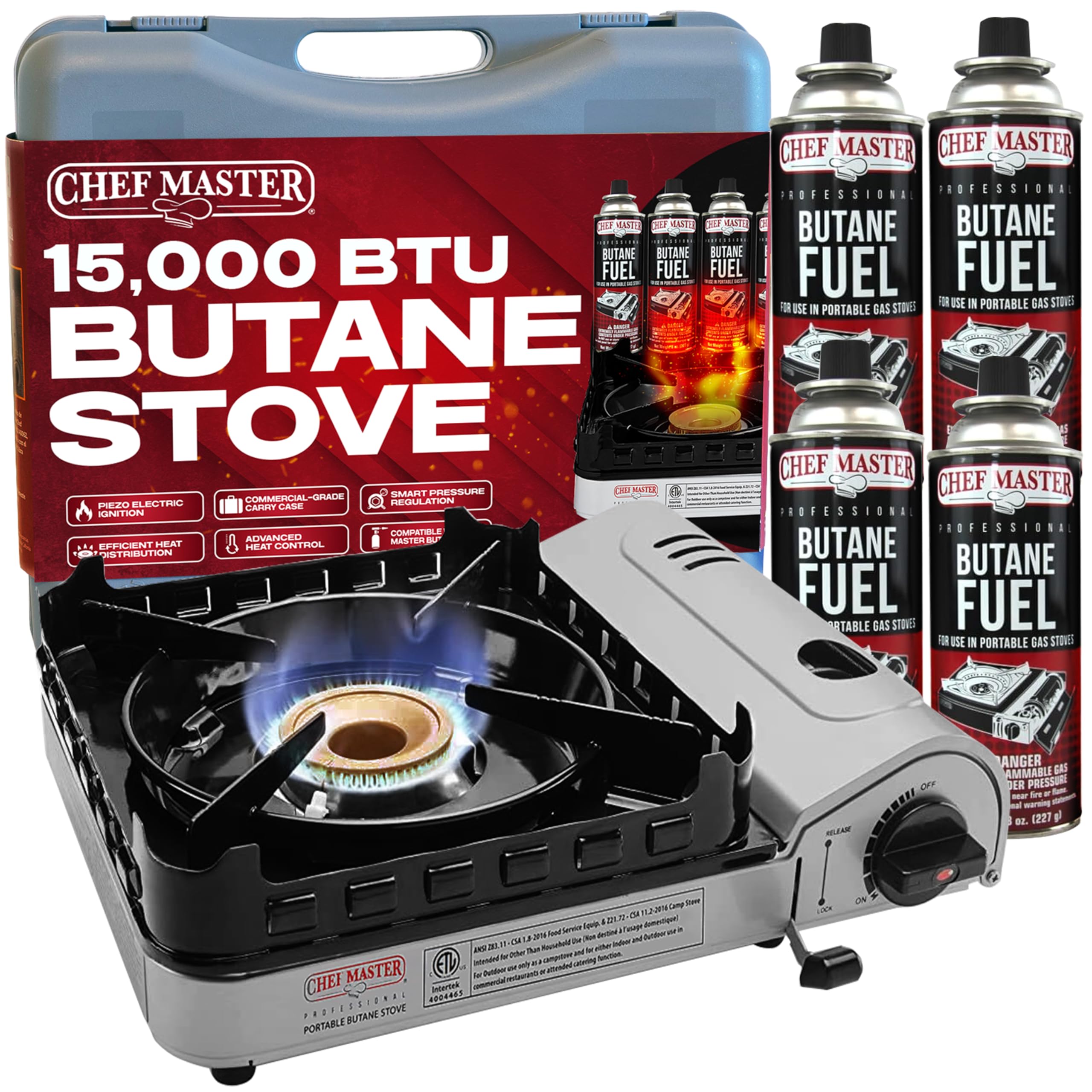
The Chef Master 90019-Combo is a purpose-built butane stove that arrives with four 8-ounce butane canisters in the box — you can cook immediately with no extra purchases. The 15,000 BTU brass burner delivers high heat for searing meats or achieving wok hei, and the double wind-guard built into the burner head keeps the flame stable indoors and in light outdoor drafts. The piezo ignition works with a simple knob turn, and the pressure-sensing shut-off system automatically stops gas flow if internal pressure spikes, preventing flashbacks.
Owner reports reveal a loyal following among home cooks who want wok-level heat without converting their kitchen to gas. The stove fits standard woks and small frying pans easily, and the included hard-shell carrying case makes storage clean and organized. For candy making, the high heat output reduces cooking time compared to electric ranges. The inline regulator provides fine enough control to keep a chocolate tempering bath at a consistent temperature.
The butane fuel limitation is the primary constraint. Butane stops vaporizing efficiently below freezing, so this stove is not suitable for cold-weather camping. The included carrying case feels durable but adds bulk to the overall package. At full heat, the 15,000 BTU output can be too aggressive for delicate tasks — you’ll need to dial it back significantly. This stove excels as an indoor/outdoor tabletop burner for warm-weather use, emergency preparedness kits, and high-heat home cooking.
Why it’s great
- Comes with 4 butane canisters ready to use
- Double wind-guard improves flame stability
- Perfect for high-heat wok and searing applications
Good to know
- Butane fuel fails in sub-freezing temperatures
- Full heat is too intense for delicate simmering
5. Camp Chef EX60LW Explorer 2 Burner Outdoor Camping Modular Cooking Stove

The Camp Chef Explorer EX60LW is the highest-output portable gas stove in this lineup, with two 30,000 BTU cast-aluminum burners delivering a combined 60,000 BTU. That’s enough raw power to boil a 30-quart pot for pressure canning, sear multiple steaks simultaneously on a griddle, or cook for large groups at basecamp. The three-sided windscreen is genuinely effective — it shields the burners from wind that would extinguish open-flame stoves, allowing consistent performance in exposed conditions.
The modular design adds versatility. Detachable steel legs let you use the stove on a tabletop or set it up as a freestanding unit. The 14-inch system compatibility means you can attach Camp Chef griddles, BBQ boxes, and other accessories directly to the stove frame. The appliance-style control knobs offer precise adjustment across the flame range, which is important when handling the intense heat of 30,000 BTU burners. The stove packs down into a relatively compact shape for its power class.
The compromises are all tied to its industrial-grade design. The stove weighs about 30 pounds with legs attached — this is strictly car camping or basecamp equipment, not for backpacking. There is no electric ignition; you need a long-reach lighter or match to start the burners. Some users note that the intense heat requires heavy-gauge cookware to prevent warping on thin pans. The recessed knob design can be awkward to reach when the stove is placed on a table. For serious outdoor cooking volume, the Explorer is unmatched in the portable space.
Why it’s great
- Massive 60,000 BTU output for heavy-duty cooking
- Effective three-sided windscreen for windy conditions
- Modular with 14-inch accessory compatibility
Good to know
- Very heavy — strictly for car camping or basecamp
- No integrated ignition — requires external lighter
6. Iwatani 35FW Single-Burner Butane Portable Cooktop

The Iwatani 35FW is the gold standard for butane portable cooktops, and its reputation is earned through engineering details other manufacturers ignore. The brass burner delivers even flame distribution across the entire pan bottom, not just a concentrated ring of heat. The magnetic lock system for fuel canister insertion is foolproof — push the canister onto the magnet and it clicks into the correct position, making incorrect loading physically impossible. The double windbreaker surrounds the burner head and protects the flame from light indoor air currents and outdoor breezes alike.
Flame control is where the Iwatani separates itself from cheaper butane stoves. The valve adjusts smoothly from a roaring 15,000 BTU flame down to a whisper-low simmer that can keep a hot pot at a gentle bubble without sputtering. The built-in automatic safety shut-off activates if canister pressure rises to unsafe levels, and the heat panel technology ensures the entire butane canister is consumed during use, leaving virtually no residual fuel waste. Users report boiling water faster than their home gas range.
The price is the main barrier — this stove costs roughly double what a generic butane burner goes for. The included plastic carry case is a weak point; the latches feel cheap and the windbreaker can detach if the case is opened upside down. The 4.4-pound weight is reasonable for car camping but too heavy for backpacking. Made in Japan, the build quality justifies the premium for anyone who values precise flame control and long-term reliability over upfront savings.
Why it’s great
- Unequaled simmer control from high to low flame
- Simple magnetic lock eliminates fuel loading errors
- Japanese build quality with brass burner for even heat
Good to know
- Premium price point — higher investment than alternatives
- Plastic carry case has mediocre latches
7. Jetboil MicroMo Lightweight Precision Camping and Backpacking Stove Cooking System

The MicroMo is Jetboil’s integrated cooking system that solves the biggest complaint about ultralight stoves: poor simmer control. The MicroMo’s fuel regulator offers adjustable heat from a full boil down to a light simmer, allowing you to cook actual meals beyond just boiling water — think dehydrated backpacker meals, oatmeal, and even simple stir-fries. The 0.8-liter FluxRing cook pot has a flexible handle strap and an internal heat exchanger that improves fuel efficiency, boiling 16 ounces of water in about 2 minutes 15 seconds using roughly half the fuel of traditional canister stoves.
The system packs everything inside the pot: the stove, the lid with pour spout and strainer, the bottom cup that doubles as a measuring cup or bowl, and the fuel can stabilizer tripod. The total weight is just 12 ounces, making it one of the lightest integrated systems on the market. Multiple reviewers confirm it’s even lighter than the Jetboil Flash by about 5 ounces while offering better temperature control. The system is rated for reliable performance down to 20°F, making it suitable for shoulder-season backpacking.
The trade-off for the integrated design is limited capacity — the 0.8-liter pot is sufficient for one person’s dehydrated meal plus a hot drink, but too small for two people or bulk cooking. The 6,000 BTU maximum output is lower than standalone burners, so it won’t boil large pots quickly. The plastic pour spout on the lid is functional but feels less durable than the aluminum body. The MicroMo is the best integrated system for solo backpackers who want the fuel efficiency of a Jetboil with actual flame control for real cooking.
Why it’s great
- Adjustable regulator enables simmering in an integrated system
- Very fuel-efficient — cuts fuel weight for multi-day trips
- Packs entirely inside the pot at just 12 ounces
Good to know
- 0.8L capacity is tight for cooking beyond dehydrated meals
- Lower BTU output than standalone burners
FAQ
How many BTUs do I really need for a portable gas stove?
Can I use a butane stove in cold weather?
What is the difference between a canister-top and remote canister stove?
Are portable gas stoves safe to use indoors?
Final Thoughts: The Verdict
For most users, the best portable gas stove winner is the Cofiyard 20,000 BTU 2-Burner because it delivers genuine dual-burner independence, a compact foldable design, and a 20,000 BTU output at a price that undercuts competitors by half. If you want ultralight performance for solo backpacking, grab the Jetboil MightyMo. And for heavy-duty basecamp cooking where raw power matters most, nothing beats the Camp Chef EX60LW Explorer with its monstrous 60,000 BTU output and accessory system.