Tap water should never taste like the container it sits in, yet most countertop filters solve one problem only to create another by leaching plastic compounds into every pour. The search for clean hydration without petrochemical exposure demands a different approach entirely, one that prioritizes non-toxic materials as seriously as it treats filtration performance.
I’m Mohammad Maruf — the founder and writer behind AirfryerBite. I have spent years analyzing water filtration hardware across dozens of brands, with a specific focus on material safety, certified contaminant reduction, and total dissolved solids (TDS) performance so you can filter without adding hidden plastic to your glass.
This guide examines seven distinct designs that prioritize glass or stainless steel construction — from pour-through pitchers to under-sink systems — so you can confidently choose a plastic free water filter that actually fits your counter, your budget, and your family’s daily volume.
How To Choose The Best Plastic Free Water Filter
Eliminating plastic from your water filtration process means looking past pretty glass housings to examine every wetted component — the spout, the reservoir collar, the filter casing, the lid seal. A true plastic free water filter keeps non-glass materials to a minimum, and that distinction matters more than brand name or aesthetic appeal.
Material Construction: Glass vs. Stainless Steel vs. Plastic Liners
Full glass pitchers offer the cleanest taste path, but many “glass” models still use a plastic top rim, filter housing, or inner sleeve that contacts water before it reaches the spout. Stainless steel countertop units like the Frizzlife SS99 eliminate plastic entirely from the water path but require a faucet adapter. Under-sink systems with stainless steel housings hide behind your cabinet door, freeing counter space entirely. Verify the exact BPA-free and lead-free certifications — NSF/ANSI 372 certifies that any material touching water contains less than 0.25% lead, a critical threshold.
Filtration Depth: What You Remove vs. What You Keep
Activated carbon blocks reduce chlorine, odor, and sediment, while ion-exchange resins tackle heavy metals like lead and mercury. If your tap water has high total dissolved solids (TDS), a 5-stage system like ZeroWater delivers 0 TDS water — but it also strips beneficial calcium and magnesium. Some premium units (Santevia) add minerals back post-filtration to raise pH and improve taste. Check the micron rating: 0.5 micron is standard for countertop units, while 0.01 micron ultrafiltration membranes catch bacteria and cysts.
Filter Lifespan and Replacement Economics
Longer filter life means less material waste, but the per-filter cost varies dramatically — some glass pitcher filters need replacement every 2 months at a premium price, while stainless steel countertop cartridges can last 12 months and filter 8,000 gallons. Under-sink systems with separate pre-filter and ultrafiltration stages extend intervals even further, with individual cartridges lasting 6 to 24 months. Calculate your household’s daily consumption before committing to a system; a high-flow filter that lasts a full year reduces both plastic waste and long-term operating cost.
Flow Rate and Daily Convenience
Pour-through pitchers typically filter at 0.5 to 2 minutes per cup — the tradeoff is patience for purity. The Waterdrop PT-09W delivers 8.5 oz per minute, which is roughly 10 times faster than standard gravity pitchers. Countertop faucet-connected units like the Frizzlife SS99 push 2 gallons per minute, making them nearly instant. Under-sink systems with dedicated faucets hold similar speed. Consider how many people in your household drink water daily and how long you are willing to wait between refills.
Quick Comparison
On smaller screens, swipe sideways to see the full table.
| Model | Category | Best For | Key Spec | Amazon |
|---|---|---|---|---|
| Waterdrop PT-09W | Glass Pitcher | Fast flow, NSF-certified glass | 8.5 oz/min flow rate | Amazon |
| Waterdrop TST-UF | Undersink Steel | Hidden installation, 0.01 micron UF | 1.59 GPM flow | Amazon |
| Santevia Glass System | Glass Countertop | Alkaline + mineral addition | 2-year mineral stone life | Amazon |
| LifeStraw Home Pitcher | Glass Pitcher | Bacteria & parasite removal | Membrane microfilter 264 gal | Amazon |
| Frizzlife SS99 | Countertop Steel | No-drill, 2 GPM fast flow | 12-month filter life | Amazon |
| Puro Glass Pitcher | Glass Pitcher | Instant pour-through filtration | 1.3 L glass body | Amazon |
| ZeroWater 32-Cup | Plastic Dispenser | 0 TDS reading with meter | 5-stage ion exchange | Amazon |
In‑Depth Reviews
1. Waterdrop PT-09W 10-Cup Glass Pitcher

The Waterdrop PT-09W earns the top spot because it solves the two biggest frustrations of glass pitcher ownership: slow drip speed and uncertain certification. The glass body is non-toxic and easy to clean, and the plastic components are limited to a sturdy inner liner and the filter housing — a reasonable compromise for the speed gain.
Certification is where this pitcher separates itself from the pack. NSF/ANSI 42 covers chlorine and taste reduction, NSF/ANSI 53 confirms mercury removal, and NSF/ANSI 372 certifies that all wetted materials contain less than 0.25% lead. The filter lasts 100 gallons (roughly 2 months), and the built-in dial reminds you when replacement is due. Note that this system does not reduce TDS, so if you are chasing zero dissolved solids, look elsewhere.
At 10 cups total capacity, this pitcher serves a household of 2-3 people comfortably. The glass is noticeably heavy when full, so users with limited hand strength should consider the stainless steel countertop alternatives. Overall, this is the most balanced glass pitcher available right now — fast enough to not annoy, certified enough to trust, and built primarily from glass rather than plastic.
Why it’s great
- Fastest flow rate of any glass pitcher tested at 8.5 oz/min
- Triple NSF certification (42, 53, 372) for genuine contaminant reduction
- Glass body reduces plastic exposure compared to standard pitchers
Good to know
- Heavy when full — requires two hands to pour safely
- Does not reduce TDS or remove microplastics
- Filter compartment and inner liner are plastic, not fully glass
2. Waterdrop TST-UF Under Sink System

The Waterdrop TST-UF is the answer for anyone who wants zero plastic on their counter and zero visible hardware in their kitchen. Its three stainless steel cartridges — pre-filter, ultrafiltration membrane, and carbon block — mount under the sink and connect directly to your cold water line. The 0.01 micron UF membrane catches bacteria, cysts, and sediment that standard carbon filters miss, making this one of the most thorough plastic free water filter options available.
Flow rate hits 1.59 gallons per minute, which fills an 8-ounce cup in about 2.3 seconds — essentially equivalent to unfiltered tap pressure. The stainless steel housings are lead-free 304 grade with thick sealing rings, and the system has passed 100,000 water hammer tests. Installation requires basic DIY skills and standard 3/8-inch or 1/2-inch female NPT threads; the kit includes a converter set and Teflon tape. This system does NOT reduce TDS, so it retains beneficial minerals while removing harmful contaminants.
Filter intervals are generous: the PP sediment filter lasts 6-8 months, the UF membrane lasts 12 months, and the CT carbon filter lasts 12-24 months depending on water quality. Replacement filters (models WD-P1, WD-U2, WD-C3) are sold separately. The only catch is that this system is designed strictly for municipal cold tap water — it cannot be used with well water or hot water lines. If you have a dedicated faucet hole, this under-sink unit delivers the most permanent plastic-free solution in this guide.
Why it’s great
- Fully hidden under-sink installation with zero countertop footprint
- 0.01 micron ultrafiltration removes bacteria and cysts
- 304 stainless steel housings with long 12-24 month filter life
Good to know
- Does not reduce TDS — minerals remain in the water
- Not suitable for well water or hot water lines
- Requires basic plumbing skills or a separate dedicated faucet
3. Santevia Glass Water Filtration System
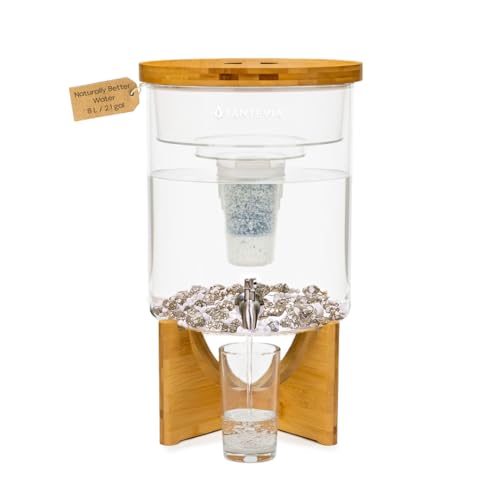
The Santevia Glass System takes a fundamentally different approach: instead of merely removing contaminants, it actively adds calcium, magnesium, and potassium back into the water while raising pH by up to 2.0 units. The 8-liter glass reservoir sits on a sustainable bamboo stand, and the included MINA Fluoride Filter plus Mineral Stones provide two separate treatment stages. The result is water that tastes noticeably smoother and less acidic than standard filtered tap water — several users report reduced acid reflux after switching.
Filtration coverage is broad: the system reduces over 90 contaminants including 99% of fluoride, chlorine, lead, PFAS/PFOS, and VOCs, tested to NSF Standards 42, 53, and 401. The fluoride filter lasts 2 months, while the Mineral Stones last a full 2 years — significantly longer than typical cartridge-only systems. The glass reservoir and bamboo components minimize plastic exposure, though the filter cartridges themselves do contain plastic casings. At 8 liters, this system serves a family of 4-5 people comfortably and fits inside most refrigerators.
The primary drawback is slow gravity filtration — filling the full 8-liter reservoir takes noticeable time, and the initial mineral infusion can taste unusual for the first few days before settling into a clean profile. The price point is the highest in this guide, but the 2-year mineral stone lifespan and the built-in remineralization feature make this a compelling all-in-one solution for households that want alkaline, mineral-rich water without a separate ionizer machine.
Why it’s great
- Remineralizes water with calcium, magnesium, and potassium
- 8-liter capacity serves larger households without constant refilling
- Mineral stones last 2 years — exceptional replacement economy
Good to know
- Very slow gravity filtration — plan ahead for full reservoir refills
- Filter cartridges contain plastic casings despite glass reservoir
- Premium price point reflects alkaline and mineral technology
4. LifeStraw Home Water Filter Pitcher

LifeStraw built its reputation on portable water filters that remove pathogens in the wild, and the Home pitcher brings that same membrane-microfilter technology to your countertop. This is the only glass pitcher in this guide that removes bacteria and parasites in addition to the standard suite of lead, mercury, PFAS, chlorine, herbicides, and pesticides. The membrane microfilter lasts 264 gallons (roughly 1 year), while the activated carbon and ion exchange filter lasts 40 gallons (about 2 months).
The glass body with silicone base is durable and aesthetically clean, and the 7-cup capacity is appropriate for 1-2 person households or as a secondary drinking pitcher. Water quality reviews are consistently excellent — users report dramatically better taste and mouthfeel compared to standard carbon-only pitchers. The tradeoff is speed: filling the full pitcher takes 10-15 minutes of gravity filtration, which is noticeably slower than the Waterdrop PT-09W. Users solve this by decanting filtered water into a secondary glass pitcher for immediate access.
One important distinction: the filter housing and lid components are BPA-free plastic, not glass, so this is not a fully plastic free water filter in the strictest sense. However, the membrane technology provides biological protection that no other glass pitcher in this price range offers. If your tap water has known bacterial concerns or you simply want the most thorough pathogen barrier in a glass body, the LifeStraw Home is the only choice that delivers it.
Why it’s great
- Only glass pitcher that removes bacteria and parasites via membrane microfilter
- 264-gallon membrane lifespan — replace only once per year
- Reduces PFAS, lead, mercury, and pesticides in addition to biologicals
Good to know
- Very slow filtration — 10-15 minutes per full pitcher
- Filter housing and lid are BPA-free plastic, not glass
- 7-cup capacity requires frequent refilling for larger households
5. Frizzlife SS99 Countertop Steel Filter
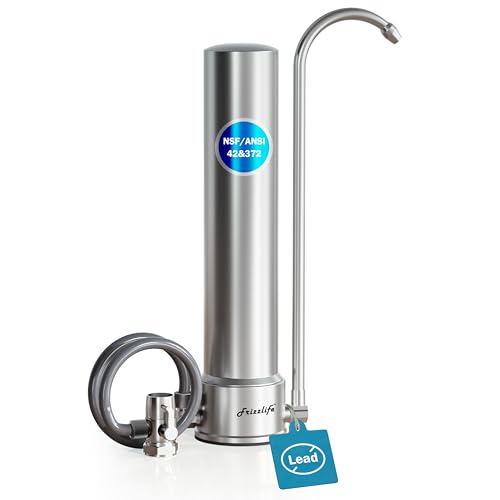
The Frizzlife SS99 is the fastest plastic free water filter in this lineup by a significant margin. Connected directly to your kitchen faucet via a diverter valve, it delivers 2 gallons per minute — enough to fill an 8-ounce cup in under 3 seconds. The entire housing is made from food-grade 304 stainless steel with 1mm thickened walls, meaning no plastic touches the water at any point from adapter to spout. The 0.5 micron carbon block filter reduces lead, chlorine, fluoride, heavy metals, VOCs, and bad taste while retaining essential minerals.
Installation takes under 15 minutes with the included adapters (covering 6 different thread sizes) and requires no drilling, no electricity, and produces zero wastewater. The diverter switch lets you toggle between unfiltered tap water (for washing dishes) and filtered water (for drinking and cooking) instantly. The inner filter cartridge (model DSF02) lasts up to 12 months or 8,000 gallons — easily the longest filter life of any countertop unit in this guide. You replace only the cartridge, not the stainless steel housing, which further reduces waste.
The main limitation is faucet compatibility: you must check that your faucet thread size matches one of the six included adapters. Some reviewers noted that managing the excess hose length can be untidy, and the filter requires a 15-minute flush before first use. But if raw speed and zero-plastic construction are your priorities — especially if you cook with filtered water daily — the SS99 is the most practical system available.
Why it’s great
- 2 GPM flow rate — fastest in this guide at 3 seconds per cup
- Fully 304 stainless steel water path with zero plastic contact
- 12-month / 8,000 gallon filter life — lowest replacement frequency
Good to know
- Faucet thread compatibility must be verified before purchase
- Requires a 15-minute flush before first use
- Hose management can look messy on smaller counters
6. Puro Glass Water Filter Pitcher

The Puro Glass Pitcher is the entry-level plastic free water filter that removes the biggest barrier to switching from plastic: price. Its 1.3-liter glass body with protected spout provides immediate pour-through filtration — water filters as you pour, so there is no waiting for a full batch to gravity-drip. The activated carbon filter reduces chlorine, lead, odors, rust, and impurities, and one filter replaces roughly 1,600 single-use plastic bottles over its lifespan.
User reviews consistently praise the sleek glass design and the noticeable taste improvement over tap water. The lightweight construction fits easily in most refrigerator doors, and the protected spout prevents splashing during pours. However, the capacity is small — 1.3 liters serves one to two glasses before needing a refill, which can be annoying for households that drink filtered water throughout the day. Some users also report that the glass diameter makes one-handed pouring feel slightly unbalanced, requiring two hands for stability.
The most significant concern is replacement filter cost. Reviewers note that a 2-pack of Puro filters costs as much as the pitcher itself, making long-term operation expensive relative to larger systems. The plastic closing cap on the lid has also been flagged as a potential failure point over time. For single users or those on a tight budget who want to start eliminating plastic from their water routine, the Puro is a reasonable entry point — just budget for the recurring filter expense.
Why it’s great
- Most affordable glass-bodied water filter pitcher available
- Instant pour-through filtration — no waiting for gravity drip
- Compact size fits small fridges and bathroom vanities
Good to know
- 1.3L capacity is small — requires frequent refilling
- Replacement filters are expensive relative to pitcher cost
- Glass body feels unbalanced for one-handed pouring
7. ZeroWater 32-Cup 5-Stage Dispenser

The ZeroWater 32-Cup dispenser sits at the bottom of this list not because it filters poorly — it filters better than almost anything here on a pure TDS basis — but because it is the only unit in this guide built primarily from plastic. The 32-cup (7.5-liter) BPA-free plastic reservoir and dispensing body represent a significant compromise for anyone specifically seeking a plastic free water filter. However, for readers who prioritize contaminant removal above all else, the 5-stage ion exchange technology is genuinely impressive: it reduces total dissolved solids to 0 ppm, verified by the included instant-read TDS meter.
The built-in TDS meter is the most useful feature for anyone who wants scientific confirmation of their water quality. When the meter reads 006 or higher, you replace the filter. The system is IAPMO certified to reduce PFOA/PFOS, lead, chromium, and mercury, and each filter saves up to 110 single-use plastic bottles. The 32-cup capacity serves large families or offices without constant refilling, and the dispenser design fits standard countertops at 10.38 inches tall.
The tradeoffs are substantial for those wanting zero plastic. The BPA-free plastic body still leaches concerns for some users, and the water intentionally tastes “flat” because all minerals are removed — some users add mineral drops back in. Filter life varies dramatically based on source water TDS; users with hard water report replacing filters every 3-4 weeks, which becomes expensive quickly. If you need verified 0 TDS water and don’t mind a plastic housing, this is the most capable option — but for a genuinely plastic free water filter, look at the glass or stainless steel alternatives above.
Why it’s great
- Verified 0 TDS water with built-in meter for real-time confirmation
- 32-cup (7.5L) capacity — best for large households or offices
- IAPMO certified for PFOA/PFOS, lead, chromium, mercury reduction
Good to know
- Entire body is BPA-free plastic — not a plastic-free water filter
- Water tastes flat because all minerals are stripped out
- Filter replacement frequency is high with hard tap water
FAQ
Do glass water filter pitchers need a specific type of filter cartridge?
Can a plastic free water filter remove PFAS and microplastics?
Is stainless steel better than glass for a plastic free water filter?
How often should I replace the filter in a glass water filter pitcher?
Final Thoughts: The Verdict
For most users, the plastic free water filter winner is the Waterdrop PT-09W because it combines a primarily glass body with the fastest pour-through flow rate (8.5 oz/min) and the strongest set of independent NSF certifications in the mid-range price tier. If you want high-speed countertop filtration with zero plastic contact at any point, grab the Frizzlife SS99. And for the most thorough under-sink solution with 0.01 micron ultrafiltration and stainless steel housings that hide completely, nothing beats the Waterdrop TST-UF.