Choosing the right containers is the single most critical decision for a thriving indoor herb garden—the difference between a lush, fragrant windowsill and a sad, droopy transplant comes down to how well the planter manages moisture, root space, and light exposure. Too many home cooks buy standard pots that drain poorly or crowd roots, stunting basil, mint, and parsley before the first harvest.
I’m Mohammad Maruf — the founder and writer behind AirfryerBite. I have spent years cross-referencing engineering specs, material science ratings, and soil moisture data to isolate which specific design features (woven wick systems, matte vs gloss plastic, drain hole placement, and galvanized steel gauge) actually improve plant health outcomes versus just looking pretty on a shelf.
After analyzing dozens of models across plastic, composite, and metal categories, I have assembled a tight guide to the planters for herbs that solve real growing problems rather than introducing new ones.
How To Choose The Best Planters For Herbs
Selecting a planter for herbs requires you to balance root depth allowance, water management strategy, and the specific light conditions of your windowsill or patio. A planter that works beautifully for succulents can drown basil roots in a week; likewise, a pot that lacks insulation can cook delicate chive roots under direct afternoon sun. Focus on the three specifications below before considering color or price.
Drainage Method: Wicking vs. Hole-and-Tray vs. Drillable Base
The most common herb-killer is standing water at the root zone. Self-watering planters with absorbent cotton wicks draw water upward only when the soil is dry, which works extremely well for thirsty herbs like mint and parsley. Traditional pots with drainage holes and an attached tray allow excess to run off, but you must empty the tray after heavy watering. Drillable-bottom planters—common with composite materials—give you the freedom to add your own hole pattern, useful for outdoor use where rainfall is unpredictable. Avoid any planter with zero drainage and no wick system unless you are growing in a sealed terrarium environment.
Material Thermal Conductivity and Longevity
Plastic is the most common material for herb planters because it is lightweight, non-porous, and resists cracking in freezing temperatures. However, thin plastic walls heat up quickly in direct sunlight, raising root-zone temperature above the optimal 65-75°F range. Thicker-wall matte plastic (like the D’vine Dev set) and plastic-stone-wood composites (like Arcadia PSW) provide better insulation. Galvanized steel planters are excellent for outdoor raised beds because they resist rust and reflect heat, but they should have an open bottom to prevent water from pooling against the metal. Avoid any planter made from recycled plastic that lacks a UV stabilizer—it becomes brittle after one season.
Container Volume and Shape for Common Culinary Herbs
Container volume determines how often you must water and how large your herbs can grow. Basil, cilantro, and dill need at least 1 quart of soil per plant to reach harvest size without bolting. Rosemary and thyme prefer a wider, shallower pot (around 4-5 inches deep) rather than a deep narrow one. A windowsill box that measures 17 inches long and holds roughly 3-4 quarts total will support three small herb plants comfortably. Multi-pot sets with individual compartments of around 0.75 quarts each are best for starting seedlings but will require transplanting once the taproot hits the bottom. Always check the planter’s internal depth, not just its exterior height, because a thick rim reduces usable growing space.
Quick Comparison
On smaller screens, swipe sideways to see the full table.
| Model | Category | Best For | Key Spec | Amazon |
|---|---|---|---|---|
| OurWarm Herb Planter Box Set of 6 | Self-Watering Pot | Forgetting to water | Cotton wick, water level window | Amazon |
| Arcadia PSW Simplicity Window Box | Composite Box | Outdoor durability and stone look | PSW composite, 17.5″ long, UV stable | Amazon |
| GADI 2-Pack Metal Raised Bed | Raised Bed | Large outdoor herb patches | Galvanized steel, open bottom | Amazon |
| D’vine Dev Herb Garden Planter Set | Plastic Pot Set | Countertop kitchen herb garden | BPA-free, thick matte wall | Amazon |
| LOCONHA Window Box Planter 7-Pack | Plastic Box | Budget-friendly multi-herb planting | Attached tray, recyclable, 17″ | Amazon |
In‑Depth Reviews
1. OurWarm Windowsill Herb Planter Box Set of 6
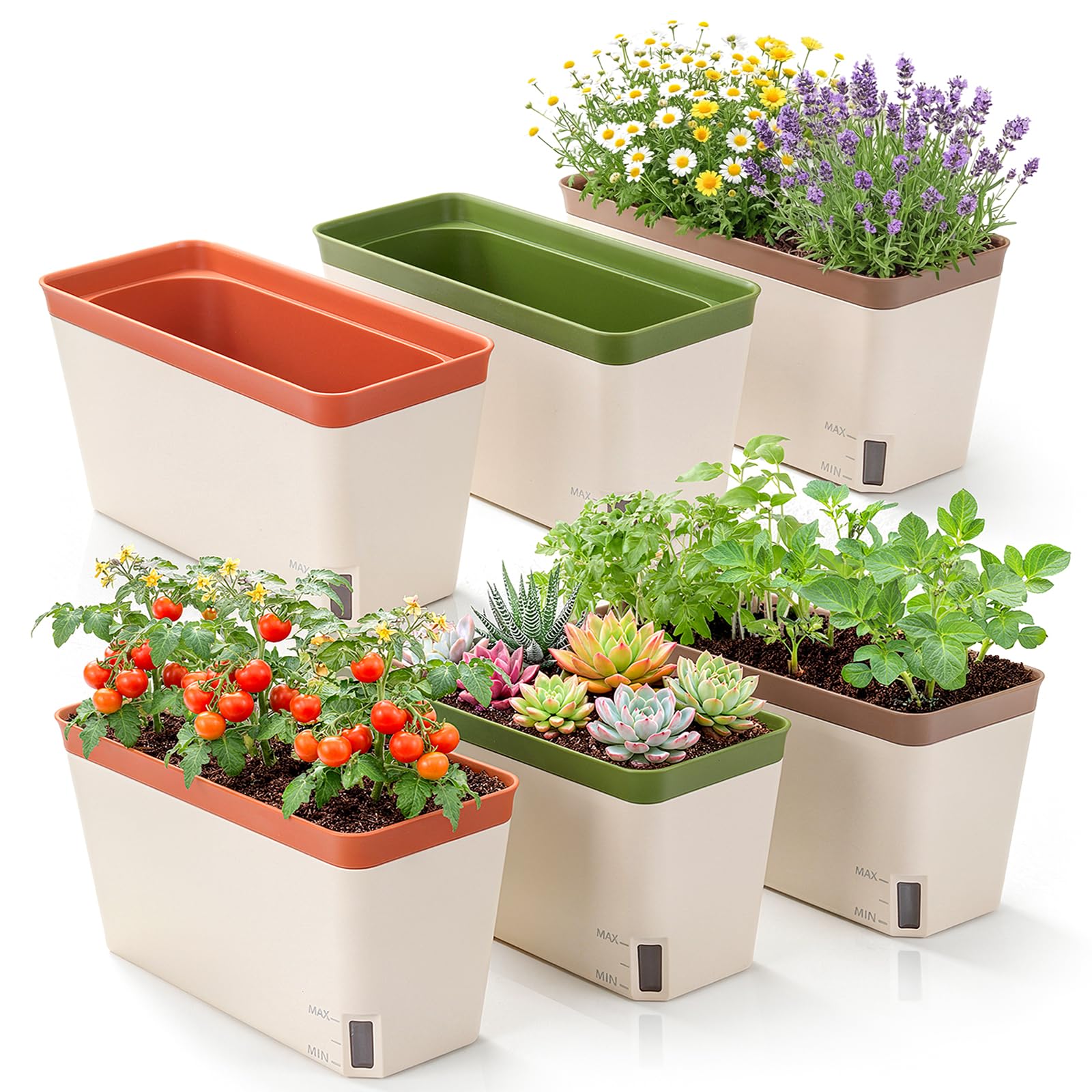
This self-watering system uses absorbent cotton wicks that rely on capillary action to keep the root zone uniformly moist without waterlogging—a critical feature for finicky herbs like basil and cilantro that wilt immediately when the soil dries out. Each 10.24 x 4.33 x 4.92 inch pot holds roughly 1.5 quarts of soil, and the clear water level window at the base lets you see exactly when to refill the reservoir rather than guessing by weight. The set includes six pots in green, orange, and brown, making it visually cohesive for a kitchen windowsill without looking like a nursery rack.
The double-layer design separates the upper soil chamber from the lower water reservoir, preventing root rot even if you accidentally overshoot the fill line. During summer months when pots dry faster, the wick pulls water more aggressively; in winter, simply leave the reservoir empty to avoid bacterial buildup in the lower compartment. The plastic walls are lightweight but durable enough for daily handling when you rotate pots for even light exposure. Assembly takes about two minutes per pot—snap the wick through the inner floor, fill the bottom chamber, and insert the top cylinder.
One practical limitation: the wicks lose efficiency if the reservoir runs completely dry for more than 24 hours, reactivating slowly when refilled. Users report that the 6-pot set stays within a standard 24-inch windowsill width, though the orange and brown colors may clash with cooler-toned kitchen decor. Overall, this is the most foolproof system for anyone who wants consistent moisture without the discipline of daily tray emptying.
Why it’s great
- Cotton wick maintains even soil moisture for up to 5 days without refill
- Clear water level window eliminates overwatering guesswork
- Six pots fit neatly on a standard windowsill ledge
Good to know
- Wick rehydration is slow if reservoir runs completely dry
- Color selection (green/orange/brown) may not match all kitchen aesthetics
2. Arcadia Garden Products PSW Simplicity Window Box

This 17.5 x 7 x 6 inch window box is made from a proprietary PSW (Plastic/Stone/Wood) composite that looks and feels like lightweight concrete without the 15-pound heft or freeze-thaw cracking risk. The natural taupe finish has slight color variation from batch to batch—each unit has a unique surface texture that mimics stone more convincingly than painted plastic. Unlike most plastic planters, this box resists UV fading so strongly that three years of direct southern sun will not bleach the color. It holds approximately 17.5 liters of soil, enough for three large herb plants or five smaller transplants spaced 4 inches apart.
The factory ships this planter with no drainage hole—only a sticker marking where to drill. This is actually a design advantage for herb growers: you can drill three bottom holes spaced 5 inches apart for a standard drainage pattern, or drill only two if you want to convert it into a semi-self-watering system by adding a capillary mat. The composite material drills cleanly without splitting or melting, unlike thin polypropylene. Use a ¼-inch masonry bit and drill slowly. The box also works as a cachepot if you keep herbs in nursery pots inside it, using the sealed bottom to protect furniture from spills.
Outdoors, the 1.5-pound empty weight means it can be lifted by wind gusts if planted with lightweight potting mix—fill it with moist soil to anchor it. The natural taupe gradient can look slightly artificial under direct flash photography, but in ambient daylight it reads as a subtle beige concrete. Buyers consistently report that flowers and perennials grow better in this composite than in standard plastic because the material insulates roots from temperature swings—a 10-degree buffer compared to thin-wall pots.
Why it’s great
- PSW composite looks like stone but weighs 90% less than concrete
- Drillable base lets you customize drainage pattern for specific herbs
- UV-stable material resists fading after multiple seasons outdoors
Good to know
- No pre-drilled hole—you must drill your own drainage
- Lightweight when empty; can tip in strong wind until soil-filled
3. GADI 2-Pack Metal Raised Garden Bed
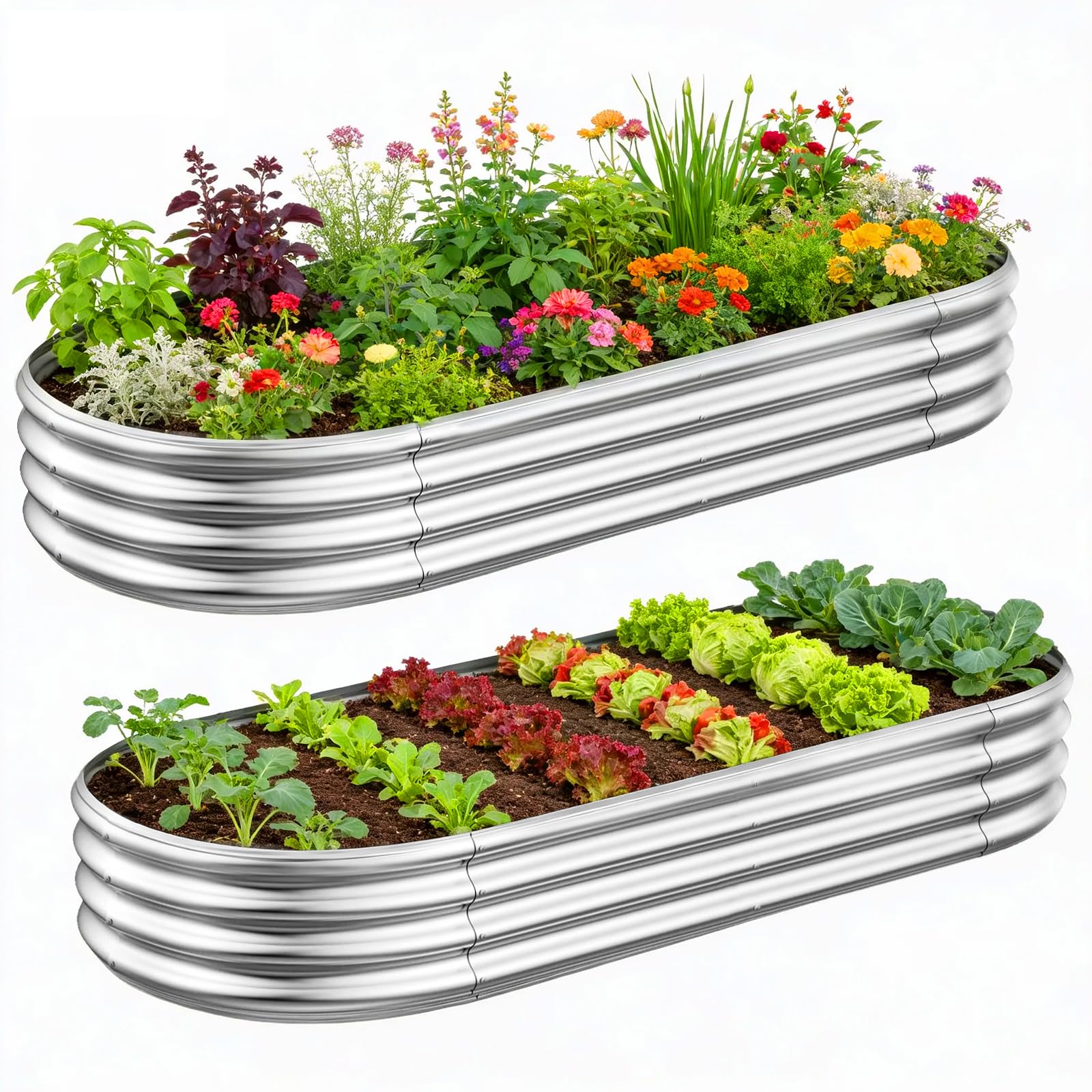
This 4x2x1 foot raised bed provides the largest growing volume in this guide—roughly 8 cubic feet of soil per unit, enough to support a full culinary herb patch with multiple basil plants, a rosemary bush, oregano, thyme, and chives all in one bed. The galvanized steel panels resist rust through multiple growing seasons, and the open-bottom design allows earthworms and beneficial microbes to migrate up from the native soil below, which dramatically reduces the need for fertilizer. Each pack includes two beds, giving you 16 square feet of growing area total. Assembly uses pre-drilled holes with nuts and bolts—no welding or power tools required.
Because the bottom is open, drainage is essentially perfect: excess water drains into the ground rather than pooling inside the bed. This is especially beneficial for herbs like rosemary and lavender that demand sharp drainage and will rot in a sealed container. The 1-foot height is low enough to reach comfortably without bending your back but tall enough to prevent grass and weed roots from competing with your herbs. The silver galvanized finish reflects some sunlight, keeping root temperature a few degrees cooler than dark soil in midsummer. A protective coating on the steel prevents heavy metal leaching into the soil, so your herbs remain safe for culinary use.
One practical consideration: these beds have no rigid cross-supports in the middle of the 4-foot span. If you fill them with dense garden soil rather than lightweight potting mix, the long side panels may bulge slightly outward—counteract this by adding a center cross-tie (not included) or by filling the bed in stages, tamping the soil every 4 inches. The included hardware pack provides enough bolts for assembly, but a 10mm socket wrench speeds the process significantly. For growers who want a permanent outdoor herb installation, this is the most productive option per dollar in the lineup.
Why it’s great
- Open-bottom design prevents standing water and supports healthy soil biology
- Galvanized steel resists rust and reflects heat away from roots
- Two-pack provides 16 square feet of growing area for high-yield harvests
Good to know
- Long side panels may bulge without a center support bar
- Requires socket wrench for faster assembly
4. D’vine Dev Herb Garden Planter Set

This 3-pot set is designed specifically for countertop herb growing: each pot measures 4 inches wide and 4.5 inches tall, sitting on a shared 12-inch-long drip tray that catches overflow without requiring a second saucer. The plastic is thick-walled with a matte white finish that feels more substantial than typical seedling pots—it weighs roughly 2.7 pounds fully filled, enough to stay put when you snip leaves. Each pot has a drainage hole at the bottom, and the set includes fine mesh nets that cover the hole to prevent potting soil from washing out while still allowing water to drain freely. This mesh is particularly useful for fine-particle mixes that include coco coir.
The material formulation is BPA-free, which matters for edible herbs because residual chemicals from lower-grade plastics can be absorbed by leafy greens. The matte surface does not show scratch marks like glossy plastic, and it cleans easily with a damp sponge even after muddy repotting sessions. The shared tray design means you can water from above and the excess drains into a single low-profile container that slides out for emptying. For bottom-watering, you can lift one pot slightly and pour water into the tray—the drainage holes wick moisture upward through the mesh, which encourages deeper root growth.
A design limitation: the individual pots sit flush against each other in the tray with no separation, so if one pot develops fungus gnats or mildew, the tray water facilitates spread to the adjacent pots. Space them with small gaps or clean the tray weekly to prevent this. The 4-inch width also means mature basil or dill plants will become root-bound after about 6 weeks and need transplanting to larger containers. For starting seedlings or growing small-leaf herbs like chives and thyme that stay compact, these pots work indefinitely without transplant stress.
Why it’s great
- BPA-free thick-wall plastic is safe for culinary herbs and feels premium
- Mesh drainage nets prevent soil loss while allowing bottom-watering
- Minimalist white matte finish blends into modern kitchen aesthetics
Good to know
- Shared drip tray can spread disease between pots if not cleaned regularly
- Small pot size limits growth of large herbs—transplant after 6 weeks
5. LOCONHA Window Box Planter 7-Pack
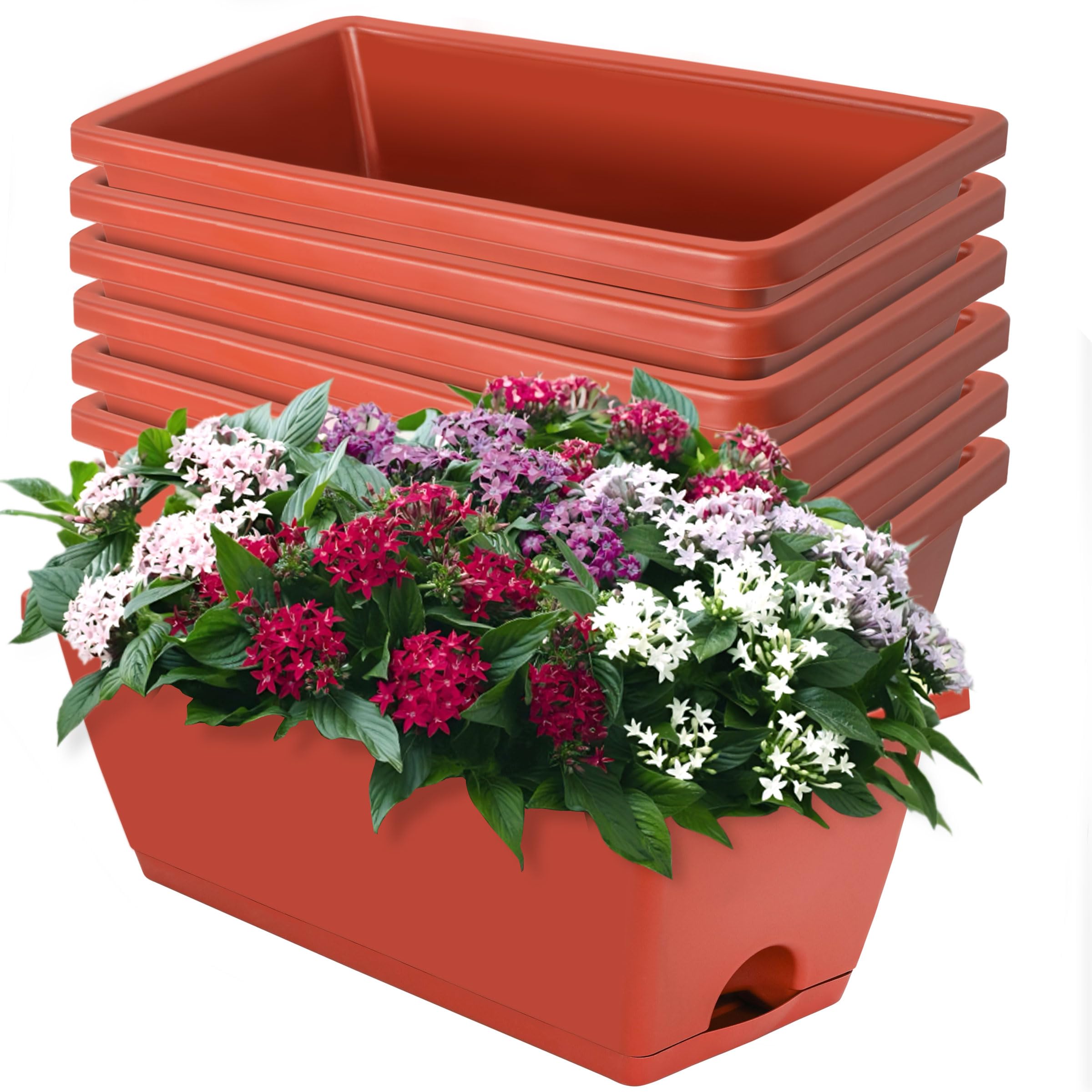
This 7-pack of 17-inch rectangular plastic planters comes with attached drainage trays, eliminating the need to buy separate saucers. Each box is made from recyclable, UV-stabilized plastic that holds up to direct sun exposure without becoming brittle or discolored—a common failure point for ultra-budget planters. The design includes two water inlets at the bottom of each box, allowing you to water directly into the tray without opening the planter, which keeps windowsills dry and prevents splash-back onto furniture. At roughly 0.83 liters of soil per box, each planter can hold two small herb plants or one medium basil.
The brick red color has a classic terracotta appearance but without the porosity of real clay, meaning the plastic does not wick moisture away from the soil like unglazed terracotta does. This is a benefit for herbs that prefer consistent moisture (mint, parsley, cilantro) but less ideal for rosemary or oregano, which like the drying effect of porous pots. The attached tray is not removable after assembly—the bottom snaps into place permanently—so you cannot clean inside the drainage gap once soil particles accumulate. Flush the tray by tilting the box sideways and running water through the inlets every few weeks.
Stackability is a practical highlight: the boxes nest inside each other when empty, saving significant storage space between growing seasons. The plastic is lightweight enough that a single box filled with moist soil weighs under 3 pounds, making it easy to move plants to catch afternoon light or bring indoors during frost warnings. For a first-time herb grower who wants maximum quantity of containers at a minimal outlay, this set provides the most pots per dollar without sacrificing basic drainage functionality. Just be aware that the permanent tray makes thorough cleaning more tedious than detachable saucer designs.
Why it’s great
- Seven 17-inch planters with attached trays—most units per dollar in the guide
- UV-stabilized plastic resists sun damage and remains flexible
- Bottom water inlets keep countertops dry during watering
Good to know
- Attached tray is non-removable, making deep cleaning inconvenient
- Non-porous plastic does not provide the drying effect rosemary prefers
FAQ
Can I grow multiple herb types in a single self-watering planter?
How many drainage holes should I drill in a drillable herb planter?
What is the minimum soil depth for kitchen herbs like basil and chives?
Is galvanized steel safe for growing edible herbs?
Final Thoughts: The Verdict
For most users, the planters for herbs winner is the OurWarm Herb Planter Box Set of 6 because its cotton wick system and visible water level window eliminate the guesswork that kills most windowsill herb gardens—overwatering and dry spells. If you want a permanent outdoor installation with zero drainage maintenance, grab the GADI 2-Pack Metal Raised Bed for its open-bottom, rust-resistant design. And for a kitchen countertop starter set that looks clean and resists chemical leaching, nothing beats the D’vine Dev Herb Garden Planter Set with its BPA-free, thick-wall matte pots.