Pushing a stiff ball of pizza dough through a home stand mixer often stalls the motor, walks the machine across the counter, or overheats the unit before the gluten network forms. Dedicated pizza mixers solve that by pairing higher torque motors with bowl and hook geometries designed specifically for dense, low-hydration doughs that typical kitchen mixers simply cannot handle.
I’m Mohammad Maruf — the founder and writer behind AirfryerBite. I have spent years analyzing commercial and prosumer kitchen hardware, focusing on the specific torque curves, bowl capacities, and planetary versus spiral mixing actions that determine whether a machine can consistently produce a smooth, elastic pizza dough without stalling.
This guide breaks down the essential specs and real-world performance data you need before buying the best pizza mixer for your kitchen, bakery, or pizzeria operation.
How To Choose The Best Pizza Mixer
Selecting a pizza mixer requires looking past brand names and focusing on the physical demands of dough kneading. The wrong choice leads to stalled motors, incomplete gluten development, or a machine that takes up counter space without delivering consistent results.
Spiral vs. Planetary Mixing Action
Planetary mixers have a single beater or hook that rotates on its own axis while orbiting the bowl, which works well for batters and medium dough. Spiral mixers use a stationary spiral hook while the bowl rotates, creating a folding and stretching action that develops gluten faster and generates less heat — ideal for the high-hydration or low-hydration doughs typical in pizza making. For serious pizza production, a spiral mixer often produces a more consistent crumb and better oven spring.
Bowl Capacity and Dough Weight Limits
Bowl size listed in quarts does not equal usable dough capacity. A general rule: the maximum dough weight is roughly 60 to 65 percent of the bowl volume. A 20-quart bowl typically handles between 11 and 13 pounds of dough, enough for roughly 14 to 18 twelve-inch pizzas. Overloading forces the motor to work harder and shortens the lifespan of the transmission gears.
Motor Power and Torque Delivery
Wattage provides a baseline, but gear-driven transmissions and motor type (pure copper vs. aluminum wound) determine how much torque reaches the hook at low speeds. A 650-watt machine with a well-designed gear reduction can outperform an 1100-watt unit with plastic gears. Look for models that list RPM at each speed and verify the lowest speed stays under 120 RPM for heavy dough to prevent the hook from spinning faster than the gluten network can form.
Quick Comparison
On smaller screens, swipe sideways to see the full table.
| Model | Category | Best For | Key Spec | Amazon |
|---|---|---|---|---|
| Ooni Halo Pro Spiral Mixer | Spiral | Home pizza enthusiasts | 58 speed settings, spiral hook | Amazon |
| GarveeTech 10.5 Qt | Planetary | Small batch pizzerias | Touch screen, 650W dual rotation | Amazon |
| LEEVOT 20 Qt 1100W | Planetary | Mid-volume bakeries | 20 qt bowl, 13.2 lb dough capacity | Amazon |
| LEEVOT 30 Qt 1250W | Planetary | High-output pizzerias | 30 qt, 60-min timer, 22 lb dough | Amazon |
| Towallmark 20 Qt | Planetary | Schools and commercial kitchens | 1100W, safety guard, 408 RPM high | Amazon |
| EKway 20 Qt 1100W | Planetary | Versatile commercial baking | Touch control, 304 SS bowl, timer | Amazon |
| VEVOR 20 Qt 750W | Planetary | Budget-conscious commercial users | 750W motor, 30-min timer, 6.6 lb dough | Amazon |
| EKway 30 Qt 1250W | Planetary | Large batch production | 1250W, 60-min timer, 13.2 lb dough | Amazon |
| LEEVOT 60 Qt 3000W | Planetary | High-volume industrial kitchens | 60 qt, 3000W, 46.3 lb dough, 220V | Amazon |
In-Depth Reviews
1. Ooni Halo Pro Spiral Mixer

This is the only spiral-action mixer on this list, and that distinction matters for pizza dough. The rotating bowl and stationary spiral hook create a folding and stretching motion that develops gluten at a lower temperature than planetary mixers, preserving fermentation activity. With 58 speed settings ranging from 60 RPM to over 1,000 RPM, you can dial in the exact mixing intensity for any hydration level.
The 7.3-quart bowl size is aimed at the home enthusiast or very low-volume commercial use. It ships with four attachments: a spiral dough hook, a removable breaker bar, a flexible beater, and a geared whisk. Users consistently note the build quality exceeds typical KitchenAid units and that cleanup is simpler because the bowl and hook design prevents dough from climbing the shaft. An integrated cooling fan protects the motor during longer mixing cycles.
At roughly 32 pounds, this machine is significantly lighter than the 100-plus-pound commercial units on this list, making it feasible for a home counter. The capacitive touch controls with a rotary dial feel precise, and the built-in timer eliminates guesswork. For anyone making pizza dough weekly and wanting professional-level gluten development without industrial weight, this is the standout choice.
Why it’s great
- True spiral mixing action builds gluten efficiently without overheating dough
- 58 precise speed settings from 60 to 1000+ RPM for fine control
- Removable breaker bar and bowl simplify cleaning
Good to know
- 7.3-quart capacity limits batch size to roughly 4.5 to 5 pounds of dough
- Not suitable for high-volume commercial pizzerias
2. GarveeTech Commercial Food Mixer 10.5 Qt
GarveeTech brings a touch screen interface to the planetary mixer category, a feature usually reserved for much more expensive units. The 10.5-quart stainless steel bowl handles up to 11 pounds of dough, placing it squarely in the small-batch commercial category. Dual rotation means the bowl turns at 21 RPM while the mixing rod spins at 159 RPM, providing thorough kneading without excessive heat buildup.
The 650-watt pure copper motor runs quietly according to user reports, and the safety shield with emergency stop satisfies commercial kitchen requirements. The digital timer allows you to set precise mixing durations up to 60 minutes, which is useful for consistent batch-to-batch results. One trade-off: the bowl and hook are not removable, making cleaning more involved than with designs that lift off. Owners recommend a three-towel method or dedicated wipe-down station.
Pizza makers running 100 sourdough loaves per week have reported this unit produces smooth, elastic dough comparable to Estella commercial mixers. The 112-pound weight demands a permanent counter location, but the stability during mixing is excellent. For a pizza shop starting out or a bakery that values digital precision, this model offers an unusual feature set at its tier.
Why it’s great
- Touch screen control with timer for precise, repeatable mixing
- Dual rotation ensures even gluten development at 159 RPM hook speed
- Quiet motor operation even under heavy dough loads
Good to know
- Bowl and mixing hook are permanently attached, complicating cleaning
- Extremely heavy at 112 pounds, requiring a dedicated permanent spot
3. LEEVOT 20 Qt 1100W Commercial Food Mixer
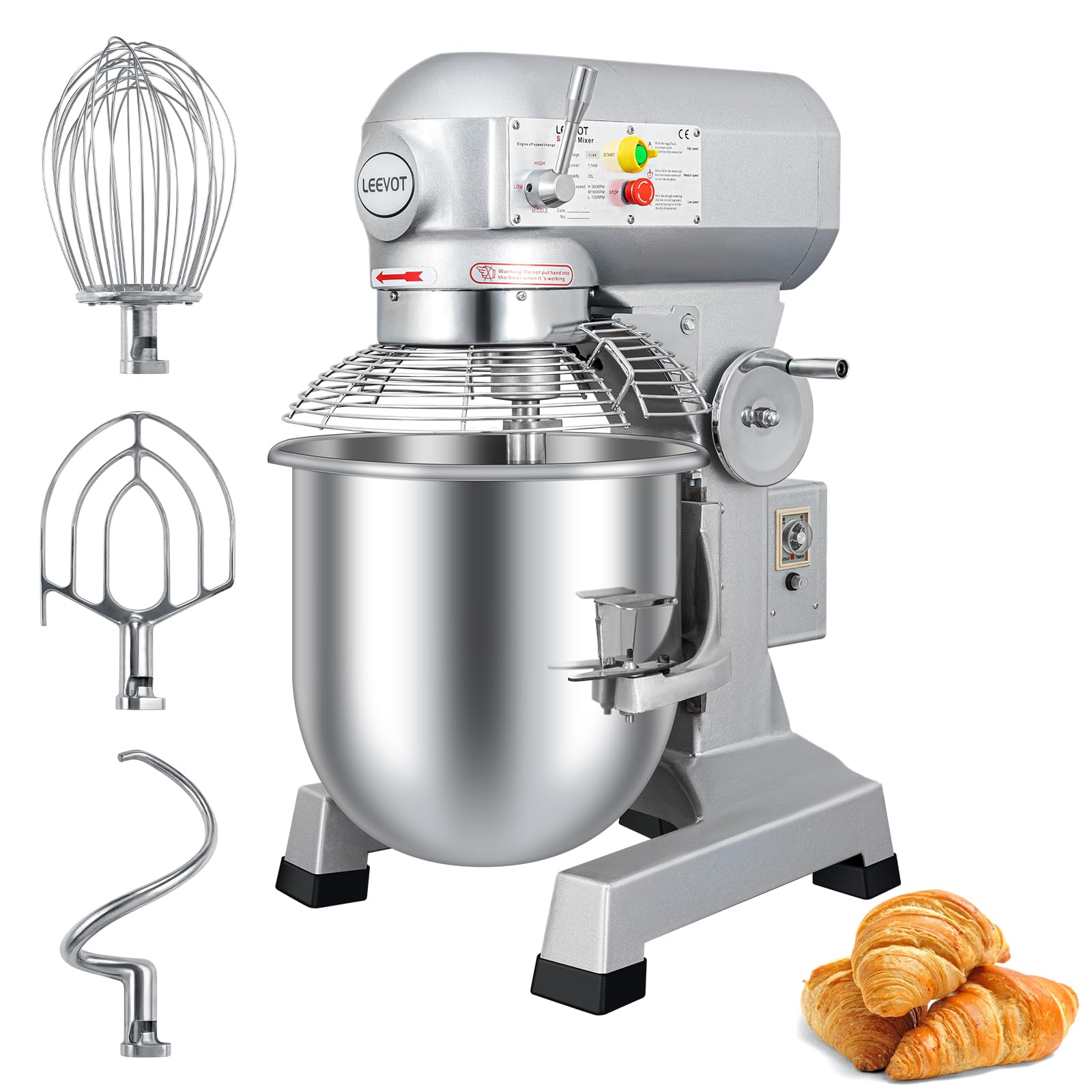
This 20-quart planetary mixer from LEEVOT offers a sweet spot for mid-volume bakeries and pizzerias that need more capacity than a 10-quart but do not want to jump to a 30-quant footprint. The 1100W motor drives three speed ranges: 100 RPM for dough, 166 RPM for fillings, and 360 RPM for whipping. The 20-quart bowl handles up to 13.2 pounds of dough at once, enough for roughly 16 to 18 twelve-inch pizzas per batch.
The build uses food-grade 304 stainless steel for the bowl, hook, and rod, and the safety shield automatically shuts the machine down if opened during operation. Users report the unit mixes bread dough efficiently in minutes, though a small number of reviews mention grinding noise developing after first use or motor issues emerging around the one-year mark. LEEVOT includes a one-year service plan and is responsive with replacement parts under warranty.
At 110 volts, this plugs into a standard commercial outlet without needing a dedicated 220V line. The 30-day return policy and one-year support give some safety net, though the weight of the machine makes returns logistically challenging. For a pizzeria that prioritizes capacity and stainless steel hygiene standards, this is a workable mid-tier option.
Why it’s great
- 20-quart capacity handles 13.2 lb of dough for large pizza batches
- 100 RPM low speed suitable for heavy dough mixing without stalling
- 304 stainless steel bowl and hook meet commercial hygiene standards
Good to know
- Some units developed grinding noise or motor issues within the first year
- No dishwasher-safe components; all parts require hand washing
4. LEEVOT 30 Qt 1250W Commercial Food Mixer

Stepping up to 30 quarts gives this LEEVOT model the ability to mix 22 pounds of dough in a single batch, translating to roughly 28 to 30 twelve-inch pizzas. The 1250W motor uses the same three-speed layout as the 20-quart version but adds a 60-minute timer function so you can walk away without manually checking the dough. The digital timer is a practical upgrade for busy commercial environments where multitasking is constant.
The bowl, hook, and rod maintain the 304 stainless steel standard, and the safety shield remains consistent across the LEEVOT line. User feedback mirrors the 20-quart version: strong performance when the unit works correctly, but some instances of motor degradation after extended use. The 30-day return and one-year service plan apply here as well.
One consideration is that the larger bowl and heavier motor make this machine nearly impossible to move without assistance. Plan for a permanent station with a robust table or floor mount. For a pizzeria that runs multiple dough cycles per day and needs batch sizes above 15 pounds, this volume class reduces the number of mixing cycles and speeds up production throughput.
Why it’s great
- 30-quart bowl handles 22 lb of dough for high-output pizzerias
- Built-in 60-minute timer eliminates need to monitor mixing manually
- 1250W motor provides reliable torque for stiff pizza dough
Good to know
- Motor reliability issues reported after 6-12 months of heavy use
- Extremely heavy; requires permanent placement and two people to position
5. Towallmark 20 Qt Commercial Food Mixer

The Towallmark 20-quart mixer uses a gear-driven transmission and an 1100W motor to deliver three speeds of 105 RPM, 180 RPM, and 408 RPM. The low speed at 105 RPM is slightly higher than the LEEVOT’s 100 RPM, but still within the acceptable range for heavy dough. The blue finish on the housing makes this unit visually distinctive in a commercial kitchen, though the stainless steel bowl and attachments are the standard 304 grade.
Users running bagel and bread production at 150 bagels per week report this machine handles the workload without issue. The primary complaint involves the safety guard design: it can pop open during mixing if not secured tightly, and some owners use a rubber band to hold it closed. Flour also tends to fly out of the bowl at higher speeds, so a towel draped over the top is a common field modification.
The 30-minute timer knob is a simpler mechanical alternative to the digital timers found on other models. Replacement parts or customer service contact information is not clearly provided, so buying from a seller with a solid return policy is advisable. For a pizzeria that wants a no-frills, gear-driven machine and can tolerate minor design quirks, this unit delivers consistent mixing power at its price point.
Why it’s great
- Gear-driven transmission provides durable, consistent torque at low RPM
- Handles high-volume loads like 150 bagels per week without stalling
- Stainless steel bowl and attachments meet food safety standards
Good to know
- Safety guard can detach during mixing; may need a DIY fix
- Flour escapes at high speeds; a towel cover is often necessary
6. EKway 20 Qt 1100W Commercial Food Mixer
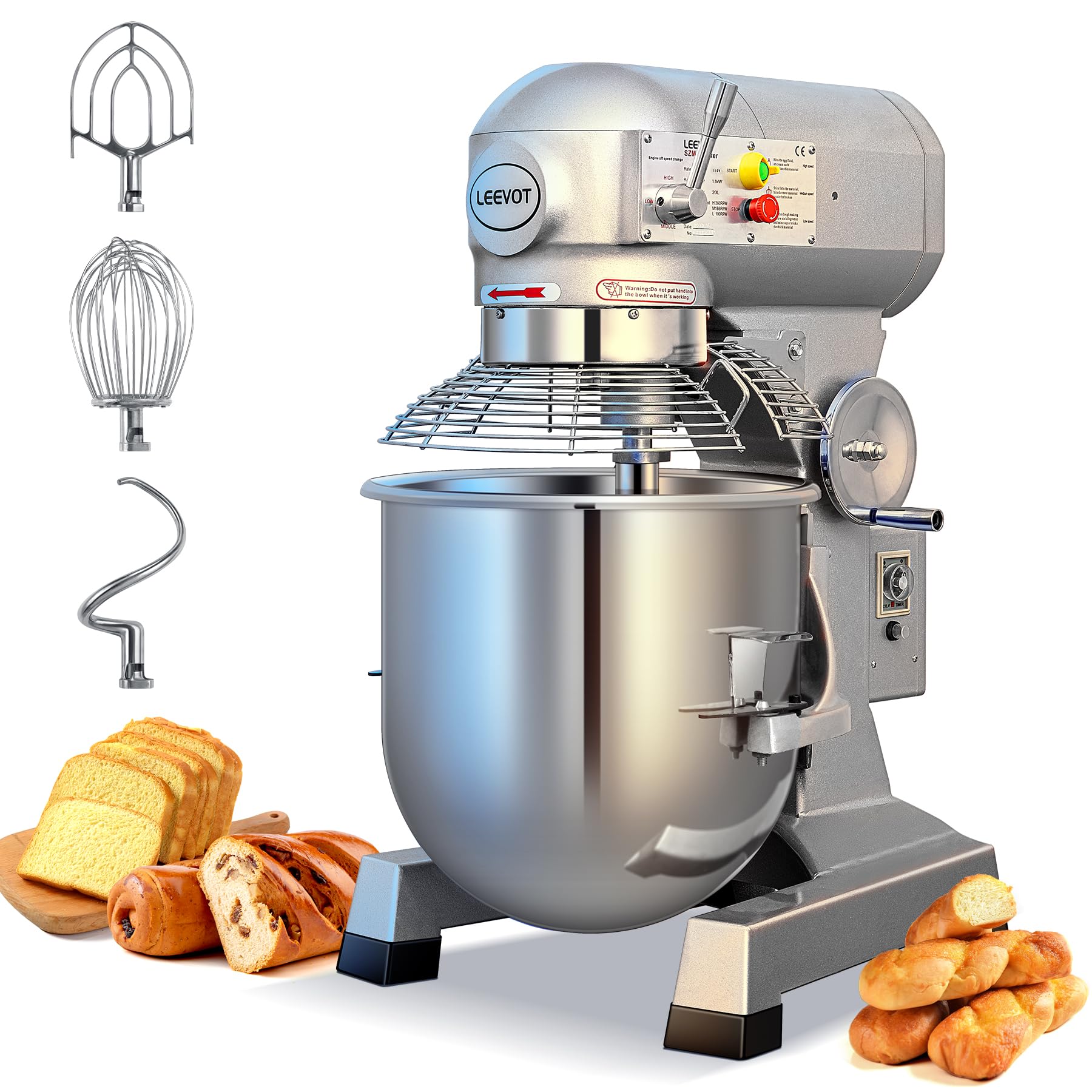
EKway’s 20-quart entry combines a touch control interface with an 1100W pure copper motor and a 60-minute timer, placing it in the same feature bracket as models costing more. The three-speed range runs 100 RPM, 166 RPM, and 360 RPM, matching the LEEVOT speeds precisely. The bowl and attachments are food-grade 304 stainless steel, and the bowl is detachable for easier cleaning — a distinction from some fixed-bowl competitors.
User feedback highlights the quiet operation and effective safety features, though a few owners found the instructions lacking clarity about the safety stop switch. The 12-month maintenance and 10-year after-sales support are better than average for this tier. One common observation is that at 145 pounds, this is one of the heavier 20-quart machines, contributing to stability during kneading but making installation a two-person job.
The unit is rated for 110V, so it integrates into standard commercial outlets. Pizzeria owners report it handles large bread dough batches without bogging down. If you want a 20-quart planetary mixer with electronic controls and a strong warranty package, this model delivers comparable specs to pricier alternatives.
Why it’s great
- Touch controls with 60-minute timer for precise mixing cycles
- Detachable bowl simplifies cleaning compared to fixed-bowl designs
- 12-month warranty with 10-year parts support reduces long-term risk
Good to know
- Instructions lack clarity on safety stop switch operation
- Very heavy at 145 pounds; requires permanent counter placement
7. VEVOR 20 Qt 750W Commercial Food Mixer

VEVOR positions this machine as the most affordable 20-quart option on the list, but the 750W motor is a significant reduction in power compared to the 1100W competitors. The three speeds are 108 RPM, 199 RPM, and 382 RPM, with the low speed at 108 RPM still usable for pizza dough but potentially borderline if you work with very stiff, low-hydration recipes. The maximum dough capacity is listed at 6.6 pounds, which is roughly half what the LEEVOT 20-quart can handle.
Users note that the lowest speed still throws flour around the bowl, and some owners report the machine sits unevenly, requiring a shim under one foot. On the positive side, the 30-minute mechanical timer and safety shield function reliably, and the bowl detaches for cleaning. The machine weighs 161 pounds, which is unusually heavy for a 750W unit, suggesting substantial metal in the frame and transmission.
For a pizzeria just starting out or a bakery that needs occasional large-batch mixing without a premium investment, this machine works within its limits. The motor may struggle with continuous high-volume production, but for moderate weekly use, the build feels solid. The trade-off for the lower entry cost is reduced power and smaller effective dough capacity.
Why it’s great
- Most budget-friendly 20-quart option for entry-level commercial use
- Sturdy frame and transmission weigh 161 lbs for stable operation
- Mechanical timer and safety shield provide reliable basic functionality
Good to know
- 750W motor limits effective dough capacity to 6.6 pounds
- Lowest speed still throws flour; some units sit unevenly on the floor
8. EKway 30 Qt 1250W Commercial Food Mixer

The EKway 30-quart model shares the same motor platform as the LEEVOT 30-quart — 1250W with three speeds of 100 RPM, 166 RPM, and 360 RPM — but adds EKway’s own 10-year parts support and 12-month maintenance warranty. The 30-quart bowl can handle 13.2 pounds of dough, which is actually the same figure as the EKway 20-quart model, suggesting a conservative rating for the larger bowl to protect the motor.
User reports mirror those of the 20-quart EKway: quiet operation, effective safety shield, and a timer that works reliably up to 60 minutes. The instructions have the same lack of clarity around the emergency stop button, and the left-side safety bars can slip off, though this does not affect mixing performance. The bowl and attachments are removable for cleaning, a welcome feature at this size class.
At 146 pounds, this machine is slightly lighter than the VEVOR 20-quart despite being larger — likely due to differences in metal thickness. Pizzeria owners who need 30-quart capacity but want the reassurance of long-term parts availability will find the EKway warranty compelling. For businesses that intend to keep the same mixer for years, the extended support reduces the risk of downtime.
Why it’s great
- 30-quart capacity with 1250W motor handles large dough batches
- Removable bowl and attachments simplify cleaning after heavy use
- 10-year parts support and 12-month warranty provide long-term coverage
Good to know
- Instruction manual lacks clarity on safety stop button operation
- Side safety bars may slip out of position during use
9. LEEVOT 60 Qt 3000W Commercial Food Mixer
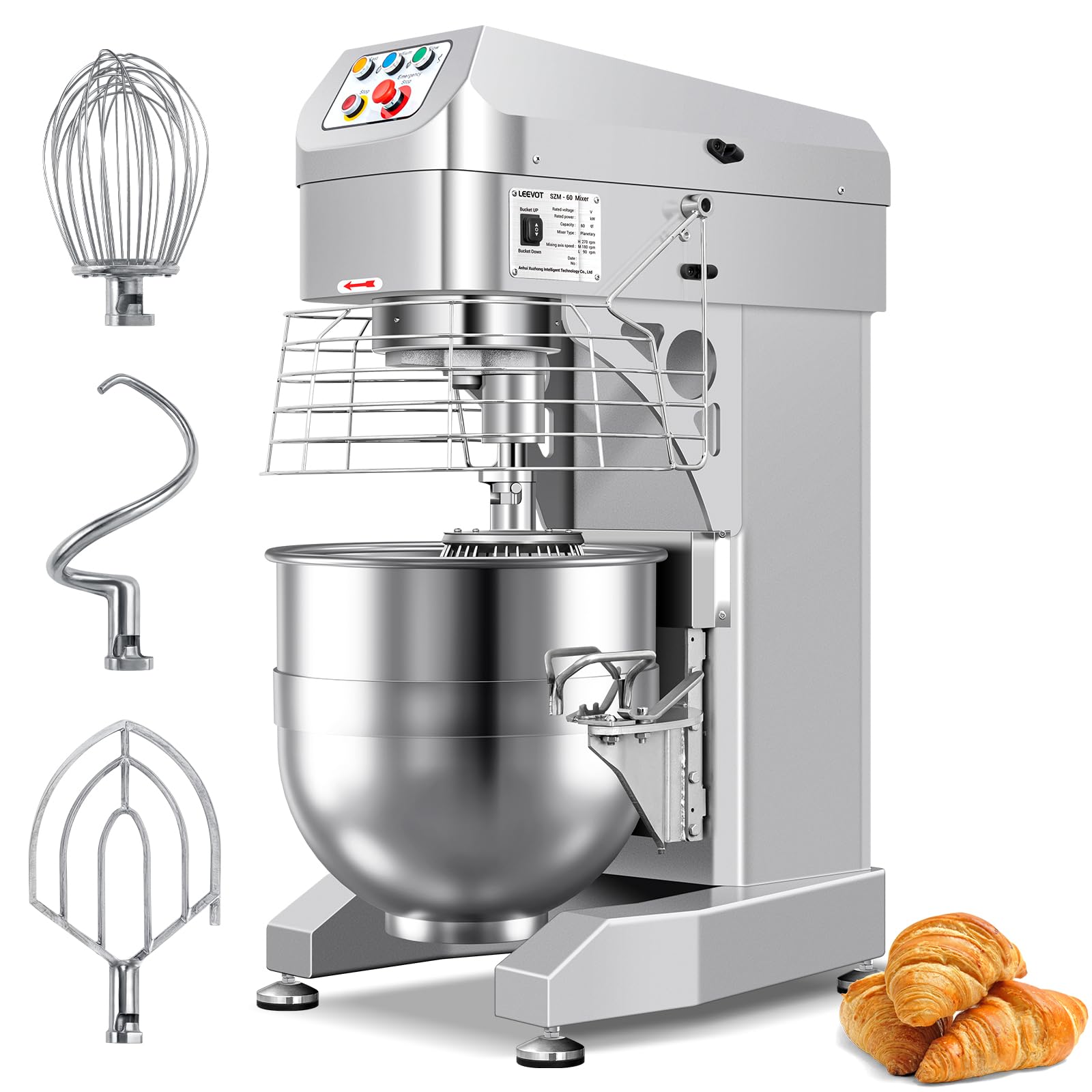
This is a full industrial machine with a 60-quart bowl and a 3000W motor that requires a 220V electrical connection — standard in commercial kitchens but not available in typical home setups. The bowl handles 46.3 pounds of dough per batch, enough for roughly 60 twelve-inch pizzas in a single mix. The three-speed system remains the same layout as smaller LEEVOT models: 100 RPM for dough, 166 RPM for fillings, and 360 RPM for whipping.
The build quality follows LEEVOT’s commercial line with 304 stainless steel bowl and attachments, a safety shield that shuts the machine down when opened, and a motorized lift button to raise and lower the bowl — a practical convenience when dealing with a bowl holding nearly 50 pounds of dough. At 547 pounds, this machine settles permanently onto a floor, not a counter. The 30-day return policy and one-year service plan apply, though returning a 547-pound unit would be logistically complex.
User feedback for the 60-quart is scarce but mirrors the smaller models: strong mixing performance when the unit works, but occasional motor issues reported in the long-term reviews of the 30-quart version. This machine is for high-volume pizza operations, commissary kitchens, or bakeries producing hundreds of pies daily. It is overkill for any smaller business and requires dedicated electrical planning.
Why it’s great
- 60-quart capacity handles 46.3 lb of dough for massive batch production
- 3000W motor with 220V power delivers sustained torque for continuous use
- Motorized bowl lift reduces physical strain with heavy dough loads
Good to know
- Requires a dedicated 220V electrical connection not found in home kitchens
- 547-pound weight makes installation and returns extremely difficult
FAQ
Can a home stand mixer knead pizza dough as well as a dedicated pizza mixer?
What is the difference between spiral mixing and planetary mixing for pizza dough?
How much dough can a 20-quart pizza mixer actually handle?
Do I need a 220V pizza mixer for a pizzeria?
How important is the safety shield on a commercial pizza mixer?
Final Thoughts: The Verdict
For most users, the best pizza mixer winner is the Ooni Halo Pro Spiral Mixer because its true spiral mixing action develops gluten faster and cooler than planetary alternatives, and the 58 speed settings give precise control over hydration levels. If you want a 20-quart workhorse for a commercial pizzeria, grab the LEEVOT 20 Qt 1100W for its proven capacity and 304 stainless steel build. And for high-volume production needing 30 quarts or more, nothing beats the LEEVOT 30 Qt 1250W for maximizing output per mixing cycle.