For anyone who makes pizza at home more than once a week, the process of stretching dough by hand becomes the single biggest bottleneck between you and a perfect pie. A dedicated press eliminates wrist fatigue, uneven thickness, and the guesswork, delivering a uniformly flat disc ready for sauce and toppings in under a minute.
I’m Mohammad Maruf — the founder and writer behind AirfryerBite. My research focuses on matching kitchen hardware to real home-baking workflows, analyzing mechanical leverage, roller tolerances, and motor reliability to find tools that save serious time without introducing new frustrations.
Whether you run a small pizzeria or simply want consistent crusts every Friday night, identifying the best pizza dough press means choosing between manual leverage, electric automation, or a dedicated sheeter that handles bulk batches. best pizza dough press options range from compact manual presses to heavy-duty electric sheeters designed for volume.
How To Choose The Best Pizza Dough Press
A dough press is a straightforward machine, but the differences in plate size, actuation method, and material thickness determine whether it becomes a daily workhorse or a frustrating dust collector. Focus on these three factors before you click buy.
Manual Lever vs. Electric Sheeter vs. Crank Roller
Manual lever presses use a mechanical advantage arm to push a flat platen down onto a dough ball, producing a disc in one smooth stroke. They are reliable, require no power, and are easy to clean — ideal for home users making a few pies at a time. Electric sheeters automate the pressing process with motor-driven rollers, handling 200+ pieces per hour for commercial settings. Crank roller machines bridge the gap, giving you manual control over thickness via a hand-cranked roller that sheets dough continuously, perfect for high-volume home bakers or small cafes.
Pressing Plate Diameter and Thickness Range
The plate diameter directly determines the maximum pizza size you can press. A 9.5-inch plate suits personal pizzas and flatbreads, while 14-inch plates handle large pizzas for parties. Adjustable thickness is equally critical — look for a range between 1 mm and 12 mm so you can go from thin-crust cracker style to thick, fluffy Neapolitan bases. Manual presses typically lock into a fixed thickness (often 5 mm), whereas roller sheeters let you dial in any intermediate setting.
Build Material and Structural Rigidity
The press must resist flexing under repeated force. Stainless steel platens and support plates resist rust and are food-safe. For manual presses, check that the base is wide and heavy enough to stay planted during use — a lightweight press will slide across the counter. Electric sheeters need food-grade stainless steel rollers or resin rollers, a strong metal frame, and non-slip feet to handle the motor vibration. Avoid machines with particle-board bases; they degrade quickly if exposed to moisture from dough.
Quick Comparison
On smaller screens, swipe sideways to see the full table.
| Model | Category | Best For | Key Spec | Amazon |
|---|---|---|---|---|
| VEVOR 14-Inch Automatic | Electric Sheeter | High-volume commercial pressing | 14-inch plate, 1-5.5mm thickness | Amazon |
| DKN E-Pro 18-Inch Roller | Crank Sheeter | Large pizzas & fondant work | 18-inch roller, 0.08-12.7mm | Amazon |
| VEVOR 9.5-Inch Manual | Manual Lever | Home pizzeria & flatbreads | 9.5-inch plate, 5mm fixed | Amazon |
| YUCHANLUCK 7L Mixer | Dough Mixer | Mixing & fermenting dough | 7-liter bowl, 304 SS, timer | Amazon |
| AmareMagis 5.3QT Kneader | Dough Mixer | Kneading & fermentation | 5.3Qt, 304 SS, 100°F heat | Amazon |
| Bear 3.7Qt Dough Maker | Dough Mixer | Compact countertop mixing | 3.7Qt, 304 SS, 120W motor | Amazon |
| PIAOCAIYIN Manual Press | Manual Lever | Budget entry-level pressing | 9.5-inch plate, 5mm fixed | Amazon |
In‑Depth Reviews
1. VEVOR 14-Inch Automatic Pizza Dough Roller Sheeter
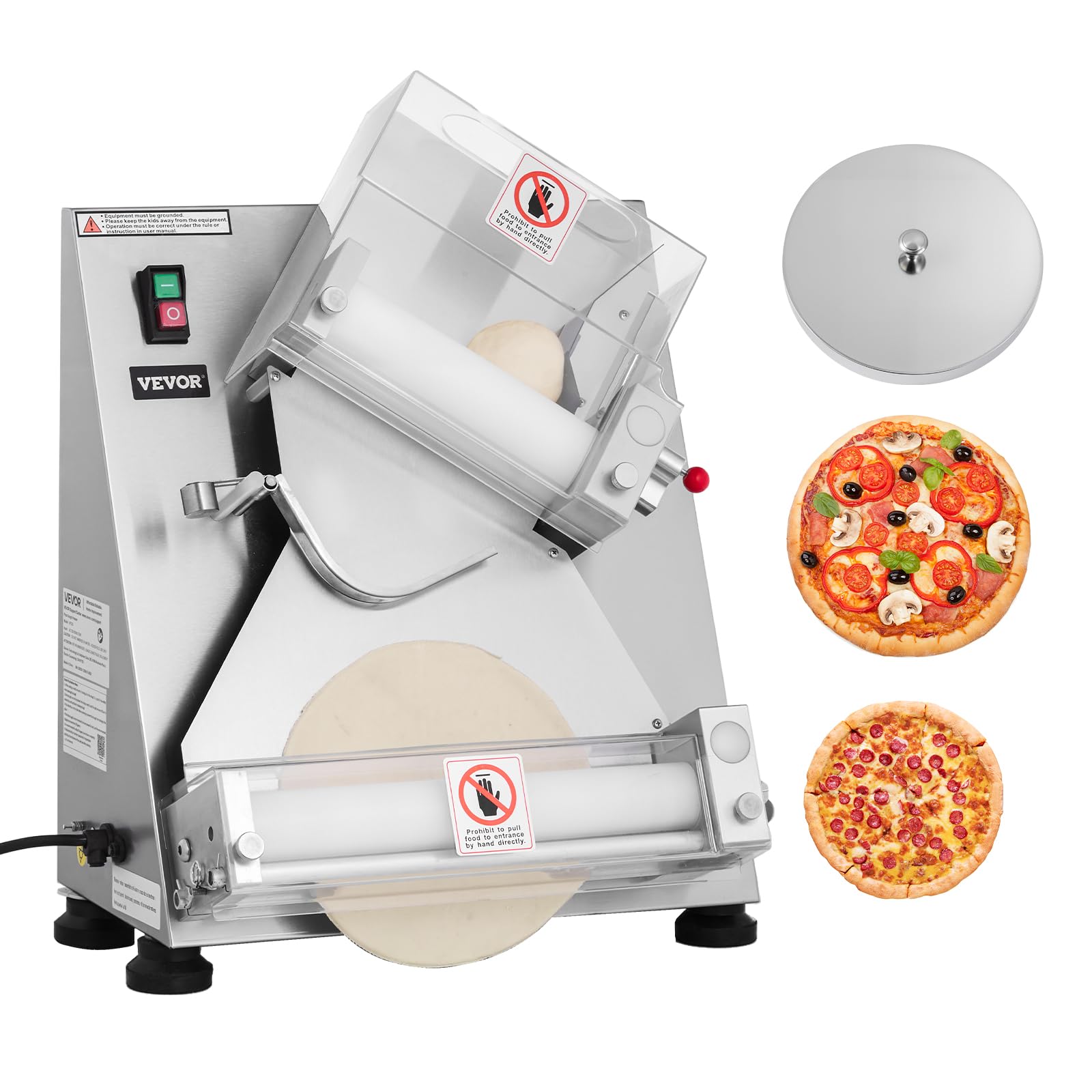
This fully automatic sheeter from VEVOR is built for volume. With a 370-watt motor and a dual-roller design, it can press between 240 and 260 pieces per hour, making it the fastest option in this lineup. The plate adjusts between 3 and 14 inches in diameter and from 1 mm to 5.5 mm in thickness, giving you full control over crust style from thin Roman to thick Sicilian.
The machine body is thickened stainless steel that resists rust and corrosion, and the food-grade resin rollers are paired with a transparent PP plastic safety cover. The metal arm rotates the dough automatically during the pressing cycle, so you get even thickness without manually flipping the disc. At 76 pounds, it demands a permanent counter or cart, but the stability is excellent during operation.
Some commercial users have reported roller failure within days, indicating that quality control can be inconsistent for heavy daily use. For home enthusiasts or low-volume commercial settings, however, the speed and consistency are unmatched at this spec level. The non-slip feet and waterproof switch add to the safety profile.
Why it’s great
- Massive throughput — 240+ discs per hour saves hours of labor.
- Fully automatic rotation ensures even thickness every cycle.
- Adjustable from 3 to 14 inches covers personal to large pizzas.
Good to know
- Heavy 76-pound unit requires a sturdy, permanent workspace.
- Mixed long-term reliability reports from high-volume commercial kitchens.
2. DKN E-Pro 18-Inch Pizza Dough Roller Machine

This crank-driven sheeter from DKN E-Pro is the best option for anyone who needs extra-large 18-inch pizza discs without buying a commercial electric unit. The rollers are built from solid steel and aluminum, with a hand crank that lets you control the feed rate. Thickness adjusts from 0.08 inches to 12.7 mm via set screws, so you can go from paper-thin cracker crust to thick pan dough.
The machine ships with table clamps to secure it to your counter, a recipe book, and a thickness dial system. Experienced users report that three passes through the rollers produce a consistent, even disc. It also doubles as a pasta maker, fondant roller, and croissant sheeter, making it a versatile tool beyond pizza. At just under 8 pounds, it is easy to move and store.
Some users note that the particle-board base is not moisture-resistant and can warp if dough water drips onto it. The rollers require a constant dusting of flour to prevent sticking, and the design lacks a motorized assist, so cranking through thick dough can be tiring for larger batches. Despite these quirks, it remains the most accessible way to get 18-inch sheeting at home.
Why it’s great
- Massive 18-inch roller capacity for extra-large pizzas.
- Durable steel and aluminum construction with smooth gears.
- Multi-purpose — works for pasta, fondant, and croissants.
Good to know
- Particle-board base is vulnerable to water damage.
- Requires manual cranking and frequent flour dusting to prevent sticking.
3. VEVOR 9.5-Inch Manual Pizza Dough Press Machine
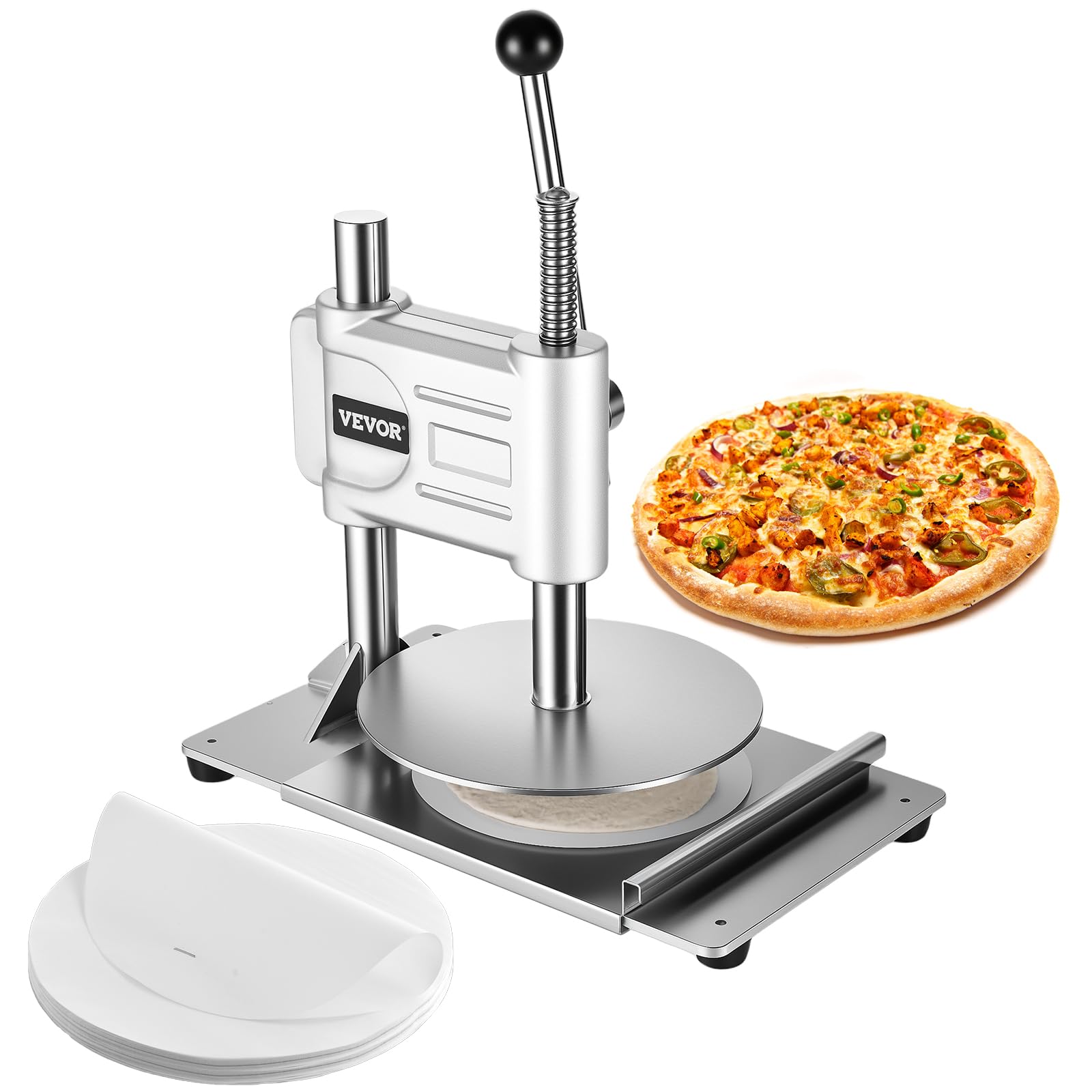
VEVOR’s manual press offers a heavy-duty stainless steel build with a 9.5-inch platen and a fixed pressing thickness of 5 mm. The ergonomic lever handle uses a high-strength spring that auto-rebounds after each press, so you can crank out flatbreads, tortillas, or pizza crusts with minimal effort. The widened base provides excellent stability, and the machine requires no assembly — it is ready to use right out of the box.
The package includes 100 sheets of parchment paper, which you place above and below the dough ball to prevent sticking during the press. This clever addition makes cleanup nearly instant — just peel the paper off and discard. The vertical pressing design ensures even force distribution across the entire disc, so you avoid the thin-center/thick-edge problem common with rolling pins.
Some users report that the 5-mm fixed thickness limits versatility for those who want ultra-thin crusts or very thick bases. The press is also heavy at 26.5 pounds, so it is not portable. A few reviewers found the spring action insufficient to fully flatten larger dough balls, requiring them to use a rolling pin to finish the job.
Why it’s great
- Sturdy all-stainless steel construction resists rust and flex.
- Comes with 100 parchment sheets for zero-mess pressing.
- Auto-return lever mechanism makes repetitive pressing easy.
Good to know
- Fixed 5 mm thickness limits crust variety.
- Heavy unit at 26.5 lbs — not easily moved.
4. YUCHANLUCK 7L Large Capacity Electric Dough Maker

For bakers who need to mix and ferment dough before pressing, this 7-liter electric dough maker handles both tasks in one machine. The 304 stainless steel bowl and mixing blade are dishwasher safe, and the built-in timer lets you program mix and ferment cycles separately. The constant-temperature fermentation feature maintains an ideal environment for yeast activity, producing consistent, well-risen dough every time.
A convenient top window allows you to add water or seasoning without stopping the mixer, and the touch control panel is intuitive to navigate. The machine uses an intermittent kneading pattern to prevent the dough from overheating during long mix cycles — a design that comes from lab testing. Users report that it produces smooth, elastic dough suitable for bread, pizza, and pastries.
Some users note that the included accessories (dumpling maker, egg separator) feel less premium than the main unit. The 7-liter capacity is generous, but the bowl shape can leave unmixed flour on the sides if you overload it. Cleanup is straightforward, but the bowl is heavy when full.
Why it’s great
- Large 7-liter bowl handles dough for multiple batches at once.
- Constant-temperature fermentation speeds proofing reliably.
- Top window lets you add ingredients mid-cycle without stopping.
Good to know
- Included accessories feel lower quality than the main bowl.
- Flour can stick to bowl sides if capacity is pushed beyond limit.
5. AmareMagis 5.3QT Dough Kneader Machine
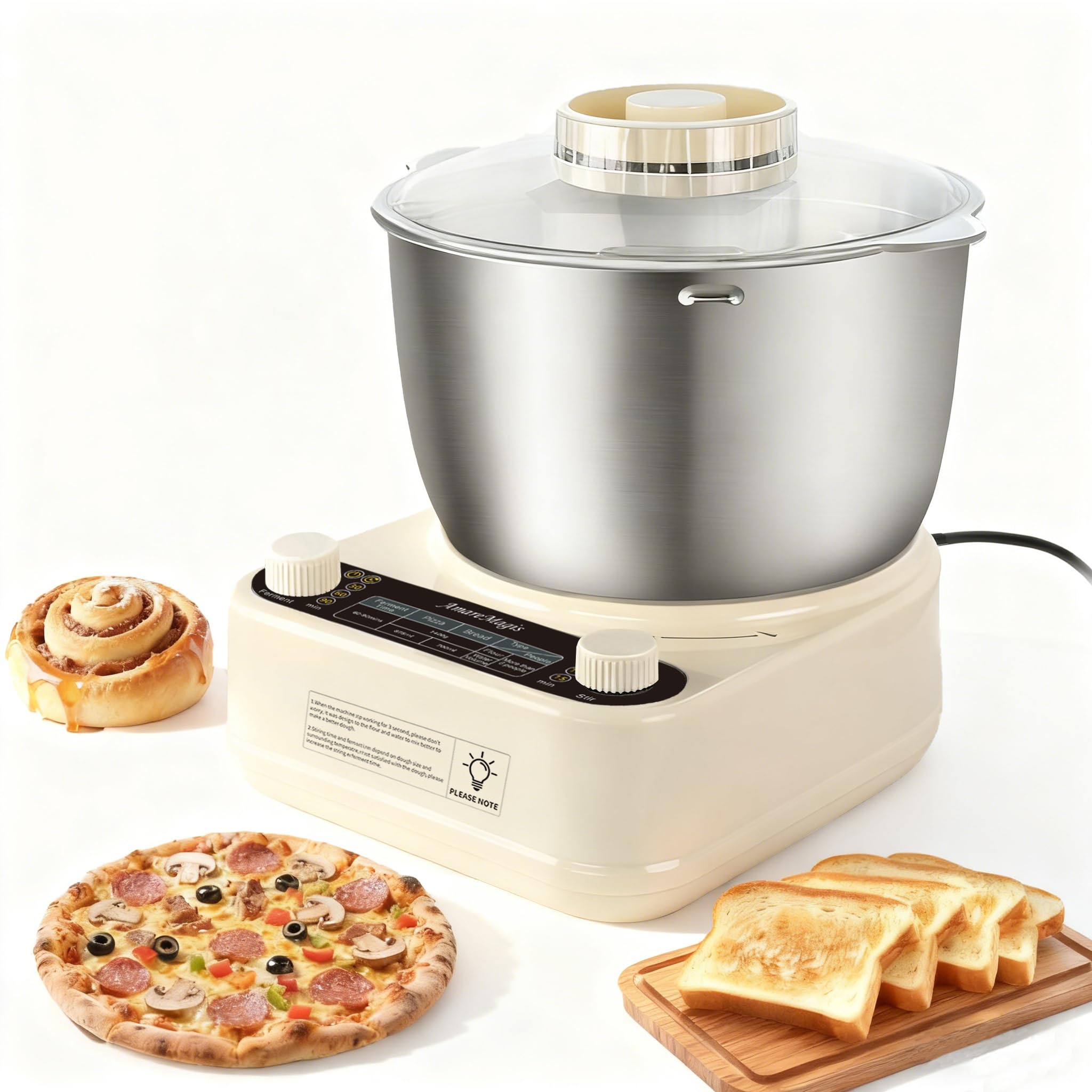
This dough kneader from AmareMagis is purpose-built for gluten development, not general mixing. The 5.3-quart 304 stainless steel bowl can handle up to 1.4 kg of dough, and the high-torque, low-speed motor kneads quietly and steadily. Unlike traditional stand mixers that whip air into dough, this machine uses a dedicated kneading action that builds gluten strands efficiently for pizza, bread, and pasta dough.
The built-in fermentation function heats the dough to 100°F (38°C), reducing rising time by up to 50% compared to room-temperature proofing. The timer lets you set mix and ferment cycles independently, so you can walk away and come back to fully proofed dough. The beige color and compact dimensions (12.6 x 11.4 x 11.8 inches) fit neatly on most countertops.
Some users report that the knob controls feel less intuitive than push-button interfaces, and the machine lacks a mixing attachment for creaming or whipping tasks. A small number of customers found that the beater simply spins the dough in a circle rather than kneading it effectively, which may indicate variation between units or improper dough hydration levels.
Why it’s great
- Dedicated kneading action develops gluten better than stand mixers.
- Fermentation heater speeds proofing by up to 50%.
- Quiet operation with high-torque motor for heavy dough.
Good to know
- Knob controls are less precise than digital buttons.
- Some units may not knead evenly if dough hydration is off.
6. Bear 3.7-Quart Electric Dough Maker

The Bear dough maker is a compact countertop unit with a 3.7-quart 304 stainless steel bowl, designed for home bakers who make one or two pizzas at a time. The 120-watt motor drives a three-dimensional mixing blade that increases the kneading area, producing pliable dough in 15 minutes by default. The control panel offers mix and ferment functions with adjustable timers — mix up to 40 minutes, ferment up to 120 minutes.
Constant-temperature fermentation keeps the dough between 77°F and 100°F, ensuring consistent proofing regardless of ambient kitchen temperature. The conical top cover distributes stress evenly during mixing, and the snap-fit lid prevents overflow. Suction cup feet at the base reduce vibration and noise, making this one of the quieter units in its class.
Some users find that dough sticks to the bowl during mixing; applying a thin layer of olive oil to the bowl and paddle resolves this. The instructions are minimal, so beginners may need to watch online videos for proper technique. The smaller capacity means you cannot mix dough for more than two loaves or two large pizzas in one batch.
Why it’s great
- Compact footprint fits easily on small countertops.
- Whisper-quiet suction feet keep operation stable and low-noise.
- Constant-temperature fermentation works reliably in cool kitchens.
Good to know
- Dough can stick to the bowl without an oil coating.
- Instruction manual is sparse — better suited for experienced bakers.
7. PIAOCAIYIN Manual Pizza Dough Press
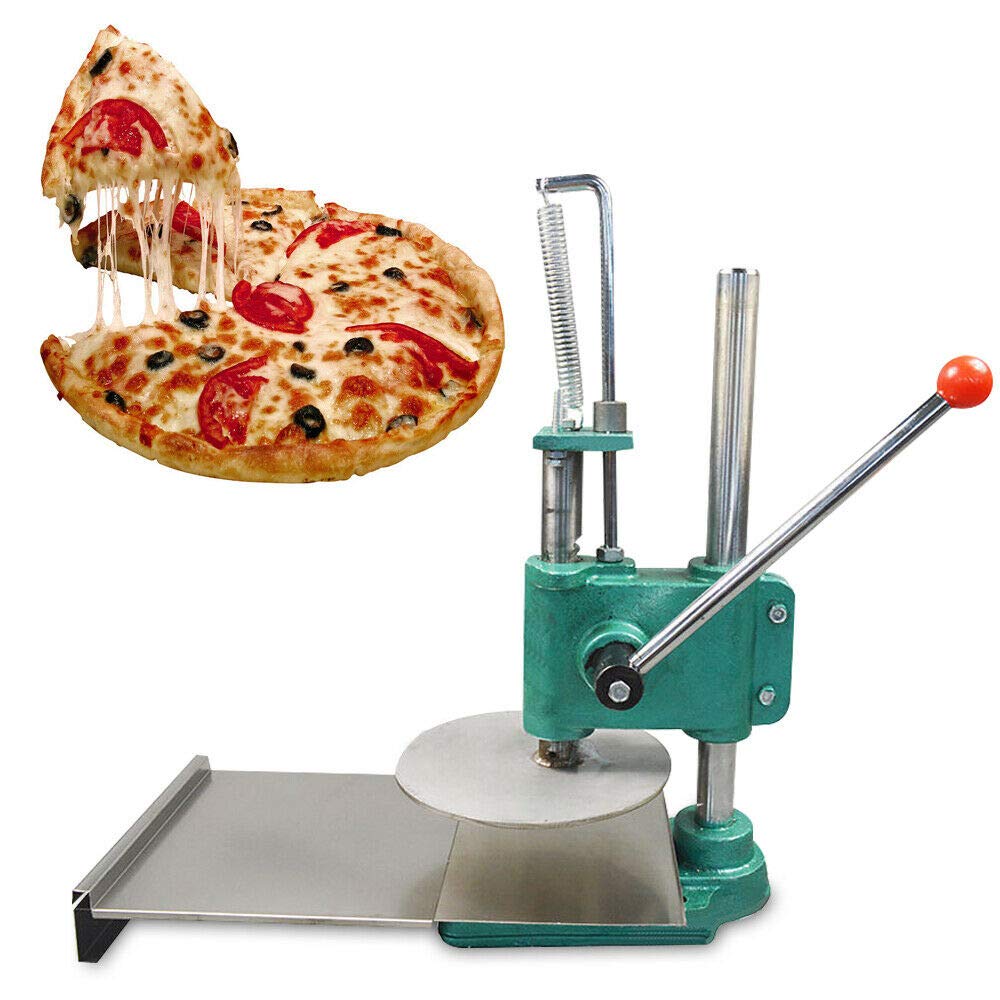
This manual press from PIAOCAIYIN offers a stainless steel platen, support plate, and pull plate at an entry-level price point. The 9.5-inch diameter round platen is manually operated via a handle that pulls the plate down onto the dough ball, producing a 5 mm thick disc. The three-piece design separates for easy cleaning — just wipe the stainless steel surfaces with a damp rag.
The machine is small enough to store in a cabinet when not in use, and it works for more than just pizza: puff pastry, pie crusts, chapati, roasted meat slices, and dumpling wrappers are all within scope. Some users report that it makes thin pasta sheets faster than a KitchenAid attachment, which is a nice bonus for multi-purpose use.
Build quality is mixed — several customers report that the press does not flatten dough evenly and that the seller refuses to cover return shipping, making returns expensive relative to the purchase price. Because the thickness is fixed at 5 mm, you cannot adjust for thinner or thicker crusts, which significantly limits its utility for serious pizza makers.
Why it’s great
- Very affordable entry point for anyone new to dough pressing.
- Compact and easy to store in a standard cabinet.
- Multi-purpose — works for dumplings, pasta, and pastry.
Good to know
- Fixed 5 mm thickness cannot be adjusted for different crust styles.
- Inconsistent flattening and difficult return process reported.
FAQ
Can a pizza dough press handle high-hydration dough without sticking?
What is the difference between a pizza dough press and a pasta sheeter?
How do I clean a manual pizza dough press without damaging it?
Final Thoughts: The Verdict
For most users, the best pizza dough press winner is the VEVOR 9.5-Inch Manual Press because it balances heavy-duty stainless steel construction, a simple lever mechanism, and included parchment paper for zero-mess pressing at a reasonable investment. If you want fully automatic high-volume output for commercial use, grab the VEVOR 14-Inch Automatic Sheeter. And for home bakers who need extra-large 18-inch discs with multi-purpose sheeting capability, nothing beats the DKN E-Pro 18-Inch Roller for its crank-driven versatility.