You turn on the tap, fill a glass, and wonder: what exactly is swimming in this water? For millions of households, PFAS—per- and polyfluoroalkyl substances, often called “forever chemicals”—have become a silent concern that standard fridge pitchers simply cannot handle. A real PFAS water filter is the only line of defense that removes these stubborn compounds, and the technical landscape is more varied than most shoppers realize.
I’m Mohammad Maruf — the founder and writer behind AirfryerBite. Over the past several years, I’ve analyzed dozens of filter systems, from countertop reverse osmosis units to whole-house three-stage setups, comparing NSF certifications, micron ratings, filter longevity, and real-world contaminant removal data to separate marketing claims from measurable results.
While many filters claim broad spectrum protection, only systems independently certified to NSF/ANSI standards for PFAS reduction can guarantee removal of these compounds. I built this guide to help you confidently select a best pfas water filter that matches your home’s setup, budget, and daily consumption needs without getting lost in jargon.
How To Choose The Best PFAS Water Filter
PFAS removal is not a standard feature on every pitcher or faucet mount. The chemistry of these compounds requires either a dense reverse osmosis membrane (0.0001 micron) or a specially formulated carbon block with verified certification. Before you click buy, consider these three decision points.
Certification Over Claims: Look for NSF/ANSI Standard 58 or 53
Many filters claim PFAS reduction using vague language. The only trustworthy proof is independent testing against NSF/ANSI standard 58 (reverse osmosis) or standard 53 (carbon filtration). Systems that list these certifications publicly share their removal percentages and lab results. Skip any product that buries its certification details in fine print or omits them entirely.
Flow Rate, Capacity, and Filter Replacement Rhythm
A countertop RO system like the AquaTru or DREO produces water slowly—roughly one pitcher every 20 to 30 minutes—but delivers the highest rejection of PFAS. Gravity filters such as the Culligan or Purewell are faster but use thicker pores (0.01 to 0.2 microns) and rely on carbon media to adsorb chemicals. Check the rated gallon capacity of each filter: 100-gallon cartridges need quarterly swaps, while 3,000-gallon gravity elements may last six to twelve months depending on your water quality.
Footprint and Installation Requirements
Under-sink RO systems like the Waterdrop D6 require an electrical outlet and a drilled hole for the faucet. Countertop units like the DREO and AquaTru plug into a standard wall outlet and sit next to the sink. Gravity pitchers need no power and fit on countertops but take up vertical space (some stand over 20 inches tall). If you rent or prefer a non-permanent setup, countertop reverse osmosis is your most effective certifiable option.
Quick Comparison
On smaller screens, swipe sideways to see the full table.
| Model | Category | Best For | Key Spec | Amazon |
|---|---|---|---|---|
| Clearly Filtered Pitcher | Pitcher | Family with counter space | 80 fl oz, NSF Std 42/372 | Amazon |
| Purewell Gravity System | Gravity | Off-grid or well water | 2.25 gal, 0.01 micron UF | Amazon |
| DREO Countertop RO | RO | Small households | 3L tank, SGS tested RO | Amazon |
| Culligan MaxClear Gravity | Gravity | Berkey-compatible users | 2.25 gal, NSF Std 42 | Amazon |
| iSpring Whole House | Whole House | Whole-home chloramine | 30,000 gal, 3-stage GAC/KDF | Amazon |
| Waterdrop D6 Under-Sink RO | Under-Sink RO | Frequent drinkers | 600 GPD, tankless 6-stage | Amazon |
| AquaTru Carafe RO | Countertop RO | Apartment renters | 64 oz glass, 4-stage RO | Amazon |
In‑Depth Reviews
1. Clearly Filtered Filtered Water Pitcher
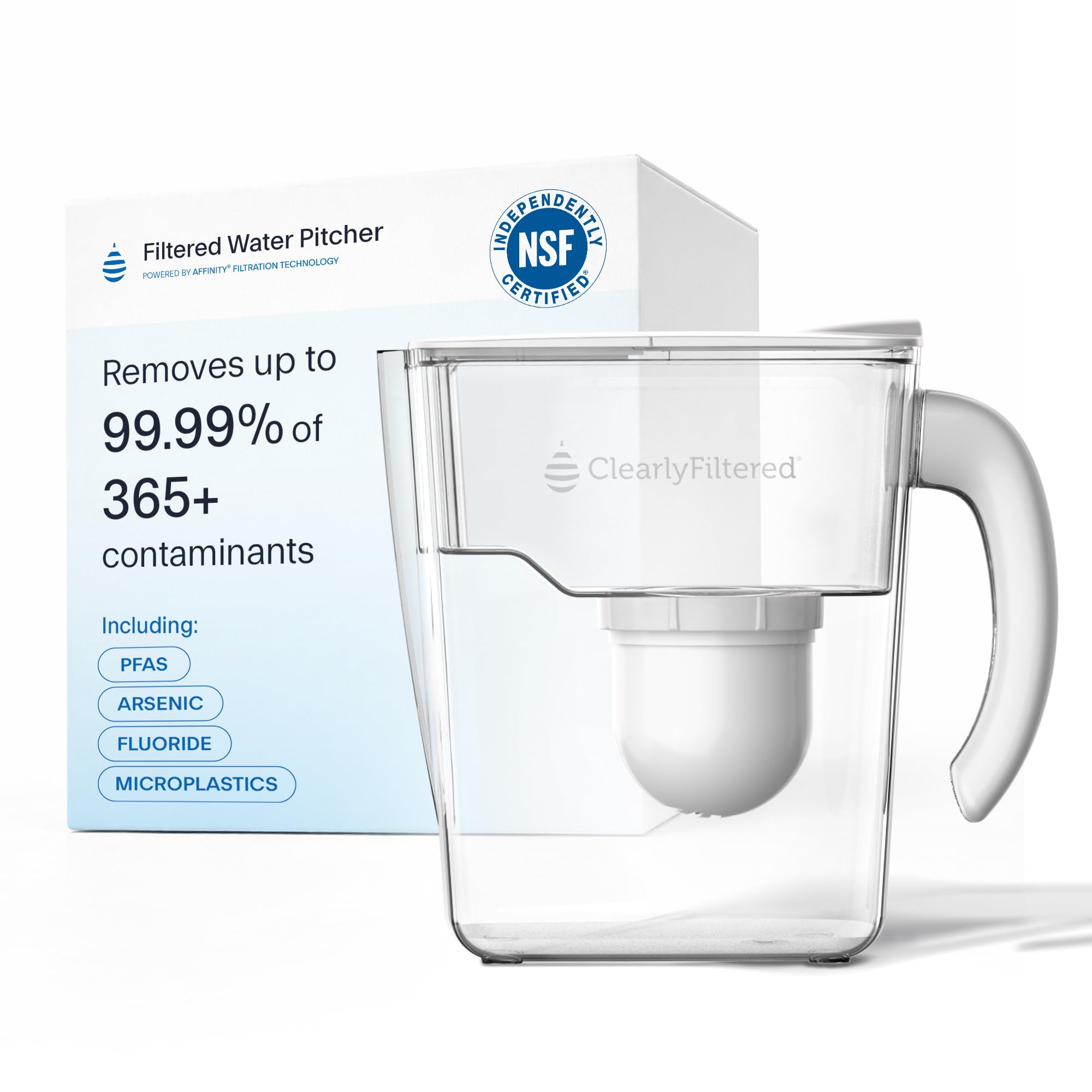
The Clearly Filtered pitcher stands out for its Affinity Filtration Technology, which uses ionic binding to target 365+ contaminants including PFAS, fluoride, lead, and microplastics while retaining beneficial minerals. Its medical-grade Tritan plastic is BPA-free and BPS-free, addressing a common concern about plastic leaching from the container itself. The 80-ounce capacity fits standard refrigerator shelves and includes a redesigned ergonomic handle and spill-resistant dam that make daily use genuinely convenient.
Each filter delivers up to 100 gallons of treated water, roughly four months of normal household use, and replacement filters are simple to source through subscription. Independent third-party testing backs its NSF certification to standards 42 and 372 for chlorine reduction and lead-free materials, with publicly available removal rates for PFAS and other VOCs. Users report dramatically improved taste, removal of municipal chlorine odor, and fluoride readings dropping to non-detectable levels.
The one recurring criticism involves durability: isolated reports mention black microbial growth inside the pitcher after several months, and customer service responses have been inconsistent. Regular cleaning and avoiding extended storage at room temperature helps. For a mid-range investment that balances broad-spectrum protection with easy fridge storage, this pitcher remains the most accessible PFAS-reducing option in its class.
Why it’s great
- Targets 365+ contaminants including PFAS and fluoride
- NSF/ANSI 42 and 372 certified with public lab reports
- Retains healthy minerals while removing pollutants
Good to know
- Plastic pitcher may develop growth if not cleaned frequently
- 100-gallon filter life means quarterly replacement
- Does not reduce TDS like RO systems
2. Purewell 2.25G Gravity Water Filter System

The Purewell gravity system uses a 3-stage composite filter with a 0.01 micron hollow fiber UF membrane, significantly smaller pore size than many gravity competitors that stick to 0.2 microns. This precision captures 99.99% of microscopic particles including sediment, rust, and heavy metals, while the silver ion membrane and activated carbon block handle chlorine and organic matter. The transparent water level window lets you see exactly how much filtrate remains without opening the chamber.
Running entirely on gravity with no electricity required, each set of two filters handles up to 6,000 gallons total (3,000 gallons per element), making the long-term operating cost remarkably low. The stainless steel construction with brushed finish looks intentional on a countertop, and the stand elevates the spigot for easy glass filling. Users on well water report excellent reduction of metallic taste and sediment, and the 4-gallon-per-hour flow rate keeps up with moderate daily demand.
The system does not reduce TDS or specifically target PFAS with independent certification, so its protection against forever chemicals depends on the carbon block’s adsorption capacity rather than a certified membrane. The lower chamber’s actual volume is somewhat reduced by the filter elements, and priming the new filters takes patience. For off-grid households or well water users seeking high-volume particle reduction, this is a solid mid-range gravity pick.
Why it’s great
- 0.01 micron UF membrane blocks 99.99% of particles
- No electricity needed, works off-grid
- 6,000-gallon total filter life reduces long-term cost
Good to know
- Not independently certified for PFAS removal
- Actual water volume less than rated 2.25 gallons
- Filter priming process takes time
3. DREO Reverse Osmosis Water Filter Countertop
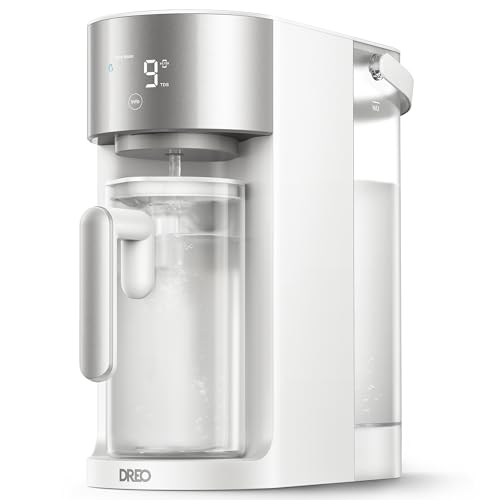
The DREO countertop RO system brings true reverse osmosis to a slim 14.5-inch footprint with no plumbing required, a major convenience for renters or anyone avoiding under-sink modification. Its 7-in-1 filtration is tested by SGS against NSF/ANSI 58 standards and removes up to 99.99% of over 1,000 impurities including PFOA, PFOS, chlorine, and fluoride. The auto-fill pitcher sensor triggers hands-free refills, and the self-cleaning system flushes internal tubes to maintain water quality between uses.
Real-time TDS monitoring displays raw and pure water TDS side by side on the front panel, a feature that RO enthusiasts appreciate for verifying performance. The 3:1 pure-to-drain ratio is notably efficient for a countertop RO, reducing wastewater compared to older units. Each filter lasts between 6 and 12 months, costing roughly a couple of cents per bottle equivalent. Users report TDS dropping from 375–450 ppm to 12–22 ppm, with water feeling noticeably softer and cleaner.
The filter rate is slow—expect to wait while the 1.1-liter pitcher fills—and the unit requires periodic backflush cycles that dump the reservoir. The 3-liter tank plus small pitcher works best for one to two people; larger families may find themselves waiting for refills. For a no-install, certifiable PFAS solution that fits tight counters, the DREO delivers measurable reduction backed by SGS testing.
Why it’s great
- SGS tested meeting NSF/ANSI 58 for PFAS removal
- Auto-fill pitcher and self-cleaning flush system
- Real-time TDS monitoring for performance verification
Good to know
- Slow filtration rate, best for 1–2 person households
- Requires periodic backflush that uses water
- Petite tank may need frequent refills for heavy users
4. Culligan MaxClear 2.25 Gallon Gravity Water Filter System
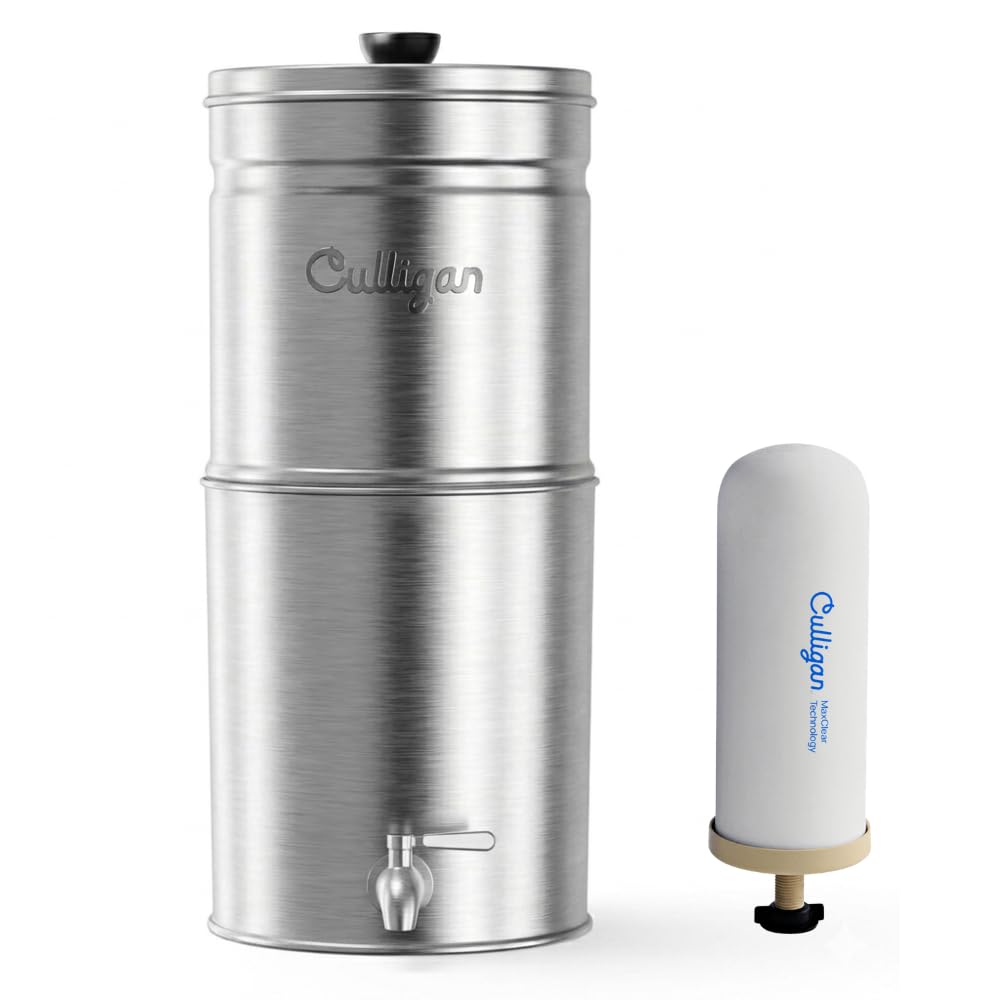
Culligan’s MaxClear gravity system is the only filter in this roundup certified to NSF/ANSI 42 for reducing microplastics, lead, and total PFAS while retaining essential minerals like calcium and magnesium. The key differentiator is its compatibility with Berkey and other standard gravity filter elements—you can swap in Berkey Black filters, Boroux, ProOne, or Purewell replacements if you prefer a different media blend. This flexibility makes it a future-proof platform rather than a locked ecosystem.
The brushed stainless steel body stands 26 inches tall with a 2.25-gallon capacity that serves up to three people per day. No electricity or plumbing is required, and the unit nests down to under 12 inches for storage. The included ceramic and carbon filter features a high-grade ceramic outer shell with a proprietary granular carbon core designed to tackle PFAS and lead without stripping beneficial minerals. Users transitioning from bottled water report significant taste improvement and crystal-clear water.
Some users have flagged that TDS actually rises after filtration, which is normal for ceramic systems that do not remove dissolved solids. One reviewer measured an increase from 151 to 267 ppm and raised concerns about verifying PFAS reduction without third-party lab testing. The initial chalky taste during break-in requires cycling more water than the manual recommends. For buyers who want a certifiable gravity platform with filter interchangeability, the Culligan MaxClear is a premium mid-range choice.
Why it’s great
- Certified to NSF/ANSI 42 for total PFAS reduction
- Compatible with Berkey, Boroux, ProOne filters
- Stainless steel body with compact storage
Good to know
- TDS rises after filtration, normal for ceramic systems
- Initial chalky taste requires extended priming
- Vertical footprint may be too tall for low cabinets
5. iSpring Whole House Water Filter System

The iSpring WCB32C-KS is a 3-stage whole-house system that treats water at every tap, shower, and appliance. Its second-stage GAC (granular activated carbon) and KDF composite filter targets a broad range of contaminants including chlorine, PFAS, lead, radon, chloramine, and hydrogen sulfide. The first stage uses a 5-micron PP sediment filter to protect the downstream elements, and the third-stage CTO (chlorine, taste, odor) block polishes residual impurities for clearer water throughout the home.
Rated for 30,000 gallons with filters lasting approximately six months for a family of four, this system handles high flow rates up to 12 gallons per minute without noticeable pressure drop. The transparent first-stage housing lets you visually inspect sediment buildup so you can replace it before it clogs the more expensive carbon stages. Installation is wall-mountable with 3/4-inch inlet and outlet ports, and iSpring provides detailed video guides plus lifetime technical support from a US-based team.
This system does not reduce TDS, so if your primary goal is PFAS removal at the drinking tap, you will want a dedicated RO unit downstream. Some users report initial leaks at the top screw that required re-torquing or thread sealant, though iSpring’s customer support is widely praised for quick replacements. For homeowners who want baseline PFAS and chloramine reduction across the entire house, this is the most cost-effective entry point in the whole-house category.
Why it’s great
- 30,000-gallon capacity for family of four
- GAC/KDF composite reduces PFAS, chlorine, lead
- 12 GPM flow rate with minimal pressure drop
Good to know
- Does not remove TDS, best paired with RO at sink
- Installation may require thread sealant to prevent leaks
- Filter housing must be mounted vertically to function
6. Waterdrop D6 Reverse Osmosis Water Filter
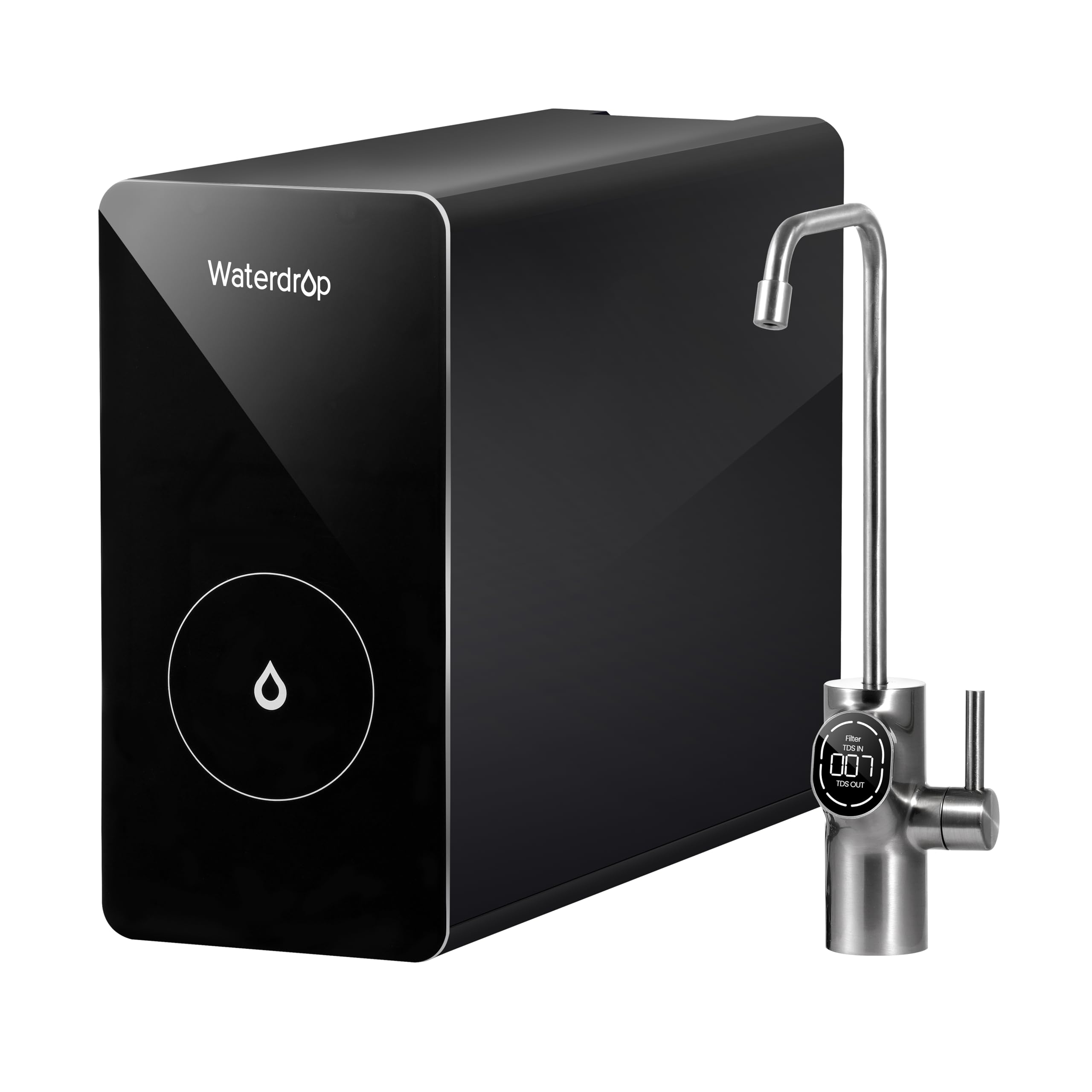
The Waterdrop D6 is a tankless 6-stage reverse osmosis system delivering 600 gallons per day, filling a cup in about eight seconds. Its compact footprint saves roughly 70 percent of under-sink space compared to traditional RO setups with storage tanks, and the composite filter cartridge combines all stages into a single twist-in replacement that takes two seconds. The smart designer faucet includes a waterproof LED screen showing real-time TDS and remaining filter life.
With a 2:1 pure-to-drain ratio, this system produces two cups of clean water for every one cup of wastewater, significantly more efficient than older RO units that dumped 3–4 cups of waste per cup of product. The 0.0001-micron reverse osmosis membrane reduces PFAS, chlorine, microplastics, salt, and radioactive substances, though Waterdrop does not publish specific NSF certification for PFAS reduction. The internal pump maintains consistent pressure even in homes with lower incoming water pressure.
Installation requires an electrical outlet and drilling a hole for the faucet, which may be challenging for renters or granite countertops. Some users note a humming noise during operation that can be dampened with a foam pad. TDS drops from around 400 ppm to roughly 25 ppm, delivering water that multiple reviewers describe as comparable to Icelandic spring water. For households that drink a lot of water and want tankless under-sink convenience with high throughput, the D6 is a balanced premium choice.
Why it’s great
- 600 GPD tankless design with 8-second cup fill
- 2:1 drain ratio reduces wastewater significantly
- Smart faucet shows TDS and filter life in real time
Good to know
- Requires electrical outlet and faucet hole drilling
- Makes faint humming noise during operation
- No publicly listed NSF certification for PFAS
7. AquaTru Carafe Countertop Water Purifier
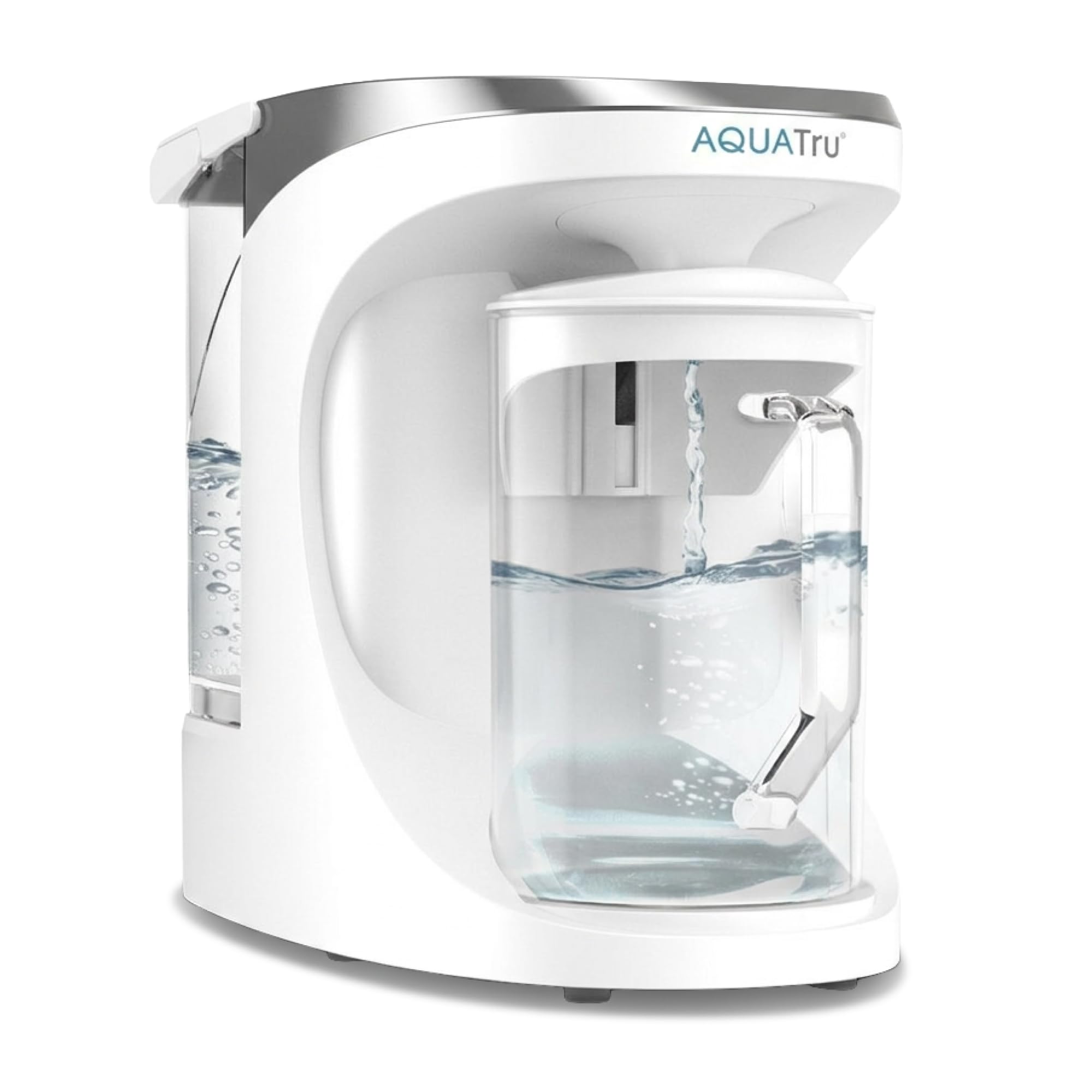
The AquaTru Carafe is certified by IAPMO to NSF standards (including 58) for reducing 84 contaminants including PFAS forever chemicals, lead, fluoride, and chlorine. Its 4-stage reverse osmosis system packs into a countertop footprint about the size of a mid-range coffee maker, requiring no plumbing or drilling—just plug it into a standard outlet. The borosilicate glass carafe avoids the plastic leaching concerns that affect many countertop RO units, and each filter set replaces up to 4,500 plastic bottles over its lifespan.
The system uses a patented recirculation design that cycles water through the RO membrane multiple times to maximize contaminant removal without a storage tank. The glass carafe holds 64 ounces, and the input tank on the back holds enough raw water for roughly 1.5 carafe cycles. Users report the water tastes dramatically cleaner, with chlorine odor completely eliminated and TDS dropping to near zero. Filters are easy to replace with a simple twist mechanism and last six months under average use.
The input tank is relatively small, requiring frequent refilling for households drinking more than two carafes daily, and the filtration cycle produces wastewater that must be dumped manually. Some users have reported early RO membrane failure and inconsistent customer support responses. At the higher end of the budget spectrum, the AquaTru Carafe delivers certifiable PFAS removal with the cleanest materials—glass storage and food-grade plastic in the housing—making it the top recommendation for buyers prioritizing material safety and certified performance.
Why it’s great
- Certified by IAPMO to NSF 58 for PFAS reduction
- Borosilicate glass carafe avoids plastic leaching
- No plumbing, compact coffee-maker footprint
Good to know
- Small input tank requires frequent refilling
- Produces wastewater that must be dumped manually
- Some reports of premature RO membrane failure
FAQ
Do all NSF-certified filters remove the same amount of PFAS?
Can a gravity water filter remove PFAS without electricity?
How often should I replace a PFAS filter cartridge?
Does a PFAS water filter also remove fluoride and lead?
Final Thoughts: The Verdict
For most users, the best pfas water filter winner is the Clearly Filtered pitcher because it combines NSF-certified removal of 365+ contaminants including PFAS with a simple countertop footprint and no installation cost. If you want certified reverse osmosis with zero plumbing, grab the AquaTru Carafe. And for whole-house reduction that protects every tap and appliance, nothing beats the iSpring whole-house system for coverage volume and value.