A petty knife is the missing link between a bulky chef’s knife and a tiny paring knife. It handles the tasks that neither can do well—slicing a single tomato, trimming chicken breasts, cutting cheese, or mincing a shallot. Unlike a chef’s knife, a petty knife gives you nimble control; unlike a paring knife, it has enough blade length for real work. The problem is that most options on the market are either too flimsy, too dull, or too poorly balanced to be useful.
I’m Mohammad Maruf — the founder and writer behind AirfryerBite. I’ve spent years analyzing kitchen knife construction, steel grades, handle ergonomics, and edge retention to separate the real performers from the shelf fillers.
Whether you are upgrading from a cheap supermarket set or looking for your first dedicated utility blade, finding the best petty knife means understanding blade steel, handle materials, and the specific geometry that makes a small knife actually enjoyable to use instead of frustrating.
How To Choose The Best Petty Knife
A petty knife is defined by its blade length, steel composition, handle ergonomics, and construction method. Ignore any of these and you risk buying a knife that either dulls fast, feels awkward, or lacks the reach for simple prep tasks. Here is what actually matters.
Blade Length: The 4-to-6-Inch Sweet Spot
True petty knives measure between 4 and 6 inches. Anything shorter and you are holding a paring knife, which lacks the blade surface for slicing. Anything longer and you drift into chef’s knife territory, losing the nimble control that makes this category useful. A 5-inch blade is the most versatile length, giving you enough edge to slice a sandwich apple or trim a pork loin without feeling unwieldy.
Steel Type and Hardness
High-carbon stainless steel is the standard for petty knives because it balances sharpness, edge retention, and stain resistance. Look for a Rockwell hardness (HRC) rating between 58 and 62. Below 58 HRC, the blade will require frequent honing. Above 62 HRC, the blade becomes brittle and harder to sharpen at home. VG-10, 10Cr15CoMoV, and German 1.4116 are reliable steels commonly found in this category.
Handle Material and Ergonomics
The handle determines how the knife feels during extended use. Rosewood, pakkawood, olive wood, and G10 fiberglass all offer good grip and moisture resistance. Avoid slippery synthetic handles that become dangerous when wet. The handle should also have a full tang—the steel extends through the handle—for proper balance and durability. A well-balanced petty knife should feel neutral in your hand, not blade-heavy or handle-heavy.
Quick Comparison
On smaller screens, swipe sideways to see the full table.
| Model | Category | Best For | Key Spec | Amazon |
|---|---|---|---|---|
| TIVOLI Damascus 5″ | Premium | Precision slicing with Damascus aesthetics | VG10 steel core, 60-62 HRC | Amazon |
| WÜSTHOF Classic 4″ | Premium | German engineering in a compact form | Forged high-carbon stainless, 58 HRC | Amazon |
| HOSHANHO 6″ | Premium | Extended reach for slicing and mincing | 10Cr15CoMoV core, 60 HRC | Amazon |
| Milk Street Kitchin-kiji 3.5″ | Mid-Range | Compact utility with knuckle clearance | German 1.4116 steel, forged | Amazon |
| SHAN ZU Damascus 3.7″ | Mid-Range | Damascus pattern with high hardness | 10Cr15CoMoV core, 62 HRC | Amazon |
| WÜSTHOF Gourmet 4″ | Budget | Reliable stamped blade at entry-level price | Stamped high-carbon stainless, 4″ | Amazon |
| Huusk Japanese 5.5″ | Budget | Budget-friendly carbon steel with rosewood | High-carbon steel, 5.5″ blade | Amazon |
In‑Depth Reviews
1. TIVOLI Damascus Kitchen Utility Knife – 5 Inch
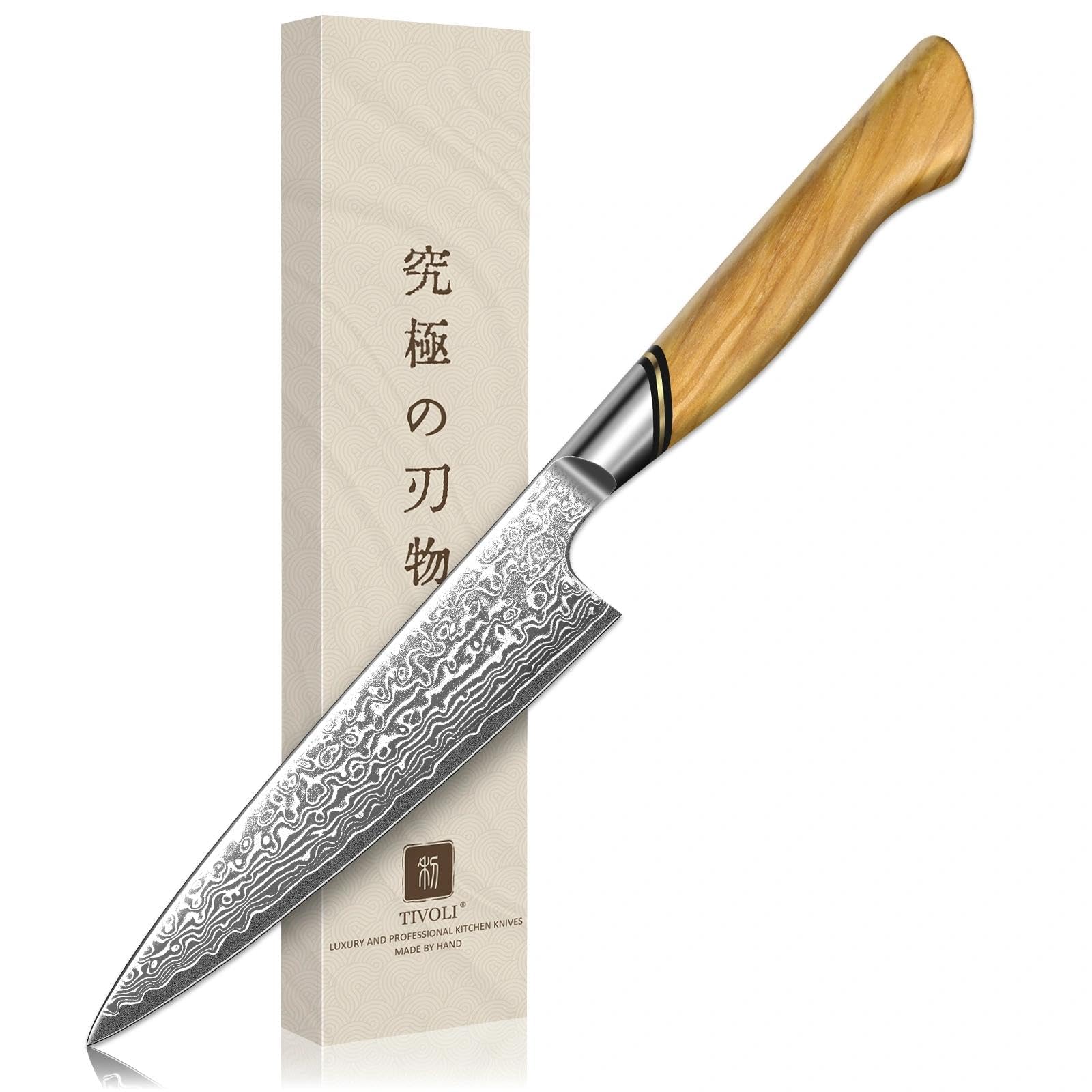
The TIVOLI Damascus petty knife hits every note a serious home cook wants. Its VG10 steel core, hand-sharpened to a 15-degree edge, delivers a Rockwell hardness of 60 to 62 HRC. That means the blade stays sharp through weeks of daily prep without needing a steel between uses. The 5-inch length is the sweet spot for petty knife work—long enough to slice a bell pepper cleanly, short enough to peel garlic with precision.
The olive wood handle is a standout feature. It is ergonomically shaped with a sloped bolster that encourages a proper pinch grip, and the natural wood provides a warm, secure hold even with wet hands. The Damascus cladding layers are real, not laser-etched, giving the blade both visual depth and practical corrosion resistance. This knife arrives in a premium gift box, but it is built for serious use, not display.
Customer feedback consistently praises the out-of-box sharpness and the balanced weight distribution. Users report that the blade glides through dense vegetables and raw meat with noticeably less effort than stamped alternatives. The only caveat is that olive wood requires occasional oiling to maintain its appearance, and the knife must be hand-washed. For the combination of steel quality, handle craftsmanship, and cutting geometry, this is the most complete petty knife on the market.
Why it’s great
- Genuine VG10 Damascus steel with high edge retention
- Olive wood handle with excellent ergonomics and pinch-grip bolster
Good to know
- Hand wash only; olive wood needs occasional conditioning
- Blade is very sharp—requires careful handling during storage
2. WÜSTHOF Classic 4″ Paring Knife

The WÜSTHOF Classic is a benchmark in German knife making. Forged from a single block of high-carbon stainless steel and tempered to 58 HRC, the 4-inch blade benefits from WÜSTHOF’s Precision Edge Technology, which is 20 percent sharper than previous generations and holds its edge twice as long. This is a precision-oriented petty knife designed for cooks who value predictability and durability over flashy aesthetics.
The full-tang handle is triple-riveted with synthetic polypropylene, which resists fading, impact, and heat—a practical choice for busy kitchens where tools take abuse. At 4 inches, the blade is best suited for detail work: hulling strawberries, peeling apples, deveining shrimp. The balance point is exactly where the handle meets the blade, giving you direct control for small cuts. Users consistently note that the knife arrives laser-sharp and requires only occasional honing to maintain performance.
The Classic line is the middle tier in WÜSTHOF’s range, but it is the one most professional cooks choose for daily use. The blade geometry is thinner than the forged Gourmet series, making it more agile for precise tasks. Some owners wish the handle offered more texture for grip when wet, and the price is higher than stamped alternatives, but the lifetime warranty and Solingen heritage justify the investment for serious knife users.
Why it’s great
- Precision Edge Technology for sharper, longer-lasting edge
- Durable polypropylene handle with full tang and triple rivets
Good to know
- At 4 inches, better for fine detail work than larger slicing tasks
- Handle can become slippery when greasy or wet
3. HOSHANHO 6 Inch Kitchen Knife

The HOSHANHO 6-inch petty knife pushes the boundary of the category toward a small chef’s knife. Its core is Japanese 10Cr15CoMoV steel, a high-carbon alloy that takes a very sharp edge and holds it at 60 HRC. The blade is hand-sharpened to 15 degrees per side, creating a cutting profile that slices through squash, potatoes, and raw chicken with minimal resistance. The 6-inch length makes it more versatile for larger produce than shorter petty knives.
The handle is pakkawood, a resin-stabilized hardwood that resists heat, cold, and moisture better than natural wood. It is integrated with the blade tang in a seamless design, creating a smooth ridge for a comfortable pinch grip. The blade has a frosted finish that reduces drag during slicing, and the overall weight is light enough for extended prep sessions without wrist fatigue. Owners with small to medium hands particularly appreciate the balance and grip comfort.
Customer reviews highlight the razor-sharp out-of-box edge and the knife’s ability to handle both precision tasks and general chopping. Some users note that the handle feels slightly short for larger hands, and the blade is extremely sharp—several reviews mention accidental cuts. If you want a petty knife that can double as a mini chef’s knife for smaller kitchens, this is a strong candidate. It requires hand washing and drying immediately to maintain the pakkawood handle.
Why it’s great
- 6-inch blade offers more reach for slicing and chopping tasks
- Pakkawood handle is durable, moisture-resistant, and comfortable
Good to know
- Handle may feel short for cooks with larger hands
- Extremely sharp edge requires careful storage and handling
4. Milk Street Kitchin-kiji Knife, 3.5 Inch

Christopher Kimball’s Milk Street team designed the Kitchin-kiji with a specific problem in mind: knuckles hitting the cutting board on small knives. The handle angles away from the blade, providing genuine knuckle clearance that most paring knives lack. The 3.5-inch Wharncliffe-style blade has a straight cutting edge that meets the board flat, giving you maximum control for tasks like tomato coring, strawberry hulling, and potato eye removal.
The steel is German 1.4116, a resilient stainless alloy that resists corrosion and takes a sharp edge easily. It is not as hard as VG10 or super-steels, but it is easier to sharpen at home and less prone to chipping. The full-flat grind creates a thin edge geometry that slices cleanly without wedging. The handle is a matte polymer with subtle texturing that improves grip when wet, and the balance is neutral—neither blade-heavy nor handle-heavy.
Professional cooks and home users alike praise the comfortable handle shape and the nimble feel of the blade. The wide blade at the heel provides a secure pinch-grip zone, and the pointed tip is precise for detail work. Some users note that the 3.5-inch length is shorter than a traditional petty knife, so it works best as a dedicated small-task tool rather than a general slicer. If knuckle clearance and ergonomic design matter more than raw blade length, this is the best option.
Why it’s great
- Angled handle provides excellent knuckle clearance during use
- Wharncliffe blade offers precise control for detailed tasks
Good to know
- 3.5-inch blade is shorter than standard petty knives
- Not ideal for larger slicing tasks like sandwich prep
5. SHAN ZU Damascus Paring Knife 4 Inch
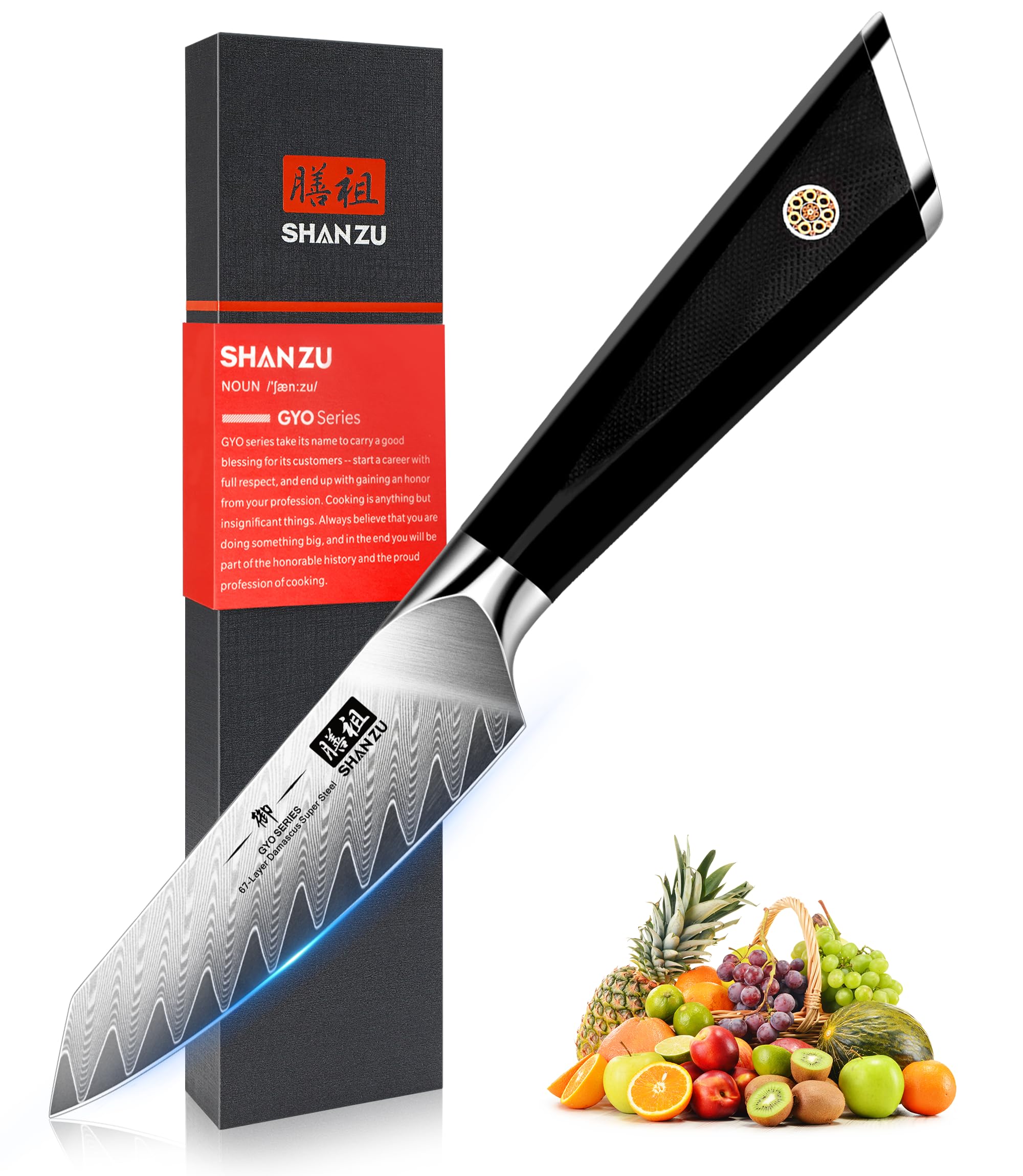
SHAN ZU has built a reputation for offering true Damascus construction at prices that undercut most competitors. The 3.7-inch blade features a core of Japanese 10Cr15CoMoV steel, clad in 66 layers of carbon steel on each side, with a hardness rating of 62 HRC. That is notably hard for a petty knife, which means the blade stays sharp for very long periods between sharpenings. The 15-degree V-shaped edge on both sides slices through fruit skins and vegetable flesh with minimal effort.
The handle is frosted G10 fiberglass, which is stronger and more chemically resistant than wood or standard polymers. It provides a secure grip even with oily hands, and the ergonomic contouring fits naturally into a pinch grip. The blade pattern is genuine Damascus—repeated folding and forging, not laser etching—so the visual depth will not wear off with use. The knife comes in a gift box and includes a 24-month warranty, adding confidence to the purchase.
User reviews consistently mention the impressive sharpness out of the box and the premium feel of the handle. Several users note that the blade is thinner than western-style paring knives, which improves slicing but requires more care to avoid flexing under heavy pressure. The knife is dishwasher-safe according to the specs, but hand washing is strongly recommended to preserve the Damascus pattern and edge geometry.
Why it’s great
- Genuine 67-layer Damascus with hard 62 HRC steel core
- G10 fiberglass handle is durable, grippy, and ergonomic
Good to know
- Thin blade may flex under heavy cutting pressure
- Damascus pattern requires hand washing for longevity
6. WÜSTHOF Gourmet 4″ Utility Knife

The WÜSTHOF Gourmet series is the entry point into German knife quality without the forged price tag. The 4-inch utility blade is laser-cut from high-carbon stainless steel, then precision-honed to a sharp edge. Stamped construction makes the blade thinner and more flexible than forged knives, which helps with tasks like slicing thin citrus wheels or boning small poultry pieces. The synthetic polypropylene handle is impact-resistant and will not discolor over time.
At 4 inches, this knife is best suited for utility work—cutting sandwiches, trimming vegetables, and opening packages. The blade has a noticeable flexibility that some cooks appreciate for delicate cuts, though it lacks the rigidity for heavy chopping. The handle is smooth polypropylene with a full tang, but the surface can get slippery when wet. The Gourmet line lacks the bolsters of the Classic series, so the balance is slightly more blade-forward.
Customer reviews praise the value and the sharpness right out of the box. Some users note that the edge does not hold as long as forged WÜSTHOF knives and requires weekly honing to maintain peak performance. This is normal for a stamped blade at this price tier. If you want the WÜSTHOF pedigree at a lower cost and are comfortable with more frequent edge maintenance, the Gourmet is a solid choice.
Why it’s great
- Stamped blade is thinner and more flexible for precise cuts
- Polypropylene handle resists heat, impact, and fading
Good to know
- Edge retention is moderate; requires weekly honing
- Smooth handle becomes slippery when wet
7. Huusk Japanese Paring Knife 5.5″
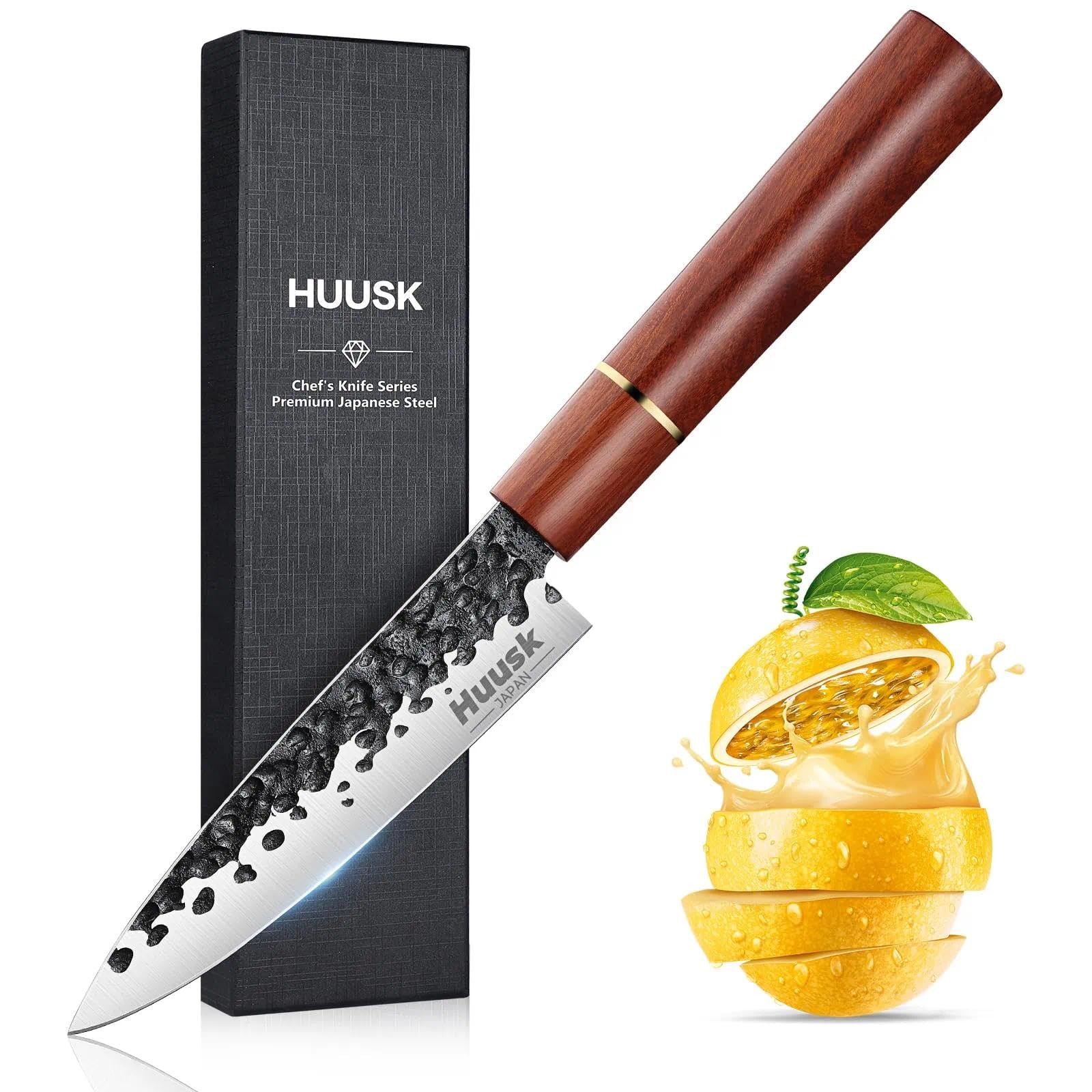
The Huusk petty knife offers a traditional Japanese aesthetic at a budget-friendly price point. The 5.5-inch blade is forged from high-carbon steel, which can take an extremely sharp edge but requires more maintenance than stainless alloys—carbon steel will discolor and rust if not dried immediately after use. The black and silver finish gives it a distinct look that stands out from standard stainless knives.
The rosewood handle is contoured for comfort and provides a warm, secure grip. It is lighter than full-tang western handles, which reduces wrist fatigue during longer prep sessions. The blade is plain-edged and ground thin, making it effective for slicing fruits, vegetables, and boneless meats. The knife comes in elegant packaging, making it a viable gift option for casual cooks who appreciate Japanese knife styling.
Owner reviews highlight the impressive sharpness and the balanced feel of the knife during use. Some users report that the handle-to-blade junction has a slightly rough ring that can irritate during prolonged cutting. The carbon steel blade requires diligent drying and occasional oiling to prevent rust, which may be a dealbreaker for users who prefer low-maintenance tools. For its price, the Huusk delivers solid cutting performance if you are willing to care for the blade.
Why it’s great
- Sharp high-carbon steel blade with traditional Japanese design
- Lightweight rosewood handle reduces fatigue during use
Good to know
- Carbon steel is prone to rust if not dried and oiled regularly
- Handle junction may have a rough edge on some units
FAQ
What length petty knife should I buy as my first one?
Can a petty knife replace both a chef’s knife and a paring knife?
Is a forged petty knife better than a stamped one?
How do I maintain the Damascus pattern on a petty knife?
Final Thoughts: The Verdict
For most users, the best petty knife winner is the TIVOLI Damascus 5 Inch because it combines a genuine VG10 steel core with an ergonomic olive wood handle at a price that undercuts many lesser options. If you want the German precision of a forged Solingen blade, grab the WÜSTHOF Classic 4 Inch. And for a budget-friendly carbon steel option with traditional Japanese character, nothing beats the Huusk Japanese 5.5 Inch.