That moment when you tilt the pot toward the sink and half your spaghetti escapes through oversized holes is a kitchen failure you shouldn’t tolerate. A proper pasta strainer needs tightly spaced perforations, a stable base that won’t tip under a full load, and handles that feel secure even when wet — because the difference between a good drain and a counter-soaking disaster is measured in millimeters.
I’m Mohammad Maruf — the founder and writer behind AirfryerBite. I analyze kitchen hardware through a lens of material thickness, hole density, handle ergonomics, and real-world durability testing patterns, focusing specifically on how pasta strainer designs handle the physical demands of draining hot, heavy starches day after day.
You need a strainer that lets water escape fast, holds pasta without spillage, and stays rust-free through years of sink-side abuse. After evaluating over a dozen wire-mesh and perforated options, this guide zeroes in on the five models that actually deliver on those requirements, sorted by the specs that matter most for this single task.
How To Choose The Best Pasta Strainer
The right strainer balances three variables: hole size that traps pasta while letting water rush out, a rim and handle geometry that doesn’t wobble under a heavy load, and a material that won’t corrode after thousands of hot-water cycles. Here is what to check before clicking add to cart.
Hole Pattern and Spacing
Standard perforated colanders with 3-millimeter holes work for spaghetti and penne but fail for orzo, couscous, and pastina. If you cook small shapes regularly, look for a mesh opening of 1.5 millimeters or smaller — that threshold catches nearly every shape while still draining fast. The trade-off is that finer mesh takes slightly longer to rinse clean, but a quick spray of water clears it instantly.
Material Grade and Thickness
Not all stainless steel is equal. 18/8 (304) stainless steel contains 18 percent chromium and 8 percent nickel, giving it strong corrosion resistance and a bright finish that holds up for years. Cheaper 18/0 grades lack nickel and may show rust spots in the seams over time. Thinner gauges (0.3 millimeters or below) can dent when you accidentally drop a heavy saucepan into the strainer — aim for a wall thickness around 0.5 millimeters if the manufacturer lists it.
Base Stability and Handle Attachment
A strainer that wobbles when you pour hot pasta water is dangerous. Look for an elevated ring base with a wide footprint — at least 80 percent of the basket diameter — to sink into the drain basin without tipping. Handles should be riveted through the basket wall rather than spot-welded; riveted handles can handle 30-plus pounds of pull force without shearing off, while welded handles often snap after a few years of twisting and lifting.
Nesting and Storage
Single large colanders dominate counter space, so many kitchens benefit from a nesting set of three or more sizes. A 1.5-quart mini strainer handles berries and rice rinsing, a 3-quart works for small pasta batches, and a 5-quart drains a full pound of spaghetti. Nesting sets stack into the same cabinet footprint as one colander, which matters if your drawer depth tops out at 6 inches.
Quick Comparison
On smaller screens, swipe sideways to see the full table.
| Model | Category | Best For | Key Spec | Amazon |
|---|---|---|---|---|
| Tiawudi 5-Pack | Nesting Set | Multiple sizes in one purchase | 1.5 mm mesh openings | Amazon |
| KitchenAid 5 Quart | Perforated | Small hole retention | 304 stainless steel | Amazon |
| EWFEN 3-Piece Set | Nesting Set | Fast drainage with tiny holes | 1.5 mm mesh, elevated feet | Amazon |
| OXO 3-Piece Strainer Set | Mesh Strainer | Straining citrus and fine grains | Wide plastic rim for stability | Amazon |
| Paoli 3.5QT + Bowl | Combo Set | Draining and mixing in one | 18/8 steel with mixing bowl | Amazon |
In‑Depth Reviews
1. Tiawudi 5-Pack Stainless Steel Colander Sieves

This five-piece set covers every straining scenario from rinsing a single cup of blueberries to draining a full pound of linguine. The 1.5-millimeter mesh openings catch orzo, quinoa, and even small seeds that would slide through a standard perforated colander, while the 18/8 stainless steel construction resists rust without any coating that could chip. Each basket has a mirror-finished wide rim that adds rigidity, and the handles are riveted through the framework rather than spot-welded, so they withstand repeated twisting and lifting without loosening.
The nested storage footprint takes up the same cabinet space as one colander — the mini 1.5-quart fits inside the 3-quart, which fits inside the 5-quart, and so on. That makes this set a practical choice for kitchens where drawer real estate is tight. Users consistently report that the handles feel secure even when wet and that the mesh does not warp or stretch after months of dishwasher cycles.
The fine mesh does require a quick rinse under running water to clear trapped food particles — thicker sediment like cooked grits can lodge in the weave. But for the price of a single premium colander, you get five sizes that handle everything from steaming vegetables to sifting flour, making this the most versatile option for a home cook who wants one solution for multiple tasks.
Why it’s great
- Five nested sizes save counter space
- 1.5 mm mesh catches even the smallest pasta shapes
- Riveted handles provide long-term durability
Good to know
- Fine mesh requires thorough rinsing after use
- Baskets are lightweight and can flex under very heavy loads
2. KitchenAid Stainless Steel Colander, 5 Quart, Black

KitchenAid’s single 5-quart colander is a focused tool for the cook who needs one reliable strainer for large batches. Its perforated stainless steel bowl uses smaller holes than most standard colanders — roughly 2 millimeters in diameter — which holds spaghetti and penne securely while draining water quickly. The rubber-coated rim and base add stability on wet countertops and prevent the colander from scratching your sink finish.
The raised feet elevate the basket a quarter-inch above the sink floor, which keeps food out of standing water and promotes faster drainage. At 1.1 pounds, it is light enough to handle with one hand even when full of hot pasta, yet the 304-grade stainless feels dense enough that it won’t dent from normal use. The soft-grip handles are comfortable to hold and provide leverage when you tilt the colander to drain the last drops of water.
Because the holes are perforated rather than woven mesh, cleaning is straightforward — a quick scrub with a brush clears any stuck residue. However, the 2-millimeter holes are still too large for small pasta shapes like ditalini or orzo, so if you frequently cook those, you will want a separate fine-mesh strainer. The black rubber trim also attracts visible mineral deposits in hard-water areas and may require periodic wiping to stay clean.
Why it’s great
- Smaller holes than typical perforated colanders
- Rubber base and rim for stable, non-slip handling
- Light enough for one-handed draining
Good to know
- Holes still too large for tiny pasta shapes
- Black rubber shows hard-water residue over time
3. EWFEN Stainless Steel Colander Set of 3
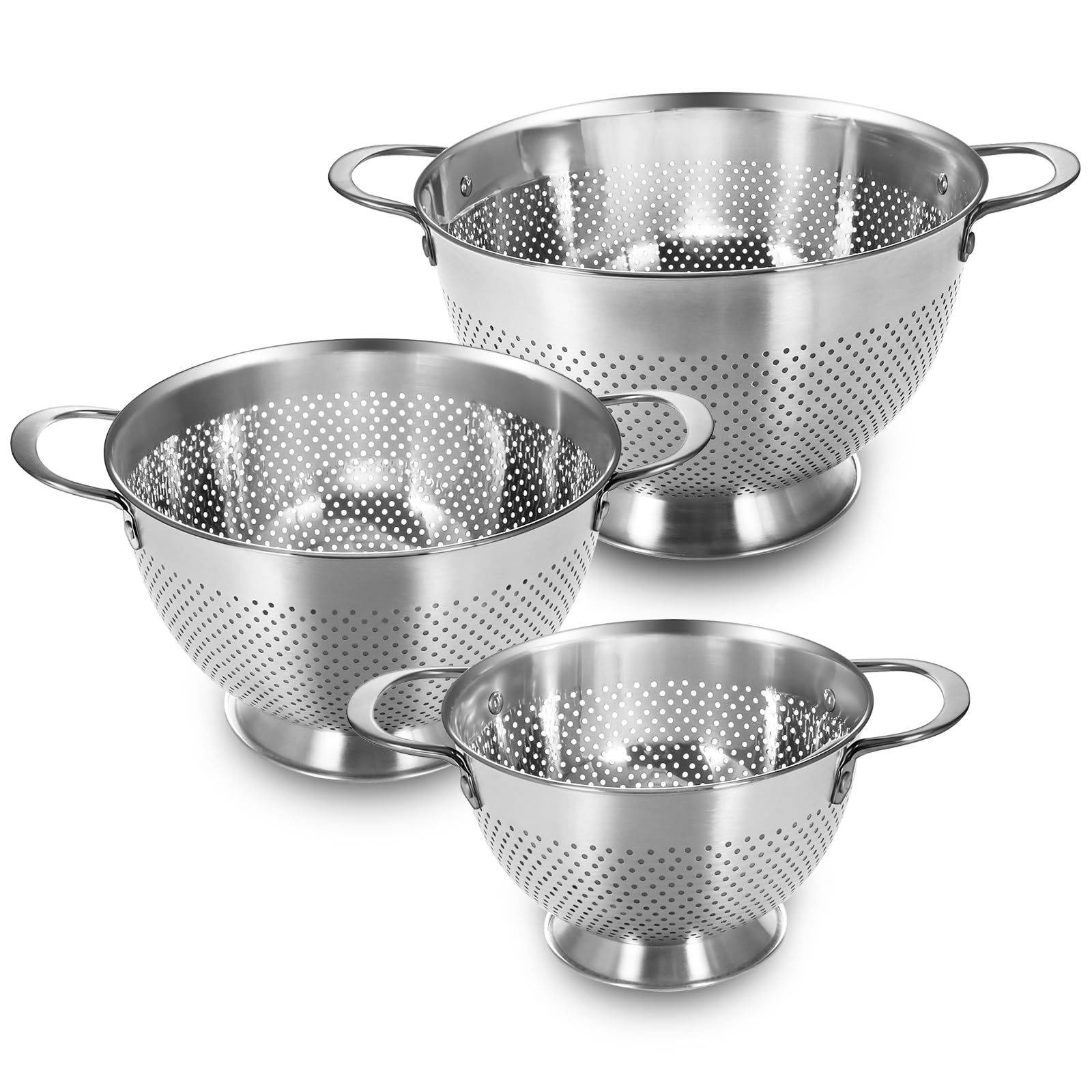
EWFEN’s three-piece set (1.5-quart, 3-quart, and 5-quart) hits the sweet spot between coverage and cabinet efficiency. The mesh construction uses 1.5-millimeter openings that trap rice, quinoa, and small pasta without requiring a separate fine-mesh sieve, and the closely spaced wire weave drains noticeably faster than perforated bowls because water has more escape paths. Each colander features an elevated ring base that lifts the basket above sink water, reducing the risk of cross-contamination from dirty basin surfaces.
The mirror-finished outer rim and base are formed from a single piece of thick wire that resists bending under the weight of a full 5-quart load. Handles are riveted securely to the basket walls, and the wide, rolled edges provide a comfortable grip surface that does not heat up when you strain hot pasta. All three sizes nest together into a stack just over 3 inches tall, freeing up drawer space for other tools.
Some users note that the mesh weave can catch small food particles during rinsing, particularly with starchy foods like rice or lentils. A quick spray from the faucet dislodges most debris, though a soft brush helps for stubborn bits. The 18/8 steel holds up well in the dishwasher, but the polished finish may show water spots if air-dried — a towel wipe prevents that.
Why it’s great
- Fine mesh catches every shape from orzo to spaghetti
- Elevated base keeps food out of sink water
- Three nested sizes fit in a single cabinet slot
Good to know
- Mesh can trap starchy residues that need rinsing
- Polished finish shows water spots without drying
4. OXO Good Grips 3-Piece Strainer Set

OXO’s three-strainer set takes a different approach: the wide plastic rims extend beyond the mesh basket to form a stable ledge that rests securely on bowls, pots, and even measuring cups. This design lets you strain hands-free — set the strainer over a mixing bowl, pour your pasta or rice, and walk away while it drains. The 3-, 6-, and 8-inch diameters cover small jobs like rinsing a handful of berries up to larger tasks like draining a pot of angel hair pasta.
The mesh is food-grade stainless steel with 1.5-millimeter openings, so it catches fine grains and small pasta shapes effectively. The plastic rims are overmolded with a soft-touch material that stays grippy when wet, and the storage holes at the end of each handle let you hang the set on a hook rack. The variety of sizes makes this particularly useful for cooks who frequently strain multiple ingredients during meal prep — one strainer can handle citrus seeds while the other drains blanched vegetables.
The plastic rim, while convenient for balancing on bowls, is less stable on a sink basin than a full metal base — the strainer can tip if you overload it with heavy pasta. The 8-inch size is also too small to drain an entire 5-quart pot in one pour, so you will need to ladle in batches or use a different primary colander for large batches. Cleanup is simple since the stainless mesh rinses clean quickly, but the plastic rim can trap water if you do not shake it dry after washing.
Why it’s great
- Wide plastic rim rests securely on bowls and pots
- Three sizes cover small to medium straining tasks
- Comfortable non-slip handle grip
Good to know
- 8-inch size is too small for full-pot draining
- Plastic rim less stable on sink basins than metal bases
5. Paoli 3.5QT Colander with Mixing Bowl
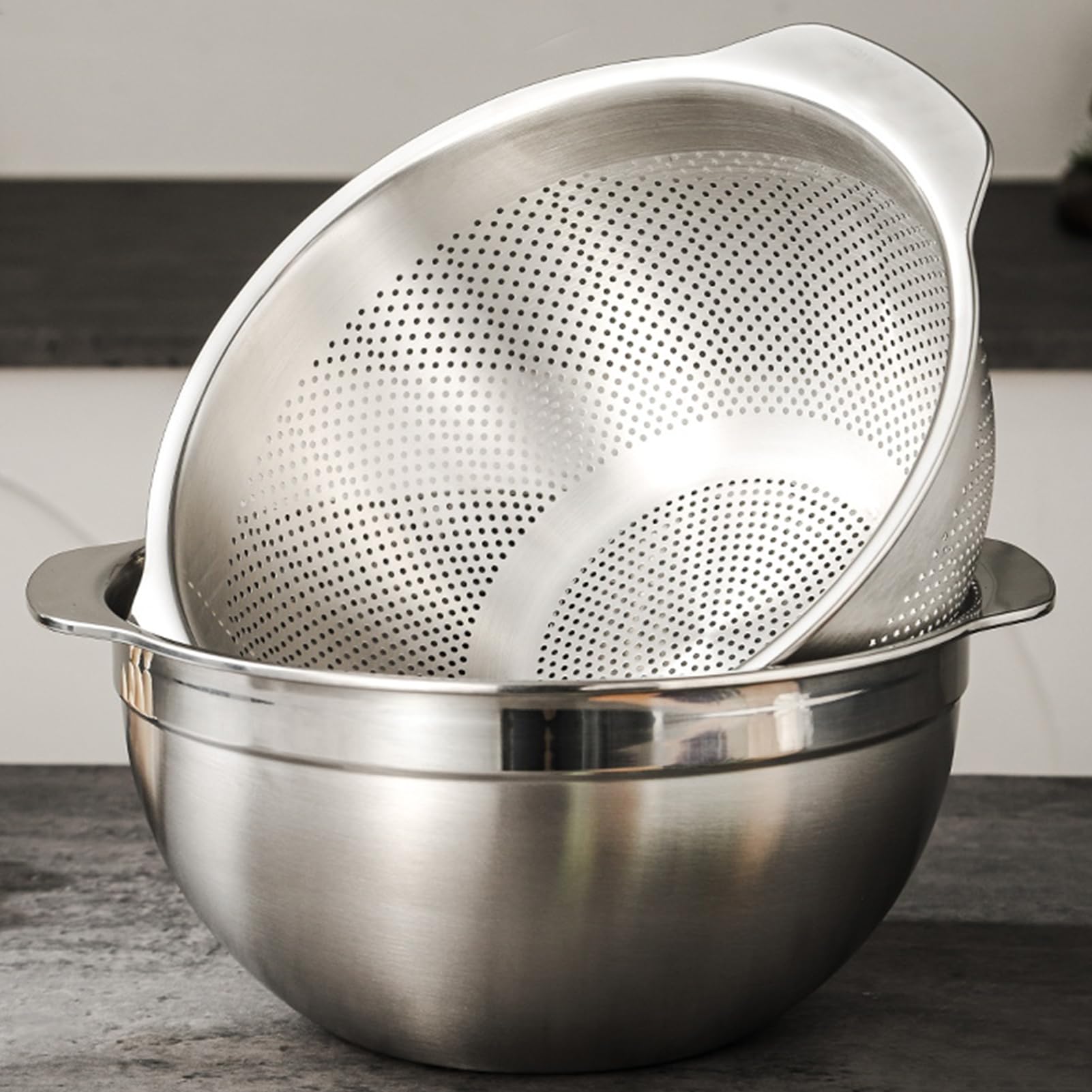
Paoli pairs a 3.5-quart colander with a matching stainless mixing bowl, creating a two-in-one system that moves seamlessly from draining to tossing. The colander uses perforated holes — approximately 3 millimeters in diameter — that work well for standard spaghetti, penne, and rigatoni but let small shapes like ditalini slip through. The deep bowl shape helps prevent spills during transport from sink to counter, and the single sturdy handle provides a solid grip for lifting and pouring.
The 18/8 steel body has a smooth, polished exterior that resists fingerprints and rinses clean without scrubbing. The mixing bowl nests inside the colander for compact storage, and both pieces are dishwasher safe. At 0.88 pounds, the colander is the lightest on this list, making it easy to handle even with arthritic hands or reduced grip strength. The base features a solid ring that keeps the colander stable on flat surfaces, though it lacks the elevated feet of other models.
The included mixing bowl is a practical addition — you can drain pasta directly into the sink, then toss it with sauce in the same bowl without dirtying extra dishes. However, the colander’s 3.5-quart capacity means it cannot handle a full pound of dry spaghetti in one batch; you may need to drain in two passes. A few users have noted that the steel is on the thinner side and can dent if dropped or handled roughly.
Why it’s great
- Includes matching mixing bowl for saucing and tossing
- Lightweight and easy to handle
- Smooth polished finish resists fingerprints
Good to know
- 3.5-quart capacity limits batch size
- Thinner steel may dent under heavy use
FAQ
What size mesh opening prevents small pasta from falling through?
Is 18/8 stainless steel better than basic stainless for a colander?
Can you put a stainless steel pasta strainer in the dishwasher?
How does a nesting colander set compare to a single large colander?
Why do some colanders have elevated feet and others don’t?
Final Thoughts: The Verdict
For most users, the best pasta strainer winner is the Tiawudi 5-Pack because it delivers five nested sizes with 1.5-millimeter mesh that catches every pasta shape, riveted handles for durability, and a storage footprint no larger than a single colander. If you want a single heavy-duty piece with small perforated holes and rubber grip stability, grab the KitchenAid 5 Quart. And for a versatile set that rests securely on bowls instead of sink basins, nothing beats the OXO 3-Piece Strainer Set.