The difference between a forgettable boxed noodle and a silky, toothsome bowl of handmade pasta is a few simple tools—and a clear understanding of which kit actually delivers the elasticity and cut consistency you’re after. Store-bought pasta often sacrifices texture and flavor, but assembling your own kitchen system opens the door to custom hydration, fresh eggs, and the precise thickness that transforms a weeknight dinner into a ritual.
I’m Mohammad Maruf — the founder and writer behind AirfryerBite. I’ve spent the last several years analyzing small-kitchen hardware, specifically focusing on build materials, clamping stability, rolling-gear ratios, and the real-world failure points that separate a weekend curiosity from a genuine staple. My work examines over a hundred units per category cycle to isolate the specs that matter most.
This guide walks you through the top contenders in the space, evaluating every unit on roller precision, non-stick handling, cutter durability, and overall ease of storage. Whether you are a weekend chef or a daily pasta advocate, the full list is designed to help you confidently choose from the best pasta making kits currently on the market.
How To Choose The Best Pasta Making Kits
Selecting the right pasta kit comes down to matching your physical effort tolerance, counter space, and desired variety of shapes. Every kit in this category revolves around a central rolling mechanism—either hand-crank or stand-mixer-driven—and the quality of that mechanism determines whether your dough emerges as a smooth, uniform sheet or a torn, frustrating mess. Below are the three decisive factors to evaluate before clicking purchase.
Roller Material and Gear Feel
The roller is the single point of contact with your dough, so its surface finish and gear engagement matter more than any other spec. Stainless steel rollers resist corrosion, transfer heat away from the dough (preventing premature drying), and produce a polished sheen that makes sheets release cleanly. Budget kits often use aluminum alloy, which is lighter but can develop pitting over time. Gear feel is equally critical—a hand-crank unit that jams or slips when you increase thickness resistance will destroy your workflow. Look for machined gears that mesh smoothly at every setting, and test the crank handle’s slot fit to avoid mid-session dislodging.
Thickness Adjustability and Cutting Width Options
Most entry-level kits offer between 7 and 9 thickness settings, ranging from paper-thin (0.3 mm) for ravioli sheets to a more substantial 3 mm for rustic pappardelle or lasagna layers. The range itself is less important than the incremental step between each stop—a quality unit lets you move up one click without the dough tearing or jamming. For cutters, the two standard widths are 2 mm (spaghetti) and 6 mm (fettuccine). Some premium kits add a third cutting head for linguine or a dedicated lasagna sheet roller that bypasses the cutting blades entirely. If you plan to make filled pastas like tortellini, ensure the roller can accept a full-width sheet without the dough buckling at the edges.
Clamping Stability and Mixer Compatibility
Manual pasta makers rely on a table clamp that must withstand uneven torque as you crank through stiff dough. A clamp with rubberized pads and a locking screw that extends at least a quarter inch past the edge of your counter prevents the entire machine from walking or tipping. Measure your counter overhang—many clamps require a minimum 2-inch lip to sit securely. For mixer-powered kits, compatibility is the primary gatekeeper: not every attachment fits every hub interface. While most modern attachments work with universal KitchenAid-style hubs, the tapered hub design of some vintage or compact mixers may reject a third-party roller. Always confirm the attachment’s hub diameter and locking pin alignment against your specific mixer model before buying.
Quick Comparison
On smaller screens, swipe sideways to see the full table.
| Model | Category | Best For | Key Spec | Amazon |
|---|---|---|---|---|
| AceChef Pasta Maker | Manual | Family pasta nights | 7 thickness settings | Amazon |
| Sailnovo Pasta Maker | Manual | Budget-friendly entry | 9 thickness settings | Amazon |
| Fedowal 3 in 1 (Mixer) | Mixer Attach | Quick 3-in-1 workflow | 8 thickness settings | Amazon |
| ZACME 3PCS (Mixer) | Mixer Attach | Durable metal build | 8 thickness settings | Amazon |
| Gomen 3 PCS (Mixer) | Mixer Attach | Heavy-duty rolling | 8 thickness settings | Amazon |
| RAFBAR 3-in-1 (Mixer) | Mixer Attach | Compact storage | 8 thickness settings | Amazon |
In‑Depth Reviews
1. AceChef Pasta Maker

The AceChef is the rare manual pasta maker that balances weight, stability, and cutting versatility right out of the box. Its all-stainless construction tips the scale at over 6 pounds, which translates to a rock-solid platform when the clamp is secured—a direct benefit if you’ve ever fought a lightweight machine walking across the counter mid-crank. The roller offers seven distinct thickness levels, and the dual 2-in-1 cutter head gives you both 4.5 mm fettuccine and 2 mm spaghetti without needing to unscrew and swap a separate attachment. Real-world users consistently note that the dough rolls through without tearing, and the clamp holds firmly even on polished granite surfaces, provided you have at least two inches of overhang.
The crank handle assembly is the one area where owners report minor friction—the handle slot can be loose enough that the crank falls out if you aren’t pressing inward during rotation. This is not a dealbreaker, but it is a quirk that requires a slight adjustment in grip technique. Cleaning is straightforward: a dry brush removes flour residue, and the company explicitly advises against submerging the unit in water. For a mid-range manual option that delivers consistent sheet thickness and a satisfyingly sturdy feel without requiring an electric mixer, this kit earns its place as the top all-around pick.
Pasta enthusiasts who prioritize a traditional hand-cranking experience and want the heft to handle stiff egg dough without vibration will appreciate the AceChef’s build philosophy. It also works as a shared activity for family pasta nights since the manual crank slows the pace just enough for everyone to participate. If you are looking for a machine that bridges the gap between entry-level aluminum rollers and the premium Italian imports, this is the sweet spot.
Why it’s great
- Heavy stainless steel build stays planted during cranking
- Dual cutter head cuts both spaghetti and fettuccine without swapping parts
- 7 thickness settings offer fine granularity for thin ravioli to thick lasagna sheets
Good to know
- Crank handle slot can be loose; requires inward pressure during use
- Not dishwasher safe—must be dry-brushed after each session
2. Sailnovo Pasta Maker Machine
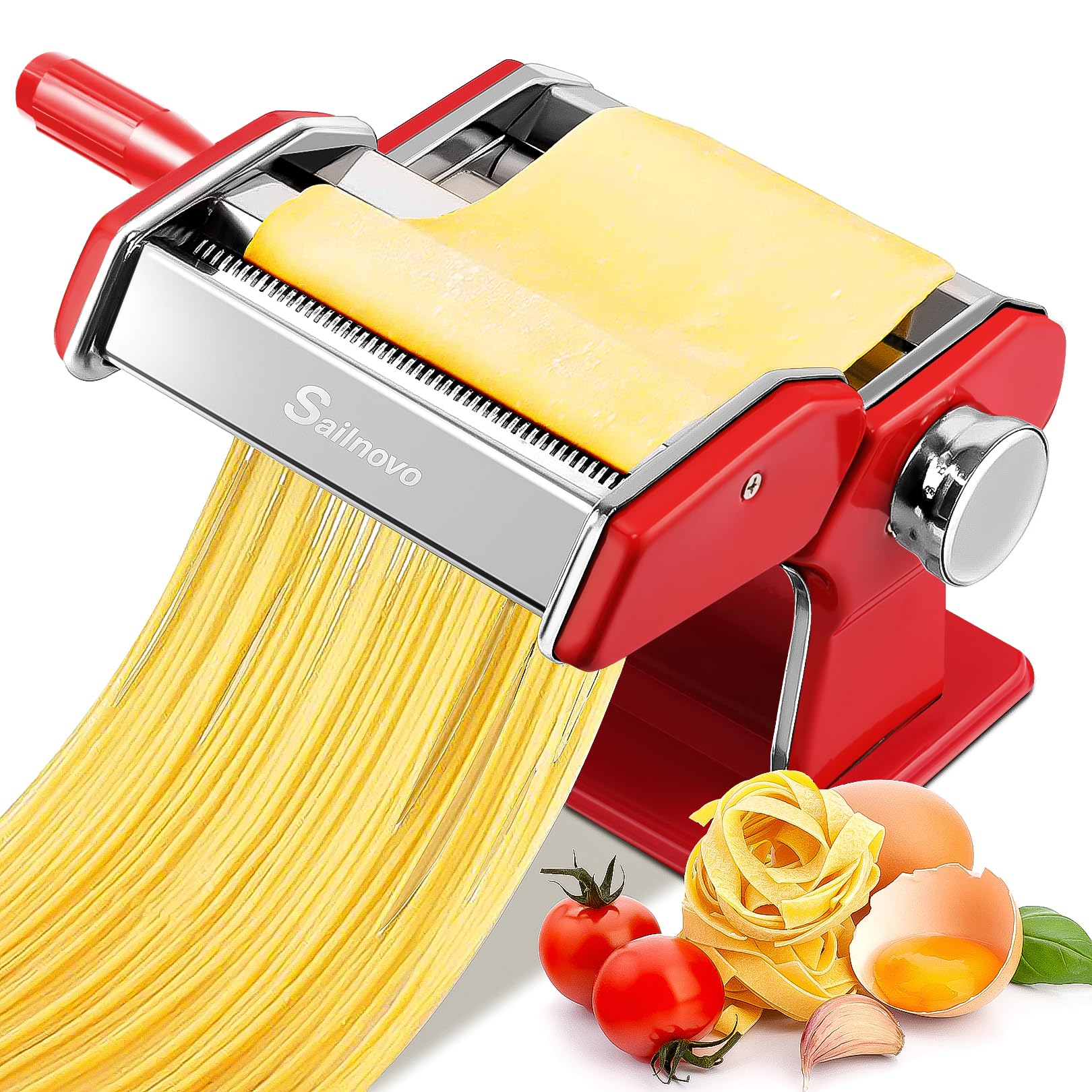
The Sailnovo undercuts many competitors on price while delivering the widest thickness range in this lineup at nine settings, spanning from 0.3 mm to 3 mm. That extra travel means you can dial in a translucent sheet for delicate ravioli squares or a hearty pasta for baked casseroles with the same unit. The rollers are constructed from aluminum alloy rather than full stainless steel, which keeps the overall weight manageable—a double-edged benefit because the machine is easier to handle but may develop surface wear over many years of heavy use. The clamp uses a threaded screw with a rubberized pad that grips well on standard counters, though some users have noted the clamp needs periodic tightening as the crank torque works the screw loose.
Cutting options are limited to two widths—2 mm and 6.25 mm—which covers spaghetti and fettuccine but skips a dedicated linguine or lasagna-only slot. One recurring observation from buyers is that thick dough passes can bog down the cranking speed, requiring a steady, consistent pace to avoid bunching at the roller entry. First-time pasta makers may need to feed the dough start manually until the rollers grip, a common learning curve for manual units at any price tier. The housing is also marked as dishwasher safe, a rare claim in this category, though the manufacturer recommends using a dry brush or cloth to preserve the aluminum finish.
For someone who wants to test homemade pasta without a large upfront investment, the Sailnovo offers a genuine entry point with spec parity to more expensive models in the range-adjustment department. Its compact footprint stores easily in a drawer, and the bright red finish makes it easy to spot in a cluttered cabinet. If you plan to make pasta weekly for years and want a machine that can survive constant dough contact, the aluminum alloy is the main trade-off to weigh against the lower entry cost.
Why it’s great
- 9 thickness settings provide the widest adjustment range in this price tier
- Lightweight and easy to store with a compact footprint
- Dishwasher-safe construction reduces cleanup effort
Good to know
- Aluminum rollers may show wear or pitting with heavy long-term use
- Thick dough requires consistent cranking speed to prevent bunching at the rollers
3. Fedowal 3 in 1 Pasta Attachment
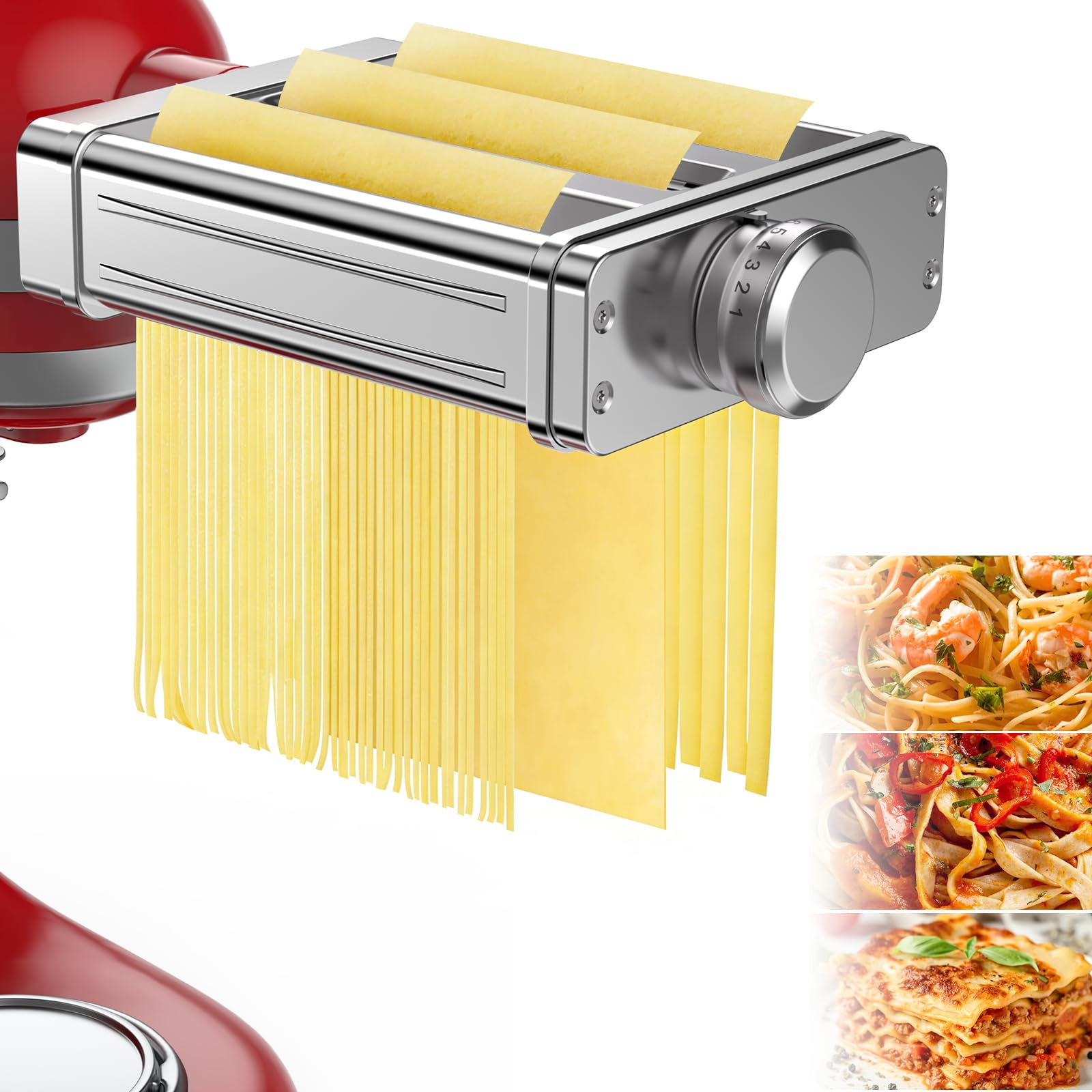
The Fedowal 3-in-1 brings an innovative integrated design to the KitchenAid stand-mixer ecosystem: the roller, spaghetti cutter, and fettuccine cutter are housed in a single chassis, so you never have to detach and reattach individual heads to switch between shapes. This direct-drive convenience shaves minutes off the pasta-making workflow, especially during large-batch sessions where swapping cutters between dough sheets would normally interrupt the rhythm. The roller is constructed from 304 stainless steel, and the internal gears are machined for quiet, consistent engagement—a notable upgrade from the plastic-gear units that sometimes strip under thick dough loads.
Eight thickness settings give the same range as most dedicated roller attachments, and the removable safety flap protects your fingers while allowing single-handed dough feeding. Some early users have noted that the thickness-selector knob can be difficult to lock into its notch, occasionally requiring a firm push to confirm the setting. The 4.25-pound weight is modest for a full metal assembly, meaning the mixer’s own weight handles vibration dampening rather than the attachment itself. Cleaning follows the dry-brush protocol common to all pasta attachments, and the polished steel surface rejects most dough residue with a quick sweep.
For existing KitchenAid owners who want the fastest possible shape-switching experience, this Fedowal unit eliminates the most common frustration with three-piece sets: the hunt for the right cutter while the dough dries out. Its single-body design also reduces the number of small parts that can get misplaced between sessions. The price sits in the upper-mid range, reflecting the engineering investment in the all-in-one head rather than a premium material upgrade over simpler sets.
Why it’s great
- True 3-in-1 design eliminates cutter-swapping downtime
- 304 stainless steel rollers resist corrosion and provide a non-stick surface
- Safety flap allows hands-free operation during rolling
Good to know
- Thickness knob can be tricky to lock into the precise setting notch
- Integrated head design is slightly bulkier to store than separate attachments
4. ZACME 3PCS Pasta Maker Attachment
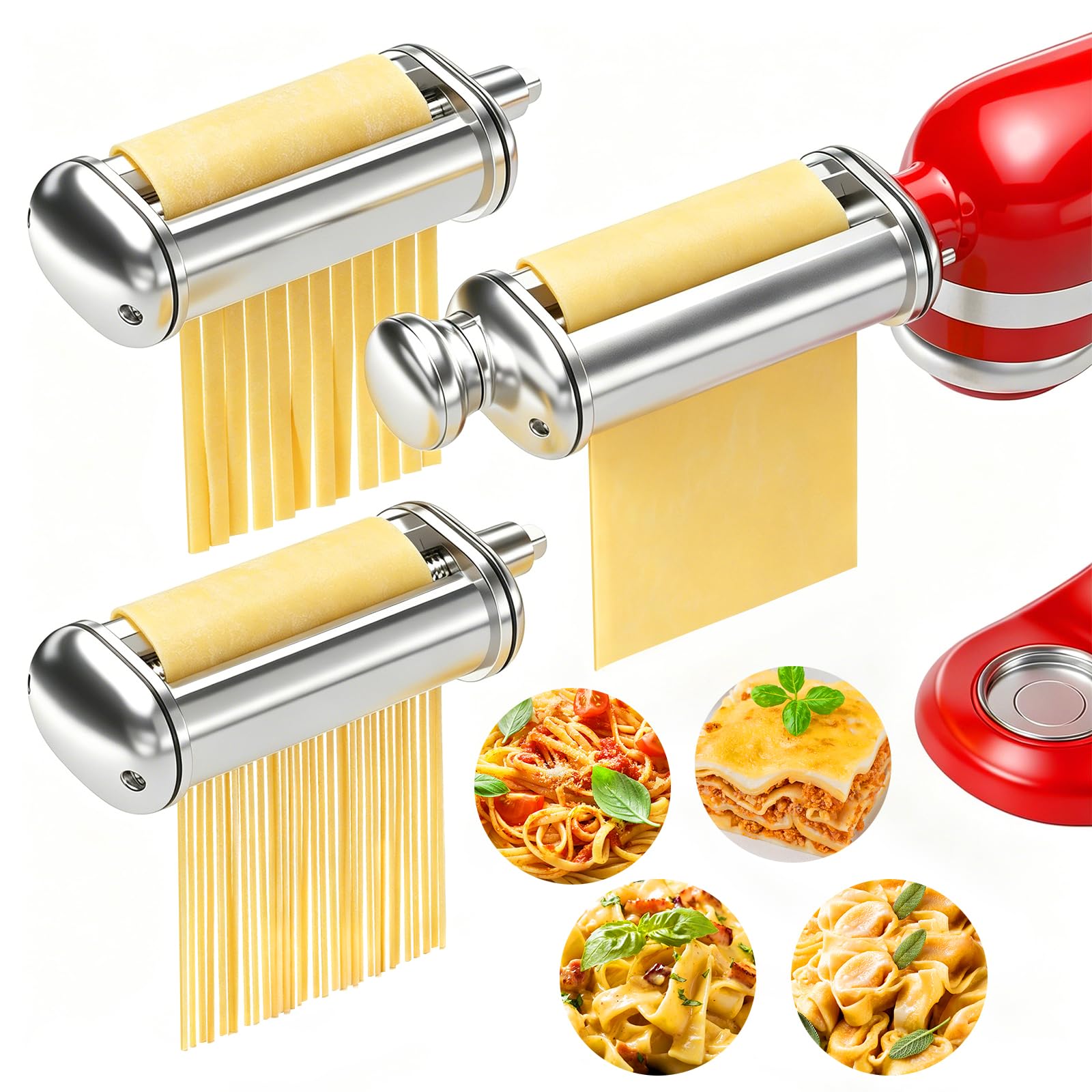
The ZACME three-piece set earns its mid-range positioning through a noticeably dense build—it tips the scale at nearly 6 pounds, heavier than many competing KitchenAid attachments, which contributes to wobble-free operation during high-torque rolling. The roller, fettuccine cutter, and spaghetti cutter each attach independently via the standard hub interface, so you trade the all-in-one convenience of the Fedowal for a more traditional modular approach. What you gain in return is a thicker metal gauge that feels substantial in the hand and resists flexing when you feed a stiff semolina dough through the widest roller gap. The eight thickness settings cover from 0.4 mm to 2 mm, a slightly narrower top end than some competitors but still adequate for most lasagna sheet applications.
One smart design choice is the inclusion of a cleaning brush in the package—a small addition, but one that signals the manufacturer expects dry-brush maintenance rather than water rinsing. Users report that the roller produces smooth, even sheets without sticking, provided the dough is dusted with flour before each pass. The only real functional friction point is that the roller and cutters require the dough to be pre-flattened to a certain extent; very thick dough chunks can cause the mixer hub to twist if you skip the initial hand rolling. The set also claims compatibility with a limited range of Cuisinart stand mixers, widening its usability beyond KitchenAid households.
If you value heft and rigidity in your pasta attachments and do not mind swapping heads between rolling and cutting phases, the ZACME delivers a durable, long-lasting build quality that should outlast many lighter-weight counterparts. Its all-metal construction with no plastic gears or housing panels means the only potential failure point is the mixing hub itself. For the mid-range price, this kit gives you the confidence that weekly pasta production will not loosen seams or strip gears over time.
Why it’s great
- Heavy 6-pound all-metal construction eliminates wobble during use
- Works with select Cuisinart stand mixers in addition to KitchenAid
- Included cleaning brush simplifies dry maintenance
Good to know
- Dough needs pre-flattening before feeding to avoid hub twisting
- Maximum roller thickness of 2 mm may feel limiting for rustic thick-cut pasta
5. Gomen 3 PCS Pasta Attachment
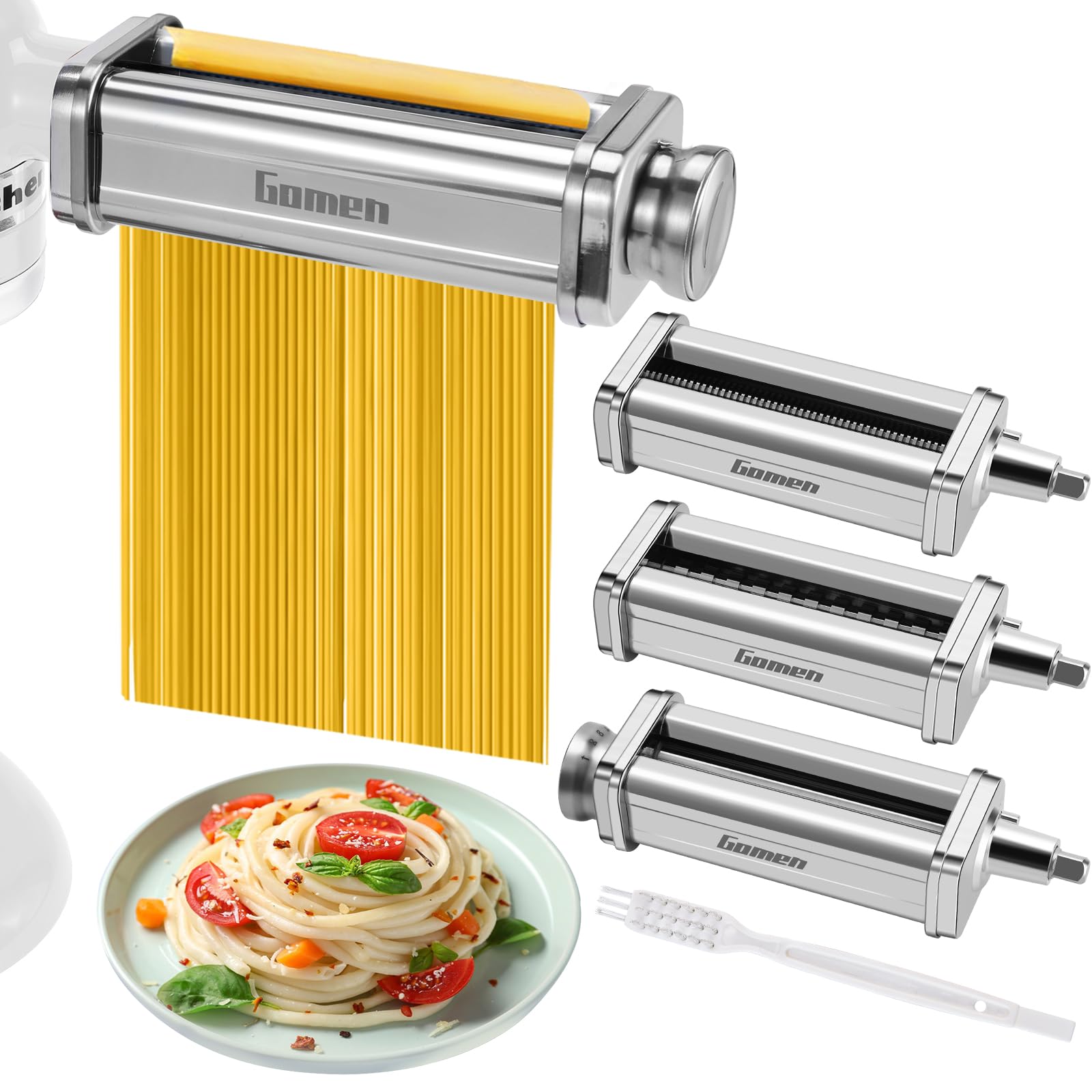
The Gomen attachment set is one of the heavier options in this category at 5.48 pounds, and that weight correlates directly with its thick-walled stainless steel construction. The gear housing is fully enclosed in metal, which helps dissipate heat buildup during extended rolling sessions and prevents the gear-train misalignment that sometimes plagues lighter attachments with plastic components. This unit offers the standard three-piece layout—a sheet roller, a fettuccine cutter, and a spaghetti cutter—each equipped with a quick-lock mechanism that seats firmly into the mixer hub without wobble. The eight thickness settings span from a very fine 0.4 mm to a moderate 2 mm maximum, a range that tilts toward thinner pasta styles but handles delicate sheets for filled pastas with precision.
Some users have flagged the thickness-adjustment knob as a weak point, describing it as flimsy compared to the rest of the body. The markings can be difficult to read in low light, and the knob does not always index cleanly into each setting, occasionally requiring a second nudge to settle into the correct detent. Despite this, the rollers themselves operate smoothly and produce even sheets without visible striations. Cleanup follows the standard dry-brush protocol, and the high-polish finish resists dough adhesion effectively—a benefit of the 304-grade stainless steel surface.
For cooks who already own a KitchenAid stand mixer and want a no-compromise all-metal attachment that feels like an extension of the mixer rather than a plastic add-on, the Gomen delivers that tactile experience. The heavier gear assembly also contributes to quieter operation, as the extra mass dampens the high-frequency whine that thinner gears sometimes produce. If you plan to make pasta in bulk or frequently work with high-hydration doughs that require extended cranking, the robust build of this set is a worthwhile investment.
Why it’s great
- Thick-walled all-metal construction for quiet, stable operation
- High-polish 304 stainless steel resists dough sticking
- Quick-lock hub mechanism fits securely with minimal play
Good to know
- Thickness adjustment knob feels less substantial than the main gear housing
- Maximum roller thickness of 2 mm limits rustic pasta applications
6. RAFBAR 3-in-1 Pasta Maker Attachment
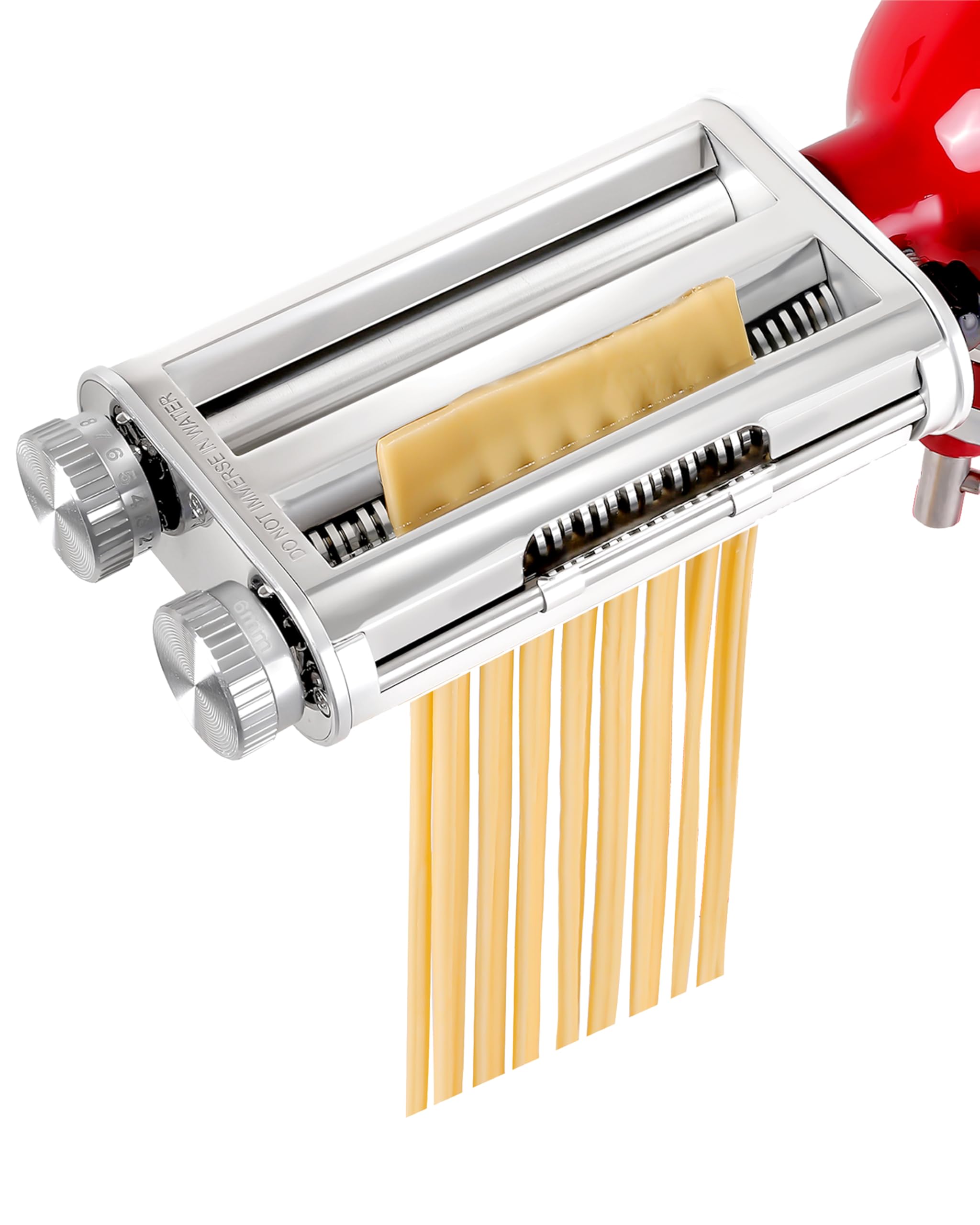
The RAFBAR 3-in-1 attachment distinguishes itself with a uniquely compact design—it measures roughly 4.3 inches deep, 9 inches wide, and under 2 inches tall, making it the most space-efficient option in this collection for kitchens where drawer or cabinet real estate is tight. Despite the small footprint, it integrates the roller, spaghetti cutter, and fettuccine cutter into one unified body, so you never need to swap parts. The internal gears are stainless steel, and the external housing is a durable metal that feels dense for its size. The roller supports eight thickness settings, and users report that it produces smooth, consistent sheets even with all-purpose flour doughs on the first attempt.
A notable practical upside is the dry-cleaning lid: you flip it open and brush away the flour and dough residue directly, without disassembling the attachment. This design reduces the chance of losing small components during cleanup and speeds up the turnaround between dough batches. The unit’s light weight (about 2.2 pounds) means it relies more on the mixer’s stability than its own mass, but feedback indicates that the roller never bogs or clogs even when feeding continuous sheets for large batches. Some users have mentioned that the 3-in-1 head produces slightly narrower sheet widths than the separate roller-only attachments, which can limit the size of lasagna or ravioli you can make per pass.
For the entry-level side of the premium bracket, the RAFBAR offers a compelling trade-off: you sacrifice maximum sheet width and some perceived heft, but you gain a tidy, clutter-free workflow that requires zero part storage. It is also a strong entry point for first-time pasta makers who want to test the mixer-attachment route without spending for a full three-piece set. The value proposition is clear when you factor in the space saved and the reduced friction of not having to track multiple cutters.
Why it’s great
- Ultra-compact all-in-one body saves significant drawer and cabinet space
- Dry-cleaning lid lets you brush clean without disassembly
- Stainless steel internal gears deliver quiet, reliable operation
Good to know
- Narrower sheet width limits the size of lasagna or ravioli sections per pass
- Lighter build relies on the mixer’s weight for vibration dampening
FAQ
Can I wash my pasta maker rollers in the dishwasher?
How do I know if a mixer attachment fits my specific stand mixer model?
Why does my dough keep sticking to the rollers despite dusting with flour?
Final Thoughts: The Verdict
For most users, the best pasta making kits winner is the AceChef Pasta Maker because its heavy stainless steel construction, reliable clamping system, and dual cutter head deliver the best balance of durability and output quality for both beginners and experienced pasta makers. If you want the fastest shape-switching workflow without any part swaps, grab the Fedowal 3 in 1 Pasta Attachment for your KitchenAid mixer. And for a budget-friendly entry point that still offers nine thickness settings, nothing beats the Sailnovo Pasta Maker.