A baking pan that flexes under heat or sticks like glue can turn a carefully proofed loaf into a kitchen failure. The material, thickness, and coating of your pan directly control how your bread rises, browns, and releases — and too many home bakers underestimate that connection.
I’m Mohammad Maruf — the founder and writer behind AirfryerBite. I’ve spent years analyzing bakeware specifications, from carbon steel gauge thickness to cast iron heat retention rates, to identify which pans actually deliver consistent results.
Whether you bake daily sandwich loaves or weekend artisan sourdough, choosing the right pan for baking bread determines whether your crust shatters or softens and whether your crumb stays even or collapses, every single bake.
How To Choose The Best Pan For Baking Bread
The three specifications that separate an average bread pan from a high-performance one are material composition, surface coating, and physical dimensions including wall thickness. Each factor directly impacts heat conduction, crust development, and how cleanly the finished loaf releases.
Material: The Heat Conductor
Carbon steel pans heat up quickly and cool fast, making them ideal for lean doughs that need a moderate crust. Cast iron, by contrast, absorbs and radiates heat slowly and evenly, delivering superior browning and a thicker, crunchier crust. The weight difference is significant — a steel pan around 1.8 pounds versus a cast iron unit exceeding 4 pounds — so choose based on how often you lift and move the pan.
Coating and Release
PTFE-based non-stick coatings make cleanup trivial but deteriorate above 500°F and scratch under metal utensils. PTFE-free ceramic coatings offer better heat tolerance and are marketed as safer alternatives, though they can lose release performance over time. Pre-seasoned cast iron, when properly maintained, develops a naturally slick surface that actually improves with use and has no upper temperature limit in home ovens.
Lid vs. Open Top
Open-top pans are standard for sandwich loaves and banana bread where a domed top is desirable. A fitted lid, as found on Pullman pans and covered cast iron loaf pans, traps steam around the dough to create a shiny, thin crust and forces the bread to bake into a perfectly square shape, ideal for uniform sandwich slices.
Quick Comparison
On smaller screens, swipe sideways to see the full table.
| Model | Category | Best For | Key Spec | Amazon |
|---|---|---|---|---|
| Flavehc Cast Iron Loaf Pan | Premium | Artisan sourdough with crisp crust | Enameled cast iron, 1.6qt capacity | Amazon |
| GRMImosa 2 in 1 Cast Iron Loaf Pan | Premium | Versatile baking and roasting | Cast iron with lid, 3.8qt capacity | Amazon |
| Bachdomc Cast Iron Loaf Pan | Mid-Range | Beginner sourdough and steam baking | Pre-seasoned cast iron, 3.4qt capacity | Amazon |
| YURTKUMAS Pullman Loaf Pan Set | Mid-Range | Square sandwich loaves in three sizes | Carbon steel, Pullman lids, 3 pans | Amazon |
| Monfish Loaf Pan Set | Budget | Entry-level baking with easy cleanup | Carbon steel, PTFE-free, 2-pack | Amazon |
In‑Depth Reviews
1. Flavehc Bread Pan Cast Iron Loaf Pan with Lid
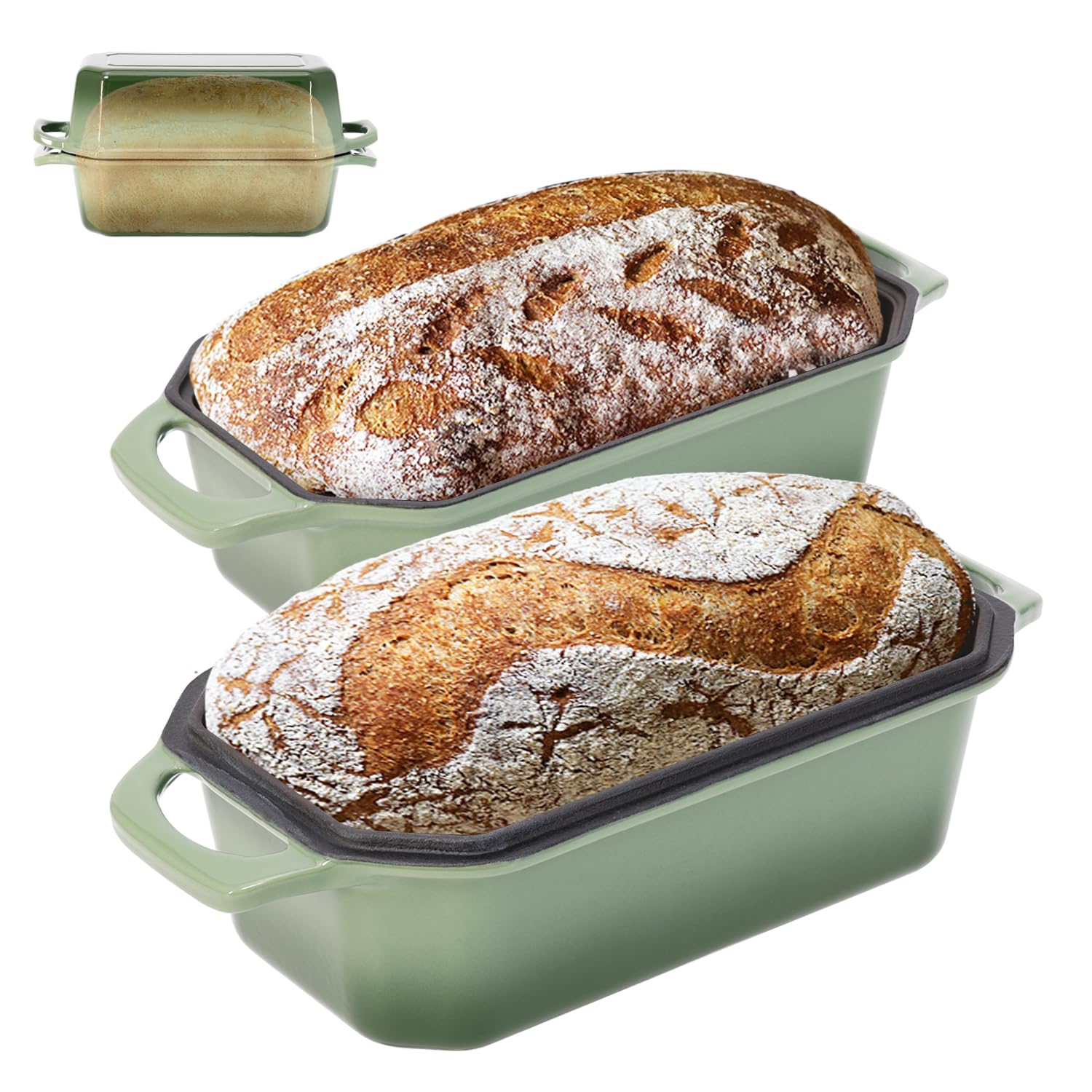
The Flavehc pan uses a heavy enameled cast iron body that holds steady heat at 500°F, giving artisan sourdough the sustained thermal mass needed for a deep, caramelized crust. The 1.6-quart capacity is slightly smaller than standard 9×5 steel pans, but the lid traps steam effectively to create a shiny, thin shell during the first 20 minutes of baking.
The matte black interior enamel reduces sticking significantly compared to raw cast iron, though using parchment paper underneath the dough still provides a foolproof release. Reviewers consistently report excellent browning and even crumb structure, with some noting that pre-heating the pan before adding the dough improves oven spring noticeably.
At roughly 4.2 kilograms this pan is substantial and retains heat long after leaving the oven, so a trivet or cooling rack is essential. The aqua green exterior adds a decorative element that stands out on open shelving, but the real advantage is the superior heat distribution that eliminates the pale sides common in thin steel pans.
Why it’s great
- Enameled surface resists sticking and is easy to clean with warm soapy water
- Lid creates a closed steam environment for professional-quality crust
- Sustained 500°F tolerance suits high-heat sourdough techniques
Good to know
- Smaller than a standard 9×5 pan; you may need to scale dough down
- Extremely heavy at over 9 pounds — not ideal for frequent handling
- Hand wash only; enamel can chip if knocked against hard surfaces
2. GRMImosa 2 in 1 Cast Iron Bread Loaf Pan with Lid

The GRMImosa pan stands out for its 2-in-1 design — the lid flips to serve as a second baking surface, effectively allowing you to bake two smaller loaves simultaneously. The internal dimensions match the standard 9×5 inch footprint, but the 3.8-quart total capacity indicates notably tall sidewalls that accommodate high-rising dough without spilling over the rim.
Pre-seasoned cast iron here requires a brief initial seasoning session before first use. Reviewers praise the even heating profile, noting an absence of hot spots that cause burnt bottoms. For no-knead doughs using around six cups of flour, the pan delivers a consistent crumb and a crust that cracks satisfyingly when the bread cools.
The 9-pound weight is a serious consideration — this pan does not move easily when filled with hot dough. Beginners may find the heft surprising, but experienced bakers recognize that mass translates directly to heat retention and browning quality. The rough cast iron interior can grab sticky dough, so parchment paper lining is strongly recommended during the first few bakes.
Why it’s great
- Lid doubles as a second pan for baking two loaves at once
- Thick cast iron walls eliminate scorching and produce even color
- Generous sidewall height supports large rustic dough recipes
Good to know
- Extremely heavy at 9 pounds; requires two hands when full
- Rough surface may stick with very wet dough — use parchment
- Smaller than traditional 9×5 steel pans despite the same label
3. Bachdomc Cast Iron Loaf Pan With Lid

The Bachdomc pan delivers cast iron performance at a mid-range investment that undercuts many enameled competitors. The pre-seasoned surface arrives ready for immediate baking, and the included lid transforms the pan into a mini Dutch oven that traps steam for that signature crackling crust. The 9×5 inch cavity matches standard loaf recipes without requiring ingredient scaling.
Multiple reviewers have confirmed that this pan produces bakery-quality sourdough on the very first attempt. The thermal mass ensures the dough stays at a consistent temperature throughout the bake, preventing the gummy center problem that plagues thin aluminum pans. A dry paper towel wipe is often sufficient for cleaning after baking, though occasional oil seasoning maintains the non-stick performance.
The cast iron requires more deliberate care than non-stick coated steel — it must be dried immediately after washing and lightly oiled to prevent rust. Users who follow the seasoning instructions report that the release improves with each bake. For sourdough bakers who want the crust benefits of cast iron without the premium enamel price, this pan hits a sweet spot.
Why it’s great
- Pre-seasoned and bake-ready straight from the box
- Lid traps steam effectively for professional crust texture
- Even heat distribution eliminates pale sides and burnt bottoms
Good to know
- Requires diligent drying and oiling to prevent rust
- Weighs over 10 pounds when loaded with dough and lid
- Cast iron interior can stick with very high-hydration doughs
4. YURTKUMAS 3 Pack Pullman Loaf Pan with Lids
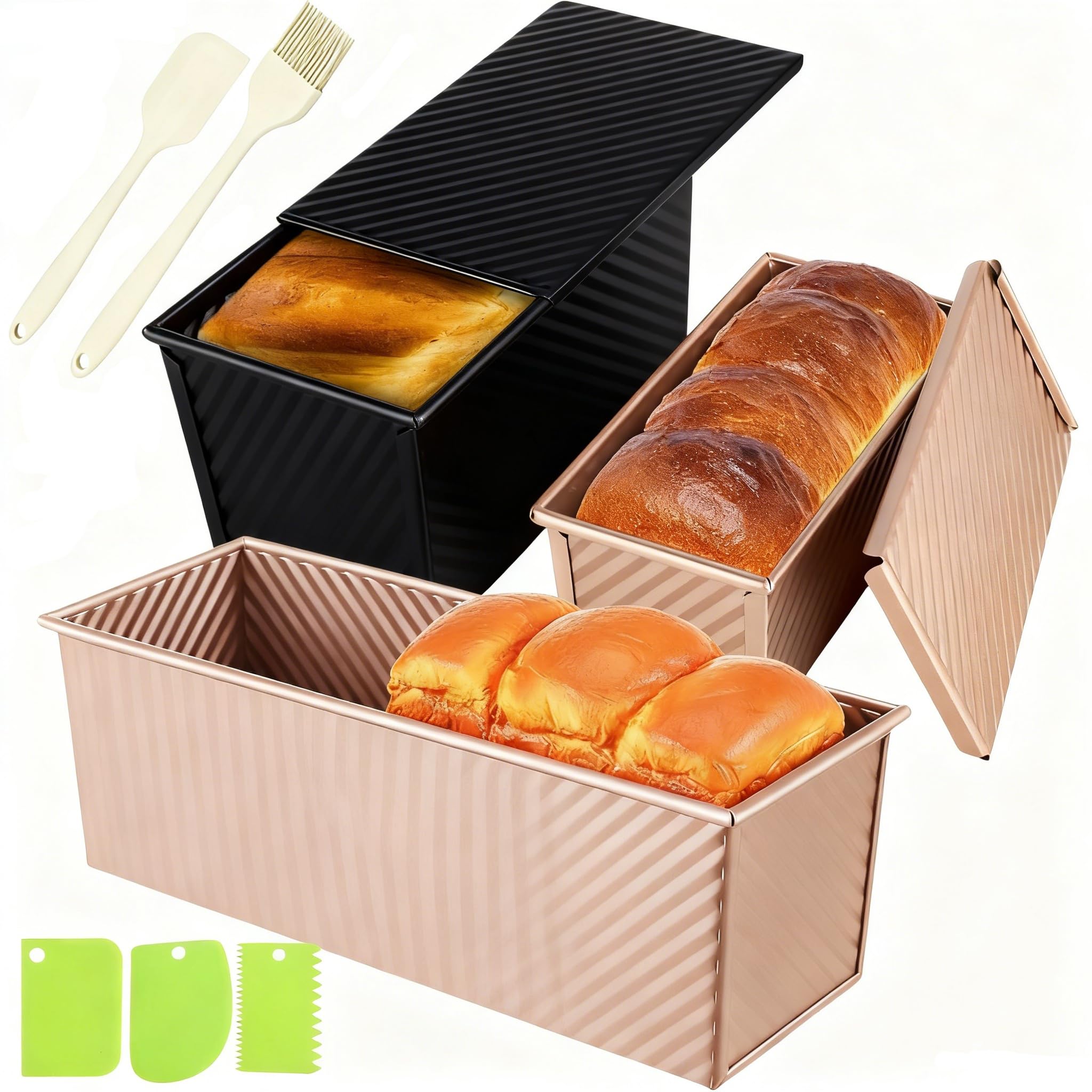
This YURTKUMAS set includes three carbon steel Pullman pans with capacities of roughly 0.8 pounds, 1 pound, and 2.2 pounds, giving you the flexibility to bake small test batches or full-size sandwich loaves. The sliding lids force the dough to bake into perfectly square blocks, which slice into uniform pieces ideal for toaster use or packed lunches.
The wavy non-stick coating is PTFE-free and designed to release even lean doughs without greasing. Reviewers highlight that the lids fit snugly enough to trap steam but slide off easily when the pan is inverted. The included dough scrapers and spatula add practical value, though the hand-wash-only care instruction should be respected to preserve the coating long-term.
One consideration is that the 2.2-pound pan is narrower than a standard 9×5 loaf pan, so your standard bread recipe may need slight shaping adjustments. Users switching from open-top pans should also adjust baking time by about five minutes since the lid prevents top browning and requires a brief uncovered finish to color the crust.
Why it’s great
- Three sizes cover everything from small test loaves to family batches
- Pullman lids create uniform square slices for sandwiches
- PTFE-free non-stick coating releases dough reliably
Good to know
- Hand wash recommended despite dishwasher-safe label
- Narrower than standard bread pans; shapes may differ
- Lid prevents top browning — finish last few minutes uncovered
5. Monfish Loaf Pan Baking Bread Set of 2

The Monfish set delivers two 9×5 inch carbon steel pans with a haze blue non-stick coating that is free of PTFE, PFOA, and PFAS, making it a solid entry-level choice for new bread bakers. The 1.76-pound weight per pan is light enough to handle comfortably but still provides the heat conduction needed for even browning compared to ultra-thin budget pans.
Reviewers consistently note that the pans release banana bread, meatloaf, and standard yeast loaves with minimal sticking, especially when a light grease is applied before filling. The straight sidewalls produce tall, well-defined loaves rather than the sloped shapes common in tapered pans. Multiple users confirm the pans fit standard 9×5 baking recipes without adaptation.
The colorful design is eye-catching, but the coating durability at high temperatures is the main trade-off. Carbon steel conducts heat efficiently but can warp over time if exposed to extreme temperature swings, and the non-stick layer may degrade faster than ceramic alternatives. For casual bakers making a few loaves per month, this set offers practical performance at a low barrier to entry.
Why it’s great
- Two-pan set allows baking multiple loaves simultaneously
- PTFE/PFOA-free coating provides peace of mind for health-conscious bakers
- Lightweight and easy to handle compared to cast iron alternatives
Good to know
- Non-stick coating may degrade faster than ceramic or bare cast iron
- Carbon steel can warp under extreme thermal shock
- Not suitable for high-heat applications above 450°F for extended periods
FAQ
Does a Pullman pan lid really improve sandwich bread quality?
How do I prevent my bread from sticking to a new cast iron loaf pan?
Can I use a glass loaf pan for artisan sourdough?
Final Thoughts: The Verdict
For most users, the pan for baking bread winner is the Flavehc Cast Iron Loaf Pan because the enameled surface combines the heat retention benefits of cast iron with a smooth, easy-to-clean interior that does not require seasoning. If you want multiple sizes for different recipes, grab the YURTKUMAS Pullman Pan Set. And for a no-fuss entry-level option that still delivers solid results, nothing beats the Monfish Loaf Pan Set.