A backyard compost bin sits at the intersection of waste reduction and soil fertility. But choosing the wrong design — a tumbler that jams, a static bin that goes anaerobic, or a wooden frame that rots — turns a noble goal into a frustrating chore. The right unit transforms kitchen scraps and yard clippings into dark, crumbly humus without attracting pests or requiring a physics lesson to spin.
I’m Mohammad Maruf — the founder and writer behind AirfryerBite. I’ve spent hundreds of hours cross-referencing material density, aeration channel geometry, and bearing quality across the most reliable outdoor compost bins to separate genuine engineering from marketing talk.
Whether you manage a small vegetable patch or maintain a sprawling lawn, this guide breaks down the real differences between static and tumbling designs to help you confidently choose the right best outdoor compost bin for your specific space and waste volume.
How To Choose The Best Outdoor Compost Bin
Picking a compost bin is not about brand loyalty — it is about matching the system to your waste volume, physical strength, and how much time you want to spend turning material. Three factors dominate the decision: design type, capacity, and construction durability.
Static Bin vs. Tumbler: Which System Works for You?
Static bins sit directly on the ground, allowing earthworms and microorganisms to enter from below. They require manual aeration with a pitchfork but accept larger volumes of mixed waste without the balancing act of browns and greens. Tumblers elevate the drum off the ground, use a crank or rotational force to mix contents, and produce finished compost faster — often in four to six weeks — provided you maintain proper moisture and turn the barrel every few days. Tumblers also block rodents more effectively because the sealed drum denies ground-level access.
Capacity: Matching Volume to Household Size
A single-person household generating kitchen scraps and occasional yard trimmings gets by with a 37- to 45-gallon tumbler. A family with a vegetable garden and lawn clippings should consider a 65- to 80-gallon static bin or a dual-chamber tumbler where one side matures while you fill the other. Overloading a small unit leads to slow, slimy decomposition; undersizing a large bin wastes space and makes turning impractical.
Materials That Withstand the Elements
Polypropylene bins resist UV rays and impact but can become brittle in freezing temperatures. Cedar bins breathe naturally and look attractive but will eventually weather and may warp if the slats are thinner than 3/4 inch. Steel frames should be powder-coated or galvanized to prevent rust at the pivot points. For any plastic unit, confirm that it is BPA-free and contains UV inhibitors — without those, the drum will fade and crack within two full sun seasons.
Quick Comparison
On smaller screens, swipe sideways to see the full table.
| Model | Category | Best For | Key Spec | Amazon |
|---|---|---|---|---|
| RSI Maze Compost Tumbler | Premium Tumbler | Large-volume, low-effort turning | 65-gallon capacity / geared crank | Amazon |
| Greenes Fence Cedar Composter | Premium Static | Natural aeration and expandability | 173.92-gallon / 3/4″ North American cedar | Amazon |
| FCMP Outdoor HOTFROG | Mid-Range Tumbler | Fast two-week compost cycles | 37-gallon dual chamber / UV-inhibited PE | Amazon |
| Marcytop 45-Gallon Dual Chamber | Mid-Range Tumbler | Beginner-friendly split batching | 45-gallon dual chamber / 30.2 lbs frame | Amazon |
| EJWOX 43-Gallon Tumbler with Thermometer | Mid-Range Tumbler | Monitoring internal temperature | 43-gallon dual chamber / built-in thermometer | Amazon |
| DIAMONDFORGE 43-Gallon Tumbler | Budget Tumbler | Quick 20-minute assembly | 43-gallon dual chamber / 8-panel plastic | Amazon |
| EJWOX 80-Gallon Static Bin | Budget Static | High-volume passive composting | 80-gallon / polypropylene with circular vents | Amazon |
In‑Depth Reviews
1. RSI MCT-MC Maze Compost Tumbler

The RSI Maze Tumbler is the largest sealed unit on this list with a 65-gallon drum that sits on a heavy-duty metal frame. Its standout feature is the geared crank handle — a mechanical advantage that lets you rotate the drum even when it is fully packed with wet kitchen scraps and grass clippings. The sliding dual doors make loading and unloading straightforward, and the built-in adjustable air vents give you direct control over oxygen flow inside the barrel.
Assembly requires patience — expect roughly two hours with clear but part-heavy instructions. A few owners noted slightly misaligned holes on the wheelbarrow handle that needed drilling, but once assembled, the frame is rigid and the drum spins with minimal effort. The cart underneath makes it easy to wheel finished compost directly to garden beds, a feature no other tumbler here offers.
For households generating serious yard waste year-round, the RSI eliminates the common tumbler complaint of “too hard to turn.” The geared handle is not a gimmick — it genuinely reduces the muscle required. The only real compromise is the assembly time, but for a unit this capable, that is a one-time investment.
Why it’s great
- Geared crank allows effortless turning even when fully loaded
- 65-gallon capacity handles large volumes without frequent emptying
- Integrated wheelbarrow cart makes transport to garden beds practical
- Adjustable air vents provide fine-tuned aeration control
Good to know
- Assembly takes roughly two hours and requires careful attention
- Some units arrive with minor hole misalignment on the cart handle
2. Greenes Fence Premium Cedar Wood Composter

The Greenes Fence composter takes a completely different approach — instead of a sealed plastic drum, it is a 36-inch square bin made from 3/4-inch thick North American cedar. The open-bottom design allows earthworms and beneficial microbes to enter directly from the soil, which accelerates breakdown naturally. Assembly requires no tools: you slide the slats between the corner posts and tap them flush with a mallet, a process that takes under 30 minutes.
At 173.92 gallons, this bin dwarfs every tumbler in this guide. It is ideal if you have a steady stream of leaves, grass clippings, and untreated wood chips that would overwhelm a 40-gallon drum. The slatted construction provides excellent passive aeration, and the front boards lift out individually, giving you easy access to finished compost at the bottom while you keep adding fresh material on top.
The trade-off is that cedar is a natural material — it will weather and eventually need replacement slats after several seasons, though the wood is rot-resistant compared to pine. This bin also requires manual turning with a pitchfork or aerator tool. It is not a set-and-forget system, but for gardeners who want to process bulk yard waste without plastic, it is the most capable design here.
Why it’s great
- Massive 173.92-gallon capacity handles enormous volumes of yard waste
- Tool-free assembly in under 30 minutes with slat-and-post design
- Aesthetic natural cedar appearance blends into any landscape
- Expandable to a multi-bin system using add-on kits
Good to know
- Requires manual turning with a pitchfork — no rotating mechanism
- Open-bottom design does not prevent ground pest entry
- Cedar will weather over time; expect some warping after several seasons
3. FCMP Outdoor HOTFROG 37-Gallon Dual-Chamber Tumbling Composter
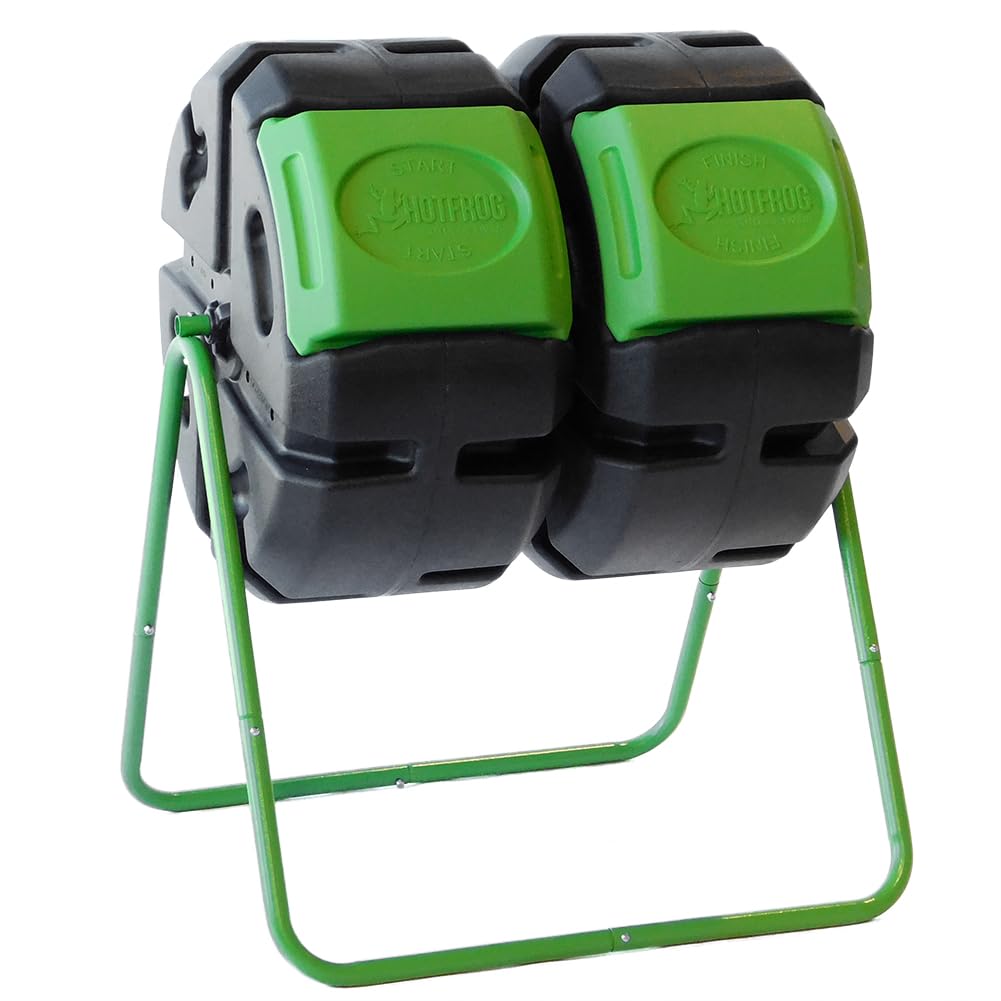
The FCMP HOTFROG is a legend in the budget-friendly tumbler space for a simple reason: it works reliably without fuss. The dual-chamber body — 18.5 gallons per side — allows continuous batching, and the factory specs claim you can produce finished compost in as little as two weeks under hot, sunny conditions with the right brown-to-green ratio. The barrel is made from UV-inhibited, BPA-free recycled polyethylene, which resists cracking better than standard polypropylene units.
Assembly is straightforward: the instructions are printed inside the barrel halves. Owners consistently report a 15-minute build time. The sliding doors on each chamber open wide enough to accept large kitchen scraps, and the aeration holes along the barrel walls keep airflow consistent. The powder-coated galvanized steel frame holds up well against moisture, and the ergonomic handholds make rotating the barrel comfortable even for smaller users.
The 37-gallon total capacity is modest compared to the multi-bay tumblers, but for a one- to two-person household with a small garden, it is perfectly sized. The main caveat is that the plastic doors can be slightly stiff initially, and the screws that secure the frame are not the highest grade — a few owners replaced them with stainless hardware for long-term peace of mind.
Why it’s great
- Fast 15-minute assembly with instructions printed inside the barrel
- UV-inhibited polyethylene resists sun damage better than standard polypropylene
- Dual chambers allow continuous batching without interrupting the active pile
- Compact 30-inch width fits narrow garden spaces
Good to know
- 37-gallon total capacity is on the smaller side for large households
- Frame screws are basic quality — upgrading to stainless steel is recommended
4. Marcytop 45-Gallon Dual Chamber Rotating Composter
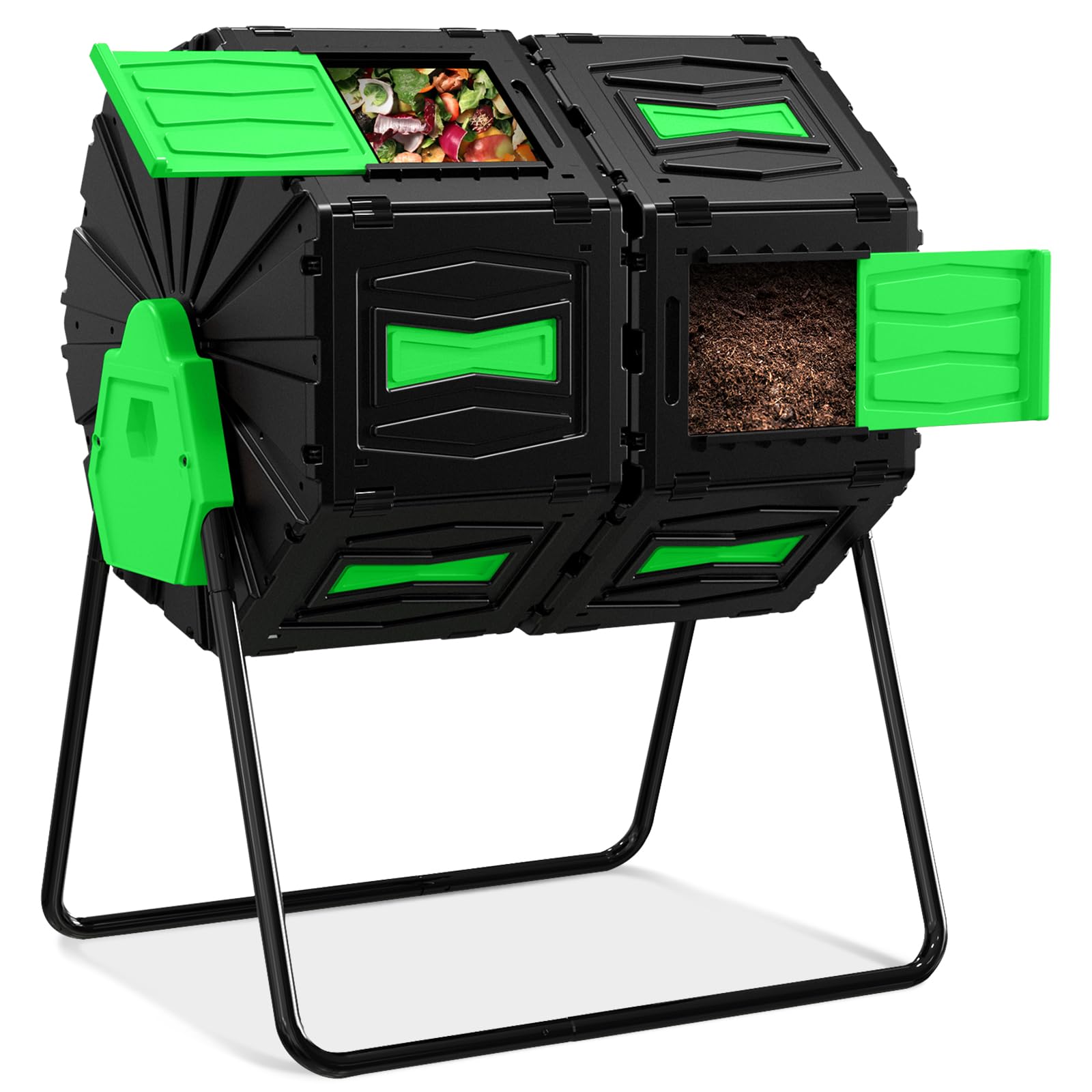
The Marcytop 45-gallon tumbler uses extra-thick polypropylene panels and a powder-coated steel frame that feels noticeably more rigid than cheaper dual-chamber alternatives. Each of the two chambers holds 22.5 gallons, and the deep aeration fins on every panel break up clumps as you rotate the barrel. The design prioritizes stability — the base does not rock or wobble during spinning, a common complaint with lighter tumblers.
Assembly takes about 30 to 40 minutes using the included buckles and a reduced screw count. Several owners noted that the green door panels look clean in a garden setting, and the removable doors are large enough to shovel in bulkier yard waste like wilted tomato vines or small branches. The tumbling action is smooth when the chambers are evenly loaded, though spinning becomes noticeably harder if you overfill one side without balancing the other.
For the price point, the material thickness and frame stability put the Marcytop ahead of several similarly sized competitors. The only real functional limitation is that the chambers are not independently detachable — you cannot spin one side without the other, so loading both roughly equally is necessary for easy turning. Beginners who follow the green-brown layering guidelines will find this unit forgiving and productive.
Why it’s great
- Extra-thick polypropylene panels resist cracking and warping
- Stable powder-coated steel frame avoids wobble during rotation
- Large removable doors simplify adding bulky yard trimmings
- Deep aeration fins break up clumps effectively during tumbling
Good to know
- Both chambers must be loaded relatively evenly for easy spinning
- Assembly benefits from a rubber mallet for snapping panels together
5. EJWOX 43-Gallon Dual Chamber Tumbling Composter with Thermometer
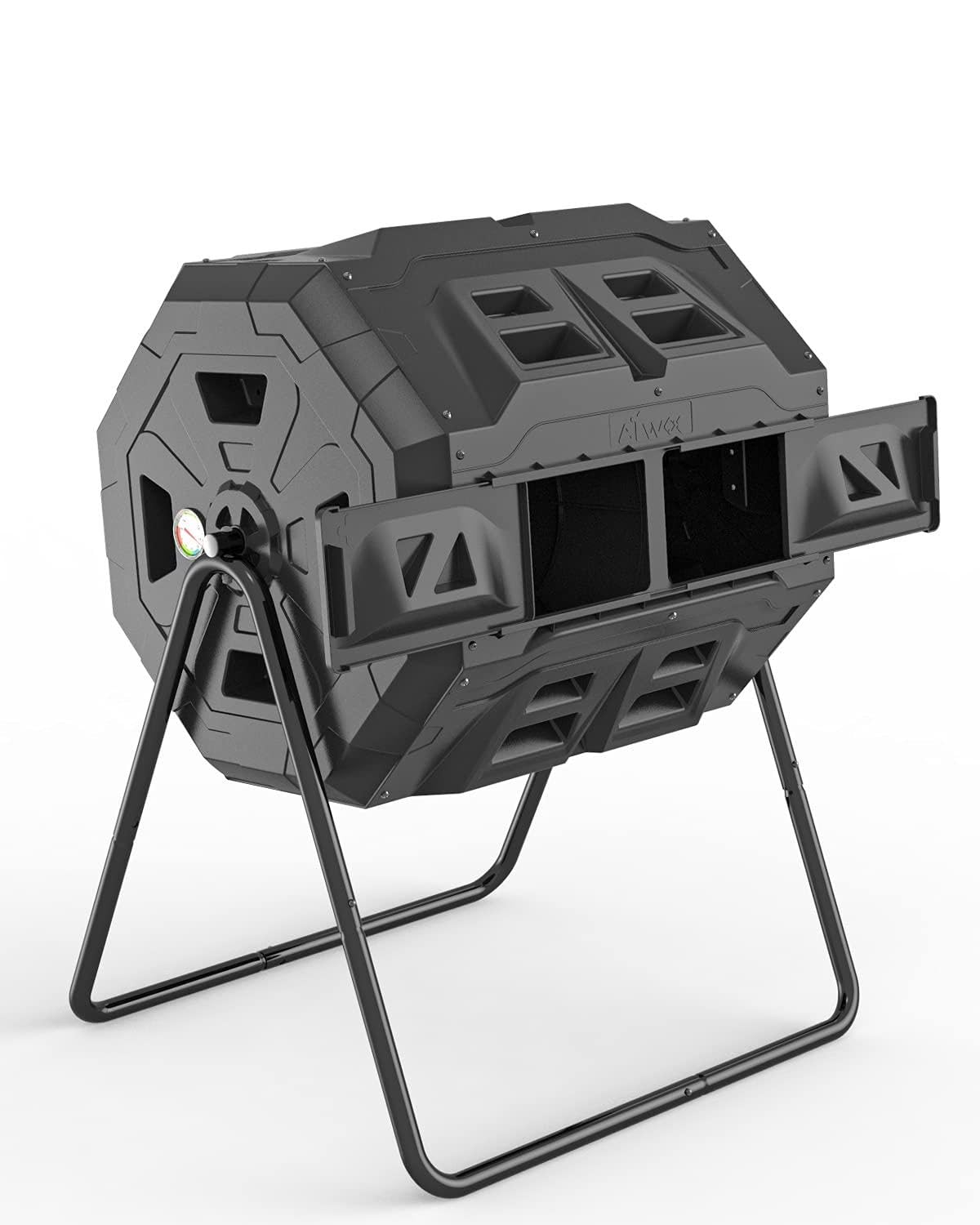
The EJWOX 43-gallon tumbler differentiates itself with an integrated thermometer mounted on the drum surface. This allows you to monitor the internal pile temperature without cracking open the door and losing heat — a real advantage when you are trying to maintain the thermophilic 130°F–160°F range that kills weed seeds and pathogens. The dual-chamber design lets you fill one side while the other finishes its cycle.
The frame uses a galvanized steel base that resists corrosion better than painted steel alone, and the polypropylene panels feel dense enough to handle moderate impacts. Assembly is picture-guided and takes roughly 45 minutes solo. Owners consistently praise the smooth spinning action, and the doors latch securely enough that raccoons and opossums have a hard time prying them open without an added bungee cord or pin lock.
The thermometer is the centerpiece feature, but it has a short probe that measures surface-level temperature rather than the core. It gives you a useful trend indicator rather than a precise reading. A few users also noted that the plus-sign icons on the doors are molded in the same color as the plastic, making them hard to spot — a quick pass with a permanent marker solves that. For the price, this is the best choice if you want to actively manage microbial heat.
Why it’s great
- Built-in thermometer helps track internal pile temperature without opening the door
- Galvanized steel frame resists rust better than basic painted frames
- Dual chambers enable continuous batch composting
- Smooth spinning action even when chambers are partially loaded
Good to know
- Thermometer probe is short and only measures surface-level temperature
- Door icons are molded in same-color plastic — marking them with a sharpie helps visibility
6. DIAMONDFORGE 43-Gallon Dual Chamber Compost Tumbler
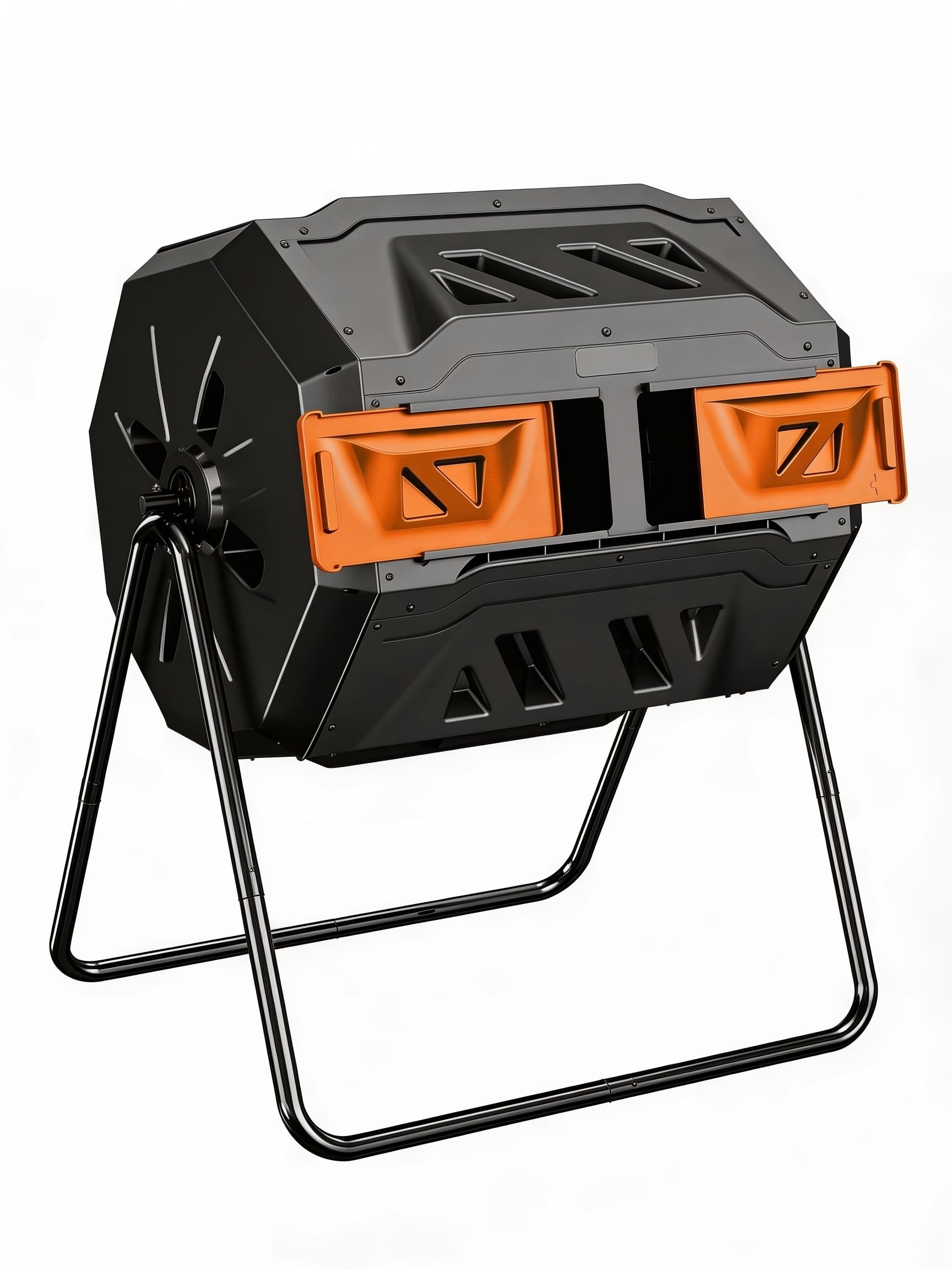
The DIAMONDFORGE tumbler markets itself on speed — the manufacturer claims a 20-minute assembly time, and the snap-together panel design largely delivers on that promise. The 43-gallon dual-chamber drum sits on a steel frame with a black-and-orange color scheme that stands out in the garden. The octagonal panels include deep aeration fins that mix the contents thoroughly with each rotation, and the BPA-free plastic body is weather-sealed to keep rain out.
Real-world experience shows that the snap-together assembly can be tight — several owners had to use a rubber mallet to fully seat the panels, and the doors require precise alignment to close properly. Once assembled, the unit works well for its intended use: turning kitchen scraps and yard trimmings into compost without odor issues. The black finish absorbs sunlight to help heat the interior, and the 360-degree rotation is smooth when the chambers are not overloaded.
The price point is appealing for a dual-chamber design, but the plastic feels lighter than the Marcytop or FCMP units. The frame is functional but not overbuilt — it handles regular turning without issue, but aggressive overfilling could stress the joints. For the budget-conscious gardener who wants a tumbler with dual compartments and is comfortable with a slightly more involved snap-fit, this is a solid entry-level option.
Why it’s great
- Fast snap-together assembly with minimal tools required
- Dual-chamber design supports continuous batching
- Black finish absorbs heat to speed up decomposition
- Weather-sealed BPA-free plastic body
Good to know
- Panel snap-fit can be very tight — a rubber mallet is almost mandatory
- Doors require careful alignment during assembly to function properly
7. EJWOX 80-Gallon Large Capacity Static Compost Bin

The EJWOX 80-gallon static bin is the no-frills workhorse for gardeners who want maximum volume at the lowest investment. The six-piece snap-together polypropylene body assembles in under five minutes without tools, and the forest green color blends unobtrusively into a hedgerow or corner of the yard. The circular aeration vents on all sides keep the pile aerobic, and the removable front hatch gives you access to finished compost at the bottom while you keep layering fresh material on top.
At 12 pounds, the plastic is light — intentionally so, since the bin relies on ground contact for stability. Several owners recommend staking it down or placing a brick on the lid to keep it secure in high winds. The plastic panels are functional but thin; the lid tabs are the most vulnerable point and have been known to break if roughly handled. The open-bottom design allows worms to enter naturally, which is the main reason this bin can process waste effectively despite its simple construction.
This is not a set-and-forget solution. You will need an aeration tool or pitchfork to turn the pile every week or two, and the thin walls mean it will not retain heat as well as a thick-walled tumbler. But for the price and sheer capacity, it is an excellent entry point for anyone who wants to start composting without committing to a tumbler assembly project. Just plan to reinforce the lid in exposed locations.
Why it’s great
- 80-gallon capacity handles large household and yard waste volumes
- Tool-free snap assembly in under five minutes
- Open-bottom design encourages natural worm activity
- Removable front hatch provides easy access to finished compost
Good to know
- Thin polypropylene panels are prone to cracking if mishandled
- Lid does not latch securely — staking or weighting down is advised in windy areas
- Requires manual aeration with a pitchfork or aerator tool
FAQ
What is the ideal capacity for a single-person household?
Does a tumbler keep out rats and raccoons better than a static bin?
How often should I turn a dual-chamber compost tumbler?
Can I compost meat, dairy, and cooked food in an outdoor bin?
Final Thoughts: The Verdict
For most users, the best outdoor compost bin winner is the RSI Maze Compost Tumbler because its 65-gallon capacity and geared crank handle solve the two biggest tumbler pain points — insufficient volume and difficult turning. If you want a natural wood aesthetic that blends into the landscape and processes bulk yard waste without plastic, grab the Greenes Fence Premium Cedar Composter. And for a fast, budget-friendly dual-chamber system that turns kitchen scraps into garden gold reliably, nothing beats the FCMP Outdoor HOTFROG.