An on-counter water filter sits at the center of a daily choice: drink from the tap and wince at the taste, or haul gallons of plastic from the store and watch the expense pile up. This category exists to break that cycle — a dedicated unit that sits on your counter, connects to your faucet or sits freestanding, and delivers filtered water on demand without drilling a hole or losing under-sink cabinet space.
I’m Mohammad Maruf — the founder and writer behind AirfryerBite. I’ve spent years analyzing home filtration hardware, comparing flow rates, filter lifespans, and contaminant reduction claims across dozens of models to find the units that actually deliver on their promises.
This guide walks through the top models available today, breaking down the real-world performance of each so you can confidently choose the best on-counter water filter for your kitchen and your drinking habits.
How To Choose The Best On-Counter Water Filter
On-counter water filters are not a one-size-fits-all category. The right choice depends on your tap water chemistry, your counter space, and how much water your household uses daily. These three criteria will narrow the field fast.
Flow rate determines whether you wait or fill
Direct-connect faucet filters typically deliver 1.6 gallons per minute — fast enough to fill an eight-ounce glass in two to three seconds. Gravity-fed systems are slower by nature, because water seeps through the filter medium without pressure assist. A gravity unit with two carbon filters may fill a 2.25-gallon tank over the course of twenty to thirty minutes. If you drink multiple glasses throughout the day and want instant gratification, a direct-connect model wins. If you fill a bottle once and let the upper chamber trickle into the lower chamber while you work, gravity-fed works fine.
Filter lifespan and replacement cost matter more than the unit price
A premium unit that costs more upfront may use filters rated for six to twelve months, while a cheap unit could demand monthly swaps that add up fast. Look for filters that handle at least 6,000 gallons or twelve months on municipal water. Some models reduce 70+ contaminants and use a single cartridge that lasts six months; others use two or three separate filter stages with different replacement schedules. Calculate the annual cost of replacement filters before you commit to any on-counter water filter.
Bypass vs. TDS reduction: know what you are removing
A common point of confusion: many countertop filters retain beneficial minerals like calcium and magnesium, meaning they do not reduce total dissolved solids (TDS). That is by design — these filters target chlorine, heavy metals, sediment, and odor while leaving the mineral profile intact. If you need TDS reduction because your water is high in dissolved solids, you need a reverse osmosis system, not a standard countertop carbon filter. Read the product specs carefully before buying.
Quick Comparison
On smaller screens, swipe sideways to see the full table.
| Model | Category | Best For | Key Spec | Amazon |
|---|---|---|---|---|
| Brondell H630 Cypress | Direct-Connect | Premium on-demand filtration | Three-stage; 0.5 GPM flow rate | Amazon |
| Brita Hub | Electric Dispenser | Instant push-button water | 12-cup reservoir; corded electric | Amazon |
| Waterdrop King Tank | Gravity-Fed | Family of four, no electricity | 2.25 gallons; 6,000 gal filter life | Amazon |
| VEVOR Gravity-Fed | Gravity-Fed | Off-grid and RV use | 1.45 gallons; 304 stainless steel | Amazon |
| OEMIRY OM-CF01 (Stainless) | Direct-Connect | Durable build, fast flow | 1.6 GPM; 8000 gal filter life | Amazon |
| OEMIRY OM-CF04 (Alkaline) | Direct-Connect | Alkaline water on a budget | 1.6 GPM; ABS plastic housing | Amazon |
| Waterdrop ED25TW | Electric Dispenser | Portable rechargeable pitcher | 3.55L; battery-powered; TDS reduction | Amazon |
In‑Depth Reviews
1. Brondell H630 Cypress

The Brondell H630 Cypress uses a three-stage filtration train — a composite-plus pre-filter, a patented nanotrap filter rated at 0.001 micron, and a carbon block final stage — that targets chlorine, lead, cysts, and volatile organic compounds. It carries Water Quality Association Gold Seal certification and is certified under NSF/ANSI standards 42, 53, and 372, which is rare for a countertop unit at this price. The nanotrap stage in particular handles particulates that standard carbon blocks miss, making it a strong choice for municipal water treated with chloramines or for supply lines with fine sediment.
The unit connects directly to your faucet via the provided diverter valve and adapters, and dispenses water at the push of a button — no electricity required for the filtration itself, though the unit does include an adapter for the indicator light that tracks filter life. Flow is rated at 0.5 gallons per minute, noticeably slower than the direct-connect carbon filters, but the tradeoff is far finer filtration. The cartridge system includes three separate filters with staggered replacement schedules: the composite-plus and carbon block at six months, the nanotrap at twelve months. That means you manage three different expiration dates, which adds some logistical overhead.
The countertop footprint is compact at 3.75 inches wide by 13.5 inches deep, and the unit stands 10.5 inches tall. It does not interfere with under-sink storage and opens up refrigerator space by eliminating the pitcher. Customers with notoriously bad tap water — lake water with high chlorine, or Jamaican municipal supply with visible contaminants — report that the Brondell produces water indistinguishable from bottled. TDS reduction is minimal because the unit retains beneficial minerals; if your goal is stripping dissolved solids, you need an RO system, not this filter.
Why it’s great
- Third-party NSF certified for contaminant reduction
- Nanotrap stage (0.001 micron) catches cysts and fine particles
- Compact countertop footprint with no under-sink install
- Staggered filter replacement extends total system life
Good to know
- Three separate filters with different replacement schedules
- Flow rate (0.5 GPM) is slower than cheaper direct-connect filters
- Does not reduce TDS; retains beneficial minerals
- Not compatible with pullout or spray-style faucets
2. Brita Hub

It sits freestanding on your counter, plugs into a standard wall outlet, and dispenses water through a programmable push-button spout. The 12-cup removable reservoir fills under the faucet and gravity-feeds into the filtration chamber, so there is no faucet diverter or plumbing required. Setup takes about two minutes: insert the filter, fill the reservoir, plug in, flush twice.
The dispenser offers preset 12-ounce and 20-ounce portions plus a manual mode for continuous flow. The spout height clears a 12-inch tall bottle, so it fits a standard Hydro Flask or Nalgene without tilting. Each filter lasts six months or 120 gallons, and the machine includes a filter-change indicator light. The all-plastic construction keeps the unit light (under 7 pounds when full), but it also means the housing feels less substantial than stainless steel alternatives. Some users report that after long-term use the filter can become loose and drop during dispensing, though that issue appears after roughly two years of daily use.
The reservoir holds enough water for a family of four to refill glasses through the day, but you will need to refill the reservoir itself from the faucet — that is the tradeoff for the no-plumbing setup. The taste improvement is immediate and substantial, especially in areas with heavy chlorine treatment. The Brita Hub is a strong choice if you want instant, push-button filtered water without any permanent installation, and if your water is already relatively clean and you do not need to filter bacteria or heavy sediment.
Why it’s great
- No plumbing or drilling required — just plug and fill
- Reduces over 70 contaminants including microplastics
- Convenient push-button dispensing with preset portions
- Fits tall water bottles up to 12 inches
Good to know
- All-plastic construction may feel less durable
- Needs wall outlet; not portable
- Reservoir refill can be a minor daily chore
- Does not filter bacteria or rust from old pipes
3. Waterdrop King Tank (TK-A)

The Waterdrop King Tank is a gravity-fed countertop filter built around two black carbon filters that use natural coconut activated carbon as the filter medium. The system is third-party tested to reduce up to 99% of chlorine and effectively reduces lead, sediment, rust, and other impurities. It does not reduce TDS — it retains beneficial minerals — and it requires no electricity. The 2.25-gallon capacity is enough for a family of four to drink for a full day without refilling the upper chamber.
The unit is constructed from 304 stainless steel with a brushed finish, and it includes a metal spigot for dispensing. The total height is 15.75 inches, which is tall enough to require some vertical clearance under cabinets — measure your counter height before buying. Assembly is straightforward: prime the filters as instructed, attach them to the upper chamber with the included wing nuts and gaskets, let the gravity feed do the rest. Filtration speed depends on water pressure and filter condition, but typical users report filling the lower chamber in twenty to thirty minutes. Replacement filter pairs are rated for up to 6,000 gallons.
Customers consistently compare the King Tank favorably to the Berkey brand at roughly one-quarter the cost. The primary difference is that the King Tank uses two filter ports (carbon filters only), while some Berkey systems offer additional fluoride reduction options. If you need fluoride removal, you can purchase add-on fluoride filters separately and replace one of the carbon filters. The system ships with two black carbon filters and a user manual. This is the strongest budget-to-performance ratio in the gravity-fed category.
Why it’s great
- Large 2.25-gallon capacity serves a family of four
- Third-party tested for chlorine reduction up to 99%
- 304 stainless steel construction with metal spigot
- Filter pair lasts up to 6,000 gallons
Good to know
- Gravity-fed is slower than direct-connect systems
- Does not reduce TDS; retains minerals
- Tall profile may not fit under low cabinets
- Priming filters is a minor extra step at setup
4. VEVOR Gravity-Fed Water Filter
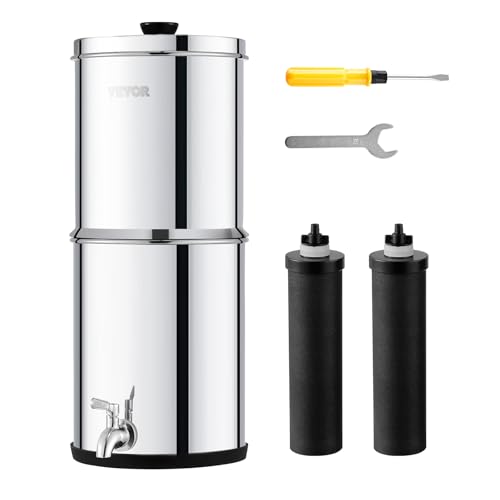
The VEVOR gravity-fed water filter is a 1.45-gallon system built from seamless 304 stainless steel, designed for portability and off-grid use. It comes with two coconut activated carbon filters and a metal spigot. The seamless barrel construction eliminates welds that could crack over time, reducing the risk of leaks — a common failure point on cheaper gravity systems. The unit compresses to roughly half its assembled height for storage, making it practical for camping, fishing, RV trips, or emergency preparedness.
The setup is simple: attach the two carbon filters with the included gaskets and wing nuts, place the upper chamber on the lower reservoir, fill with tap water, and let gravity do the work. Each filter pair is rated to last up to 6,000 gallons. The filtration speed is typical for gravity-fed systems — expect the lower chamber to fill over the course of thirty to forty minutes depending on water quality and filter condition. The system removes 99% of chlorine, heavy metals, sediment, and rust, and improves taste significantly. It does not reduce TDS.
Customer feedback consistently compares the VEVOR to the Berkey at a fraction of the cost, with most users reporting no leaks when the filters are installed correctly (the key is to use both gaskets per filter and not overfill the upper chamber). A few buyers noted that the unit ships with only carbon filters even when the listing indicates a fluoride reduction option — check the included components before ordering if fluoride reduction is a priority. For pure gravity-fed filtration on a budget, this is a solid, durable choice that does not compromise on build quality.
Why it’s great
- Seamless 304 stainless steel barrel resists leaks and corrosion
- Compact when stored — collapses to half height for portability
- Filter pair lasts up to 6,000 gallons
- No electricity or plumbing required
Good to know
- Gravity-fed filtration is slower than direct-connect models
- Some orders may not include the listed fluoride filter
- Does not reduce TDS; retains beneficial minerals
- Requires careful filter priming and gasket alignment to avoid leaks
5. OEMIRY OM-CF01 Stainless Steel

The OEMIRY OM-CF01 is a direct-connect faucet water filter with a housing made from 304 food-grade stainless steel, featuring a brushed finish and a 1mm thickened wall that resists corrosion better than ABS plastic alternatives. It uses a multistage filtration system — sediment pre-filter, activated carbon, and a mineral retention layer — that reduces up to 99% of chlorine, heavy metals, fluoride, and hydrogen sulfide while preserving beneficial calcium, magnesium, and potassium. It does not reduce TDS.
Flow rate is rated at 1.6 gallons per minute, which is fast enough to fill an eight-ounce glass in under three seconds. Installation takes under three minutes and requires no tools beyond the included wrench and adapters. It comes with six adapter sizes to fit most standard kitchen faucets, plus Teflon tape for a leak-free seal. The unit is not compatible with pullout, handheld, spray-style, or sensor faucets — standard thread faucets only. The filter is rated for 8,000 gallons or twelve months of use on municipal water, whichever comes first.
Customer feedback highlights the leak-free operation, the small footprint, and the noticeable improvement in taste. Some users report that the faucet diverter screw can be challenging to align on certain faucet types, and the unit does not include a drip plate or hose holder, so the diverting line may need to be taped in place. Replacement filters are available under ASIN B0B28YCF1Q. For a direct-connect filter that will not rust or crack over years of use, the stainless steel OM-CF01 is a compelling mid-range option.
Why it’s great
- 304 stainless steel housing with 1mm wall resists corrosion
- Fast 1.6 GPM flow rate — fills a glass in seconds
- 8,000 gallon or 12-month filter lifespan
- Includes six faucet adapters for broad compatibility
Good to know
- Not compatible with pullout, handheld, or sensor faucets
- No drip plate included; may require taping the line
- Does not reduce TDS; retains minerals
- Faucet alignment can be tricky on some thread types
6. OEMIRY OM-CF04 Alkaline

The OEMIRY OM-CF04 is a direct-connect countertop filter that uses multistage filtration with an alkaline stage to raise pH and add beneficial minerals — potassium, calcium, sodium, and magnesium — while reducing 99% of chlorine, heavy metals, and other contaminants. The housing is made from environmentally friendly ABS plastic, which keeps the weight low (3.8 pounds) and the cost down. It does not reduce TDS, nor is it designed to: the goal is to produce alkaline drinking water with a clean taste and zero wastewater.
The flow rate is 1.6 gallons per minute, identical to the stainless steel model, and installation follows the same tool-free process with the included six adapters and Teflon tape. Filter lifespan is rated at 8,000 gallons or twelve months. The unit is only compatible with standard kitchen faucets — pull-out, handheld, spray-style, or sensor faucets will not work. The compact dimensions (5.5″ x 5.5″ x 12.4″) mean it takes up very little counter space, which is a major plus for small kitchens or RVs.
Customer reviews are overwhelmingly positive, with the most common praise centered on the easy installation and the immediate improvement in taste. Well water users report that the filter removes the metallic or sulfur notes that made their tap water unpleasant. The main drawbacks are the ABS plastic housing, which is not as durable as stainless steel over the long term, and the lack of a drip plate or hose management solution. If you want an affordable, no-fuss alkaline water filter that does not require electricity or plumbing, the OM-CF04 is a smart entry-level choice.
Why it’s great
- Fast 1.6 GPM flow — fills a cup in seconds
- Alkaline stage adds beneficial minerals and raises pH
- Compact and lightweight (3.8 pounds)
- Filter rated for 8,000 gallons or 12 months
Good to know
- ABS plastic housing less durable than stainless steel
- Does not reduce TDS; retains minerals
- Only compatible with standard faucets
- No drip plate or line holder included
7. Waterdrop ED25TW Rechargeable
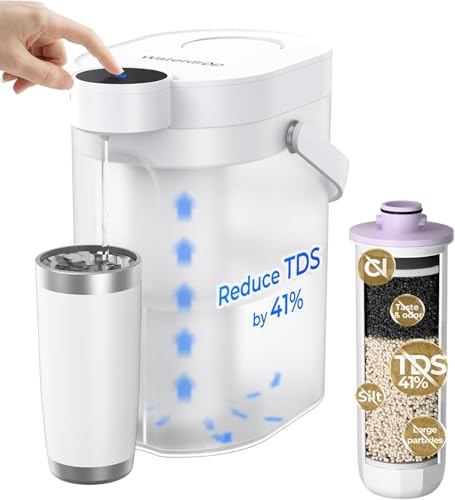
The Waterdrop ED25TW is a rechargeable electric water filter dispenser that uses a 5-stage filtration system to reduce TDS by approximately 41% while retaining beneficial minerals like calcium and magnesium. This is a significant distinction from most countertop carbon filters, which do not reduce TDS at all. The unit is battery-powered with a built-in rechargeable battery that lasts up to 20 days on a single charge, and it charges via USB-C. It has a capacity of 3.55 liters (about 15 cups) and dispenses water instantly at the push of a button — no waiting for gravity filtration or refilling a reservoir.
The filtration system uses activated carbon and carbon block media to reduce chlorine, odors, sediments, and over 20 other contaminants. The TDS reduction claim is verified by third-party laboratory testing. The unit includes a smart indicator that flashes red when the battery is low and signals when the filter needs replacement. The dimensions are 10.3 inches tall by 6.5 inches wide, and it sits proudly on the counter with a slim footprint. It is portable enough to move between kitchen, office, and RV without any installation.
User feedback is consistently positive, with the majority of customers reporting a noticeable improvement in water taste and a smooth user experience. The button to activate the water flow can be a bit sensitive and may require a deliberate press, but this is a minor quirk. The battery life often exceeds the advertised 20 days in practice, with some users reporting months between charges. The primary limitation is the relatively small capacity compared to direct-connect or gravity-fed systems — at 3.55 liters, you will need to refill from the faucet if you drink heavily throughout the day.
Why it’s great
- Reduces TDS by ~41% while retaining healthy minerals
- Battery-powered with USB-C charging — no wall outlet needed
- Instant dispensing at the push of a button
- Third-party tested for contaminant reduction
Good to know
- Small capacity (3.55L) compared to direct-connect units
- Button can be tricky to press accurately
- Requires periodic charging — not indefinite battery life
- Filter replacements add to annual cost
FAQ
Does an on-counter water filter reduce TDS?
How often do I need to replace the filter on a countertop water filter?
Can I install an on-counter water filter myself?
Are on-counter water filters compatible with pullout faucets?
Final Thoughts: The Verdict
For most users, the best on-counter water filter winner is the Brondell H630 Cypress because it combines NSF-certified three-stage filtration with a compact countertop footprint and no need for under-sink plumbing. If you want instant push-button dispensing without any installation at all, grab the Brita Hub. And for a gravity-fed system that serves a family without electricity, nothing beats the Waterdrop King Tank for sheer value and capacity.