An office water filtration system has to survive a demanding environment: high daily volume, a stream of different users, limited maintenance windows, and zero tolerance for leaks or slow flow. The wrong choice means bottles stacked in the breakroom, recurring filter changes that get ignored, or a machine that takes up half the counter and still struggles to fill a 16-ounce cup.
I’m Mohammad Maruf — the founder and writer behind AirfryerBite. I’ve spent years analyzing commercial-grade filtration specs, comparing flow rates at various PSI, dissecting filter media compositions, and cross-referencing lab certifications to separate systems that perform under real office loads from those that only look good on paper.
After evaluating nine leading options across countertop, under-sink, gravity-fed, and point-of-use designs, one set of specs repeatedly separated the workhorses from the headaches. This guide breaks down everything you need to secure the right office water filtration system for your team’s actual daily usage.
How To Choose The Best Office Water Filtration System
Picking the wrong system for a workplace creates a cascade of downstream problems: low staff adoption, forgotten maintenance schedules, slow flow that frustrates during peak hours, and recurring costs that quietly eat the budget. Focus on these five criteria to avoid those traps.
Total Daily Capacity vs. Employee Count
A system that filters 12 gallons per day might satisfy a 5-person startup, but it will strand a 25-person office with an empty reservoir by 11 a.m. Calculate roughly half a gallon per employee per eight-hour shift, then double that for peak demand. Countertop units with 3-liter tanks work for small teams; larger gravity-fed or tankless systems with 500+ gallon-per-day membranes suit medium to large offices.
Filtration Technology: RO vs. Carbon Block vs. Gravity
Reverse osmosis reduces total dissolved solids below 20 ppm, which removes everything from lead to PFAS, but it wastes water (typical 3:1 to 1:1 pure-to-drain ratio) and requires electricity. Carbon block systems preserve minerals and produce zero wastewater but don’t remove dissolved solids that cause scale buildup. Gravity-fed systems like the Big Berkey need no power and handle high-volume filling without electricity, but their filter elements require periodic cleaning and have a slower initial flow.
NSF/ANSI Certifications for Office Liability
A system installed in a workplace should carry at least NSF/ANSI 42 (aesthetic effects like chlorine taste and odor) and NSF/ANSI 53 (health-related contaminant reduction like lead and VOCs). For RO systems, NSF/ANSI 58 is the relevant standard. NSF/ANSI 372 confirms lead-free materials. These certifications provide legally defensible evidence that the system actually reduces the contaminants it claims to remove.
Maintenance Frequency and Filter Cost
Office systems get maintained when the water stops flowing, not on a calendar schedule. Look for replacement intervals of at least six months per filter set, with clearly labeled cartridges that don’t require tools to swap. Gravity-fed Berkey elements last up to 6,000 gallons per pair — years in most offices. Countertop RO filters typically need replacement every 6 to 12 months. Factor in annual filter cost and whether the system reminds you when to change them.
Physical Footprint and Installation Requirements
Countertop units need 14 to 16 inches of vertical clearance under cabinets and a power outlet nearby. Under-sink tankless RO systems like the iSpring RCS5T require drilling a hole in the countertop or sink deck for the dedicated faucet. Wall-mounted coolers like the Elkay EZS8L need a 115V outlet and a water line connection. Measure your breakroom’s available counter or wall space and confirm whether your office’s plumbing setup supports the installation type before buying.
Quick Comparison
On smaller screens, swipe sideways to see the full table.
| Model | Category | Best For | Key Spec | Amazon |
|---|---|---|---|---|
| DREO WF511 Upgraded | Countertop RO | Medium Office (5-15 people) | 5L capacity + 2 pitchers, 7-stage RO | Amazon |
| iSpring RCS5T | Under-Sink Tankless RO | Large Office (15+ people) | 500 GPD membrane, 1.5:1 drain ratio | Amazon |
| Big Berkey | Gravity-Fed | Offices without power or plumbing | 2.25-gallon capacity, 6,000-gallon filter life | Amazon |
| Elkay EZS8L | Wall-Mounted Cooler | High-traffic office hallways | 8 GPH chilled capacity, ADA compliant | Amazon |
| Aigerri UV RO | Countertop RO + UV | Small Office with space constraints | 5L tank, 5:1 pure-to-drain ratio | Amazon |
| Brita Hub | Countertop Carbon Block | Small Office (2-5 people) | 12-cup reservoir, 6-month filter | Amazon |
| Express Water EZRO5 | Countertop RO | Budget-minded small teams | 4-stage RO, 12 GPD capacity | Amazon |
| DREO RO 112 | Countertop RO | 1-2 person office desk | 3L tank + 1.1L pitcher, real-time TDS | Amazon |
| Frizzlife DS99 | Countertop Carbon Block | Entry-level office upgrade | 2 GPM flow, 0.5 micron, stainless steel | Amazon |
In‑Depth Reviews
1. DREO WF511 Upgraded 7-Stage Countertop RO
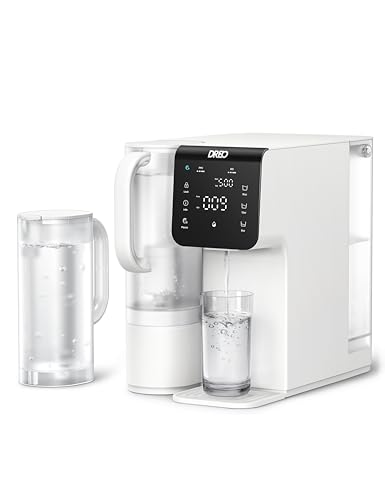
The DREO WF511 packs a 7-layer RO membrane with a 0.0001-micron pore size, reducing over 1,000 contaminants per SGS testing. The 5-liter raw water tank feeds two separate BPA-free pitchers, so one can chill in the fridge while the other sits on the unit auto-refilling — a practical workflow for a mid-sized office breakroom. Real-time TDS readings and filter life tracking on the touchscreen eliminate the guesswork around maintenance scheduling.
Setup requires zero plumbing: fill the tank, plug into a standard outlet, and flush twice. The 3:1 pure-to-drain ratio is decent for a countertop RO, though the unit measures 15.9 inches wide and weighs 14.6 pounds, so it needs dedicated counter space. The child lock prevents accidental dispenses in a shared environment.
Customers consistently report TDS dropping from 350-400 ppm to single digits, with noticeably cleaner taste for coffee and tea. Some users note the single-glass dispense mode only works when the pitcher is seated on the machine, which can feel limiting — but the two-pitcher system largely offsets that constraint.
Why it’s great
- Seven-stage filtration with 0.0001-micron RO membrane removes PFAS, lead, fluoride, and chlorine
- Two auto-refilling pitchers allow simultaneous chilling and dispensing
- Real-time TDS meter and filter life indicator enable proactive maintenance
Good to know
- Requires significant counter space (nearly 16 inches wide)
- Single-glass dispense only functions when pitcher is docked on unit
- 3:1 pure-to-drain ratio still wastes some water compared to higher-efficiency models
2. iSpring RCS5T Commercial Tankless RO
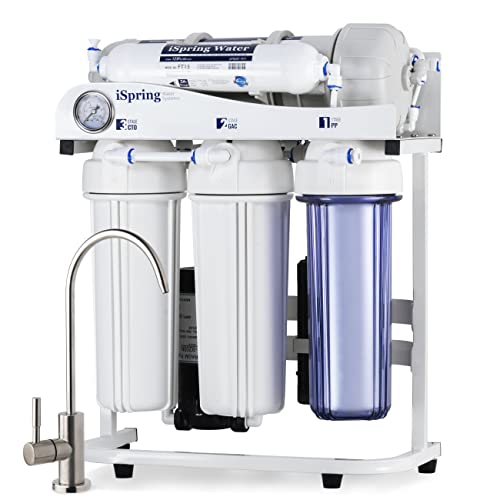
The iSpring RCS5T is built for continuous high-volume duty. Its 500-gallon-per-day membrane, combined with a built-in booster pump that compensates for low water pressure, makes it suitable for offices, breakrooms, and light commercial kitchens. The 5-stage filtration train starts with a sediment filter and carbon block to handle PFAS and chlorine, then hits the RO membrane, and finishes with a final polishing carbon stage.
Installation requires under-sink space measuring 14 by 11 by 18 inches and a standard 115V outlet for the booster pump. A dedicated chrome faucet with 360-degree swivel feeds the dispense point. The pressure gauge gives a quick visual check on system health, and the clear first-stage housing allows easy sediment inspection without disassembly.
Long-term owners report the unit running for 6+ years with routine filter changes. Some users note the membrane is rated for roughly 1,500 gallons — at 500 GPD output, heavy commercial use can deplete it faster than expected. Customer service from iSpring receives consistent praise for diagnosing issues remotely.
Why it’s great
- 500 GPD membrane handles high-volume office demand without a storage tank
- Booster pump ensures consistent production even under low incoming water pressure
- 1.5:1 pure-to-drain ratio reduces wastewater compared to older RO designs
Good to know
- Requires under-sink installation with a dedicated faucet and power outlet
- Membrane replacement cost can add up if run near maximum capacity continuously
- Setup is more involved compared to plug-and-play countertop systems
3. Big Berkey Gravity-Fed Water Filter System
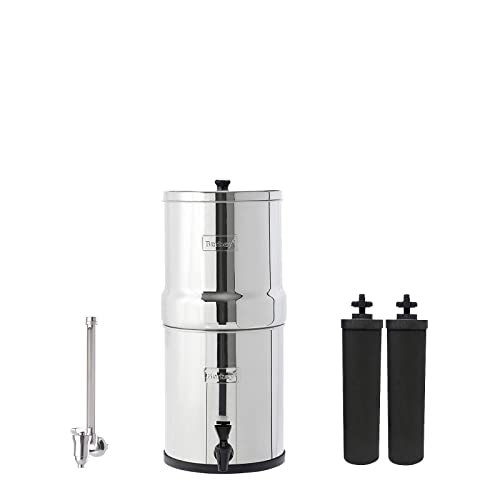
The Big Berkey operates on a fundamentally different principle than electric systems: gravity. Pour water into the upper chamber, and it passes through two Black Berkey Elements using a proprietary blend of multiple media types — not just activated carbon — to reduce over 250 contaminants including heavy metals, pesticides, and pathogenic bacteria. No electricity, no plumbing, no booster pump.
The 2.25-gallon stainless steel body with the deluxe 7-inch Water View spigot shows the remaining water level through a glass tube, eliminating the need to lift the top chamber. The system stands about 19 inches tall and sits on a countertop, making it ideal for offices where installing a dedicated water line or running electrical is impractical.
Each pair of Black Berkey Elements delivers up to 6,000 gallons before replacement, which translates to years of service in most office settings. Multiple verified users confirm that the red dye test works — the system removes both visible dye and invisible contaminants. The initial priming process requires thorough saturation of the filters, and the glass spigot insert must be seated firmly to prevent leaks.
Why it’s great
- Zero electricity or plumbing required — works anywhere with a water source
- 6,000-gallon filter life per pair dramatically reduces ongoing maintenance costs
- Stainless steel construction with visible water level spigot eliminates guesswork
Good to know
- Gravity-fed flow is slower than pressurized systems — filling the lower chamber takes about an hour
- Initial filter priming is a multi-step process that must be done correctly to avoid leaks
- 19-inch height may not fit under standard overhead cabinets
4. Elkay EZS8L Barrier Free Water Cooler
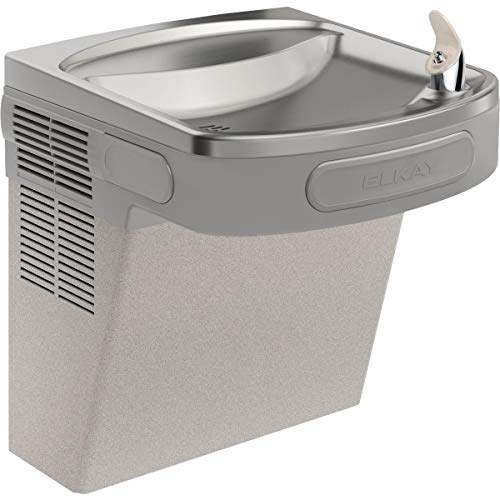
The Elkay EZS8L is the most traditional office water solution on this list — a wall-mounted, ADA-compliant drinking fountain that delivers 8 gallons per hour of chilled water. The electronic push-bar activation and Flexi-Guard antimicrobial bubbler mouth guard address hygiene concerns in shared spaces. The fastenerless integrated drain reduces debris accumulation and simplifies janitorial cleaning.
Installation requires a 115V power source and a supply line connection. The unit measures 18.38 inches wide by 19.81 inches tall and mounts at standard ADA height, making it accessible for wheelchair users and standing employees alike. At 44 pounds, it requires secure wall mounting.
Multiple users with institutional buying experience note this unit directly replaces older Oasis coolers with a shorter install time and noticeably quieter operation. The 8 GPH capacity is appropriate for medium-traffic hallways, breakrooms, and waiting areas. The vinyl-clad finish is industrial-grade and holds up well in public environments.
Why it’s great
- ADA-compliant design ensures accessibility for all employees and visitors
- 8 GPH chilled capacity keeps up with peak breakroom demand
- Low noise level and easy-to-clean drain reduce maintenance friction
Good to know
- Requires professional installation with dedicated plumbing and electrical
- No built-in filtration — must be paired with an in-line filter system for contaminant reduction
- At 44 pounds and wall-mounted, relocation after installation is not practical
5. Aigerri UV Countertop Reverse Osmosis

The Aigerri combines a 5-stage RO membrane with a UV sterilization stage, providing dual protection against chemical contaminants and microbiological hazards. The 5-liter raw water reservoir and 2-liter purified tank serve small to medium office teams, while the 5:1 pure-to-drain ratio is among the most water-efficient in the countertop RO category.
No installation is required — plug in, fill the tank, and use the touch control panel to select water volume options. The unit measures 7.4 by 16.2 by 16.4 inches with the lid closed, and extends to about 21.7 inches with the lid open, so measure vertical clearance before placing under cabinets. Two replacement filter cartridges are included out of the box, covering up to 529 gallons of total capacity.
Customer feedback highlights the noticeable improvement in water clarity and taste compared to standard pitcher filters. Some users report the touch control panel is sensitive and the user manual lacks detail on certain settings. Filter life appears to vary significantly based on incoming water quality.
Why it’s great
- UV stage adds microbial protection beyond standard RO filtration
- 5:1 pure-to-drain ratio minimizes water waste significantly
- Easy plug-and-play setup with no plumbing or drilling required
Good to know
- Lid extends to nearly 22 inches when open — verify clearance
- Included user manual lacks detailed technical guidance
- Filter lifespan varies substantially depending on source water quality
6. Brita Hub Instant Countertop Filter

The Brita Hub is a familiar brand name applied to a countertop carbon-block system with a twist: instant hot or cold dispensing from a 12-cup removable reservoir. The carbon block filter reduces over 70 contaminants including lead, chlorine, and microplastics, and each filter lasts 6 months or 120 gallons. Preset buttons for 12-ounce and 20-ounce fills add convenience for quick water breaks.
Setup is genuinely tool-free — insert the filter, fill the reservoir, plug in, and flush. The spout accommodates glasses and bottles up to 12 inches tall. The machine is compact at 11.4 by 7.5 by 14.4 inches, fitting easily on most breakroom counters. The push-button interface is intuitive enough that new employees can use it without instructions.
Verified buyers praise the fast flow rate and excellent chlorine removal. Some long-term users report the filter can drop out of place during dispensing after a couple of years of use, causing a blinking light that requires filter reseating. The all-plastic construction feels less premium than stainless steel alternatives, and the system does not filter bacteria or dissolved solids.
Why it’s great
- Instant push-button dispensing with 12-ounce and 20-ounce presets
- No installation required and compact footprint fits small counters
- 6-month filter life reduces replacement frequency in low-volume offices
Good to know
- All-plastic construction raises durability concerns in high-traffic shared spaces
- Does not reduce dissolved solids, bacteria, or scale-causing minerals
- Some units experience filter alignment issues after extended use
7. Express Water EZRO5 Countertop RO
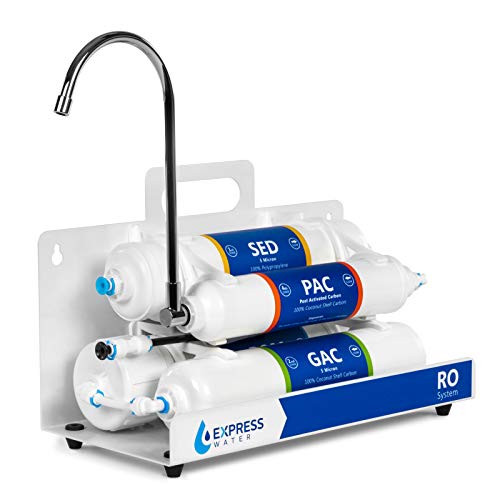
The Express Water EZRO5 brings 4-stage reverse osmosis to the countertop format at a practical price point. Sediment, granular carbon, RO membrane, and post-carbon stages work in sequence to reduce 99.99% of major contaminants. The system outputs 12 gallons per day, which suits a small team of 2 to 4 people who consume water steadily throughout the day.
Installation is a 4-point process that connects to most standard threaded faucets — not compatible with pull-down sprayer heads. The pre-assembled unit requires tightening the RO membrane cap to prevent leaks at the connector. Flow rate is slow: roughly 0.5 to 1 gallon per hour, so filling a 64-ounce container takes about 13 minutes. The 3:1 waste-to-pure ratio is on par with entry-level RO systems.
Customers with high-TDS tap water report significant improvement, reducing TDS from 500+ ppm down to single digits. Some users experienced leaks at the faucet connector due to plastic threading and note that filters require replacement every 6 months, not annually. Support is responsive, frequently sending replacement parts for leaking connections.
Why it’s great
- True 4-stage RO filtration at a budget-friendly entry point for small offices
- Pre-assembled design reduces initial setup complexity
- Significant TDS reduction verified by multiple users with high-ppm source water
Good to know
- Slow production rate — 0.5 to 1 gallon per hour — limits peak refill speed
- Plastic faucet connector can leak; requires careful tightening and occasional support intervention
- 3:1 waste-to-pure ratio is less efficient than modern countertop RO systems
8. DREO Reverse Osmosis Water Filter Countertop (Model 112)
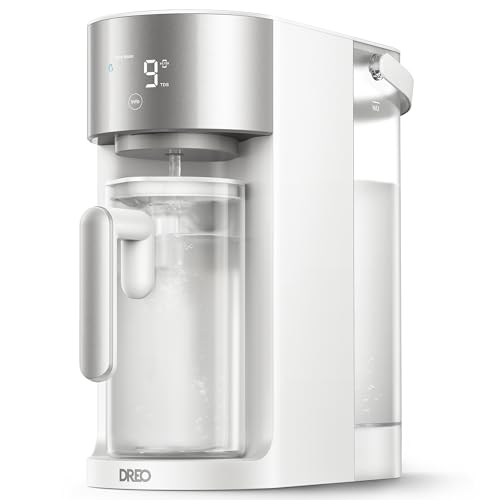
The DREO 112 is the smaller sibling to the WF511, designed for individual desks or very small office setups. It integrates a 3-liter tank with a 1.1-liter auto-fill pitcher, using a 7-in-1 RO filter that meets NSF/ANSI 58 standards to remove 1,000+ impurities including PFOA, PFOS, chlorine, and fluoride. The real-time TDS display shows both raw and filtered water readings.
The unit measures 14.5 by 6.7 by 13.4 inches with a 9.5-pound weight, making it genuinely portable — it can sit on a desk corner or a small breakroom shelf. Setup is as simple as filling the tank and plugging in; the self-cleaning system auto-flushes internal tubes between uses. The 3:1 pure-to-drain ratio is standard for this class, and the twist-to-install filter cartridge replacement takes seconds.
Buyers consistently measure TDS drops from 375-450 ppm down to 12-22 ppm. Some users note that the filtration speed is slow enough that having two pitchers is helpful — one can chill in the fridge while the other refills. The auto-fill sensor works reliably but beeps when the pitcher is full, which may be audible in a quiet office.
Why it’s great
- Compact footprint suitable for desk corners or small breakroom shelves
- Real-time TDS display and filter change reminders simplify maintenance
- NSF/ANSI 58 certified for contaminant reduction reliability
Good to know
- 1.1-liter pitcher is small for multiple consecutive refills during peak use
- Filtration speed is slow — expect several minutes per pitcher cycle
- Audible beep when full may be disruptive in quiet shared office environments
9. Frizzlife DS99 Countertop Water Filter System
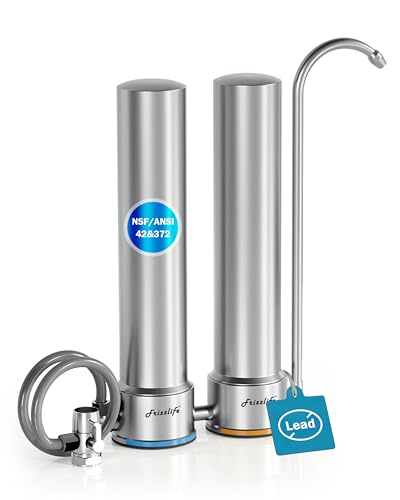
The Frizzlife DS99 is a dual-stage carbon block system with a 0.5-micron filtration precision, housed in food-grade 304 stainless steel with 1-millimeter thickened filter housings. It connects directly to the existing sink faucet using one of six included thread adapters, delivering 2 gallons per minute at 60 psi — the fastest flow rate of any system in this lineup.
Installation takes about 15 minutes with no tools, and the integrated switch lets users toggle between unfiltered tap water and filtered water instantly. The first-stage filter lasts up to 8 months, and the second stage lasts up to 12 months or 8,000 gallons. Replacement requires swapping only the internal cartridges — the stainless steel housings stay in place, reducing plastic waste.
Verified buyers praise the zero-wastewater operation and the fact that no electricity is needed. Some users note residual pressure causes a minor dribble from the filter spout after shutoff, which drains harmlessly into the sink. The system is not compatible with pull-down sprayer faucets, and the thread compatibility should be verified before purchase.
Why it’s great
- 2 GPM flow rate delivers filtered water near instantly — ideal for high-traffic refills
- All-stainless-steel construction with 1-millimeter housing walls is built to last years
- Zero wastewater and no electricity required keep operating costs minimal
Good to know
- Residual pressure creates a post-shutoff dribble that drains into the sink
- Not compatible with pull-down sprayer or non-threaded faucet heads
- Carbon block filtration does not reduce dissolved solids or TDS
FAQ
How many gallons per day does an office of 10 people need from a water filtration system?
What is the difference between a countertop RO system and a faucet-mounted carbon filter for office use?
How often should I replace the filters on an office water filtration system to maintain hygiene?
Why would an office choose a wall-mounted water cooler over a countertop filtration system?
Final Thoughts: The Verdict
For most offices, the office water filtration system winner is the DREO WF511 Upgraded because its 7-stage RO filtration, two-pitcher auto-refill system, and real-time TDS monitoring strike the best balance between contaminant removal, capacity for a medium team, and hassle-free installation. If your office has higher traffic and dedicated under-sink space, the iSpring RCS5T delivers commercial-grade 500 GPD output with significantly lower maintenance frequency. And for a workspace with no available power outlet or plumbing access, nothing beats the Big Berkey for long-term, electricity-free water purification that truly lasts.