A “non-plastic” water filter pitcher promises what every health-conscious kitchen needs: contaminant reduction without chemical leaching from the container itself. Moving away from polycarbonate or Tritan plastic reservoirs means choosing borosilicate glass, stainless steel, or ceramic—each material carrying distinct thermal properties, weight profiles, and durability limits that directly affect daily use, refrigerator fit, and pour control.
I’m Mohammad Maruf — the founder and writer behind AirfryerBite. My research focuses on material safety certifications, filter performance data (NSF/ANSI standards, micron ratings, and flow rates), and real-world user feedback to identify which non-plastic designs actually deliver on filtration speed, capacity, and long-term filter cost.
This guide compares seven of the market’s most compelling options, from mid-range glass pitchers to premium gravity-fed stainless systems, to help you find your ideal non plastic water filter pitcher without getting lost in marketing claims.
How To Choose The Best Non Plastic Water Filter Pitcher
Selecting the right non-plastic pitcher requires evaluating three interconnected factors: the pitcher material’s durability and thermal resistance, the filter technology’s certified removal capabilities, and the system’s flow rate versus your household’s daily water consumption. Pitchers made from borosilicate glass handle thermal shock from hot tap water better than soda-lime glass, while stainless steel gravity systems offer higher capacity but slower filtration.
Filter Certification: NSF/ANSI 42, 53, 372, and Beyond
Activated carbon reduces chlorine taste and odor (NSF/ANSI 42). Ion-exchange resin reduces heavy metals like lead and mercury (NSF/ANSI 53). Ultrafiltration membranes with 0.2-micron pores physically block bacteria and microplastics. A non-plastic pitcher is only as good as its filter—check whether the replacement filters carry third-party certifications before assuming the system removes what the marketing claims. PFOA/PFOS reduction requires specific carbon block or membrane media, not just standard granular activated carbon.
Flow Rate vs. Filtration Patience
Standard gravity pitchers like the LifeStraw Home dispense at roughly 1–2 oz per minute during the first few refills, eventually accelerating to 3–4 oz/min after the carbon filter is saturated. Fast-flow designs like the Waterdrop PT-09W use a multi-layer carbon fiber and resin stack to push 8.5 oz/min, filling an 8-oz glass in under a minute. The trade-off is filter depth: faster systems typically cannot remove bacteria or parasites, which require membrane-based slow filtration. Decide whether you prioritize speed or pathogen removal.
Filter Replacement Cost Over 12 Months
Annual filter expenditure varies wildly across this category. Some pitchers use inexpensive drop-in carbon cartridges that cost roughly – per replacement (2-month lifespan, six replacements per year). Others require proprietary membrane cartridges at – each (6–12 month lifespan). The VEVOR gravity system’s carbon filters last up to 6,000 gallons total, making its per-gallon cost among the lowest—but the initial pitcher price is higher. Map your annual water consumption against the filter’s rated gallon lifespan before committing to a system.
Quick Comparison
On smaller screens, swipe sideways to see the full table.
| Model | Category | Best For | Key Spec | Amazon |
|---|---|---|---|---|
| Puro Glass (1.3L) | Glass / Pour-through | Daily pour-through simplicity | 1.3L capacity / activated carbon | Amazon |
| GLACIER FRESH Purela | Borosilicate glass / Dual filter | Bacteria & PFAS reduction | 10-cup / 0.2-micron membrane | Amazon |
| LifeStraw Home (7-Cup) | Glass / Bacteria + Parasite | Pathogen removal (bacteria/parasites) | 7-cup / membrane microfilter | Amazon |
| Waterdrop PT-09W (10-Cup) | Glass / Fast-flow | High-speed family filtration | 10-cup / 8.5 oz/min flow | Amazon |
| Puro Glass 2-Pack | Glass / Multi-pack | Household redundancy or gifting | 2 x 1.3L / long-life carbon filter | Amazon |
| VEVOR 1.5G Stainless | Stainless steel / Gravity-fed | Off-grid & high-capacity needs | 1.45 gal / 99% chlorine reduction | Amazon |
| Aarke Purifier 2.4L | Glass / Stainless steel / Premium | Design-forward kitchens | 2.4L / refillable stainless filter | Amazon |
In‑Depth Reviews
1. Waterdrop PT-09W 10-Cup Glass Water Filter Pitcher

The Waterdrop PT-09W combines a borosilicate glass body with a 5-stage carbon fiber, ion-exchange resin, and activated carbon block filter that holds NSF/ANSI 42 certification for chlorine reduction and NSF/ANSI 53 for mercury reduction. Its 8.5 oz-per-minute flow rate is roughly 10 times faster than standard gravity pitchers—filling an 8-ounce cup in under a minute—which makes it the most convenient option for a busy household that does not want to wait minutes between refills.
The filter’s 100-gallon lifespan (tested at 200 gallons per NSF protocol) runs approximately 2 months under average use, and the pitcher includes a mechanical reminder dial so you do not forget the replacement cycle. The glass body is non-toxic and sustainable, though there is a sturdy plastic inner liner encased within the glass to reduce thermal stress—purists should note this partial plastic component. The 10-cup (roughly 80 oz) capacity fits most standard refrigerator shelves after some adjustment.
Customers consistently report complete elimination of chlorine taste and odor from municipal tap water, and many highlight the speed improvement over previous plastic pitchers like Brita. The unit is noticeably heavy due to the glass construction, so users with limited hand strength should grip the handle with both hands when pouring. Replacement filters are widely available and reasonably priced given the certified reduction capacity.
Why it’s great
- NSF/ANSI 53 & 42 certified for mercury and chlorine reduction
- Fast 8.5 oz/min flow rate eliminates waiting
- Borosilicate glass body with 10-cup capacity
- 100-gallon filter lifespan with reminder dial
Good to know
- Contains a plastic inner liner inside the glass body
- Heavy design may require two-handed pouring
- Does not filter bacteria or microplastics
2. Aarke Purifier 2.4L Glass and Stainless Steel Water Filter Pitcher

Aarke brings its Swedish industrial design philosophy to water filtration with the Purifier, featuring a hand-blown borosilicate glass carafe, a stainless steel spout and handle (the large version uses recycled Ocean Bound Plastic for the handle), and a patented refillable stainless steel filter cartridge. The system uses granular filter media that you pour into the metal cartridge yourself, eliminating disposable plastic filter housings entirely. The standard size holds 2.4L total with a 1.18L (5-cup) filtration chamber.
Two granule options are available: the Pure filter refill (included) removes chlorine, taste, and odor, while the Enriched granules add magnesium and other minerals. Each refill bag filters up to 120 liters before needing replacement. The entire glass carafe is dishwasher-safe, and the stainless filter cartridge rinses clean—no trapped odors or biofilm buildup like plastic pitchers. Filtration speed is moderate, requiring about 5 minutes for a full batch, which is typical for a gravity-fed design prioritizing contact time over throughput.
Owners consistently praise the aesthetic—the pitcher looks more like a decanter than a kitchen appliance—and the complete absence of plastic in the water path. The unit is heavy (4.4 lb when full), and some users report that the measured TDS reduction is modest compared to carbon block systems. The replacement granule cost is higher per liter than standard drop-in cartridges, making this a deliberate choice for those who prioritize material purity and countertop elegance over absolute filtration breadth.
Why it’s great
- Zero-plastic water path (glass + stainless steel)
- Refillable stainless filter cartridge reduces waste
- Dishwasher-safe glass carafe and components
- Premium Swedish design suitable for countertop display
Good to know
- High per-liter cost for replacement granules
- Moderate flow rate (~5 min per batch)
- No NSF certification for heavy metal reduction
3. LifeStraw Home 7-Cup Glass Water Filter Pitcher

The LifeStraw Home is the only pitcher in this lineup that removes bacteria and parasites in addition to chemicals, microplastics, lead, mercury, and PFAS. It employs a two-stage system: a 0.2-micron hollow-fiber membrane microfilter (1-year lifespan, 264 gallons) that physically blocks pathogens, paired with an activated carbon and ion-exchange cartridge (2-month lifespan, 40 gallons) that handles chlorine, lead, mercury, and herbicides. The pitcher body is thick borosilicate glass with a silicone base for grip.
Filtration speed starts very slow—approximately 10 minutes for the first full filter batch—because the membrane pores require priming and the carbon media needs to saturate. After the first few refills, the flow accelerates to a steadier but still deliberate pace. The 7-cup capacity is smaller than most 10-cup competitors, so heavy users may need to refill more often. The included silicone spout cover helps keep dust out, and the glass body is hand-wash only.
Users who travel to areas with questionable tap water or who have immune-compromised household members consistently rate this pitcher highly for its pathogen-blocking capability. The main complaints center on the slow initial flow and the relatively small capacity. For households that prioritize biological safety over speed, the LifeStraw Home provides filtration breadth that no other non-plastic pitcher in this class matches.
Why it’s great
- Removes bacteria, parasites, microplastics, and PFAS
- Dual-stage membrane + carbon filtration
- 1-year membrane filter lifespan (264 gallons)
- Thick borosilicate glass with silicone base
Good to know
- Very slow initial flow (up to 10 min per batch)
- Small 7-cup capacity requires frequent refills
- Hand-wash only; not dishwasher-safe
4. GLACIER FRESH 10 Cup Purela Glass Water Pitcher
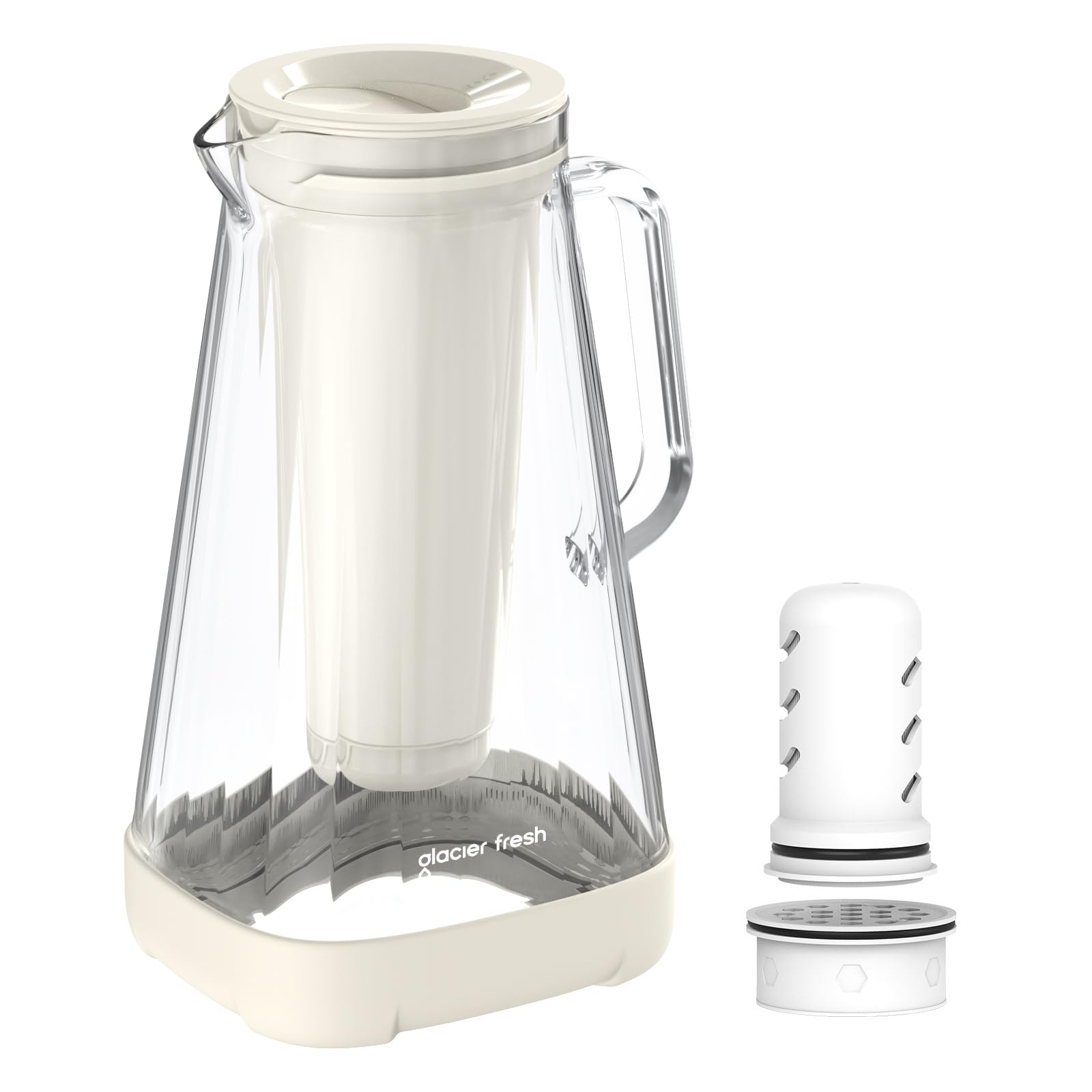
The GLACIER FRESH Purela combines two filtration technologies in one system: an ultrafiltration membrane with 0.2-micron pores that reduces 99% of chlorine, 96% of PFOA and PFOS, and coliform bacteria, plus an activated carbon fiber layer that improves taste and odor. The pitcher body is hand-blown borosilicate glass certified FDA food-grade, and the total capacity is 10 cups (roughly 80 oz). The replacement schedule splits into two cycles: the activated carbon filter needs changing every 40 gallons (2 months), while the membrane microfilter lasts 264 gallons (6–12 months).
The flow rate starts slow during the first uses while the carbon media saturates, but it accelerates to a steady drip that fills the pitcher in 3–5 minutes. Users report that the water tastes significantly fresher than from previous older pitchers, with noticeable reduction in metallic notes and chlorine. The ergonomic handle and spout lid design allow one-handed pouring, though the pitcher is heavy (3.32 lb empty) due to the thick glass construction.
Several buyers note that the initial drip is extremely slow—some reported thinking the unit was defective—but the flow normalizes after about half a gallon of use. The dual-filter system delivers broader contaminant reduction than single-carbon pitchers at a mid-range price point, making this a strong value proposition for households concerned about both chemical and microbial water quality.
Why it’s great
- Ultrafiltration membrane blocks bacteria and PFAS
- Borosilicate glass body with FDA certification
- 10-cup capacity fits standard fridge shelves
- Cost-effective dual-filter system
Good to know
- Very slow flow during initial use/priming
- Heavy construction may challenge some users
- Two separate filter replacement schedules to track
5. VEVOR 1.5G Gravity-fed Water Filter System
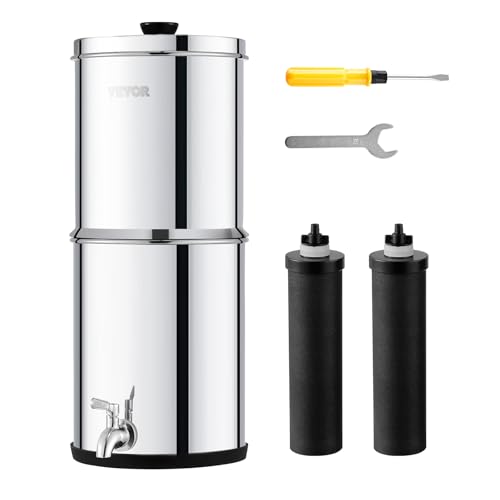
The VEVOR gravity-fed system departs from the pitcher format entirely, using two stacked 304 stainless steel chambers that hold a combined 1.45 gallons of water. Water flows through coconut activated carbon filters by gravity alone—no electricity, no pumps—and the system reduces 99% of chlorine, plus heavy metals, sediment, rust, and soil. The stainless steel construction is seamless with no welds or plastic components in the water path, making it fully BPA-free and corrosion-resistant.
Each pair of carbon filters lasts up to 6,000 gallons, a lifespan that dwarfs any pitcher-based system. The initial flow rate is about 1 gallon per hour, but it maintains consistent output over years of use. The system comes with a stainless steel spigot and all necessary fittings. At 5.4 lb empty, it is far heavier than any glass pitcher, and its 18-inch height means it does not fit in most refrigerator doors—it is designed for countertop use or off-grid setups.
Reviews frequently compare the VEVOR to the far more expensive Berkey systems, noting identical filtration performance at roughly one-quarter the cost. Some users report that the system leaks if overfilled past the indicated fill line, and a few received incorrect filter types (carbon instead of fluoride-reduction). For households that drink large volumes of water daily or need portability for camping or RV use, the VEVOR provides the best per-gallon cost in this roundup.
Why it’s great
- 6,000-gallon filter lifespan—lowest per-gallon cost
- Zero plastic in the water path (304 stainless steel)
- Large 1.45-gallon capacity for big households
- Compact storage (folds to half volume)
Good to know
- Slow 1-gal-per-hour gravity flow rate
- Too tall for standard refrigerator shelves
- Some units shipped with incorrect filter types
6. Puro Glass Water Filter Pitcher 2-Pack

The Puro Glass 2-Pack provides two identical 1.3L glass pitchers with activated carbon filters that remove chlorine, lead, odors, rust, and impurities during the pour-through process. Each filter is rated to replace 1,600 plastic water bottles before needing replacement. The pitchers feature a protective spout cover and a design that filters water as you pour, meaning there is no waiting between fill and drink—the water passes through the carbon media on its way out.
The 2-pack configuration lets one household keep a pitcher on the counter and another in the fridge, or use one for drinking water and a second for cooking. The glass body is lightweight compared to borosilicate alternatives, and the compact 5.56-inch diameter fits easily in refrigerator door bins. Filtration speed is faster than gravity-fed systems because the carbon block is small and the water passes through under manual pressure rather than gravity alone, though some users note that pouring too fast reduces contact time and filtration effectiveness.
Several reviews mention that the plastic closing cap on the spout may fail over time—the hinge appears to be a weak point. Replacement filters are more expensive than generic options (– per filter), which is a significant long-term cost for a system that does not remove bacteria or PFAS. The 2-pack is best suited for users who want the simplicity of pour-through glass filtration without needing advanced contaminant removal.
Why it’s great
- Instant pour-through filtration—no waiting
- Two pitchers for fridge + countertop use
- Compact 5.6-inch diameter fits door bins
- Lightweight glass body
Good to know
- Plastic spout cap hinge prone to breaking
- Higher long-term filter replacement cost
- Does not remove bacteria or PFAS
7. Puro Glass Water Filter Pitcher (1.3L Single)

The single Puro Glass 1.3L pitcher is the entry-level option in this lineup, using the same pour-through activated carbon filter and compact glass body as the 2-pack but sold as a single unit. It filters chlorine, lead, odors, rust, and impurities on the pour, requiring no wait time—the water passes through the carbon media as it exits the spout. The slender 5.56-inch diameter and 13.7-inch height slide into narrow fridge door shelves where bulkier pitchers cannot fit.
Because the filter is small and the contact time is brief, this system works best with municipally treated tap water that already meets safety standards—its primary job is improving taste by removing chlorine and odor, not tackling heavy contamination. The lightweight glass body is easy to handle even when full, unlike heavier borosilicate alternatives. The protective spout cover keeps dust and fridge odors out when stored.
Customer feedback highlights the noticeable improvement in taste compared to unfiltered tap water, with many users confirming that odors and metallic flavors disappear after the first pour. The main durability concern is the plastic hinge on the spout cover, which some owners report cracking after 6–12 months of use. Replacement filter costs are above average compared to Brita-style cartridges, though each filter handles 1,600 bottles’ worth of water before needing replacement. For a budget-friendly entry into glass filtration, this pitcher delivers on its core promise.
Why it’s great
- No-wait pour-through filtration
- Slim profile fits narrow fridge shelves
- Lightweight glass body is easy to handle
- Each filter replaces 1,600 plastic bottles
Good to know
- Plastic spout cover hinge is a failure point
- Higher per-filter cost than generic alternatives
- Limited contaminant removal (no bacteria or PFAS)
FAQ
Does a non-plastic water filter pitcher remove microplastics?
How often must I replace the filter in a glass water filter pitcher?
Can I put a borosilicate glass pitcher in the dishwasher?
What does NSF/ANSI 53 certification actually guarantee?
Final Thoughts: The Verdict
For most users, the non plastic water filter pitcher winner is the Waterdrop PT-09W because it combines fast 8.5 oz/min flow, NSF/ANSI 53 & 42 certified contaminant reduction, and a durable borosilicate glass body at a mid-range price point. If you need bacteria and parasite removal, grab the LifeStraw Home for its membrane-based pathogen blocking. And for off-grid or high-volume households, nothing beats the VEVOR gravity system with its 6,000-gallon filter lifespan and fully stainless steel construction.