The sound of a sharp knife on a dense wood board versus the slick slide on a tempered glass surface defines the modern kitchen. Moving away from polyethylene sheets is not just about aesthetics—it is about eliminating the microplastic shedding that occurs with every slice. High-quality non-plastic alternatives offer a cleaner, more durable prep experience that serious home cooks prioritize.
I’m Mohammad Maruf — the founder and writer behind AirfryerBite. I’ve spent years analyzing the material density, porosity, and knife-safe properties of natural-surface boards to identify which options resist warping and bacterial growth without introducing synthetic polymers into your meal prep.
After comparing construction methods, hardness ratings, and long-term maintenance requirements across multiple materials, I have assembled a definitive list of the best non-plastic cutting boards that balance hygiene, knife longevity, and everyday practicality.
How To Choose The Best Non-Plastic Cutting Boards
Selecting a non-plastic cutting board requires weighing material hardness against knife edge preservation. Glass offers extreme sanitation but can dull blades quickly, while dense hardwoods like acacia resist cuts and are gentler on steel but demand regular oiling. Understanding these trade-offs ensures you pick a board that matches your cutting style and maintenance tolerance.
Material Hardness vs. Knife Safety
Glass boards score very high on the hardness scale, making them impervious to deep scratches and bacterial harboring—but that same rigidity can chip or dull a fine chef’s knife edge with repeated use. Bamboo and acacia wood have a natural give that absorbs blade impact, extending the life of your cutlery. The key spec here is the Janka hardness rating: bamboo typically ranges around 1,400 lbf, while acacia can exceed 2,300 lbf. Softer hardwoods are more forgiving on knives but may show wear sooner.
Construction and Bonding Methods
Many bamboo boards are glued together using resins that may contain formaldehyde. Premium options now feature glue-free surface technology, where the cutting area is formed from a single piece or compressed without synthetic adhesives. This eliminates a major source of chemical migration into food. For glass boards, the critical spec is the tempered rating—boards certified to withstand 150°C continuous heat and resist thermal shock provide the highest level of safety and durability.
Thickness, Weight, and Stability
A board that slides around during use is a safety hazard. Look for rubberized silicone feet on glass boards to prevent slipping, or a thickness of at least 1 inch on wood boards—the added mass provides natural stability. Boards under 0.75 inches thick are prone to warping over time, especially in humid kitchens. Heavier boards, around 3.3 to 4.4 pounds, stay put on the counter without needing a damp towel underneath.
Quick Comparison
On smaller screens, swipe sideways to see the full table.
| Model | Category | Best For | Key Spec | Amazon |
|---|---|---|---|---|
| GAOMON Acacia | Premium Hardwood | Heavy prep with juice control | 20″ x 15″ x 1.5″ thick | Amazon |
| Greener Chef Bamboo | Glue-Free Set | Multi-size prep with toxin safety | Glue-free surface technology | Amazon |
| Keechee Bamboo | Dishwasher-Safe | Easy cleaning and light storage | 14″ x 10.6″ x 0.4″ thick | Amazon |
| LANGBOHOS Glass | Tempered Glass | Sanitary prep with easy cleaning | 16″ x 12″ x 0.8″ thick | Amazon |
| Socisen Bamboo | Entry-Level Hardwood | Budget-friendly daily chopping | 5-layer laminated bamboo | Amazon |
In‑Depth Reviews
1. GAOMON 20 Inch Acacia Wood Cutting Board

The GAOMON acacia board is a heavy-duty workhorse at 20 inches long and 1.5 inches thick. Its dense acacia construction offers a Janka hardness of around 2,300 lbf, which resists deep gauging while providing enough natural flex to protect knife edges. The deep juice groove on one side efficiently channels liquids away from your prep area, making it ideal for carving meats or slicing juicy fruits.
Reversible design adds flexibility—use the grooved side for proteins and the flat side for vegetables or as a serving board. The wood grain varies piece by piece, giving each board a unique character. At 3.74 kg (about 8.2 pounds), this board stays planted on the counter without slipping during vigorous chopping, though the weight makes it less portable for quick transfers.
Maintenance requires periodic mineral oil application (every few weeks initially) to prevent the acacia from drying and cracking. Hand washing with mild soap and immediate drying preserves the finish. This is the best choice for cooks who want a single, expansive surface that doubles as a charcuterie board for entertaining.
Why it’s great
- Exceptional 1.5-inch thickness ensures zero warping over time
- Deep juice groove prevents countertop messes during meat prep
- Reversible surface adds serving functionality
Good to know
- Heavy weight (8.2 lbs) makes it less portable
- Requires routine mineral oil conditioning
2. Greener Chef Bamboo Cutting Board Set of 3
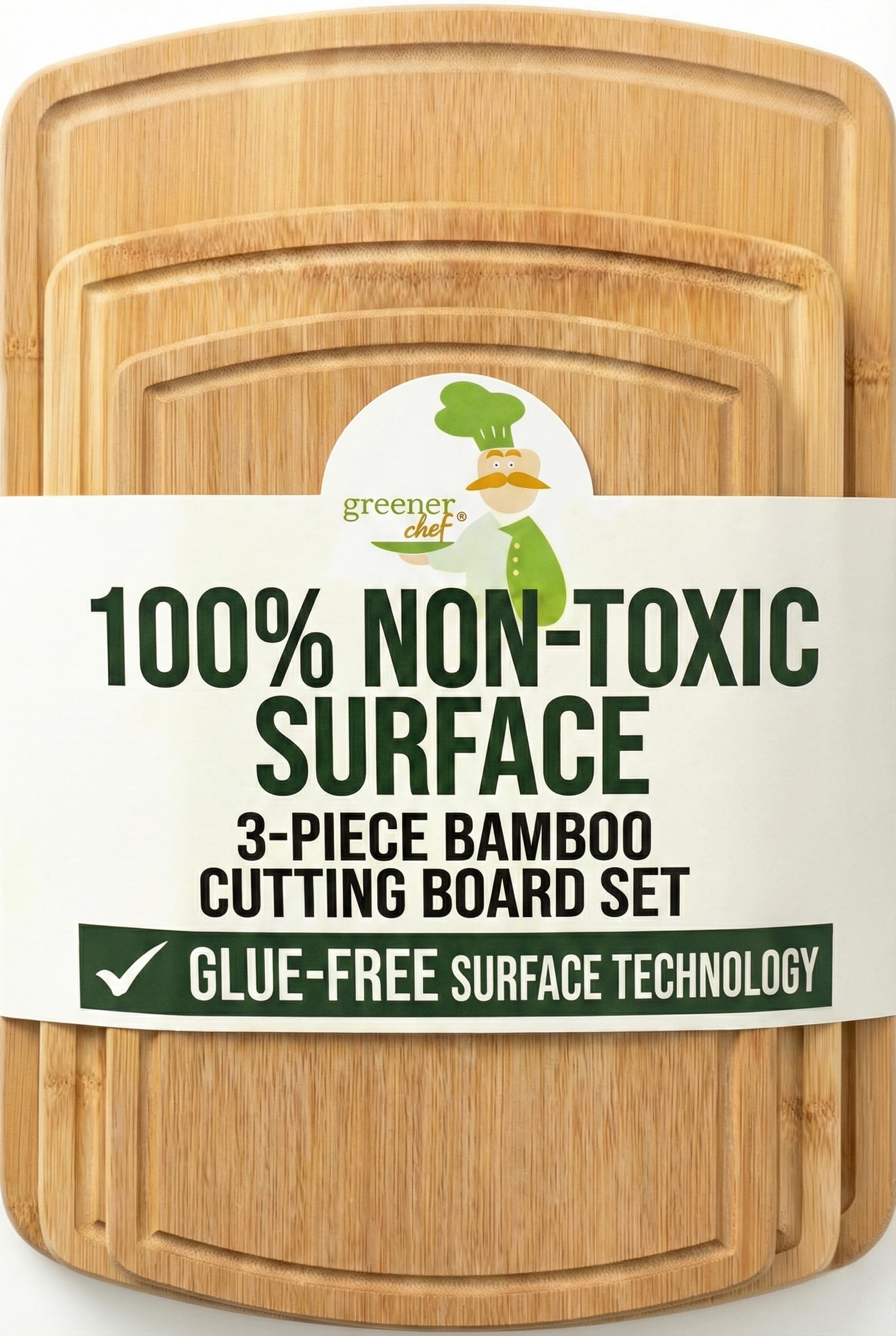
Greener Chef eliminates a major concern with bamboo boards: adhesive-based toxins. Their patent-pending glue-free surface technology means the cutting area contains zero formaldehyde or synthetic resins, making these boards a strong candidate for those who prioritize chemical-free food prep. The set includes three sizes (18×12.5″, 15×11″, and 12×9″), so you can dedicate one board to raw poultry, another to vegetables, and a third for bread without cross-contamination.
At just 0.63 inches thick, these boards are noticeably lighter than traditional butcher blocks, reducing strain when moving from counter to sink. The lightweight build does come with a trade-off—they are more prone to sliding on smooth countertops, so a damp towel underneath is recommended for stability. The rounded edges and smooth surface make them comfortable to grip and flip.
Each board is hand-sanded and finished with food-grade mineral oil at the factory. Care is straightforward: hand wash with soap and air dry—never submerge or run through a dishwasher. The bamboo has a medium Janka hardness (around 1,400 lbf), which is gentle on knife edges compared to glass or hard maple. Greener Chef backs the set with a lifetime replacement guarantee, adding confidence for long-term use.
Why it’s great
- Glue-free cutting surface eliminates formaldehyde concerns
- Three sizes allow dedicated boards for different food types
- Lifetime replacement warranty
Good to know
- Thin 0.63-inch build may slide without a towel underneath
- Not dishwasher-safe; hand washing required
3. Keechee Dishwasher-Safe Bamboo Cutting Board
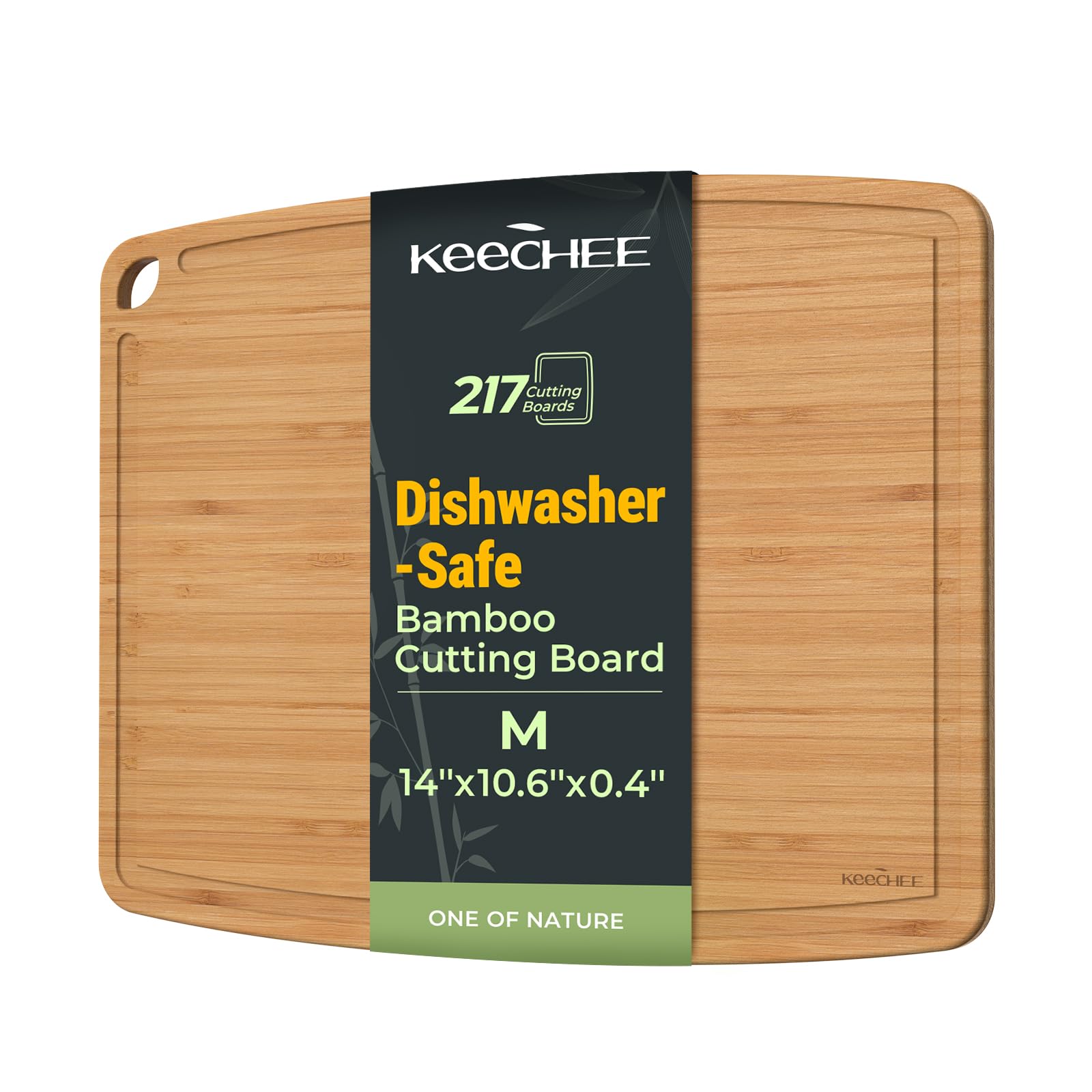
Keechee solves the biggest pain point of wood cutting boards: the inability to run them through a dishwasher. Their specially engineered bamboo withstands the heat and moisture of a standard dishwasher cycle without warping or cracking. This makes it a practical choice for home cooks who value convenience but refuse to use plastic boards that trap bacteria in knife grooves.
The board measures 14 x 10.6 inches with a slim 0.4-inch profile, making it lightweight at 1.6 pounds. It is reversible—one side has a juice groove for meats and the other is flat for vegetables or serving charcuterie. The carbonized bamboo finish gives it a rich brown color that hides stains better than lighter woods. Lab testing shows no splinter development after repeated use, which is a common issue with lower-quality bamboo boards.
While the thin profile is easy to store and carry, it does not have the heft of thicker boards—placing a damp towel underneath improves stability on very smooth countertops. The board comes in a premium gift box, making it a solid option for housewarming presents. Keechee includes a 1-year warranty and 24/7 support for peace of mind.
Why it’s great
- Certified dishwasher-safe without warping
- Lightweight at 1.6 pounds for easy handling
- Reversible with juice groove on one side
Good to know
- Slim 0.4-inch profile may slide on smooth counters
- Smaller surface area than full-size boards
4. LANGBOHOS Tempered Glass Cutting Board Set
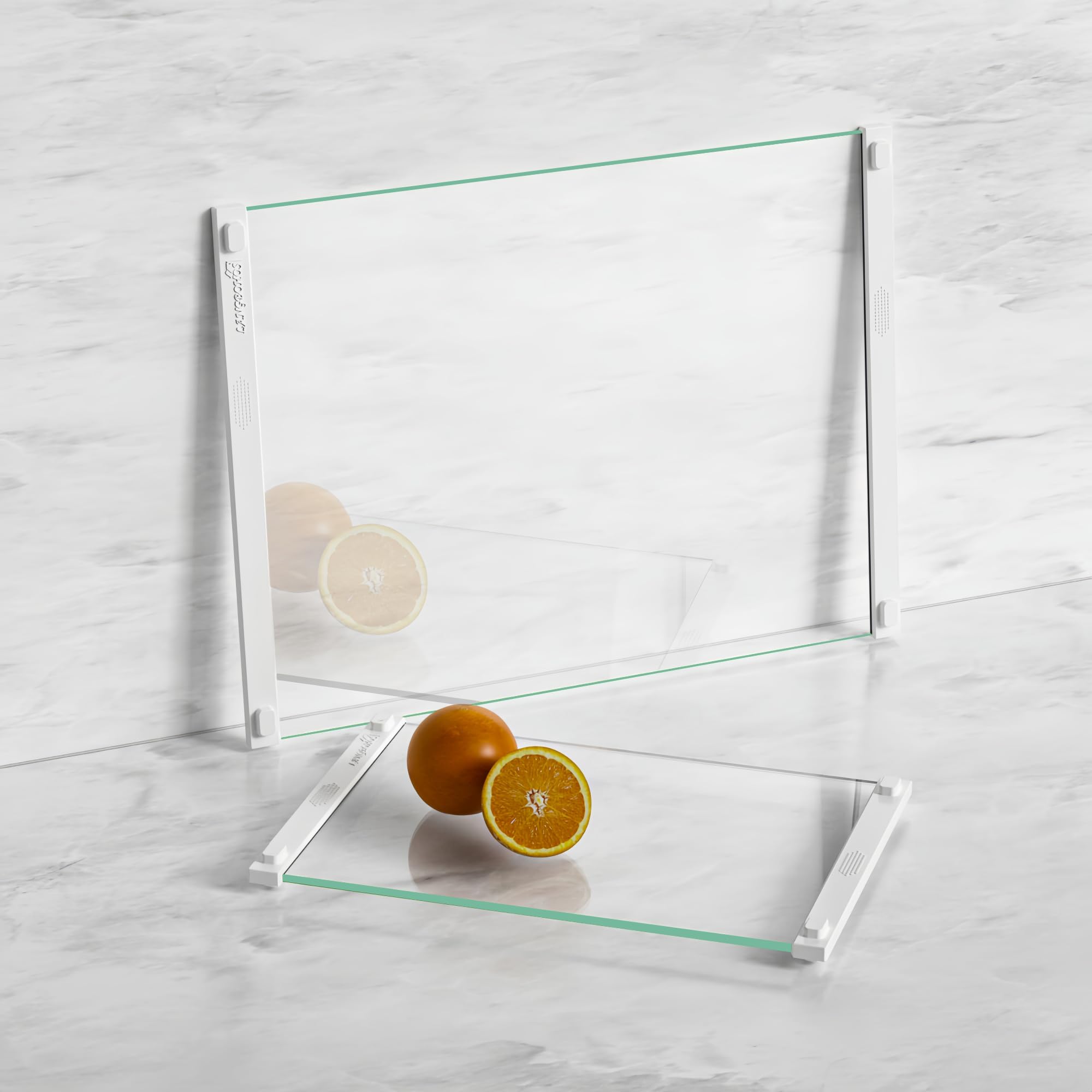
LANGBOHOS offers a completely non-porous alternative with their tempered glass board set. The two-piece set includes a 16×12-inch board and a 12×8-inch board, both with enhanced silicone grip feet that reduce slipping by 80% compared to standard glass boards. The glass is heat-resistant up to 150°C, allowing it to double as a hot trivet for pots and pans straight from the stove.
The ultra-hard surface repels scratches, stains, and odors—unlike wood, glass will never absorb beet juice or garlic smells. It also eliminates microplastic shedding entirely, as glass contains no polymers. The minor cutting noise during use is a trade-off; some users find the sound of metal on glass less pleasant than the muted thud of a wood board. The clear design with white silicone accents looks modern and fits into any kitchen aesthetic.
Cleaning is effortless: both boards are completely dishwasher-safe and can withstand continuous 150°C exposure for up to 4 hours. They also function as charcuterie trays, coffee cup mats, or countertop protectors. The primary drawback is the effect on knife edges—tempered glass will dull blades faster than bamboo or acacia. For cooks who prioritize sanitation and easy cleaning over knife edge preservation, this set delivers exceptional value.
Why it’s great
- Non-porous glass prevents bacterial growth and odors
- Heat-resistant to 150°C for dual use as hot trivet
- Silicone grip feet eliminate sliding during use
Good to know
- Glass surface dulls knives faster than wood alternatives
- Cutting noise is noticeably louder than wood boards
5. Socisen Bamboo Cutting Board
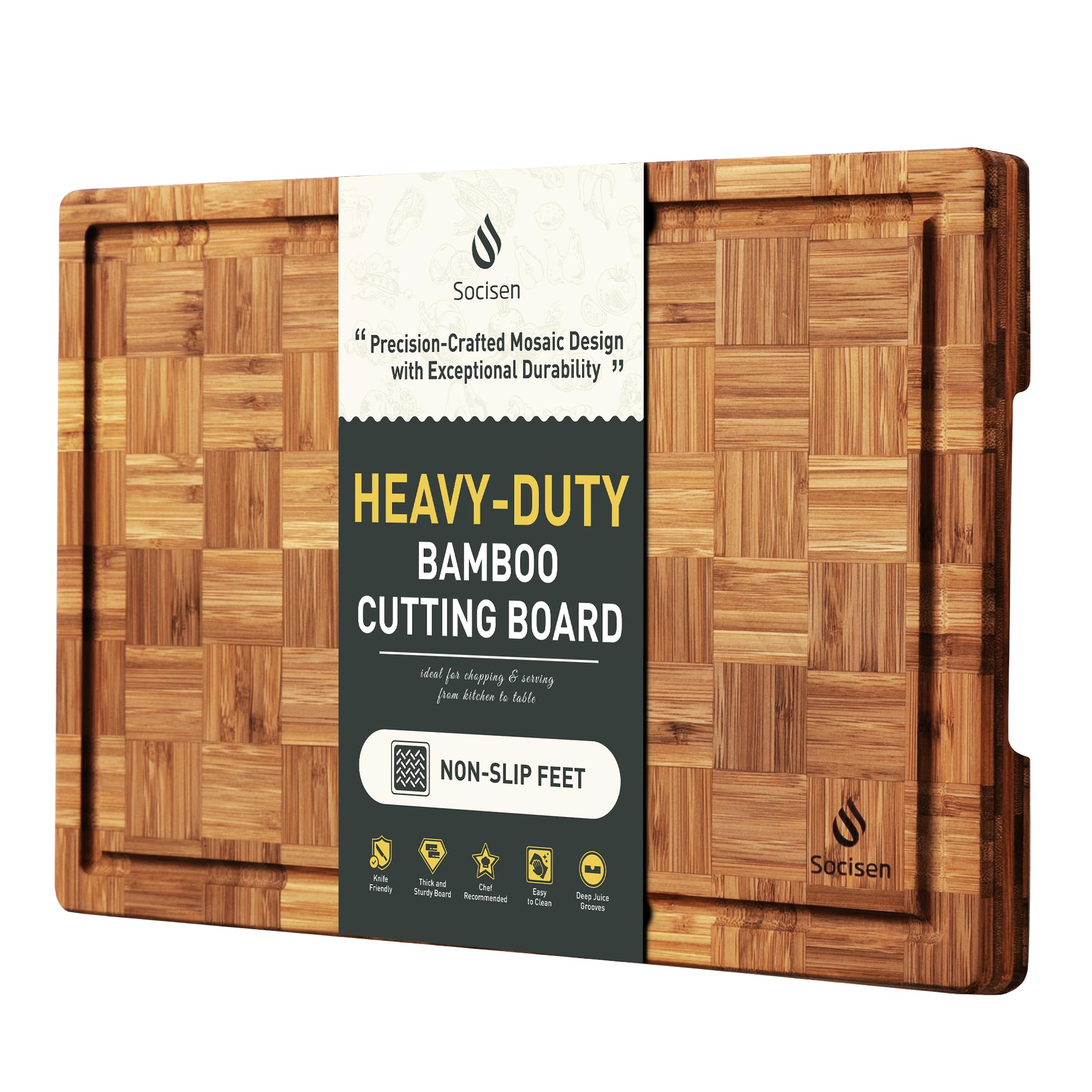
The Socisen bamboo board is an entry-level entry into non-plastic cutting surfaces. It uses a 5-layer bamboo splicing technique that makes it twice as thick as standard budget boards—the final thickness is 1 inch, which provides enough mass to resist warping during daily use. The board measures 16 x 11 inches, offering a practical surface area without dominating the counter.
FSC-certified bamboo is the core material, making this an environmentally conscious choice. Non-slip rubber feet keep the board stable during chopping, while rounded edges provide a comfortable grip. The bamboo surface has been polished to remove burrs and splinters, and it accepts regular coats of mineral oil to maintain its appearance. The natural bamboo grain gives it a clean, organic look that works with most kitchen decors.
At a budget-friendly price point, this board sacrifices some of the premium features found in pricier models—it lacks a juice groove, the surface is not reversible, and the bamboo laminate uses adhesives rather than glue-free technology. Care is limited to hand washing only. For someone new to non-plastic boards who wants a durable, knife-safe surface without a large investment, the Socisen offers a solid starting point.
Why it’s great
- 1-inch thickness prevents warping even with heavy use
- Non-slip rubber feet keep board stable during chopping
- FSC-certified bamboo for eco-friendly sourcing
Good to know
- No juice groove or reversible design
- Hand wash only; not dishwasher-safe
FAQ
Do glass cutting boards really dull knives faster than wood?
How often should I oil a bamboo or acacia cutting board?
Final Thoughts: The Verdict
For most users, the best non-plastic cutting boards winner is the GAOMON Acacia Wood Cutting Board because its 1.5-inch thickness, deep juice groove, and dense acacia construction combine durability with knife-friendly performance. If you want a glue-free, toxin-conscious set for multi-step meal prep, grab the Greener Chef Bamboo Set. And for the ultimate dishwasher-friendly convenience without plastic, nothing beats the Keechee Bamboo Board.