A muddy morel hidden under October leaves demands a tool that can slip in without bruising the cap. A standard hunting blade is too thick, too straight, and too clumsy for the careful work of cutting a stem at the forest floor. The right blade has a curved profile that mimics the natural stalk of a fungi, a stiff brush to sweep away debris, and a compact folding design that disappears into a pocket until the next patch is spotted.
I’m Mohammad Maruf — the founder and writer behind AirfryerBite. My research focuses on the hardware tolerances and material choices that define purpose-built outdoor kitchen and harvesting tools, from blade steel hardness to handle ergonomics.
After analyzing five field-tested models across budget-friendly, mid-range, and premium tiers, the best mushroom knife delivers a sharp, corrosion-resistant blade, a secure locking mechanism, and a durable bristle brush that stays in place after hours of scraping dirt and pine needles.
How To Choose The Best Mushroom Knife
Selecting a purpose-built mushroom knife goes beyond picking the cheapest blade on the shelf. The field conditions — wet logs, dry soil, tight brush — demand specific geometry and materials that a general-purpose pocket knife simply cannot match.
Blade Shape and Curvature
The most critical feature of a mushroom knife is a curved blade. A hawkbill or drop-point curve allows you to hook under the stem and cut cleanly at the base without levering the entire mushroom out of the ground. Straight blades tend to slide off the stem or slice through the cap, breaking the specimen. Look for a blade with a pronounced belly that mimics the natural angle of a forager’s wrist.
Steel Type and Edge Retention
Mushroom knives encounter damp conditions, acidic fungi, and gritty soil. Stainless steel with high chromium content, such as Sandvik 12C27 or 5Cr14MoV, resists rust and holds a fine edge through repeated cutting. Budget blades often use lower-grade 3Cr13 steel that dulls faster and stains easily. Premium options offer harder steel that sharpens to a razor edge but requires careful handling.
Locking Mechanism and Safety
Foraging involves wet hands, sudden movements, and pockets full of gathered finds. A secure locking mechanism — either a liner lock, a back lock, or the patented Virobloc collar — prevents the blade from accidentally closing on your fingers. Friction folders without a lock are lighter but carry higher risk during prolonged use in the field.
Brush Quality and Retention
An integrated brush is a hallmark of a true mushroom knife. The bristles need to be stiff enough to dislodge compacted dirt and pine needles but soft enough to avoid scraping the delicate pores of a chanterelle. Inspect how the brush is attached: a glued or embedded base that sheds bristles after a season is a poor investment.
Quick Comparison
On smaller screens, swipe sideways to see the full table.
| Model | Category | Best For | Key Spec | Amazon |
|---|---|---|---|---|
| Opinel No. 08 | Premium | Serious foragers demanding razor edge retention | Sandvik 12C27 blade, Virobloc lock | Amazon |
| Classic Outdoors Folding Lock | Premium | Multi-crop harvesting with a secure lock | Hawkbill 2.2-inch stainless blade, neoprene pouch | Amazon |
| DRACHENADER N-1 | Mid-Range | Value seekers wanting a leather sheath and liner lock | 5Cr14MoV steel, 8.15-inch overall length | Amazon |
| Rough Ryder RR1400 | Budget | New foragers testing the hobby without investment | 2.68-inch fixed stainless steel, wood handle | Amazon |
| Esschert Design | Budget | Light field cleaning with a safe, dull blade | Curved 4.49-inch blade, natural wood handle | Amazon |
In‑Depth Reviews
1. Opinel No. 08 Mushroom Knife
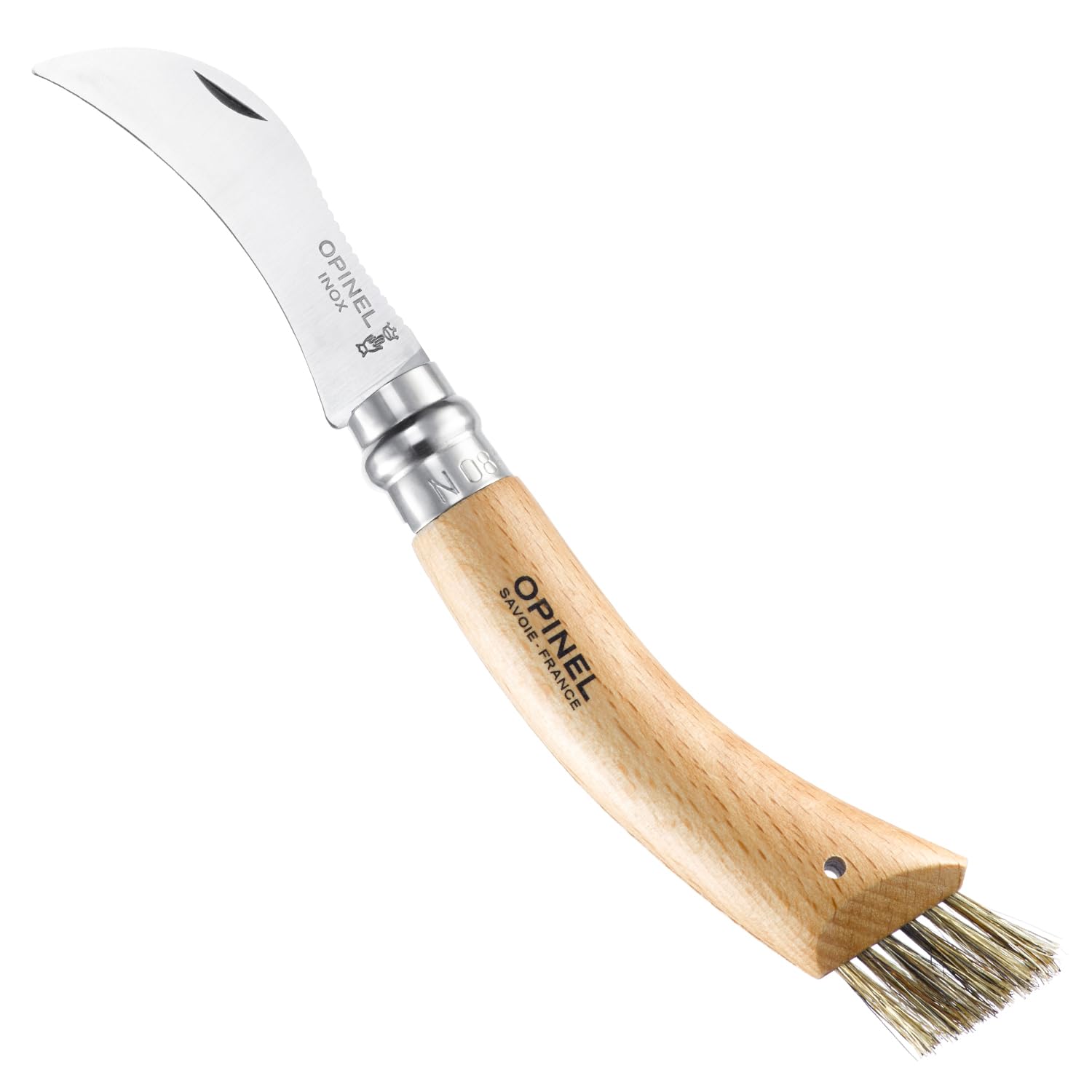
The Opinel No. 08 is the benchmark against which all other mushroom knives are measured. Its Sandvik 12C27 modified stainless steel blade delivers a razor-sharp edge out of the box and holds it far longer than the 3Cr13 steel found on budget alternatives. The 3.14-inch drop-point blade geometry is thin enough to slip under the smallest morel stem without crushing the surrounding duff, and the patented Virobloc collar locks the blade in both open and closed positions — a safety feature that matters when you are reaching into a damp coat pocket.
The beechwood handle, unchanged in its ergonomic shape since 1890, contours naturally to the palm and provides a warm, slip-resistant grip even in drizzle. The integrated brush at the handle butt is firm enough to dislodge caked-on soil from a chanterelle’s false gills but soft enough to avoid abrading the fragile cap surface. Owners report the knife lasting one to two decades of regular seasonal use with only occasional honing.
Availability and pricing fluctuate, with the Opinel occasionally appearing cheaper at camping retailers than on Amazon. The blade arrives scalpel-sharp — too aggressive for an inexperienced user — and the brush, while effective, is not replaceable once the bristles eventually wear down. For the forager who values edge geometry and mechanical lockup above all else, this is the definitive choice.
Why it’s great
- Sandvik 12C27 steel provides superior edge retention and corrosion resistance in wet conditions
- Virobloc collar locks blade open and closed for unmatched field safety
- Thin, curved blade slices stems without bruising the mushroom cap
Good to know
- Blade is extremely sharp out of box — not ideal for children or beginners
- Brush is permanently integrated and cannot be replaced when bristles wear
- Price can vary significantly across different retailers
2. Classic Outdoors Folding Lock Mushroom Knife

The Classic Outdoors Folding Lock knife takes a different approach with its hawkbill blade profile — a pronounced inward curve that hooks around the stem and pulls it away from the mycelium network cleanly. The 2.2-inch stainless steel blade, while shorter than the Opinel’s, is thick enough to handle tougher stalks and even small woody stems from asparagus or cabbage in the garden. Owners consistently praise the blade’s sharpness out of the box, with several noting it required no additional honing before a nine-hour hike.
The wooden handle features a polished, curved contour that fits the palm of an adult hand without hot spots. The locking mechanism is a solid back lock that engages with a distinct click and shows zero blade play even after repeated use. A durable neoprene pouch is included, which keeps the knife secured on a belt or inside a pack without scratching other gear. The brush, mounted at the handle end, has stiff bristles that effectively scrub dirt from mushroom stems, though some early reviews noted bristles bending slightly during shipping.
At a higher price point than the Opinel, this knife rivals it in build quality while offering a safer, less aggressive edge that still cuts through chanterelle and bolete stems effortlessly. The included pouch is a meaningful addition for those who want immediate pocket protection. The hawkbill curve is more specialized than a drop-point; foragers who prefer to slice rather than hook may need to adjust their cutting technique.
Why it’s great
- Hawkbill blade hooks under stems for clean, low-impact harvesting
- Solid back lock with no blade play ensures safe one-handed use
- Included neoprene pouch protects the blade during storage and transport
Good to know
- Hawkbill curve requires a different cutting motion than a drop-point blade
- Brush bristles can bend if the pouch compresses them during shipping
- Blade may not arrive as razor-sharp as some premium alternatives
3. DRACHENADER Mushroom Knife N-1
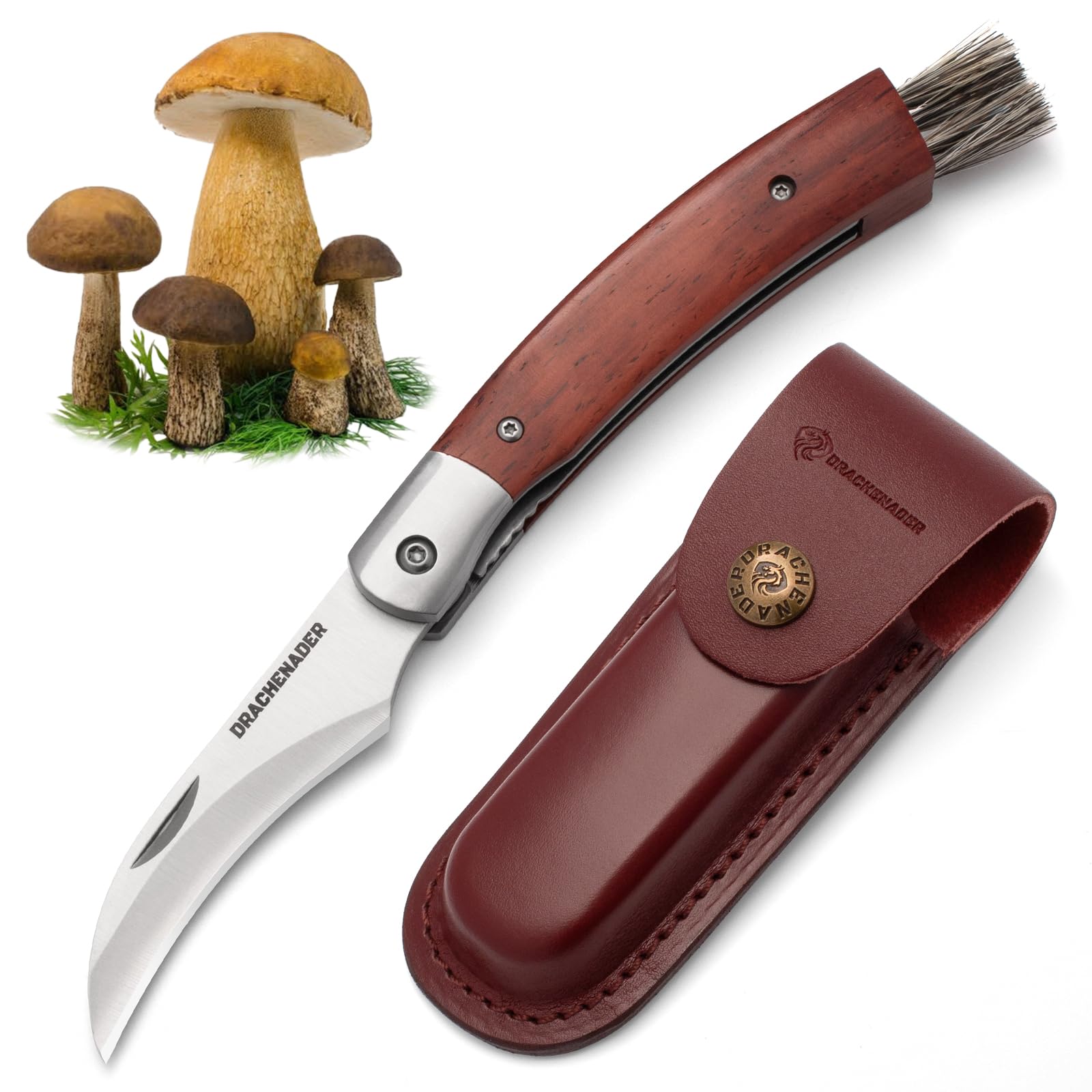
The DRACHENADER N-1 enters the mid-range segment with a feature set that punches above its price bracket. The 5Cr14MoV stainless steel blade is a meaningful upgrade over the generic stainless found on budget knives, providing better edge stability and rust resistance in damp forest environments. The liner-lock mechanism — rare at this price level — engages with authority and gives the user confidence when cutting through tough stalks or digging under embedded logs.
The handle is crafted from natural wood with a smooth, ergonomic contour that feels substantial in hand. A hand-crafted double-layered leather sheath is included, adding significant value for buyers who want immediate carry protection without purchasing an accessory. The integrated brush is attached securely at the handle butt; reviewers noted the bristles remained fully intact after heavy use in chanterelle patches, avoiding the shedding problem seen on cheaper designs.
The main trade-off is factory sharpness. Several users reported the blade cut adequately but not effortlessly through mushroom stems, requiring either a field sharpener or a quick pass over a honing rod before serious harvesting work. The 8.15-inch overall length is slightly longer than pocket-friendly alternatives, though the leather sheath mitigates this. For the forager seeking premium features — liner lock, good steel, leather sheath — without the Opinel price tag, this is the strongest contender.
Why it’s great
- 5Cr14MoV steel offers better edge retention than budget-grade 3Cr13
- Liner-lock mechanism provides safe one-handed operation in the field
- Includes a double-layered leather sheath for immediate carry protection
Good to know
- Blade may not be sharp enough out of the box for effortless cutting
- Overall length of 8.15 inches feels large for pocket carry
- Brush bristles are fixed and cannot be replaced when they wear out
4. Rough Ryder Mushroom Hunters Knife (RR1400)

The Rough Ryder RR1400 is a fixed-blade design that strips away complexity in favor of straightforward reliability. The 2.68-inch stainless steel blade is sharpened to a fine edge from the factory and paired with a curved profile that follows the natural growth angle of a mushroom stem. The fixed configuration means there is no lock to fail, no pivot to loosen — simply grab the wood handle and cut. Owners consistently describe the blade as surprisingly sharp for the low cost, with one reviewer noting it handled a five-hour, ten-pound chanterelle harvest without needing a touch-up.
The handle is made from natural wood with a contoured shape that fills the hand comfortably, even during extended sessions. A stiff bristle brush is integrated into the handle butt, and while some reviews noted the bristles are soft enough to bend when stored in a pocket, they rebound after a wash with warm water. The included compact design makes it easy to slip into a jacket or cargo pocket without the bulk of a folding knife. Country of origin is China, but the fit and finish exceed expectations for the entry-level price.
The trade-off for the fixed-blade simplicity is lack of portability when closed. There is no sheath included, so the blade must be carried exposed or in a dedicated pocket. The brush, while functional, is not as stiff as the brushed found on premium models and may struggle with deeply packed soil. For the forager on a tight budget or the beginner who wants to test whether mushroom hunting is a lasting hobby, this knife delivers outstanding value without sacrificing blade performance.
Why it’s great
- Fixed stainless steel blade is sharp out of box with no lock mechanism to fail
- Curved blade shape matches natural stem angle for clean cuts
- Wood handle provides warm, slip-resistant grip in wet conditions
Good to know
- No sheath included — blade must be carried exposed in a pocket
- Brush bristles are softer than premium models and may require washing to restore stiffness
- Fixed configuration is less pocket-friendly than folding alternatives
5. Esschert Design Mushroom Knife
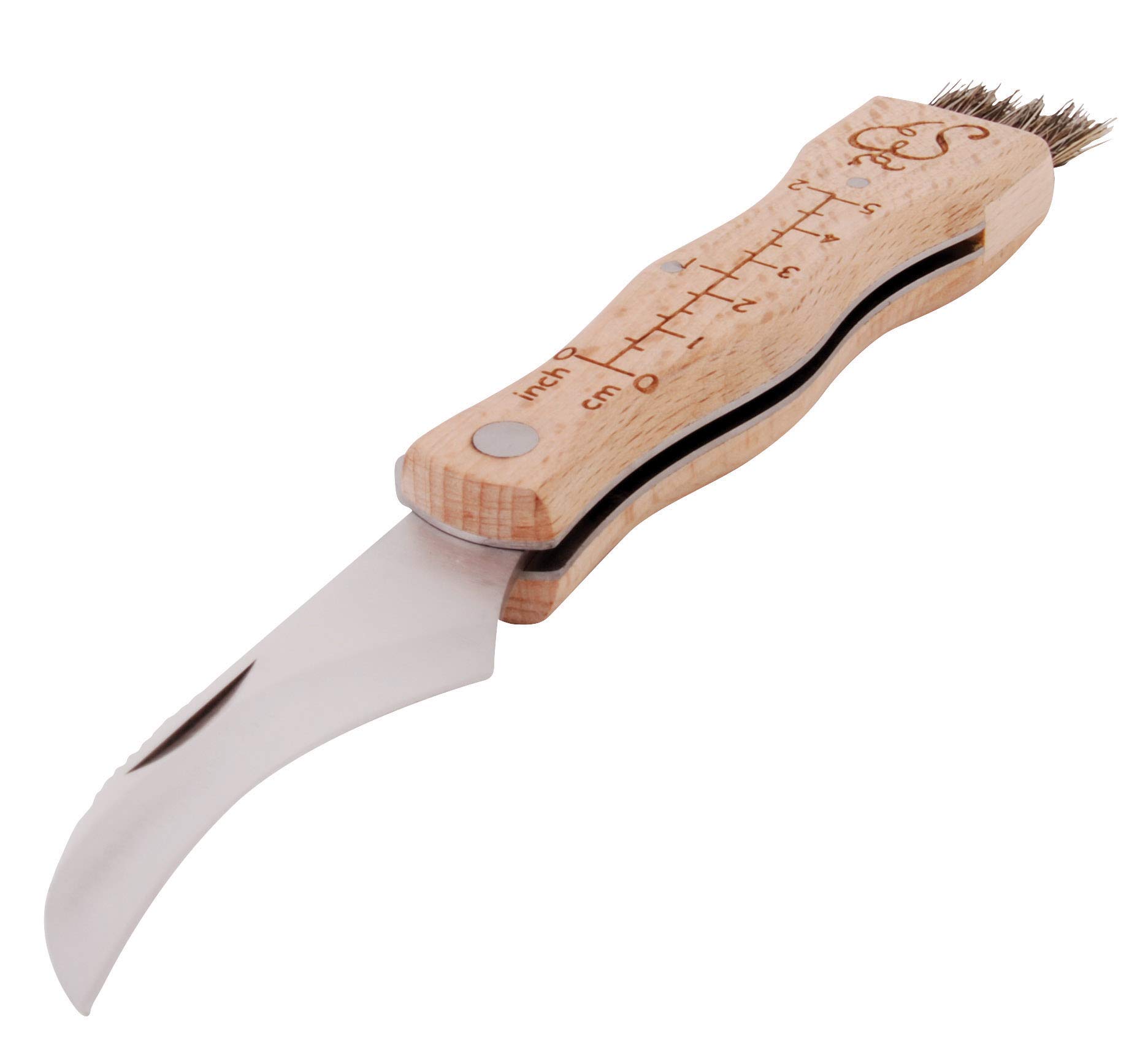
The Esschert Design mushroom knife fills the role of an affordable, accessible entry point for the casual forager. Its most notable feature is the intentionally dull blade, which the manufacturer designed for safety — a sensible choice for beginners or for use with children. The curved blade is still effective for cutting through soil and slicing the base of a mushroom stem, and several reviewers noted it works well for digging under the root ball without risking a cut. The 4.49-inch blade is longer than most mushroom-specific knives, providing extra reach for reaching into dense brush.
The handle is constructed from natural wood and has a classic, simple profile that fits an ambidextrous grip. The integrated brush at the handle end is functional for brushing loose dirt off a freshly picked mushroom in the field. The included measuring marks on the handle are a clever addition for foragers who want to quickly gauge the diameter of a specimen without carrying a separate ruler. The knife folds for compact storage, though some reviewers noted the hinge is stiff initially and requires breaking in.
The intentional dull edge is both the biggest selling point and the biggest limitation. Foragers who need a sharp blade for cutting through tough stems or woody fungi will find themselves frustrated by the lack of bite. The stiffness of the folding mechanism also reduces one-handed operability. At the lowest price point, the Esschert is best viewed as a training tool or a spare to lend to a companion, not a primary harvesting blade for serious collectors. It will get the job done on soft-stemmed species but should not be your only knife in a heavy patch.
Why it’s great
- Intentionally dull blade is safe for beginners and children learning to forage
- Longer blade reaches into dense brush for harvesting embedded mushrooms
- Handle includes measuring marks for quick diameter checks in the field
Good to know
- Blade is too dull for cutting tough stems or woody mushroom stalks
- Folding hinge is stiff from factory, limiting one-handed operation
- Not suitable as a primary harvesting tool for serious, high-volume foraging
FAQ
Why is a curved blade better than a straight blade for mushroom foraging?
How do I clean and maintain a mushroom knife with a wooden handle?
Should I buy a fixed blade or folding mushroom knife?
Final Thoughts: The Verdict
For most users, the best mushroom knife winner is the Opinel No. 08 because it combines a premium Sandvik steel blade with the patented Virobloc locking collar, giving you razor-sharp performance and field safety in a compact folding design. If you want the added utility of a hawkbill blade and a protective storage pouch, grab the Classic Outdoors Folding Lock Knife. And for a mid-range build that includes a leather sheath and a liner lock at a compelling price, nothing beats the DRACHENADER N-1.