Choosing the right supplement while trying to conceive is a medical decision that directly impacts early fetal development, ovarian health, and your hormonal baseline. The wrong blend can leave you deficient in critical nutrients like active folate or CoQ10, while the correct one supports egg quality and a healthy implantation environment.
I’m Mohammad Maruf — the founder and writer behind AirfryerBite. I’ve spent years analyzing supplement formulations for preconception health, focusing on ingredient bioavailability, third-party verification, and how the ratio of key compounds like myo-inositol and D-chiro inositol affects fertility outcomes.
After cross-referencing formularies and real-user feedback, I’ve built a focused guide to the best multivitamin for trying to conceive that balances nutrient density with value.
How To Choose The Best Multivitamin For Trying To Conceive
The preconception supplement market is flooded with broad “prenatal” formulas that often skip key fertility-focused ingredients like myo-inositol, CoQ10, and high-dose zinc. A true conception multivitamin must target ovulation hormone balance, egg maturation, and micronutrient sufficiency simultaneously.
Active Folate vs. Folic Acid
Roughly 40–60% of women carry a genetic variation in the MTHFR enzyme that reduces their ability to convert synthetic folic acid into the active folate form (5-MTHF) used by the body for DNA synthesis and neural tube closure. A multivitamin formulated with methylfolate bypasses this bottleneck and ensures usable levels regardless of genotype.
The 40:1 Inositol Ratio
Myo-inositol (MI) and D-chiro-inositol (DCI) work together to improve insulin sensitivity and ovarian follicle quality, especially in women with PCOS. The physiological ratio found in the body is roughly 40:1 MI to DCI. A supplement that matches this ratio delivers targeted support for ovulation regularity and hormone signaling.
Coenzyme Q10 and Antioxidant Support
Egg quality declines with age partly due to mitochondrial oxidative stress. CoQ10 (preferably in its ubiquinone or ubiquinol form) supports cellular energy production in the oocyte. N-acetyl cysteine (NAC) provides additional glutathione precursor activity to reduce oxidative damage in the ovarian environment.
Quick Comparison
On smaller screens, swipe sideways to see the full table.
| Model | Category | Best For | Key Spec | Amazon |
|---|---|---|---|---|
| Nature Made Prenatal | Prenatal | Daily foundational nutrition | 200 mg DHA + Folic Acid | Amazon |
| MEDCHOICE Inositol Complex | Inositol Blend | Hormone & ovulation support | 40:1 MI/DCI ratio + Folate | Amazon |
| Pregnacare Conception Max | Fertility Multi | Advanced fertility & egg support | CoQ10 + NAC + Inositol | Amazon |
| Wholesome Story Inositol | Inositol Combo | Honest 40:1 ratio formula | 2000 mg Myo + 50 mg DCI | Amazon |
| Natures Craft Fertility | Fertility Blend | Total preconception coverage | Choline + CoQ10 + DHEA | Amazon |
In‑Depth Reviews
1. Pregnacare Conception Max

Pregnacare Conception Max delivers the most complete fertility-forward formula in this lineup. It includes Coenzyme Q10 for mitochondrial egg energy, N-acetyl cysteine for antioxidant glutathione support, and myo-inositol alongside D-chiro inositol — all wrapped in a base of zinc, selenium, magnesium, and high-purity omega-3 fish oil. The addition of vitamin B12 and vitamin D at increased levels addresses two common preconception deficiencies linked to implantation failure.
This is the only product in this review that combines CoQ10, NAC, inositol, and enhanced B vitamins in a single daily regimen. The zinc content (15 mg per serving) directly supports ovulation and fertilization processes. Users report that the softgel format is easy to swallow and doesn’t produce the fishy aftertaste typical of lower-grade omega-3 supplements.
While Pregnacare is a UK brand, the formulation meets global preconception standards and is widely available via Amazon. The bottle provides a 30-day supply, which makes it a mid-range investment for a premium blended approach.
Why it’s great
- Contains CoQ10 for egg quality
- N-acetyl cysteine for antioxidant defense
- Inositol blend plus high-purity fish oil
- Enhanced B12 and D levels
Good to know
- 30-day supply requires monthly reordering
- Not third-party certified by USP or NSF
2. Natures Craft Female Fertility Supplement

Natures Craft positions itself as a “preconception multivitamin plus” by including Choline (450 mg), CoQ10, DHEA, and a full B-complex alongside iron and calcium. Choline is critical for fetal neural tube development before many women even realize they are pregnant, and many prenatal formulas neglect it at effective doses. The inclusion of DHEA is notable because it can support ovarian reserve in women over 35.
The formula uses a broad blend that covers both standard micronutrients and fertility-specific components. The 120-count bottle provides a 60-day supply at a mid-range price point, making it one of the more cost-effective comprehensive options. Users have noted that the capsules are moderate in size but not difficult to swallow.
One limitation is that the inositol content is not specified as a standalone ingredient — it is embedded within the proprietary fertility blend rather than disclosed in milligrams. For women specifically seeking the 40:1 MI/DCI ratio, this makes dosage tracking less transparent.
Why it’s great
- High-dose choline (450 mg per serving)
- CoQ10 and DHEA for advanced support
- 60-day supply from one bottle
- Mid-range value for broad coverage
Good to know
- Inositol dose not disclosed separately
- DHEA may not suit all hormonal profiles
3. MEDCHOICE 14-in-1 Women’s Inositol Complex

MEDCHOICE delivers a precise 40:1 ratio of myo-inositol (2500 mg) to D-chiro-inositol (62.5 mg) per two-capsule serving, making it the most targeted inositol product in this review. The formula adds bioactive folate (methylfolate) rather than folic acid, along with zinc, magnesium, and vitamin D3. This combination supports ovulatory function and hormone balance without the synthetic folic acid conversion issue.
The capsule count is 120, and the recommended serving is four capsules per day (two with breakfast, two with dinner). Users appreciate that the formula is non-habit-forming and contains no stimulants. The inclusion of magnesium (200 mg) also supports sleep and stress regulation during the trying-to-conceive period.
For women specifically managing PCOS or irregular cycles, this product’s ratio and bioactive nutrient profile make it a smart pick. The tradeoff is that it is targeted toward hormone support rather than being a full prenatal multivitamin — you would still need a separate DHA or iron source if those are priorities.
Why it’s great
- Exact 40:1 inositol ratio per serving
- Methylfolate instead of folic acid
- Zinc, magnesium, and D3 included
- No stimulants or fillers
Good to know
- Four capsules daily dosing
- Not a complete prenatal — needs DHA separately
4. Wholesome Story Myo-Inositol & D-Chiro Inositol

Wholesome Story keeps its formulation simple and transparent: 2000 mg of myo-inositol paired with 50 mg of D-chiro-inositol, delivering the clinically studied 40:1 ratio. The capsule count is 120 (30 servings at 4 capsules per day). The product focuses on inositol support without adding a full multivitamin base, making it ideal for women who already take a separate prenatal.
This is a no-frills supplement that appeals to users who want a pure inositol product without fillers, binders, or added micronutrients that might overlap with their existing regimen. It is particularly popular among women with PCOS looking to support ovulation and androgen balance. The four-capsule serving can be split into two doses to improve tolerance.
Because it lacks folate, iron, DHA, and zinc, it is not a standalone multivitamin for trying to conceive. Pair it with a complete prenatal that covers the basic micronutrients if you choose this as your inositol source.
Why it’s great
- Transparent 40:1 ratio disclosure
- No unnecessary additives or fillers
- Pairs easily with any prenatal
- Well-reviewed for PCOS support
Good to know
- Not a standalone prenatal — needs partner supplement
- Four capsules per day may be inconvenient
5. Nature Made Prenatal Vitamins with Folic Acid + DHA
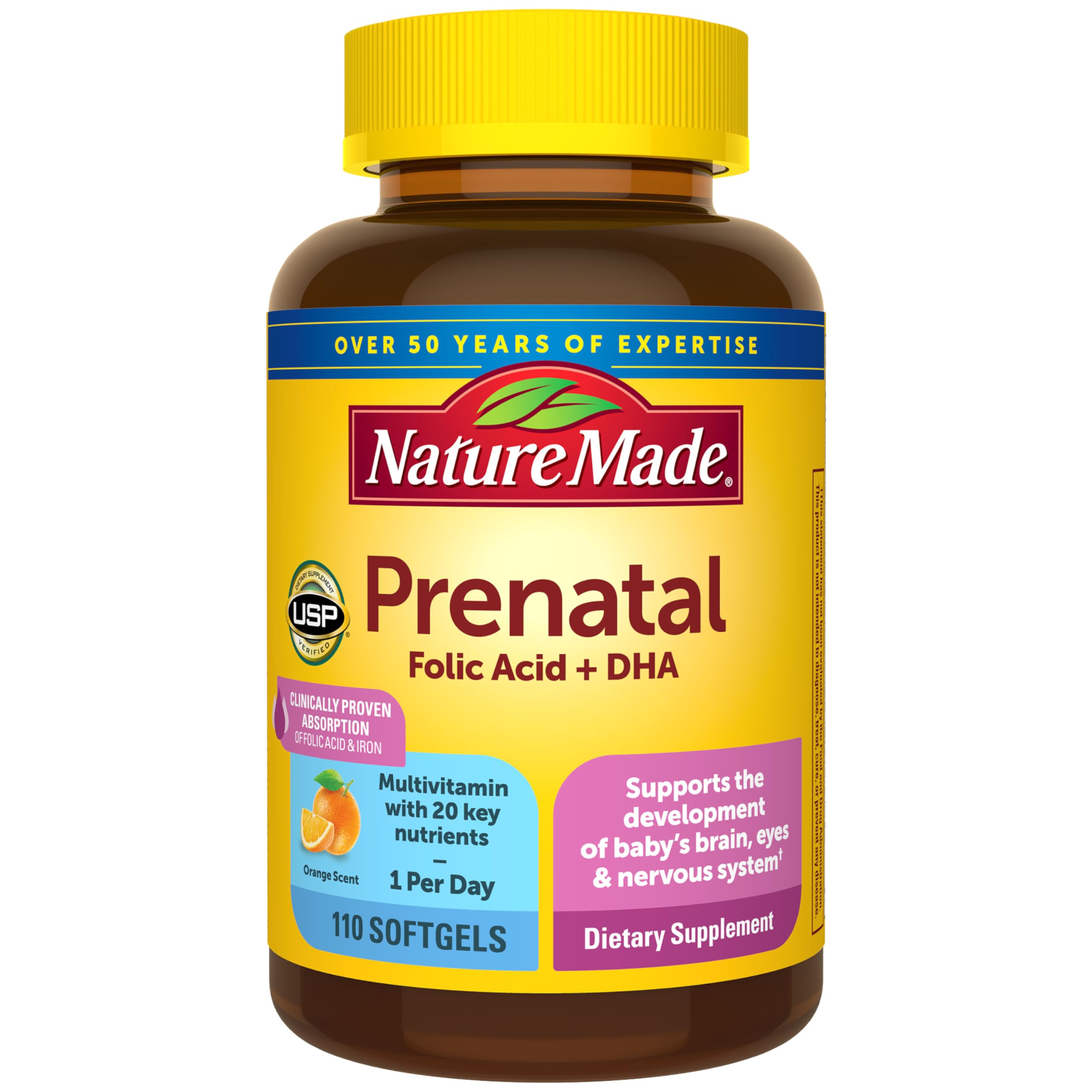
Nature Made is the most established and accessible option here, with a USP-verified formula that includes 800 mcg folic acid, 200 mg DHA, and a full B-vitamin complex including biotin. This is a true prenatal multivitamin designed for women who are already pregnant or planning pregnancy, and it delivers reliable daily nutrition at an entry-level price point. The 110-softgel bottle provides a 110-day supply.
The DHA content is standard at 200 mg, supporting brain and eye development. The formula includes magnesium for muscle and nervous system support. Because it is USP verified, you get independent assurance of ingredient purity and potency — a meaningful advantage over many competitors that lack third-party testing.
The notable absence is any inositol, CoQ10, NAC, or active folate. For women specifically trying to conceive — especially those with PCOS, irregular cycles, or MTHFR variants — this formula may be too basic. It works best as a low-cost daily safety net for women with no specific fertility concerns.
Why it’s great
- USP verified for purity and potency
- 110-day supply per bottle
- Gluten-free, no synthetic dyes
- FSA/HSA eligible
Good to know
- Uses synthetic folic acid, not methylfolate
- Lacks inositol, CoQ10, and NAC
FAQ
Should I take a prenatal or a dedicated fertility multivitamin while trying to conceive?
What is the difference between folic acid and methylfolate in a conception supplement?
Can I take a myo-inositol supplement alongside a regular prenatal multivitamin?
What is the role of CoQ10 in a fertility multivitamin?
Final Thoughts: The Verdict
For most users, the multivitamin for trying to conceive winner is the Pregnacare Conception Max because it combines CoQ10, NAC, inositol, and enhanced B vitamins in a single formulation — covering both egg quality and hormone support. If you want a complete multivitamin with high-dose choline and DHEA, grab the Natures Craft Fertility Supplement. And for targeted inositol support with bioactive folate, nothing beats the MEDCHOICE Inositol Complex.