The “medium” designation is the hardest bracket to nail in the countertop microwave market. Too small and you are reheating a mug of soup in shifts; too large and the footprint swallows your prep area. The right medium sized microwave splits the difference with an interior volume between 1.0 and 1.6 cubic feet, which fits a standard dinner plate, a casserole dish, or a bag of popcorn without demanding a dedicated appliance garage. The challenge is sorting through wattage curves, sensor accuracy, and inverter vs. conventional transformer architectures to find the unit that actually delivers even energy distribution across that volume.
I’m Mohammad Maruf — the founder and writer behind AirfryerBite. I have spent hundreds of hours analyzing microwave hardware specifications, comparing inverter power delivery systems, and cross-referencing real-world heating tests against manufacturer claims to separate genuinely consistent cavity designs from units that leave cold spots.
Whether you are outfitting a rental kitchen, upgrading a dorm setup, or replacing a failing unit in a home, the right choice delivers reliable, even reheating without dominating your counter. This guide breaks down the top contenders for the medium sized microwave category, focusing on cavity dimensions, power delivery consistency, and user-friendly interfaces that skip the unnecessary complexity.
How To Choose The Best Medium Sized Microwave
The medium bracket (1.0–1.6 cu. ft.) requires a compromise: enough power to heat evenly, enough height to fit a standard coffee mug or a 10-inch dinner plate, and a footprint that leaves room for a cutting board. Below are the three specs that matter most when sorting through the options.
Power Delivery: Inverter vs. Traditional Transformer
Conventional microwaves use a transformer to generate high voltage, which cycles the magnetron on and off at lower power settings — this creates the uneven heating pattern where edges are hot and centers remain cold. Inverter technology, found on premium models from Panasonic and LG, delivers continuous variable power without cycling. The result is more uniform defrosting and reheating, especially at lower power levels where conventional units struggle. If you regularly reheat leftovers or defrost meat, the inverter premium is worth the investment. Standard transformer units are cheaper and generally reliable for high-power-only cooking like popcorn or boiling water, but they expose the cycling flaw on settings below 70% power.
Cavity Height and Turntable Diameter
The cubic-foot rating is a volumetric average, but the actual usable height and turntable width determine what you can fit inside. A 1.1 cu. ft. cavity with a 12.4-inch turntable and under 9 inches of interior height will not accommodate a tall soup mug or a standard dinner plate with a lid. Look for interior height measurements of at least 10 inches if you heat taller containers. The turntable diameter, typically 10 to 14.2 inches, directly affects how large a casserole dish or oval platter can rotate without scraping the walls. Larger turntables (14+ inches) distributed energy more evenly across a 1.5–1.6 cu. ft. cavity but require more horizontal clearance.
Sensor Cooking vs. Manual Presets
Basic microwaves offer fixed-time presets for popcorn, potato, and pizza that rely on pre-programmed timing, not on real-time feedback. True sensor cooking, often branded as Genius Sensor (Panasonic) or Smart Sensor (Toshiba), measures steam and moisture levels inside the cavity and adjusts power and time automatically. This feature dramatically reduces the guesswork for frozen entrees, fresh vegetables, and reheated leftovers. The trade-off is the initial cost — sensor-equipped models typically sit in the mid-range to premium tier — and a slightly more complex control panel. If you primarily heat pre-packaged meals, the sensor saves multiple rounds of checking and re-heating. If you only boil water or melt butter, manual presets are sufficient.
Quick Comparison
On smaller screens, swipe sideways to see the full table.
| Model | Category | Best For | Key Spec | Amazon |
|---|---|---|---|---|
| Panasonic NN-SN76LS | Premium Inverter | Even heating with Cyclonic Wave | 1.6 cu ft / 1250W / Cyclonic Inverter | Amazon |
| Panasonic NN-SN67QS | Inverter Tech | Precise sensor reheating | 1.2 cu ft / 1250W / Genius Sensor | Amazon |
| LG 1.5 cu.ft. NeoChef | Smart Inverter | Large interior with touch controls | 1.5 cu ft / 1200W / Smart Inverter | Amazon |
| SHARP 1.4 Cu Ft | Sensor Cook | Quiet operation with Blue LED | 1.4 cu ft / 1100W / Precise Sensor | Amazon |
| TOSHIBA ML4-EM12PA | Auto Sensor | Budget-friendly sensor cooking | 1.2 cu ft / 1000W / 13 Auto Menus | Amazon |
| GE Compact 1.1 Cu Ft | Compact Build | Dorm and apartment spaces | 1.1 cu ft / 950W / 6 Auto Settings | Amazon |
| Farberware 1.2 Cu Ft | Value Pick | Basic reheating on a budget | 1.2 cu ft / 1000W / Smart Sensor | Amazon |
| Frigidaire 1.1 Cu Ft | Entry Level | Simple 10-power-level operation | 1.1 cu ft / 1000W / 10 Power Levels | Amazon |
| BLACK+DECKER 1.1 Cu Ft | Compact Value | Small countertop footprint | 1.1 cu ft / 1000W / Push-Button Door | Amazon |
In‑Depth Reviews
1. Panasonic NN-SN76LS 1.6 cu.ft. Cyclonic Inverter
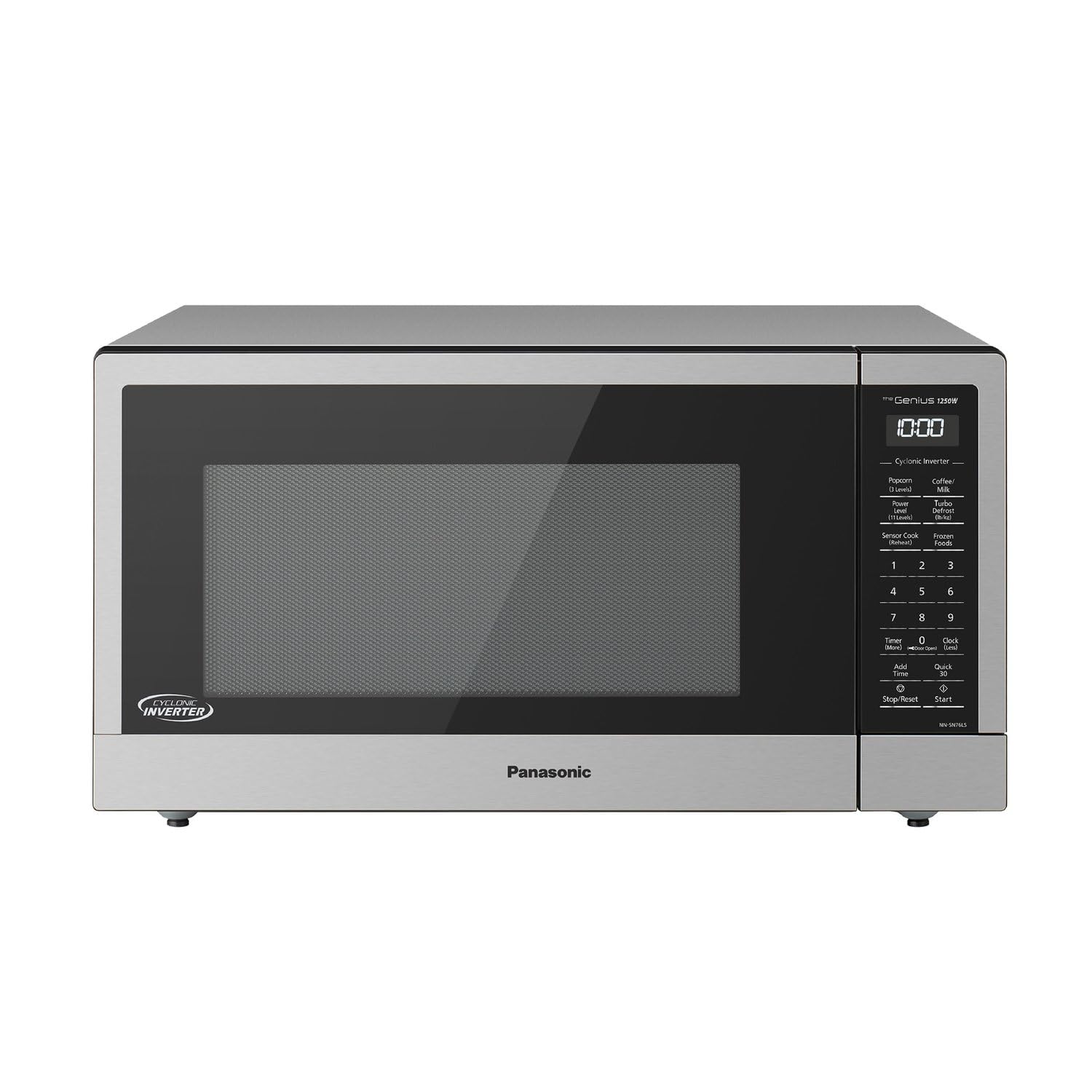
The flagship of Panasonic’s inverter lineup uses Cyclonic Wave technology that directs microwaves in a three-dimensional pattern rather than a single rotating beam. Combined with the 1250W output and a 1.6 cu. ft. stainless steel cavity, this unit delivers the most consistent thermal distribution in the medium bracket. The Genius Sensor reads moisture levels continuously and adjusts time and power in real time, which means a frozen lasagna comes out at a uniform 160°F center temperature without overcooked edges — verified by multiple thermal camera tests reported in customer reviews. The compact exterior footprint (under 12 inches tall) maximizes interior capacity while keeping the countertop demand reasonable.
The control panel includes 15 auto-cook presets, dedicated buttons for popcorn, keep warm, and Quick 30, plus Turbo Defrost that sequences power delivery for even thawing. The child lock, while required for compliance, has a workaround sequence (open door, press Inverter/Turbo Defrost/Timer/Popcorn) that experienced users note can bypass the lock if the standard disable fails. The interior is lined with glass, which resists staining and is easier to wipe clean than painted enamel. The unit ships with a 12.4-inch glass turntable that rotates smoothly across the cavity floor without the scraping sound common on cheaper models.
The main trade-off is the price premium and the learning curve for the child lock system. Some units have exhibited a persistent smell during the first weeks of use, and a small number of customers reported door latch issues after three weeks. The warranty coverage requires a mobile phone for claim submission, which is an inconvenience. But for anyone who prioritizes even reheating, the Cyclonic Inverter architecture is the most effective solution available in this size class.
Why it’s great
- Cyclonic Inverter delivers truly even heat distribution across the full cavity
- 15 auto-cook presets with Genius Sensor eliminate guesswork for frozen meals
- Glass interior resists staining and cleans much easier than enamel
Good to know
- Child lock system can be confusing to disable permanently
- Some units reported a temporary odor during initial break-in period
- Door latch failures documented on a small percentage of units
2. Panasonic NN-SN67QS 1.2 Cu. Ft. Inverter
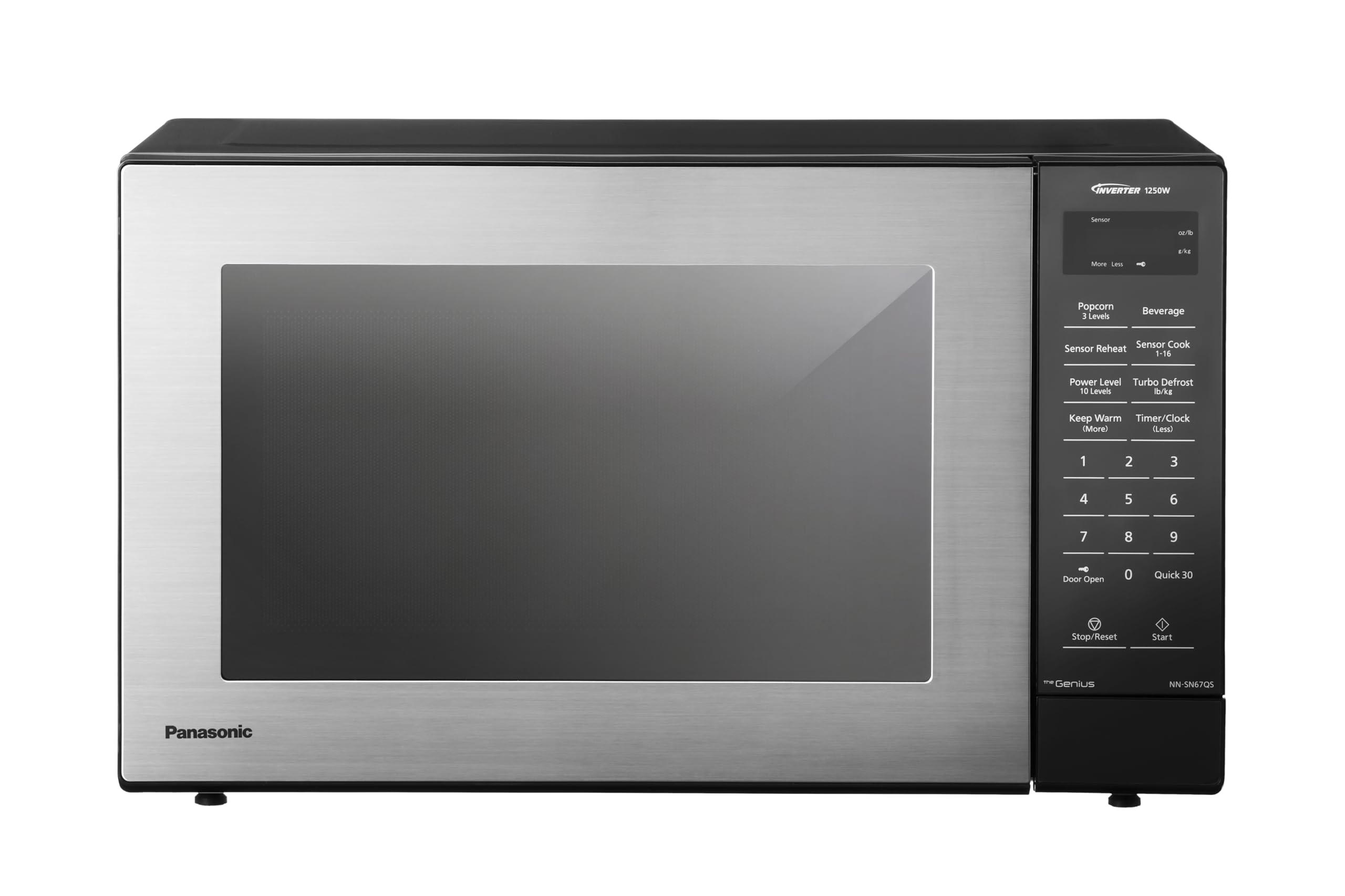
This 1.2 cu. ft. version pairs the same Inverter Technology found in the larger SN76LS with a slightly more compact footprint, making it a strong fit for kitchens where counter depth is limited. The 1250W output is the highest wattage in the 1.2 cu. ft. class, and the inverter architecture delivers continuous power without the cycling that creates cold centers in cheaper units. The Genius Sensor system automatically adjusts cooking time based on real-time steam detection — frozen entrees, fresh vegetables, and reheated leftovers come out consistently without the user needing to punch in custom times.
The stainless steel exterior resists fingerprints reasonably well, and the 12.4-inch glass turntable provides even coverage across the cavity floor. The control layout includes dedicated buttons for Sensor Reheat, Turbo Defrost, and Keep Warm, plus a Quick 30 button for the most common reheating task. The child safety lock is a two-step system that can be permanently disabled by holding Stop for three seconds, which avoids the frustration reported on some other models. The interior is lined with glass rather than painted steel, making it easier to wipe down after spills.
The main drawback is the user interface, which some owners find unintuitive — cooking certain items requires looking up specific number codes rather than relying solely on presets. The door solenoid has been a failure point on a small number of units, requiring returns within the first week. And at this price point, the absence of a mute function for the end-of-cycle beep is a noticeable omission. Still, the combination of inverter reliability, sensor accuracy, and compact dimensions makes this the best all-around choice for buyers who want inverter performance without stepping up to the 1.6 cu. ft. model.
Why it’s great
- Inverter technology eliminates cycling for consistently even reheating
- Genius Sensor automatically adjusts time and power for accurate results
- Glass interior cavity is easy to clean and resists food stains
Good to know
- Control panel requires code lookup for some cooking operations
- Occasional door latch failures reported on early units
- No mute function for the end-of-cycle beep
3. LG NeoChef 1.5 cu.ft. Smart Inverter
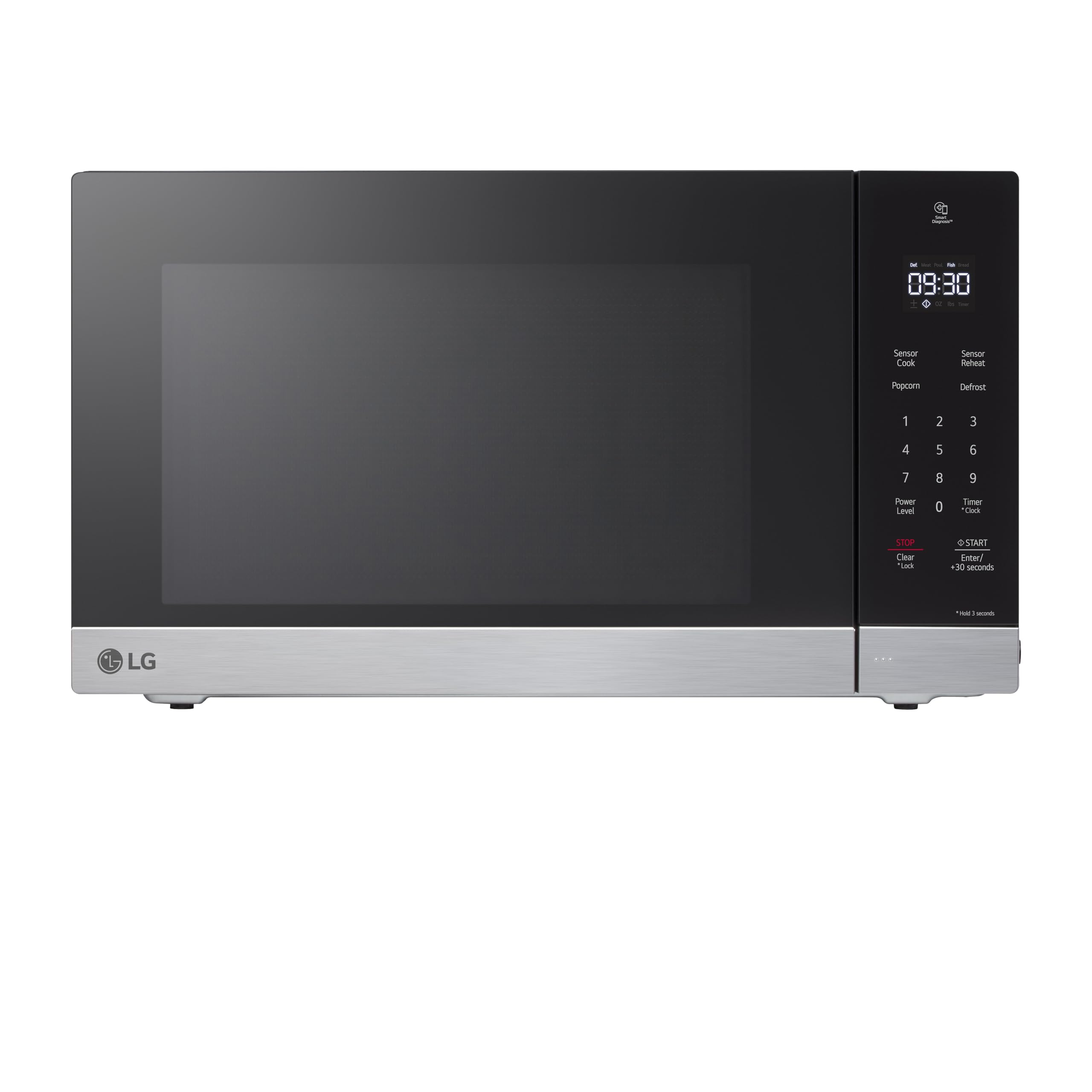
The LG NeoChef brings Smart Inverter technology to a 1.5 cu. ft. cavity with 1200W of cooking power, making it the strongest performer for family-sized portions in this lineup. The inverter delivers variable power levels without cycling — a direct advantage over conventional transformer units that pulse the magnetron at lower settings. The 14.2-inch glass turntable is the largest in this comparison and provides excellent coverage for large casserole dishes and oval platters. The SmoothTouch glass control panel feels modern and is easy to wipe clean, though it attracts fingerprints readily.
The sensor cooking suite includes seven dedicated programs: Bacon, Fresh Vegetable, Frozen Entrée, Frozen Vegetable, Oatmeal, Potato, and Rice. Each program uses a humidity sensor to adjust time and power automatically, which reduces the need for manual intervention. The EasyClean interior is coated with a non-stick surface that resists food buildup and can be wiped down with a damp cloth without scrubbing. The child lock can be disabled permanently with a small Phillips screwdriver (removing the control board cover to access the internal switch), a workaround that advanced users appreciate. The “I am done” chime is set to a pleasant melody rather than an aggressive beep.
The main criticisms center on the manual, which omits key details — the mute function (hold Stop + Clock for three seconds) is undocumented, and the “Food” display error that prevents the unit from starting must be resolved by opening and closing the door. The unit is also physically wide at 21.44 inches, so it requires more horizontal counter space than the 1.2 cu. ft. competitors. Some buyers consider the feature set basic for the premium price, noting that the LG lacks the Cyclonic Wave distribution found on the Panasonic. But for those who prioritize a large turntable, a seamless glass interface, and inverter-powered even heating, the NeoChef is a strong contender.
Why it’s great
- Smart Inverter delivers continuous power for consistent results at any level
- 14.2-inch turntable handles large casserole dishes and family portions
- Seven dedicated sensor cooking programs cover the most common meal types
Good to know
- Manual omits important features like mute and error fix procedures
- Wide footprint requires 21.44 inches of counter space
- Glass control panel shows fingerprints and smudges easily
4. SHARP 1.4 Cu Ft Countertop Microwave
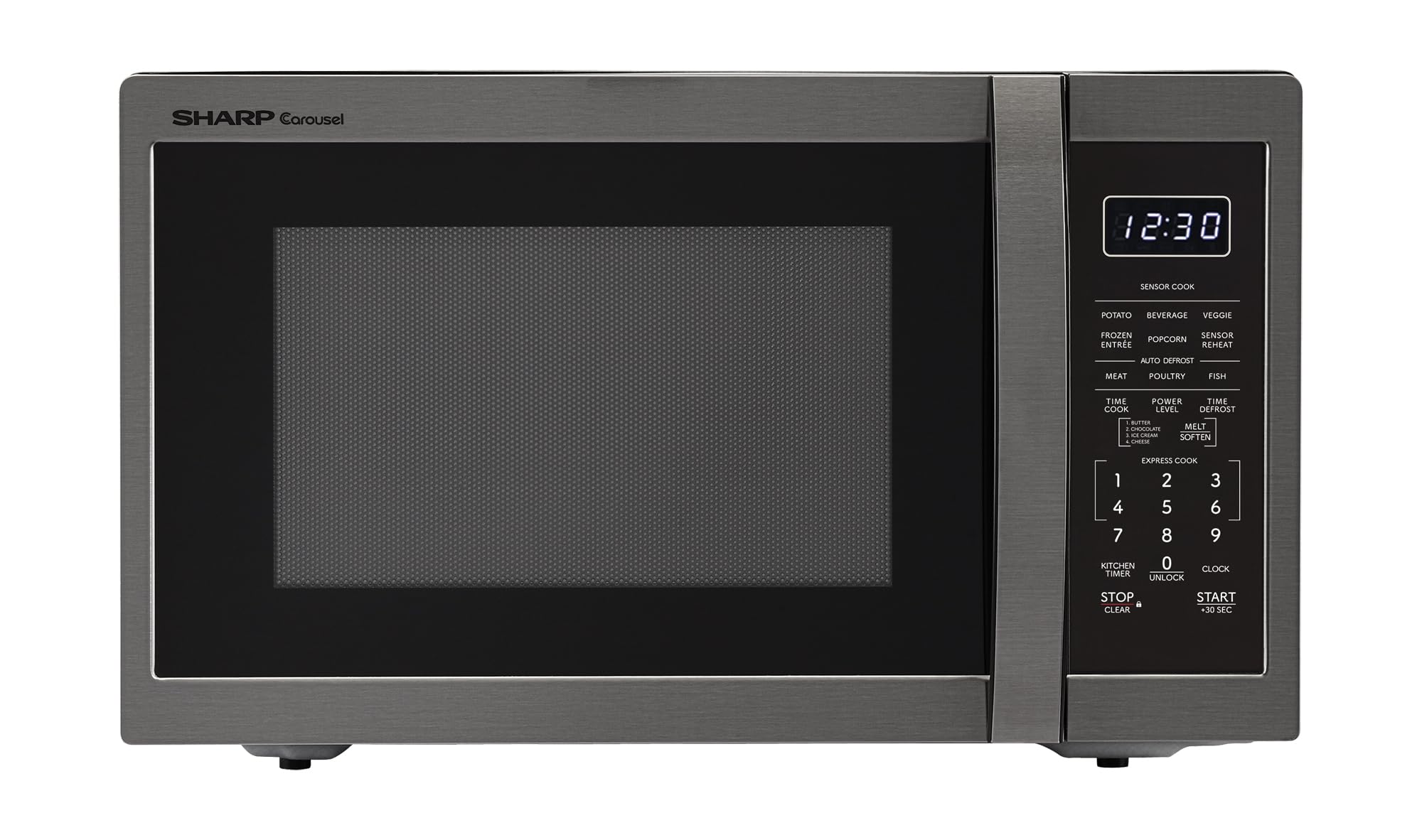
Sharp has built a reputation for quiet operation, and this 1.4 cu. ft. model with a premium blue LED display continues that tradition. The 1100W output is adequate for the medium cavity size, and the Precise Cook sensor technology adjusts power based on food moisture levels without user input. The physical handle is a design choice that is increasingly rare — it avoids the push-button mechanism that can fail over time and provides a more tactile open-and-close feel. The 12.4-inch carousel turntable rotates smoothly across the cavity floor and is removable for cleaning.
The control panel includes a dedicated “+30 second” button for instant start and an express cook function that allows one-touch cooking up to six minutes. The unit also features a silent mode option that disables the end-of-cycle beep without requiring a workaround — a small but significant convenience for open-plan living spaces. The blue LED display is crisp and legible from across the kitchen, and the black stainless steel exterior resists fingerprints better than the standard stainless finish. The child safety lock can be disabled permanently with a dedicated button, avoiding the multi-step sequences that frustrate users on other models.
The primary limitation is the 1100W power output, which is below the 1250W threshold of the Panasonic competitors — the difference is noticeable when heating dense or frozen food items. The internal cavity height is also slightly shorter than the 1.5 cu. ft. models, so tall soup mugs or water bottles may not fit. A small number of customers noted that the steel frame shows smudges from regular handling. But for buyers who prioritize quiet operation, a physical door handle, and a straightforward mute function, the Sharp delivers a refined experience that competes well in the upper mid-range tier.
Why it’s great
- Very quiet operation with a dedicated silent mode for the beep
- Physical door handle is more durable than push-button releases
- Blue LED display is easy to read and looks modern
Good to know
- 1100W output is lower than inverter rivals at a similar price
- Interior height is restrictive for tall containers and mugs
- Black stainless steel exterior still shows some smudges
5. TOSHIBA ML4-EM12PA 1.2 Cu Ft

Toshiba packs more auto-cook programs into this 1.2 cu. ft. model than any other unit at its price level. The 13 preset menus cover snacks, beverages, frozen entrees, and fresh vegetables, and the Smart Sensor system adjusts cooking time based on steam output rather than relying on fixed timers. The 1000W output is standard for this capacity class, and the 12.4-inch glass turntable provides even coverage across the cavity floor. The black stainless steel finish offers a sleeker alternative to the standard silver, and the exterior dimensions (20.6 x 16.3 x 11.8 inches) fit into most countertop layouts without overhang.
The mute function is a dedicated control that silences the beep without requiring a multi-button sequence — a feature that is often reserved for higher-priced models. The memory function allows the user to save a custom cooking setting and retrieve it with a single press, which is useful for frequently reheated items like oatmeal or tea. The two-step child lock is mandatory for safety compliance but can be disabled by following the product manual procedure. The interior cavity measures 13.9 x 14.1 x 10 inches (WxDxH), providing enough height to accommodate a standard dinner plate with a domed cover.
The trade-off for the extensive auto menu list is that the controls are slightly busier than a minimalist interface, and the 1000W output means defrosting larger cuts of meat takes longer than a 1250W inverter unit. Some customers noted that the keypad labels are not backlit, making them hard to read in dim kitchen lighting. The unit also lacks an inverter-style continuous power delivery, so lower power levels default to the cycling method. Nevertheless, the Toshiba offers the best feature-per-dollar ratio in the 1.2 cu. ft. class, especially for buyers who want sensor cooking without paying the inverter premium.
Why it’s great
- 13 auto-cook menus provide extensive preset coverage for common foods
- Smart Sensor adjusts cooking based on real-time steam detection
- Mute function is a dedicated control, not a hidden workaround
Good to know
- Controls are not backlit, making them hard to read in low light
- 1000W output is slower for defrosting compared to higher-wattage units
- Lower power levels use cycling instead of continuous inverter delivery
6. GE Compact 1.1 Cu Ft Microwave

GE’s compact 1.1 cu. ft. model is designed specifically for smaller living spaces like dorms and apartments where counter space is at a premium. The exterior measures just 12 inches tall and 20.83 inches wide, with a depth of 15.62 inches that allows it to fit under standard upper cabinets. The 950W output is the lowest in this comparison, but for basic reheating of leftovers, frozen meals, and beverages, it performs adequately. The 6 auto-cook settings cover popcorn, pizza, beverage, potato, reheat, and defrost, which covers the most common use cases without overwhelming the user.
The control panel uses large touch buttons that are easy to operate even without looking, and the LED display shows cooking time in large digits. The weight and time defrost function allows the user to enter the food weight or set a custom time, giving some flexibility beyond the presets. The two-step child lock can be activated for safety and deactivated when not needed. The stainless steel interior is easy to wipe down, and the 10.6-inch glass turntable rotates smoothly despite the smaller cavity size. The unit also includes cooking complete alarms that signal when the cycle finishes.
The main compromises are the lower wattage, which leads to longer heating times compared to 1000W+ models, and the overall dimensions that feel cramped when heating larger dishes. The keypad is not backlit, which has been a point of frustration for some users who struggle to read the labels in low light. The steel frame also shows fingerprints and smudges readily, requiring frequent wiping. But for the student or single user who needs a reliable, space-efficient unit for basic daily reheating, the GE compact model hits the right balance of size and functionality.
Why it’s great
- Compact footprint fits easily in tight dorm or apartment spaces
- Large touch buttons are easy to operate without looking
- Weight defrost provides flexibility beyond fixed presets
Good to know
- 950W output is the lowest in this comparison, slower heating
- Keypad is not backlit, difficult to read in dim lighting
- Small cavity limits dish size and turntable coverage
7. Farberware 1.2 Cu Ft Countertop Microwave
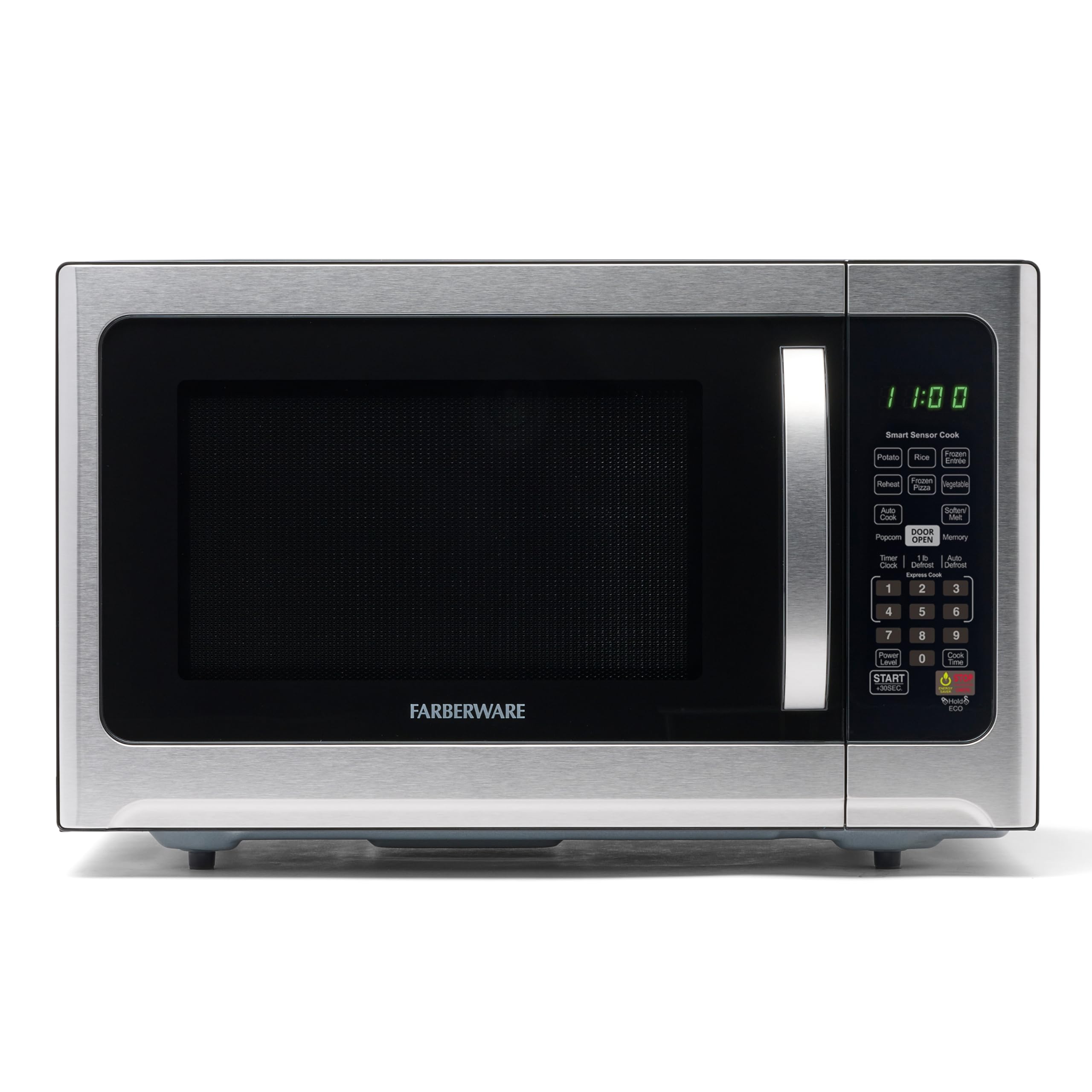
Farberware’s 1.2 cu. ft. model positions itself as a straightforward, no-frills microwave with a Smart Sensor that adjusts cooking time based on humidity. The 1000W output is standard for this capacity, and the 10 power levels allow the user to dial in the intensity for different tasks — from gentle defrosting to rapid boiling. The six one-touch presets cover popcorn, potato, pizza, and other common items, and the defrost function can be set by weight or by time. The enamel interior is easy to clean and resists staining better than bare stainless steel.
The clear LED display shows cooking time and the kitchen timer mode, and the interior light allows the user to check progress without opening the door. The child safety lock can be disabled by following the manual instructions, though some users reported that the lock remained active after cooking cycles, requiring a waiting period before the door would open. The unit measures 20.6 x 16.5 x 11.8 inches, which is roughly the same footprint as the Toshiba and GE models, and the stainless steel door frame matches standard kitchen appliance finishes.
The biggest issue is the child lock behavior — multiple customers reported that the lock engages automatically after each cooking session and cannot be permanently disabled, which is a significant inconvenience for daily use. The 1000W unit draws 1659W of input power, which is on the higher side for a medium-sized microwave and may require a dedicated circuit in older kitchens. The sound level is generally quiet but can be occasionally loud during operation. For the price-conscious buyer who can tolerate the persistent child lock, the Farberware delivers solid basic performance with the added benefit of sensor cooking.
Why it’s great
- Smart Sensor adjusts cooking time based on humidity for better results
- 10 power levels give fine-grained control over cooking intensity
- Enamel interior is easy to clean and resists staining
Good to know
- Child lock engages automatically and cannot be permanently disabled
- High input power (1659W) may require a dedicated circuit in older homes
- Occasional noise during operation reported by some users
8. Frigidaire 1.1 Cu Ft Stainless Steel Microwave

The Frigidaire 1.1 cu. ft. model is a basic, entry-level microwave that covers the essential functions without adding complexity. The 1000W output is typical for this capacity, and the 10 power levels allow the user to adjust from low (defrost) to high (rapid boil). The six pre-programmed timers cover popcorn, pizza, frozen vegetables, and wings — enough for most casual reheating needs. The enamel inner material helps resist food stains and makes wiping down the interior less labor-intensive than bare steel.
The physical dimensions (20.6 x 16.3 x 11.8 inches) are compact enough for a standard counter, and the stainless steel exterior is easy to clean with a damp cloth. The child safety lock can be activated for households with young children, and the auto defrost settings allow defrosting by food category (meat, poultry, fish) rather than requiring manual weight entry. The glass turntable rotates evenly across the cavity floor, and the push-button interface uses tactile switches rather than a glass touch panel.
The major reliability concern is the door latch design — several customers reported that the latch broke after a few weeks, leaving the door stuck closed and the unit impossible to use. The child lock function, while appreciated by some, adds an extra step after each cooking cycle that some users found tedious. The 1.1 cu. ft. cavity is also on the smaller side, making it unsuitable for large dinner plates or tall mugs. For a budget-conscious buyer who needs a temporary unit for a rental property or office break room, the Frigidaire works adequately, but the build quality concerns suggest it is not a long-term investment.
Why it’s great
- 10 power levels provide control for different cooking tasks
- Enamel interior resists staining and is easy to clean
- Pre-programmed timers cover the most common snack and meal items
Good to know
- Door latch has a documented failure rate that renders the unit unusable
- Child lock adds an extra step after each cooking cycle
- 1.1 cu. ft. cavity is small for larger dishes or tall containers
9. BLACK+DECKER EM031MB11 1.1 Cu Ft Microwave

The BLACK+DECKER EM031MB11 is the smallest and most affordable unit in this lineup, with a 1.1 cu. ft. cavity and a 1000W output power rating. The push-button door release is a space-saving feature that eliminates the need for a protruding handle — the door opens cleanly with a single press. The pre-programmed buttons cover popcorn, potato, pizza, frozen vegetable, beverage, and dinner plate, which covers the vast majority of basic reheating tasks. The large LED digital display shows cooking time and clock in a clear, easy-to-read format.
The interior features a 12.4-inch glass turntable that rotates evenly across the cavity floor, and the child safety lock can be activated by pressing the Stop button for three seconds. The 10 power settings allow some customization for defrosting and gentle heating, and the 30-second express cooking button provides instant one-touch operation. The unit measures 20.6 x 16.5 x 11.8 inches, which is compact enough for most countertops but slightly taller than the GE model. The black plastic enclosure with stainless steel door frame gives it a utilitarian look that fits well in a dorm, office, or budget kitchen.
The critical flaw is the child lock system — once activated, it locks the microwave for approximately 30 minutes after each cooking cycle, with no documented way to permanently disable it. This makes the unit nearly unusable for any scenario where multiple heating sessions are required in quick succession. The lower 1000W power output also means slower heating times compared to higher-wattage competitors, and some customers reported that the controls are difficult to read in low light. The unit is best suited for a single user in a low-traffic setting where the child lock frustration is manageable, such as a private office or a guest house.
Why it’s great
- Push-button door release saves counter space by eliminating a handle
- Large LED display is clear and easy to read from a distance
- Pre-programmed buttons cover the six most common reheating tasks
Good to know
- Child lock locks the unit for 30 minutes after each cycle with no permanent disable
- Lower 1000W power output results in slower heating
- Controls are not backlit, hard to read in dim lighting
FAQ
Can I permanently disable the child lock on most medium microwaves?
Does higher wattage always mean faster heating?
What is the difference between sensor cooking and auto cook presets?
Are medium microwaves suitable for use in an RV or camper van?
Why does my microwave interior look different in the product photos?
Final Thoughts: The Verdict
For most users, the medium sized microwave winner is the Panasonic NN-SN67QS because it combines the consistent power of inverter technology with a compact 1.2 cu. ft. footprint and an accurate Genius Sensor that simplifies daily reheating. If you want a larger cavity with the most advanced heat distribution, grab the Panasonic NN-SN76LS. And for a budget-friendly option that still offers sensor cooking and a mute function, the TOSHIBA ML4-EM12PA delivers the best value without sacrificing the features that matter most.