A dull blade is a danger in any kitchen, forcing you to apply extra pressure that leads to slips and uneven cuts. A manual knife sharpener removes the guesswork and expense of professional sharpening, restoring a razor edge from your own countertop.
I’m Mohammad Maruf — the founder and writer behind AirfryerBite. I’ve studied dozens of manual sharpening systems to understand how abrasive material, angle consistency, and grit sequence directly affect edge retention on common kitchen steels.
Whether you maintain a high-carbon chef’s knife or revive a neglected pocket blade, choosing the right best manual knife sharpener depends on matching abrasive stages to your blade’s hardness and your preferred sharpening routine.
How To Choose The Best Manual Knife Sharpener
A manual knife sharpener’s real value lives in its abrasive stages, angle precision, and stability. Without these three elements aligned, you risk grinding away steel unevenly or producing an edge that dulls after a single use.
Abrasive Material and Grit Sequence
Tungsten carbide blades remove metal aggressively — ideal for repairing chips or reshaping a severely dull edge, but they can leave a rough finish if not followed by a finer stage. Diamond discs grind faster on high-hardness steels (60 HRC or above) and stay flat longer than natural stones. Ceramic rods or discs polish the edge to a razor finish; a 3000 to 6000 grit ceramic stage refines micro-serrations for cleaner slicing. Avoid single-stage sharpeners if you own kitchen knives that see daily use — you need at least a coarse/fine sequence to restore and then refine the edge.
Angle Control and Guide System
Kitchen knives typically benefit from a 20-degree edge, while Japanese-style blades perform best at 15 degrees. A sharpener with preset angle slots or a magnetic angle guide locks the blade into the correct orientation every pass. Fixed-angle pull-through designs are beginner-friendly; rolling sharpeners with magnetic holders allow you to see the burr formation and adjust pressure. Without angle consistency, you risk creating a convex edge that never fully sharpens.
Stability and Build Quality
A sharpener that slides or wobbles during use forces you to compensate with uneven pressure, which causes inconsistent edge geometry. Look for rubberized feet, silicone base pads, or a weighted wood base that anchors the unit to the countertop. The handle or body material matters too — high-impact plastic resists cracking if dropped, while beech wood adds mass and vibration dampening. For pocket or outdoor sharpeners, compact size and a built-in diamond rod for serrations add versatility without sacrificing portability.
Quick Comparison
On smaller screens, swipe sideways to see the full table.
| Model | Category | Best For | Key Spec | Amazon |
|---|---|---|---|---|
| EDOVEN Rolling Sharpener | Rolling Disc | Consistent dual-angle sharpening at home | 400 & 6000 grit, 15°/20° magnetic guide | Amazon |
| BOGONI Rolling Sharpener | Rolling Disc | Pro-grade edge with leather strop finish | 400 & 3000 grit, N52 magnets, strop | Amazon |
| MAD SHARK Adjustable | Adjustable Pull-Through | Multi-angle sharpening for diverse knives | 6 angles 14°-24°, tungsten + ceramic | Amazon |
| AccuSharp 4-in-1 | Pull-Through / Compact | Portable outdoor and tool sharpening | Tungsten carbide + ceramic + diamond rod | Amazon |
| Edgemaker Pro 331 | Cross-Steel Pull-Through | Quick maintenance for kitchen knives | Rotatable crossed steels, compact body | Amazon |
In‑Depth Reviews
1. EDOVEN Rolling Knife Sharpener
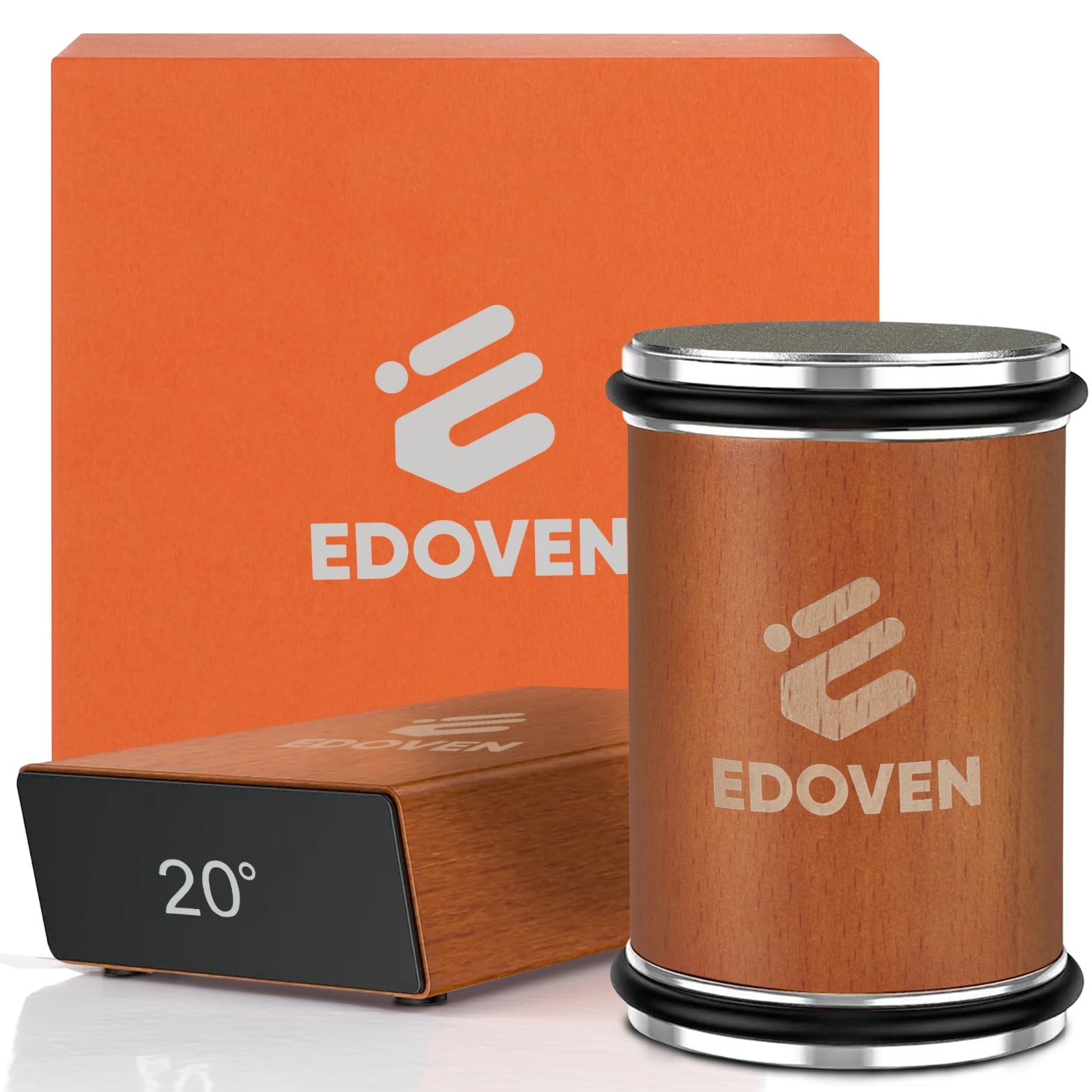
The EDOVEN rolling sharpener uses a 400-grit diamond disc to reshape dull edges and a 6000-grit ceramic disc to polish micro-serrations to a mirror finish. The magnetic angle guide locks the blade at exactly 15 or 20 degrees with N48 neodymium magnets, so there is no guesswork about holding the correct tilt. The beech wood body adds mass that dampens vibration, making each pass feel controlled and stable.
This two-stage system works well on high-carbon and stainless steel knives from 58 to 64 HRC. The rolling action lets you see the burr form on the edge — a tactile feedback that pull-through sharpeners cannot provide. Users report restoring previously unrecoverable blades within minutes, and the non-slip base keeps the unit planted even during aggressive passes.
The compact footprint (2.5 by 2.5 inches) stores easily in a drawer, and the included gift-box packaging makes it a thoughtful present for serious cooks. A few users noted that very small knives like paring blades can be tricky to stabilize on the magnetic holder, but standard chef and utility knives pose no problem.
Why it’s great
- Two-stage diamond-to-ceramic progression delivers professional-grade edges
- Magnetic angle guide removes skill barrier for consistent 15 or 20 degree sharpening
- Sturdy beech wood base and non-slip feet prevent movement during use
Good to know
- Small or very short blades may be difficult to hold securely on the magnetic guide
- Requires a clean counter surface and stable rolling motion for best results
2. BOGONI Rolling Knife Sharpener

The BOGONI rolling sharpener pairs a 400-grit diamond disc for edge reshaping with a 3000-grit ceramic disc for fine polishing — a slightly coarser ceramic finish than the EDOVEN, which some users prefer for a more aggressive cutting edge. The six built-in N52 magnets provide a stronger hold than most rolling sharpeners, keeping even wide chef blades firmly planted during the sharpening stroke.
A standout addition is the included leather strop, which refines the edge beyond what the ceramic disc alone can achieve. Professional chefs with repetitive strain issues report that this system reduces physical effort compared to using a steel or whetstone, because the rolling motion and magnetic guide eliminate the need to hold an angle manually. The entire process takes under four minutes for a dull kitchen knife and returns a razor edge that lasts through heavy prep sessions.
The natural wood construction resists moisture and looks elegant on the countertop, and the deluxe gift box adds value for gifting. Some users experienced a loose roller upon arrival, requiring a screwdriver to tighten, and the leather strop’s purpose is not immediately obvious from the packaging — it functions as a final polishing step after the ceramic disc.
Why it’s great
- Leather strop included for final edge refinement beyond ceramic polishing
- Six N52 magnets offer superior blade stability during rolling passes
- Professional chefs with hand fatigue find it significantly easier than traditional steels
Good to know
- Roller may need tightening out of the box on some units
- 3000-grit ceramic leaves a slightly coarser finish than 6000-grit alternatives
3. MAD SHARK Knife Sharpener

The MAD SHARK stands apart from fixed-angle sharpeners by offering six adjustable sharpening angles from 14 to 24 degrees, controlled by a simple dial on the body. This flexibility lets you match the edge angle to the blade’s intended use — 14 or 15 degrees for Japanese and Asian-style knives, 20 degrees for western chef knives, and 22 to 24 degrees for heavy-duty or outdoor blades. The tungsten steel slot handles coarse edge repair, while the ceramic slot refines the edge for daily cutting.
A dedicated scissor sharpening slot adds functionality that most pull-through sharpeners lack. The ergonomic handle keeps your grip well away from the cutting path, and two silicone pads on the base anchor the tool firmly to the counter. Users report that even novice sharpeners achieve consistent edges on both American and Japanese knives after a few passes, and the fine ceramic stage leaves a smooth finish without scratching the blade face.
The angle guide printed on the sharpener body suggests which setting to use for each knife type, removing confusion. However, left-handed users may find the natural pull direction less comfortable, and the plastic body feels lighter than wood-based rolling sharpeners — though this also makes it more portable for camping or travel.
Why it’s great
- Six adjustable angles from 14 to 24 degrees fit Asian, western, and outdoor blades
- Integrated tungsten and ceramic slots plus a scissor sharpening station
- Silicone base pads prevent slipping during pull-through passes
Good to know
- Pull-through motion feels more natural for right-handed users
- Plastic body has less vibration dampening compared to wood or weighted bases
4. AccuSharp 4-in-1 Knife & Tool Sharpener

The AccuSharp 4-in-1 packs coarse tungsten carbide blades, fine ceramic rods, and a retractable diamond-tapered rod into a unit that measures just 4.25 by 1.5 inches — small enough to fit in a tackle box or camping pack. The carbide blades remove metal quickly on very dull blades, while the ceramic rods hone the edge for smoother cutting. The diamond rod includes a groove for sharpening fish hooks, darts, and pointed tools, making this a true multi-tool for outdoorsmen.
Molded rubber feet keep the unit stable on wet or uneven surfaces, and the textured handle provides a secure grip even with wet hands. Users consistently praise its ability to restore a pocket knife or fillet knife to shaving sharpness within a minute, and the low weight (0.13 pounds) means it disappears into a pack or drawer. The design sacrifices a fine polishing stage — after the ceramic rods you get a working edge but not a mirror finish — which suits field use better than kitchen precision work.
The retractable diamond rod requires lubrication at the pivot to extend smoothly; forcing it open without lubricant can damage the mechanism. Several long-term owners report the unit lasting years with occasional cleaning, and they buy replacements only after wearing out the carbide blades through heavy use.
Why it’s great
- Ultra-compact 4.25-inch design fits in pockets, tackle boxes, or camping gear
- Three abrasive stages cover coarse repair, honing, and serration/detail work
- Rubber feet and textured handle provide stability on wet surfaces
Good to know
- Lacks a fine polishing stage for kitchen blades needing a mirror finish
- Diamond rod pivot requires lubrication before first use to prevent binding
5. Edgemaker Pro 331

The Edgemaker Pro 331 uses two crossed hardened steel rods that hone and sharpen the blade simultaneously as you draw the knife through. There is no coarse carbide stage — this is strictly a fine finishing tool designed for quick touch-ups rather than edge repair. The design mimics a butcher’s steel in a compact, safe housing that prevents the blade from wandering off-angle.
The rods can be pulled out, rotated to a fresh surface, and reinserted after the base plastic is softened in hot water. This extends the sharpener’s life significantly: some users report getting over a decade of regular use by rotating rods multiple times. The high-impact plastic body withstands drops and the 11-inch length provides enough room to draw even large chef knives fully through the steels.
This sharpener excels as a daily maintenance tool but cannot fix seriously dull or chipped blades — those need a coarse stone prior to the Edgemaker. Users who own both a coarse repair system and the Edgemaker find the combination ideal: the coarse system restores geometry, and the Edgemaker keeps the edge sharp between full sharpenings. The crossed steel design also produces less metal debris than abrasive sharpeners, keeping the workspace cleaner.
Why it’s great
- Rotatable steels provide years of usable sharpening surface without replacement
- Prevents blade scratching and over-sharpening through controlled steel-to-steel contact
- Ultra-compact and lightweight at 0.26 pounds for drawer storage
Good to know
- Not suitable for repairing severely dull or chipped blades
- Requires a separate coarse sharpener for initial edge restoration
FAQ
Can a manual knife sharpener handle Japanese high-carbon steel at 62 HRC?
How often should I use a manual sharpener on my chef’s knife?
Will a rolling disc sharpener work on serrated bread knives?
Is a magnetic angle guide accurate enough for professional knife edge geometry?
Final Thoughts: The Verdict
For most users, the best manual knife sharpener winner is the EDOVEN Rolling Knife Sharpener because it combines a 400/6000 grit diamond-to-ceramic progression with a magnetic angle guide that removes all angle guesswork from the process. If you want a leather strop for mirror-edge finishing and stronger N52 magnets, grab the BOGONI Rolling Sharpener. And for portable outdoor use that also handles serrations and fish hooks, nothing beats the AccuSharp 4-in-1.