The difference between a muddy, bitter espresso shot and a bright, crema-topped one often comes down to one thing: the quality of the grind. A motorized blade grinder pulverizes beans unevenly, creating a mix of dust and boulders that extract at wildly different rates—ruining your shot. A precision manual grinder, with its conical burrs and fine step adjustments, delivers the uniform particle size espresso demands, giving you the control to dial in the perfect extraction every morning.
I’m Mohammad Maruf — the founder and writer behind AirfryerBite. I’ve spent countless hours analyzing burr geometries, bearing tolerances, and adjustment mechanisms to separate the grinders that deliver genuine espresso-grade consistency from those that are better suited for drip or French press.
After evaluating dozens of models on build materials, grind uniformity, and espresso-specific range, I’ve identified the top contenders that belong on your shortlist. This guide breaks down the best manual espresso grinder options for every budget and brewing style so you can buy with confidence.
How To Choose The Best Manual Espresso Grinder
Choosing a manual grinder for espresso is different from picking one for pour-over or French press. Espresso demands a narrow particle distribution at a very fine setting, which requires a grinder with precise adjustment mechanics and a stable burr set. Here are the critical factors to consider before buying.
Burr Material and Geometry
Almost all serious manual espresso grinders use conical burrs. The material—stainless steel versus ceramic—affects longevity, heat dissipation, and grind speed. High-carbon stainless steel burrs (often CNC-machined) stay sharper longer and grind faster with less heat transfer, preserving bean aroma. Ceramic burrs are cheaper but can wear unevenly over time, especially when grinding light roasts. For espresso, a steel burr set with a hardness rating above 55 HRC is the benchmark.
Adjustment Mechanism and Step Size
The ability to make micro-adjustments is non-negotiable for espresso. Look for grinders that offer external adjustment rings (no disassembly required) and step sizes of 20 microns per click or finer. A grinder with 16–20 microns per click allows you to dial in a shot by 1–2 grams of dose without jumping past the sweet spot. Internal adjustment systems with 30–40 clicks per full rotation are functional but less convenient for switching between brew methods.
Build Stability and Bearing Quality
Espresso grinding at fine settings creates high torque, which can cause burr wobble in poorly built grinders. A dual-bearing axle—ideally with precision bearings rated to 5–7 microns of tolerance—keeps the burrs perfectly aligned, ensuring uniform particle size. The body should be a full-metal unibody (aluminum or stainless steel) rather than one with plastic components that can degrade or flex under pressure.
Quick Comparison
On smaller screens, swipe sideways to see the full table.
| Model | Category | Best For | Key Spec | Amazon |
|---|---|---|---|---|
| TIMEMORE Chestnut S3 | Premium | Ultra-precise espresso dial-in | 0.015mm/grid external adjustment | Amazon |
| KINGrinder K6 | Mid-Range | Value-focused espresso beginners | 16 microns per click | Amazon |
| MHW-3BOMBER R3 Pro | Mid-Range | Espresso with sifting capability | Titanium-coated CNC burr | Amazon |
| 1Zpresso J Manual | Premium | Durable daily driver for all methods | 48mm steel burr, 30 clicks/rotation | Amazon |
| Comandante C40 MK4 | Premium | Legendary consistency for serious enthusiasts | 40g capacity, click system | Amazon |
| TIMEMORE Chestnut C2S | Budget | Entry-level espresso on a budget | Full metal unibody, 38mm burr | Amazon |
| Vivaant Manual Grinder | Budget | Portable and quiet single-dosing | 32g capacity, 6 external settings | Amazon |
In‑Depth Reviews
1. TIMEMORE Chestnut S3 Manual Coffee Grinder

The TIMEMORE Chestnut S3 is the brand’s new flagship manual grinder, built around a proprietary S2C890 steel burr set that delivers exceptional particle uniformity. The external digital adjustment ring uses a 0.015mm-per-grid scale, allowing you to dial in espresso with precision that rivals electric grinders costing three times as much. The S3’s customized high-precision bearings reduce axle tolerance from 7 microns to 5 microns, which translates to noticeably less burr wobble at fine settings.
Grinding 18 grams of medium-roast espresso takes roughly 30 seconds with smooth, even resistance. The collapsible spring-assisted handle folds flush against the body, making it storage-friendly and stable on the counter. The metal catch cup holds about 33 grams and produces minimal static, a common issue with other grinders in this class. Some users note that the external ring can be nudged accidentally if you grip the grinder near the top, so handle position matters during operation.
Build quality is outstanding—full aluminum unibody with no flex. It handles everything from coarse French press to fine Turkish grind, though one reviewer reported that even the finest setting wasn’t enough for true Turkish powder. For espresso, pour-over, and Aeropress, the S3 delivers top-tier performance. Its combination of external micro-adjustment, premium bearings, and burr geometry makes it the strongest contender for espresso-focused users who prioritize precision above all else.
Why it’s great
- Ultra-fine 0.015mm external adjustment for precise espresso dial-in
- Custom 5-micron tolerance bearings reduce burr wobble
- Fast grinding speed with minimal static retention
Good to know
- External dial can be rotated accidentally if gripped near the top
- Some light roasts at finest setting may not produce true Turkish powder
2. KINGrinder K6 Manual Hand Coffee Grinder

The KINGrinder K6 has become a go-to recommendation in specialty coffee circles, and for good reason. It features an internal adjustment system with 16 microns per click—fine enough to make meaningful changes to your espresso shot without jumping past the extraction sweet spot. The burr set is CNC-machined stainless steel, and the body is full aluminum, giving it a premium heft that rivals grinders well above its price tier.
Grinding 15 grams of dark roast for espresso takes about 45 seconds with moderate effort, and the dual-bearing axle keeps the burrs stable throughout the process. The 30-gram capacity is sufficient for two standard shots. One nuance: the “true zero” point is offset by about 2 clicks on some units, so you may need to calibrate the dial indicator with the burrs touching before your first use. The straight-handle design feels ergonomic, though some users prefer a folded handle for storage.
Compared to the 1Zpresso J and Timemore C2, the K6 delivers competition-level grind uniformity at a fraction of the cost. It minimizes fines and produces a clean particle distribution that shines in espresso. The screw-on catch cup can occasionally bind if over-tightened, but that’s a minor quibble. For anyone entering the manual espresso world without wanting to overspend, the K6 is the smartest buy on the market today.
Why it’s great
- 16-micron clicks provide ample adjustment range for espresso
- Full aluminum body with CNC steel burrs feels built to last
- Excellent grind uniformity that rivals grinders costing twice as much
Good to know
- True zero may be offset by 1–2 clicks, requiring initial calibration
- Screw-on catch cup can jam if tightened too firmly
3. MHW-3BOMBER R3 Pro Manual Coffee Grinder
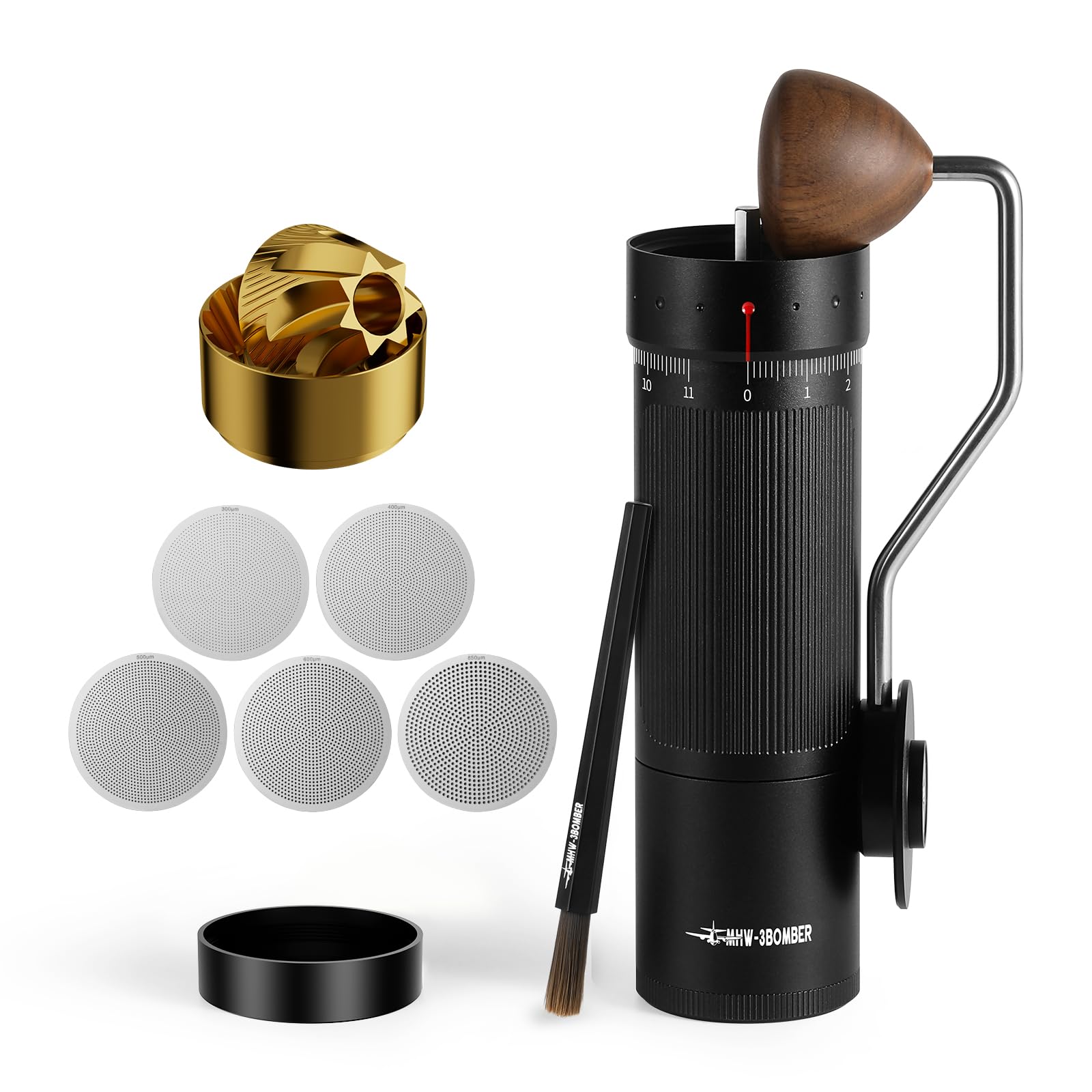
The MHW-3BOMBER R3 Pro stands out by bundling a premium titanium-coated conical burr with a five-sieve sifting system, a combination rarely seen in manual grinders. The titanium layer reduces friction and heat transfer during grinding, preserving delicate volatile aromas that often get lost in standard steel burrs. The external adjustment ring covers the entire grind range in one full rotation, with 11 macro markings for repeatable settings.
Its 20-gram capacity is more limited than competitors—enough for two shots but requiring a refill for three. The grinding effort is notably low thanks to the high-torque handle design and stable center shaft. The included sieve set lets you filter out superfines and chaff, giving you control over particle distribution that was previously only possible with lab-grade equipment. Some users note that the magnetic catch cup works well but can detach if not handled carefully.
Build quality is excellent: SUS304 and SUS420 stainless steel burrs housed in a high-strength aluminum alloy body with a walnut accent. The R3 Pro is ideal for the home barista who wants to experiment with sifting to eliminate bitterness. If you value the ability to customize your grind profile beyond what the grinder itself delivers, this kit is unmatched in its category.
Why it’s great
- Titanium-coated burr reduces heat and preserves bean aroma
- Five-sieve sifting system allows granular particle distribution control
- Single-turn external adjustment with repeatable macro markings
Good to know
- 20g capacity requires refill for three espresso shots
- Magnetic catch cup can detach if bumped during operation
4. 1Zpresso J Manual Coffee Grinder

The 1Zpresso J is a workhorse manual grinder built around a 48mm stainless steel conical burr—one of the largest in its class. The internal adjustment system offers 30 clicks per rotation, giving you 0.5–1 gram resolution for dialing in espresso. The burr set is factory-calibrated to maintain alignment over its rated 100–200 kilogram lifespan, and the tool-free disassembly makes cleaning straightforward.
Grinding 18 grams of espresso takes 60–90 seconds at a setting of 8–10 clicks from zero, with moderate resistance that increases noticeably for light roasts. The foldable handle tucks away for storage, though the 1Zpresso J lacks the magnetic catch cup found on some competitors. Static can build up, especially in dry climates, but a light water spritz on the beans before grinding resolves the issue. A few grams of retention are common, so single-dosing with a bellows is recommended.
Build quality is exceptional—mostly metal with a rubber grip and a plastic lid cover being the only concessions. Users consistently report that the 1Zpresso J competes head-to-head with electric grinders in the + range. The learning curve for zeroing the dial is real, but once set, the grinder delivers uniform grounds shot after shot. For a premium build that will last years, the 1Zpresso J is a reliable choice.
Why it’s great
- 48mm steel burr provides fast, consistent grinding
- Tool-free disassembly simplifies cleaning and maintenance
- Rated for 100–200 kg of grinding life
Good to know
- 0.5–1g retention may require bellows for single dosing
- Static buildup can occur in low-humidity environments
5. Comandante C40 Hand Grinder MK4

The Comandante C40 MK4 is the benchmark that other manual grinders are measured against. Its high-nitrogen steel burr produces exceptionally uniform particles with minimal fines, giving espresso a clean, bright flavor profile that highlights bean origin characteristics. The internal click system uses a detent mechanism that provides tactile feedback with each adjustment, though it requires remembering your setting rather than reading a numbered dial.
The MK4 ships with two jars: one brown glass and one clear polymer-glass, each holding about 40 grams of beans. The redesigned tri-fan axle support in the MK4 makes filling easier and reduces the chance of beans jamming at the entry point. Grinding effort is moderate—faster than cheap ceramic burr grinders but slower than the 1Zpresso J or TIMEMORE S3. The construction is tank-like: all stainless steel and aluminum with a wood grip that some users find slippery.
Priced at a premium, the C40 lacks some modern conveniences like an external adjustment ring or a magnetic catch cup. It also doesn’t include a brush or travel sack. However, its 40-click range and legendary build quality make it a long-term investment for the serious enthusiast. If you want the gold standard in grind consistency and are willing to pay for it, the C40 delivers results that few competitors can match.
Why it’s great
- Industry-leading particle uniformity with minimal fines
- High-nitrogen steel burr preserves bean flavor clarity
- Tank-like build quality with 40g capacity for larger doses
Good to know
- No external adjustment ring—must remember click setting
- Does not include a cleaning brush or travel sack
6. TIMEMORE Chestnut C2S Manual Coffee Grinder

The TIMEMORE Chestnut C2S is an upgraded version of the popular C2, addressing the common complaint of a fragile top cover by switching to a full metal unibody. It uses a 38mm CNC-machined stainless steel conical burr with a hardness of 55–58 HRC, paired with a dual-bearing central axis that keeps burr alignment stable during fine grinding. The internal adjustment offers roughly 36 click positions, covering everything from Turkish to French press.
Grinding 15 grams for espresso takes about one minute with the C2S, and the movement is notably smooth—the handle even continues spinning briefly after you release it thanks to the bearing quality. The body is compact at 52mm in diameter, making it easy to grip even for smaller hands. The catch cup holds about 24 grams, which is sufficient for one double shot but requires a refill for larger batches.
At its price point, the C2S offers exceptional value. It lacks the external adjustment of pricier models, and changing grind size requires rotating the internal dial, which can be slightly tedious if you switch between brew methods frequently. But for a dedicated espresso setup where you set the grind once and leave it, the C2S delivers reliable consistency without breaking the bank.
Why it’s great
- Durable full metal unibody fixes the C2’s fragile top cover issue
- Dual-bearing axle ensures stable burr alignment at fine settings
- Fast grinding with smooth bearing movement
Good to know
- Internal adjustment is less convenient for frequent brew method changes
- 24g capacity requires refill for more than one double shot
7. Vivaant Coffee Grinder Manual

The Vivaant manual grinder uses a stainless steel “Dragon Tooth” conical burr that grinds significantly faster than ceramic alternatives—Turkish in about two minutes versus 15–20 minutes for ceramic burrs. The 6 external grind settings are adjusted by simply turning the handle assembly, requiring no disassembly. The clear glass jar is marked for measurements and doubles as a storage container with a tight-sealing lid.
With a 32-gram capacity, the Vivaant holds enough for two standard espresso shots. The grind consistency at fine settings is good for its price range, producing a usable espresso grind, though particle distribution won’t match the more expensive steel burr grinders from 1Zpresso or TIMEMORE. The operation is virtually silent—a major plus for early-morning use in shared spaces. The entire unit weighs very little, making it an excellent travel companion.
Customer reviews consistently praise the company’s lifetime warranty and responsive customer support. The main trade-off is the limited 6-setting range, which offers less granularity for dialing in espresso compared to grinders with 30+ click positions. If you need a compact, quiet, and affordable manual grinder for travel or occasional espresso use, the Vivaant is a solid entry point that won’t disappoint.
Why it’s great
- Steel burr grinds 2x faster than comparable ceramic burr models
- Extremely quiet operation suitable for shared living spaces
- Lifetime warranty with highly rated customer support
Good to know
- Only 6 grind settings limit fine-tuning for espresso
- Grind consistency at espresso fineness lags behind premium steel burr grinders
FAQ
What step size in microns per click is ideal for espresso tuning?
Why do some manual grinders use internal vs external adjustment for espresso?
Does burr material affect espresso grind quality in manual grinders?
Final Thoughts: The Verdict
For most users, the best manual espresso grinder winner is the TIMEMORE Chestnut S3 because its external 0.015mm-per-grid adjustment, custom 5-micron bearings, and fast S2C890 burrs deliver espresso-grade precision in a compact manual package. If you want the best value that doesn’t compromise on grind quality, grab the KINGrinder K6. And for the enthusiast who demands legendary consistency and a tank-like build that will last a lifetime, nothing beats the Comandante C40 MK4.