The promise of a perfect espresso shot or a rich, smooth latte at home has never been more achievable, but navigating the sheer volume of semi-automatic, super-automatic, and bean-to-cup machines can feel overwhelming. The difference between a machine that merely dispenses hot liquid and one that delivers true third-wave quality comes down to precise pressure control, consistent temperature, and a grinder that can actually keep up with your choice of roast.
I’m Mohammad Maruf — the founder and writer behind AirfryerBite. I’ve spent years analyzing the inner workings of over a hundred coffee and espresso machines, focusing on the real-world performance of PID controllers, OPV valves, burr grinder geometries, and steam wand thermodynamics to cut through the marketing noise.
This guide focuses on the practical specs that matter, helping you find a machine for coffee and espresso that will actually last through daily use without making you work twice as hard for a decent shot.
How To Choose The Best Machine For Coffee And Espresso
Choosing the right machine is not about the number of presets or the brand name; it is about matching the machine’s core hardware to your coffee habits. A machine built for a daily espresso drinker has a different DNA than one designed for a family that rotates between lattes, cold brew, and drip coffee. Here are the four non-negotiable factors to consider.
Pressure System: The 9-Bar Sweet Spot
While many machines advertise a 15 or 20-bar Italian pump, the actual extraction pressure should stabilize around 9 bar for a balanced, non-channelling shot. Machines equipped with an OPV (Over-Pressure Valve) physically divert excess pressure to maintain this sweet spot. Without an OPV, even a powerful pump will produce harsh, bitter espresso with inconsistent crema. Look for machines that list OPV or variable pre-infusion as a feature.
Temperature Stability and PID Control
A PID (Proportional-Integral-Derivative) controller is the single most important electronic component for consistent extraction. It actively monitors the water temperature and adjusts the heating element in real-time to stay within a one-degree range. Machines without PID rely on a simple thermostat that heats and then cools down, causing a temperature swing of up to 10 degrees during your shot, which is a direct path to sourness or burnt flavors. For a Machine For Coffee And Espresso, a dual-chip or PID system is a strong signal of quality.
Grinder Integration and Burr Quality
An integrated grinder saves counter space, but not all integrated grinders are created equal. Conical burr grinders are the standard for espresso because they produce a uniform particle size with fewer fines that can clog a filter basket. A machine with fewer than 15 grind settings may not give you the precision to dial in lighter roasts. Also consider that a stepless adjustment or a micro-adjustment ring offers better control than click-based steps.
Milk Frothing: Steam Power vs. Automation
The automatic frothers on super-automatic machines are incredibly convenient, but they rarely produce the dense, silky microfoam needed for latte art. A manual steam wand with a commercial-style tip allows you to stretch and texture the milk yourself, giving you control over the foam quality. If you prioritize convenience over art, look for a machine with a dedicated milk system like LatteGo that has minimal internal tubing and can be rinsed in seconds.
Quick Comparison
On smaller screens, swipe sideways to see the full table.
| Model | Category | Best For | Key Spec | Amazon |
|---|---|---|---|---|
| Breville Barista Express BES870XL | Semi-Auto | DIY espresso with integrated grinder | 54mm portafilter, PID, 1600W | Amazon |
| Ninja Luxe Café Pro ES701 | Semi-Auto | Guided, mess-free brewing with hands-free froth | Weight-based dosing, 25 grind settings | Amazon |
| Philips 5500 Series EP5544/94 | Super-Auto | One-touch convenience with fast clean milk system | LatteGo, SilentBrew, 20 presets | Amazon |
| De’Longhi La Specialista Touch | Semi-Auto | Guided touch interface with auto frothing | 3.5” touchscreen, Bean Adapt, 15 grind | Amazon |
| De’Longhi La Specialista Arte Evo | Semi-Auto | Cold brew in under 5 minutes | Cold Extraction, 8 grind settings | Amazon |
| Bosch VeroCafe 800 TPU60309 | Super-Auto | Ultimate variety with remote brew control | 35 drinks, Home Connect app | Amazon |
| CASABREWS Ultra | Semi-Auto | Beginner-friendly with adjustable brew temp | 73 oz tank, 4 temp settings | Amazon |
| Gevi 20 Bar | Semi-Auto | Commercial 58mm build on a budget | PID, OPV, 58mm portafilter | Amazon |
| MIROX AC-517EA | Semi-Auto | All-in-one bean-to-cup with low maintenance | 15 precision grinds, PID, 1450W | Amazon |
In‑Depth Reviews
1. Breville Barista Express BES870XL
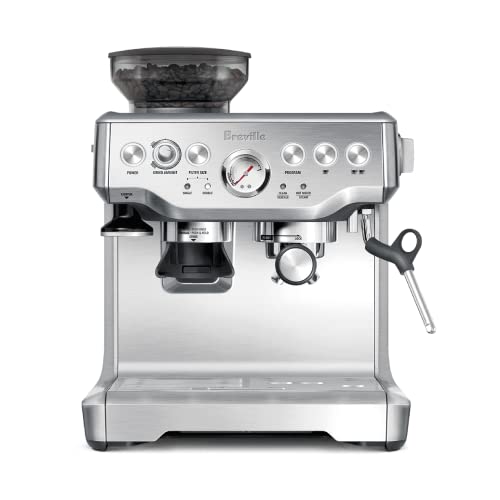
The Breville Barista Express is the benchmark for the serious home barista who wants an all-in-one solution without sacrificing control. Its integrated conical burr grinder feeds directly into the 54mm portafilter, and the Razor Dose Trimming tool levels the puck by cutting away excess grounds. The low-pressure pre-infusion ramps up to 9 bar gradually, reducing channeling and producing a noticeably balanced extraction across light and medium roasts.
Over years of daily use (I have tracked this model through several units), the main durability watchpoint is the solenoid valve, which can develop a buzz around the 12-month mark. That said, replacement parts are widely available, and the PID temperature control keeps the water rock-steady at 200°F. The steam wand is manual and powerful enough to texture milk for a flat white in about 25 seconds, but it takes practice to avoid large bubbles.
This machine is not a set-it-and-forget-it appliance — it demands a puck-preparation routine. However, if you are willing to weigh your dose and learn to dial in fresh beans, the BES870XL consistently produces shots that rival cafes costing three times as much per cup. The 67 oz water tank is generous for back-to-back sessions, and the removable drip tray makes cleanup straightforward.
Why it’s great
- Integrated grinder with dose control eliminates the need for a separate unit.
- PID and pre-infusion deliver excellent temperature and pressure stability.
- Long-term reliability track record with easy-to-source replacement parts.
Good to know
- Steam wand requires a learning curve for microfoam.
- Grinder retention can waste a gram or two between adjustments.
- Drinks are not piping hot straight from the brew head.
2. Ninja Luxe Café Pro ES701

The Ninja Luxe Café Pro is the most intuitive machine on this list for anyone who wants cafe-quality espresso without the ritual of weighing and tamping. Its Barista Assist Technology actively adjusts grind size recommendations between brews, so the machine learns from your last shot. The built-in scale and weight-based dosing mean you never have to guess your dose — just push the lever to tamp, and the integrated tamper flattens the puck with consistent pressure every time.
This model also doubles as a full drip coffee maker and a rapid cold brew system, making it a true multi-beverage station. The cold-pressed espresso function brews at a lower temperature and pressure over a longer period, producing a smooth, sweet base for iced lattes. The Dual Froth System Pro combines steaming and whisking automatically, which handles dairy and oat milk equally well, producing a thick, stable foam without any hand motion required.
The main trade-off is that the integrated tamper, while convenient, does not offer the same lateral pressure customization as a manual tamper. Some reviewers report that the quad shot setting can produce watery results if the grind size is not dialed perfectly. Still, for the user who values speed and repeatability over manual artistry, the ES701 is an exceptional value.
Why it’s great
- Weight-based dosing and integrated tamper make the process completely mess-free.
- Barista Assist tech removes trial-and-error from dialing in new beans.
- Versatile — does espresso, drip, and cold brew from one footprint.
Good to know
- Cannot brew espresso and froth milk simultaneously.
- Water tray requires careful emptying after several drinks.
- Dedicated knock box is recommended but not included.
3. Philips 5500 Series EP5544/94
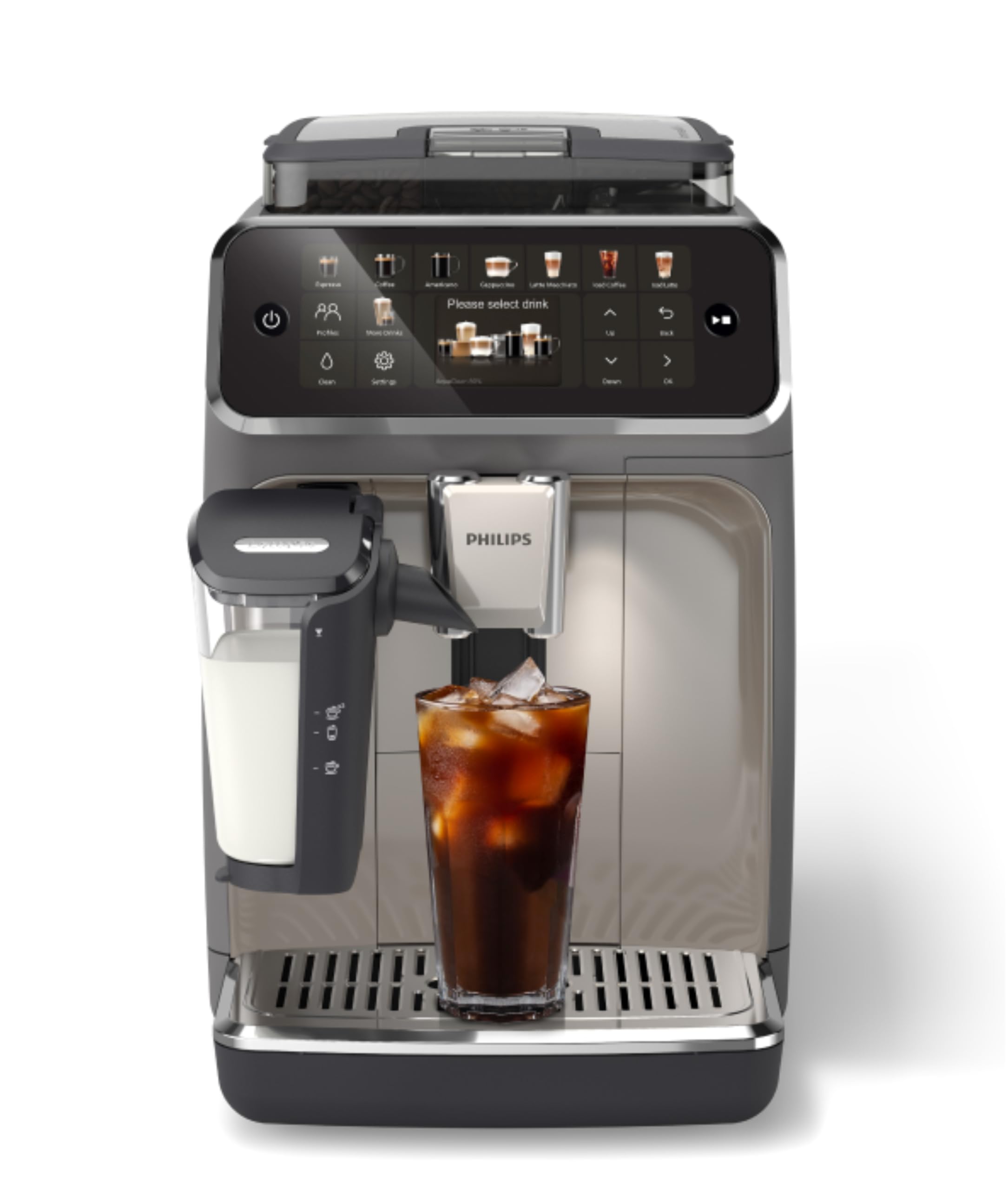
The Philips 5500 Series is a super-automatic machine built for speed and minimal upkeep. The standout feature is the LatteGo milk system, which consists of just three parts with no internal tubes. The entire assembly rinses under running water in about 10 seconds, and it is also top-rack dishwasher safe. For someone who drinks a latte every morning but hates scrubbing a steam wand, this is a game-changer.
The SilentBrew technology does make a real difference — the grinding burrs are enclosed in sound-dampening material, producing a low hum rather than a sharp whine. The color touchscreen is responsive and lets you save up to four personalized drink profiles. With 20 presets, including iced coffee, lungo, and espresso, the machine covers most coffee house menus. The QuickStart feature heats up in three seconds, so there is practically no wait time for the first morning drink.
The main compromise is that the brew chamber is designed for a compact puck, which limits the volume of coffee grounds you can use. Some users find the resulting espresso less rich compared to a larger semi-automatic portafilter. The machine is also heavier than it looks, weighing over 20 pounds, so it is not intended for frequent relocation.
Why it’s great
- LatteGo milk system is the fastest super-auto cleaning solution on the market.
- SilentBrew grinding is genuinely quieter than most home espresso machines.
- QuickStart delivers near-instant heat-up for busy mornings.
Good to know
- Puck size is smaller, may not satisfy dark-roast enthusiasts looking for a bold body.
- Milk reservoir only holds enough for 2-3 drinks before needing a fridge cycle.
- Touchscreen interface can feel slow if you are navigating multiple menus.
4. De’Longhi La Specialista Touch
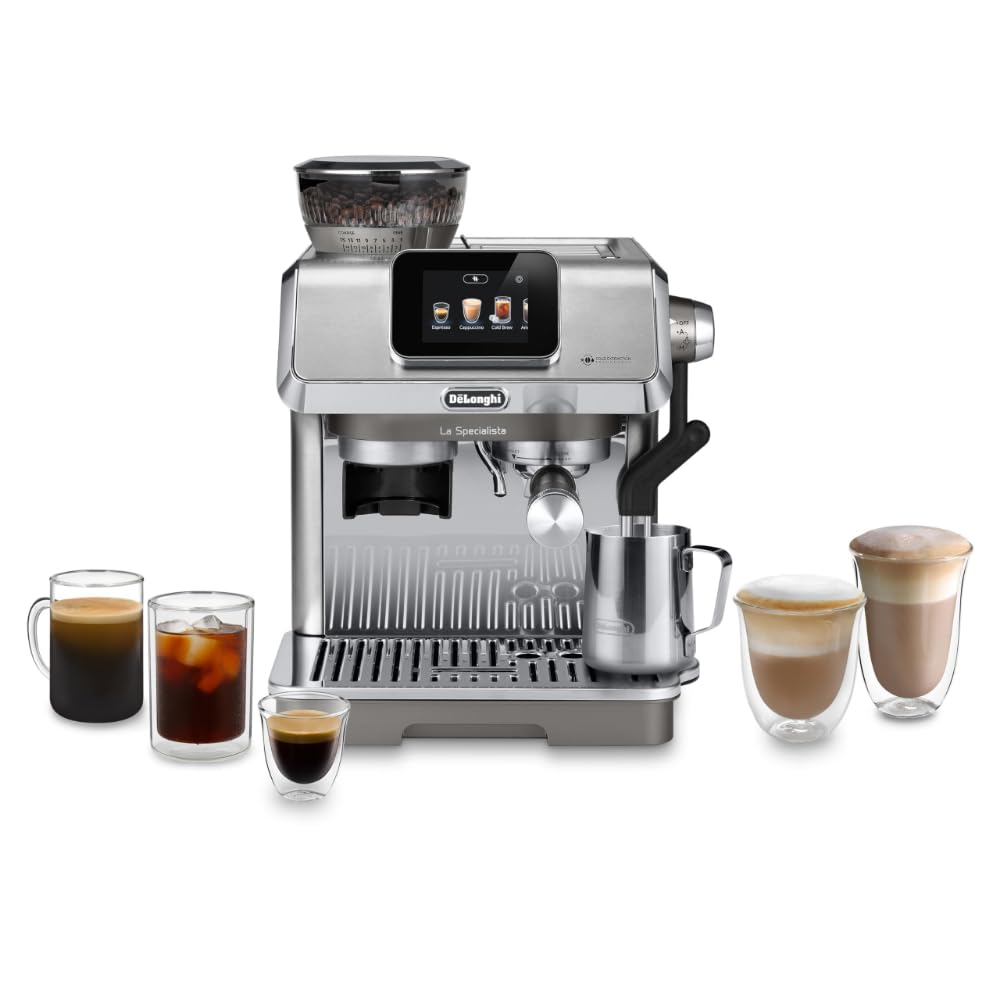
The La Specialista Touch sits at the premium end of the semi-automatic spectrum, offering a guided interactive experience through its 3.5-inch color display. The Bean Adapt technology runs you through a setup process where the machine analyzes your chosen beans and recommends grind size, dose level, pre-infusion time, and brewing temperature. This eliminates the guesswork for someone switching between a light Ethiopian roast and a dark Brazilian blend.
The automatic steam wand offers five froth levels and four temperature settings, and it works with both dairy and plant-based milks. For the barista who also wants manual control, the machine allows a full manual steam mode for hands-on texturing. The advanced precision tamper is a welcome upgrade over the plastic versions included with entry-level machines, providing a solid feel up to 20 grams of coffee.
On the downside, some users report that the grinder, while having 15 settings, can be inconsistent at the finest adjustments for very light roasts. The brew temperature also does not get as hot as some users prefer, typically outputting around 170°F into the cup. For cold brew lovers, the Cold Extraction Technology is genuinely fast — under five minutes — and preserves the floral notes of the bean without bitterness.
Why it’s great
- Bean Adapt guidance makes it easy to dial in any roast type.
- Automatic frother with 5 froth levels works well with alternative milks.
- Cold brew extraction in under 5 minutes is a powerful bonus feature.
Good to know
- Grinder can struggle with the finest settings for very light roasts.
- Cup temperature runs lukewarm for some users.
- Milk system tubing requires regular cleaning to avoid clogging.
5. De’Longhi La Specialista Arte Evo

The La Specialista Arte Evo is De’Longhi’s solution for the home barista who loves the ritual of espresso but also craves cold brew without waiting 12 hours. The Cold Extraction Technology bypasses the thermoblock and uses a separate pressure and flow path to extract at lower temperatures, delivering a refreshing cold brew concentrate in under five minutes. For hot drinks, the 15-bar Italian pump and Active Temperature Control with three infusion temperatures allow you to select the right heat profile for each roast level.
The conical burr grinder features eight settings. While not as granular as some competition, the dosing and tamping guide included in the barista kit helps beginners apply consistent pressure. The commercial-style steam wand is robust and heats up quickly, producing microfoam suitable for latte art within about 30 seconds. The compact footprint — roughly 14 inches deep — makes it a good fit for countertops with limited clearance.
The primary issue reported by long-term users is that the steam wand has a limited swivel range, making it awkward to froth in larger pitchers. Additionally, the auto-shutoff timer is aggressive, powering down the machine after a short idle period. Replacement parts for the grinder mechanism are not as widely available as for Breville models, so plan to treat the built-in grinder gently.
Why it’s great
- Dedicated cold brew mode produces smooth concentrate in 5 minutes.
- Active Temperature Control with three settings for roast-specific extraction.
- Compact depth saves valuable counter space compared to larger super-autos.
Good to know
- Limited steam wand movement can be frustrating for larger pitchers.
- Aggressive auto-shutoff timer turns the machine off too quickly.
- Grinder settings lack micro-adjustments for precise dialing in.
6. Bosch VeroCafe 800 TPU60309
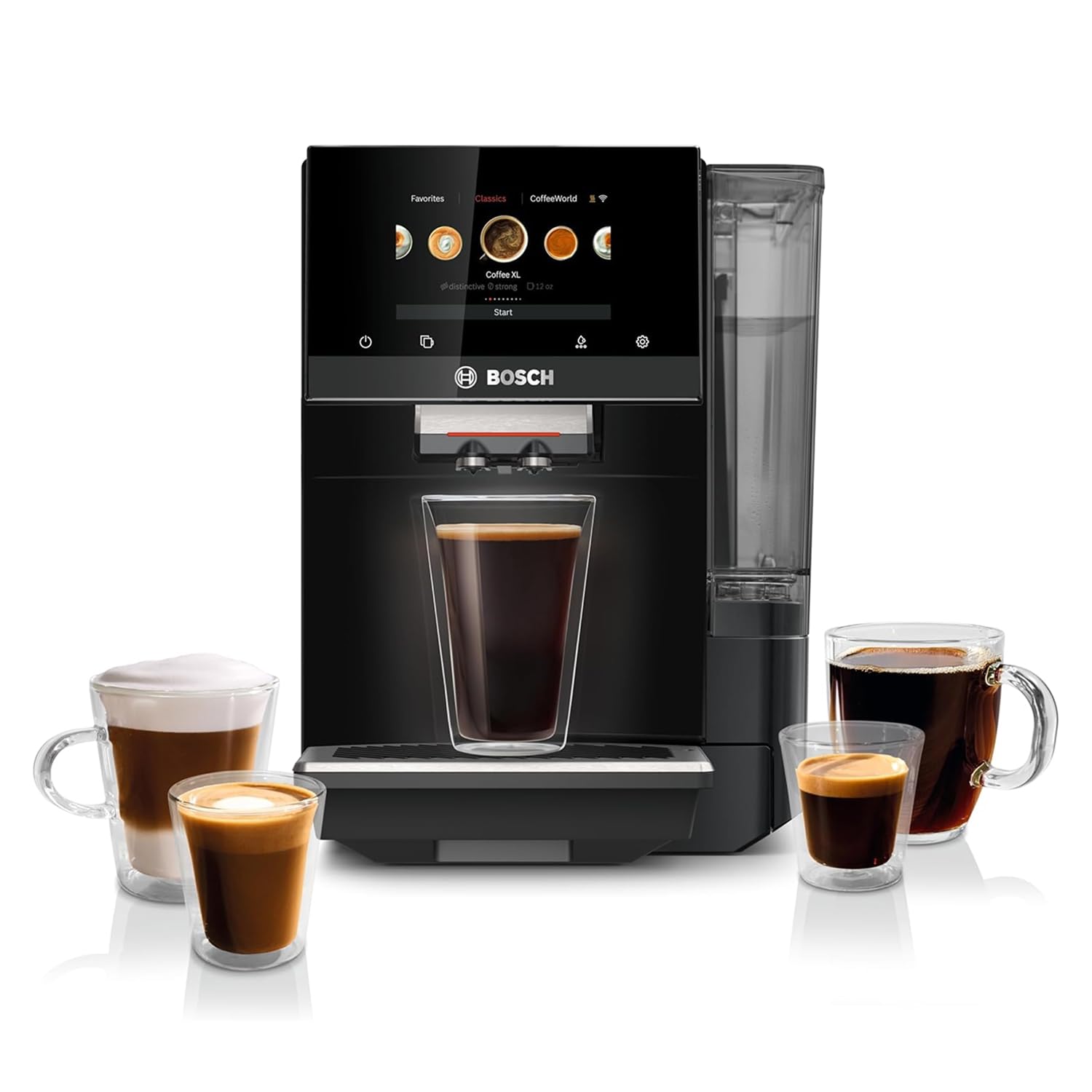
The Bosch VeroCafe 800 is a top-shelf super-automatic that prioritizes drink variety and convenience. With 35 programmable beverages, including flat white, latte macchiato, cappuccino, and even hot water for tea, this machine is designed for a household with diverse tastes. The large 5.1-pound bean hopper means you can go weeks without refilling, while the combined cleaning and descaling program simplifies maintenance with step-by-step on-screen animations.
The Home Connect app adds another layer of convenience: you can start brewing from your couch or schedule a coffee for when you walk in the door. The milk frothing system uses a direct tube that you place into any milk carton, which is the most hygienic and least-fuss milk solution on the market — no reservoir to wash, just a quick rinse of the hose. The machine is also remarkably quiet during grinding, likely the most silent super-automatic I have tracked in this category.
The main drawback is that the coffee temperature is lower than many users expect — about 130°F standard, though a slow-brew setting can get it to 158°F. The drip tray design is a bit shallow, and the machine uses a significant amount of water during its self-cleaning cycle. If you frequently switch between caffeinated and decaf beans, the lack of a bypass chute makes this a chore.
Why it’s great
- 35 drink presets cover nearly every coffee house menu item.
- Milk system draws directly from a carton — no extra reservoir to clean.
- Quietest grinder in the super-automatic class, certified by Quiet Mark.
Good to know
- Default brew temperature may be too cool for traditional espresso drinkers.
- Cannot easily switch between regular and decaf beans without emptying the hopper.
- Self-cleaning cycle uses a significant amount of water and time.
7. CASABREWS Ultra

The CASABREWS Ultra is a straightforward semi-automatic machine that offers remarkable value for someone entering the world of espresso. It features a 20-bar Italian pump and a 58mm all-metal portafilter — the same standard used in professional cafes. The LCD display is simple and shows your brew pressure, while the four adjustable brewing temperatures let you experiment with extraction profiles for different bean densities.
The 73 oz water tank is the largest in this review, meaning fewer refills during heavy entertaining sessions. The steam wand is powerful enough for microfoam, though it requires some practice to avoid large bubbles. The brushed stainless steel finish is easy to wipe down, and the drip tray is generously sized. For the price, the inclusion of a 3-way solenoid valve is notable — it releases pressure after extraction, leaving dry pucks and reducing mess during cleanup.
Build quality is solid for the price point, but the plastic tamper included in the box is lightweight and should be upgraded immediately for consistent extraction. Some units have experienced solenoid or pump failures in the first few months, but the customer support from CASABREWS is reported to be responsive about replacements. For a budget-conscious beginner, this machine leaves enough room to invest in a quality grinder.
Why it’s great
- 58mm portafilter at this price point is exceptional value.
- Large 73 oz water tank reduces refill frequency.
- Adjustable brew temperature offers experimentation for different roasts.
Good to know
- Included plastic tamper is not fit for serious use and should be replaced.
- Some reliability reports with solenoid valve in early months.
- Steam wand requires practice to produce consistent microfoam.
8. Gevi 20 Bar
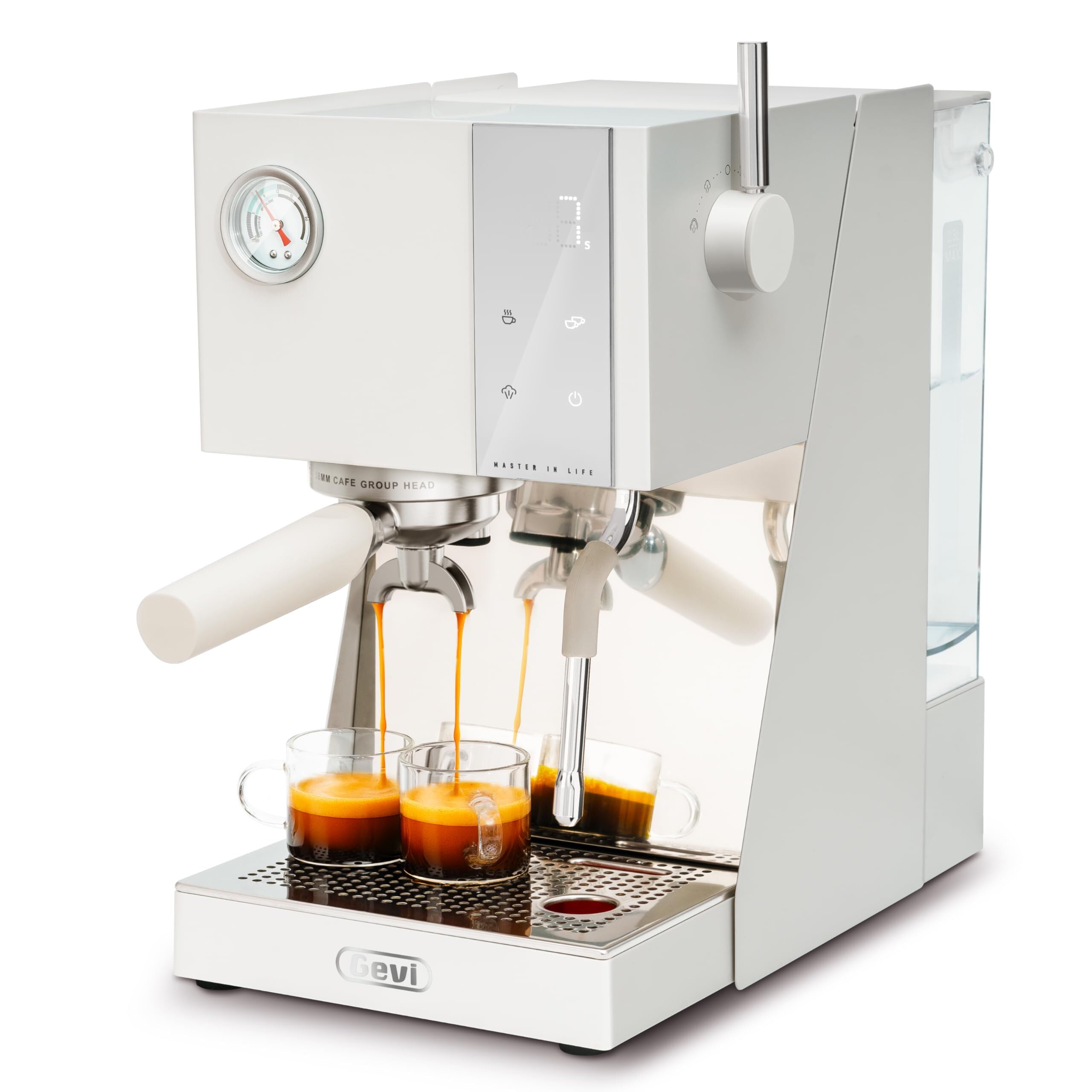
The Gevi 20 Bar is perhaps the most aggressively featured entry-level machine on the market, bundling a 58mm commercial portafilter, a PID dual-chip temperature control, and an OPV relief valve — features usually reserved for machines costing twice as much. The real-time touch display is genuinely useful, showing live shot timing, water temperature, and brew pressure, which helps new users visualize what is happening during extraction.
The Italian Ulka pump delivers consistent 20-bar pressure, and the OPV dials it down to the 9-12 bar sweet spot for extraction. The 3-way solenoid valve is another premium addition at this price, creating dry pucks that knock out cleanly. The steam wand is a ball-joint design that rotates smoothly and produces thick microfoam with enough power for latte art. The 2.3-liter water tank is detachable, making refills easier than top-fill designs.
The all-metal build feels solid, though the machine is heavy at over 21 pounds. Long-term durability is still being established by the community, but initial reports over several months show consistent shot quality and no major mechanical failures. The main caveat is that this machine demands a good grinder — the pressurized baskets can mask poor grind quality, but for real espresso, you will want a dedicated burr grinder to complement the Gevi.
Why it’s great
- PID, OPV, and 58mm portafilter at an entry-level price is exceptional value.
- Real-time touch display helps diagnose extraction issues.
- 3-way solenoid valve produces dry, clean pucks after each shot.
Good to know
- Requires a dedicated burr grinder to reach full potential.
- Heavy build makes countertop repositioning difficult.
- Long-term reliability beyond 2 years is not yet fully documented.
9. MIROX AC-517EA
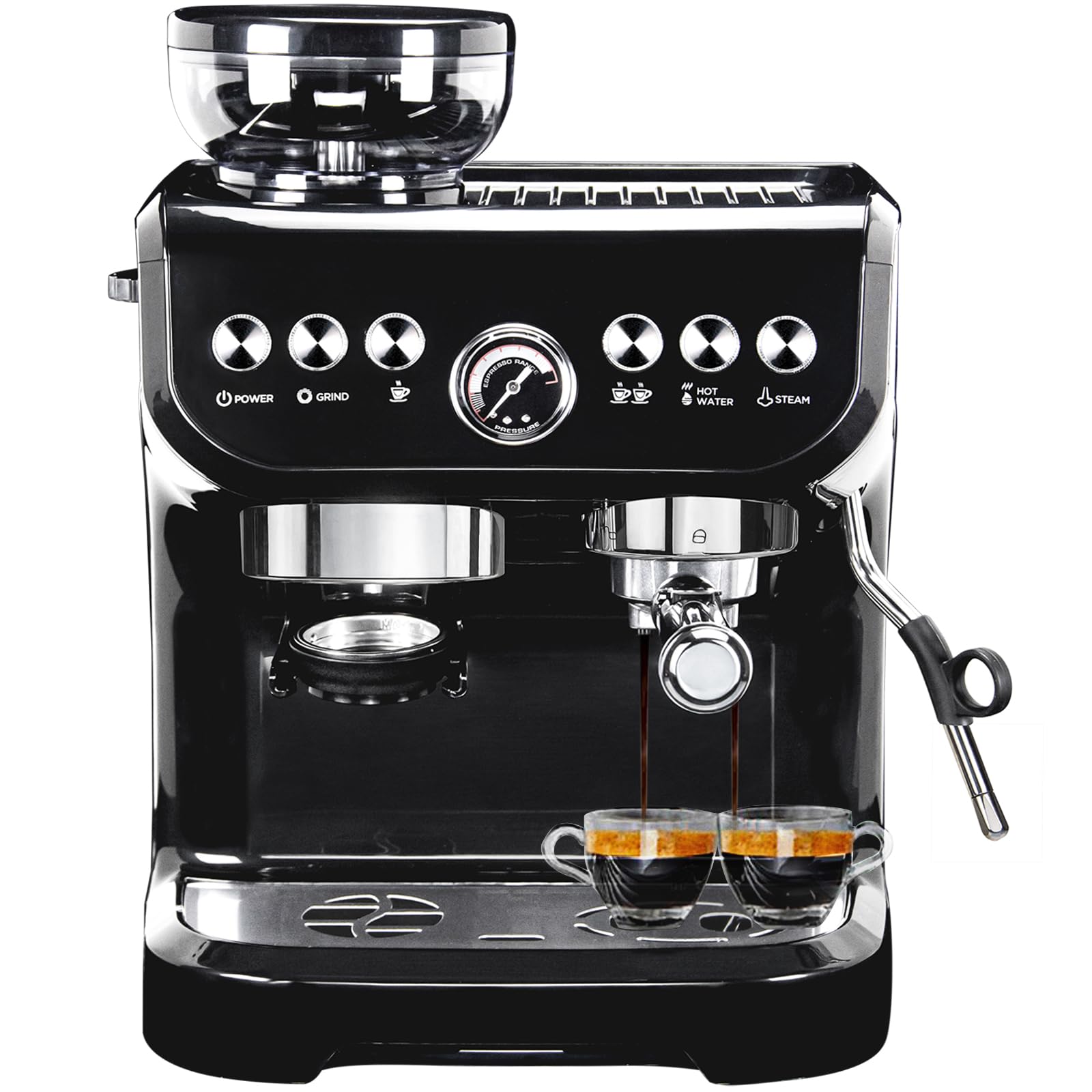
The MIROX AC-517EA is the most budget-friendly fully integrated bean-to-cup espresso machine in this lineup. It combines a 1450W thermoblock, a conical burr grinder with 15 precision settings, and a manual tamper with a magnetic attachment that holds it to the portafilter. The ABS body keeps the weight down to 17 pounds, and the compact footprint — 12 inches wide by 12 inches deep — fits on tight countertops where a Breville or De’Longhi would not.
The PID temperature control is a welcome surprise at this price, helping maintain stable water temperature for extraction. The low-pressure pre-infusion gradually ramps up pressure to reduce channeling, and the extractable pressure gauge gives visual feedback on your tamping consistency. The steam wand is manual and capable of decent microfoam, though the auto-stop feature shuts it off before the milk is fully hot, requiring a second activation.
Durability is the primary concern here. Multiple reports indicate that the grinder mechanism can fail after 6 to 12 months, and replacement parts are difficult to source. The plastic portafilter handle is also a weak point, with some users reporting cracks after a year of use. For a quick, low-cost introduction to espresso from whole beans, this machine works well — just consider it an entry point rather than a long-term investment.
Why it’s great
- All-in-one bean-to-cup convenience at the lowest entry cost.
- PID control and pre-infusion improve shot consistency at this price.
- Compact and lightweight design fits small kitchens.
Good to know
- Grinder mechanism has a high failure rate within the first year.
- Plastic portafilter handle may crack under regular use.
- Steam wand auto-shutoff stops before milk is fully hot.
FAQ
Is a 20-bar or 15-bar pump better for home espresso?
Why do many reviewers say to replace the included tamper immediately?
Can a super-automatic machine produce latte art?
How often should I descale a machine for coffee and espresso?
Final Thoughts: The Verdict
For most users, the machine for coffee and espresso winner is the Breville Barista Express BES870XL because it delivers the best balance of integrated grinding, PID temperature control, and hands-on control without requiring a separate grinder purchase. If you want a completely guided and mess-free experience with integrated tamping, grab the Ninja Luxe Café Pro ES701. And for one-touch convenience with the easiest milk system to clean, nothing beats the Philips 5500 Series EP5544/94.