The line between a good morning and a great one often comes down to the hiss of steam and the weight of a perfectly pulled shot. When you’re shopping above a thousand dollars, you are no longer just buying a machine to heat water and push it through grounds; you’re buying consistency, thermal stability, and the silence of a burr grinder that doesn’t sound like a power tool. The luxury tier demands that every component, from the group head to the drip tray, justifies its place on your counter.
I’m Mohammad Maruf — the founder and writer behind AirfryerBite. For the past several months, I have been cross-referencing European build specs, PID controller accuracy, brew boiler materials, and real-world extraction reports to separate the genuinely refined from the merely expensive in this category.
Whether you value precise digital dosing or a hand-built Italian heat exchanger, finding the best luxury espresso machine requires knowing which specs translate to better flavor and which are just glossy marketing.
How To Choose The Best Luxury Espresso Machine
At the premium end of the market, the choice is rarely about whether the machine works — it’s about how it works. You need to decide between full automation that grinds, doses, and steams with a single button press, and a manual or semi-automatic setup that puts you in control of every variable. The wrong choice here leads to either frustration from lack of control or boredom from too little involvement.
Brew System: Dual Boiler vs. Heat Exchanger vs. Thermoblock
A dual boiler gives you a dedicated water vessel for brewing and a separate one for steam, allowing you to pull shots and froth milk simultaneously without temperature swings. Heat exchanger (HX) systems use a single boiler with a tube running through it, which is faster to heat up but can require a cooling flush between drinks. Thermoblocks heat water on demand, which is common in super-automatics but rarely offers the thermal stability that pure espresso purists demand. For serious milk-drink households, dual boiler is the gold standard.
Grinder Quality and Dosing Consistency
A luxury machine is only as good as its grinder. Look for conical or flat steel burrs — ceramic burrs are cheaper but shatter if a small rock enters the hopper. Step-less adjustment lets you dial in grind size to the micron level, which is essential for achieving the 25-to-30-second extraction window. Machines with automatic dosing and tamping, like those using an Impress Puck System, remove guesswork but add complexity and potential failure points. For purists, a separate high-end grinder often outperforms an integrated one.
Temperature Control and Pre-Infusion
A PID (Proportional-Integral-Derivative) controller lets you set and hold the brew temperature within a single degree, which directly impacts whether your shot tastes sour (under-extracted) or bitter (over-extracted). Pre-infusion, either programmable or passive, slowly wets the coffee puck before full pressure hits, which reduces channeling and improves extraction uniformity. Machines that offer programmable pre-infusion are better suited for light-roast beans, which require a longer pre-wet phase to unlock their full flavor profile.
Quick Comparison
On smaller screens, swipe sideways to see the full table.
| Model | Category | Best For | Key Spec | Amazon |
|---|---|---|---|---|
| Breville Barista Touch Impress | Super-Automatic | Guided puck prep | 3-second ThermoJet heat-up | Amazon |
| Breville Oracle Touch | Dual Boiler | Auto-dose & tamp | Dual stainless steel boilers | Amazon |
| Rocket Espresso R58 | Prosumer Manual | Hand-built Italian quality | E61 group head, rotary pump | Amazon |
| Jura E8 | Super-Automatic | 17 one-touch specialties | Pulse Extraction Process | Amazon |
| Jura Z10 (VERRE ART) | Super-Automatic | Hot & cold brew versatility | Cold Extraction Process | Amazon |
| Diletta Bello+ | Semi-Pro Manual | PID & programmable pre-infusion | Handmade in Milan, Italy | Amazon |
| KitchenAid KF7 | Super-Automatic | 20+ recipe options | Dual drink delivery system | Amazon |
| KitchenAid KF6 | Super-Automatic | Entry-level luxury automatic | 15 recipes, metal-clad build | Amazon |
| De’Longhi Dinamica Plus | Super-Automatic | 24 recipes, 4 user profiles | LatteCrema Hot System | Amazon |
| De’Longhi Eletta Explore | Super-Automatic | 50+ recipes including cold brew | Cold Extraction Technology | Amazon |
| Bosch VeroCafe 800 (Black) | Super-Automatic | App connectivity & 35 drinks | Home Connect app control | Amazon |
| Bosch VeroCafe 800 (SS) | Super-Automatic | Integrated milk container | Integrated milk system | Amazon |
| Terra Kaffe TK-02 | Super-Automatic | App & roaster-scan settings | 100,000+ drink combos | Amazon |
In‑Depth Reviews
1. Breville Barista Touch Impress BES881BSS

The Barista Touch Impress is Breville’s answer to the complaint that espresso machines are either fully manual and finicky or fully automatic and mediocre. Its Impress Puck System grinds, doses, assists the tamp at a verified 22 pounds of pressure, then auto-corrects the next dose if the previous puck was off. The ThermoJet heating system reaches extraction temperature in three seconds, which means you aren’t waiting for the machine to warm up while your morning routine slips away.
The integrated Baratza European precision conical burrs offer 30 grind settings, and the touchscreen walks you through each step with real-time feedback. The auto steam wand includes alternative milk settings (Auto MilQ) that calibrate air injection and temperature for oat, almond, or soy, which is rare even in this price tier. The 67.6-ounce water tank means fewer refills, and the brushed stainless steel finish resists fingerprints better than glossy black alternatives.
Where this machine truly earns its top spot is in consistency. Multiple long-term reviews confirm that once you dial in your bean, the machine reproduces that shot reliably day after day. The few complaints center on grind recalibration being necessary if you switch bean types frequently, and some users report slight shot time variance with very fresh roast dates. For most households, however, this machine eliminates the variables that cause bad espresso without removing the satisfying ritual of making it.
Why it’s great
- Assisted tamping with auto dose correction removes guesswork while preserving control
- Three-second heat-up time with ThermoJet is class-leading speed
- Auto MilQ settings produce proper microfoam with plant-based milks
Good to know
- Grind and dose may need recalibration when switching between very different bean roast levels
- Not designed for fully manual operation — users wanting complete hands-on control should look at a prosumer E61 machine
2. Breville Oracle Touch BES990BSS

The Oracle Touch takes the guided approach of the Touch Impress and adds a second boiler, a more powerful 1800-watt heating system, and a 58mm professional portafilter. The dual boiler construction means you can steam milk and pull a shot simultaneously without any temperature drop on the brew side — a feature that matters most to households making multiple milk-based drinks back-to-back. The integrated grinder automatically doses and tamps 22 grams of coffee, and the over-pressure valve limits pump pressure to prevent bitter over-extraction.
The touchscreen lets you save up to eight personalized drink profiles with custom names, which is useful for households where each person has a different preferred grind size or milk texture. The self-cleaning steam wand is powered by its own dedicated boiler, so there is no waiting for the steam system to recover between frothing sessions. The 67-ounce water tank is front-accessible, meaning you don’t have to pull the machine out from under the cabinets to refill it.
Long-term reliability is the main concern here. While many owners report years of trouble-free service, a notable minority have encountered pump issues and boiler leaks within the first year. Breville’s customer support has received mixed reviews, and some users report that the machine requires a firmware-level fix for persistent chattering or erratic behavior. If you value repairability and a proven track record of ten-year lifespans, the Rocket R58 or a Jura super-automatic may be safer bets. But for day-to-day convenience and café-quality output with minimal skill required, the Oracle Touch is hard to beat.
Why it’s great
- Dual boilers allow simultaneous brewing and steaming with no temperature loss
- Auto-dose and tamp system delivers consistent 22g pucks every time
- PID digital temperature control maintains precise extraction heat
Good to know
- Reliability reports are mixed — some units develop pump and boiler issues within months
- Touchscreen can time out mid-cleaning cycle, which is a known software annoyance
3. Rocket Espresso R58 Cinquantotto

The R58 Cinquantotto is built by hand in Milan, Italy, and it looks and feels like a piece of precision engineering. It uses an E61 group head, which is the industry standard for thermal stability in prosumer machines, paired with a dual boiler system that lets you control brew and steam temperatures independently through a detachable touchscreen PID. The rotary pump is quieter and more durable than the vibration pumps found on most domestic machines, and it supports being plumbed directly into your water line for continuous operation.
The machine’s footprint is substantial — 22.75 inches wide and 17 inches deep — and it weighs enough that you will want a dedicated spot on your counter. The stainless steel frame and boiler are designed for decades of service, with non-proprietary parts that any competent repair shop can source. The shot timer is mirrored so you can read it without craning your neck, and the auto-on scheduling means the machine is fully heated by the time you wake up.
This is not a machine for beginners. There is no automatic dosing or tamping — you need a separate grinder, a scale, a WDT tool, and the patience to dial in your shot. The drip tray is small, and the clearance under the group head limits the size of cups you can use without a bottomless portafilter. But if you are willing to learn, the R58 rewards you with espresso that can rival a three-thousand-dollar commercial setup. Users who have upgraded from Breville machines consistently report that the Rocket’s output is in a different league entirely.
Why it’s great
- Hand-built E61 group head and dual boiler deliver unmatched thermal stability
- Rotary pump is quiet, reliable, and supports direct water line plumbing
- Fully serviceable with standard parts — designed to last 10+ years
Good to know
- Requires a separate high-end grinder and barista-level skill to use properly
- Small drip tray and limited cup clearance under the group head can be frustrating
4. Jura E8 Automatic Espresso Machine

The Jura E8 is a super-automatic that prioritizes convenience and consistency over hands-on control. It uses the Pulse Extraction Process (P.E.P.), which alternates pressure during the brew cycle to maximize flavor extraction, especially for short specialties like ristretto and espresso doppio. The Professional Aroma Grinder uses conical burrs that Jura claims deliver 12.2% more aroma than standard grinders, and the 2.8-inch color display with AI-driven operating concept adapts the menu based on your most-used drinks.
It prepares 17 programmed specialties including cappuccino, flat white, cortado, and latte macchiato with a single button press. The water tank holds 64 ounces, and the machine has a chrome-plated cup grille and a grooved water tank that gives it a clean, modern look. The milk system is a fixed tube that draws from a separate container, which is easy to clean but requires daily rinsing to prevent bacterial buildup.
The long-term cost of ownership is the main factor to consider. The E8 requires proprietary Jura cleaning tablets, milk system cleaner, and water filters to maintain its warranty, and the combined consumable cost can run thirty to fifty dollars per month. Some users report that the bean hopper slope can cause inconsistent feeding with certain roast levels, and the milk spout placement can cause splatter. If you want a machine that makes excellent espresso with zero skill required and you are prepared for the ongoing expense, the E8 is a proven workhorse.
Why it’s great
- Pulse Extraction Process maximizes flavor for short espresso-based drinks
- AI-driven display learns your habits and surfaces favorites automatically
- Super-automatic convenience — grind, dose, brew, and steam with one touch
Good to know
- Proprietary consumables (filters, cleaner, tablets) cost up to per month
- Bean hopper design can cause inconsistent feeding with darker or oilier roasts
5. Jura Z10 (Jura WE6 / VERRE ART listing)

The Jura Z10 is the flagship model that adds cold brew capability to an already comprehensive super-automatic platform. Its Cold Extraction Process uses precisely measured water flow and pressure at a lower temperature to produce a cold brew concentrate in under three minutes — a feature that no other machine in this list offers at this level of integration. The eighth-generation brewing unit and the Product Recognizing Grinder that adjusts grind consistency in a fraction of a second make this the most technologically advanced machine in its class.
The diamond black finish and compact footprint (17.75 inches deep, 12.62 inches wide) fit well on most countertops. The touchscreen interface is intuitive, and the J.O.E. app lets you control the machine remotely, schedule wake times, and save custom drink profiles. The milk fridge and hot water dispenser are useful additions for households that make tea or need cold milk storage at the ready.
The six-month reliability picture is good for most users, but there are concerning reports of cold brew function failure within the first month and Jura refusing warranty service for units purchased from third-party Amazon sellers. The machine requires proprietary maintenance products and ongoing costs similar to the E8. The coffee quality is excellent, but some users report that a mid-range De’Longhi machine produces similar-tasting espresso at a quarter of the price. The Z10 is for buyers who want the absolute latest technology and cold brew convenience, not necessarily the best raw espresso quality per dollar.
Why it’s great
- Cold Extraction Process makes real cold brew in under three minutes
- Product Recognizing Grinder auto-adjusts to optimal grind consistency
- App connectivity with scheduling and remote brewing adds real convenience
Good to know
- Warranty may be voided if purchased from non-authorized Amazon sellers
- Ongoing consumable costs are significant — budget thirty to fifty dollars per month
6. Diletta Bello+

The Diletta Bello+ is a heat exchanger machine built by Quickmill in Italy, offering an E61 group head with a PID controller that lets you adjust steam boiler temperature from a front-mounted screen. It supports programmable pre-infusion for up to ten seconds, which is critical for light-roast beans that need a longer wetting phase before full pressure. The shot timer doubles as the PID display during brewing, and the low-power eco mode reduces boiler temperature when idle to save energy while still maintaining faster recovery than a cold start.
This machine is not for beginners. It has no automatic dosing, tamping, or milk steaming — you must use a separate grinder and learn to dial in your shot manually. The stainless steel case, frame, and boiler are built for longevity, and the E61 group head is fully serviceable with standard parts. The Bello+ is compact for an E61 machine at 11 inches wide, which helps on crowded counters, but the drip tray is small and fills quickly during the cooling flush that heat exchanger machines require before brewing.
Users who upgrade from a Breville Barista Express or a Rancilio Silvia consistently report that the Bello+ produces noticeably smoother, more balanced espresso with better body and crema. The learning curve is steep — you will need a WDT tool, a proper tamper, and likely a bottomless portafilter — but the reward is consistent shot quality that can match machines costing twice as much. If you are an intermediate barista looking to step into a prosumer machine without paying for a dual boiler you don’t need, the Bello+ is the smart pick.
Why it’s great
- E61 group head with PID and programmable pre-infusion for precision brewing
- Hand-built in Italy with stainless steel construction designed for decades of use
- Eco mode reduces energy consumption while maintaining faster warm-up recovery
Good to know
- Requires a separate grinder and advanced barista skills — not a set-it-and-forget-it machine
- Small drip tray fills quickly, especially during required cooling flushes
7. KitchenAid Fully Automatic KF7 KES8557
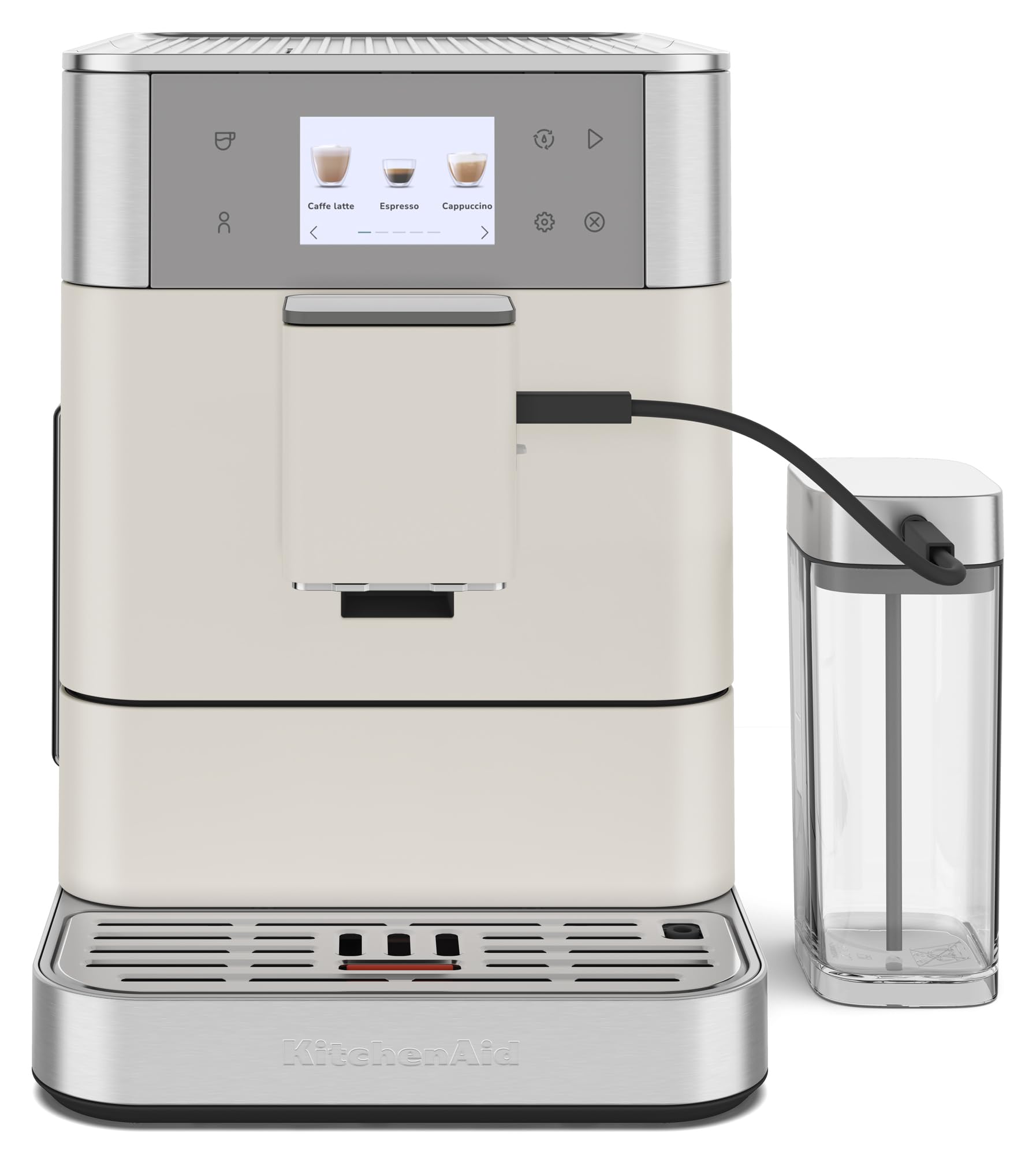
The KitchenAid KF7 is the mid-range option in KitchenAid’s new fully automatic line, offering 20-plus recipe options including espresso, americano, latte, and cappuccino through a touchscreen interface. It uses automatic smart dosing technology that adjusts the grind volume based on your previous shot, and the removable bean hopper can be twisted off easily to swap beans without spilling grounds everywhere. The metal-clad construction feels sturdy on the counter, and the 2.2-liter water tank is generous for its footprint.
The dual drink delivery system uses a separate milk container with a hose, and the automatic frothing and heating feature produces consistently textured milk for lattes and flat whites. The machine prompts you for cleaning cycles and maintenance, and users report that the UI is simple and intuitive. The KF7 is quieter than many competitors at this price point, and the removable brew unit makes deep cleaning much easier than machines with sealed brewing chambers.
Some downsides include the lack of granular drink volume control — you can adjust strength and temperature, but you cannot fine-tune the exact milliliter output. The machine also uses a significant amount of water during startup rinsing cycles, which means the drip tray fills after roughly six drinks. A small but notable number of users have reported defects within the first few weeks, though KitchenAid’s two-year warranty covers these issues. Overall, the KF7 offers a strong balance of build quality and automation for those entering the luxury super-automatic space.
Why it’s great
- Metal-clad construction and removable bean hopper for easy bean swapping
- Intuitive touchscreen with automatic dosing and maintenance prompts
- Quieter operation than many super-automatics in its class
Good to know
- No granular drink volume control — customization is limited to strength and temperature
- Startup rinse cycles deplete the water tank quickly, requiring frequent refills
8. KitchenAid Fully Automatic KF6 KES8556

The KitchenAid KF6 is the entry-level model in the new KitchenAid automatic line, sharing the same metal-clad construction and smart dosing technology as the KF7 but with a reduced recipe library of 15 options and a single drink delivery system instead of dual. It is the most affordable way to get KitchenAid’s build quality in a fully automatic espresso machine, and it is aimed squarely at buyers who want a reliable super-automatic without paying for features they won’t use daily.
The removable bean hopper, 2.2-liter water tank, and automatic milk frothing are identical to the KF7. The machine includes a water filter and cleaning tablets in the box, and the brew unit is easy to access for regular maintenance. The temperature is adjustable, though some users report that the default brew temperature is not hot enough and needs to be increased through the settings menu. The machine is quiet during grinding and brewing, and the side-mounted water tank makes it easy to refill without moving the machine.
Build quality is solid for the price tier, but the KF6 has the same water usage quirk as the KF7 — the startup rinse cycle consumes about half a liter of water before every drink. The lack of a dual delivery system means you cannot make two milk drinks simultaneously, which is a limitation for households that often serve multiple people at once. A small number of early units have developed leaks, and KitchenAid’s customer service response time has been a pain point for some affected owners.
Why it’s great
- Metal-clad build at the most accessible price point in KitchenAid’s automatic line
- Smart dosing and removable bean hopper for easy bean variety swapping
- Quiet operation and side-access water tank improve daily usability
Good to know
- Single drink delivery system limits simultaneous milk drink preparation
- Some early units have reported leakage issues, and customer support response can be slow
9. De’Longhi Dinamica Plus ECAM
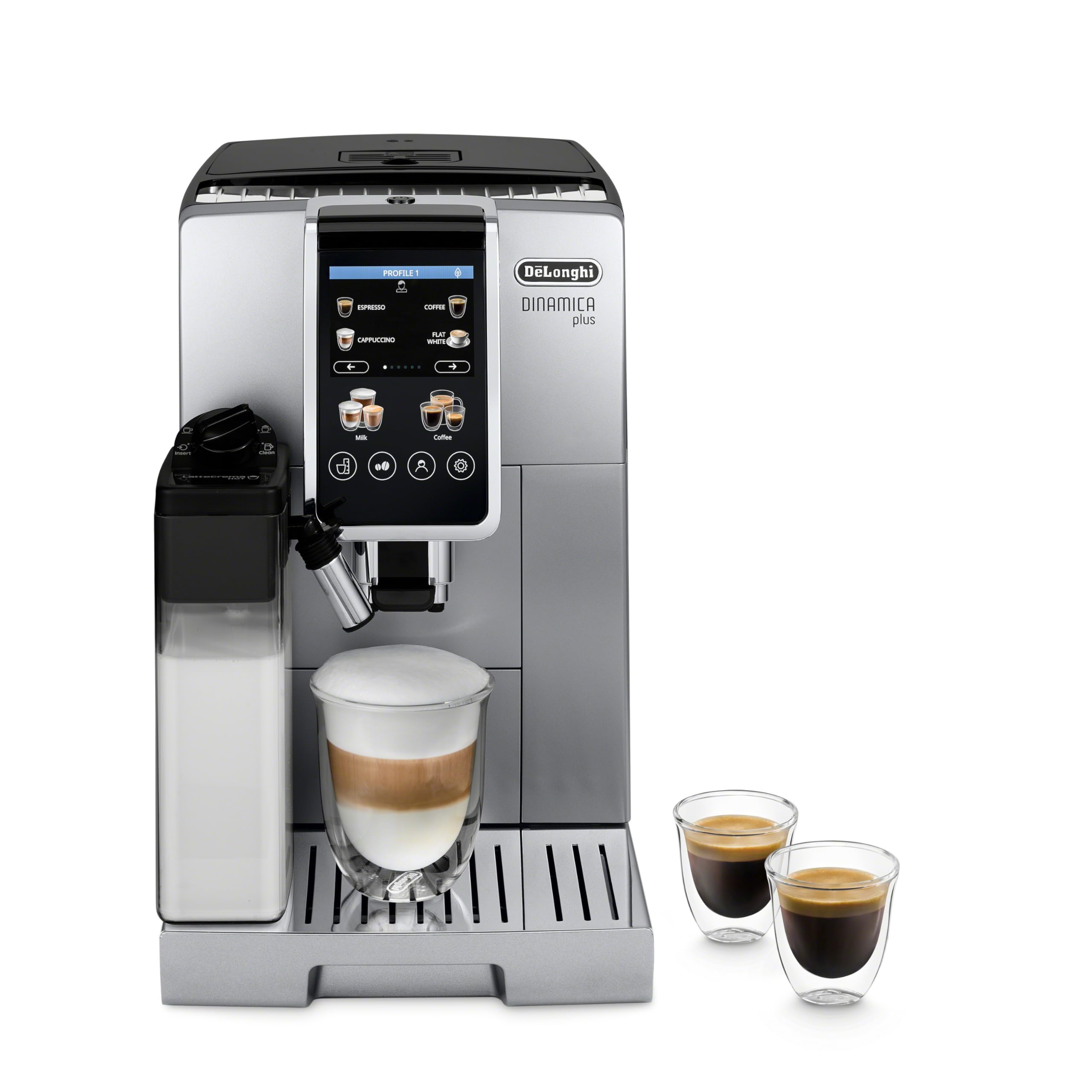
The De’Longhi Dinamica Plus is a fully automatic machine that focuses on multi-user customization with four separate profiles, each storing preferred drink recipes, strength, and volume settings. It offers 24 one-touch recipes including iced coffee, flat white, and cappuccino, all controlled through a 3.5-inch TFT color touchscreen. The Smart One-Touch system learns your most frequently selected drinks and surfaces them first, reducing the number of taps needed to start brewing.
The built-in conical burr grinder has 13 settings, and the LatteCrema Hot System froths milk and milk alternatives with consistent results. The machine includes a removable water spout and an active carbon filter to reduce scale buildup. The plastic construction is the main visual compromise compared to metal-clad competitors, but the build quality is solid and the machine has proven reliable over six months of daily use in multiple verified reviews.
The main practical complaint is that the milk carafe port is very tight, making it difficult to remove without creating a vacuum seal that pulls the milk tube out of the carafe. The machine also runs frequent purge cycles that waste water and require the drip tray to be emptied more often. The 3.8-pound bean capacity is generous, and the overall coffee quality is excellent — several users report that the Dinamica Plus produces coffee that rivals output from machines costing significantly more.
Why it’s great
- Four user profiles with individual drink preferences — great for multi-person households
- 24 one-touch recipes including iced coffee through the intuitive touchscreen
- Proven reliability with many users reporting flawless operation after six months
Good to know
- Milk carafe port is very tight, making removal difficult and messy
- Frequent purge cycles waste water and require constant drip tray emptying
10. De’Longhi Eletta Explore

The De’Longhi Eletta Explore is the most feature-dense super-automatic in its price tier, offering over 50 hot and cold recipes including cold brew, iced lattes, and iced cappuccinos through a single touchscreen interface. Its Cold Extraction Technology uses precisely measured water flow and pressure at a controlled temperature to produce cold brew concentrate in under three minutes — a feature that positions it as the primary competitor to the Jura Z10 at a significantly more accessible price. The LatteCrema Cool System delivers cold milk foam, while the LatteCrema Hot System handles traditional hot milk drinks.
The machine includes a travel mug that is compatible with 15 hot and cold recipes up to 16 ounces, making it practical for commuters. The 60-ounce removable water tank is generous, and the Bean Adapt Technology guides you through optimizing extraction based on the specific beans you load. The app connectivity allows you to set up profiles, customize recipes, and receive maintenance alerts. The stainless steel and plastic construction is sturdy, and the 24.7-pound weight reflects the heavy-duty components inside.
The most common complaint across verified reviews is that milk-based drinks are served at a lower temperature than hot coffee drinks — around 125 degrees Fahrenheit for flat whites versus 157 for black coffee. Several users have reported that De’Longhi was unresponsive to this issue and that they must microwave milk drinks to reach an acceptable temperature. The machine also self-cleans frequently, which fills the drip tray faster than most competitors. For households that prioritize cold brew and iced drink variety over piping-hot milk drinks, the Eletta Explore is unmatched.
Why it’s great
- Cold Extraction Technology makes real cold brew and iced drinks in under three minutes
- 50-plus hot and cold recipes with customizable user profiles via app
- Included travel mug compatibility for on-the-go coffee
Good to know
- Milk drink serving temperature is lower than hot coffee — typically around 125°F
- Frequent self-cleaning cycles fill the drip tray faster than most super-automatics
11. Bosch VeroCafe 800 TPU60309 (Black)
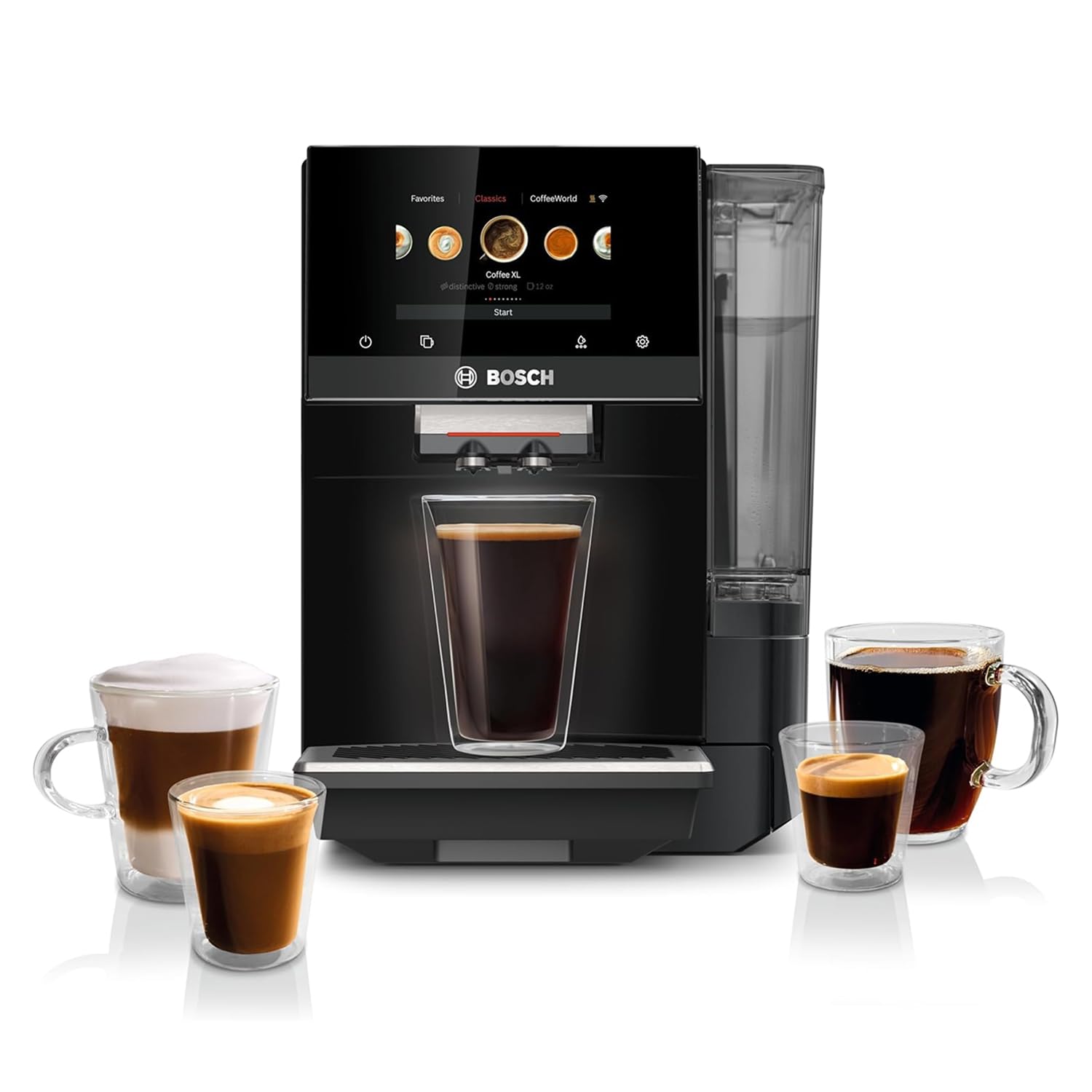
The Bosch VeroCafe 800 Series brings 35 beverage options and Home Connect app control to a fully automatic platform. The large touchscreen display makes navigating drink selection and customization straightforward, and the app lets you start brewing remotely or schedule wake times so the machine is ready when you are. The integrated conical burr grinder with 13 settings feeds into a brewing unit that can produce two cups of espresso or coffee simultaneously.
The milk system uses a hose that connects to any milk container, which is simpler to clean than a built-in carafe. The machine features a combined cleaning and descaling program that Bosch calls Calc’n Clean, and the step-by-step guide on the display makes maintenance less intimidating. The 5.1-pound bean capacity is among the largest in its class, and the water tank is accessible from the front without pulling the machine out from under cabinets.
Multiple users report that brew temperature is adjustable but defaults on the cooler side, with coffee coming out around 129 degrees Fahrenheit. The manual is sparse, and setting up the water filter is more complicated than on competing machines. The bean hopper lid does not seal tightly, which can allow beans to escape during grinding. A small number of units have experienced major internal failures within weeks, though Bosch customer support appears responsive based on user reports. Overall, the VeroCafe 800 is a strong choice for those who value app connectivity and a large drink library, but temperature performance is a consistent trade-off.
Why it’s great
- 35 drink recipes with app connectivity for remote brewing and scheduling
- Large 5.1-pound bean capacity reduces refill frequency
- Combined cleaning and descaling program simplifies maintenance
Good to know
- Brew temperature is relatively low — around 129°F — and requires adjustment
- Bean hopper lid does not seal well, and filter setup is more complex than competitors
12. Bosch VeroCafe 800 TQU60703 (Stainless Steel)
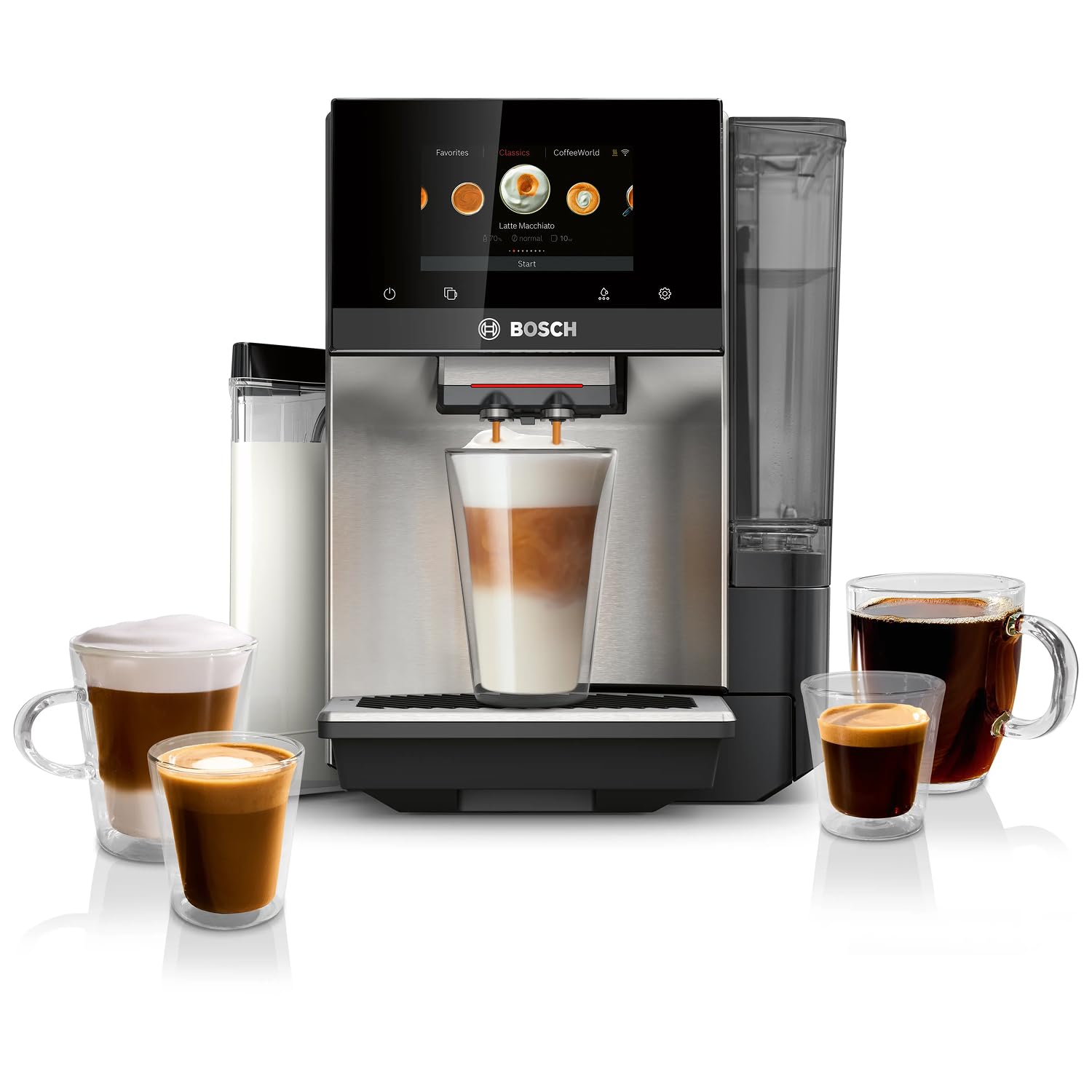
The stainless steel version of the Bosch VeroCafe 800 Series shares the same platform as the black model but adds an integrated milk container and includes a cup warming tray on top, which the black version lacks. It also supports 36 beverage options instead of 35, adding one extra recipe variation. The machine uses the same Home Connect app, conical burr grinder, and combined cleaning program as its black counterpart, making the choice between them mostly about aesthetics and the milk container preference.
The stainless steel finish is more resistant to scratches and fingerprints than the black gloss finish, and the cup warmer is a genuine quality-of-life addition for households that drink multiple espresso shots in a row. The integrated milk container is more convenient than the tube-and-bottle setup on the black model, and it keeps milk cold longer during the brewing session. The brew unit is removable, which makes deep cleaning easier than on machines like the Jura E8 where the brewing chamber is sealed.
Users who have compared this machine directly to Jura and Miele alternatives report that the Bosch produces coffee quality that is on par with the Jura E8 at a lower ongoing consumable cost. The milk system is easy to clean, and the self-rinsing cycle before and after each drink is effective. The same temperature issues from the black model carry over, and some users report that the machine’s default milk temperature is only warm, not hot. If you want a super-automatic with a removable brew unit and a cup warmer at a mid-range price point, this is the best option.
Why it’s great
- Integrated milk container and cup warming tray add genuine daily convenience
- Removable brew unit makes deep cleaning easier than many sealed-chamber competitors
- Lower ongoing consumable costs compared to Jura machines with similar coffee quality
Good to know
- Default milk and coffee temperatures are on the cooler side — expect to adjust settings
- Setup can take up to two hours, and a small number of units have had early failures
13. Terra Kaffe TK-02 Super Automatic
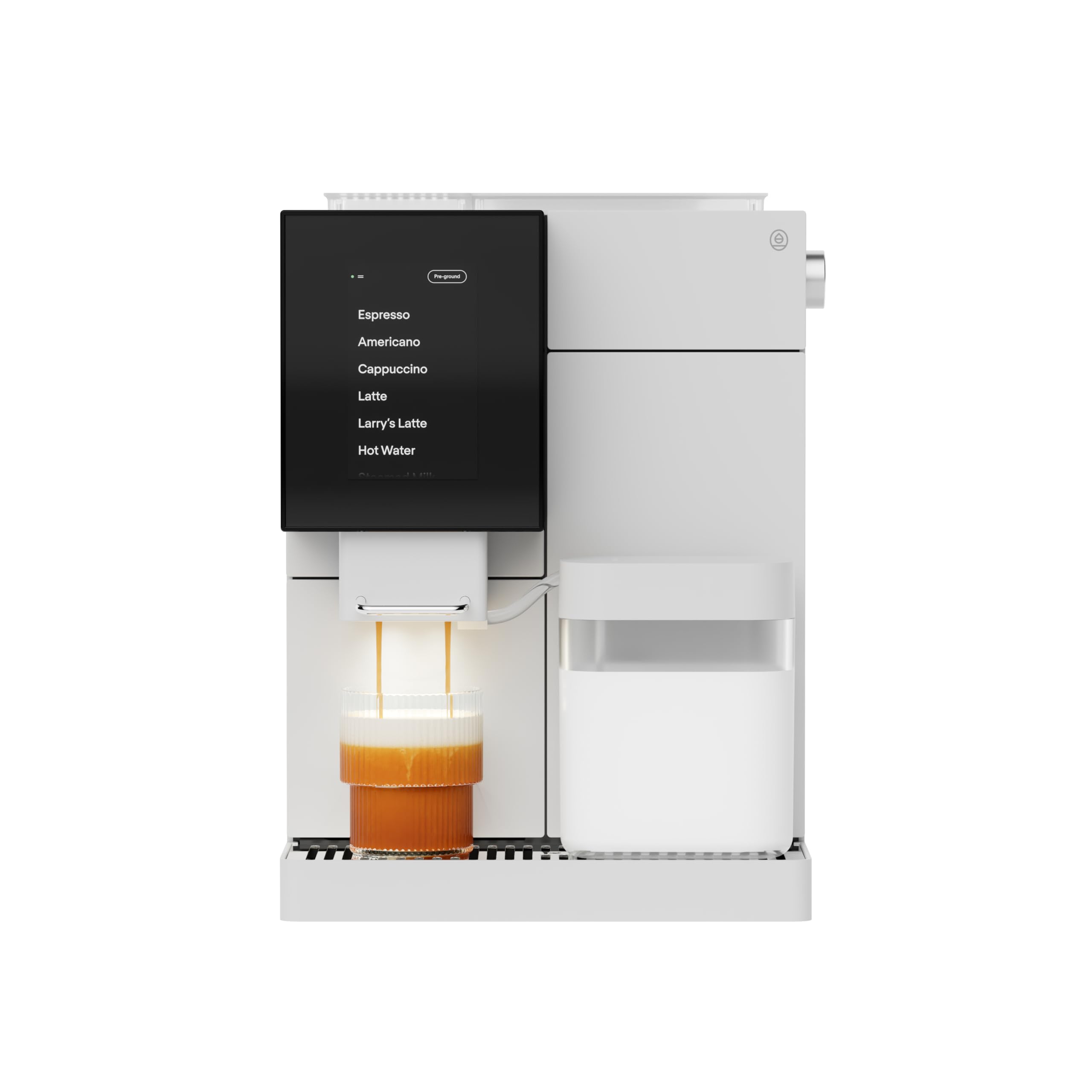
The Terra Kaffe TK-02 is the most app-integrated machine in this lineup, offering over 100,000 possible drink combinations through a combination of its touchscreen interface and companion app. The roaster-scan feature lets you scan QR codes on TK Shop coffee purchases to automatically adjust grind, dose, and extraction parameters to the roaster’s recommended profile — a genuine innovation in the super-automatic space. The hybrid brew unit can prepare both authentic drip coffee and espresso from whole beans or pre-ground coffee.
The machine uses a stainless steel burr grinder and a 75-ounce water tank. The auto wake and sleep scheduling is controlled through the app, so you can set the machine to turn on before you wake up and shut off after the household has finished morning coffee. The milk system uses a carafe that can froth all milk types including plant-based alternatives, and the drink profiles are saved to your personal Terra Kaffe account so your preferences follow you to any TK-02 machine. The white finish is clean and modern, and the 29.5-pound weight gives it a planted, solid feel on the counter.
Despite its innovative features, the TK-02 has notable reliability concerns. Multiple users report a burning plastic smell during the first few weeks of use, and the machine can freeze mid-cycle if interrupted during startup. The drinks are lukewarm even at the hottest setting — a complaint that appears in multiple verified reviews. The water reservoir depletes quickly due to frequent rinse cycles, and the drip tray needs constant emptying. Some users love the customization and convenience, but others report returning the machine within the first month due to persistent issues. Proceed if you value app integration and are comfortable with some teething problems.
Why it’s great
- Roaster-scan QR code settings allow instant, expert-recommended brew profiles
- 100,000-plus drink combinations through app and touchscreen customization
- Hybrid brew unit produces both espresso and drip coffee from whole beans
Good to know
- Burning plastic smell and freezing issues reported during early weeks of ownership
- Brew temperature is notably low — even the hottest setting produces lukewarm drinks for many users
FAQ
Do I need a dual boiler or is a heat exchanger machine enough for home use?
Is a super-automatic luxury espresso machine worth it compared to a semi-professional machine?
How important is the grinder on a luxury super-automatic espresso machine?
Why do some luxury espresso machines serve drinks at a lower temperature than expected?
Final Thoughts: The Verdict
For most users, the best luxury espresso machine winner is the Breville Barista Touch Impress because it delivers the most forgiving and consistent path to café-quality shots without requiring a separate grinder, a scale, or hours of practice. If you want a true prosumer machine that will last for a decade and teach you the art of espresso, grab the Rocket Espresso R58. And for pure one-touch convenience with cold brew capability, nothing beats the De’Longhi Eletta Explore.