The fastest way to ruin a fresh-baked sourdough is to squash it flat with a dull blade. The struggle isn’t the crust itself — it’s finding a knife whose serrations bite through hard shell without mangling the soft crumb beneath. That friction point defines the entire search for a reliable bread knife.
I’m Mohammad Maruf — the founder and writer behind AirfryerBite. I’ve spent years analyzing kitchen hardware specifications, breaking down blade geometries, serration patterns, and steel hardness numbers to separate functional cutlery from decorative gadgets.
After sizing up dozens of models on edge retention, handle ergonomics, and real-world slicing behavior, I’ve narrowed the field to the seven most reliable contenders you can buy right now. This guide covers exactly what separates a good knife to cut bread from a great one — no fluff, just the specs that matter.
How To Choose The Best Knife To Cut Bread
Not every serrated blade is built the same. The wrong geometry will crush artisan loaves, tear sandwich bread, and leave a countertop littered with crumbs. Here are the three criteria that actually separate a keeper from a drawer filler.
Blade Length: 8 vs. 10 Inches
A 10-inch knife clears the full width of a large sourdough boule in one stroke, which means you avoid the sawing-back-and-forth that creates ragged edges. Shorter 8-inch blades are easier to control for smaller baguettes or sandwich rolls. For anyone who bakes or buys wide-crust loaves weekly, the extra two inches make a measurable difference in slice uniformity.
Serration Profile: Pointed vs. Scalloped
Standard pointed serrations act like tiny saw teeth — they grab and tear through hard crust efficiently but can leave a dusty finish. Scalloped edges, shaped like a series of crescent divots, glide through with less drag and tend to produce a smoother cut face. Both work, but scalloped edges generally stay sharper longer because there are fewer stress points on the blade.
Steel Hardness and Edge Retention
German high-carbon steel with a Rockwell rating of 56 or higher holds a working edge through hundreds of slices. Softer stainless blades below 54 HRC will feel dull after a few months of regular use. Premium options often use powdered metallurgy or Japanese super steels like 10Cr15CoMoV, which push hardness past 60 HRC while resisting chipping on hard crusts.
Quick Comparison
On smaller screens, swipe sideways to see the full table.
| Model | Category | Best For | Key Spec | Amazon |
|---|---|---|---|---|
| HOSHANHO 10-inch | Premium | Artisan loaves & baguettes | Japanese 10Cr15CoMoV steel, 15° edge bevel | Amazon |
| ZWILLING Twin Signature 8-inch | Premium | Precision slicing, tight control | Forged high-carbon stainless steel | Amazon |
| HENCKELS Forged Premio 8-inch | Premium | Everyday all-purpose bread cutting | German stainless, forged bolster, full tang | Amazon |
| SYOKAMI Bow-Design 10-inch | Mid-Range | Uniform slices with thickness scale | 420J2 steel, 4 thickness marks on frame | Amazon |
| Dexter-Russell V-Lo 9-inch | Mid-Range | Commercial kitchens, crusty baguettes | 9-inch scalloped edge, NSF certified | Amazon |
| PAUDIN 10-inch | Budget | Budget-friendly entry into bread slicing | German high-carbon steel, HRC 56+ | Amazon |
| Mercer Culinary Millennia 9-inch | Budget | Offset handle for knuckle clearance | 9-inch wavy scalloped edge, offset handle | Amazon |
In‑Depth Reviews
1. HOSHANHO Bread Knife 10 inch

This knife earns the top spot because of its Japanese 10Cr15CoMoV super steel — a high-carbon alloy that hits a hardness well above standard German blades while remaining tough enough to resist chipping on rock-hard sourdough crusts. The 15-degree edge bevel is noticeably sharper out of the box than most bread knives, and the Pakkawood handle provides a warm, grippy feel that doesn’t slip when hands are wet.
At 10 inches, the blade clears a full boule in one pass. The serrations are medium-depth, aggressive enough to bite into crust without dragging crumbs through the crumb. This balance makes it equally effective on crusty baguettes and soft brioche loaves. The high-corrosion resistance of the 10Cr15CoMoV alloy also means less staining after acidic tomato slices.
Edge retention is exceptional — dozens of home users report the factory edge lasting months of weekly use before any noticeable drop-off. The included protective sheath is a practical bonus for drawer storage. At this performance level, the Pakkawood handle and Japanese metallurgy justify the premium tier investment without hesitation.
Why it’s great
- Japanese super steel delivers superior hardness and edge retention
- 15° precision bevel cuts with negligible crumb scatter
- 10-inch length handles large artisan loaves cleanly
Good to know
- Pakkawood handle requires hand washing to preserve finish
- Aggressive serrations may feel too aggressive for very soft sandwich bread
2. ZWILLING Twin Signature 8-inch Bread Knife

ZWILLING’s Twin Signature is the gold standard for precision slicing — the forged high-carbon stainless steel blade is ice-hardened to maintain a straight edge that won’t wander through dense crumb. The 8-inch length trades some reach for better maneuverability, making it ideal for baguettes, sandwich rolls, and smaller boules where control matters more than raw span.
The serration pattern is ZWILLING’s proprietary scalloped design, which produces a noticeably smoother cut surface compared to pointed teeth. Each scallop grabs the crust and guides the blade through without the jerky snag typical of cheaper serrations. The full-tang construction gives the knife a confident heft in hand — 0.35 pounds of balanced steel that feels substantial without being tiring.
Dishwasher-safe construction is a genuine convenience, though the bolster-less design means the blade goes edge-to-edge, making honing with a ceramic rod straightforward. The satin finish resists visible scratching over time. For home cooks who prioritize precision over raw length, this is the most controlled bread knife on the list.
Why it’s great
- Ice-hardened forged steel holds a precise edge for years
- Scalloped serrations produce a clean, smooth cut face
- Dishwasher-safe for easy cleaning
Good to know
- 8-inch length requires a second pass on very wide loaves
- Higher price point than many mid-range alternatives
3. HENCKELS Forged Premio 8-inch Bread Knife

The HENCKELS Forged Premio brings traditional German blacksmithing to the bread category with a forged bolster that creates a seamless transition from blade to handle. This isn’t a stamped blade — it’s forged from a single piece of stainless, which gives it superior lateral stiffness and a more balanced weight distribution than most bread knives.
The satin-finished blade is finely honed with medium serrations that chew through crusty rye and pumpernickel without excessive force. The triple-riveted handle is curved to fill the palm comfortably, and the full tang runs the entire length of the knife for added strength. At 0.35 pounds, it’s light enough for all-day prep but dense enough to feel authoritative through hard crusts.
Dishwasher-safe rating is a practical bonus for busy kitchens, though hand drying is still recommended to maintain the satin finish. The metal endcap displays the J.A. Henckels logo cleanly. For bakers who want a recognizable brand with proven heat treatment and forgiving edge geometry, this is the most reliable daily driver in the premium tier.
Why it’s great
- Forged bolster construction adds durability and balanced heft
- Triple-riveted ergonomic handle reduces hand fatigue
- Dishwasher-safe and easy to maintain
Good to know
- 8-inch blade is short for very large artisan boules
- Serration pattern is more aggressive than ZWILLING’s scalloped edge
4. SYOKAMI Bow-Design Bread Knife 10 inch
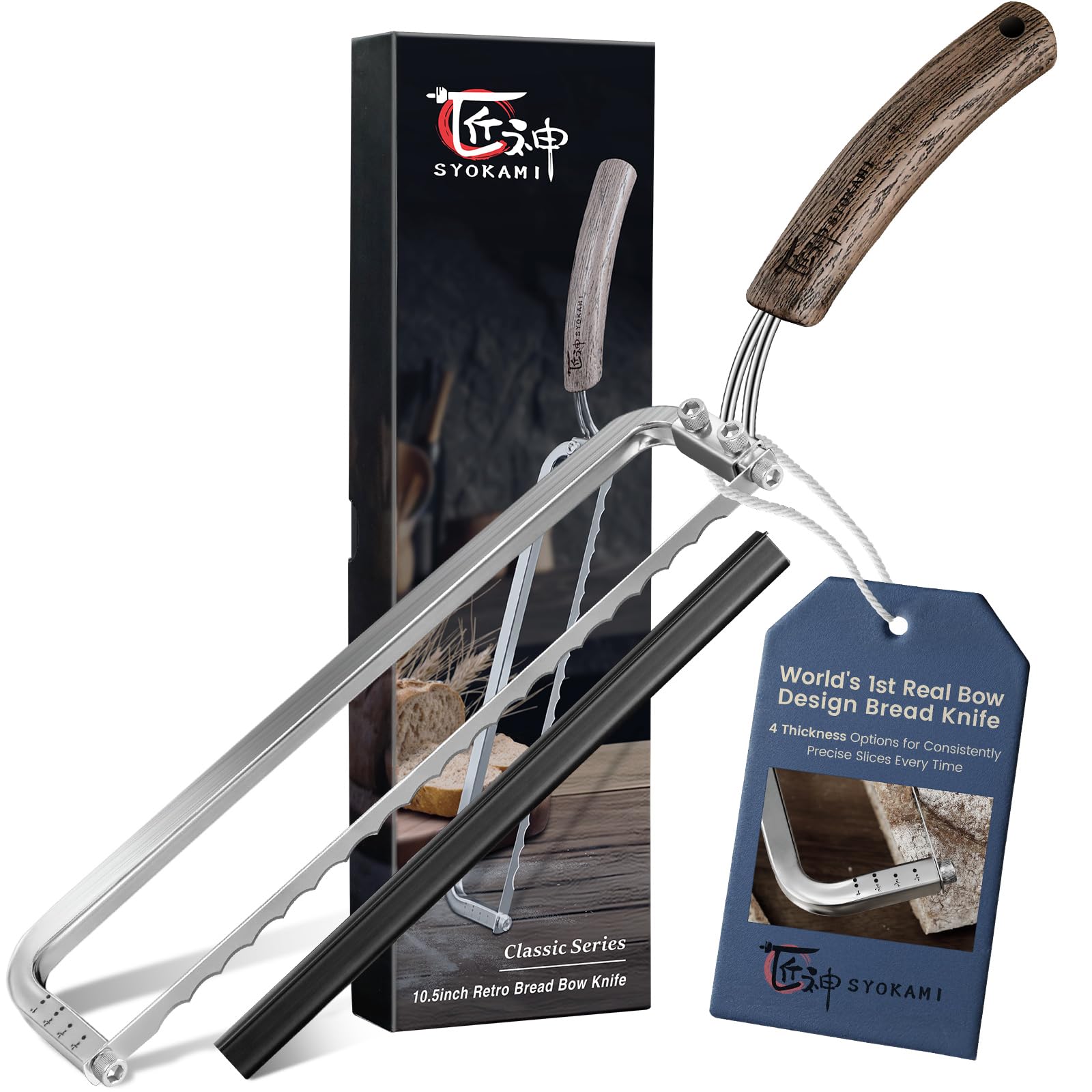
The SYOKAMI abandons the traditional chef’s knife silhouette in favor of a bow-frame design reminiscent of a butcher’s saw. The blade is tensioned between two arms of a stainless steel frame, and the offset handle gives your knuckles full clearance above the cutting board — particularly useful when slicing tall boules or thick baguettes.
The 420J2 stainless steel blade is the same material used in surgical blades, and the company has engineered the serrations to match standard household sharpening rods, meaning the edge can be restored at home without special equipment. Four thickness scale marks (1/4″, 1/2″, 3/4″, 1″) are etched into the frame, allowing you to cut uniform slices by sight without a guide.
The blade extends 0.5mm below the frame, ensuring the serrations reach the base of the loaf without the frame hitting the board. The included blade cover stores safely on a wall hook. The frame is food-grade stainless steel, avoiding the chipping risks of painted wood. This is a specialized tool, but for home bakers who obsess over slice uniformity, it’s hard to beat.
Why it’s great
- Bow-frame design provides excellent knuckle clearance
- Thickness scale marks enable perfectly even slices every time
- 420J2 steel can be resharpened with standard household rods
Good to know
- Optimized for right-handed users only
- Frame and blade require hand washing to maintain tension
5. Dexter-Russell V-Lo 9-inch Sandwich Knife
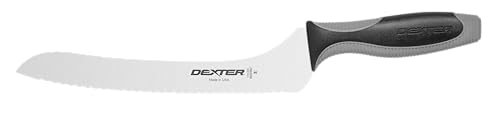
Dexter-Russell has been making commercial cutlery in the USA since 1818, and the V-Lo series is the standard in professional deli and sandwich stations. The 9-inch scalloped edge is different from traditional serrations — each scallop is a rounded divot that creates a smooth, tearing-free cut through crusty baguettes without crushing the interior.
The offset handle lifts your hand above the cutting surface, reducing knuckle drag during long prep shifts. DEXSTEEL stain-free high-carbon steel resists discoloration from acidic foods like tomatoes and citrus, which is common in sandwich prep. The soft-to-the-touch polypropylene handle is sealed to the blade with an impervious bond that prevents bacteria from seeping into crevices.
NSF certification means this knife meets commercial sanitation standards — the blade can withstand repeated hot-water scrubbing without losing its temper. At 5 ounces, it’s lightweight enough for rapid slicing but stiff enough to hold a straight line through dense rye. For home users who value commercial durability, this is the utilitarian champion of the group.
Why it’s great
- Scalloped edge slices crusty bread without tearing the interior
- NSF certified and built for commercial sanitation protocol
- Offset handle provides excellent knuckle clearance
Good to know
- Not dishwasher safe — requires hand washing
- Rubber handle can feel tacky in very hot water
6. PAUDIN Bread Knife 10 inch

The PAUDIN 10-inch bread knife delivers impressive specs at an entry-level price point. The German high-carbon steel blade with a Rockwell hardness of 56+ is the same material class used in knives costing three times as much. The razor-sharp serrated edge cuts through crusty sourdough and bagels with minimal resistance right out of the box.
The full stainless steel handle is a double-edged feature — it’s durable and easy to sanitize, but the smooth metal surface can become slippery when wet. The knife is not dishwasher safe, so hand washing and immediate drying are required to prevent water spots on the polished finish. The elegant gift packaging is a nice touch for holiday giving.
At 10 inches, the blade length handles large artisan loaves effectively. The edge retention at HRC 56 is adequate for weekly home use, though users who slice bread daily may notice a drop-off after six months. For bakers on a budget who still want a 10-inch German steel blade, this is the most cost-effective option available.
Why it’s great
- German high-carbon steel with HRC 56+ for solid edge retention
- 10-inch blade fits wide boules in one stroke
- Corrosion-resistant stainless steel resists rust and staining
Good to know
- All-metal handle gets slippery when wet
- Not dishwasher safe despite stainless construction
7. Mercer Culinary Millennia 9-inch Offset Bread Knife

Mercer Culinary’s Millennia line is a staple in culinary school tool kits for good reason. The 9-inch wavy scalloped edge combines the clean cut of a scalloped profile with the aggressive bite needed for tough crusts. The offset handle lifts your hand high enough to avoid bruised knuckles when slicing tall loaves — a feature typically reserved for much more expensive knives.
The white color-coded handle is part of Mercer’s color-coded system to prevent cross-contamination in commercial kitchens, but at home it adds a clean, professional look that’s easy to spot in a crowded drawer. The blade is stamped from high-carbon steel and individually honed, producing a sharp edge that handles baguettes and sandwich rolls with equal ease.
The lightweight build reduces arm fatigue during extended prep sessions. While not as stiff as a forged blade, the stamped construction keeps the price accessible without sacrificing the scalloped-edge performance that makes bread slicing effortless. Hand washing is required, but the polypropylene handle is impervious to moisture. For a budget-conscious cook who wants offset knuckle clearance, this is the smart pick.
Why it’s great
- Offset handle prevents knuckle contact with the cutting board
- Wavy scalloped edge combines clean cut with crust penetration
- Lightweight design reduces hand fatigue during long sessions
Good to know
- Stamped blade lacks the stiffness of forged alternatives
- Not dishwasher safe despite plastic handle
FAQ
What is the ideal blade length for a bread knife?
Can I sharpen a serrated bread knife at home?
Does a bread knife need to be forged or is stamped okay?
Is a bread knife dishwasher safe?
Final Thoughts: The Verdict
For most users, the knife to cut bread winner is the HOSHANHO 10-inch because its Japanese 10Cr15CoMoV steel, 15-degree edge bevel, and Pakkawood handle deliver premium slicing performance at a price that undercuts many German competitors. If you want a proven forged blade with dishwasher convenience, grab the HENCKELS Forged Premio 8-inch. And for the home baker who insists on perfectly uniform slices every time, nothing beats the SYOKAMI bow-frame design with its integrated thickness scale.