Dull knives are not just a frustration—they are a safety hazard that forces you to apply more pressure, increasing the risk of slips. A guided knife sharpening system removes the guesswork of freehand stones, locking the blade at a precise angle so every stroke removes only the right amount of metal. The result is a consistently sharp, long-lasting edge without years of practice.
I’m Mohammad Maruf — the founder and writer behind AirfryerBite. I’ve spent countless hours analyzing the mechanical tolerances, abrasive materials, and clamp designs that separate a usable system from a truly precision tool.
After evaluating dozens of models across multiple price tiers, I’ve narrowed the field to the seven systems that deliver reliable, repeatable results. This guide breaks down the specs and real-world performance to help you choose the best knife sharpening system for your kitchen or workshop.
How To Choose The Best Knife Sharpening System
A guided sharpening system is only as good as its weakest component—the clamp, the guide rods, or the abrasive plates. Here are the three factors that define performance in this category.
Angle Adjustment Range and Repeatability
The core advantage of a guided system is the ability to set and lock an angle. Look for models that allow fine-tuning in 1-degree increments between 15 and 30 degrees. A fixed-angle system with no adjustment may limit you to one edge profile, while a full-range system lets you switch between a steep 15° chef’s edge and a durable 25° outdoor blade.
Abrasive Quality and Grit Progression
The abrasives you use determine how fast you remove metal and how polished the final edge becomes. Diamond plates cut quickly and last longer than bonded stones, while ceramic stones refine the edge to a smoother finish. A good system offers at least four grit levels—coarse for reprofiling, medium for sharpening, fine for honing, and a leather strop for a mirror polish.
Clamp Stability and Build Materials
The clamp must hold the blade firmly without flexing under pressure. Look for dual sliding clamps with rubber pads that grip both the spine and the edge of the blade. Aluminum or steel construction on the main body adds weight and rigidity, reducing vibration during sharpening. Plastic components can introduce play that compromises edge consistency.
Quick Comparison
On smaller screens, swipe sideways to see the full table.
| Model | Category | Best For | Key Spec | Amazon |
|---|---|---|---|---|
| Work Sharp Pro Precision Adjust | Premium Guided | Professional edge consistency | 15-30° angle, 7 abrasives | Amazon |
| SHARPAL 202H | Premium Guided | Full abrasive progression | 10-35° angle, 7 abrasives | Amazon |
| Work Sharp Precision Adjust | Mid-Range Guided | Budget precision sharpening | 15-30° angle, Tri-Brasive rod | Amazon |
| XARILK GEN3 | Aluminum Guided | Durable aluminum build | 3 diamond plates (320/800/2000) | Amazon |
| VIDOME Electric | Electric Pull-Through | Quick kitchen edge touch-up | 15° edge, diamond abrasives | Amazon |
| Lansky Deluxe 5-Stone | Classic Guided | Hunting and pocket knives | 5-stone set with honing oil | Amazon |
| Arbenefe Rolling Sharpener | Roller Entry-Level | Effortless no-guide sharpening | 4 angles (12/15/20/25°) | Amazon |
In‑Depth Reviews
1. Work Sharp Professional Precision Adjust Knife Sharpener

The Work Sharp Professional Precision Adjust is the most complete guided system in this roundup, featuring a metal chassis, a digital angle indicator, and seven abrasive stages. The build quality is immediately apparent—the clamp is machined from aluminum and grips blades from small pen knives to wide cleavers without shifting, and the guide rod slides on a bearing for near-zero play.
What sets this system apart is the abrasive selection: five diamond plates spanning 220 through 800 grit, plus a fine ceramic stone and a leather strop. This lets you progress from reprofiling a damaged edge to a mirror polish in a single session. The digital angle indicator reads down to 0.1 degrees, making it easy to set and repeat angles between 15 and 30 degrees.
The base is heavy and rubberized, staying planted during aggressive strokes. The only trade-off is the premium price, which reflects the all-metal construction and the included digital gauge—features aimed at serious enthusiasts and professionals who demand absolute repeatability. For anyone who sharpens frequently, this system pays for itself in edge quality alone.
Why it’s great
- Metal construction with zero-flex clamp for consistent edges
- Digital angle indicator allows 0.1-degree precision
- Seven abrasives cover coarse repair to mirror stropping
Good to know
- Premium price puts it above casual buyers’ budgets
- Larger footprint requires dedicated bench space
2. SHARPAL 202H Precision Knife Sharpening System
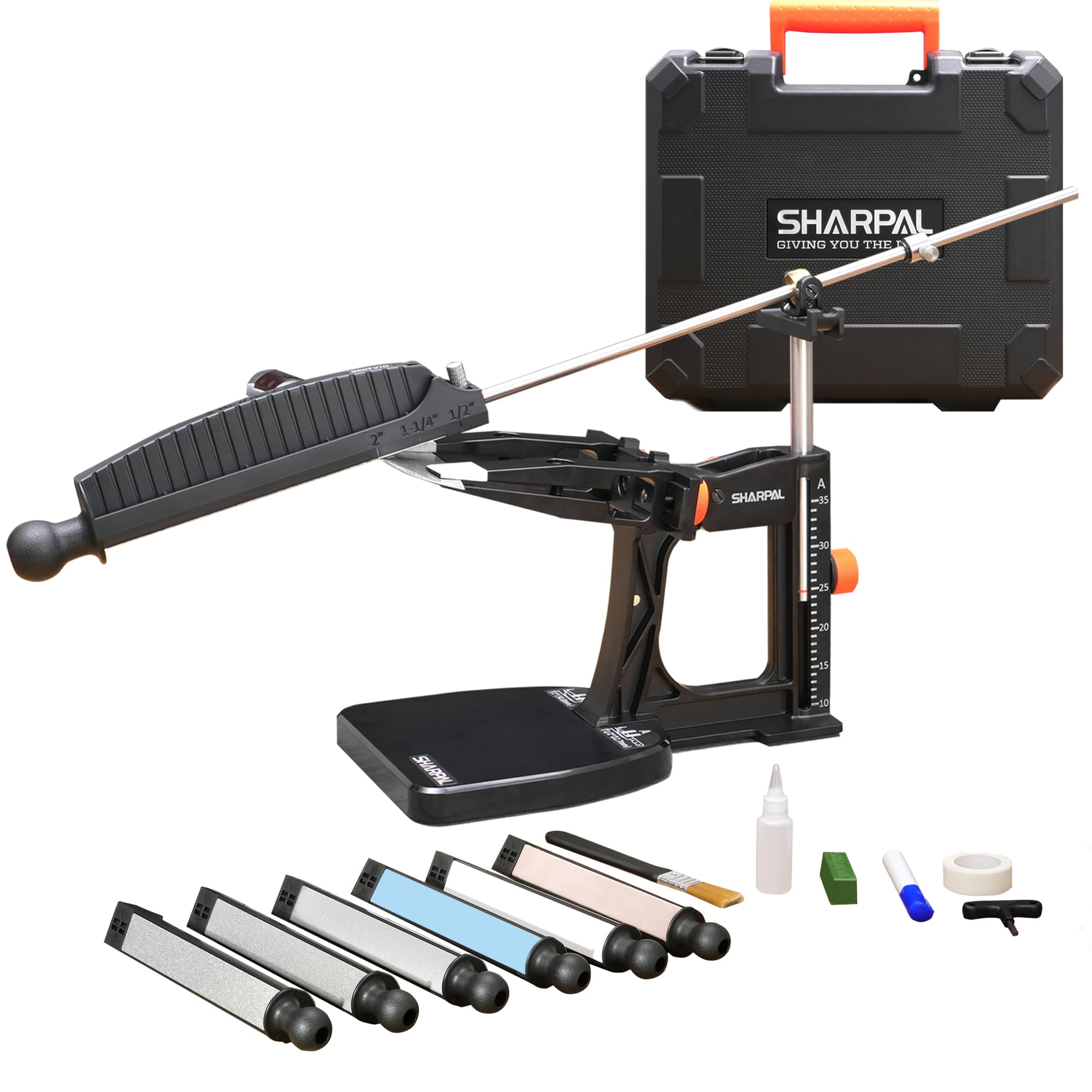
The SHARPAL 202H is a standout for its innovative distance-based angle setting that keeps the edge-to-clamp distance constant, meaning the angle stays accurate regardless of blade width. The system covers an impressive 10 to 35 degrees, making it compatible with everything from ultra-fine sushi knives to heavy-duty outdoor blades.
The included seven abrasives are a complete kit: monocrystalline diamond plates in 220, 325, 600, and 1000 grit, two whetstone plates at 3000 and 6000 grit, and a leather strop with green polishing compound. This progression allows you to bring a chipped edge back to life and then refine it to a razor finish without buying any extra stones. The dual sliding clamps hold the blade firmly and flip to maintain angle consistency on both sides.
The heavy-duty metal construction and anti-slip base keep the system stable during use, and the rigid carry case keeps everything organized for storage or transport. The angle adjustment takes a few seconds to set, and the clamp accommodates blades from narrow pocket knives to extra-wide cleavers. This is a versatile system that balances professional-grade features with a reasonable learning curve.
Why it’s great
- Distance-based angle setting eliminates width-variation inaccuracies
- Seven abrasives from 220 grit to 6000 grit plus strop
- Wide 10-35° range suits all knife types
Good to know
- Whetstone plates require water soak before use
- Case is bulky for small kitchens
3. Work Sharp Precision Adjust Knife Sharpener Kit

The Work Sharp Precision Adjust is the entry point into guided sharpening without sacrificing angle accuracy. It uses a three-sided abrasive jig-and-clamp design that indexes between coarse diamond, fine diamond, and fine ceramic stones. The angle adjusts from 15 to 30 degrees in 1-degree increments, which covers the majority of kitchen and pocket knife profiles.
The Tri-Brasive rod simplifies the process—you rotate it to switch grits instead of swapping stones. This makes it faster to move from sharpening to honing, and the ceramic side produces a clean, polished edge. The V-block clamp secures the blade consistently, and the benchtop base provides enough stability for light to moderate use.
At this mid-range price point, the Precsion Adjust offers the core benefit of guided sharpening—repeatable angles—without the premium cost of a full metal system. The plastic chassis is durable but does flex slightly under heavy pressure. For home cooks and hobbyists who want a reliable edge without investing in a professional setup, this kit delivers excellent value.
Why it’s great
- Three-sided abrasive rod allows quick grit changes
- 1-degree angle increments for precise edge setting
- Affordable entry into guided sharpening
Good to know
- Plastic base can flex with heavy pressure
- Only three abrasives limit coarse reprofiling
4. XARILK GEN3 Guided Knife Sharpening System
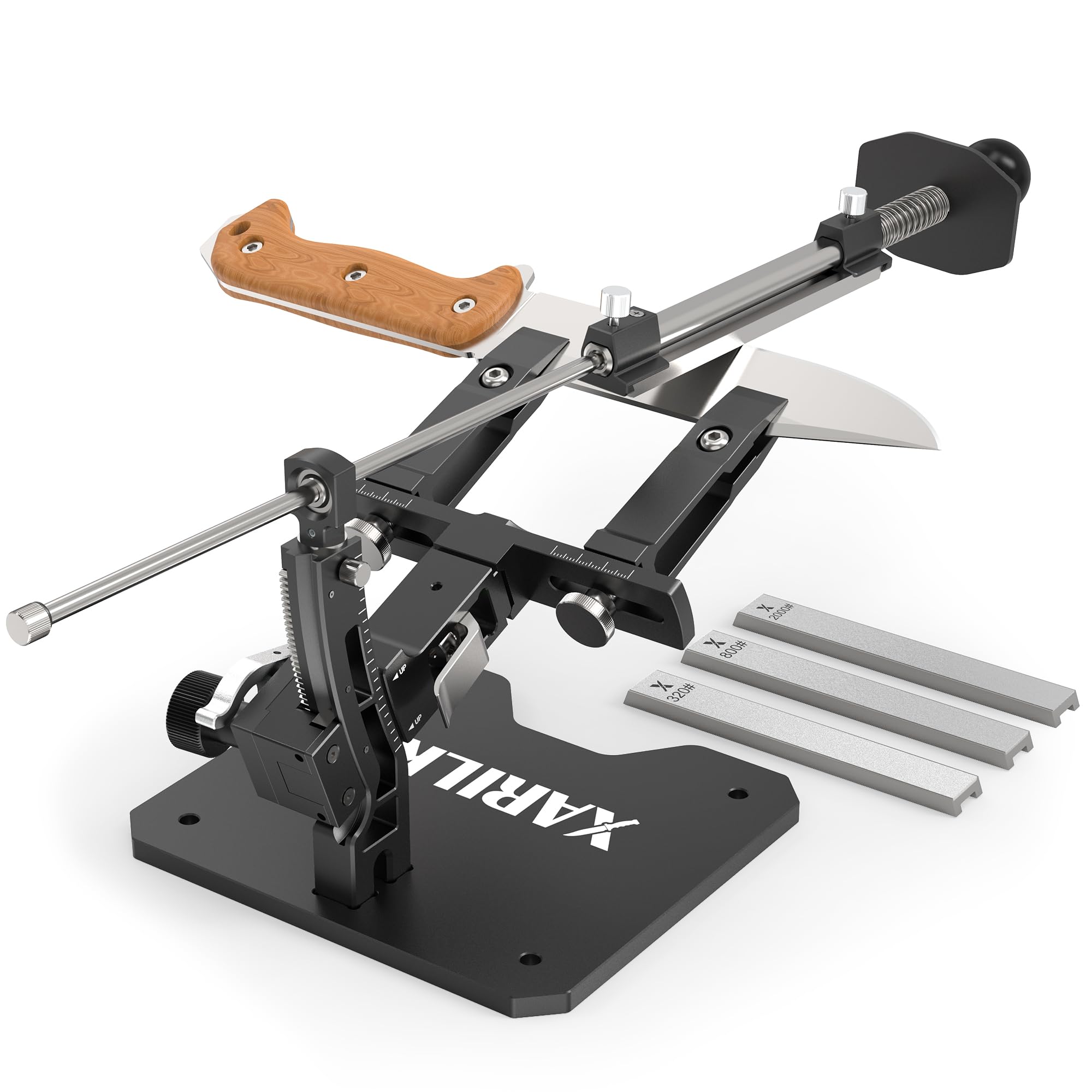
The XARILK GEN3 is built around a high-strength aluminum alloy frame that provides excellent rigidity without being overly heavy. The system comes with three monocrystalline diamond plates at 320, 800, and 2000 grit, which cover the essential progression from coarse edge repair to fine polishing. The plates are securely mounted and show minimal wear after repeated use.
The guided rod and clamp assembly are machined to tight tolerances, allowing you to set and maintain a consistent angle with each stroke. The design is simple—no digital readouts or complex adjustments—which makes it approachable for beginners. The 4-pound weight of the base helps keep the system planted, and the included Allen wrench allows easy plate changes.
While the GEN3 lacks the wider abrasive selection of premium systems, the three diamond plates are sufficient for maintaining already-sharp knives or touching up edges. The aluminum construction gives it a lifespan that plastic-bodied systems cannot match. For users who prioritize durability and a straightforward workflow, this is a strong mid-range option.
Why it’s great
- Aluminum alloy frame offers long-term durability
- Three diamond plates cover coarse to fine sharpening
- Simple, beginner-friendly design
Good to know
- No ceramic or leather strop for final polish
- Limited to 3 grit options
5. VIDOME Professional Electric Knife Sharpener

The VIDOME electric sharpener uses 100% diamond abrasives across three stages to sharpen, hone, and polish blades. The first two stages use diamond plates for aggressive metal removal, while the third stage uses stropping disks for a clean finish. A magnetic chip collector catches metal filings for easy cleanup, and the motor operates between 60 and 80 decibels—quieter than most electric sharpeners.
The spring-loaded guide arms hold the blade at a fixed 15-degree angle, which is ideal for most Western-style chef’s knives. The system also handles ceramic and serrated blades, making it more versatile than many electric pull-through models. Sharpening a dull knife takes about 30 seconds on the first pass, and touch-ups require only 4 to 8 seconds for metal knives.
The trade-off is the lack of angle adjustment—every blade gets a 15-degree edge. This works well for kitchen knives but may not suit outdoor blades that need a more durable 20-degree bevel. The electric motor also means you cannot feel the stone contact as you would with a manual guided system, so it is best for users who prioritize speed over tactile control.
Why it’s great
- Fast 30-second sharpening for dull blades
- Diamond abrasives last longer than bonded stones
- Handles ceramic and serrated edges
Good to know
- Fixed 15° angle limits edge profile options
- Electric operation reduces tactile feedback
6. Lansky Deluxe 5-Stone Controlled-Angle System

The Lansky Deluxe 5-Stone System is a long-standing benchmark in the guided sharpening world. It includes five stones spanning coarse, medium, fine, and ultrafine grits, plus a ceramic hone, all mounted on color-coded rods. The system uses a multi-angle clamp that locks onto the blade spine and allows you to set angles at 17, 20, 25, or 30 degrees by inserting the guide rod into the corresponding hole.
The stones are made from bonded aluminum oxide and require honing oil for lubrication, which prevents metal particles from clogging the abrasive surface. The clamp design works well on blades with a straight spine but struggles with curved or recurve blades. The included storage case keeps everything organized, and the system is compact enough to fit in a toolbox or kitchen drawer.
This is a proven design that has been used by hunters and outdoorsmen for decades. The main limitation is the fixed-angle holes—you get four angle options rather than continuous adjustment. For users who sharpen mainly straight-edged hunting and pocket knives, the Lansky system remains a reliable, affordable choice that delivers consistent results.
Why it’s great
- Five stones provide a complete grit progression
- Compact, portable design with storage case
- Proven reliability for straight-edged blades
Good to know
- Only four preset angles—no fine adjustment
- Requires honing oil for best results
7. Arbenefe Rolling Knife Sharpener Tool Kit

The Arbenefe Rolling Sharpener takes a different approach to guided sharpening by using a magnetic roller system instead of a clamp and rod. The base offers four angle slots—12, 15, 20, and 25 degrees—and you simply pull the roller across the blade at the chosen angle. One end features a 400-grit diamond surface for sharpening, while the other end has a smooth ceramic surface for polishing.
The rolling mechanism reduces the physical effort compared to traditional stones, making it accessible for users with limited hand strength. The wood base is attractive and includes a magnetic support that holds the knife in place. The included gift box packaging makes it a ready-to-give option for casual cooks or outdoor enthusiasts.
This system works well for light maintenance on already-sharp knives but lacks the aggressive grit needed to repair chipped or heavily dulled edges. The rolling design also makes it harder to maintain a perfectly consistent angle across long blades. For entry-level users who want a fuss-free way to keep kitchen knives sharp, it offers a low-cost introduction to angle-guided sharpening.
Why it’s great
- Low-effort rolling design reduces hand fatigue
- Four angle options cover most edge profiles
- Attractive wooden base with magnetic support
Good to know
- Only one diamond grit—limited for heavy reprofiling
- Rolling action less precise than rod-guided systems
FAQ
What angle should I use for my kitchen knives?
Can a guided sharpening system fix a chipped blade?
How often should I use my guided sharpening system?
Are diamond stones better than ceramic stones?
Final Thoughts: The Verdict
For most users, the best knife sharpening system winner is the Work Sharp Professional Precision Adjust because its metal construction, digital angle indicator, and seven-abrasive kit deliver professional-grade consistency without guesswork. If you want the most complete abrasive progression in a single package, grab the SHARPAL 202H with its seven stones and wide 10-35 degree range. And for a budget-conscious entry into guided sharpening, nothing beats the Work Sharp Precision Adjust for its simplicity and repeatable results at a mid-range price.