A premium Japanese chef’s knife loses its soul the moment you run it through a generic electric pull-through sharpener. The acute edge geometry — typically a 15° bevel on each side — demands a precision medium that respects the original grind, not a machine that chews away metal indiscriminately. Choosing the right abrasive system determines whether your blade retains its laser-like bite or gets relegated to utility duty.
I’m Mohammad Maruf — the founder and writer behind AirfryerBite. I’ve spent the last several years analyzing kitchen hardware specifications, comparing grit compositions, and evaluating the angle guides, stone densities, and build quality that separate a competent home sharpening setup from one that ruins a high-carbon edge.
Whether you maintain a single gyuto or a full set of hand-forged blades, this guide breaks down the five contenders that deliver the controlled, water-cooled sharpening essential for hard, thin steel. My goal is to help you identify the knife sharpener for japanese knives that matches your skill level and your blade’s specific needs.
How To Choose The Best Knife Sharpener For Japanese Knives
Japanese knife steel — whether it is Shirogami white carbon steel, Aogami blue steel, or VG-10 stainless — runs harder (Rockwell 60–65) and thinner than most Western blades. That hardness demands an abrasive that cuts cleanly without overheating the edge. A water stone, or whetstone, is the only tool that combines the controlled abrasion and heat-dissipating water film these blades require. Below are the critical factors to evaluate.
Grit Sequence and Progression
A single grit rarely covers both repair and polish. Coarse stones (200–400 grit) reshape damaged edges but should be used sparingly — they remove metal fast and can thin the blade profile. Medium grits around 1000 are the workhorse stage for restoring a dull edge. Fine grits (3000–6000) refine the edge and remove burr. Ultra-fine stones at 8000 or above add a mirror polish. A kit that skips from 1000 directly to 8000 leaves a rough finish; a three-step progression (repair, sharpen, polish) is ideal.
Angle Guidance Systems
Japanese knives typically sharpen at 15° per side, though some single-bevel blades run 10°–12°. A built-in angle guide or a removable clip-on guide keeps the edge consistent through the stroke. Beginners benefit from preset guides that lock the angle; experienced sharpeners often freehand. Look for a system that offers at least a 15° and 17° option — the extra 2° suits slightly thicker Western-made Japanese-style blades.
Stone Composition and Base Stability
White corundum (aluminum oxide) is the standard abrasive for Japanese water stones — it fractures during use to expose fresh cutting particles, maintaining speed. Ceramic stones last longer but load up faster with metal swarf. A non-slip base, whether wood with rubber feet or a dedicated plastic platform, prevents the stone from sliding during the stroke. A stone that shifts even a millimeter ruins the bevel angle.
Quick Comparison
On smaller screens, swipe sideways to see the full table.
| Model | Category | Best For | Key Spec | Amazon |
|---|---|---|---|---|
| Work Sharp Benchtop Whetstone | Mid-Range | Consistent angle new sharpeners | 1000/6000 grit, 15° & 17° guide | Amazon |
| Cutluxe Whetstone Kit | Mid-Range | Versatile multi-grit setups | 4 sides: 400/1000/3000/8000 | Amazon |
| Goodjob Premium Whetstone Kit | Mid-Range | Complete safety-focused bundles | 400/1000 + 3000/8000, cut-resistant gloves | Amazon |
| King KDS 1000/6000 | Mid-Range | Traditional Japanese stone feel | 8″ surface, 1000/6000 double-sided | Amazon |
| MITSUMOTO SAKARI 1000/3000 | Budget | Budget entry into water stones | 7.09″ white corundum, non-slip wood base | Amazon |
In‑Depth Reviews
1. Work Sharp Benchtop Whetstone Knife Sharpener

Work Sharp’s benchtop unit solves the angle consistency problem that frustrates most first-time Japanese-knife sharpeners. The integrated guide clicks into a precise 15° or 17° setting, locking your blade’s orientation through every stroke so the bevel remains uniform from heel to tip. The 1000 grit side cuts quickly enough to raise a burr on VG-10 stainless in about five passes, while the 6000 grit side refines the edge to a hair-popping finish without over-polishing to a slippery, less-aggressive edge.
The water-control base is the standout feature for home kitchens — it holds water around the stone’s perimeter, reducing how often you need to re-wet the surface, and the drainage channels catch slurry runoff so your counter stays dry. The corundum stone itself is slightly softer than some competitive brands, which means it releases fresh abrasive particles faster during heavy use, maintaining cutting speed without loading up with metal debris. At 2.25 pounds, the whole assembly stays planted during the push stroke on a damp towel or bare granite.
Seasoned sharpeners can remove the guide entirely and freehand, giving the unit a dual life as a training system that graduates you to full manual control. The limited lifetime warranty backs the build confidence, though the plastic base feels less premium than all-wood alternatives. For anyone who sharpens two to four knives a week and wants repeatable 15° edges without guesswork, this is the most reliable bridge between beginner mistakes and professional results.
Why it’s great
- Detachable angle guides lock to exact 15° and 17°, ideal for Japanese bevels
- Water-control base minimizes mess and stone drying mid-session
- Dual-grit 1000/6000 covers both sharpening and honing on one stone
Good to know
- Plastic base feels less robust than bamboo or acacia alternatives
- Stone is narrower than traditional 8-inch bench stones, requiring more passes on long blades
2. Cutluxe Whetstone Knife Sharpener – 4 Side Grit 400/1000/3000/8000
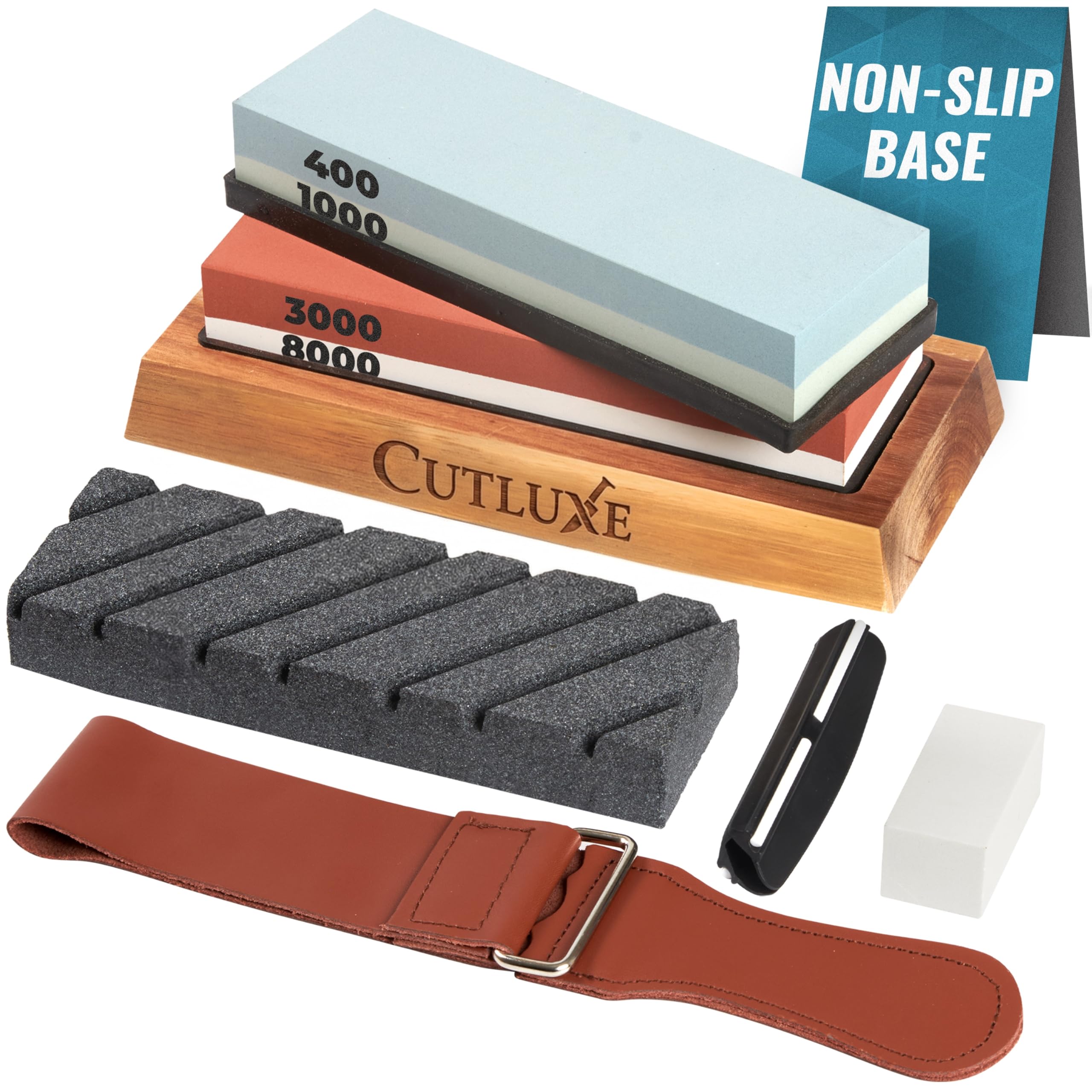
The Cutluxe kit packs four discrete grit surfaces — 400, 1000, 3000, and 8000 — across two double-sided stones, giving you a full progression that most single-stone sharpeners cannot offer. The 400 grit side is aggressive enough to reprofile a chipped edge on a Shirogami blade or thin out the primary bevel after years of sharpening, but you should limit its use to avoid excessive metal removal. From there, the 1000 grit sets the apex, the 3000 refines, and the 8000 delivers a polished, mirror-like finish that reduces drag through food.
The acacia wood base includes a rubber holder that grips the stone from four sides, preventing lateral movement during the forward stroke — a common frustration with loose stones that slide off a damp towel. A dedicated flattening stone is included to keep each surface true; once a water stone develops a dish in the center, the bevel angle becomes concave and the blade edge loses contact. The leather strop and angle guide complete the package, though the plastic angle clip is basic and may require a firm hand to stay seated on thicker blades.
At just under 4.7 pounds, the full kit is portable enough to store in a drawer but heavy enough to stay in place. Beginners will find the included instructions adequate, but the lack of preset angle stops (the guide is a free-floating clip) means you still need to maintain consistent hand pressure. For cooks who maintain multiple blade types — from a 240mm gyuto to a paring knife — the four-grit ladder covers repair through polish without needing a second purchase.
Why it’s great
- Four distinct grit stages cover coarse repair through ultra-fine polishing in one set
- Included flattening stone prevents dishing and maintains bevel consistency
- Acacia base with rubber grip keeps the stone locked during heavy passes
Good to know
- Angle guide is basic and does not lock to a specific degree increment
- Stones require full 10-minute soak before each session for peak performance
3. Goodjob Premium Whetstone Sharpening Kit – 400/1000 3000/8000

The Goodjob set uses Japanese Osaka production technology — baked at 2000°F for 48 hours across 20 manufacturing stages — to produce a dense white corundum stone that releases grit slowly for a longer usable life per stone. The dual-grit stones (400/1000 and 3000/8000) mirror the Cutluxe progression, but the included accessories push the package further: a pair of cut-resistant gloves reduce the risk of a slip when your fingers are wet and soapy, and the silicone-lined bamboo base absorbs vibration so the stone does not chatter during the return stroke.
The honing guide and angle guide are separate tools in this kit, which gives you more precision than a single clip. You mount the blade in the honing guide to set the angle, then use the angle guide as a reference for your hands. It is a two-step process that slows down the first few sessions but trains muscle memory faster than a freehand-only approach. The green compound and leather strop allow for a final micro-polish that removes residual burr without touching the stone, an essential step for achieving the kind of edge that slices a paper towel one-handed.
Stone dimensions are 7.1 inches long, which is adequate for blades up to 210mm; longer 240mm gyutos will require an extra sweeping stroke that can round the tip if you are not careful. The included flattening stone is smaller than the Cutluxe version, so you need to overlap passes to re-true the full surface. For a home cook who wants a full sharpening station with safety gear and a dedicated strop in one box, this kit delivers the highest accessory-to-value ratio among the mid-range contenders.
Why it’s great
- Cut-resistant gloves and separate honing/angle guides improve safety and accuracy for beginners
- Japanese high-temperature firing process produces a durable, slow-wearing stone surface
- Leather strop and green compound included for burr removal and final polish
Good to know
- 7.1-inch stone length requires extra passes for blades longer than 210mm
- Flattening stone is undersized, needing multiple overlapping runs to true the grit surface
4. King KDS Whetstone 1000/6000 Grit

The King KDS is the stone that many professional sushi chefs in Japan learned on — a no-frills, double-sided block that prioritizes cutting speed and feedback over accessories. The 1000 grit side uses a medium-soft bond that releases fresh abrasive grains quickly, making it one of the fastest-cutting medium stones available for high-hardness Japanese steels. On a Shirogami #2 blade, the 1000 side will raise a consistent burr in three to four passes, cutting faster than the Work Sharp’s equivalent grit while producing a slightly grittier finish that holds a toothy edge well for produce slicing.
The 6000 grit side is noticeably finer than most combo stones in this price band. It leaves a semi-mirror finish that reduces drag through tomato skins and raw fish, though it stops short of the full gloss an 8000 grit stone delivers. The 8-inch length is the key advantage here — it accommodates a full stroke on a 240mm gyuto without the tip-overhang problem you see on 7-inch stones. The extra surface area also means the stone wears more evenly across its length, delaying the dishing that eventually requires flattening.
There is no base, no guide, and no strop included — the KDS ships as a bare stone. You need a separate non-slip base or a wet towel to keep it from skating on the counter. The King brand’s binder is relatively friable, so the stone generates more slurry than denser options; that slurry is the actual cutting agent, and beginners often mistake it for messy stone breakdown when it is actually the mechanism doing the work. For purists who prefer a traditional water stone experience and already own a base and angle guide, the King KDS offers the most authentic Japanese sharpening feel at a mid-range price.
Why it’s great
- 8-inch stone provides full-stroke coverage for 240mm blades without overhang
- Fast-cutting 1000 grit side raises a burr on hard Japanese steel in very few passes
- Authentic Japanese stone with a friable bond that self-sharpens during use
Good to know
- No base or angle guide included — requires separate purchase for stable use
- Generates heavy slurry that beginners may misinterpret as poor stone quality
5. MITSUMOTO SAKARI Japanese Knife Sharpening Stone 1000/3000 Grit

The MITSUMOTO SAKARI is the most affordable entry point in this roundup that still uses genuine white corundum abrasive rather than the silicon carbide found in cheaper hardware-store stones. The double-sided 1000/3000 grit layout skips the coarse repair stage entirely, which protects beginners from accidentally oversharpening a thin Japanese edge — you cannot easily reprofile a chip with this stone, but you also cannot round the tip by pressing too hard on a 400-grit surface. The 1000 side restores a dull but undamaged edge quickly, and the 3000 side refines it to a finish suitable for most home slicing tasks.
The wooden base with TPR rubber feet is the strongest selling point at this tier — it provides the same non-slip stability as premium bamboo bases at a fraction of the cost. The base also elevates the stone slightly, giving your knuckles clearance from the counter during the stroke. The stone dimensions (7.09 inches) are shorter than ideal for a full gyuto stroke, so you will need to use a sweeping arc motion to cover the entire blade length, which requires more practice to maintain a consistent angle across the arc.
Customer feedback consistently notes that the included instructions are minimal, and there is no angle guide in the box. That means the MITSUMOTO SAKARI works best for someone who has either watched a few stone-sharpening tutorials or is willing to learn the angle by feel. The 3000 grit side is softer than premium stones, so it wears faster and will develop a dish after 20–30 sharpenings; you can flatten it with the same 400-grit stone from the Cutluxe kit if you own one. For the price, it is a capable first water stone that will teach you the fundamentals without the sunk cost of a premium system.
Why it’s great
- Pre-attached non-slip wooden base with rubber feet stays planted on wet counters
- Entry-level 1000/3000 grit range is safe for thin Japanese edges with no risk of coarse over-grinding
- Genuine white corundum abrasive cuts faster than cheap silicon carbide alternatives
Good to know
- Short stone length requires sweeping strokes on blades over 180mm, demanding practice
- No angle guide or instructional booklet included — beginners must learn angle control elsewhere
FAQ
Can I use an electric pull-through sharpener on a Japanese knife?
What is the correct angle for sharpening a Japanese knife on a whetstone?
How long should I soak a water stone before sharpening?
How do I know when my whetstone needs flattening?
Final Thoughts: The Verdict
For most users, the knife sharpener for japanese knives winner is the Work Sharp Benchtop Whetstone because it combines a precise 15° angle guide with a water-control base and a competent 1000/6000 grit stone in a package that works for both beginners and experienced sharpeners. If you want a full four-grit progression with a flattening stone and leather strop, grab the Cutluxe Whetstone Kit. And for the most traditional Japanese stone experience without unnecessary accessories, nothing beats the authentic cutting action of the King KDS 1000/6000 — just pair it with a good non-slip base.