A dull fillet knife turns a clean, 30-second cut into a ragged, frustrating tear that ruins the fish. The thin, flexible blade that makes a fillet knife so precise is exactly what makes it vulnerable — the wrong sharpener can grind away that subtle taper in seconds, leaving you with a blade that’s thick, blunt, and useless. Matching the right sharpening system to that delicate edge geometry is the only way to keep your fillet knife slicing effortlessly through skin and bone.
I’m Mohammad Maruf — the founder and writer behind AirfryerBite. Over the last fifteen years, I’ve analyzed hundreds of blade-sharpening systems, mapped the specific angle and material requirements for flexible fillet blades, and cross-referenced real-world performance data from commercial fishermen, home cooks, and professional butchers to separate the tools that actually preserve a fillet knife’s edge from those that damage it.
Whether you’re breaking down a salmon on the dock or trimming a tenderloin in the kitchen, the right tool keeps your blade razor-ready. This guide cuts through the noise to find the best knife sharpener for fillet knives.
How To Choose The Best Knife Sharpener For Fillet Knives
Fillet knives are defined by their flexibility and thin edge stock. The wrong sharpener will remove too much metal too quickly, alter the blade geometry, or fail to reach the extreme cutting angle these blades require. Here are the four criteria that matter most when selecting a sharpener for this specific blade type.
Sharpening Angle: The 15-Degree Baseline
Most fillet knives arrive from the factory with a 15 to 17-degree edge angle per side. This acute angle produces the aggressive sharpness needed to slide through skin and separate flesh from bone without tearing. A sharpener that locks into a 20-degree angle (common for Western chef’s knives) will produce a more durable but noticeably less sharp edge that stubles through delicate cuts. Look for a system with adjustable angle settings or a fixed guide that matches the 15-degree standard. The Work Sharp Precision Adjust, for example, lets you dial in 1-degree increments from 15 to 30, giving you full control over that fillet-specific geometry.
Abrasive Type: Diamond Over Carbide for Thin Edges
Carbide pull-through sharpeners are fast but aggressive — they can gouge and chip the thin edge of a fillet knife, especially if the blade flexes during the pull. Diamond abrasives, whether on electric wheels or fixed stone sets, are harder and cut more cleanly, producing a finer edge without the risk of fracturing the blade steel at the apex. Diamond also handles the high-alloy stainless steels many premium fillet knives are made from without dulling the abrasive itself. For any sub-2mm edge stock, diamond is the safer, sharper choice.
System Type: Guided vs. Freehand vs. Belt
Freehand sharpening on a whetstone gives you the most control over edge geometry, but it requires significant practice to maintain a consistent angle along the full length of a flexible blade. Guided fixed-angle systems like the Work Sharp Precision Adjust remove the guesswork entirely — the knife is clamped and the abrasive rod moves at a locked angle. Electric belt sharpeners like the Work Sharp Ken Onion offer speed and repeatability but require careful speed control to avoid overheating the thin edge and drawing the temper out of the steel. For most users, a guided manual system delivers the best combination of precision and safety for a fillet knife.
Quick Comparison
On smaller screens, swipe sideways to see the full table.
| Model | Category | Best For | Key Spec | Amazon |
|---|---|---|---|---|
| Work Sharp Ken Onion Mk.2 | Belt-driven | Professional-grade speed & precision | Variable speed belt, 15°-30° angle | Amazon |
| Work Sharp Precision Adjust | Guided manual | Absolute angle control for fillet blades | 1° increments, 15°-30° range | Amazon |
| VIDOME 3-Stage Electric | Electric diamond | Quick 15° edge on metal & ceramic | 100% diamond abrasives, 3-stage | Amazon |
| Homly 3-Stage Electric | Electric diamond | Versatile kitchen & fillet knife set | 100% diamond abrasives, 3-stage slots | Amazon |
| Narcissus S867 Electric | Electric diamond | Compact, stable diamond sharpening | 30W DC motor, diamond wheels | Amazon |
| Dawnstar S865 Electric | Electric diamond | Auto-angle guide for beginners | 20° diamond wheels, auto guide | Amazon |
| MAD SHARK Pull-Through | Manual pull-through | Adjustable angle for any blade | 6 angles: 14°,16°,18°,20°,22°,24° | Amazon |
| BANTBSKT Rolling Kit | Manual rolling | Whetstone-like precision for beginners | Diamond & ceramic discs, 15° & 20° | Amazon |
| Victorinox Pocket Sharpener | Portable manual | On-the-go touch-ups for straight blades | Ceramic notch, honing stone | Amazon |
In‑Depth Reviews
1. Work Sharp Ken Onion Knife Sharpener Mk.2

The Work Sharp Ken Onion Mk.2 is the benchmark for serious edge enthusiasts who want professional-grade results at home. Its flexible abrasive belt system sharpens at adjustable angles from 15 to 30 degrees, making it ideal for the acute 15-degree edge a fillet knife demands. The electronic speed control lets you dial down the belt speed when working with thin, flexible blades, preventing heat buildup that can soften the steel temper.
Designed in partnership with knife-making legend Ken Onion, this Mk.2 iteration improves on an already proven platform. Precision sharpening guides keep the blade aligned while the belt does the work, and the system handles not just fillet knives but serrated blades, scissors, and even tools. The 3-year warranty backs the investment, and replacement belts in higher grits (800 and 1000) are readily available for refining that fillet edge to a surgical finish.
Users consistently report that this sharpener restores knives to a sharpness they could never achieve with stones or pull-through systems. The only real trade-off is the higher investment and the need to buy extra fine-grit belts if you want a polished, hair-shaving edge on your fillet knives. For anyone processing fish or meat regularly, the speed and consistency are transformative.
Why it’s great
- Variable-speed belt prevents edge overheating on thin fillet blades
- Adjustable 15°-30° angle range matches fillet knife geometry
- Sharpens serrated blades and scissors in addition to straight edges
Good to know
- Requires purchasing finer grit belts separately for a polished edge
- Higher price point may be overkill for occasional home use
2. Work Sharp Precision Adjust Knife Sharpener

The Work Sharp Precision Adjust is the sharpener that finally makes fixed-angle sharpening accessible to anyone who’s struggled with freehand stones. The knife clamps securely into a V-block, and the tri-abrasive rod — coarse diamond, fine diamond, and fine ceramic — moves along a slide at an angle you set from 15 to 30 degrees in 1-degree increments. For a fillet knife typically sharpened at 15 degrees, this level of control is critical.
The kit includes 320 and 600 grit diamond plates plus a fine ceramic stone, which gives you a solid progression from reprofiling a dull edge to refining a polished one. The benchtop base is stable and compact enough to store in a drawer. Users who own the upgrade kit (additional finer grit plates) report being able to achieve a mirror-polished edge that rivals professional work.
Customer feedback is overwhelmingly positive, with many noting that this system produced sharper edges on their pocket and kitchen knives than they had ever managed before. The one caveat for fillet knives is that the clamp’s V-block design requires a straight section of blade to grip — very narrow or extremely flexible fillet tips may need careful positioning. Overall, it’s the best manual guided system for the money.
Why it’s great
- 1-degree angle adjustment allows precise 15° fillet edge setting
- Tri-abrasive rod (diamond + ceramic) provides complete edge progression
- Compact, stable benchtop design stores easily
Good to know
- Clamp may not hold extremely flexible fillet blade tips securely
- Upgrade kit needed for ultra-fine polishing grits
3. VIDOME Professional Electric Knife Sharpener

The VIDOME electric sharpener is built around a 3-stage system that uses 100% diamond abrasives in stages 1 and 2, followed by stropping disks in stage 3 to polish the blade to a factory-fresh finish. This is particularly effective for fillet knives because diamond cuts cleanly through thin edge stock without chipping, and the stropping step removes any micro-burrs left after honing.
The sharpener applies a 15-degree edge, which is the standard angle for most fillet knives. The German imported motor is energy-efficient and operates at a reasonable noise level between 60 and 80 dB. A magnetic chip collection tray catches metal particles for easy cleanup. The elastic spring guide rods hold the blade at the optimal angle throughout the pass, ensuring uniform sharpening along the entire length of the blade.
Users who switched from traditional whetstones report that the VIDOME delivers consistently sharper results with far less effort. The main limitation is that the sharpening slots require the knife to be pulled back evenly immediately after insertion — there’s no room for hesitation. For anyone who wants a quick, repeatable electric solution for fillet knives, this is a top contender.
Why it’s great
- 100% diamond abrasives cut cleanly without chipping thin fillet edges
- 3-stage system includes stropping for a polished, burr-free finish
- 15-degree angle matches standard fillet knife geometry
Good to know
- Requires a smooth, even pull motion — hesitation can cause uneven sharpening
- Some users report the stage 1 slot is narrow for larger blades
4. Homly Professional Electric Knife Sharpener

The Homly electric sharpener brings a 3-stage diamond abrasive system to a broader audience, with a focus on versatility for all kitchen knives including fillet, boning, and slicing blades. Stages 1 and 2 use 100% diamond abrasives for sharpening and honing, while stage 3 polishes the edge to a refined finish. The double-layer shell construction with electroplating provides added durability and a distinct appearance on the counter.
What sets this model apart is the flexible spring guide rod system that maintains consistent blade contact throughout the sharpening stroke. This is especially useful for fillet knives, where maintaining a steady angle along a flexible blade can be challenging. The powerful motor includes noise-reduction design, and the unit measures 12.2 inches long, giving you a stable, wide base during use.
The Homly is compatible with all metal steel knives — chef, Santoku, boneless, butcher, Viking, fish slice, and fillet. The 2-year manufacturer warranty provides peace of mind. The main consideration is that it’s built for versatility rather than specialized fillet work, so users who sharpen exclusively fillet knives may prefer a system with finer angle control. For a mixed-kitchen household, it’s a strong all-rounder.
Why it’s great
- Flexible spring guide rods maintain consistent angle on flexible fillet blades
- 3-stage diamond system handles both sharpening and polishing
- Double-layer shell construction adds long-term durability
Good to know
- No adjustable angle setting — fixed at the factory 15° equivalent
- Better suited for mixed knife sets than dedicated fillet-only use
5. Narcissus Electric Knife Sharpener S867
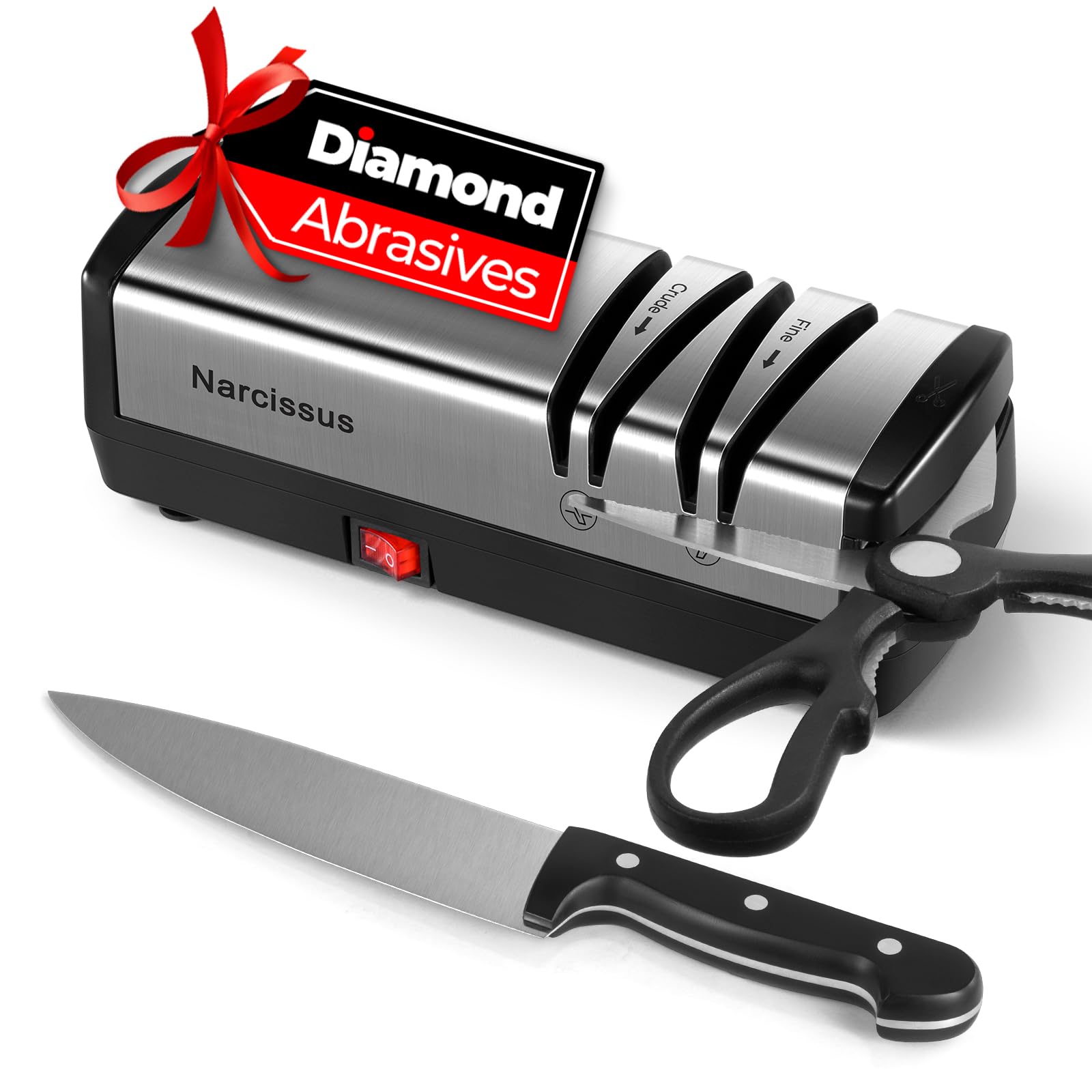
The Narcissus S867 is a compact, diamond-abrasive electric sharpener that punches above its size. The dual-slot system uses diamond grinding wheels in both a coarse and fine slot, restoring dull edges quickly and refining the finish in the second pass.
Measurement-wise, the unit is notably small at 8.2 by 2.9 by 2.7 inches and weighs 1.7 pounds, making it easy to store or take to a camp kitchen. The four anti-slip foot pads and low center of gravity keep vibration to a minimum during use, which helps maintain a steady angle when pulling through a flexible fillet blade. It also includes a dedicated scissors sharpening slot, adding utility beyond knives.
Customer feedback highlights the sharpener’s ability to restore severely dull knives quickly, though some note it requires a steady hand to hold the blade at the correct angle — there’s no fixed guide system. The wide voltage design (100-240V) makes it travel-friendly. For the price, it’s a solid entry-level electric option that won’t damage thin fillet edges.
Why it’s great
- 30W DC motor runs continuously for over an hour without overheating
- Compact footprint (8.2 inches) fits small kitchens and camp setups
- Low-vibration design with anti-slip foot pads for stable sharpening
Good to know
- No fixed angle guide — requires user skill to maintain consistent angle
- Diamond wheels are effective but wear faster than premium systems
6. Dawnstar Electric Knife Sharpener S865
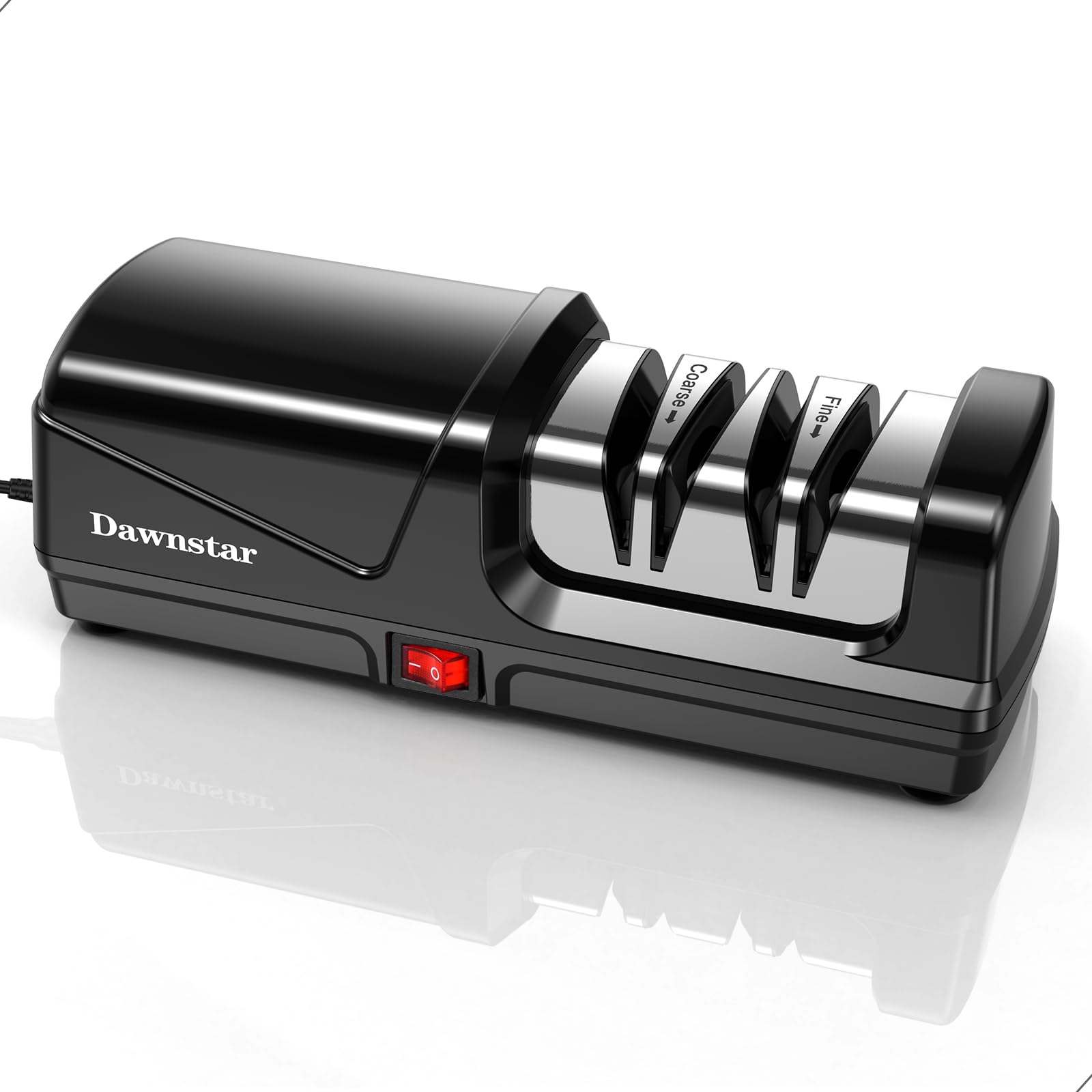
The Dawnstar S865 sets itself apart with an updated direction guide piece inside the sharpening slots that automatically positions the blade at the optimal angle. For novice sharpeners who worry about wrecking a fillet knife’s edge by holding it wrong, this auto-guide feature removes the guesswork entirely. The dual-stage system uses diamond abrasives for both coarse sharpening and fine polishing.
The machine has a 15.3-inch length and a low center of gravity, with four anti-slip foot pads that significantly reduce vibration during operation. The ergonomic handle provides a secure grip, and the included metal dust collection box keeps steel filings contained. The 100-240V global voltage design makes it usable anywhere in the world.
The primary limitation for fillet knife users is the fixed 20-degree sharpening angle. While 20 degrees produces a durable edge, it’s noticeably less sharp than the 15-degree edge most fillet knives are designed for. The sharper angle matters when you need that blade to slide through skin without catching. The Dawnstar is a fine choice for general kitchen knives, but fillet enthusiasts should consider an adjustable-angle alternative.
Why it’s great
- Auto-angle guide piece eliminates angle-guessing for beginners
- Low-vibration, stable base with ergonomic handle
- Metal dust collection box for easy cleanup
Good to know
- Fixed 20° angle is less aggressive than ideal fillet knife edge
- Auto guide may not accommodate very narrow fillet blade tips
7. MAD SHARK Knife Sharpener

The MAD SHARK is one of the few manual pull-through sharpeners that offers genuine angle adjustability. The dial lets you select from six angles — 14, 16, 18, 20, 22, and 24 degrees — meaning you can dial in the exact 14 or 16-degree angle that many fillet knives require. A handy guide on the sharpener suggests which angle to use based on knife type, which is thoughtful for newcomers.
The tool includes a tungsten steel slot for coarse sharpening and a ceramic slot for fine honing, plus a separate scissor slot. The ergonomic handle and two silicone pads on the bottom keep the device firmly anchored to the countertop during use. It’s lightweight at 0.4 pounds and compact at 10.4 inches, making it easy to store in a tackle box or kitchen drawer.
Customer reviews from professional chefs and home users alike praise the sharpener’s effectiveness, particularly on Japanese and American knives. The pull-through design requires only forward motion — never back and forth — which reduces the chance of gouging the blade. The trade-off is that the tungsten slot is more aggressive than diamond; frequent use on thin fillet edges will remove metal faster than a diamond system.
Why it’s great
- Six adjustable angles include 14° and 16° — perfect for fillet knives
- Tungsten coarse and ceramic fine slots provide complete edge progression
- Compact, lightweight design with stable silicone base pads
Good to know
- Tungsten slot is aggressive — frequent use removes metal quickly
- Not suitable for serrated or ceramic blades
8. BANTBSKT Rolling Knife Sharpener Kit

The BANTBSKT Rolling Sharpener Kit is a whetstone alternative that uses rotating diamond and ceramic discs mounted on a natural beech wood base. The base incorporates N48 neodymium magnets to hold the knife in place during sharpening, which is particularly useful for fillet knives that tend to flex and shift under pressure. The kit includes a #400 diamond plate for coarse removal, a #1000 diamond plate for refining, and a #3000 ceramic plate for polishing.
Two sharpening angles are available: 15 degrees for filigree sharpness (ideal for fillet knives) and 20 degrees for a more robust edge. A leather strop made from top-layer cowhide and green polishing compound is included for final edge refinement. The wood base measures 8.26 by 5.51 by 2.76 inches and adds a natural aesthetic to the kitchen counter.
The rolling disc design mimics the action of a whetstone with less skill required, making it accessible for beginners who want precision without investing in an electric system. The 6-piece kit includes everything needed to start sharpening immediately. The caveat is that the rolling motion can be less intuitive than a fixed stone, and the magnetic hold may not be strong enough for very thin, highly flexible fillet blades.
Why it’s great
- 15° and 20° angle options match fillet knife requirements
- Magnetic wood base holds flexible blades steady during sharpening
- Complete kit includes leather strop and polishing compound
Good to know
- Rolling disc action takes practice to master
- Magnetic hold may not secure extremely thin fillet tips
9. Victorinox Pocket Knife Sharpener
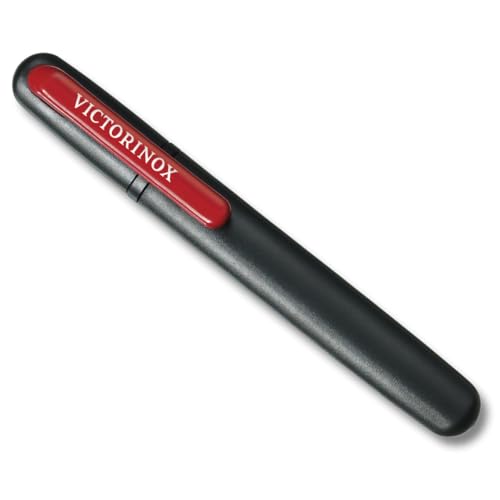
The Victorinox Pocket Sharpener is the most portable option in this guide, designed specifically for maintaining straight blades — including the kind of fillet knife you’d carry on a fishing trip or camping expedition. Its pencil-sized form factor (5 by 2 by 2 inches, 1.44 ounces) fits easily in a pocket or tackle box. The sharpener integrates a honing stone for pre-sharpening and a ceramic V-notch for fine edge finishing.
The ceramic notch is particularly effective at removing the burr that forms after sharpening, leaving a clean, sharp edge. Users with limited dexterity report that the V-shaped ceramic guide is easier to use than other manual sharpeners for flat-ground blades, which is relevant for fillet knives that typically feature a flat grind. The Victorinox brand reliability is backed by a lifetime warranty against material or manufacturing defects.
This is not a heavy-duty sharpening solution — it’s designed for quick touch-ups, not reprofiling a severely damaged edge. If your fillet knife is completely dull or chipped, you’ll need a more aggressive system first. But as a compact companion for maintaining an already-sharp edge in the field, the Victorinox is unmatched in portability and ease of use.
Why it’s great
- Ultra-portable pencil-size design fits in pocket or tackle box
- Ceramic V-notch effectively removes burrs from fillet blade edges
- Lifetime warranty from a trusted Swiss brand
Good to know
- Best for light touch-ups, not reprofiling dull or chipped edges
- Limited to straight blades — no support for serrated edges
FAQ
What is the best sharpening angle for a fillet knife?
Can I use a pull-through carbide sharpener on my fillet knife?
How do I keep my fillet knife from flexing while sharpening?
Is an electric knife sharpener safe for thin fillet blades?
Final Thoughts: The Verdict
For most users, the best knife sharpener for fillet knives winner is the Work Sharp Precision Adjust because it offers the most precise angle control (1-degree increments from 15 to 30) in a guided, user-friendly system that preserves the delicate edge geometry of a fillet blade. If you want the speed and convenience of electric sharpening, the VIDOME 3-Stage Electric delivers a consistent 15-degree edge with diamond abrasives. And for a portable field solution, nothing beats the Victorinox Pocket Sharpener for quick touch-ups on the dock or campsite.