Every sushi lover knows the feeling: you lay down a beautiful slice of salmon, press down with a dull blade, and the fish tears instead of gliding cleanly. That single ragged edge ruins the texture, the presentation, and the entire dining experience. A real sushi knife isn’t just sharp — it is purpose-built with a single-bevel edge and a specific geometry that prevents that tearing and preserves the integrity of each delicate protein.
I’m Mohammad Maruf — the founder and writer behind AirfryerBite. I have spent years deep-diving into Japanese cutlery metallurgy, analyzing blade hardness ratings, edge angles, and core steel compositions to understand what separates a proper yanagiba from a standard chef’s knife.
Whether you are a home enthusiast building your first sushi station or a professional looking to upgrade your roll prep, choosing the right tool changes everything. This guide breaks down the essential specs and top contenders to help you find the absolute knife for sushi that fits your hand and your budget.
How To Choose The Best Knife For Sushi
Selecting a sushi knife boils down to three core considerations: blade geometry, steel composition, and handle ergonomics. A standard Western chef’s knife has a curved belly that rocks when you chop — perfect for mincing herbs, terrible for drawing a clean slice through raw fish. The right sushi knife uses a flat, long blade with a single, acutely angled cutting edge that pulls through proteins without crushing cell structures.
Single-Bevel vs. Double-Bevel: Why Yanagiba Rules
A yanagiba (willow-leaf) knife is ground on only one side — typically the right side for right-handed users. This single-bevel design creates an exceptionally sharp edge that slices rather than wedges, reducing drag and preserving delicate fish texture. Double-bevel blades like a sujihiki can also work, but they push food off center and create more resistance. For traditional sushi and sashimi, a single-bevel yanagiba is the professional standard.
Blade Hardness and Steel Type
Japanese knives are often rated on the Rockwell Hardness scale (HRC). A reading of 58–60 HRC is typical for entry-level stainless, while premium cores like VG10 or 10Cr15MoV hit 60–62 HRC. Harder steel holds a finer edge longer but becomes more brittle — you cannot cut through bones or frozen blocks with a sushi knife. High-carbon stainless offers the best balance of corrosion resistance and edge retention for sushi work.
Handle Shape and Balance
Traditional Wa-handles (octagonal or D-shaped) are lighter and allow the index finger to wrap around the blade’s tang for precise control on long slices. Western-style handles are heavier and more familiar to many cooks, but they shift the balance point backward, making fine draw cuts feel less connected. For repeated slicing over a full sushi prep session, a lightweight octagonal handle reduces fatigue and improves accuracy.
Quick Comparison
On smaller screens, swipe sideways to see the full table.
| Model | Category | Best For | Key Spec | Amazon |
|---|---|---|---|---|
| Yoshihiro VG10 46-Layer Sujihiki | Premium | Precision slicing with Damascus aesthetics | VG10 core, 60 HRC | Amazon |
| Cangshan KITA 10″ Sashimi | Premium | Hammered Damascus with magnetic sheath | X-7 Damascus, 60 HRC | Amazon |
| Global G-11R 10″ Yanagi | Premium | Lightweight Japanese stainless, professional feel | CROMOVA 18 steel, stamped | Amazon |
| SHAN ZU 10″ Sashimi Yanagiba | Mid-Range | Best value forged steel with red sandalwood handle | 10Cr15MoV core, 62 HRC | Amazon |
| Mercer Culinary 12″ Yanagi | Mid-Range | Long blade for large fish sides, NSF certified | German steel, single-edge | Amazon |
| Kai Seki Magoroku 240mm | Entry-Level | Budget-friendly right-handed yanagiba | Moly-Vanadium, 58 HRC | Amazon |
| Kai Wasabi Black 8.25″ Yanagiba | Entry-Level | Entry-level price, traditional D-handle design | High-carbon stainless, 9″ blade | Amazon |
In‑Depth Reviews
1. Yoshihiro VG10 46-Layer Hammered Damascus Sujihiki (9.5″)
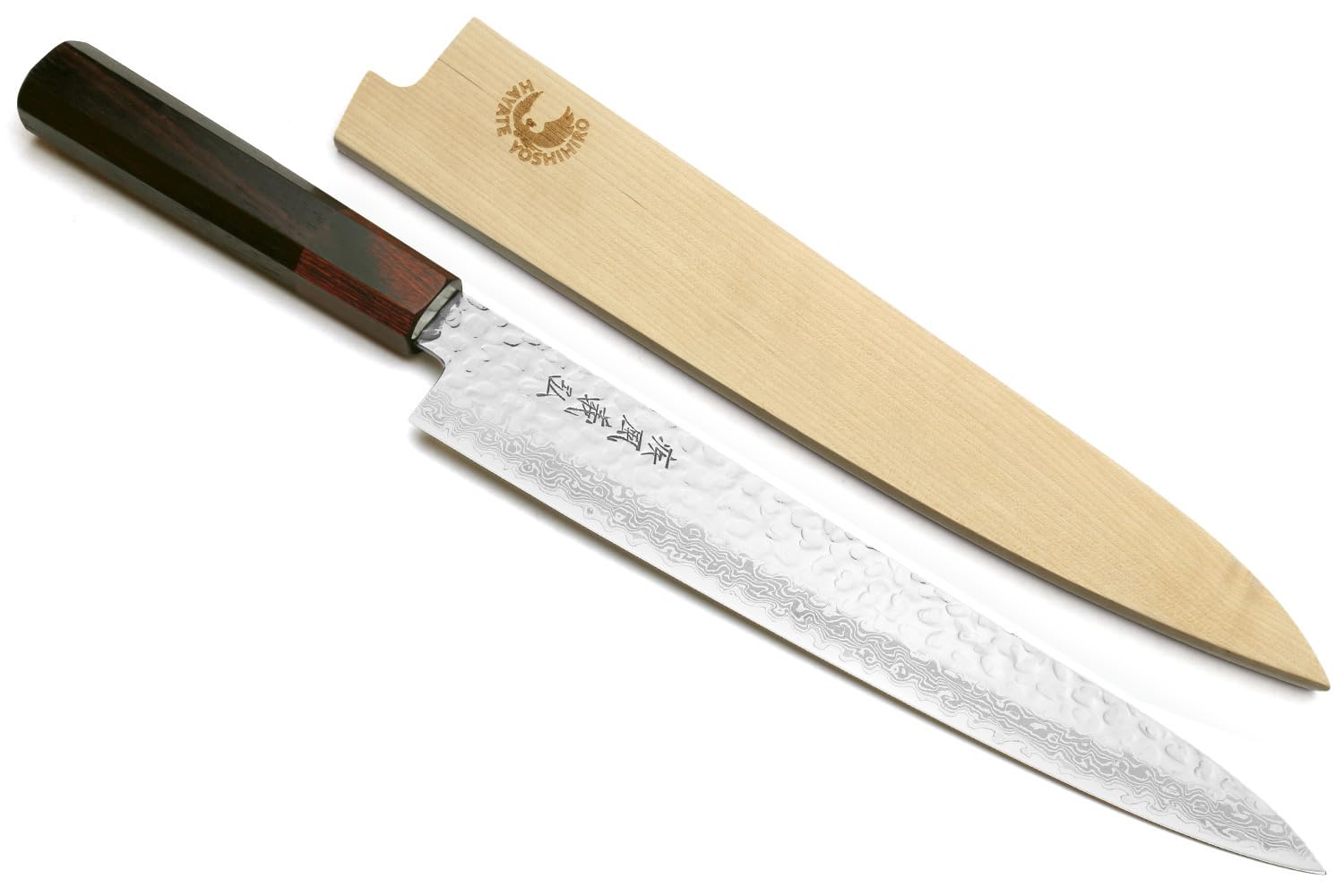
The Yoshihiro Sujihiki is a masterpiece of traditional Japanese forging — 46 layers of Damascus cladding sandwich a VG10 core hardened to 60 HRC. The hammered (tsuchime) finish reduces friction so sliced fish falls away cleanly without sticking, and the double-edged grind makes it more forgiving for beginners who haven’t yet mastered single-bevel technique.
At 9.5 inches, the blade strikes an ideal balance between a full 10-inch slicer and a shorter utility knife. The octagonal rosewood Wa-handle is lightweight (just under a pound) and provides a solid, connected grip for long draw cuts through salmon belly or tuna blocks. The included magnolia wood saya sheath protects the blade when stored.
This is a genuine Japanese-made knife from Seki, and it shows in the hair-popping out-of-box sharpness. Because it uses a double-bevel sujihiki profile rather than a yanagiba’s single bevel, you sacrifice a tiny amount of precision on ultra-thin translucent slices, but you gain the ability to slice left-handed or sharpen on a standard whetstone without reversing the angle.
Why it’s great
- Beautiful 46-layer Damascus pattern with hammered texture that prevents sticking.
- VG10 core at 60 HRC delivers exceptional edge retention.
- Includes custom wooden saya sheath for safe storage.
Good to know
- Double-bevel sujihiki design — not traditional single-bevel yanagiba.
- Hand wash only; never use a dishwasher.
- Premium price reflects craftmanship — not recommended for bone or frozen food.
2. Cangshan KITA Series 10″ Sashimi Knife with Sheath

Cangshan’s KITA series brings a distinctly modern visual to traditional sashimi cutting. The X-7 Damascus steel blade features a hammered texture and a hollow edge that creates tiny air pockets, reducing friction and drag as you slice through raw fish. The full-tang construction gives a reassuring heft and balance, while the octagonal G-10 fiberglass handle in a blue-and-black faux wood pattern is both durable and moisture-resistant.
The 10-inch blade is well suited for larger fish — think whole sides of salmon or yellowtail block. The hardness rating hits 60 HRC, which puts it in the same league as many premium Japanese knives, yet the steel is formulated to be less brittle than traditional Japanese carbon, making it a little more forgiving for home use. The included magnetic Saya-style sheath is a standout feature, holding the blade securely and looking striking on the counter.
Out of the box, the edge is sharp enough for paper-thin cucumber and translucent tai snapper slices. The hollow edge does require some care during sharpening — you cannot simply lay the full blade flat on a stone — but for the home sushi enthusiast who values looks and performance in equal measure, the KITA delivers.
Why it’s great
- Unique hammered finish and hollow edge reduce sticking during long slicks.
- Full-tang forged construction with a rock-solid G-10 handle.
- Premium magnetic sheath adds display value and blade protection.
Good to know
- Hollow edge requires special attention when honing or reshaping.
- Handle shape may feel wide for users with smaller hands.
- Not a traditional yanagiba blade geometry — modern hybrid design.
3. Global 10″ Right-Handed Yanagi Sashimi Knife G-11R

Global knives have a dedicated following for a reason: the seamless one-piece stainless steel construction eliminates the joint where traditional handles meet the tang, creating a perfectly balanced tool that feels like an extension of your hand. The G-11R is a 10-inch yanagiba specifically ground for right-handed users, with a hollow edge on one side and a convex grind on the other.
Weighing only 11.84 ounces, this is one of the lightest 10-inch sushi knives available, reducing fatigue during long prep sessions. The stamped blade is made from Global’s proprietary CROMOVA 18 stainless steel, which includes vanadium and molybdenum for improved hardness and corrosion resistance. The ice-tempering process the steel undergoes brings the hardness up to a level that stays sharp noticeably longer than generic stainless.
The dimpled metal handle provides a sure grip even with wet hands, though some users find it slippery compared to wood or synthetic handles. Because it is a true single-bevel yanagiba, the G-11R excels at producing ultra-thin, translucent slices of hamachi, maguro, and saba. Just remember to sharpen only the 15-degree bevel side and maintain the flat back side as a reference.
Why it’s great
- Seamless one-piece construction provides ideal weight balance.
- True single-bevel yanagiba grind for authentic sashimi cuts.
- Lightweight and nimble — reduces hand fatigue over long preps.
Good to know
- Right-handed only — left-handed users need the G-11L model.
- Metal handle can feel slippery when coated in fish oil.
- Stamped construction has thinner blade than forged alternatives.
4. SHAN ZU 10″ Japanese Sushi Knife Yanagiba
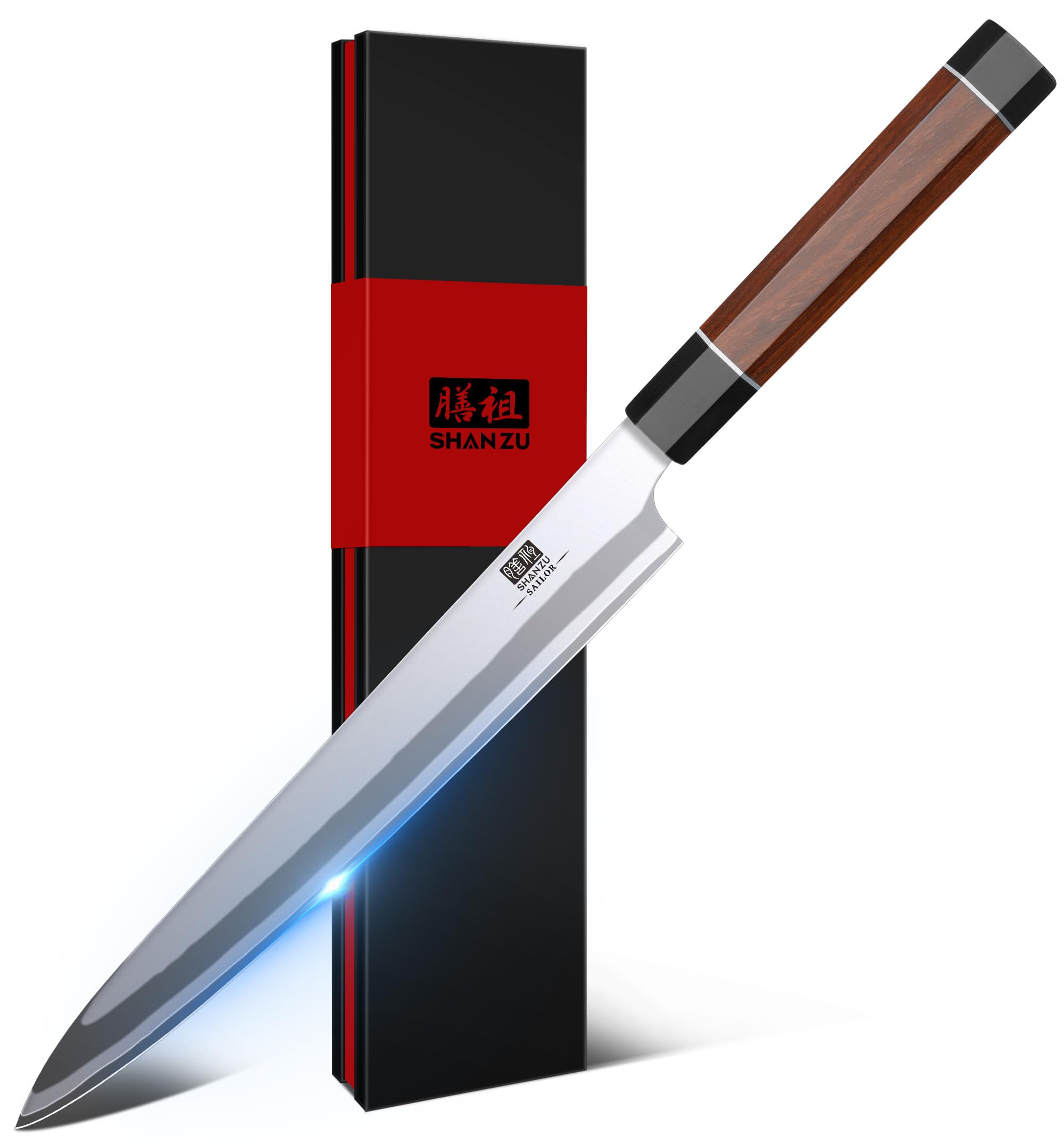
SHAN ZU has carved a reputation for delivering high-value Japanese-style cutlery, and the 10-inch yanagiba is a strong example. The blade uses a 9-layer forged construction with a Japanese 10Cr15MoV steel core hardened to 62 HRC — one of the highest hardness ratings in this lineup. This translates to impressive edge retention and the ability to maintain a razor-thin 12-degree angle for effortless slicing.
The handle is carved from natural red sandalwood (pakkawood) into an octagonal shape that fits comfortably in most grips. It is lighter than Western-style handles and allows the index finger to ride forward on the blade’s spine for more control on draw cuts. The blade features a matte finish that minimizes food residue buildup — a subtle but practical advantage when slicing multiple pieces of fatty tuna.
Packaged in a luxury gift box, this knife feels like a much more expensive tool than its price suggests. The 62 HRC edge does mean you will need a quality water stone to sharpen it when the time comes — standard pull-through sharpeners are too aggressive for this hardness. For home sushi makers who want a serious upgrade without jumping into the premium tier, this is the sweet spot.
Why it’s great
- 9-layer forged construction with a 62 HRC core — exceptional value.
- Natural octagonal red sandalwood handle offers superior control.
- Matte blade finish reduces sticking and shows fewer fingerprints.
Good to know
- Not dishwasher safe — hand wash and dry immediately.
- 62 HRC requires diamond or water stone for sharpening.
- Single-bevel design means left-handed users will struggle.
5. Mercer Culinary Asian Collection Yanagi Sashimi Knife 12″

Mercer Culinary is a staple in professional kitchens, and their Asian Collection yanagi knife is NSF-certified, meaning it meets commercial sanitation standards. The 12-inch blade is significantly longer than most sushi knives, making it the ideal choice for breaking down large whole fish like yellowtail or slicing full fillets of halibut in a single pass.
The blade is made from high-carbon German steel with a single-edge grind (6° on one side, 15° on the other) that delivers sharp, drag-free cuts. Instead of a traditional Wa-handle, Mercer uses a slip-resistant Santoprene handle with a D-shaped cross-section. This provides excellent grip even when wet and is more familiar to cooks trained on Western knife styles. The full tang adds heft and balance.
At a mid-range price point, this knife punches above its weight in terms of pure cutting performance. The trade-off is the bulky handle profile, which lacks the elegance of a traditional octagonal handle and may feel clumsy when making precise, delicate cuts. If you prioritize ruggedness and volume over aesthetics, the Mercer is a solid workhorse.
Why it’s great
- 12-inch blade glides through large fish portions in one motion.
- NSF-certified for commercial kitchen safety standards.
- Slip-resistant Santoprene handle with full tang construction.
Good to know
- 12-inch length may feel unwieldy for small prep stations.
- Santoprene handle lacks the elegance of wood or fiberglass.
- Not suitable for left-handed use without custom grinding.
6. Kai Seki Magoroku Kinju AK-1106 Yanagiba 240mm

Kai’s Seki Magoroku line brings genuine Japanese blade-making heritage to a more accessible price point. The AK-1106 is a 240mm (9.4-inch) yanagiba designed for right-handed use, with a molybdenum vanadium stainless steel blade rated at 58 HRC. The blade is durable and relatively easy to sharpen for anyone learning to maintain a single-bevel edge.
The handle is a traditional D-shaped Wa-style made from stainless steel with a wood-like texture, but here is a notable limitation: the knife is specifically designed for right-handed users, and the single-bevel grind is asymmetrical. The blade is relatively thick behind the edge compared to premium yanagibas, which creates slightly more resistance when slicing soft raw fish like scallop or fluke. Still, for breaking down a pack of wild salmon or farmed trout, it performs admirably.
Considering the price point, you get a dedicated sushi knife shape with a proper single-bevel geometry, made in Japan’s knife capital of Seki. The steel is stain-resistant enough to handle raw protein without immediate discoloration. It makes an excellent entry point for a home cook who wants to practice single-bevel technique without a major investment.
Why it’s great
- Genuine Seki, Japan manufacture with traditional yanagiba profile.
- Molybdenum vanadium steel offers good stain resistance and ease of sharpening.
- Budget-friendly entry into single-bevel sushi knife ownership.
Good to know
- 58 HRC is softer — edge retention is shorter than premium options.
- Thicker blade geometry creates more drag on delicate fish.
- Only suitable for right-handed users; left-handed version is not available.
7. Kai Wasabi Black Yanagiba Knife 8.25″

The Kai Wasabi Black represents the most affordable entry into a dedicated yanagiba-style sushi knife. The 8.25-inch (9-inch blade claimed) high-carbon stainless steel blade is stamped rather than forged, which keeps the price low, and the traditional D-shaped polypropylene handle is comfortable and easy to clean.
At this price point, you are not getting Japanese craftsmanship or premium steel — the blade is made in China and the edge geometry is a single-bevel approximation rather than a precision-ground asymmetrical edge. However, for the occasional home sushi night where you need a clean slice through rolls and fish, it performs far better than a German chef’s knife. The long, thin blade slides through maki rolls without crushing the nori.
One notable positive: Kai claims the knife is dishwasher safe, though traditionalists will cringe at the thought. The polypropylene handle can handle the heat, and the stainless steel resists corrosion better than carbon. Treat it as a beginner-friendly, low-stakes tool to decide if a yanagiba is right for you before committing to a higher-tier blade.
Why it’s great
- Most accessible price point for trying a yanagiba-style knife.
- Dishwasher-safe handle and blade simplify cleanup.
- Lightweight and nimble for home sushi rolling sessions.
Good to know
- Stamped construction lacks the durability and weight of forged blades.
- Single-bevel grind is approximate — not precision sharpened.
- Edge dulls quickly compared to higher HRC options.
FAQ
Should I buy a yanagiba or a sujihiki for home sushi?
Can I use a sushi knife on frozen fish or bones?
Final Thoughts: The Verdict
For most users, the knife for sushi winner is the SHAN ZU 10″ Yanagiba because it pairs a 62 HRC forged core with an ergonomic red sandalwood handle at a mid-range price that outpaces many competitors twice its cost. If you want a true single-bevel yanagiba with professional pedigree, grab the Global G-11R. And for maximum cutting length and commercial-grade durability, nothing beats the Mercer Culinary 12″ Yanagi.