A cleaver that bounces off a chicken thigh or shatters on a pork rib isn’t just frustrating — it’s dangerous. The right bone knife drives straight through dense cartilage and marrow without losing its edge or transferring jarring impact to your wrist. This guide isolates the blade geometry, steel hardness, and handle engineering that separate a confident chop from a kitchen accident.
I’m Mohammad Maruf — the founder and writer behind AirfryerBite. I’ve spent hundreds of hours analyzing blade metallurgy reports, cross-referencing Rockwell hardness ratings with real-world edge retention data, and mapping the weight distribution profiles of dozens of bone-cleaving knives to understand what actually makes a cut feel solid versus reckless.
Whether you’re breaking down whole chickens for weekly meal prep or splitting beef shanks for stock, finding a reliable knife for cutting through bone demands more than just a heavy blade — it requires the right steel composition, tang construction, and edge angle working in concert.
How To Choose The Best Knife For Cutting Through Bone
Choosing a bone-cleaving knife isn’t about picking the heaviest hunk of steel you can find. The wrong weight distribution will leave your wrist sore after three chops, and the wrong steel composition will chip on the first deer shank. Focus on these three factors and you’ll land on a knife that feels planted in your hand and cuts clean every time.
Blade Steel and Hardness (Rockwell Rating)
Bone contact demands steel that balances hardness with toughness. Aim for a Rockwell hardness between 56 and 62 HRC. Below 56 HRC, the edge rolls over and requires constant steeling. Above 62 HRC, the blade becomes brittle and prone to chipping when it strikes dense bone at an awkward angle. High-carbon stainless steel alloys with chromium, molybdenum, and vanadium — like 7Cr17MoV or X50CrMoV15 — offer the corrosion resistance and edge stability needed for regular bone work. Avoid low-carbon stainless blades; they lack the tensile strength to maintain a sharp edge through repetitive marrow strikes.
Weight, Balance, and Tang Construction
A bone-cleaving knife should feel slightly blade-heavy — that forward momentum does the work so your arm doesn’t have to. Look for a total weight between 1.1 and 1.9 pounds; lighter blades lack the inertia to split bone in one stroke, while heavier blades fatigue the wrist during extended prep sessions. Full-tang construction is non-negotiable: the steel should extend through the entire handle, secured by at least three rivets. Partial tangs or rat-tail tangs create a weak point that can snap under the lateral stress of a bone chop. A full tang also shifts the balance point forward naturally, which improves cutting accuracy.
Edge Geometry and Blade Thickness
Bone knives need a thicker spine — typically 2.5 mm to 5 mm — to absorb the shock of impact without flexing. A convex or V-shaped edge ground at 15 to 20 degrees per side provides the durability for bone contact while still allowing clean slices through cartilage and meat. Blades with a thin, delicate edge (common on Japanese-style chef’s knives) will micro-chip immediately against bone. A plain edge is preferable to a serrated edge for bone work; serrations catch and tear rather than cut cleanly, and they’re far more difficult to sharpen at home.
Quick Comparison
On smaller screens, swipe sideways to see the full table.
| Model | Category | Best For | Key Spec | Amazon |
|---|---|---|---|---|
| Dexter-Russell 8″ Heavy Duty Cleaver | Premium | Heavy daily bone chopping with industrial durability | 8 in blade, high-carbon steel, 1.25 lb, USA-made | Amazon |
| ZWILLING Pro 6″ Meat Cleaver | Premium | Precision bone work from a top German brand | 6 in blade, Sigmaforge, FRIODUR ice-hardened | Amazon |
| MAD SHARK 7.5″ Professional Bone Chopper | Premium | Cracking through pork ribs and poultry carcasses | 7.5 in blade, German military-grade composite steel | Amazon |
| Henckels CLASSIC 6″ Meat Cleaver | Mid-Range | All-purpose cleaving with a trusted German forged blade | 6 in blade, German stainless steel, forged | Amazon |
| BLADESMITH 6.3″ Bone Chopper | Mid-Range | Axe-style chopping for thick beef and pork bones | 6.3 in blade, 7Cr17MoV steel, 1.83 lb | Amazon |
| Topfeel 2-Piece Butcher Knife Set | Mid-Range | Home cooks needing both a cleaver and a bone knife | 7.5 in cleaver + 8.5 in bone knife, forged, 5 mm thick | Amazon |
| PAUDIN 7″ Meat Cleaver | Entry-Level | Budget-friendly entry into bone and cartilage cutting | 7 in blade, HC stainless steel, 56+ HRC | Amazon |
| TIJERAS 3-Piece Butcher Knife Set | Entry-Level | Versatile set for trimming, slicing, and light bone work | Set: Serbian chef knife, cleaver, Viking knife | Amazon |
| ROCOCO 8.66″ Effort Saving Cleaver | Entry-Level | Light-duty chopping with an ergonomic bronze handle | 8.66 in blade, 60±2 HRC, stainless steel | Amazon |
In‑Depth Reviews
1. Dexter-Russell 8″ Stainless Heavy Duty Cleaver

This is the cleaver commercial butcher shops have trusted for decades because it simply does not quit. The thick, high-carbon stainless steel blade lands at a substantial weight — around 2.6 pounds according to owner measurements — which means gravity does most of the work when you’re splitting chicken backs or lamb ribs. The precision-ground edge arrives razor sharp from the factory and holds that edge through dozens of prep sessions before it needs a steel.
The traditional rosewood handle with brass compression rivets provides a secure grip even when your hands are slick from handling raw protein. It’s a stamped blade, not forged, but the DEXSTEEL technology used in the manufacturing process delivers consistent hardness and edge geometry that outlasts many forged alternatives at this price level. Owners report using it weekly for years without the blade developing any play or the handle loosening.
Be aware that you are buying a brute-force tool — this is not a delicate slicer. The blade thickness means it excels at heavy chopping but feels clumsy for fine vegetable work. And at nearly three pounds, it will fatigue anyone with smaller hands or weaker wrists after extended use. But for pure bone-splitting authority, it remains the reference standard in American butcher shops.
Why it’s great
- Extreme heft provides effortless momentum through dense bone
- Brass-riveted rosewood handle stays secure under wet conditions
- Edge holds remarkably well for a stamped blade in a high-impact role
Good to know
- Significant weight — over 2.5 pounds — may fatigue some users
- Blade is too thick and wide for precise slicing or vegetable work
- Requires careful storage; the edge is exposed without a sheath
2. ZWILLING Pro 6-inch Meat Cleaver

ZWILLING’s Pro series represents the brand’s highest level of blade engineering, and this 6-inch cleaver showcases why the Sigmaforge process commands a premium. Each blade is forged from a single piece of Special Formula High-Carbon NO STAIN steel, then ice-hardened using the FRIODUR process to create a blade that starts sharper, stays sharper longer, and exhibits superior corrosion resistance compared to standard German stainless. The 6-inch length keeps the knife nimble while still delivering the inertia needed for bone contact.
The curved bolster is a critical detail for anyone who chokes up on the blade for control cuts — it encourages proper grip placement and prevents your hand from sliding forward when you strike bone. The POM (polyoxymethylene) handle is non-porous, resistant to both moisture and temperature changes, and won’t crack or swell over time like some wood handles. Precision-honed laser-controlled edge geometry ensures a consistent 15-degree angle per side that slices cartilage without wedging.
The trade-off is a 1-pound total weight that feels light compared to traditional heavy cleavers. You’ll need to supply more arm force when chopping through thick beef femurs or pork neck bones because the blade doesn’t carry as much forward momentum. This cleaver rewards proper technique more than brute strength. It’s also one of the few bone knives labeled dishwasher-safe, though hand washing still extends the edge life significantly.
Why it’s great
- Sigmaforge single-piece forging delivers exceptional blade integrity
- FRIODUR ice-hardening produces outstanding long-term edge retention
- Curved bolster and ergonomic POM handle prevent hand fatigue
Good to know
- Light weight requires more user effort for thick bones
- Premium price point is a significant investment
- Dishwasher safe on paper, but hand washing preserves the edge longer
3. MAD SHARK 7.5″ Professional Bone Chopper
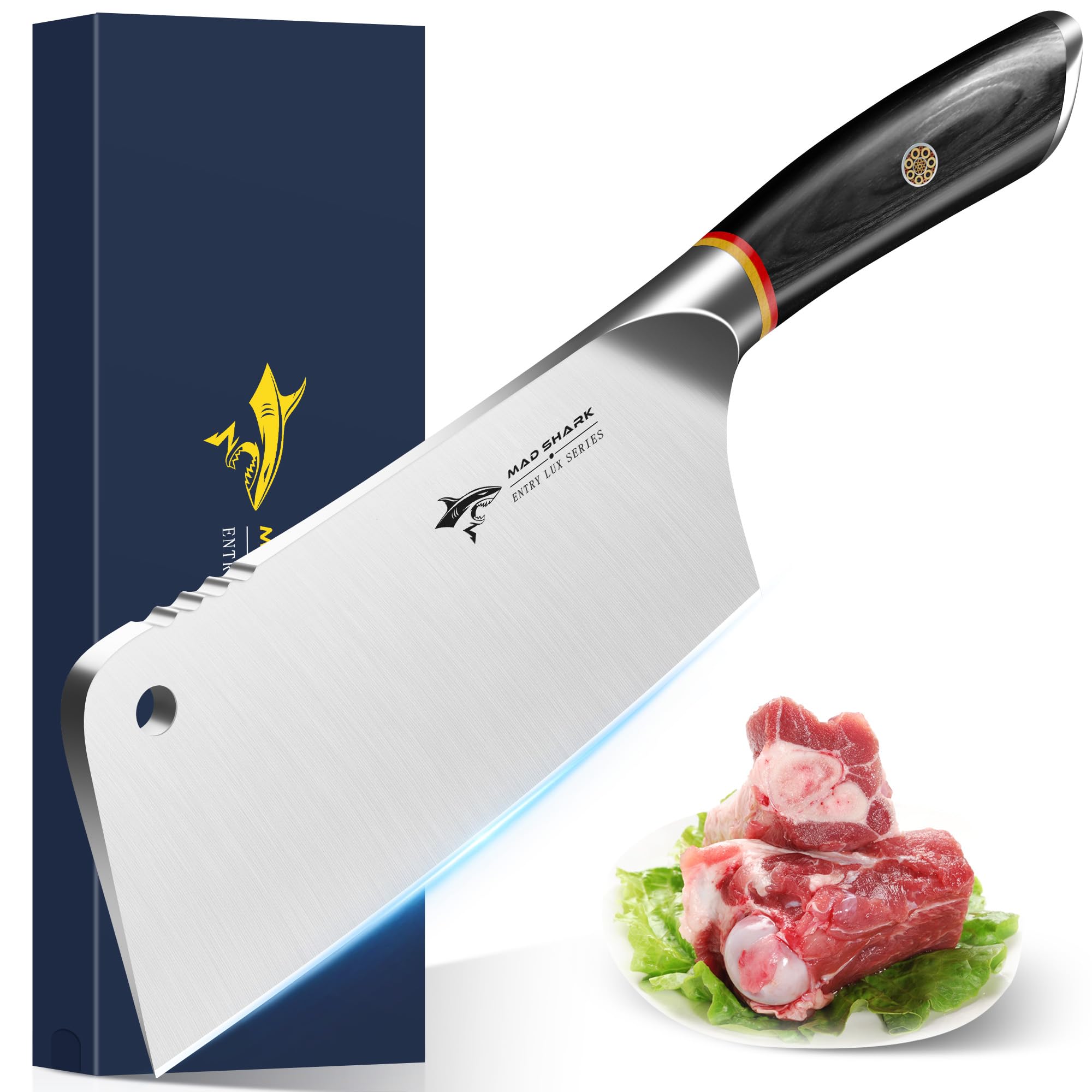
MAD SHARK uses a German military-grade composite steel that incorporates carbon, chromium, molybdenum, vanadium, and cobalt — a five-element alloy that addresses the two biggest failure modes for bone knives: edge chipping and corrosion. The 7.5-inch blade carries a 1.26-pound weight that hits a sweet spot between the ultra-heavy Dexter-Russell and the lighter ZWILLING, providing enough momentum to split poultry and pork bones cleanly without feeling like a sledgehammer.
The full-tang ebonywood handle with carved rivets adds a visual distinction that many budget knives lack. The handle is contoured to fill the palm naturally, and the forward balance point makes one-handed chopping feel controlled rather than wild. Owners consistently report that the blade arrives slice-your-finger sharp and requires only occasional steeling to maintain performance through heavy weekly use. The spine is thick enough to smash garlic or ginger without flexing, adding utility beyond bone work.
Some users note that the blade finish is prone to minor discoloration if left wet, so immediate drying is necessary. The included white gift box packaging feels premium but does not include a protective sheath, which means you’ll need to buy a blade guard or magnetic strip for safe storage. For the price, this is one of the best-balanced options for home cooks who need a bone knife that also handles general kitchen prep without feeling like overkill.
Why it’s great
- Five-element alloy steel resists chipping and corrosion effectively
- Optimal 1.26-pound weight balances momentum with control
- Ebonywood handle with full tang provides excellent grip security
Good to know
- Blade may discolor if not dried immediately after washing
- No sheath included for safe storage
- Requires regular steeling to maintain peak edge performance
4. Henckels CLASSIC 6-inch Meat Cleaver

The Henckels CLASSIC line has been a kitchen staple for home cooks since the 1970s, and this 6-inch meat cleaver follows the same formula that made the brand famous: fully forged German stainless steel, a precision-honed satin-finished edge, and a traditional triple-rivet handle that feels familiar in the hand. At 0.9 pounds, it’s significantly lighter than most dedicated bone cleavers, which makes it approachable for cooks who don’t want to arm-wrestle their knife. It handles turkey joints, chicken backs, and pork rib sections with surprising authority for its weight.
Made in Spain from German-sourced stainless steel, the CLASSIC cleaver benefits from Henckels’ heat-treatment process that delivers consistent 55-57 HRC hardness — slightly below the ideal 56-62 range for frequent bone contact, but adequate for weekly poultry and light pork work. The satin finish resists staining better than polished blades, and the triple-rivet polypropylene handle is comfortable for extended prep sessions. Owners report that the edge arrives extremely sharp and holds for several weeks of regular use before needing a steel.
The main limitation is thickness — this blade is not built for repeated impact against dense beef or lamb bones. Attempting to split a veal shank or deer femur will likely cause micro-chipping along the edge. It’s also a 6-inch blade, which limits the cutting surface area for large roasts or whole birds. Think of this as an everyday cleaver for light-to-moderate bone work rather than a dedicated butcher’s tool.
Why it’s great
- Fully forged construction from a heritage German brand
- Light weight reduces fatigue during longer prep sessions
- Classic triple-rivet handle is comfortable and familiar
Good to know
- Light weight requires more arm effort for thick, dense bones
- 6-inch blade limits capacity for large cuts
- Sharpening the curved edge requires care and a quality stone
5. BLADESMITH 6.3″ Bone Chopper

BLADESMITH took an axe-inspired approach with this 6.3-inch bone chopper, and the design philosophy is immediately apparent when you pick it up. At 1.83 pounds, this is the heaviest knife on our list behind the Dexter-Russell, with a thick 7Cr17MoV stainless steel blade that tapers to a high-density V-shaped edge. The pear wood handle is engineered to absorb oils from your hands over time, actually improving its grip the more you use it — a clever solution to the slippery-handle problem that plagues many bone knives.
The 58±2 HRC hardness hits the ideal zone for bone contact: hard enough to hold a sharp edge through cartilage and thin bone, tough enough to resist chipping when you hit a dense joint at an awkward angle. The spine is thick enough to smash bones directly — owners report using it to crack beef knuckles for marrow extraction with no edge deformation. The high-carbon content does require diligence: acidic foods like tomato or citrus should not sit on the blade, and it must be dried immediately after washing to prevent surface oxidation.
The axe-like geometry means this knife is purpose-built for chopping and is not well suited to slicing or mincing. The blade thickness creates noticeable wedging when you try to cut through large vegetables like squash or cabbage. Storage is also a consideration — the included packaging does not have a fitted sheath, so a blade guard or separate storage block is necessary to protect the edge and prevent accidents.
Why it’s great
- High 1.83-pound weight delivers massive chopping momentum
- 7Cr17MoV steel at 58 HRC provides excellent chip resistance
- Pear wood handle improves grip with repeated use
Good to know
- Axe geometry makes slicing and mincing awkward
- Not suitable for cutting large vegetables due to blade thickness
- No sheath included; requires dedicated storage solution
6. Topfeel 2-Piece Meat Cleaver & Bone Chopper Set

The Topfeel set addresses the fundamental limitation of single-cleaver bone work — you need one knife for the heavy splitting and another for the precise trimming. This two-piece set includes a 7.5-inch cleaver for general chopping and an 8.5-inch heavy-duty bone knife specifically designed to cut through bone nearly as easily as through skin and muscle. Each blade is hand-forged by experienced craftsmen using German high-carbon stainless steel, and the 5 mm thickness on the bone knife provides the rigidity needed for repeated impact.
The rosewood handles feature full-tang construction secured with three rivets, creating a seamless transition from blade to handle that distributes shock away from your wrist. The 1.36-pound weight of the bone knife is well-calibrated — heavy enough to split chicken thighs and pork chops in one stroke, light enough that cooks with smaller hands can control the swing. Owners specifically call out the balance as a standout feature, noting that the knife feels planted rather than blade-heavy or handle-heavy.
Both knives require the same diligent care as any high-carbon steel tool: clean immediately after use, dry thoroughly, and store in a dry environment. Occasional application of a thin layer of cooking oil is recommended if you plan to store them for extended periods. The set comes in a premium gift box that works well for gifting but doesn’t include individual blade guards — you’ll need to add edge protection for drawer storage.
Why it’s great
- Two-knife set covers splitting and trimming without overlap
- Hand-forged German steel with 5 mm thickness on the bone knife
- Full-tang rosewood handles provide excellent shock absorption
Good to know
- High-carbon steel requires immediate drying to prevent staining
- No individual blade sheaths included in the box
- Bone knife is purpose-built; less effective for general prep
7. PAUDIN 7″ Meat Cleaver

PAUDIN positions this cleaver as an entry-point bone tool for home cooks who don’t want to invest in a high-end butcher knife but still need reliable performance for breaking down chickens and cutting through cartilage. The high-carbon stainless steel blade is hand-sharpened to a 16-degree V-shaped edge with a 2.3 mm spine thickness — not as thick as premium bone knives, but sufficient for the light-to-moderate bone work most home cooks encounter. At a modest 0.63 kilograms (about 1.4 pounds), it offers enough heft to feel substantial without intimidating newer cooks.
The pakkawood handle is ergonomically shaped to reduce slicing resistance and fatigue, and the full-tang construction with a lifetime warranty against defects suggests PAUDIN is confident in the build quality. The included sheath is a welcome addition at this price tier — many budget cleavers skip this essential safety feature. Owners report that the blade arrives sharp enough to slice paper and handles whole chickens, pork chops, and even small beef cuts without needing immediate sharpening.
The limitations become apparent with denser bone work. The 56+ HRC rating is at the low end of the bone-cutting range, and the 2.3 mm spine thickness means the blade can flex under heavy impact. Attempting to split beef shanks or deer bones could lead to edge rolling or micro-chipping. This is best viewed as a capable all-purpose cleaver that can handle bone occasionally rather than a dedicated bone-splitting tool.
Why it’s great
- Excellent entry-level price for a functional bone-cleaving tool
- Includes a blade sheath for safe storage
- Full tang with lifetime warranty provides peace of mind
Good to know
- 56 HRC is at the low end of the ideal bone-cutting hardness range
- 2.3 mm spine thickness allows blade flex on dense bone
- Not suitable for heavy-duty beef or large game processing
8. TIJERAS 3-Piece Butcher Knife Set
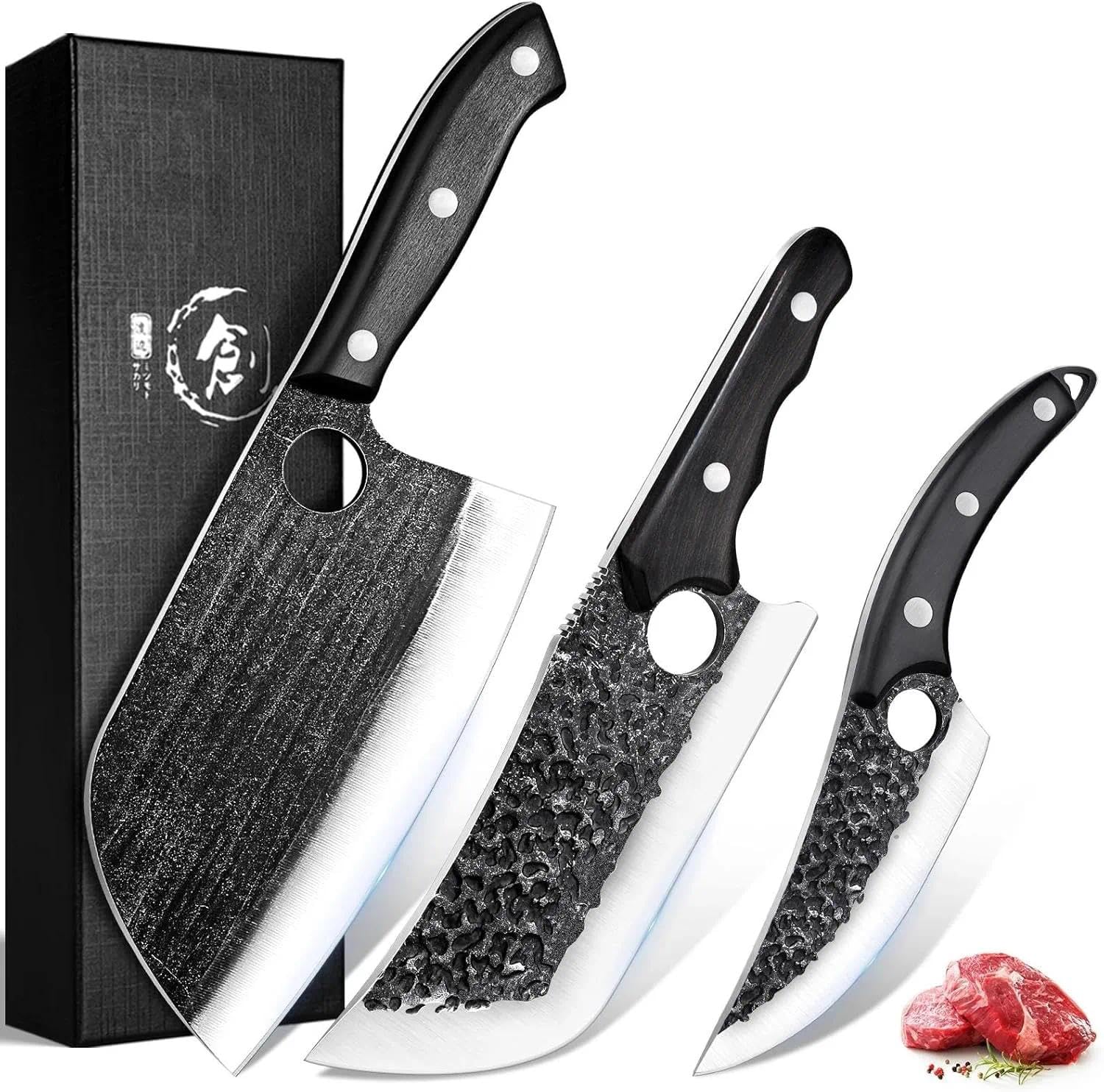
TIJERAS takes a systematic approach to protein prep by including three distinct knives in one set: a Serbian chef knife built for chopping through bone, a razor-sharp meat cleaver for portion cuts, and a flexible Viking-style knife for trimming fat and sinew. This three-knife workflow mirrors what professional butchers do — you use the right tool for each phase rather than forcing one blade to do everything. The high-carbon steel blades are hand-sharpened using traditional Japanese forging techniques with a hammered finish that reduces drag during slicing.
The contoured wood handles are designed for secure grip even with wet or greasy hands, and the full-tang construction ensures each blade can withstand the lateral stress of bone contact. The set comes in an elegant gift box that feels substantial, making it a strong candidate for gifting to home cooks, hunters, or BBQ enthusiasts. Owners note that the hammered finish not only looks distinctive but actually helps food release more easily during slicing compared to smooth blades.
The trade-off for three specialized knives is that none of them are quite as robust as a single dedicated bone cleaver. If your primary need is splitting large beef bones daily, a single heavy cleaver will outperform this set. But for home cooks who process a variety of proteins — trimming, portioning, and occasional bone work — this set provides versatility that a single cleaver cannot match.
Why it’s great
- Three specialized knives cover the full butchering workflow
- Japanese hammered finish reduces drag and improves food release
- Contoured wood handles maintain grip with wet or greasy hands
Good to know
- None of the knives match the heft of dedicated bone cleavers
- Hammered finish can trap food particles during cleaning
- Storage block or magnetic strip needed; no individual sheaths included
9. ROCOCO 8.66″ Effort Saving Cleaver
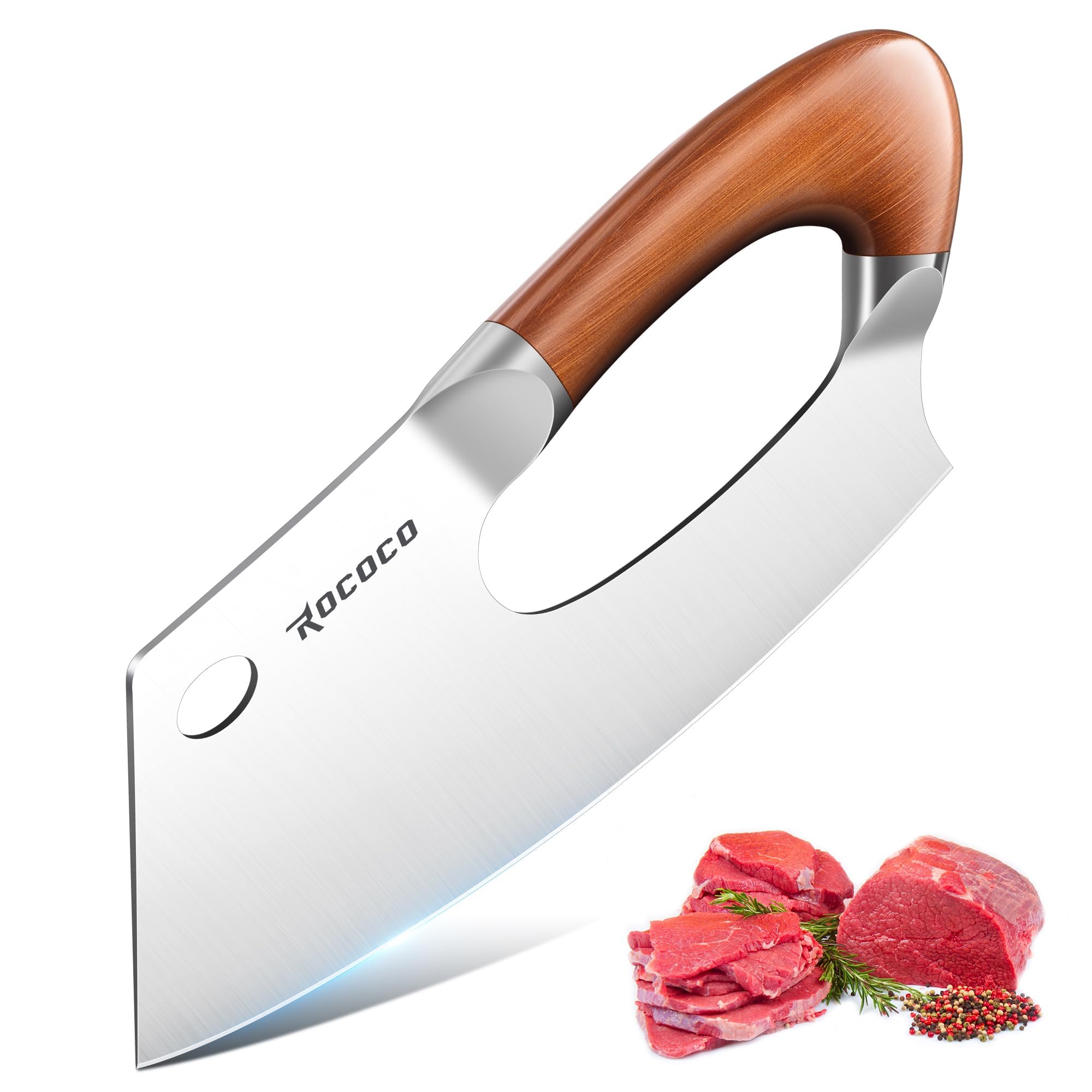
ROCOCO’s effort-saving cleaver stands out for its unusual handle design — the bronze-colored handle curves upward and positions your grip forward of the blade, reducing the force distance required to drive the edge through food. The science is sound: a shorter lever arm means your hand exerts less force to achieve the same cutting pressure. The stainless steel blade is hand-forged and heat-treated to a 60±2 HRC hardness, which places it firmly in the premium steel range for edge retention, though it also makes the blade more susceptible to chipping if used carelessly against hard bone.
The 8.66-inch blade provides ample cutting surface for large roasts and whole birds, and the 15-degree V-shaped edge is hand-polished to minimize cutting resistance. The seamless transition from blade to handle creates a balanced feel, and the oval handle shape fills the palm naturally. Owners consistently praise the sharpness out of the box, with several noting that it’s one of the sharpest knives they’ve ever purchased. The stainless steel construction is easy to clean and rust-resistant, reducing maintenance requirements.
It is critical to note that the manufacturer explicitly states this cleaver is not designed for bone cutting. Despite its 60 HRC hardness and substantial blade length, the edge geometry and thin profile mean it will chip if used to chop through poultry bones, pork ribs, or any dense cartilage. This is a vegetable and meat slicer with cleaver aesthetics — not a bone tool. Its inclusion here serves as a cautionary example: high Rockwell hardness alone does not qualify a knife for bone work. For the price, it’s an excellent general-purpose chef’s knife, but it should not replace a dedicated bone cleaver in your kitchen.
Why it’s great
- 60 HRC hardness provides excellent edge retention for meat and vegetables
- Ergonomic upward-curved handle reduces cutting force requirements
- Large 8.66-inch blade surface handles high-volume prep efficiently
Good to know
- Manufacturer explicitly states it is not designed for bone cutting
- High hardness makes edge prone to chipping on bone contact
- No sheath included; requires careful storage
FAQ
Can I use a standard chef’s knife to cut through bone?
What does the Rockwell hardness number mean for a bone knife?
How thick should a bone-cleaving knife blade be?
Is a serrated bone saw better than a cleaver?
Final Thoughts: The Verdict
For most users, the knife for cutting through bone winner is the Dexter-Russell 8″ Heavy Duty Cleaver because its industrial build quality, substantial weight, and time-tested DEXSTEEL edge deliver reliable bone-splitting performance that professional butchers have counted on for generations. If you prefer a lighter, more refined cutting experience with premium German engineering, grab the ZWILLING Pro 6-inch Meat Cleaver. And for the best balance of price, performance, and versatility in a two-knife system, nothing beats the Topfeel 2-Piece Butcher Knife Set.