Municipal tap water often carries a noticeable dose of chlorine, sediment, and trace contaminants that affect both taste and health. A dedicated kitchen water filter system eliminates these unwanted elements directly at the point of use, delivering crisp, clean water for drinking, cooking, and brewing without the waste or expense of bottled water.
I’m Mohammad Maruf — the founder and writer behind AirfryerBite. I spend my days analyzing filtration specifications, certification standards, and flow rates so you know exactly which system fits your home’s water quality and your counter space.
This guide evaluates nine distinct systems — from gravity-fed countertop units to multi-stage reverse osmosis rigs — to help you identify the kitchen water filter system that matches your budget, installation preference, and contaminant concerns.
How To Choose The Best Kitchen Water Filter System
The right system depends on your source water quality, available counter or cabinet space, and your tolerance for filter changes. Start by understanding what you’re trying to remove — chlorine and sediment are easy targets, but heavy metals, fluoride, and PFAS require tighter filtration.
Filtration type: gravity, ultra-filtration, or reverse osmosis
Gravity systems (like the Purewell) require no electricity and preserve some minerals by using a UF membrane with a 0.01-micron pore size. They reduce chlorine, sediment, and bacteria but do not lower TDS. Reverse osmosis systems (like the APEC or iSpring) push water through a semi-permeable membrane that removes dissolved solids, heavy metals, and fluoride, producing near-distilled water. Ultra-filtration under-sink systems (like the Waterdrop TST-UF) offer a middle ground — high flow rates and mineral retention without TDS reduction.
Certifications that actually matter
NSF/ANSI Standard 42 covers aesthetic effects (chlorine taste and odor). Standard 53 covers health-related contaminants (cysts, heavy metals, VOCs). Standard 58 is specific to reverse osmosis systems. Standard 372 confirms lead-free materials. A system certified to multiple standards offers verified protection — always check the testing body rather than relying on marketing language about “99% reduction.”
Flow rate and filter life
Under-sink systems with UF filtration can deliver 1.5+ GPM — fast enough to fill a pot without waiting. Reverse osmosis systems typically produce 0.03 to 0.06 GPM into a storage tank, then dispense from the tank at a reasonable rate. Countertop RO units often use smaller reservoirs that require more frequent refilling. Filter life ranges from 6 months (PP sediment filters) to 24 months (carbon blocks). Factor replacement cost into your total ownership calculation.
Quick Comparison
On smaller screens, swipe sideways to see the full table.
| Model | Category | Best For | Key Spec | Amazon |
|---|---|---|---|---|
| APEC Water ROES-50 | Under-Sink RO | Reliable whole-home RO | 50 GPD, NSF 58 certified | Amazon |
| iSpring RCC7AK | Under-Sink RO | Remineralized alkaline water | 75 GPD, NSF 58 certified | Amazon |
| VonWater CT910 | Countertop RO | Portable RO with presets | 0.0001μm, 3:1 drain ratio | Amazon |
| AquaTru Carafe | Countertop RO | Compact premium design | 64 oz glass carafe | Amazon |
| DREO RO 112 | Countertop RO | Auto-fill, self-cleaning | 3:1 pure to drain, 3L tank | Amazon |
| Waken Electric C11S | Countertop RO | High efficiency 4:1 RO | 8-stage, UV, 180oz tank | Amazon |
| Waterdrop TST-UF | Under-Sink UF | High-flow mineral retention | 1.59 GPM, 304 stainless | Amazon |
| Purewell 2.25G | Countertop Gravity | No-electricity filtration | 0.01μm UF, 4 GPH flow | Amazon |
| Aigerri UV RO | Countertop RO | Large-capacity portable RO | 5:1 drain ratio, 5L tank | Amazon |
In-Depth Reviews
1. APEC Water ROES-50

The APEC ROES-50 is a benchmark residential RO system with a proven track record spanning over two decades of real-world use. Its five-stage process begins with a polypropylene sediment filter and a carbon block, then pushes water through a high-rejection TFC RO membrane that catches up to 99.99% of total dissolved solids, arsenic, fluoride, lead, and chromium. A final carbon polish removes any residual taste or odor before the water enters the 4.4-gallon pressurized storage tank. The integrated brushed-nickel faucet gives a dedicated purified water tap without drilling an extra hole in many standard sink setups.
Installation is genuinely DIY-friendly because APEC uses color-coded tubing and push-to-connect fittings that lock with audible clicks. The system mounts vertically or horizontally inside the under-sink cabinet, and the compact footprint — 16 by 5.25 by 17.5 inches — fits tight spaces. Replacement filters are widely available and cost significantly less per gallon than bottled water, with the pre-filter set needing a change every 6 to 12 months and the RO membrane lasting 2 to 3 years depending on incoming water quality. The 50-gallons-per-day membrane rating keeps the tank full even during high-demand mornings.
Certification under NSF/ANSI 58 means the entire system — not just individual components — has been tested for contaminant reduction and material safety. Customers consistently report noticeable improvements in water clarity and taste, particularly in areas with high chlorine levels or hard water. The brushed-nickel faucet resists spotting, and the quick-connect shutoff valve stops water flow automatically when the tank is full, preventing leaks.
Why it’s great
- Full system NSF 58 certification provides verified contaminant removal
- Color-coded tubing and push fittings simplify DIY under-sink install
- Large 4.4-gallon pressurized tank delivers steady flow without waiting
Good to know
- Plastic housing may feel less robust than stainless alternatives
- Requires 1/4-inch drain saddle connection for wastewater
2. iSpring RCC7AK

The iSpring RCC7AK takes the standard 5-stage RO formula and adds a sixth stage — an alkaline mineral filter that reintroduces calcium, magnesium, and potassium to the purified water, raising the pH to a balanced spring-water level (typically 7.5 to 8.0). This is a key advantage for those who dislike the flat, acidic mouthfeel of conventional RO water. The system is NSF 58 certified for the entire system and includes a 1:1 drain ratio that reduces water waste compared to older RO designs. Its 75-gallons-per-day membrane is the highest production rate among the under-sink options in this lineup.
A patented top-mounted faucet bracket allows the user to secure the faucet entirely from above the countertop, eliminating the need to reach underneath for tightening — a genuine convenience for renters or anyone with limited under-sink access. The transparent first-stage filter housing lets you visually inspect sediment accumulation rather than relying on calendar-based guessing. The included 3.2-gallon pressurized storage tank is NSF-listed and wrapped in metal for durability, with a rubber bladder that maintains consistent dispensing pressure. Customer support is based in Atlanta, GA, and multiple reviewers highlight the responsiveness of the tech team when questions arise.
Long-term ownership costs are reasonable because iSpring offers replacement filter packs for 6-month, 1-year, 2-year, and 3-year intervals. The system reduces fluoride by more than 97% and lead by nearly 99%, making it a strong choice for households concerned about neurotoxins. The alkaline cartridge lasts about 12 months before needing replacement, and the RO membrane typically serves 2 to 3 years. Users with high TDS feed water (above 600 ppm) may see faster membrane fouling and should consider a sediment pre-filter upgrade.
Why it’s great
- Alkaline remineralization stage restores beneficial minerals and pH balance
- Top-mounted faucet design simplifies installation for tight cabinets
- Highest RO membrane output at 75 GPD among under-sink units listed
Good to know
- Alkaline filter adds ongoing replacement expense
- Plastic housing components may show wear over multi-year use
3. VonWater CT910
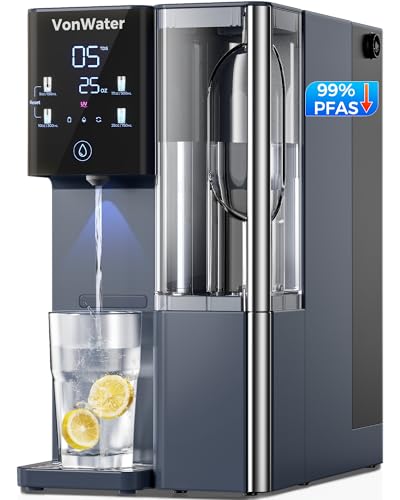
The VonWater CT910 is a no-install countertop reverse osmosis system with a 5.5-liter raw water reservoir and a detachable 1.2-liter pitcher that can be carried to the refrigerator or used for direct pouring. Its 7-stage all-in-one filter cartridge combines sediment reduction, carbon adsorption, and a RO membrane rated down to 0.0001 microns, targeting TDS, PFAS, fluoride, lead, and chromium. The 3:1 pure-to-drain ratio is moderate but still cuts water waste by three-quarters compared to older 1:1 RO systems. The unit is certified to NSF/ANSI 42, 53, 58, and 372, providing broad third-party verification.
An LED touch display on the front panel shows real-time TDS levels and filter life status, and five preset volume buttons (4oz, 8oz, 12oz, 17oz, and unlimited) make portion control simple for coffee, tea, or water bottles. The auto water production technology triggers filtration cycles automatically when the purified water level drops, keeping the pitcher ready without manual intervention. The twist-and-lock filter cartridge replaces in about three seconds — no wrenches, no water shutoff, no mess. The entire system weighs 15 pounds and occupies a footprint of 8.2 by 13.4 inches, fitting comfortably on most countertops.
Customer feedback consistently praises the after-sales support and the unit’s ability to transform high-chlorine Florida tap water into clean-tasting hydration. The main trade-off is the 2- to 3-minute wait for a full pitcher cycle, which is standard for countertop RO but slower than tapping directly from an under-sink faucet. Users with very hard water (TDS above 500 ppm) may need to replace filters more frequently than the 12-month guideline.
Why it’s great
- Five preset volume buttons enable precise dispensing for different drink sizes
- NSF certified to four standards covering aesthetics, health, RO, and lead-free materials
- Twist-and-lock filter replacement in seconds without tools
Good to know
- Pitcher capacity of 1.2 liters may require refills for heavy-use kitchens
- Raw water reservoir holds only 5.5 liters, needing periodic top-offs
4. AquaTru Carafe
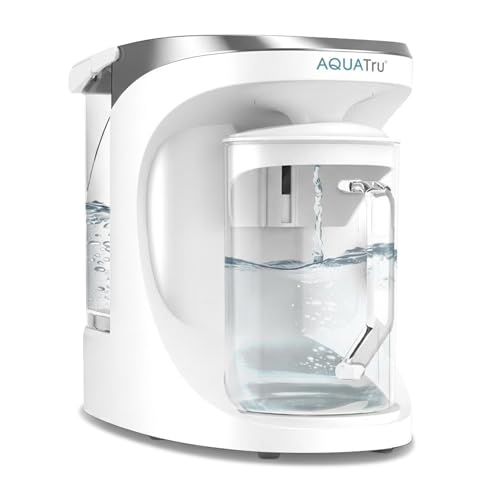
The AquaTru Carafe takes a design-first approach to countertop reverse osmosis, pairing a 4-stage filtration engine with a 64-ounce borosilicate glass carafe that avoids plastic leaching entirely. The system is certified by IAMPO to NSF standards for the reduction of 84 contaminants, including lead, fluoride, chlorine, microplastics, and PFOA/PFOS forever chemicals. The 4-stage process uses a sediment pre-filter, a carbon block, a high-rejection RO membrane, and a final carbon polish. Unlike tank-based systems, the Carafe fills directly — the user places the glass carafe under the dispenser, and the unit filters water in batches directly into it.
The installation requirement is essentially zero: open the box, rinse the carafe, and plug in the unit. The compact footprint (14 by 7.5 inches) and a 13-inch height fit under most standard cabinets when the lid is closed, though the manufacturer recommends a minimum of 22 inches of overhead clearance to open the reservoir lid fully. The filter set lasts between 6 months and 2 years depending on feed water quality, with each cartridge replacing up to 4,500 plastic bottles. The pump runs at a modest noise level — noticeable but quieter than many competitor units during the fill cycle.
AquaTru built this model specifically for apartment dwellers, renters, and anyone who wants premium RO water without drilling into countertops or connecting to a drain. The glass carafe is dishwasher-safe on the top rack, and the system automatically shuts off when the carafe is removed. Reviewers frequently note the improvement in coffee and tea flavor, as well as the elimination of hard-water spots on glassware. The main compromise is batch size — each fill cycle produces 64 ounces, so heavy users refill twice daily.
Why it’s great
- Borosilicate glass carafe avoids plastic taste and chemical leaching
- Certified for 84 contaminants with IAMPO/NSF standards verification
- Zero-install design ready in minutes for apartment or rental use
Good to know
- Batch-fill cycle limits total output to 64 oz at a time
- Premium price point exceeds many other countertop RO options
5. DREO RO 112
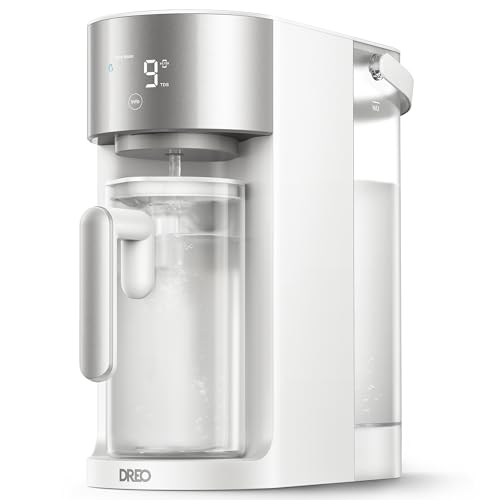
The DREO RO 112 is designed around a two-vessel system: a 3-liter raw water tank sits behind the unit, and a 1.1-liter auto-fill pitcher rests on a sensor dock at the front. When you lift the pitcher to pour, the unit detects the absence and begins filling the next batch automatically once the pitcher is replaced. This hands-free refill cycle reduces the manual chore of holding a container under a spout. The 7-in-1 RO filter is SGS-tested to NSF/ANSI 58 standards, removing 1,000+ impurities including PFOA, PFOS, chlorine, and fluoride at up to 99.99% efficiency.
The self-cleaning system runs automatic flush cycles through the internal tubing every few hours to prevent bacterial biofilm buildup when the unit is idle. A real-time TDS display on the control panel shows both the incoming raw water TDS and the treated output, giving immediate feedback on filter performance. The filter life indicator tracks usage by volume rather than time, which is more accurate for households with variable consumption. The physical dimensions (14.5 by 6.7 by 13.4 inches) make it one of the slimmer countertop options, suitable for tight kitchen counters near the sink.
The 3:1 pure-to-drain ratio balances water conservation with membrane longevity. The twist-to-install filter replacement takes about 3 seconds, and the replacement cost per bottle works out to roughly 5 per 8-ounce serving. The unit is best suited for 1 to 2 person households — the 3-liter raw tank and 1.1-liter pitcher are enough for daily drinking and cooking without constant refilling. A minority of early users reported pump failures, but DREO’s customer service appears responsive based on post-purchase support interactions.
Why it’s great
- Auto-fill pitcher sensor eliminates manual monitoring of batch cycles
- Self-cleaning flush system reduces bacterial buildup during idle periods
- Slim 6.7-inch width fits easily on tight countertops
Good to know
- Smaller 3L tank requires more frequent filling for larger households
- Some early users experienced pump reliability issues
6. Waken Electric C11S
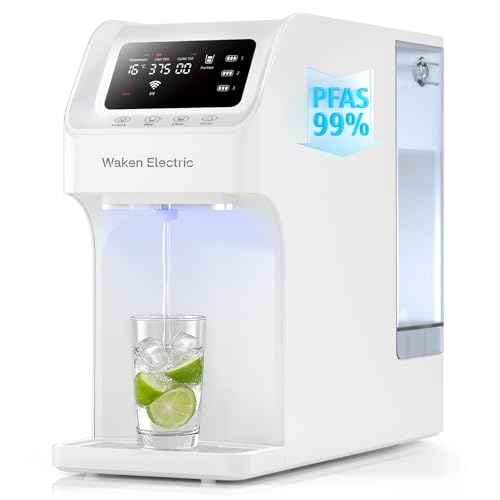
The Waken Electric C11S stands out for its 4:1 pure-to-drain ratio, which means for every four cups of purified water, only one cup goes to waste — far better than the 1:1 or 2:1 ratios common on many countertop RO systems. The 8-stage filtration train includes a sediment filter, carbon block, RO membrane, and a UV sterilization stage that neutralizes bacteria and viruses without chemical additives. The system is SGS-tested to NSF/ANSI 58 and 372 standards, with additional compliance to EPA 200 regulations. Its 180-ounce water tank (5.3 liters) is larger than most countertop competitors, reducing the frequency of manual refills.
The smart display tracks TDS levels in real time, monitors each of the three filter cartridges individually via distinct block indicators, and includes a waste-water tank reminder that alerts you to empty the drain reservoir to prevent secondary contamination. The flow rate of 418 gallons per day translates to about 14 seconds to fill an 8-ounce cup — noticeably faster than many batch-fill RO units. The system ships with pre-installed PAC, RO, and CF filters, so startup involves only plugging in and flushing the system for a few minutes. BPA-free food-grade plastic construction keeps material safety in line with certification requirements.
Customer reviews highlight the clean, smooth taste of treated water and the elimination of chlorine odor even in areas with extremely hard tap water (TDS above 500 ppm). The compact footprint (7.28 by 18.3 inches) is deeper than some designs but still fits on most countertops. The unit is designed for home, apartment, condo, and RV use — its portability and lack of permanent installation make it flexible. The main consideration is that the waste tank needs to be emptied periodically, which adds a small maintenance step not present in under-sink systems that route wastewater directly to the drain.
Why it’s great
- Industry-leading 4:1 pure-to-drain ratio minimizes water waste
- UV sterilization stage adds microbial protection beyond standard RO
- Larger 5.3L tank reduces frequency of top-ups during the day
Good to know
- Waste tank must be manually emptied to prevent overflow
- Deeper footprint may require more counter space than slim alternatives
7. Waterdrop TST-UF

The Waterdrop TST-UF is not a reverse osmosis system — it uses ultra-filtration with a 0.01-micron membrane that sieves out sediment, chlorine, heavy metals, organic matter, and bacteria while retaining beneficial minerals like potassium, calcium, and magnesium. The 6-layer filter stack includes PP sediment, carbon block, and a precision UF membrane, all housed in a lead-free 304 stainless steel casing that feels substantial compared to plastic alternatives. The flow rate of 1.59 gallons per minute is the fastest in this guide — an 8-ounce glass fills in about 2.3 seconds. The system does not reduce TDS, so water hardness and total dissolved solids remain unchanged.
Installation connects directly to 3/8-inch or 1/2-inch cold water lines with included push-fit fittings. The unit can be hung on the cabinet wall or placed on the floor, offering flexibility for under-sink layouts. No drilling is required, and the kit includes inlet/outlet hoses, a 3/8-to-1/2-inch adapter set, and Teflon tape. The three filter stages have staggered lifespans: the PP filter lasts 6 to 8 months, the UF membrane lasts about 12 months, and the CT carbon filter lasts 12 to 24 months. Total replacement costs are lower than RO systems because there is no membrane replacement or drain line installation.
The stainless steel housing is recyclable and reduces plastic waste compared to all-in-one cartridge systems. The system is designed exclusively for municipal tap water — it cannot handle well water or hot water. It also does not require electricity, making it suitable for installations where power is unavailable. Customer feedback consistently notes the straightforward installation and dramatic improvement in taste for chlorine-heavy municipal supplies. The system works best as a companion to a dedicated RO faucet rather than a standalone purifier if TDS reduction is a priority.
Why it’s great
- Extremely fast 1.59 GPM flow rate fills pots and pitchers instantly
- 304 stainless steel housing is durable, recyclable, and lead-free
- Retains natural minerals while removing chlorine, sediment, and bacteria
Good to know
- Does not reduce TDS, so hard water remains hard
- Not compatible with well water or hot water sources
8. Purewell 2.25G

The Purewell 2.25G is the only gravity-fed countertop system in this lineup, requiring no electricity, no plumbing connections, and no batteries. A transparent water-level window on the upper chamber reveals the amount of raw water remaining without needing to lift the lid. The 3-stage filtration relies on a 0.01-micron hollow-fiber UF membrane, a silver-ion membrane, and an activated carbon block — the same pore size as the Waterdrop under-sink unit, but powered only by gravity. The system reduces 99% of chlorine, sediment, and organic matter, but like all UF systems, it does not lower TDS.
The dual-chamber design separates unfiltered tap water (upper) from filtered water (lower). A stainless steel stand lifts the unit to make the included spigot accessible for filling glasses directly. Flow rate is rated at 4 gallons per hour — slower than pressurized UF systems but sufficient for passive overnight filtration. The pair of included black carbon filters delivers up to 6,000 gallons of filtered water total, with each filter rated for 3,000 gallons. Replacement is recommended every 6 months, though actual lifespan depends on feed-water turbidity. The stainless steel exterior resists rust and gives the unit a professional, modern appearance on the countertop.
The system works well for emergency preparedness, camping, or off-grid scenarios where power is unreliable. The no-electricity requirement also means zero operating cost beyond filter replacements. Assembly requires seating the upper chamber into the lower chamber, attaching the spigot, and placing the unit on the stand. Customers note that the water tastes noticeably cleaner than tap, particularly in areas with high chlorine dosing. The primary limitation is the 2.25-gallon capacity — heavy-use households may need to refill the upper chamber twice daily.
Why it’s great
- No electricity needed — works off-grid, during power outages, or on camping trips
- Transparent water-level window shows remaining capacity at a glance
- Combined filter lifespan of 6,000 gallons reduces long-term consumable costs
Good to know
- Gravity flow is slower than pressurized options; may test patience for large fills
- Does not reduce TDS or remove dissolved heavy metals
9. Aigerri UV RO

The Aigerri UV Countertop RO system packs the largest raw water reservoir in this guide — 5 liters — matched with a 2-liter purified water tank. The 5:1 pure-to-drain ratio is the highest water efficiency of any unit listed, meaning five gallons of purified water for every gallon of wastewater. The 5-stage filtration train includes a PPC sediment filter, a carbon block, a high-rejection RO membrane, and a UV sterilization light that provides an extra barrier against microbial contamination. The system is NSF/ANSI 372 certified for lead-free materials, and it reduces TDS, PFAS, fluoride, and heavy metals.
No installation is required — set the unit on the countertop, fill the upper reservoir, and plug it in. The LED control panel offers multiple water volume options and a filter-change indicator, and the self-cleaning function flushes the RO membrane periodically to extend its service life. The unit measures 7.4 by 16.2 inches at the base and stands 16.4 inches tall with the lid closed (21.7 inches with the lid open), so it requires about 22 inches of vertical clearance for countertop use. Replacement filters are brand-specific, and the manufacturer warns that third-party cartridges may compromise performance and void the warranty.
Customer reviews consistently emphasize the build quality and ease of setup, with several users comparing the water quality favorably to popular premium brands like Sans. The 5-liter capacity means less frequent refilling than most countertop competitors, making it a strong choice for families or home offices. The UV stage adds peace of mind for those concerned about microbial contaminants from aging municipal pipes. The main trade-off is physical size — the 16.2-inch width and height mean it won’t fit under standard kitchen cabinets, so it must sit on an open counter.
Why it’s great
- 5-liter raw tank and 2-liter purified tank provide best-in-class capacity for countertop RO
- 5:1 pure-to-drain ratio minimizes water waste better than any other unit in this guide
- UV sterilization adds an extra layer of pathogen protection beyond standard RO
Good to know
- Larger footprint and height may not fit under cabinets — plan for open counter space
- Replacement filters are proprietary and must be sourced from Aigerri
FAQ
Will a kitchen water filter system remove fluoride?
How often do I need to replace the filters in a countertop RO system?
Can I use a kitchen water filter system with well water?
Final Thoughts: The Verdict
For most users, the kitchen water filter system winner is the APEC Water ROES-50 because it combines verified NSF 58 certification, straightforward DIY installation, and a proven track record across millions of homes. If you want remineralized alkaline water with a higher pH and mineral content, grab the iSpring RCC7AK. And for no-install countertop convenience with the largest tank capacity and best drain ratio, nothing beats the Aigerri UV RO.