A kitchen knife that can’t hold a clean edge turns every slice into a battle. Whether you’re mincing garlic, breaking down a chicken, or dicing an onion without tears, the blade geometry and steel composition determine whether your prep work is effortless or exhausting.
I’m Mohammad Maruf — the founder and writer behind AirfryerBite. I’ve spent thousands of hours researching blade metallurgy, edge retention data, and handle ergonomics across commercial and home-use cookware to identify what separates a true performer from a drawer filler.
This guide cuts through the marketing gloss to deliver a curated selection of the best kitchen knife options for different cutting styles, budgets, and skill levels — all backed by measurable specs that actually matter in daily use.
How To Choose The Best Kitchen Knife
Selecting a kitchen knife comes down to three interdependent factors: the steel’s hardness and composition, the blade’s edge geometry, and the handle’s ergonomic fit. Each plays a distinct role in how the knife performs during repetitive cutting, chopping, and slicing.
Steel Hardness and Edge Retention
The Rockwell hardness scale (HRC) measures how resistant steel is to deformation. Kitchen knives typically fall between HRC 52 and 62. Higher numbers — above HRC 56 — hold a razor edge longer but can be more brittle and require a ceramic or diamond sharpener to resharpen. Lower numbers are softer, easier to sharpen on a steel rod, but dull faster. The ideal balance for most cooks is HRC 54-58, which combines decent edge longevity with practical maintenance.
Blade Construction: Forged vs Stamped
A forged blade is cut from a single bar of steel through extreme heat and pressure, resulting in a denser, more resilient grain structure and a thicker bolster for balance. Forged knives tend to be heavier and more expensive. A stamped blade is cut from a rolled sheet of steel, then heat-treated and sharpened. Stamped knives are lighter, thinner, and more affordable while still delivering impressive sharpness out of the box. The difference matters most for heavy-duty tasks like splitting squash or repetitive chopping over years of use.
Handle and Tang Design
A full tang — where the steel extends all the way through the handle — adds weight, stability, and durability. Partial tangs are lighter but can break under lateral stress. Handle materials range from synthetic polymers like polypropylene and POM resin to natural wood and stainless steel. The right handle should offer a non-slip grip, a comfortable contour, and a balanced center of gravity at or just ahead of the bolster. For wet or oily hands, textured or rubberized materials outperform smooth wood or metal.
Quick Comparison
On smaller screens, swipe sideways to see the full table.
| Model | Category | Best For | Key Spec | Amazon |
|---|---|---|---|---|
| WÜSTHOF Classic 2-Piece | Premium Forged | Pro-grade cutting feel | 58 HRC, forged, PEtec edge | Amazon |
| Dalstrong Valhalla 8″ | Premium Forged | Unique design and edge | 9CR18MOV HC steel, 60 HRC | Amazon |
| SYOKAMI 7-Piece Set | Mid-Range Set | Complete kitchen setup | 56+ HRC, magnetic acacia block | Amazon |
| FIKSHOT 14-Piece Set | Value Set | Budget-friendly full set | 54 HRC, full tang, one-piece | Amazon |
| Kimura 8″ Gyuto | Mid-Range Single | Japanese precision cutting | 57 HRC, 15° edge, triple rivet | Amazon |
| Mercer Culinary M18000 | Entry-Level Single | Dependable budget chef’s knife | High-carbon Japanese steel | Amazon |
| Dexter-Russell S145-10PCP | Commercial Value | NSF-certified commercial use | High-carbon stainless, USA | Amazon |
In‑Depth Reviews
1. WÜSTHOF Classic 2-Piece Chef’s Knife Set

WÜSTHOF’s Classic series has defined professional-grade German cutlery for generations, and this two-piece starter set delivers the same forged construction and precise edge geometry found in full commercial kits. The 8-inch chef’s knife and 3.5-inch paring knife both come from a single block of high-carbon stainless steel tempered to 58 degrees HRC, with Precision Edge Technology (PEtec) yielding a blade that is measurably sharper and holds that sharpness roughly twice as long as previous iterations. The full tang is triple-riveted into a synthetic polypropylene handle that resists fading, heat, and impact — a texture that stays grippy even when wet.
The weight distribution sits heavy in the hand, producing a confident, pendulum-like chop through dense vegetables and tough root skins. The paring knife is small enough for precise peel work, yet still benefits from the same forged density as its larger sibling. Both knives come factory-sharp out of the box, and their edge responds well to a honing steel between full sharpenings. The blade finish is a satin polish that minimizes drag on sticky ingredients like raw meat or potatoes.
This set is built for daily use over decades, backed by a limited lifetime warranty from a family-owned Solingen manufacturer with over two centuries of metallurgy experience. The polypropylene handle does feel slightly less organic than wood or resin handles, but the trade-off for dishwasher-safe convenience and near-zero maintenance is hard to argue against. If you want one chef’s knife and one paring knife that will outlast every other kitchen tool you own, this is the pair to buy.
Why it’s great
- Forged 58 HRC steel with PEtec edge for long-lasting sharpness
- Two-knife set covers 90% of daily prep tasks
- Lifetime warranty from a seven-generation German maker
Good to know
- Dishwasher-safe by spec, but hand washing preserves the edge longer
- Price reflects the premium forged construction
2. Dalstrong Chef Knife – 8 inch – Valhalla Series
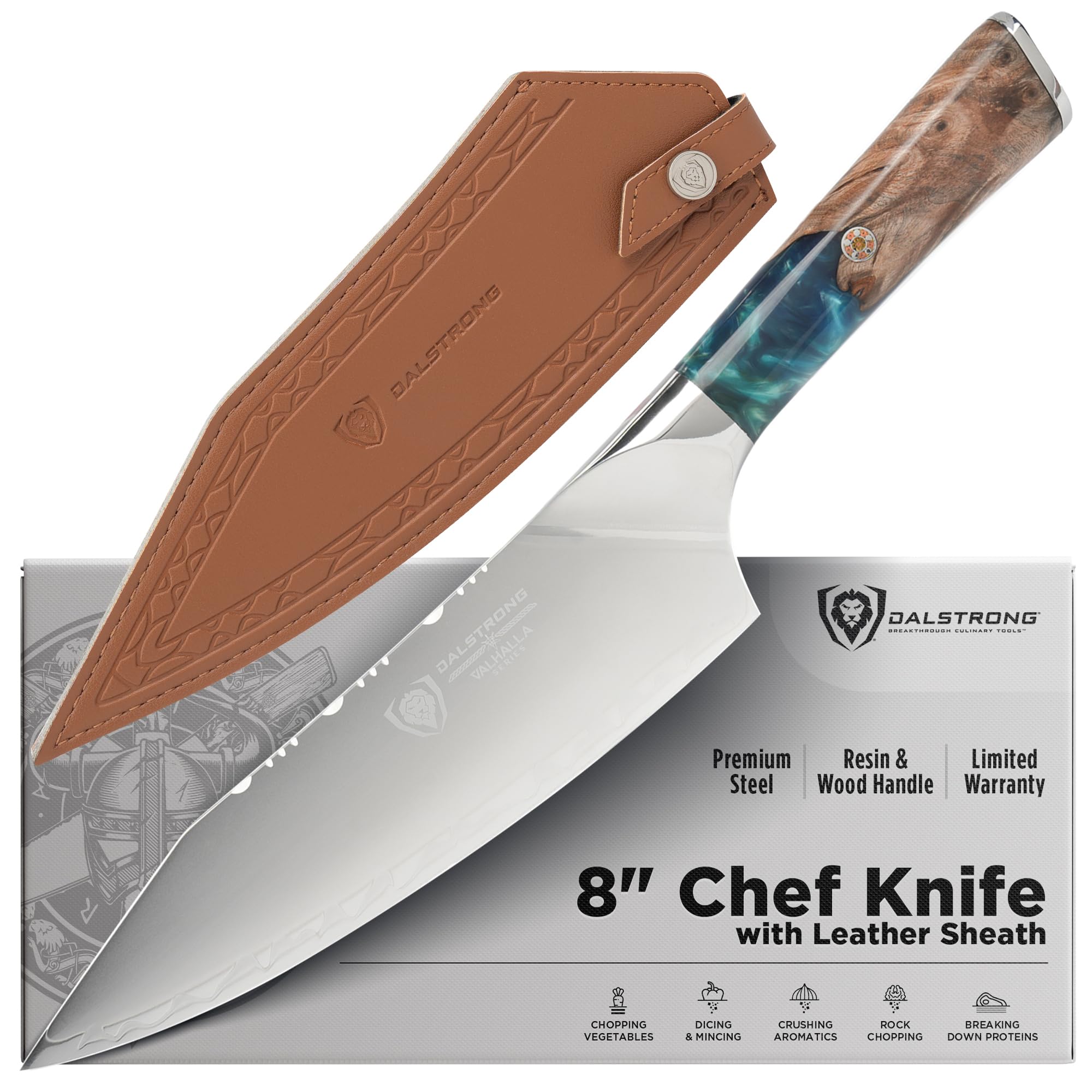
The Dalstrong Valhalla series pushes visual drama to the forefront without sacrificing actual cutting performance. The 8-inch chef’s knife uses 9CR18MOV high-carbon stainless steel, a Chinese-origin alloy that Dalstrong hardens to approximately 60 HRC — notably harder than most European chef knives. The edge is hand-finished to a razor-sharp geometry that glides through bell peppers, boneless chicken, and firm produce with minimal resistance. What sets this knife apart visually is the handle: a celestial resin and wood hybrid that produces a unique, marble-like pattern — no two handles look the same.
The blade profile is a hybrid Western-Japanese cross, with a slight curve for rocking chop and a tip that allows for detailed slicing. The full tang construction is encased in the resin-wood block, providing a solid, weight-forward balance that feels secure in a pinch grip. The included leather sheath is a thoughtful addition for storage or transport, and the edge arrives sharp enough to shave with. At 60 HRC, resharpening requires ceramic or diamond abrasives rather than a simple honing steel.
The handle shape is contoured to fill the palm, but the resin-wood combination can feel slightly slick compared to textured synthetic materials when handling oily or wet ingredients. The Valhalla is not dishwasher-safe due to the natural wood in the handle, so hand washing and drying are mandatory. For cooks who treat their knives as functional art pieces and demand a very hard, long-lasting edge, the Dalstrong Valhalla delivers a distinctive experience that few competitors match at this tier.
Why it’s great
- Very hard 60 HRC steel holds an aggressive edge for extended periods
- Unique resin-wood handle makes each knife one-of-a-kind
- Leather sheath included for safe storage
Good to know
- Not dishwasher-safe; hand wash only
- Harder steel is more brittle — avoid twisting on bones
3. SYOKAMI 7-Piece Japanese Style Knife Set
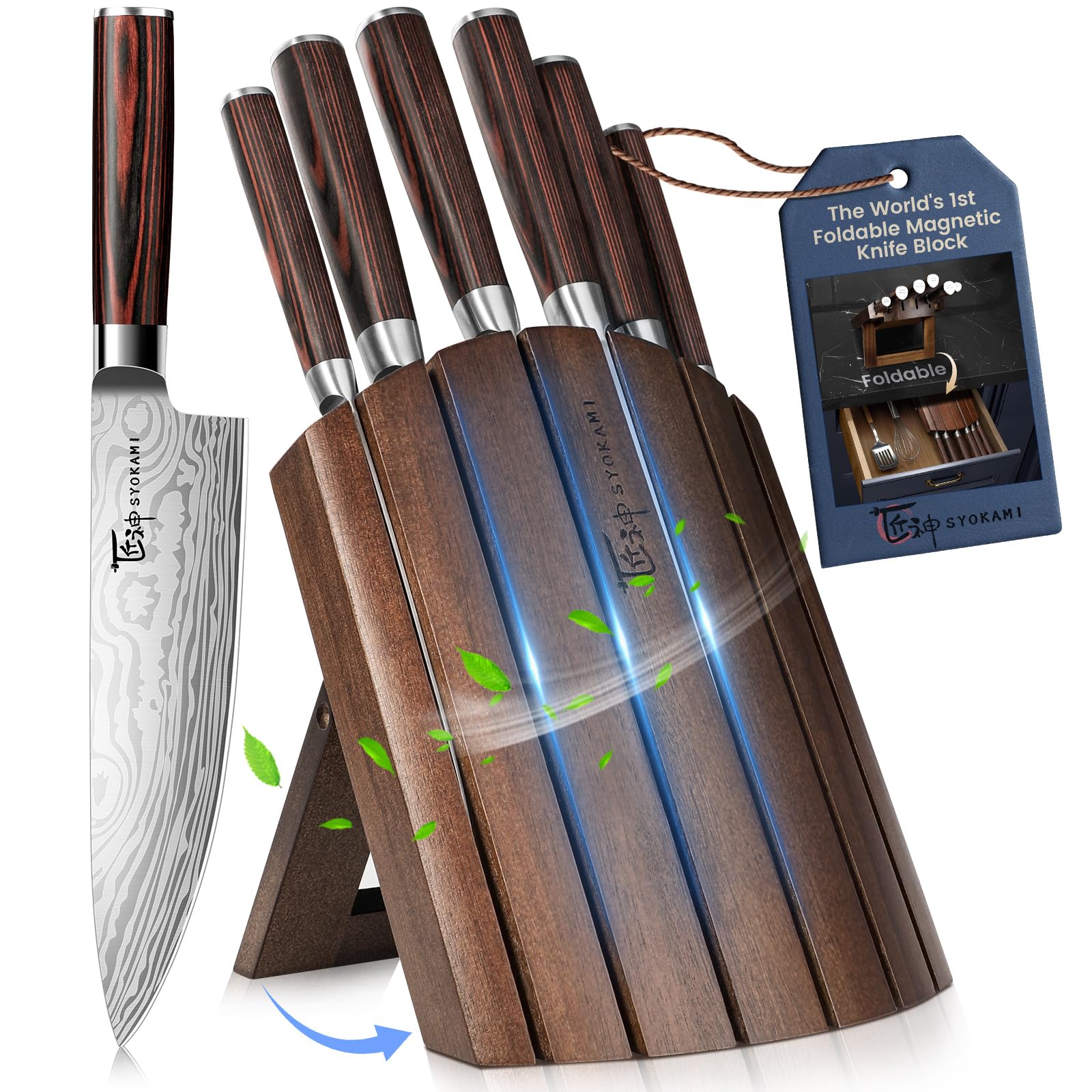
The SYOKAMI 7-piece set tackles a common pain point for families: safe storage. The folding acacia wood block collapses into a compact profile that fits inside a drawer, and the magnetic slots hold each of the six blades firmly in place, preventing accidental contact with children or pets when stored. The set includes an 8-inch chef’s knife, a 7-inch Santoku, an 8-inch slicing knife, an 8-inch bread knife, a 6-inch utility knife, and a 3.8-inch paring knife, covering virtually every blade task a home cook encounters. Each blade is high-carbon stainless steel rated at 56+ HRC and hand-sanded to a 15-degree edge.
The edge angle is a straight 15-degree single bevel on the Japanese-style blades, which produces thin, clean slices through fish, fruits, and boneless proteins. The foldable block is made from FSC-certified acacia wood, which resists moisture absorption better than cheaper bamboo alternatives. The ergonomic handles are molded to provide a secure pinch grip, and the overall weight is light enough for extended use without forearm fatigue. The magnetic retention system is strong enough to keep the knives in place even when the block is folded and carried.
The Santoku knife in this set is particularly well-balanced for push-cutting vegetables, and the bread knife’s serrated edge cuts through crusty loaves without crushing the crumb. One drawback is that the magnetic block, while space-saving, does not allow the knives to dry fully if stored immediately after washing, so thorough drying before storage is necessary. The lifetime warranty adds peace of mind. For anyone needing a complete blade arsenal that hides away safely, this SYOKAMI set is an excellent solution.
Why it’s great
- Foldable magnetic block stores blades safely in a drawer
- Six knives plus block cover all prep tasks
- FSC-certified acacia wood block is moisture-resistant
Good to know
- Knives must be dried before placing back in the block
- Single-bevel edge requires care when sharpening
4. FIKSHOT 14-Piece German Stainless Steel Knife Set

The FIKSHOT 14-piece set takes a different approach from the blade-collector strategy: instead of a small number of premium knives, it offers a comprehensive range of 14 pieces including a chef’s knife, paring knife, steak knives, scissors, and a sharpening rod, all housed in a hardwood block. The blades are German high-carbon stainless steel rated at HRC 54±2, with a 14-degree edge on the primary chef’s knife. The construction is full-tang one-piece steel — meaning the handle is a continuous extension of the blade, eliminating any seam or joint that could trap food particles.
In practice, the thin 14-degree edge makes the chef’s knife adept at precision cuts through soft vegetables and boneless proteins. The one-piece handle is balanced for control but does not offer the textured grip of Santoprene or resin handles — it is smooth stainless steel. The set includes steak knives with serrated edges, which perform adequately for cooked meats. The included sharpener rod lets you maintain the chef knife’s edge and the serrated blades. All components are labeled dishwasher-safe, though hand washing is recommended to preserve the fine edge angle.
The knife block is a hardwood composite with dedicated slots, and the overall aesthetic is modern and industrial. The stainless steel handles can feel cold to the touch, and the smooth surface offers less slip resistance compared to molded synthetics. The HRC rating of 54 is on the softer side, requiring more frequent honing to maintain peak sharpness, but the trade-off is that the blade is very easy to sharpen and less prone to chipping. For a household that wants a complete knife set with steak knives and a built-in sharpener without overspending, the FIKSHOT set delivers strong utilitarian value.
Why it’s great
- 14-piece set includes steak knives, scissors, and sharpener
- One-piece steel construction with no handle seams
- Dishwasher-safe for easy cleaning
Good to know
- 54 HRC steel dulls faster than harder blades
- Smooth stainless handle can be slippery when wet
5. Kimura 8-inch Japanese Gyuto Chef Knife

The Kimura 8-inch Gyuto is a Japanese-style chef’s knife made in Seki, Japan — a city with a centuries-old reputation for blade craftsmanship. The steel is high-carbon chrome molybdenum stainless, heat-treated to 57 HRC, which puts it in the sweet spot of edge retention and durability. Each blade is hand-sharpened to a 15-degree angle by skilled craftsmen, producing a very fine, double-bevel edge that slices through tomatoes, fish, and boneless meat with minimal drag. The full tang extends through the handle and is triple-riveted into a POM resin handle that offers a secure, non-slip grip.
The Gyuto profile is the Japanese equivalent of a European chef knife: curved enough for rocking chop but with a flatter belly that excels at push-cutting. The handle is ergonomically shaped to support pinch, point, or standard grips, and the overall weight is lighter than a German forged knife, making it ideal for long prep sessions. The knife comes in a premium gift box with traditional Kanji detailing, and Kimura backs it with a lifetime warranty. The edge out of the box is very sharp and responds well to a ceramic honing rod.
The POM resin handle is durable and resists moisture, but some users may find it slightly thin for larger hands. The blade is stamped rather than forged, which reduces production cost without compromising the steel quality. At 57 HRC, the edge can be resharpened with a whetstone without too much difficulty. For cooks who want authentic Japanese blade geometry and a made-in-Japan credential without spending mid-triple digits, the Kimura Gyuto is a strong mid-range contender that punches above its tier.
Why it’s great
- Hand-sharpened 15° edge delivers precise, low-drag cuts
- 57 HRC steel balances edge retention and ease of resharpening
- Full tang with triple rivets for lasting durability
Good to know
- Stamped construction, not forged
- Handle may feel slim for very large hands
6. Mercer Culinary M18000 Millennia 8-Inch Chef’s Knife

The Mercer Culinary M18000 Millennia is a staple in commercial culinary schools and professional kitchens that need dependable performance at a low per-unit cost. The 8-inch blade is made from high-carbon, stain-resistant Japanese steel with a hollow-ground edge, meaning the blade face is ground to create a thin, sharp concave edge that reduces friction when slicing. The handle is a dual-material design: Santoprene for comfort and slip resistance around the grip, and polypropylene for structural rigidity at the core. Textured finger points provide tactile feedback and prevent the hand from slipping forward toward the blade.
In practice, the hollow-ground edge makes this knife particularly effective for slicing cooked meats, large fruits, and soft vegetables where sticking is a common frustration. The Santoprene handle is one of the most comfortable in the budget tier, with a molded finger guard that adds a safety margin. The blade steel is on the softer side, around HRC 52-54, which means it responds quickly to a honing steel but will require that maintenance more frequently. The knife is thin behind the edge, so it works fine for most home prep, but it is not ideal for heavy-duty tasks like splitting squash or cutting through bones.
The Mercer Millennia is hand-wash-only despite the plastic handle — prolonged dishwasher exposure can degrade the edge and the Santoprene material. The knife is lightweight and nimble, making it a good choice for cooks and home users who want an affordable, comfortable chef’s knife that performs well above its price point. The steel is not as hard as premium Japanese or German offerings, but for the cost, the combination of Japanese steel, ergonomic handle, and hollow-ground edge is hard to beat.
Why it’s great
- Hollow-ground edge reduces sticking during slicing
- Comfortable dual-material handle with textured grip
- Japanese high-carbon steel for good edge retention at this price
Good to know
- Hand wash only — dishwasher can damage handle and edge
- Softer steel requires more frequent honing
7. Dexter-Russell 8″ Chef’s Knife – SANI-SAFE Series
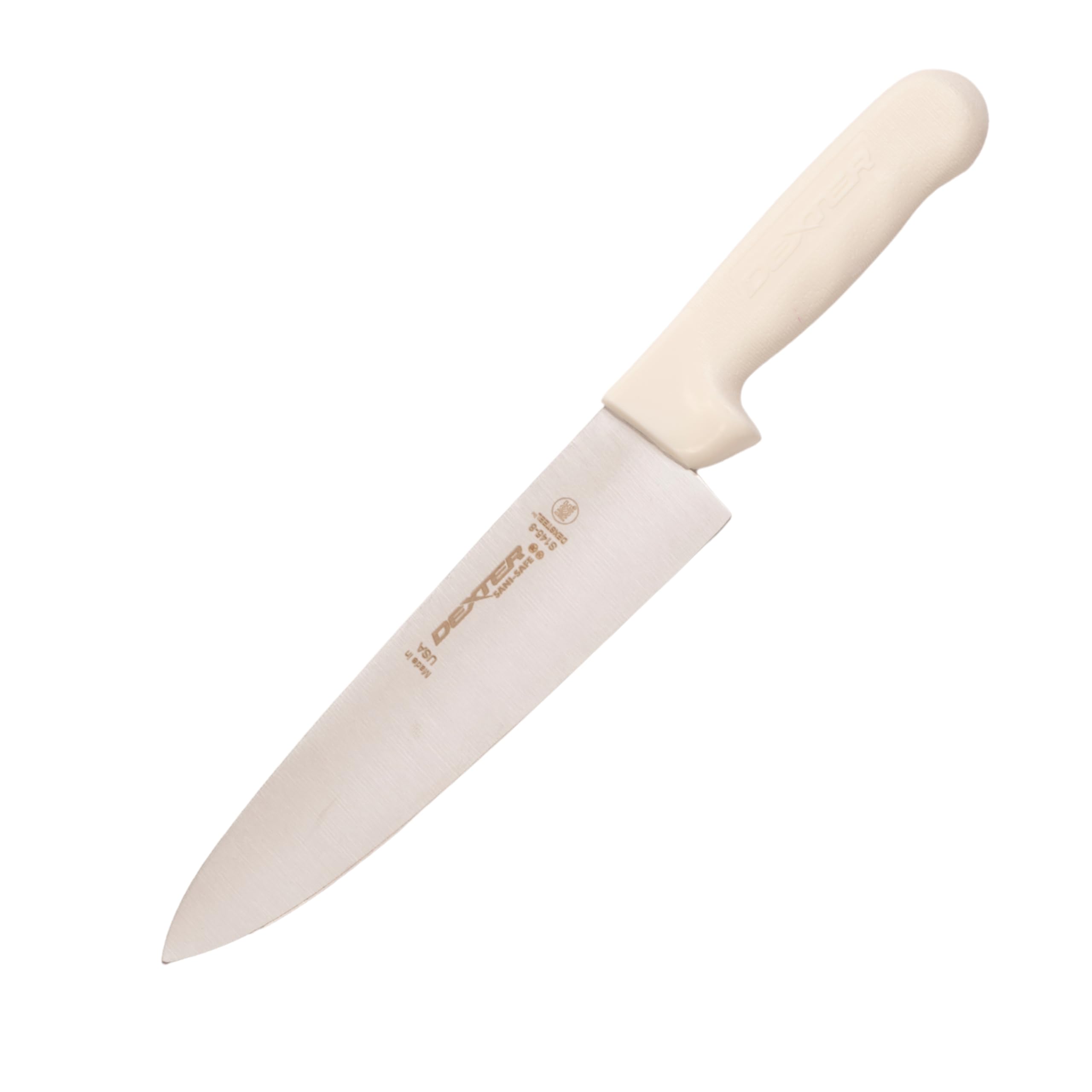
The Dexter-Russell S145-10PCP is an industry workhorse from a manufacturer that has been making cutlery in the USA since 1818. This SANI-SAFE series chef knife has an 8-inch blade made from high-carbon stainless steel, and it carries NSF certification — a standard required in commercial foodservice environments for non-porous, sanitizable construction. The white polypropylene handle is slip-resistant, ergonomically shaped, and designed to withstand frequent dishwasher cycles and harsh commercial sanitizers without cracking or fading. The blade is stamped but heat-treated to a hardness that balances edge life with the ability to hone quickly during a service rush.
The edge geometry is a standard 20-degree double bevel, which provides durability over razor sharpness. The knife is less nimble than Japanese alternatives but excels in durability and sanitation. The white handle makes visual cleanliness easy to confirm, a detail that health inspectors appreciate. The blade steel is not at the HRC level of premium consumer knives, but it takes a very sharp edge easily and can be maintained with a standard steel rod. The full tang is encased in the polypropylene handle and secured with a metal end cap to prevent the blade from pulling loose.
The Dexter-Russell is not designed as a showpiece — it is built for speed, volume, and repeated sanitization. The handle can feel utilitarian compared to contoured Santoprene grips, and the blade is thinner than forged options, which can flex slightly under heavy pressure. The price point makes it a low-risk investment for a commercial kitchen or a home cook who prioritizes dishwasher-safe convenience and wants a knife that can handle daily abuse without worry. Made in the USA, NSF certified, and backed by a long history of professional-grade production.
Why it’s great
- NSF certification for commercial sanitation standards
- Dishwasher-safe polypropylene handle resists chemicals and heat
- Made in the USA with nearly 200 years of knife-making experience
Good to know
- Thinner blade can flex during heavy cutting
- Edge angle is more durable but not as razor-sharp as premium options
FAQ
What is the best Rockwell hardness for a kitchen knife?
How often should I sharpen a kitchen knife?
Is a forged knife always better than a stamped knife?
Final Thoughts: The Verdict
For most users, the best kitchen knife winner is the WÜSTHOF Classic 2-Piece Set because it delivers German forged precision, proven edge retention at 58 HRC, and a lifetime warranty from a manufacturer with over 200 years of cutlery expertise — all in a versatile two-knife configuration that covers virtually every daily prep task. If you want a complete set with safe magnetic drawer storage, grab the SYOKAMI 7-Piece Set. And for a budget-friendly single chef’s knife that punches far above its price point, nothing beats the Mercer Culinary M18000 Millennia.