A proper Japanese knife doesn’t just cut — it parts ingredients with a clean, precise motion that transforms meal prep from a chore into a meditative craft. The geometry of a VG10 core at a 12-degree edge angle, the weight distribution of a forged blade, and the feel of a natural rosewood or Pakkawood octagonal handle define an entirely different cutting experience compared to any generic western-style knife block set.
I’m Mohammad Maruf — the founder and writer behind AirfryerBite. I spend my days analyzing kitchen hardware specifications, from steel-layer counts and Rockwell hardness ratings to handle ergonomics and blade geometry, so you can cut through the marketing fluff and find true performance.
Whether you need a multi-piece set for daily prep or a single do-it-all gyuto that feels like an extension of your hand, this guide breaks down the steel types, construction methods, and real-world trade-offs that define the best japanese knives you can actually rely on for years of heavy kitchen use.
How To Choose The Best Japanese Knives
Choosing a Japanese knife means understanding the steel core, the blade geometry, and the handle construction — not just the brand name. A well-chosen knife feels balanced in hand and holds its edge through months of daily slicing, dicing, and mincing.
Steel Core: The Foundation of Sharpness
The steel core determines edge retention and ease of sharpening. VG10 and 10Cr15CoMoV are the most common high-carbon stainless alloys in this category, typically rated at 58-60 HRC. A harder steel holds a finer edge angle (12-15 degrees per side) but requires a whetstone for maintenance, not a pull-through sharpener. Avoid soft German stainless (around 55 HRC) if you want true Japanese-level sharpness.
Blade Construction: Layered vs. Monosteel
Damascus-style layered blades consist of a hard VG10 core sandwiched between softer stainless layers — usually 9, 16, or 67 layers. This sandwich structure adds corrosion resistance and creates the distinctive wave pattern, but the real benefit is a balance of hardness (edge) and toughness (body). Monosteel blades are simpler and cheaper but may feel more brittle under lateral stress.
Handle Shape and Material
Japanese handles come in two main profiles: the traditional D-shape or octagonal (wa-gyuto style) and the western full-tang. Octagonal rosewood or Pakkawood handles allow a pinch grip with better rotational control, while western-style mahogany or G10 handles offer a familiar, secure palm grip for heavy chopping. The wrong handle shape causes fatigue during extended prep sessions.
Quick Comparison
On smaller screens, swipe sideways to see the full table.
| Model | Category | Best For | Key Spec | Amazon |
|---|---|---|---|---|
| KAWAHIRO Gyuto | Single Gyuto | Premium single-knife craft | VG10 core / Ruby wood handle | Amazon |
| Shun Classic Santoku | Prem. Santoku | Iconic brand, VG-MAX core | 16-degree edge / 68 Damascus layers | Amazon |
| Yoshihiro Santoku | Classic Santoku | Authentic Japanese craftsmanship | VG10 core / 60 HRC / Mahogany handle | Amazon |
| HexClad Santoku | Multi-Purpose | Modern ergonomic precision | 67-layer Damascus / 12-degree edge | Amazon |
| KnifeSaga 15pc Set | Full Set | Complete kitchen knife block | 15-piece set / Premium block included | Amazon |
| KYOKU Shogun Chef | Damascus Chef | Aggressive edge geometry | 67-layer VG10 / 8-12 degree edge | Amazon |
| HOSHANHO Gyuto | Single Gyuto | Budget-friendly artisan blade | 10Cr15CoMoV core / 9 layers | Amazon |
| HOSHANHO 3pc Set | Starter Set | Versatile 3-knife starter kit | 10Cr15CoMoV / 60 HRC / Pakkawood | Amazon |
| Matsato 3pc Set | Budget Set | Entry-level multipurpose set | 3-piece chef/santoku/cleaver set | Amazon |
In‑Depth Reviews
1. KAWAHIRO Japanese Chef Knife, 8 Inch Gyuto
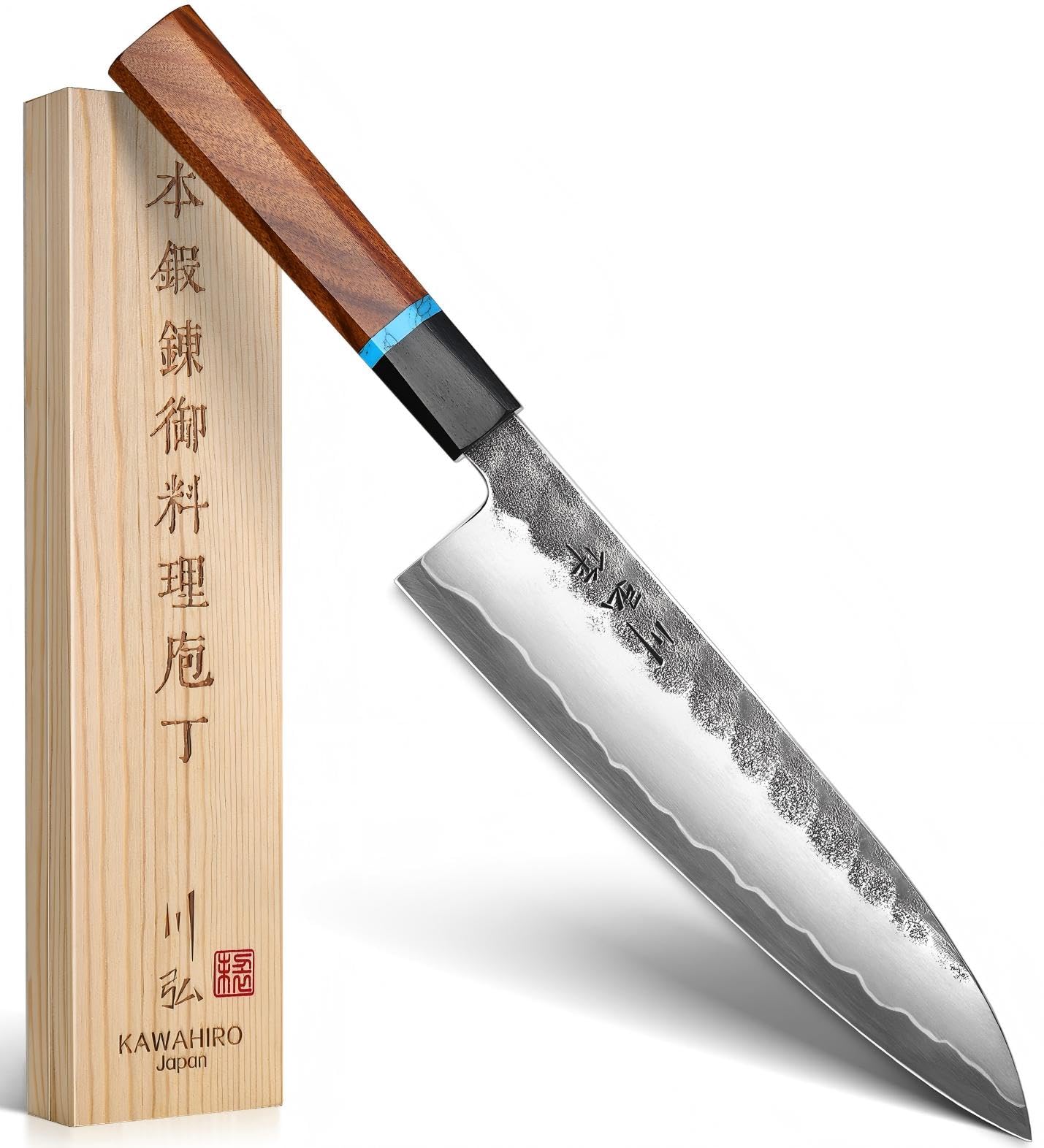
The KAWAHIRO KH-6601 gyuto represents what a serious Japanese knife should be: a hand-forged VG10 core, 3-layer composite construction, and a handle made from ebony, turquoise, and ruby wood. The black forge finish gives the blade a distinctly artisan look while the 60 HRC VG10 core delivers laser-sharp edge retention. The octagonal handle profile naturally fits a pinch grip, making long prep sessions noticeably less fatiguing.
At an 8.27-inch blade length, this gyuto handles everything from paper-thin carrot slices to clean protein cuts. The layered construction — VG10 core wrapped in softer stainless — adds corrosion resistance without sacrificing the hard edge that Japanese knives are known for. Out of the box, the 15-degree edge cuts through tomato skin with no weight behind the blade, which is the benchmark for true Japanese sharpness.
The included wooden storage case and certificate of authenticity elevate the unboxing, but the real story is the balance: the blade-to-handle weight distribution feels centered exactly at the pinch grip. This is a knife built for someone who values craftsmanship over flashy marketing. Hand-wash only, and use a whetstone for sharpening to preserve the edge profile.
Why it’s great
- Genuine VG10 core with 60 HRC for long-lasting sharpness.
- Unique ruby wood, ebony, and turquoise handle is both ergonomic and stunning.
- Black forge finish resists corrosion and adds visual depth.
- Includes premium wooden gift box and certificate of authenticity.
Good to know
- Premium-tier pricing reflects artisan hand-forging process.
- Not dishwasher safe; requires hand washing and whetstone maintenance.
- Single knife only — no block or additional blades included.
2. Shun Classic 7″ Hollow Ground Santoku
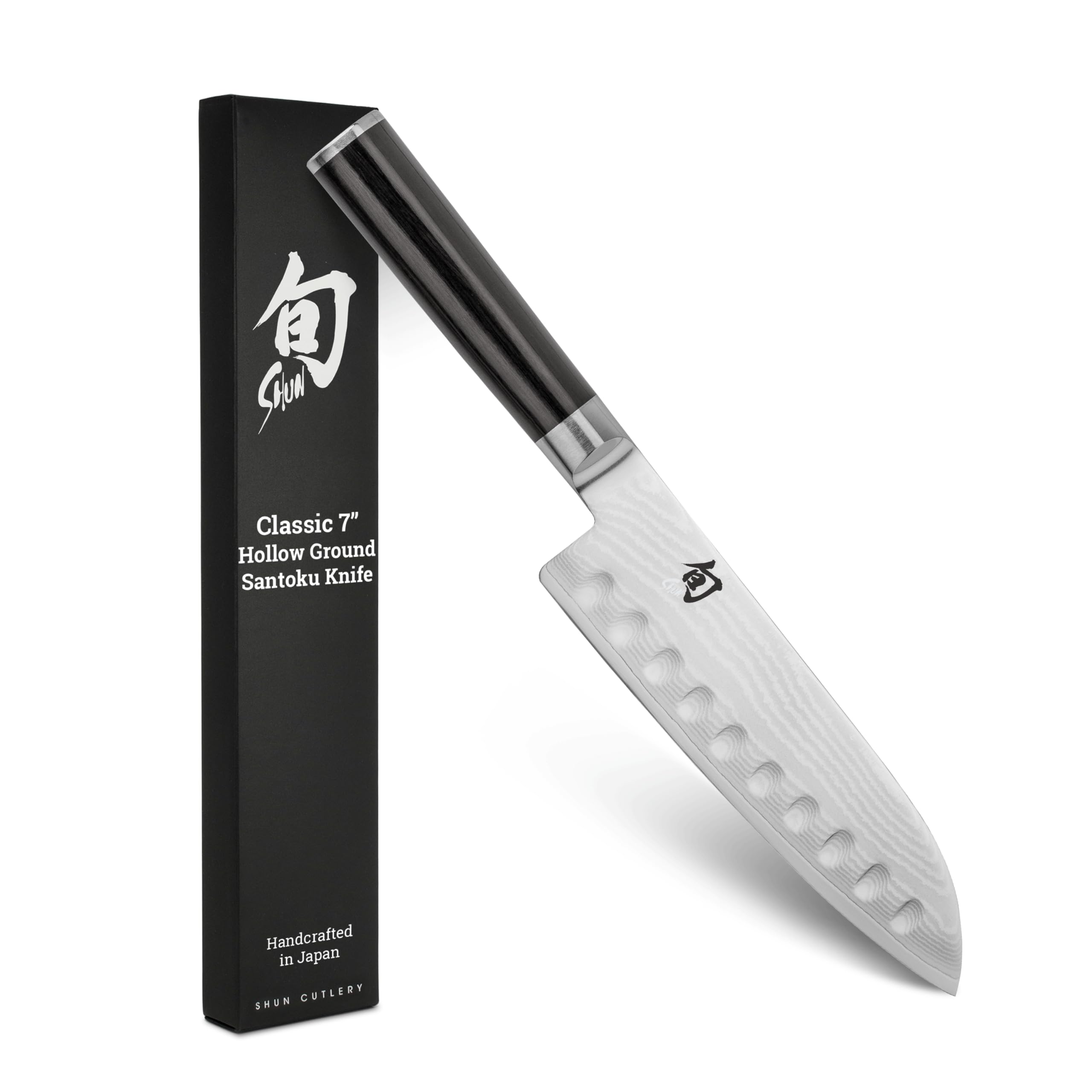
The Shun Classic series is arguably the most recognized Japanese knife line in North America, and this 7-inch hollow-ground santoku justifies the reputation. The VG-MAX core — an enhanced VG10 alloy with slightly higher carbon and vanadium — paired with 68 layers of Damascus cladding creates a blade that takes a 16-degree edge and holds it exceptionally well. The hollow-ground dimples (kullenschliff) on each side reduce friction and prevent food from sticking during slice cuts.
The D-shaped Pakkawood handle is designed for both left and right-handed use, offering a secure grip even with wet hands. At 0.6 pounds, the knife feels light and nimble, perfect for precise vegetable work, but the 7-inch blade is also capable of breaking down poultry. The edge profile has a gentle curve that allows a slight rocking motion, making it more versatile than a traditional flat santoku.
Shun offers free sharpening service with purchase, which adds long-term value. The one caveat: the hollow-ground indentations can be slightly harder to clean than a smooth blade, and the thin edge is more prone to chipping if used on bones, frozen food, or hard squash. Stick to soft-to-medium ingredients and a wood or synthetic cutting board to preserve the edge.
Why it’s great
- VG-MAX core offers superior edge retention over standard VG10.
- 68-layer Damascus cladding provides beauty and added rust resistance.
- Hollow-ground dimples reduce sticking during slicing.
- Free sharpening service included with the knife.
Good to know
- Thin edge can chip on hard ingredients like bones or frozen food.
- Hollow indentations require careful hand cleaning.
- Premium price reflects brand heritage and Japanese craftsmanship.
3. Yoshihiro VG10 16 Layer Hammered Damascus Santoku

Yoshihiro is a Japanese brand with a long history of traditional knife-making, and this hammered Damascus santoku demonstrates why the category exists. The VG10 core at 60 HRC is clad in 16 layers of stainless Damascus, hand-hammered to create a surface that reduces food adhesion. The hammered tsuchime texture is not just decorative — it creates micro-air pockets that prevent thin slices of carrot or cucumber from sticking to the blade face.
The western-style full-tang handle in mahogany is ergonomically contoured for a secure palm grip, which differs from the octagonal wa-handle found on many traditional Japanese knives. This makes the Yoshihiro more accessible to cooks transitioning from German-style knives. The 7-inch blade length is ideal for santoku-style all-purpose cutting, and the double-edged grind allows both left and right-handed use without any bevel asymmetry.
At 0.39 pounds, this is a lightweight knife that moves quickly through vegetables and fish. Made in Japan, the fit and finish are excellent — the blade spine is polished smooth and the handle-to-blade transition has no sharp edges. The only trade-off is that the VG10 core, while hard, can be slightly more brittle than softer stainless if you accidentally torque the blade while cutting through dense ingredients.
Why it’s great
- Authentic Japanese craftsmanship with hammered Damascus texture.
- VG10 core at 60 HRC delivers professional-level sharpness.
- Western-style mahogany handle fits users familiar with German knives.
- Lightweight at under half a pound for fatigue-free prep.
Good to know
- Not suitable for bones, nuts, or frozen foods.
- Requires water whetstone for proper sharpening.
- No sheath or saya included for storage.
4. HexClad Santoku Knife, 7-Inch Damascus

HexClad brings its hybrid cookware reputation into the knife world with a 7-inch santoku built around a 67-layer Damascus blade. The core steel is a high-carbon alloy that undergoes the 3-step Honbazuke heat treatment, resulting in a 12-degree cutting edge that is noticeably more acute than the 15-16 degree edges found on many competitors. This aggressive angle translates to less resistance when push-cutting through dense vegetables.
The Pakkawood handle is ergonomically shaped with a subtle contour that fills the palm, and the blade tang extends through the full handle length for balanced weight distribution. At 9.92 ounces, the knife feels substantial but not heavy — a good middle ground for those who want the precision of a Japanese edge without the featherweight feel of a traditional wa-handle knife. The 6.69-inch actual blade length is slightly shorter than a standard 7-inch, but the difference is negligible during use.
HexClad backs this knife with a lifetime warranty against manufacturer defects, though it explicitly excludes damage from improper use, including dishwasher cleaning and cutting on hard surfaces. The included sheath is a nice touch for drawer storage. For home cooks who own HexClad cookware and want a matching set, this santoku integrates seamlessly into that ecosystem.
Why it’s great
- 12-degree edge angle provides exceptionally low cutting resistance.
- 67-layer Damascus construction with Honbazuke heat treatment.
- Lifetime warranty from a reputable brand.
- Comfortable Pakkawood handle with full tang balance.
Good to know
- Actual blade length is 6.69 inches, not a full 7 inches.
- Warranty voids if used on hard surfaces or in dishwasher.
- Not a traditional wa-handle shape for purists.
5. KnifeSaga 15 Pcs Kitchen Knife Block Set
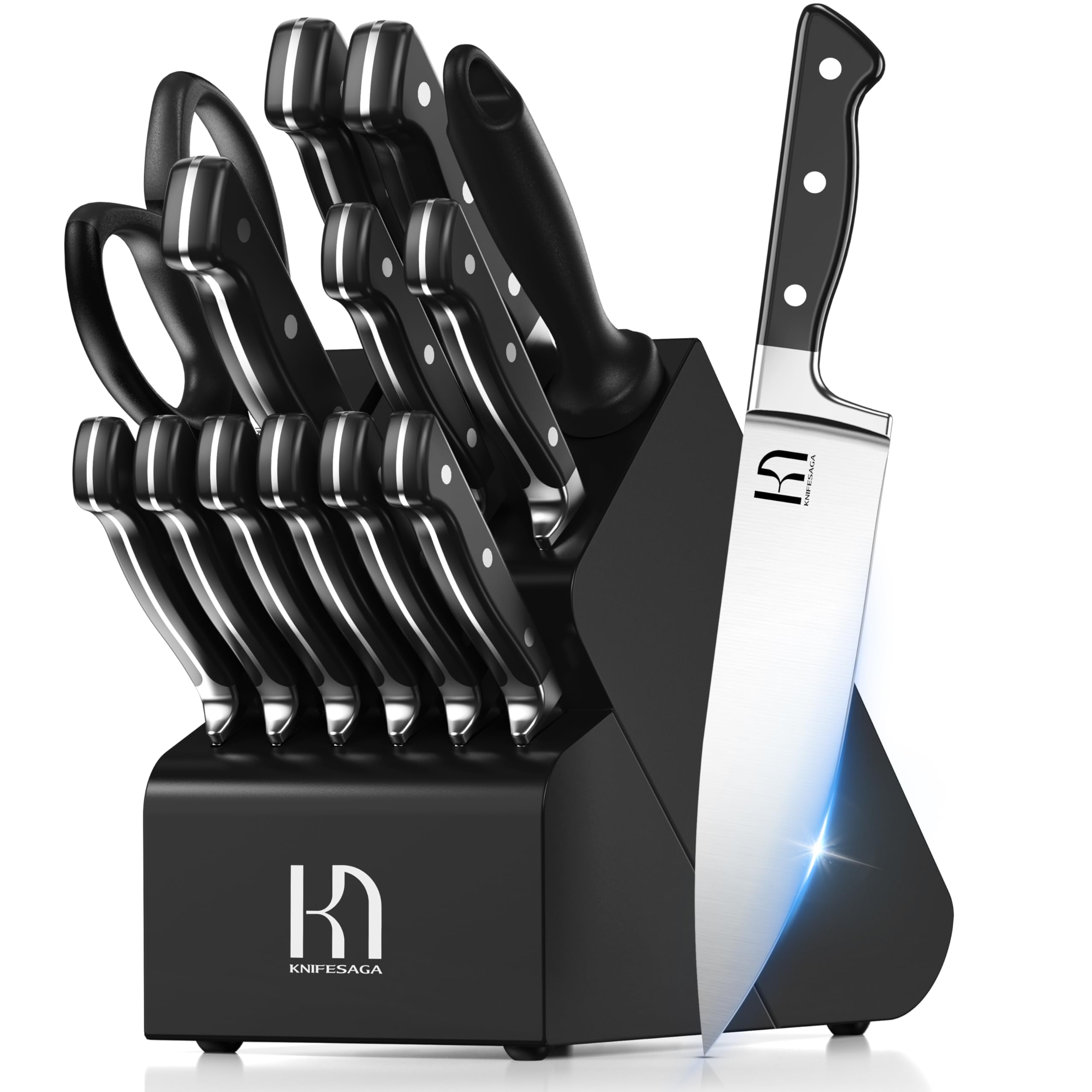
The KnifeSaga 15-piece set is designed for the home cook who wants a full knife block, sharpener, and kitchen shears all in one purchase. The blades are constructed from Japanese high-carbon stainless steel, offering a balance of corrosion resistance and edge-holding ability that fits everyday kitchen tasks. The block itself is a stylish black unit with individual slots, keeping the knives organized and within arm’s reach.
This set covers all the bases: a chef knife, santoku, bread knife, utility knife, paring knife, steak knives, and kitchen shears, plus a built-in sharpener slot in the block. For someone building a kitchen from scratch or replacing a worn-out Western-style set, this provides the full Japanese-inspired package without needing to buy individual knives. The steel quality won’t match a single VG10 gyuto, but the convenience and variety are hard to beat at this tier.
The included sharpener is a pull-through type, which is fine for maintaining a working edge but won’t produce the acute angle of a whetstone. The handles are ergonomic and comfortable for extended use. If you prioritize having every blade type available over having one exceptional blade, this set delivers coverage and organization that a single knife cannot match.
Why it’s great
- Complete 15-piece set covers every kitchen cutting need.
- Stylish block with integrated sharpener slot.
- Japanese high-carbon stainless steel offers good corrosion resistance.
- Includes steak knives and shears for full kitchen coverage.
Good to know
- Individual blade quality won’t match single premium gyuto knives.
- Pull-through sharpener limits edge angle precision.
- Knives are not dishwasher safe, despite the convenience set format.
6. KYOKU Shogun Series 8″ Chef Knife

The KYOKU Shogun Series 8-inch chef knife uses a 67-layer Damascus blade with a VG10 core, sharpened to an 8 to 12 degree edge using the traditional 3-step Honbazuke method. That edge angle is among the most aggressive in this guide — the knife will literally fall through a ripe tomato with no downward pressure. The VG10 core at 58-60 HRC provides enough hardness to maintain that acute edge through moderate use.
The handle is constructed from fiberglass-reinforced G10, a material resistant to temperature changes, moisture, and corrosion. The signature mosaic pin adds a visual detail that distinguishes it from simpler handles. The included sheath and protective case make this a travel-friendly option for cooks who bring their own knife to different kitchens. At 1.39 pounds, it has a slightly heavier feel than other 8-inch gyutos, which some cooks prefer for stability during rocking chops.
Cryogenic treatment during manufacturing helps relieve internal stresses in the steel, reducing the risk of micro-chipping at the thin edge. Customer feedback consistently mentions the razor-sharp factory edge and the stunning Damascus pattern. The trade-off: the aggressive edge angle means this knife should never touch a hard cutting board, bone, or frozen ingredient — it’s optimized for soft to medium-density produce and protein.
Why it’s great
- 8-12 degree edge is among the sharpest factory edges available.
- G10 handle withstands heat, moisture, and corrosion.
- Includes both sheath and protective case for storage.
- Cryogenic treatment improves edge stability.
Good to know
- Aggressive edge requires careful use on correct cutting surfaces.
- Heavier than many Japanese gyutos at 1.39 pounds.
- Not suitable for bones, nuts, or frozen ingredients.
7. HOSHANHO 8 Inch Gyuto Chef Knife

HOSHANHO’s 8-inch gyuto brings entry-level affordability to a genuinely Japanese-forged blade. The core is 10Cr15CoMoV super steel — a high-carbon alloy comparable to VG10 in hardness — clad in 8 layers of corrosion-resistant stainless steel for a total of 9 layers. The wet V-shaped sharpening technique produces a 12-15 degree edge that slices through bell peppers and onions with minimal effort. The hand-forged hammer pattern on the blade surface is both functional (food release) and decorative.
The ergonomic octagonal rosewood handle with copper wire accents is a traditional Japanese wa-handle design that naturally orients the blade in a pinch grip. The blade-to-handle ratio of 8.11 inches to 6.1 inches creates a near-golden proportion that balances the knife perfectly at the pinch point. For home cooks transitioning from heavy Western knives, this gyuto will feel remarkably agile and responsive.
Customer feedback highlights the value-for-money proposition: the steel performs well above its tier, and the 60-day handcrafting process is visible in the fit and finish. The knife is not dishwasher safe and should be wiped clean immediately after cutting acidic foods to prevent any discoloration on the cladding. For someone wanting to experience a true Japanese gyuto without a premium investment, this is a strong contender.
Why it’s great
- 10Cr15CoMoV core performs similarly to VG10 at a lower cost.
- Hand-forged hammer pattern aids food release.
- Octagonal rosewood handle is ergonomic and traditional.
- Excellent blade-to-handle balance for precise cutting.
Good to know
- Not dishwasher safe; requires hand washing and drying.
- May show discoloration if acidic foods are left on blade.
- Single knife only — no sheath or storage case included.
8. HOSHANHO 3 Pieces Knife Set
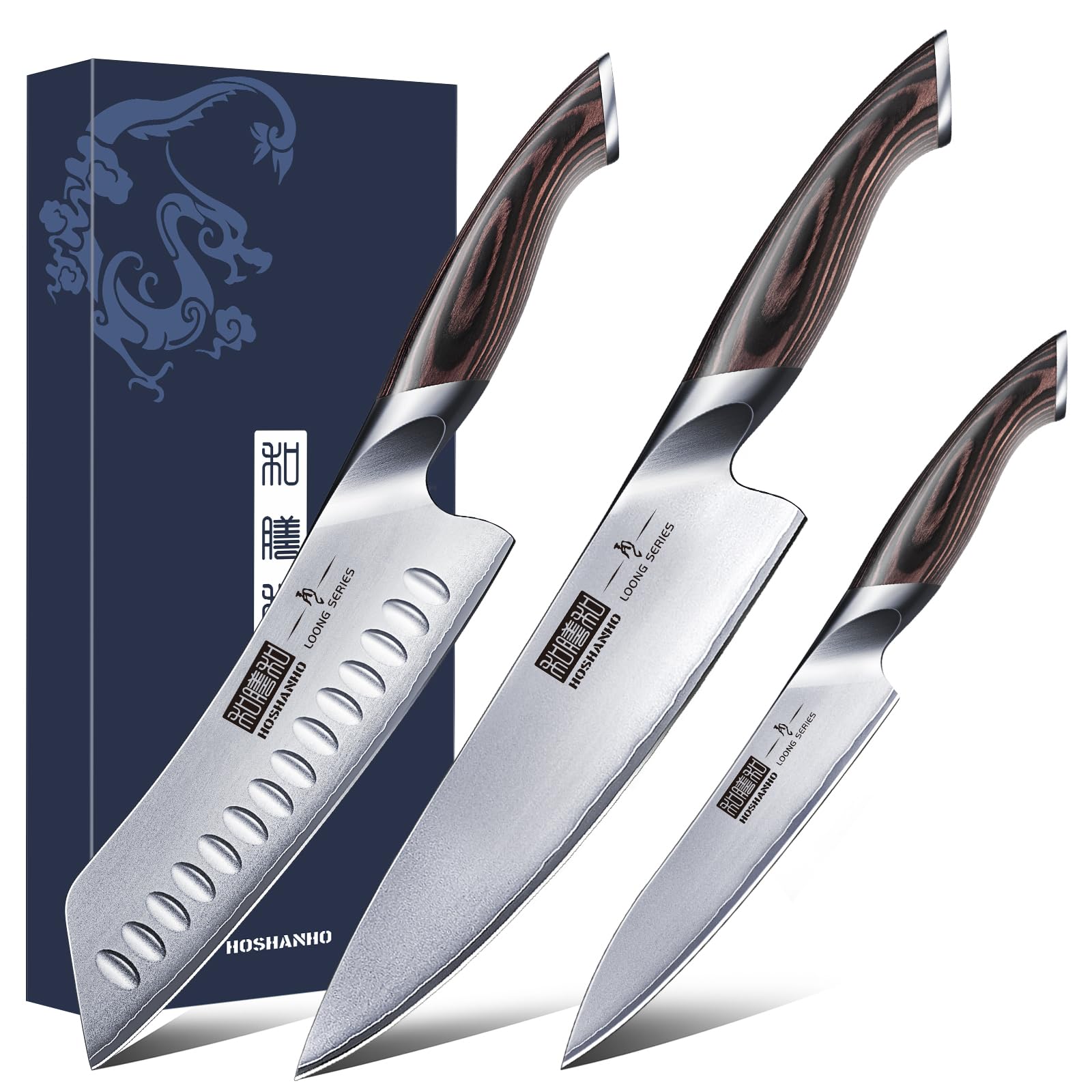
HOSHANHO’s 3-piece set bundles an 8-inch chef knife, 7-inch santoku, and 6-inch utility knife — the three most common blades for everyday kitchen work. All three use the same Japanese 10Cr15CoMoV high-carbon stainless steel at 60 HRC, ensuring consistent performance across the set. Each blade is hand-polished to a 15-degree edge per side using a high-temperature vacuum and low-temperature cold nitrogen treatment for added hardness and edge stability.
The Pakkawood handles are ergonomically shaped for a comfortable grip and are stabilized resin-impregnated wood, meaning they resist moisture absorption and cracking better than natural wood handles. The handles are fitted to full-tang blades for balanced weight distribution. The set comes in a simple, classic gift box, making it a practical present for a home cook looking to upgrade from a generic block set.
The santoku’s shorter, wider blade excels at vegetable prep, while the 8-inch chef knife handles protein and larger produce. The 6-inch utility knife fills the gap for smaller tasks like trimming or slicing fruit. For the price of a single mid-range German chef knife, this set provides three Japanese-forged blades that cover the majority of home kitchen cutting tasks. Dishwasher use is not recommended — hand wash and dry to preserve the edge and handle integrity.
Why it’s great
- Three essential blade shapes cover 90% of kitchen tasks.
- Consistent 10Cr15CoMoV steel at 60 HRC across the set.
- Pakkawood handles resist moisture and cracking.
- Gift-box packaging makes it an ideal present.
Good to know
- No chef knife-specific review data available for validation.
- Handles are full-tang western style, not traditional octagonal wa-handle.
- Block or sheath not included with the set.
9. Matsato 3-Piece Kitchen Knife Set

The Matsato 3-piece set takes a different approach by including a cleaver alongside a chef knife and santoku, giving home cooks a heavy-duty option for cutting through chicken bones or hard squash. The set is designed for cooks who want versatility across a wider range of ingredient densities — the cleaver can handle tasks that a thin Japanese gyuto should never attempt. The three blades cover chopping, slicing, and heavy-duty cutting in one affordable package.
While the steel type and HRC rating are not explicitly listed, the set is positioned as an entry-level Japanese-style option for casual cooking. The handles are ergonomically designed for comfort during extended use. For someone on a tight budget who needs a full cutting toolkit without investing in individual premium blades, this set provides functional coverage.
The major trade-off is the unknown steel quality — without a specified core alloy or hardness rating, long-term edge retention and sharpening potential remain uncertain. This set works best as an introductory purchase for a college student, first apartment, or occasional cook who does not require professional-grade edge performance. Hand washing is recommended to extend the life of both blades and handles.
Why it’s great
- Includes cleaver for heavy-duty tasks like bones and squash.
- Very budget-friendly entry point to Japanese-style knives.
- Three knives cover a wide range of cutting tasks.
Good to know
- Steel type and hardness are not specified.
- Long-term edge retention is uncertain.
- Best suited for casual or occasional kitchen use.
FAQ
What is the difference between VG10 and 10Cr15CoMoV steel?
Can I put a Japanese knife in the dishwasher?
How often should I sharpen a Japanese knife?
What is the advantage of a Damascus blade pattern?
Final Thoughts: The Verdict
For most users, the best japanese knives winner is the KAWAHIRO 8-Inch Gyuto because it pairs a genuine VG10 core with a stunning ruby-wood handle and a 60 HRC edge that glides through prep work — all backed by the kind of hand-forged craftsmanship that defines the category. If you want the iconic brand name and free sharpening service, grab the Shun Classic Santoku. And for an entry-level set that covers multiple tasks without breaking the bank, nothing beats the HOSHANHO 8-Inch Gyuto as a single-knife value pick.