Tough muscle fibers, hard silver-skin, and dense fat caps — a dull Western blade crushes these structures rather than slicing through them, releasing muscle fluids and tearing the meat surface. The result is a dry, ragged protein that looks and cooks worse. A true Japanese knife for cutting meat solves this with a geometry that separates rather than smashes, using a thinner edge angle and harder steel core to glide through protein with almost no resistance.
I’m Mohammad Maruf — the founder and writer behind AirfryerBite. Across years of deep market research on Japanese steel, I’ve analyzed blade hardness ratings on the Rockwell scale, core steel compositions from VG-10 to SG2, and handle ergonomics ranging from traditional octagonal ho-wood to modern G-10 composites to understand what separates a great meat slicer from an average one.
After evaluating edge retention data, cladding layer counts, and real-world carving performance across nine different models, this guide will walk you through the concrete specs that matter — steel type, blade profile, and heat treatment — so you can confidently purchase the best japanese knife for cutting meat that matches your hand and your budget.
How To Choose The Best Japanese Knife For Cutting Meat
Selecting a Japanese knife for meat slicing means matching three variables: the steel’s hardness and edge stability, the blade profile’s suitability for push-cutting rather than rocking, and the handle’s weight distribution. Ignoring any one of these will leave you with a blade that either chips, steers off line, or fatigues your wrist mid-way through a brisket.
Steel Core: Hardness vs. Toughness
Japanese knives for meat typically use high-carbon stainless steels like VG-10 or AUS-10V, heat-treated to 60-63 HRC. Harder steel holds a razor edge for longer across dense protein fibers, but becomes more brittle. For heavy trimming around bone or slicing through cartilage, a steel like AUS-10V at 62+ HRC offers the best trade-off: sharp enough for clean cuts, tough enough to resist micro-chipping when you accidentally graze a rib bone.
Blade Geometry: Thin Edge, Thick Spine
The most effective meat slicers use a convex or flat grind that tapers to a very thin edge — typically 9 to 15 degrees per side. This geometry lets the blade wedge through meat without the friction that crushes cell walls. A thick spine (2.5 mm or more) provides the rigidity needed to cut straight through a roast without lateral flex, while the thin edge ensures zero tearing.
Quick Comparison
On smaller screens, swipe sideways to see the full table.
| Model | Category | Best For | Key Spec | Amazon |
|---|---|---|---|---|
| Yoshihiro VG10 Hammered Damascus Gyuto | Premium | Versatile all-purpose meat prep | VG-10 core, 60 HRC, 16-layer Damascus | Amazon |
| Shun Classic 9″ Hollow Ground Slicing Knife | Premium | Slicing large roasts and brisket | VG-MAX core, 16-degree edge, Granton | Amazon |
| Miyabi Birchwood SG2 Chef’s Knife | Premium | Ultimate edge retention on large cuts | SG2 micro-carbide, 63 HRC, 100-layer | Amazon |
| Dalstrong Shogun Elite Carving Slicing Knife | Premium | Long, clean slices on cooked meat | AUS-10V, 62+ HRC, 67-layer Damascus | Amazon |
| Made In 8″ Japanese Damascus Steel Gyuto | Premium | Smooth all-day prep, excellent balance | VG-10 core, 66-layer damascus, 7.25 oz | Amazon |
| Global 8.25″ Carving Knife G-3 | Mid-Range | Lightweight carving, full stainless handle | Mo/V stainless steel, 8.25″, hollow edge | Amazon |
| Tojiro Fujita Takako DP FU-809 | Mid-Range | Value-oriented 240mm blade for general cutting | Cobalt alloy core, 240mm blade length | Amazon |
| KAWAHIRO VG10 Gyuto | Mid-Range | Hand-forged VG-10, decorative wood handle | VG-10, 3-layer composite, ebony handle | Amazon |
| HOSHANHO Carving Knife Set 3PCS | Budget | Multi-kit meat carving set with fillet knife | 10Cr15CoMoV steel, 12″+10″+7″ set | Amazon |
In-Depth Reviews
1. Yoshihiro VG10 16 Layer Hammered Damascus Gyuto (8.25″)
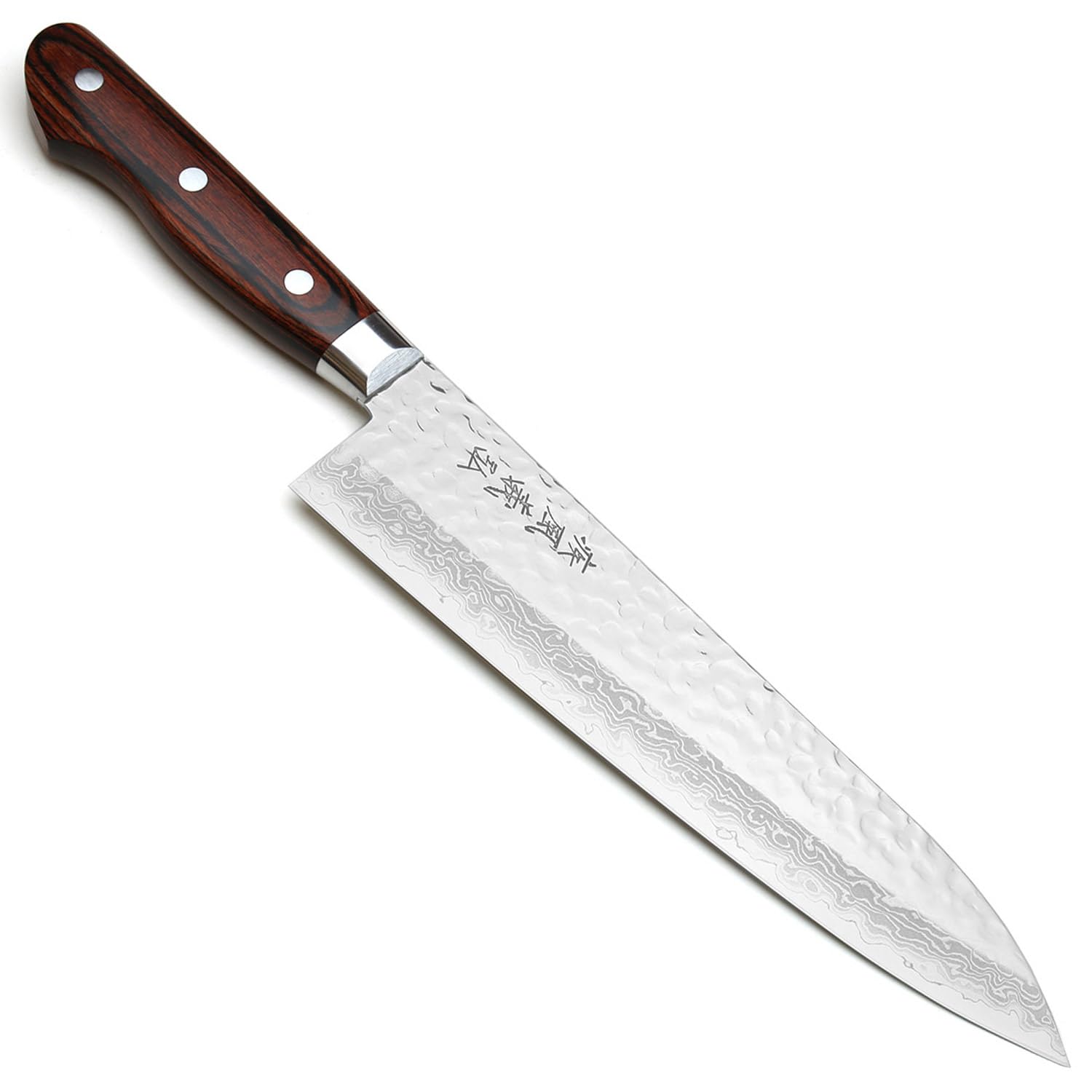
This Yoshihiro Gyuto hits the sweet spot where performance and value converge. The VG-10 core hardened to 60 HRC provides the hardness needed to push-cut through raw beef striploin or pork shoulder without crushing the protein fibers, while the 16-layer stainless Damascus cladding adds structural toughness that resists chipping when you transition from muscle to fat cap. The hammered (tsuchime) finish is not decorative — it creates micro-pockets on the blade face that reduce suction against raw meat, so slices fall away cleanly instead of sticking.
The western-style mahogany handle extends to a full tang, delivering a balanced 0.4-pound weight that feels nimble enough for delicate trimming yet substantial enough for continuous slicing through a whole chuck roast. The 8.25-inch blade length is ideal for home cooks: long enough to draw across a large brisket flat but short enough to maneuver around bone structures during deboning tasks. Reviewers consistently note that it stays sharp longer than comparable German steel knives, requiring honing only after several heavy prep sessions.
The one consideration is edge maintenance — Yoshihiro recommends water whetstones only, as pull-through sharpeners can damage the thin 15-degree edge bevel. If you are comfortable with freehand sharpening, this knife will reward you with years of clean, drag-free meat slicing. The aesthetic appeal is undeniable: the hammered pattern and layered Damascus create a one-of-a-kind visual that looks professional on any magnetic strip.
Why it’s great
- VG-10 core at 60 HRC delivers exceptional edge retention on dense meat fibers
- Hammered finish reduces food drag when slicing raw protein
- Full tang western handle provides balanced weight distribution for extended carving
Good to know
- Requires water whetstone sharpening; not compatible with pull-through sharpeners
- No saya cover included for blade storage
2. Shun Classic 9″ Hollow Ground Slicing Knife
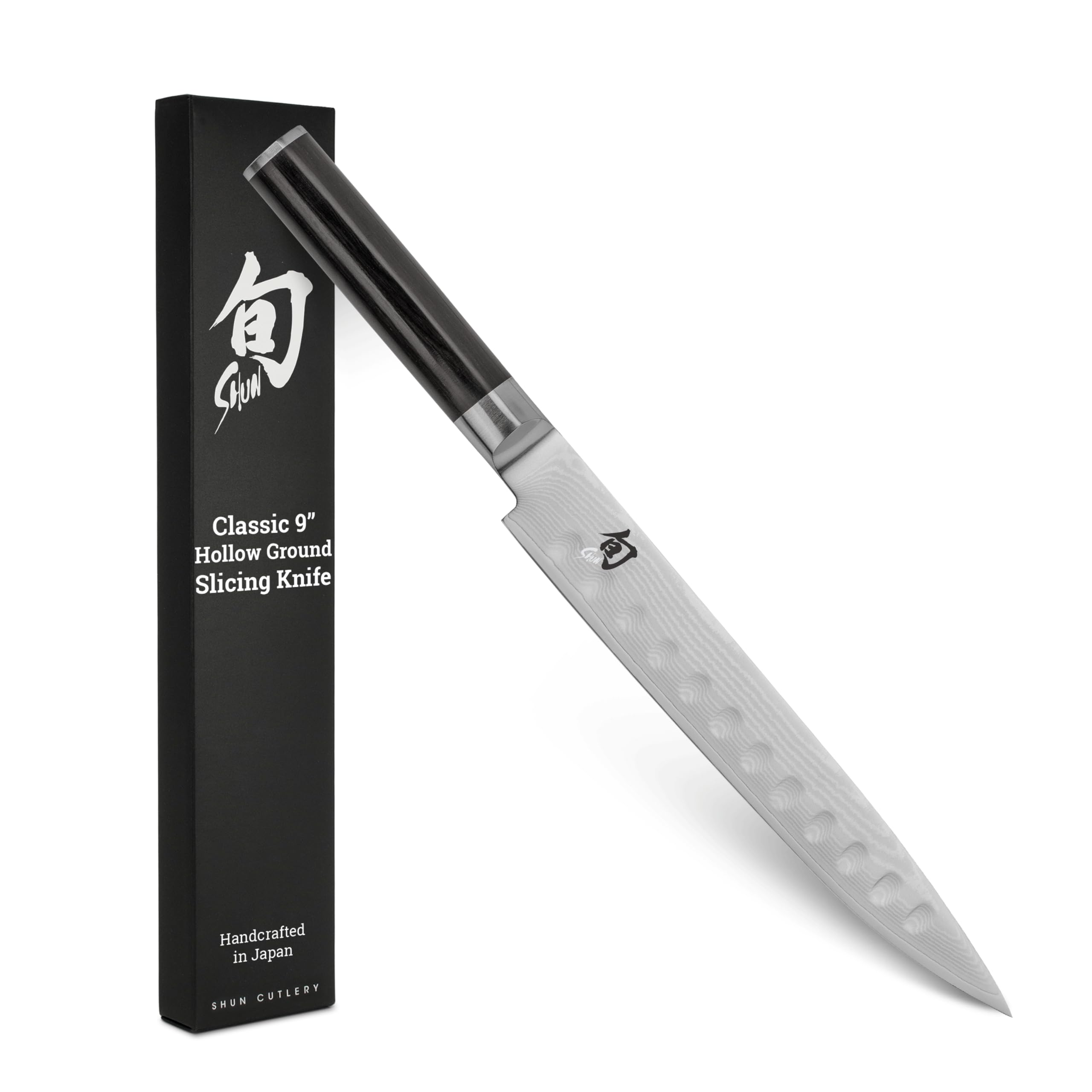
The Shun Classic 9-inch slicing knife is purpose-built for the task its name implies: producing long, uninterrupted cuts through cooked protein. The VG-MAX core steel — a proprietary composition with increased vanadium and carbon — achieves a Rockwell hardness that supports a 16-degree edge angle, allowing the blade to glide through a prime rib roast or smoked brisket in a single draw stroke. The hollow-ground Granton indentations along the blade face create air pockets that prevent thin meat slices from sticking to the steel, a critical feature when serving uniform slices for presentation.
The D-shaped Pakkawood handle is designed for the pinch grip, with a subtle asymmetry that locks the hand into a stable forward position — essential for controlling the blade’s full 9-inch length during long, steady pulls. At 0.6 pounds, the knife is notably heavier than the Yoshihiro Gyuto, which provides momentum for slicing through thicker cuts without requiring extra downward force from the user. The 68-layer Damascus cladding adds corrosion resistance and creates the distinctive wave pattern that Shun users recognize instantly.
The trade-off is specialization — this is not an all-purpose chef knife. The narrow blade profile and extended length make it awkward for chopping vegetables or mincing aromatics. It lives best on a magnetic strip next to the cutting board, reserved for the day you pull out a roast or whole turkey. Shun offers free sharpening for the life of the knife, which is a genuine value considering the cost of professional sharpening on a high-hardness VG-MAX blade.
Why it’s great
- Granton hollows prevent cooked meat slices from sticking during long pulls
- VG-MAX core at 16-degree edge delivers clean, single-stroke cuts through roasts
- Free lifetime sharpening from Shun reduces long-term maintenance cost
Good to know
- Narrow blade limits versatility; not suited for chopping or mincing tasks
- Pakkawood handle requires hand washing and oiling to prevent drying
3. Miyabi Birchwood SG2 Japanese Chef’s Knife (8″)

Miyabi’s Birchwood series represents the upper echelon of Japanese production knives, and the 8-inch chef’s knife is the gold standard for meat processing. The SG2 micro-carbide powder steel core — heat-treated to 63 HRC — is among the hardest steels commercially available in a kitchen knife, providing edge stability that exceeds VG-10 by a measurable margin. This hardness translates to dramatically longer intervals between sharpening sessions: a home cook processing several pounds of meat weekly can expect months of shaving-sharp performance before any noticeable degradation.
The Honbazuke hand-honing process brings the edge to 9.5 to 12 degrees per side, which is conspicuously sharper than the 15-16 degrees found on most production Japanese knives. This acute angle, combined with the 100-layer flower Damascus pattern, allows the blade to separate meat fibers with zero crushing force. The Karelian birch handle is not merely decorative — its dense grain structure resists moisture absorption and provides a tactile grip that improves with hand warmth. The full tang construction and 1.18-pound weight give the knife a planted, authoritative feel that inspires confidence when working through whole primals.
The primary barrier is cost: this knife demands a premium investment that not every home cook can justify. Additionally, the extreme 9.5-degree edge is more susceptible to chipping if used carelessly on bones or frozen product. But for the serious meat cook who wants the most technically advanced blade for pure slicing performance, the Miyabi Birchwood is a benchmark that few other knives approach.
Why it’s great
- SG2 steel at 63 HRC provides industry-leading edge retention for dense meat proteins
- 9.5-12 degree Honbazuke edge cuts with less resistance than standard Japanese edges
- Karelian birch handle offers exceptional moisture resistance and ergonomic grip
Good to know
- Premium cost may exceed budget for casual home cooks
- Thin acute edge requires careful use; not suitable for bone or frozen food contact
4. Dalstrong Carving Slicing Knife – 12″ Shogun Series ELITE
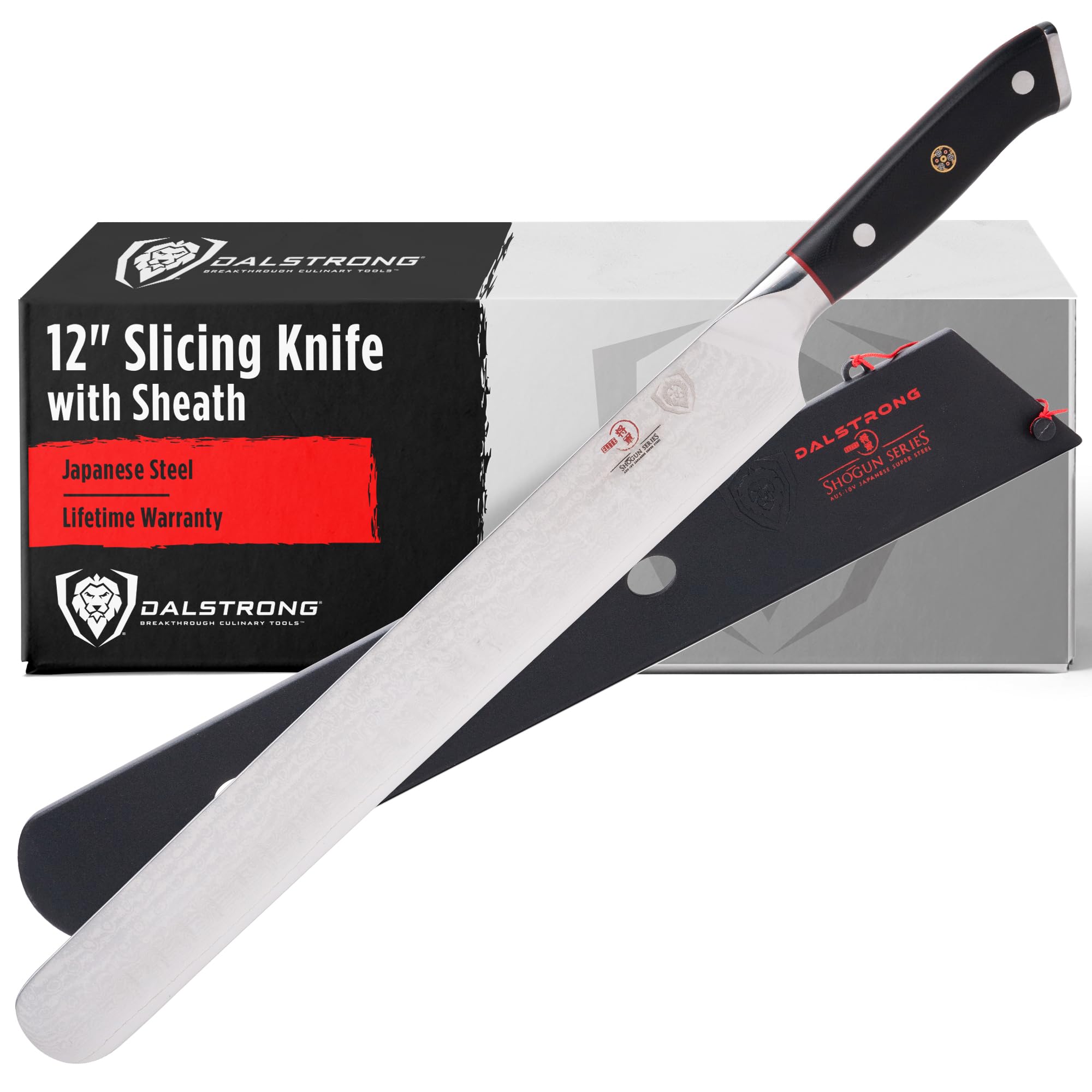
The Dalstrong Shogun Elite 12-inch slicer is built for volume: the extended blade length makes it the best tool in this lineup for carving through a whole smoked brisket point, a full turkey breast, or a large boneless leg of lamb in continuous, unbroken strokes. The AUS-10V Japanese super steel core, vacuum-treated and hardened to 62+ HRC, balances edge hardness with impact toughness better than VG-10, making it more forgiving against occasional bone contact — a real advantage in high-throughput meat carving where speed sometimes trumps precision.
The 67-layer high-carbon stainless Damascus cladding is nitrogen-cooled during treatment, which reduces distortion and improves corrosion resistance compared to traditional air-cooled damascus. The G-10 handle is the standout practical feature: this glass-epoxy composite is impervious to the moisture, heat, and fat that degrade wood handles over time, and its hand-polished shape provides a locked-in grip even when your hands are slick from trimming raw brisket fat. At 280 grams (just over 0.6 pounds), the knife carries its weight in the blade, which helps momentum drive the edge through dense cooked meat without the user exerting extra pressure.
The Dalstrong ships with a protective sheath, a welcome inclusion for a 12-inch blade that would otherwise be hazardous in a drawer. The one functional limitation is blade width — the 12-inch length combined with a slim profile means this knife is not effective for tasks like cubing stew meat or disjointing chicken parts; it is a pure precision slicer. For the home cook who regularly hosts large gatherings and needs to present picture-perfect meat platters, the Shogun Elite delivers that result consistently.
Why it’s great
- 12-inch blade draws full length across a whole brisket or turkey in one stroke
- AUS-10V core offers higher toughness than VG-10, better handling accidental bone contact
- G-10 handle resists fat, moisture, and heat for superior grip during long carving sessions
Good to know
- Extended blade length limits versatility for smaller kitchen tasks
- Sheath included, but storage requires a knife block or magnetic strip due to length
5. Made In 8″ Japanese Damascus Steel Gyuto
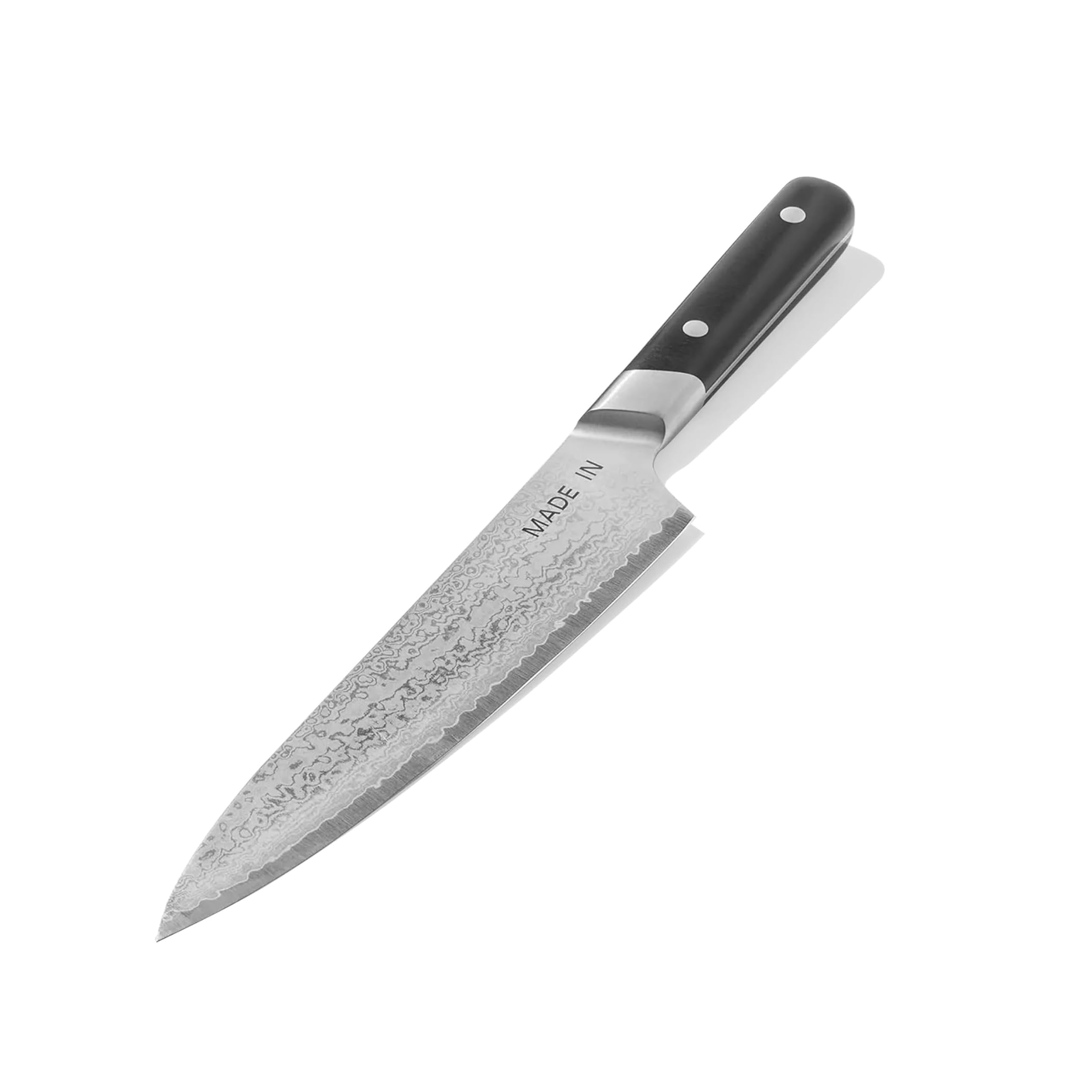
Made In’s 8-inch Gyuto is a direct challenger to the established Japanese knife brands, offering 66 layers of Damascus cladding over a VG-10 core at a mid-range price point that undercuts many competitors with similar steel specs. The 2.3 mm blade thickness behind the edge strikes a practical compromise — thin enough to reduce friction when slicing raw chicken breast or beef sirloin, yet thick enough at the spine to prevent flexing when you lever through a butternut squash or dense pork shoulder. The 15-degree edge angle hits the standard sweet spot for Japanese chef knives: sharp enough for effortless meat cutting, durable enough for day-in, day-out use without micro-chipping.
Forged in Seki, Japan — a city with 800 years of blade-making history — the knife demonstrates the fit and finish expected from that tradition. The black POM (polyoxymethylene) handle is a practical choice for meat-heavy prep: unlike wood, POM will not absorb blood or fat residue, stays dimensionally stable across temperature changes, and provides a secure grip even when wet. At 7.25 ounces, the knife is noticeably lighter than the Shun or Dalstrong models, which reduces wrist fatigue during long prepping sessions but means the blade relies more on user technique than momentum for clean cuts through thick meat.
The absence of a saya cover and the minimalist packaging may disappoint users expecting a presentation-grade unboxing experience, but the knife’s core performance — VG-10 edge retention, balanced handling, and Seki craftsmanship — delivers where it counts: on the cutting board. For the home cook who wants a single do-it-all knife that excels on meat without neglecting vegetable prep, the Made In Gyuto provides exceptional value.
Why it’s great
- 66-layer Damascus with VG-10 core delivers professional edge retention at a competitive price
- 2.3 mm blade thickness balances flexibility for meat with rigidity for dense vegetables
- POM handle resists moisture and fat absorption, ideal for raw meat prep
Good to know
- No saya cover included for blade protection during storage
- Lightweight construction requires more user technique for thick meat cuts
6. Global 8.25″ Carving Knife G-3

The Global G-3 carving knife is an icon of Japanese kitchen design, and its reputation is earned through a combination of molybdenum and vanadium stainless steel that produces a blade with exceptional corrosion resistance and a razor edge out of the box. At 170 grams (6 ounces), it is the lightest knife in this review, and the fully stamped stainless steel construction — including the handle — makes it feel like a single unified tool rather than a blade attached to a handle. The dimpled handle surface provides a tactile grip that works even with oily hands, though some users with larger hands find the all-metal handle slippery compared to wood or synthetic composites.
The 8.25-inch blade with a hollow edge reduces drag when carving cooked roast beef or ham by creating air pockets between the blade and the meat surface. However, the stamped construction and thinner blade stock mean the G-3 is less rigid than forged alternatives — when cutting through a thick, dense brisket flat, you may feel lateral flex that requires more careful edge alignment. The knife performs best on medium-rare roasts where the internal structure is tender and the blade can slide through without resistance, rather than on tough, sinewy cuts that require downward force.
Global’s lifetime warranty against defects and breakage is a tangible confidence signal, and the knife’s resistance to staining is genuinely superior to high-carbon alternatives — you can finish carving, wipe the blade clean, and not worry about immediate discoloration. The trade-off is that the stamped steel does not hold an edge as long as high-hardness forged VG-10 or SG2 cores, meaning you will need to hone or sharpen more frequently with regular meat prep use.
Why it’s great
- Ultra-light 170g design reduces hand fatigue during extended carving tasks
- Molybdenum/vanadium steel provides high stain resistance for acid-free maintenance
- Hollow edge indentations prevent cooked meat slices from sticking to blade
Good to know
- Lighter steel flexes more under pressure on tough, thick meat cuts
- All-metal handle can feel slippery to users with larger hands
7. Tojiro Fujita Takako DP Bottom Blade FU-809 (240mm)

Tojiro’s DP series has long been the entry point for professional Japanese knife performance at a working-class price, and the FU-809 is a pure representation of that philosophy. The blade uses a cobalt alloy steel core — a step above basic stainless in edge retention — clad in 13 chrome stainless steel that provides a hard-wearing outer layer resistant to rust and staining. The 240-millimeter (9.4-inch) blade length is longer than the typical 8-inch chef knife, offering extended reach for slicing through larger cuts of meat in fewer strokes.
The reinforced laminated material handle is Tojiro’s practical alternative to natural wood: it provides a secure grip, resists moisture absorption, and will not warp or crack over time. The exposed stainless steel bolster at the blade-handle transition adds a slight forward weight bias that helps the blade drop through ingredients with less wrist input. However, the fit and finish is clearly production-grade rather than hand-polished — the spine and choil area have sharper edges than the Yoshihiro or Miyabi alternatives, which may require a quick pass with fine sandpaper for comfort during extended pinch-grip use.
The 240mm blade is a genuine advantage for meat work, allowing you to draw the full length across a flank steak or pork loin in one smooth motion. The cobalt alloy core holds its edge acceptably for a mid-range knife, though it will require more frequent water-stone maintenance than VG-10 or SG2 alternatives. For the budget-conscious cook who wants a dedicated meat slicing blade with Japanese geometry and does not mind a slightly rougher finish, the Tojiro FU-809 delivers disproportionate value.
Why it’s great
- 240mm blade length allows single-stroke slicing across large meat cuts
- Cobalt alloy core with chrome stainless cladding offers good edge retention for the price
- Laminated handle resists moisture and provides stable, non-slip grip
Good to know
- Spine and choil have sharp edges that may need smoothing for pinch-grip comfort
- Production finish lacks the hand-polished feel of premium-priced Japanese knives
8. KAWAHIRO Japanese Chef Knife VG10 Gyuto (8″)
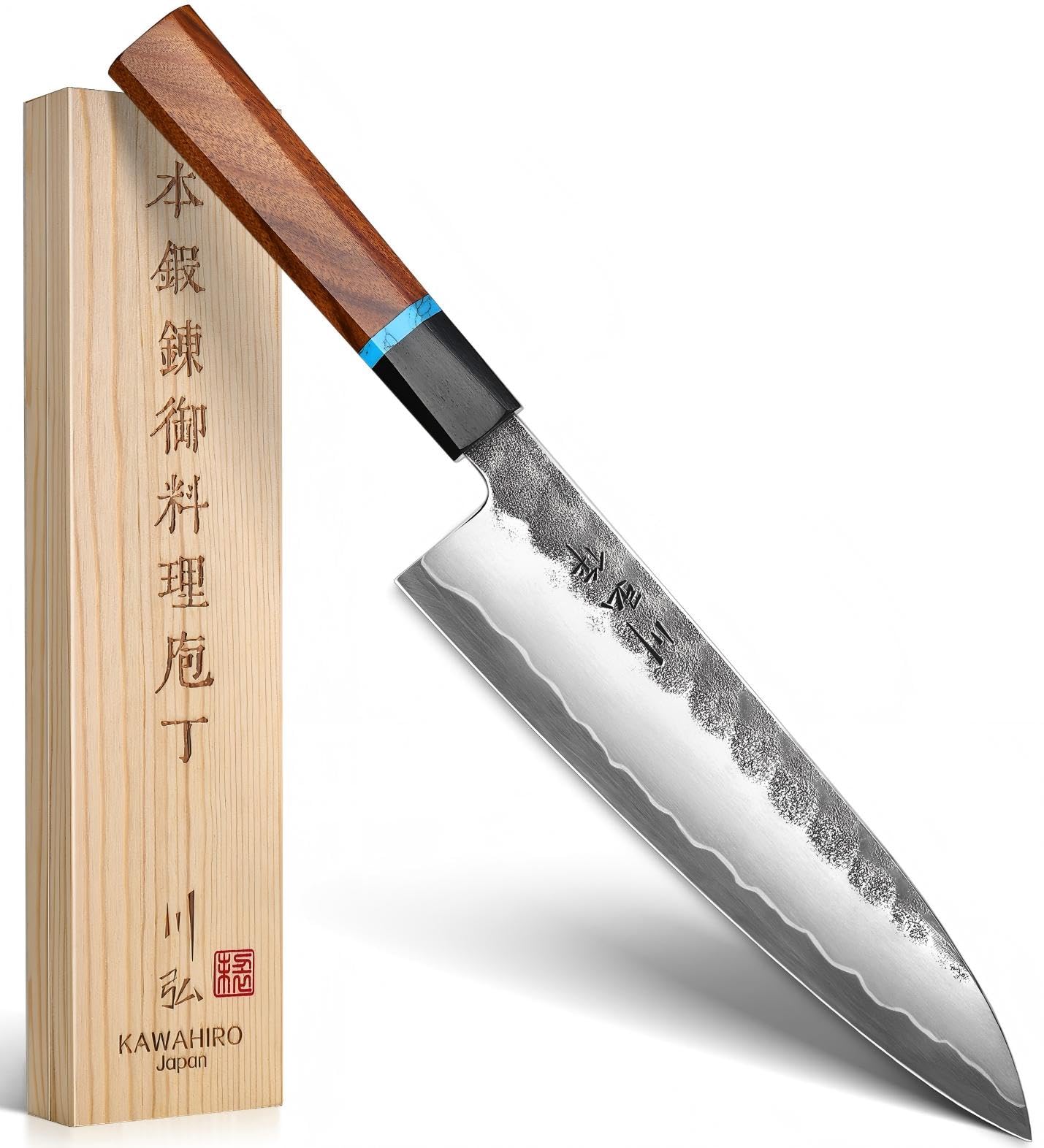
The KAWAHIRO Gyuto offers an unusual combination for its mid-range price point: a genuine VG-10 core in a hand-forged 3-layer composite blade, paired with an ornate handle made from ebony, turquoise, and ruby wood. The VG-10 core provides the hardness necessary for clean meat slicing, and the stainless steel outer layers protect the core from corrosion while adding impact toughness. The black forged finish on the blade reduces glare and has a subtle textured feel that helps release food during push cuts through raw meat.
The octagonal handle design is ergonomically sound: the eight-sided profile locks into the pinch grip with distinct pressure points that prevent the knife from rotating in your hand during repetitive slicing motions. The included wooden storage case and certificate of authenticity elevate the unboxing experience, making this a strong gift candidate. The handle’s multi-wood composite construction is visually striking, but it requires attentive care — prolonged exposure to moisture or acidic meat juices can stain the lighter turquoise and ruby wood sections over time.
Performance-wise, the VG-10 core at 8.24 inches cuts through beef, pork, and poultry with the expected Japanese precision, though the blade’s edge is not as consistently thin as the Yoshihiro or Shun alternatives. The 0.42-pound weight puts it in the lighter half of this lineup, which reduces fatigue but means the knife relies on sharpness rather than momentum. For a home cook seeking an entry-level Japanese VG-10 knife with striking aesthetics and a comfortable octagonal handle, the KAWAHIRO is a solid starting point for meat prep.
Why it’s great
- Hand-forged VG-10 core in 3-layer composite offers genuine Japanese steel performance
- Octagonal ebony/turquoise/ruby wood handle provides secure grip and unique aesthetics
- Wooden gift-grade storage case included for presentation and protection
Good to know
- Multi-wood handle requires careful drying; susceptible to staining from acidic meats
- Edge thinness is slightly less refined than higher-priced Japanese alternatives
9. HOSHANHO Carving Knife Set 3PCS
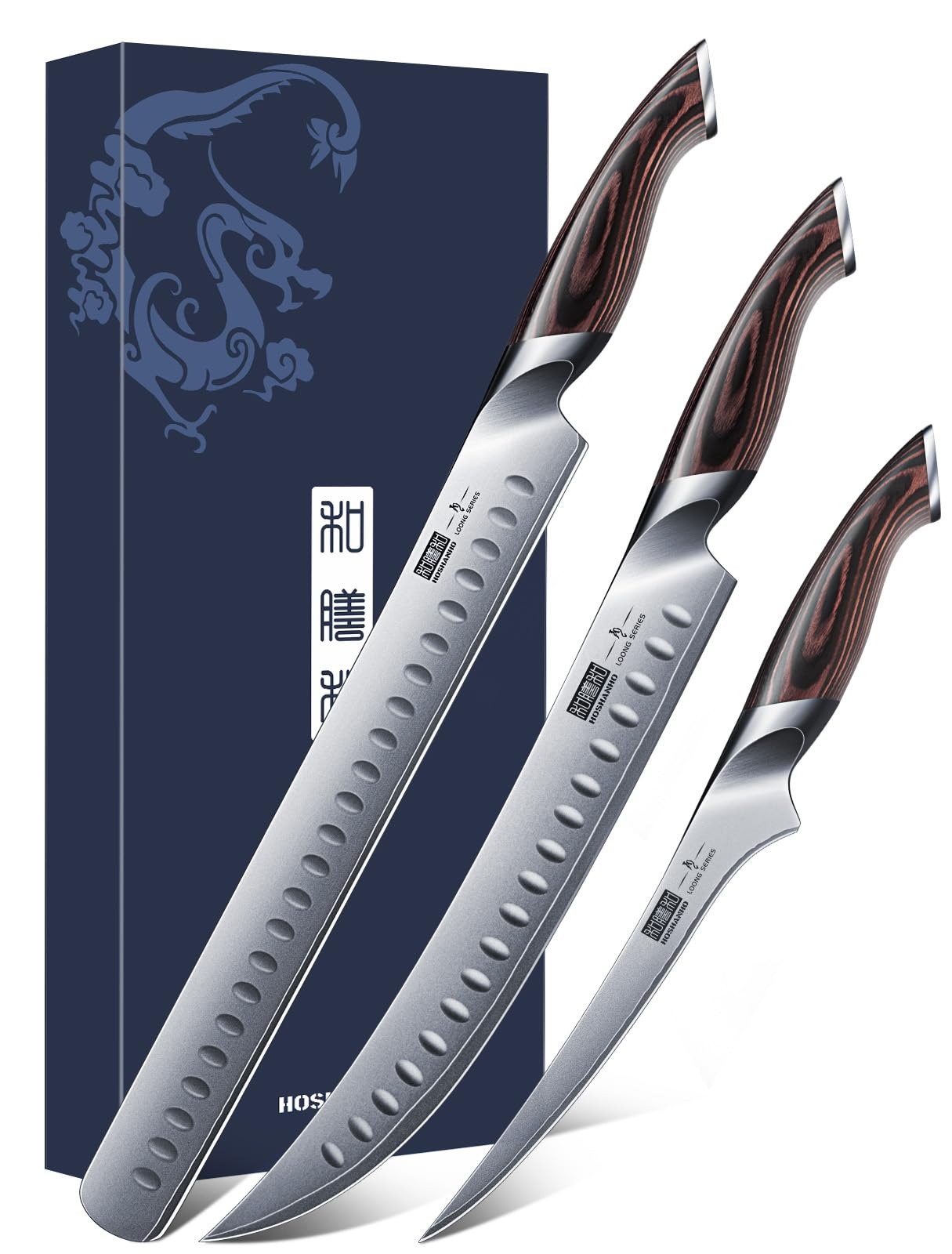
The HOSHANHO set offers three dedicated meat-cutting blades — a 12-inch carving knife, a 10-inch brisket knife, and a 7-inch fillet knife — packaged in an elegant gift box, making it the only multi-knife option in this review. The steel is 10Cr15CoMoV Japanese high-carbon stainless, a composition that incorporates chromium, molybdenum, and vanadium to increase hardness and stain resistance beyond standard 440-series stainless. Each blade receives a hand-ground 15-degree edge, which for budget-tier pricing is a genuine attention to detail that shows in initial performance on raw chicken thighs or beef tenderloin.
The Pakkawood handles across all three knives maintain a consistent ergonomic curve that fits the finger joints naturally, reducing fatigue during the extended butchering sessions that multi-knife set users often perform. The 1.5-pound total set weight indicates full-tang construction and solid handle scales, giving the knives a confidence-inspiring heft that belies the budget price point. The 12-inch carving knife performs similarly to the Dalstrong in basic slicing tasks, though the edge retention falls short of AUS-10V or VG-10 — you will notice a drop in sharpness after processing several pounds of dense meat, requiring a mid-session honing.
This set is best suited for the home cook who frequently handles different meat-cutting tasks in one session — trimming fat with the fillet knife, following with the brisket knife, then finishing with the carving knife for presentation slices — without wanting to switch between separate single knives. The budget-friendly price point makes it accessible, but the steel’s edge life is measurably shorter than premium-core alternatives. If you prioritize having the right blade for each meat task over absolute edge retention, this set delivers functional versatility.
Why it’s great
- Three-piece set covers carving, brisket slicing, and fillet trimming in one purchase
- 10Cr15CoMoV Japanese steel with hand-ground 15-degree edge for clean initial cuts
- Consistent Pakkawood handle ergonomics across all three blades reduce fatigue
Good to know
- Edge retention is not competitive with VG-10 or AUS-10V steel cores
- Requires mid-session honing when processing large volumes of dense meat
FAQ
Can I use a Japanese meat knife on bone-in cuts of meat?
How do I maintain the edge on a VG-10 or SG2 meat knife?
What blade length is best for cutting large meat roasts?
Is a Damascus cladding just cosmetic, or does it improve meat cutting performance?
Final Thoughts: The Verdict
For most users, the japanese knife for cutting meat winner is the Yoshihiro VG10 Hammered Damascus Gyuto because its VG-10 core at 60 HRC and hammered tsuchime finish deliver exceptional edge retention and food release at a price that balances premium performance with genuine value. If you want a dedicated long-blade slicer for carving roasts and brisket, grab the Shun Classic 9″ Hollow Ground Slicing Knife. And for the cook who demands the sharpest possible edge and longest intervals between sharpening, nothing beats the Miyabi Birchwood SG2 Chef’s Knife.