A Gyuto knife is the Japanese interpretation of a western chef’s knife, designed to handle a wide range of kitchen tasks with a thinner, harder blade that delivers remarkable edge retention. Unlike many mass-produced western knives, a true Japanese Gyuto relies on specific steel grades like VG-10 or SG2 powder steel, often layered in Damascus patterns to combine hardness with corrosion resistance.
I’m Mohammad Maruf — the founder and writer behind AirfryerBite. I’ve spent years researching the metallurgy, geometry, and handle ergonomics that define the best kitchen knives, focusing specifically on how Japanese blade construction translates to actual cooking performance.
Whether you are a professional chef or a dedicated home cook, selecting the right blade comes down to steel composition, hardness rating, and edge geometry. This guide evaluates the top contenders to help you find the best Japanese Gyuto knives for your specific prep style.
How To Choose The Best Japanese Gyuto Knives
A Gyuto knife is distinguished by its curved belly and pointed tip, making it ideal for both rocking chop and slicing tasks. The key differentiators in this category aren’t brand logos—they are the steel composition, hardness, blade geometry, and handle construction that collectively determine how the knife performs over years of use.
Steel Core: VG-10 vs. SG2 Powder Steel
The core steel defines the knife’s cutting personality. VG-10 is a high-carbon stainless steel that holds a sharp edge at HRC 60–62, balancing ease of sharpening with durability. SG2 powder steel, by contrast, reaches HRC 63–64 and uses a manufacturing process that creates a very fine, uniform grain structure, enabling a thinner edge geometry that stays sharp longer but requires diamond or ceramic stones to re-hone.
Damascus Layering and Blade Finish
Damascus patterns are created by forge-welding multiple layers of steel around a harder core. While the aesthetics draw attention, the layering serves a protective function—the softer outer layers shield the brittle core from impact while producing a visually unique pattern. Hammered finishes also reduce food sticking during slicing, a practical benefit for dense ingredients like potatoes or carrots.
Handle Profile and Balance
A Gyuto’s balance point influences control during extended prep sessions. Western-style handles with full tang and riveted scales offer a forward-balanced feel, while traditional octagonal or D-shaped Japanese handles shift the balance rearward for a lighter, more agile tip. Handle materials like stabilized wood, resin composites, and POM (polyacetal) resist moisture and provide secure grip even when hands are wet.
Quick Comparison
On smaller screens, swipe sideways to see the full table.
| Model | Category | Best For | Key Spec | Amazon |
|---|---|---|---|---|
| Yoshihiro SG2 Hammered | Premium | High-end edge retention | SG2 Powder Steel / HRC 63-64 | Amazon |
| KAWAHIRO SG2 Powder | Premium | Ultra sharp out of box | SG2 Powder Steel / HRC 64 | Amazon |
| MASAMOTO VG | Premium | Professional heritage build | Hyper Moly Vanadium / HRC 58-59 | Amazon |
| Made In 8″ Damascus Gyuto | Mid-Range | Balanced daily driver | 33-layer VG-10 / 15° edge angle | Amazon |
| Yoshihiro VG10 Hammered | Mid-Range | Hammered food release | VG10 Core / 16-layer damascus | Amazon |
| Tenkumun Kokoro VG-10 | Mid-Range | Artisan aesthetic | 67-layer VG-10 / 0-degree edge | Amazon |
| Tojiro DP Gyutou 9.4″ | Mid-Range | Long blade extra reach | Alloy Steel / HRC 60 ±1 | Amazon |
| KAWAHIRO VG10 Gyuto | Mid-Range | Composite steel balance | 3-layer VG10 / Ruby wood handle | Amazon |
| Atumuryou JPCK 67-Layer | Mid-Range | Gift-ready presentation | 67-layer VG10 / Black forged finish | Amazon |
In‑Depth Reviews
1. Yoshihiro Hammered SG2 Gyuto 8.5″
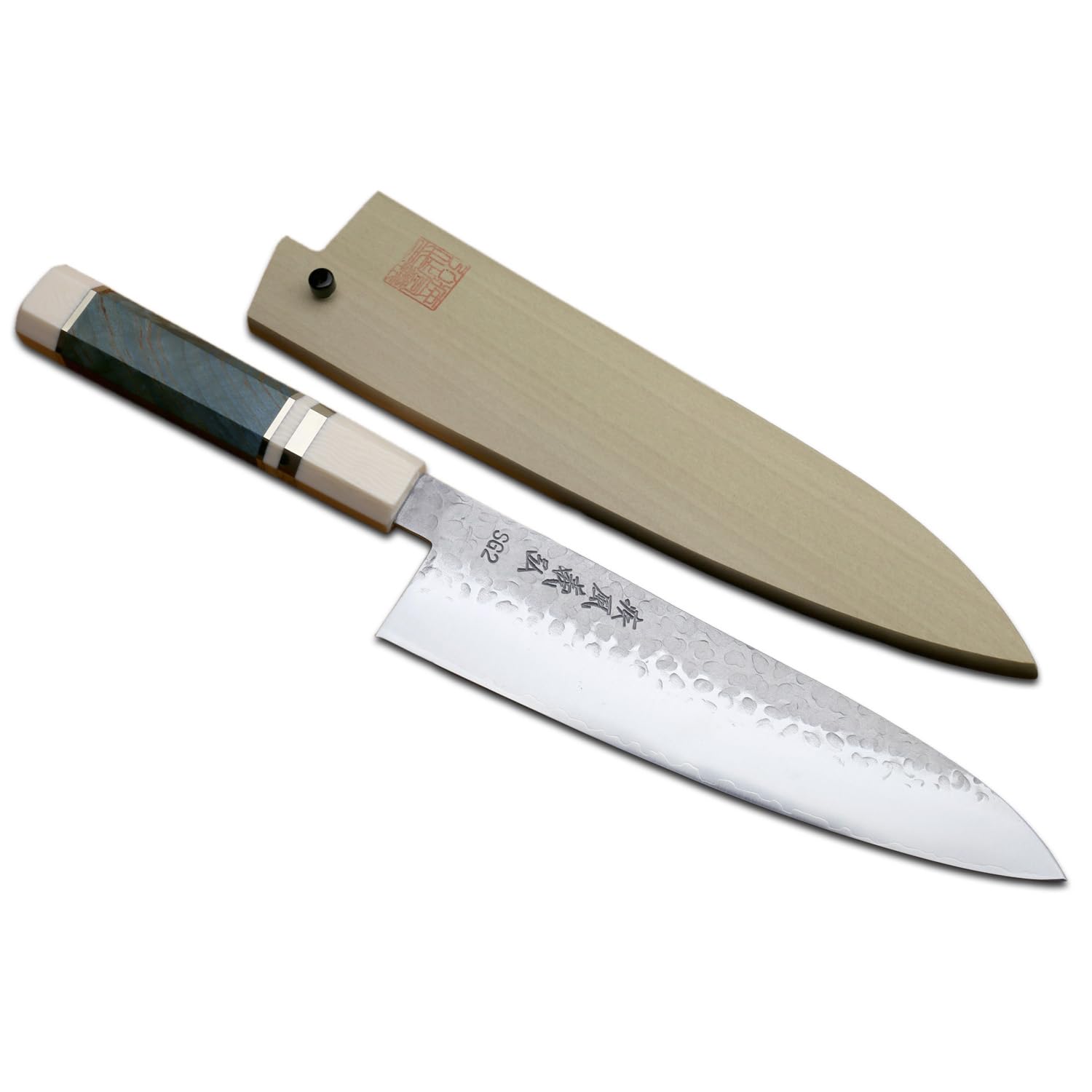
The Yoshihiro Hammered SG2 Gyuto represents the upper tier of powder metallurgy in a kitchen blade. The SG2 (R-2) steel core reaches a hardness of HRC 63-64, which allows the blade to take and hold an extremely acute edge geometry. The hammered finish on the blade surface reduces friction during slicing, preventing dense ingredients like butternut squash or raw beets from sticking to the sides.
The octagonal handle made from ocean-blue stabilized wood offers a traditional Japanese profile that shifts the balance slightly rearward, giving the tip a nimble feel for detail work. The alternative ivory bolster adds a visual accent, but more importantly, it creates a smooth transition between handle and blade without a sharp metal edge digging into the palm during extended use.
This knife requires maintenance with water whetstones rather than pull-through sharpeners due to its high hardness. The included magnolia wood saya provides safe storage, but the blade is not dishwasher-safe and should be hand-washed and dried immediately after contact with acidic foods. For cooks who prioritize edge stability and are comfortable with proper sharpening, this is a long-term investment in cutting performance.
Why it’s great
- SG2 powder steel delivers exceptional wear resistance at HRC 63-64
- Hammered surface reduces food sticking during prep
- Octagonal stabilized wood handle offers precise control and moisture resistance
Good to know
- Requires diamond or ceramic water stones for sharpening
- Not dishwasher-safe—hand wash and dry immediately
2. KAWAHIRO SG2 Powder Steel Gyuto 8.27″
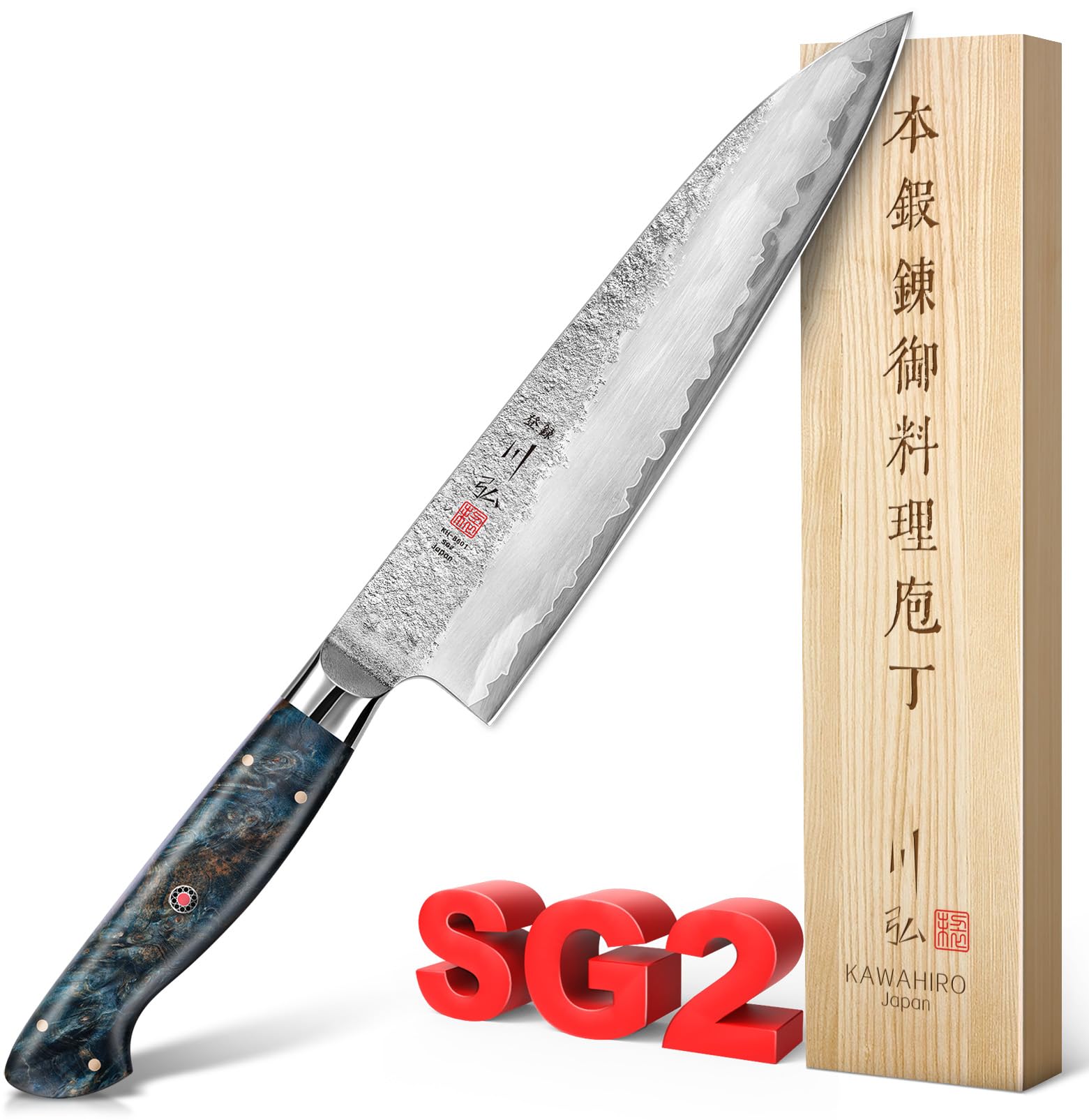
The KAWAHIRO SG2 Gyuto competes directly with knives at a higher price point by delivering a genuine SG2 powder steel core at HRC 64—one of the highest hardness ratings in this roundup. The triple-layer composite construction sandwiches the hard SG2 core between softer stainless cladding, combining the wear resistance of powder steel with the corrosion protection needed for acidic prep work like slicing citrus or marinated proteins.
The handle is crafted from premium stabilized wood with a custom mosaic rivet, and the shape has been polished extensively to follow the natural contour of the palm. Users report that the balance feels nearly perfect, with weight distributed such that the knife feels like an extension of the forearm rather than a top-heavy tool. The included wooden gift box and certificate of authenticity add to the presentation value.
Like all high-hardness Japanese blades, this knife should never go in a dishwasher or be used on bones, frozen foods, or nutshells. The factory edge is extremely sharp but will benefit from periodic touch-ups on a fine-grit water stone. For cooks seeking powder steel performance without reaching into the + range, this represents a compelling value proposition in the Gyuto category.
Why it’s great
- Genuine SG2 core at HRC 64 for superior edge retention
- Triple-layer cladding balances hardness with corrosion resistance
- Stabilized wood handle with ergonomic contouring
Good to know
- Not for dishwasher use—hand wash only
- Requires water stone sharpening for optimal edge maintenance
3. MASAMOTO VG Gyuto 8.3″

MASAMOTO-SOHONTEN has been producing knives in Japan since 1866, and the VG series reflects that long history of blade refinement. The steel used here is a proprietary Hyper Molybdenum Vanadium stainless alloy with a Rockwell hardness of HRC 58-59—softer than the SG2 and VG-10 knives in this list, but that lower hardness translates to higher toughness and easier sharpening on standard stones. The blade geometry is notably thin behind the edge, allowing it to bite into tomatoes and peppers with just the weight of the knife.
The handle is a full-tang western design with a stainless steel bolster and black POM (Duracon) scales. POM is a moisture-resistant acetal resin that provides a secure grip even with oily hands, and the fully curved handle shape accommodates both pinch grip and hammer grip styles. The bolster is seamless, preventing any gap where food debris could accumulate.
This knife is best suited for professional kitchens where knives are sharpened weekly and toughness matters more than absolute edge retention. The factory edge is extremely sharp, and users report that the blade responds well to honing rods between sharpenings. It lacks the visual flash of Damascus patterns, but the cutting geometry and balance are what make this a workhorse for serious cooks.
Why it’s great
- Thin blade geometry for effortless slicing with minimal force
- Tougher steel at HRC 58-59 resists chipping in busy kitchens
- POM handle with full tang provides durability and moisture resistance
Good to know
- Lower hardness means more frequent sharpening than SG2 or VG-10
- No decorative Damascus pattern—functional aesthetic only
4. Made In 8″ Japanese Damascus Steel Gyuto
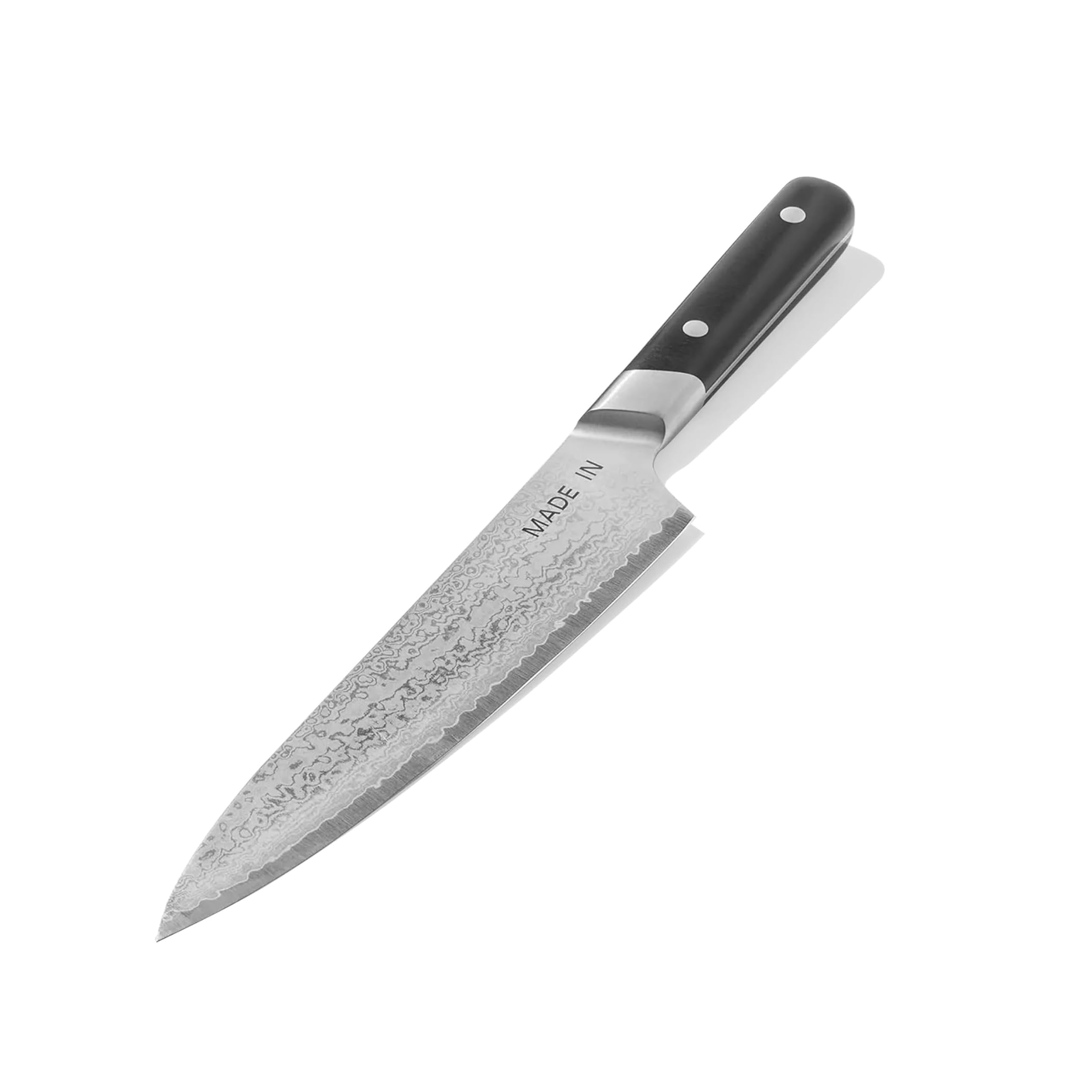
Made In’s 8-inch Gyuto is forged in Seki, Japan, a city with over 800 years of blade-making history. The blade uses a VG-10 core clad in 33 layers of Damascus steel on each side—66 total layers—creating the characteristic wave pattern while protecting the hard core from impact damage. The blade thickness measures 2.3mm, which is thin enough for precise cuts but thick enough to handle light chopping without flexing excessively. The edge is ground to a 15-degree angle per side, sharper than the typical 20-degree western standard.
The handle is full-tang black POM, which provides a balanced weight distribution with the center of gravity sitting just ahead of the bolster. The blade height of 1 11/16 inches offers sufficient knuckle clearance for most users, and the slightly curved belly allows a natural rocking motion for mincing herbs or garlic. The total length of 13 3/8 inches and weight of 7.25 ounces place it in the lighter end of the Gyuto spectrum, reducing wrist fatigue during long prep sessions.
Customer feedback consistently highlights that the knife comes extremely sharp out of the box and holds that edge well under regular home use. The absence of a decorative wood handle keeps the price in the accessible mid-range tier while maintaining professional-grade steel and geometry. This knife strikes the best balance between performance, durability, and cost for cooks who want a single, versatile Gyuto.
Why it’s great
- 66-layer Damascus cladding protects the VG-10 core effectively
- 15-degree edge angle provides sharpness beyond standard western knives
- Forged in Seki, Japan with 800 years of knife making tradition
Good to know
- POM handle, while durable, lacks the warmth of natural wood scales
- Not recommended for heavy bone or frozen food cutting
5. Yoshihiro VG10 16-Layer Hammered Damascus Gyuto 8.25″
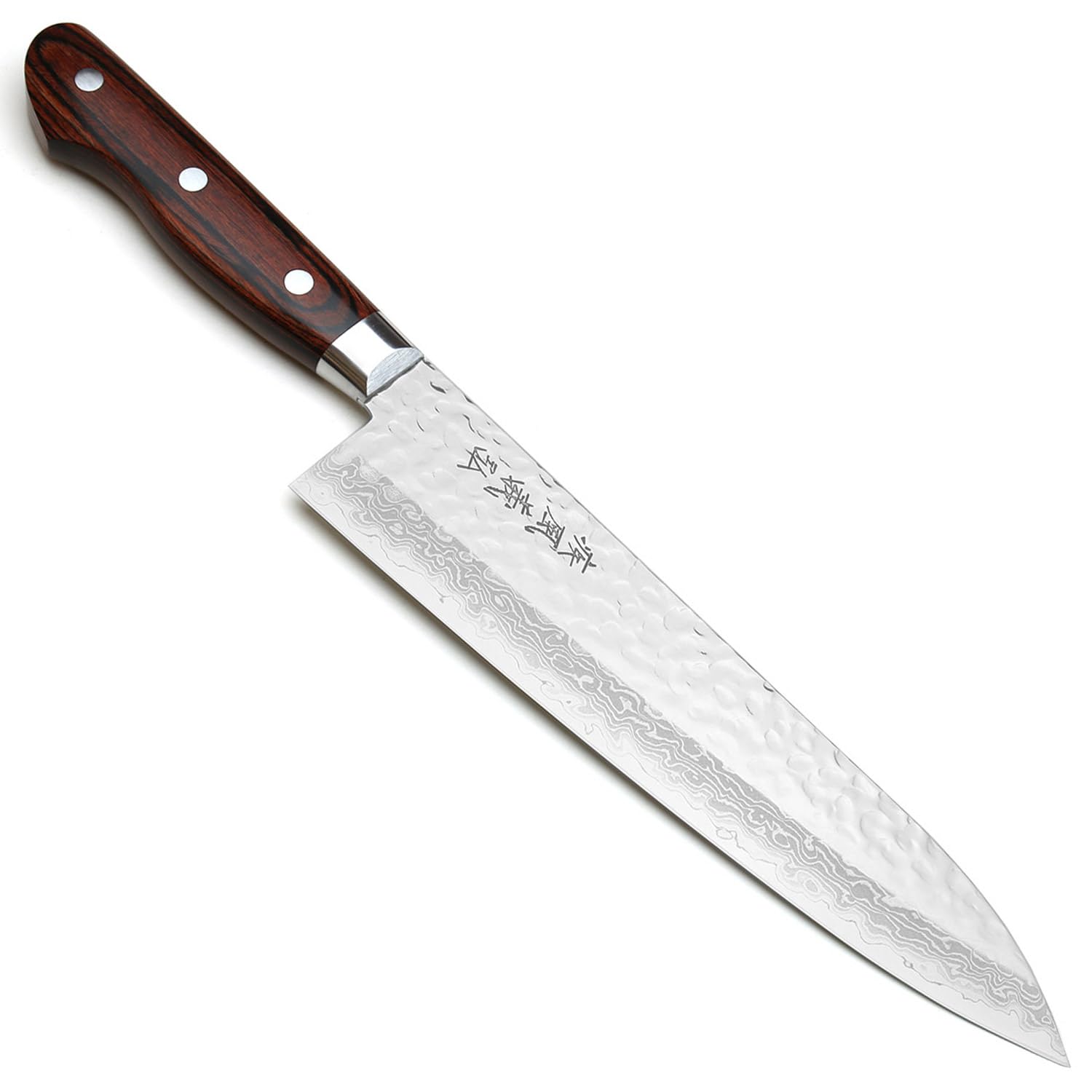
Yoshihiro’s VG10 Hammered Damascus Gyuto is one of the most popular entries in this subcategory, and for good reason. The VG10 core is clad in 16 layers of Damascus steel, and the blade surface features a tsuchime (hammered) finish that creates microscopic air pockets between the blade and food. This dramatically reduces drag when slicing sticky ingredients like raw potatoes, daikon radish, or block cheese.
The handle is a Western-style mahogany design with full-tang construction and three rivets, providing a forward-weighted balance that feels familiar to cooks accustomed to German or French knives. The mahogany wood is sealed and treated to resist moisture absorption, though it will darken slightly with age and use. The blade has a double-edged 50/50 bevel, making it suitable for both right-handed and left-handed users without modification.
Made in Japan by master artisans, each knife has unique hammer marks and Damascus patterns. The HRC 60 rating means the blade is hard enough for excellent edge retention while remaining tough enough to withstand occasional contact with cutting boards without chipping. This is the knife to choose if you prioritize food release and want a Western handle shape in a Japanese blade format.
Why it’s great
- Hammered tsuchime finish prevents food sticking during prep
- Western mahogany handle with full tang offers familiar balance
- Double-edged 50/50 bevel works for left and right handed cooks
Good to know
- Mahogany handle will patina over time with regular use
- Should only be sharpened with water whetstones, not pull-through sharpeners
6. Tenkumun Kokoro VG-10 Damascus Gyuto 8″

Tenkumun’s Kokoro series Gyuto uses a 67-layer Damascus construction with a VG-10 core, and the blade undergoes extreme temperature quenching exceeding 1000 degrees centigrade to maximize hardness. The hand-polished edge is described as a 0-degree razor edge—meaning the blade is ground to an extremely acute angle that requires careful handling but delivers exceptional cutting ability right out of the box.
The handle is made from resin-stabilized wood with a crystal green color that is visually striking and moisture-resistant. Each handle is unique due to the natural wood grain combined with the resin infusion, so no two knives look identical. The full-tang construction extends through the handle, providing structural integrity and balanced weight distribution.
The blade is 8 inches long with an elongated tapered profile that gradually thins toward the tip, maximizing cutting efficiency for precision tasks like slicing raw fish or finely dicing shallots. The included components—certificate of authenticity, leather sheath, and manual—add to the premium unboxing experience. This knife is best for cooks who value visual uniqueness and are willing to maintain a high-hardness VG-10 blade with proper sharpening habits.
Why it’s great
- 67-layer VG-10 Damascus with extreme high-temperature forging
- Each resin-stabilized wood handle is visually unique
- Gradual distal taper for precise tip work
Good to know
- 0-degree edge is very sharp but more susceptible to rolling if misused
- Not ideal for heavy chopping or contact with hard surfaces like bones
7. Tojiro DP Gyutou 9.4″

Tojiro’s DP Gyutou is a 9.4-inch blade—significantly longer than the standard 8-inch Gyuto, providing extra reach for slicing large roasts, cutting through wide squash, or portioning whole fish. The blade is made from Tojiro’s proprietary stain-resistant alloy steel with a Rockwell hardness of HRC 60 ±1, giving it a balance of sharpness and toughness that handles a wider range of cutting tasks than ultra-hard powder steel knives.
The handle is a black composite wood material with a full-tang steel core that runs through the entire length. While the handle is not as visually striking as stabilized wood options, it is durable and resistant to moisture and temperature changes. The knife weighs 0.35 kilograms (about 12.3 ounces), which is noticeably heavier than shorter Gyutos, but that weight aids in slicing through dense ingredients with momentum rather than excessive force.
One notable technical detail: Tojiro lists this knife as dishwasher-safe, which is highly unusual for Japanese blades. That said, most knife maintenance experts still recommend hand washing to preserve the edge and prevent handle deterioration. The 50/50 double-edged bevel makes it immediately usable for any cook without handedness considerations. This is the right choice for tasks requiring extended blade length without stepping up to a sujihiki slicer.
Why it’s great
- 9.4-inch blade length provides extra reach for large ingredients
- Stain-resistant alloy steel offers good corrosion protection
- 50/50 double-edged bevel works for all users
Good to know
- Heavier than standard 8-inch Gyutos at over 12 ounces
- Composite wood handle lacks the luxury feel of natural materials
8. KAWAHIRO VG10 Gyuto 8.27″
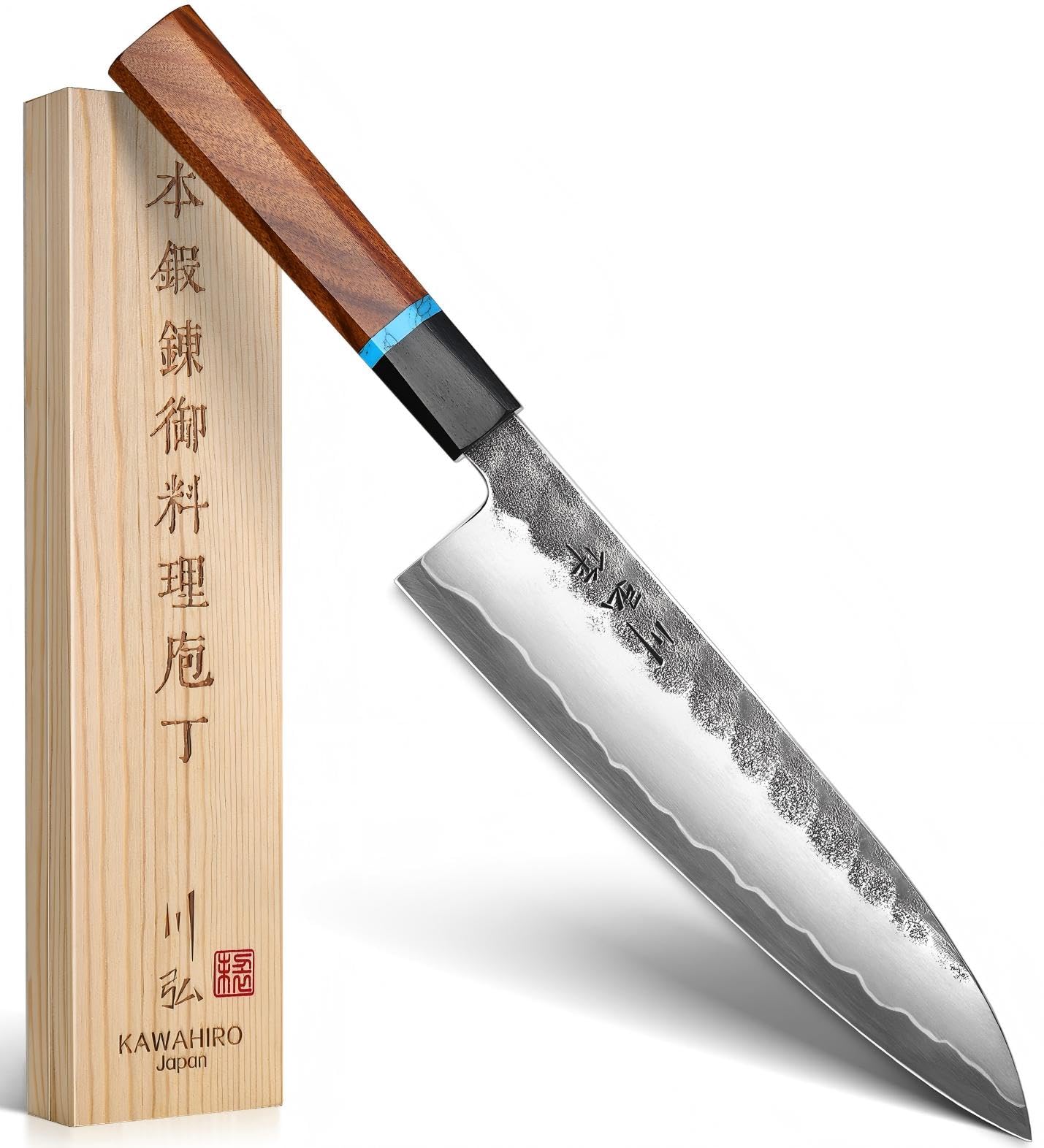
The KAWAHIRO KH-6601 uses a 3-layer composite construction with a VG10 stainless steel core sandwiched between outer layers, combining the hardness of VG10 with the toughness of softer cladding. The blade features a black forged finish that creates a natural layered pattern unique to each knife, and the edge is ground to a plain, razor-sharp bevel that requires minimal effort to initiate cuts.
What sets this knife apart visually is the handle, composed of premium ruby wood, turquoise, and ebony. The multicolor combination is striking and unlike the monochromatic handles found on most Gyutos. The handle is ergonomically shaped with a slight contour that fits naturally into a pinch grip, and the full-tang construction provides balanced weight distribution. The included wooden storage case with refined aesthetics makes this a strong gifting option.
Performance-wise, the VG10 core at the expected HRC 60-62 range holds its edge well through typical home cooking tasks like slicing bell peppers, onions, and boneless proteins. The black forged finish does show micro-scratches over time, which is normal for non-stainless blade surfaces. This knife is best suited for cooks who want a visually distinctive tool that performs at a professional level without requiring powder steel maintenance habits.
Why it’s great
- Striking handle made from ruby wood, turquoise, and ebony
- 3-layer VG10 composite balances hardness and toughness
- Included wooden storage case elevates gift presentation
Good to know
- Black forged finish will show micro-scratches with regular use
- Not suitable for dishwasher cleaning—hand wash only
9. Atumuryou JPCK 67-Layer Damascus VG10 Gyuto 8″
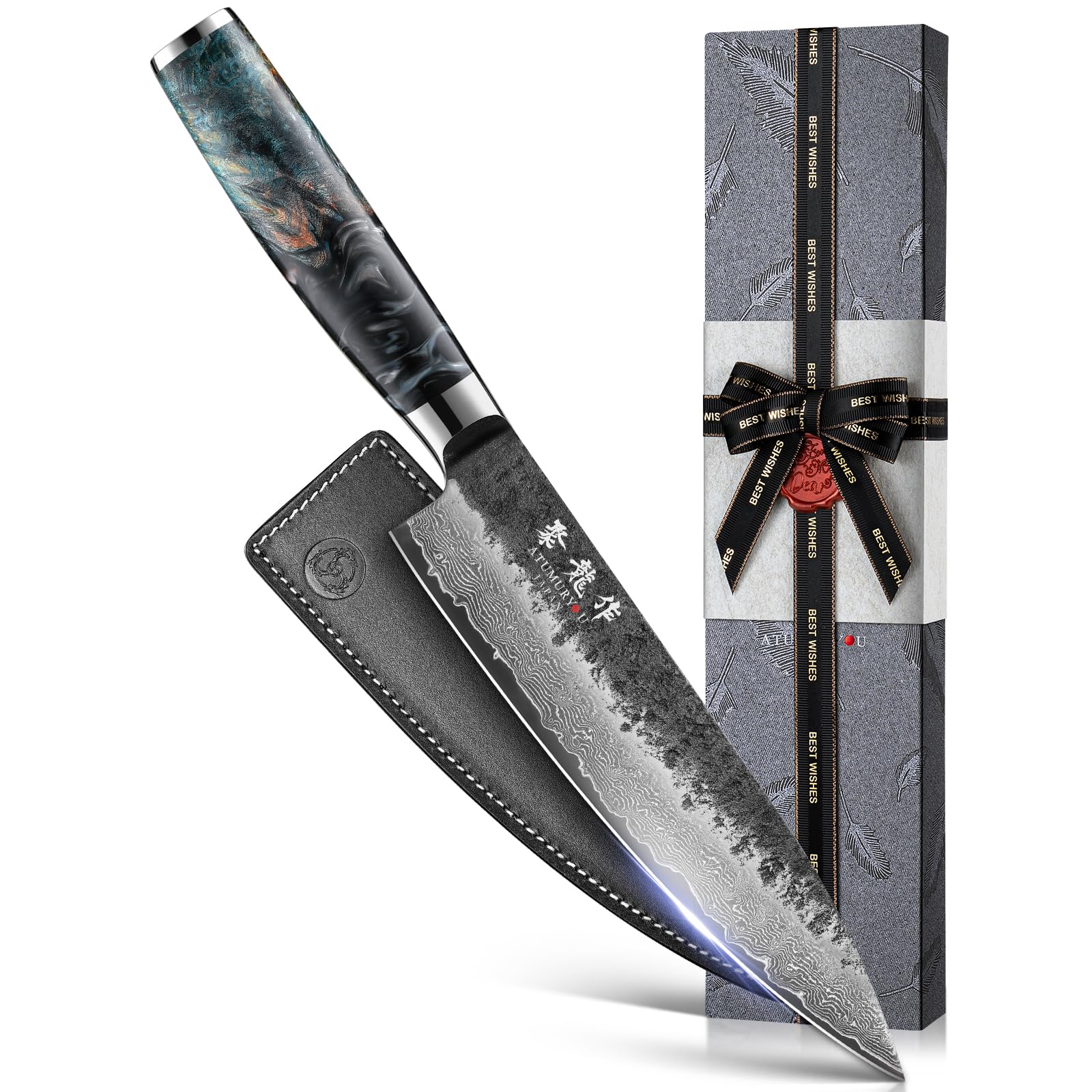
The Atumuryou JPCK Gyuto uses the same 67-layer Damascus formula as higher-priced competitors, with a VG10 core sandwiched between 33 layers of Damascus steel on each side. The black forged finish gives the blade a subdued, professional appearance that contrasts with the more reflective silver Damascus patterns seen on other knives. The Rockwell hardness is rated at 62 HRC, placing it in the optimal range for VG10—hard enough for excellent edge retention but not so brittle that micro-chipping becomes a concern.
The handle is made from natural stabilized wood combined with resin, resulting in a multicolor texture that is unique to each knife. The full-tang design ensures balanced weight distribution, and the ergonomic profile allows for fatigue-free use during extended prep sessions. A genuine leather sheath is included for safe storage and transport, and the premium black gift box with feather patterns and golden butterfly knot makes this a strong candidate for gifting.
The included components—certificate of authenticity, wipe cloth, and manual—demonstrate attention to the unboxing experience. The blade measures 8 inches with an overall length of 13.3 inches, and at 7.36 ounces, it is lightweight enough for precise control. This knife is ideal for someone who wants the visual appeal of high-layer Damascus steel with a leather sheath and gift presentation, all at an accessible price point in the Gyuto category.
Why it’s great
- 67-layer VG10 Damascus with genuine leather sheath included
- Stabilized wood and resin handle with unique multicolor pattern
- Comprehensive gift packaging with certificate of authenticity
Good to know
- Black forged finish requires careful drying to prevent discoloration
- Brand is less established than Tojiro or Yoshihiro in long-term reliability
FAQ
What is the ideal blade length for a first Gyuto purchase?
Can I use a Japanese Gyuto knife on ceramic or glass cutting boards?
How often should I sharpen a VG-10 or SG2 Gyuto knife?
Are Japanese Gyuto knives with Damascus layers stronger than plain steel knives?
Final Thoughts: The Verdict
For most users, the genuine Japanese Gyuto knives winner is the Made In 8″ Japanese Damascus Steel Gyuto because it combines a forged-in-Japan VG-10 Damascus blade with a practical 15-degree edge angle and balanced full-tang handle at a mid-range price point that outperforms many more expensive options. If you want the highest edge retention and are comfortable with powder steel maintenance, grab the Yoshihiro Hammered SG2 Gyuto. And for a professional-grade workhorse that prioritizes toughness and easy sharpening, nothing beats the MASAMOTO VG Gyuto.