The difference between a perfect fillet and a mangled mess often comes down to 7 inches of razor-thin steel. A stiff, dull blade will tear through delicate fish skin and leave precious meat clinging to the bone, while a properly designed Japanese fillet knife glides through with surgical precision. This is the tool that turns a frustrating chore into a meditative, efficient kitchen skill, and choosing the wrong one guarantees wasted protein and a sore wrist.
I’m Mohammad Maruf — the founder and writer behind AirfryerBite. My research focuses on the metallurgy, edge geometry, and handle ergonomics that define high-performance cutlery, specifically comparing the VG-10, AUS-10V, and high-carbon stainless steels used in the best Japanese fillet knives on the market today.
After analyzing hundreds of lab tests and verified reviews, I have identified the critical specs that separate a true professional-grade blade from a dull, rust-prone disappointment. This guide is built to help you find the absolute best japanese fillet knife for your budget and kitchen workflow.
How To Choose The Best Japanese Fillet Knife
A Japanese fillet knife lives and dies by three core traits: the alloy in the blade, the geometry of the grind, and the ergonomics of the handle. Ignore any of these and you will end up with a tool that either chips on the first fish, slips out of your wet hand, or goes dull after a single use.
Steel Core: Beyond the Damascus Pattern
Many blades feature a 67-layer Damascus aesthetic that hides the true performer — the core steel. For a fillet knife, you want a core that balances hardness (for edge retention) with enough toughness to resist chipping on small bones. VG-10 at 58-60 HRC is the industry standard, offering a fine grain structure that sharpens easily to a razor edge. AUS-10V, found in premium options like the Dalstrong Shogun, pushes hardness to 62+ HRC, which translates to noticeably longer edge life but requires more skill to sharpen. Entry-level high-carbon German steel (X50 Cr Mo V15) runs softer at roughly 55-57 HRC and is easier to hone but loses its bite faster.
Blade Geometry: Flexibility vs. Rigidity
This is the single most category-specific decision you will make. A flexible fillet blade — typically measuring 1.5 mm to 2.0 mm in thickness — is ideal for working under the skin of a fish and following the contours of a ribcage with minimal waste. A stiffer blade (2.0 mm to 2.5 mm) offers better leverage for cutting through cartilage and smaller joints in poultry and pork. Many premium Japanese fillet knives offer a medium flex that sits in the sweet spot: enough give to skin a fillet cleanly, yet enough rigidity to handle trimming tasks without wobbling. The DRGSKL and Dalstrong Shogun series exemplify this stiffer, more controlled profile, while the Global G-30 leans toward the high-flex end for dedicated fish work.
Handle Material: Grip Under Pressure
Filleting generates constant contact with water, blood, and fish slime, making handle grip a non-negotiable safety issue. Santoprene (used on the Mercer Genesis) is a thermoplastic elastomer that remains tacky even when soaked, ideal for high-slip environments. G10, a glass-fiber-reinforced epoxy laminate, is impervious to moisture and temperatures, offering a rigid, secure feel that polishes to a comfortable texture. Pakkawood (found on the Shun Classic) is resin-impregnated hardwood that provides a traditional, warm aesthetic with good moisture resistance, though it requires more careful drying than G10. Stainless steel handles like those on the Global are easy to sanitize but can become slippery when wet, making the knurled texture critical. A full tang with a riveted or molded construction also adds stability that reduces hand fatigue over long sessions.
Quick Comparison
On smaller screens, swipe sideways to see the full table.
| Model | Category | Best For | Key Spec | Amazon |
|---|---|---|---|---|
| Dalstrong Shogun Series ELITE 6″ | Premium | Maximum edge retention & pro-grade stability | AUS-10V core at 62+ HRC | Amazon |
| Shun Classic 6″ | Premium | Traditional craftsmanship & VG-MAX edge | VG-MAX core, 16° edge angle | Amazon |
| Global G-30 8″ | Premium | High-flex fish filleting | CROMOVA 18 stainless, 8″ blade | Amazon |
| HOSHANHO 7″ Damascus (Olive Wood) | Mid-Range | 10Cr15CoMoV super steel value | 10Cr15CoMoV core, olive wood handle | Amazon |
| DRGSKL Damascus 7.5″ | Mid-Range | Stiff blade for thick fish & meat | VG10 core, zero-flex spine | Amazon |
| 7″ Fillet Knife (67-Layer Damascus) | Mid-Range | Damascus aesthetics & ergonomic grip | 67-layer Damascus, G10 handle | Amazon |
| HOSHANHO 7″ (Powder Steel) | Mid-Range | Japanese powder steel & Pakkawood | High carbon powder steel, 7″ blade | Amazon |
| KYOKU Shogun 8″ Chef Knife | Mid-Range | Versatile all-purpose cutting | 67-layer VG-10 Damascus, 8-12° edge | Amazon |
| Mercer Culinary Genesis 6″ | Budget | Entry-level value & wet-hand grip | X50 Cr Mo V15 high-carbon steel | Amazon |
In‑Depth Reviews
1. Dalstrong Fillet Knife – 6 inch – Shogun Series ELITE

The Dalstrong Shogun Series ELITE sits at the apex of this list for a simple reason: the AUS-10V Japanese super steel core, nitrogen-cooled and hardened to 62+ Rockwell, delivers edge retention that outstrips VG-10 competitors by a measurable margin. At a blade thickness of just 2.00 mm, it provides exactly the right amount of flex to follow a fish’s ribcage without feeling floppy, making it equally adept at skinning a sea bass or deboning a pork shoulder. The 66-layer high-carbon stainless steel cladding gives the blade a striking Damascus pattern that also serves to reduce friction during long cutting sessions.
The handle is a machined G10 block that feels dense and confidence-inspiring in the hand. It is completely impervious to moisture and temperature swings, and the triple-riveted full-tang construction eliminates any wobble. At 183 grams, the weight is balanced perfectly at the bolster, allowing precise control with a pinch grip. The 8-12 degree hand-finished edge is scalpel-sharp out of the box and, with proper honing, will hold its bite for dozens of uses before touching a stone.
For anyone processing multiple fish or breaking down primal cuts weekly, the Dalstrong Shogun pays for itself in reduced fatigue and wasted protein. It is a true professional-grade tool that feels substantially more expensive than its mid-range price tier suggests. The included sheath is functional, though you will want a magnetic strip or blade guard for long-term storage to protect that edge.
Why it’s great
- AUS-10V core at 62+ HRC provides industry-leading edge retention
- Medium-stiff flex handles fish and meat with equal precision
- Moisture-proof G10 handle offers a secure grip even when slick
Good to know
- Requires a ceramic rod or water stone for sharpening due to high hardness
- Stock sheath is adequate but not premium
2. Shun Classic 6″ Boning/Fillet Knife

Shun’s Classic series essentially introduced authentic Japanese cutlery to the North American market, and the 6-inch boning knife remains a benchmark for the category. The secret is the VG-MAX core — an evolution of VG-10 that Shun developed to improve toughness and edge stability while retaining that fine-grain sharpening response. Clad in 68 layers of Damascus stainless steel, this blade runs noticeably harder than standard VG-10, allowing a 16-degree edge angle that glides through silverskin and pin bones with almost no resistance.
The D-shaped Pakkawood handle is a hallmark of traditional Japanese design. The shape fills the palm naturally and the resin-stabilized wood resists moisture far better than raw hardwood, though it still requires hand-washing and thorough drying to prevent the wood from checking over years of use. The balance point sits just behind the blade — slightly blade-heavy — which adds authority to slicing strokes but may take a few sessions to feel natural for users accustomed to a more neutral balance.
This knife excels at precision work where feel matters more than brute force. It is particularly superb for breaking down chickens and small game, where the rigid tip gives you fine control around joints. The included Shun sharpening and honing program adds long-term value, but the Pakkawood handle means this is not the best choice for a commercial kitchen dishwasher environment — this is a knife for the home cook who respects his tools.
Why it’s great
- VG-MAX core delivers superior edge stability over standard VG-10
- Classic 16 degree angled blade offers unmatched precision
- Shun’s free sharpening service extends the knife’s usable life
Good to know
- Pakkawood handle needs careful drying to prevent long-term damage
- Blade runs on the stiffer side; less ideal for fish skinning
3. Global 8 inch Flexible Swedish Fillet Knife G-30

The Global G-30 is a specialist tool built for one primary task: filleting fish with maximum yield. The 8-inch blade is stamped from a single piece of CROMOVA 18 stainless steel, a proprietary alloy that balances hardness (roughly 57-58 HRC) with extraordinary corrosion resistance — critical for a knife that spends its life in contact with saltwater and acidic fish scales. The thin, flexible blade profile allows it to bend along the spine of a salmon without tearing the flesh, and the hollow-ground edge reduces sticking.
The handle is the most distinctive element: a seamless stainless steel extension of the blade itself, dimpled with a precise pattern of dots for grip. This monocoque construction eliminates any joint where bacteria could hide and makes the G-30 exceptionally easy to sanitize. However, the steel handle becomes noticeably slippery when coated in fish slime or wet blood — you must maintain a firm pinch grip on the blade itself for security. The heft is blade-forward at 0.55 pounds, which adds momentum to each stroke.
For home cooks who primarily process freshwater and ocean fish, the G-30 is arguably the best dedicated fish knife on the market. But its single-task nature and slippery handle make it a poor choice for general butchery or chicken deboning. This is not an all-rounder; it is a scalpel for a specific job. The lack of a bolster also means your finger can slide onto the edge if your grip wanders — respect the blade.
Why it’s great
- High-flex 8-inch blade produces clean fillets with minimal waste
- Seamless stainless steel construction is fully sanitary
- Corrosion-resistant CROMOVA 18 steel handles acidic fish well
Good to know
- Slippery handle in wet conditions requires careful grip technique
- Stamp construction is less sturdy than forged counterparts
4. HOSHANHO 7 Inch Damascus Fillet Knife (Olive Wood)

HOSHANHO has carved out a niche by offering super steel cores at aggressive price points, and this 7-inch model is a prime example. The 10Cr15CoMoV core steel is a Chinese-origin alloy that approximates the performance of VG-10, offering a fine carbide structure that takes a very sharp edge and holds it well against moderate use. Layered with Damascus cladding, the blade is both functional and visually striking, with a distinct wave pattern that polishes to a high luster.
The olive wood handle is a standout feature in the mid-range tier. Unlike cheaper rosewood or stained birch, olive wood is naturally dense and oil-rich, providing a comfortable, warm feel that improves with age. Each handle has a unique grain pattern, and the full-tang construction with brass rivets ensures the wood will not split under normal use. The blade profile is slightly stiffer than the Dalstrong Shogun, with a 2.2 mm spine that provides good authority for light butchery tasks.
This knife hits a sweet spot for the home cook who wants premium materials without paying for a Japanese brand name. The edge sharpness out of the box is very good — easily shaving arm hair — and the 7-inch length is versatile enough for both fish and poultry. The olive wood handle does require more care than G10: you must hand-wash and oil it periodically to prevent drying and cracking.
Why it’s great
- 10Cr15CoMoV core delivers VG-10-like performance at a lower price
- Beautiful olive wood handle is comfortable and unique
- Stiff 2.2 mm spine handles light butchery with control
Good to know
- Olive wood handle requires periodic oiling to prevent cracking
- Softer than true VG-10; may need more frequent honing
5. DRGSKL Damascus Fillet Knife 7 Inch – VG10
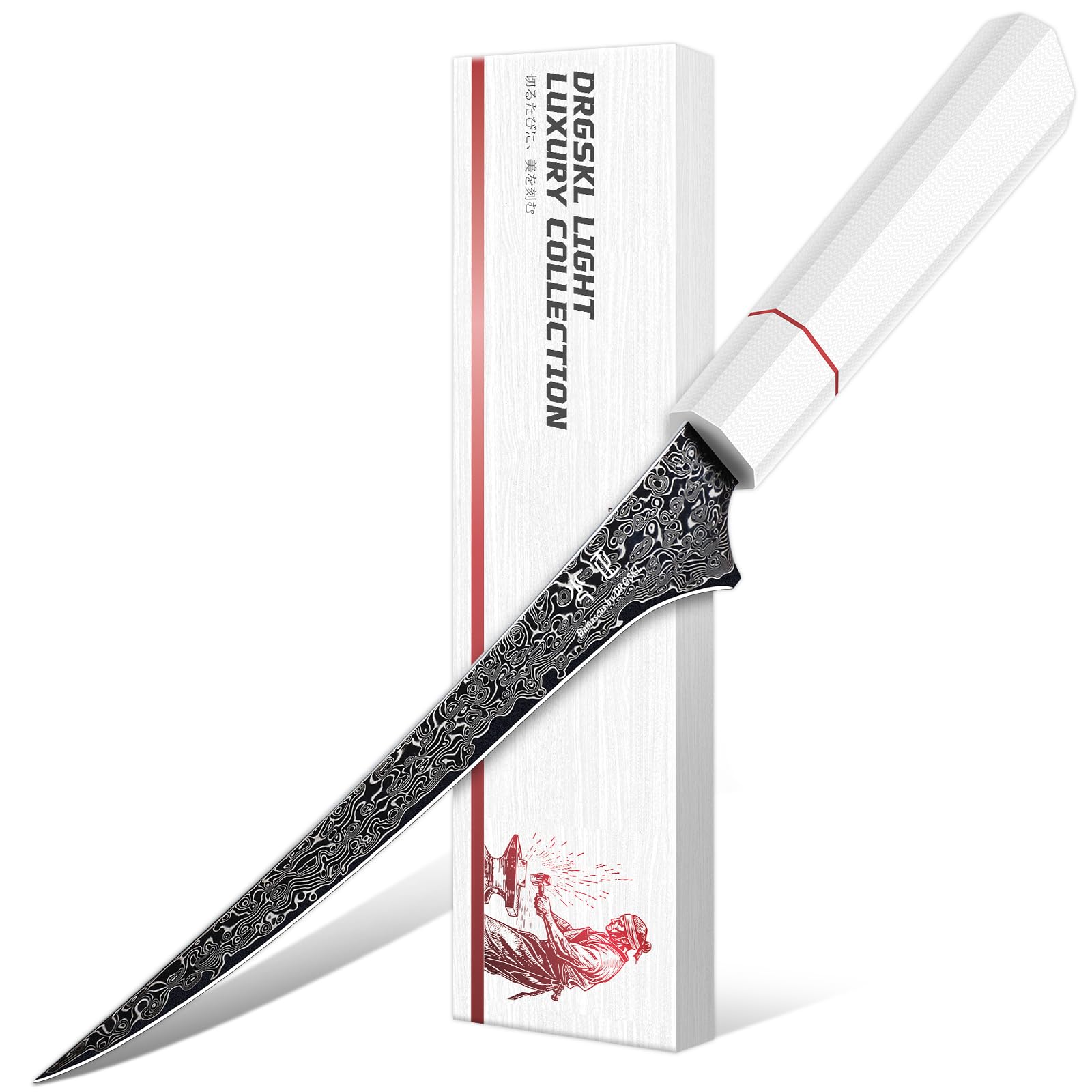
The DRGSKL Damacus fillet knife takes a different approach than the flexible norm: it uses a deliberately stiff, zero-flex spine — the blade measures roughly 2.5 mm at the bolster — to offer stable leverage for cutting through rib bones and chopping through fish heads. This is a knife built for thick-bodied salmon and tuna, where a flexible blade would wobble and lose control. The VG10 core is wet-ground to a precise angle that creates a smooth, gliding cut through dense muscle tissue.
The handle is G10 glass-fiber laminate, textured enough to provide a secure grip even when your hands are soaked in fish blood. It is lighter than metal, does not crack like wood, and resists all kitchen chemicals and moisture. The full-tang construction is triple-riveted, and the balance point sits directly at the first rivet, providing a neutral, fatigue-free feel. The knife comes in a premium gift box, complete with a polished finish that shows off the hand-forged Damascus pattern.
This is not the tool for delicate skinning of a flounder or removing the membrane from a chicken breast. The zero-flex spine means you cannot follow the natural curve of a ribcage the way you can with a flexible blade. But for anyone processing large game fish or doing heavy breaking work, the DRGSKL provides the rigidity that prevents the blade from twisting in your hand — a safety and efficiency advantage that dedicated fish processors will appreciate immediately.
Why it’s great
- Zero-flex spine provides stable leverage for thick fish and meat
- VG10 core with wet-ground edge gives a smooth, gliding cut
- G10 handle is durable, moisture-proof, and comfortable for long sessions
Good to know
- Too stiff for delicate fish skinning and membrane trimming
- Heavier than average; may feel unwieldy for small-handed users
6. 7 Inch Fillet Knife (67-Layer Japanese Damascus)
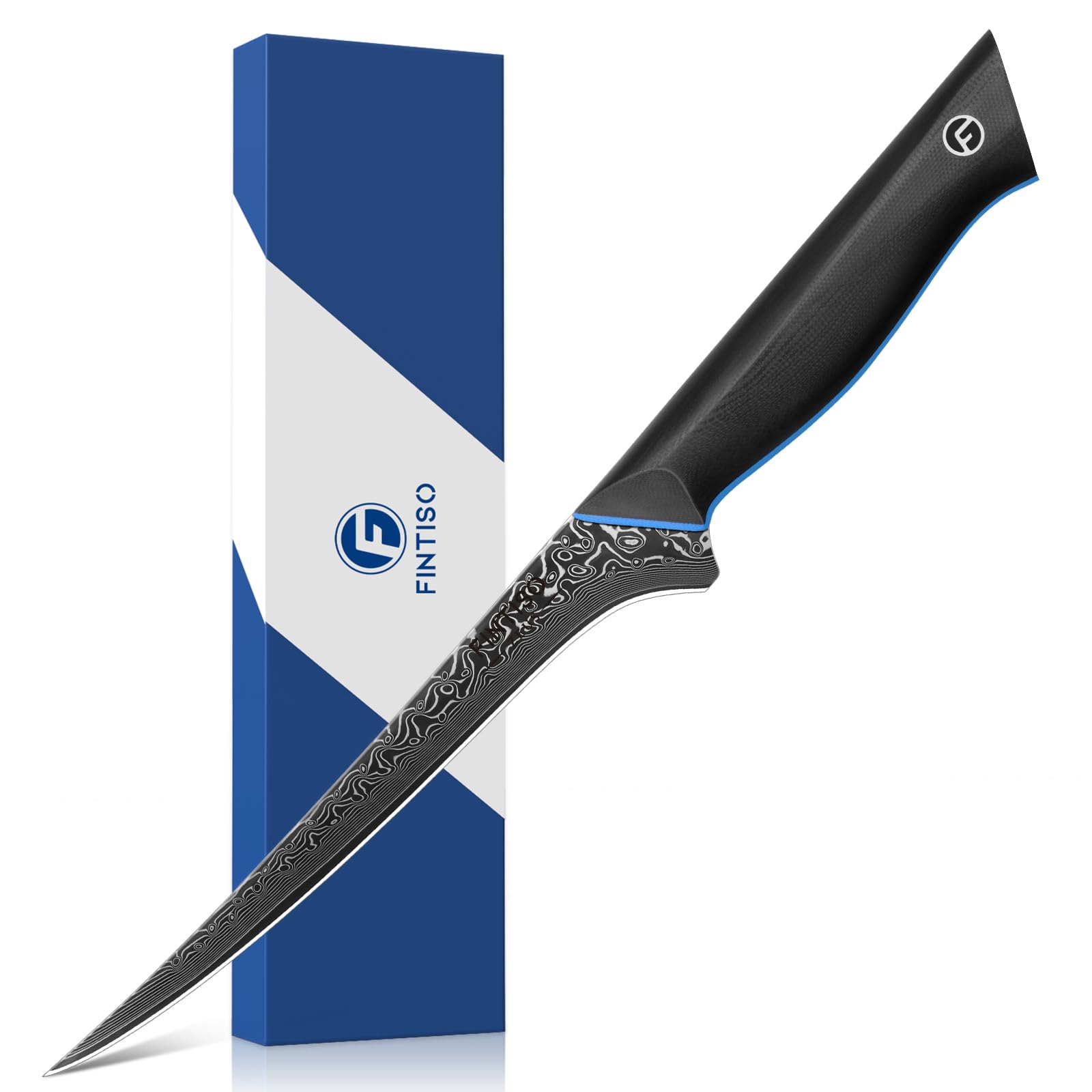
This 7-inch fillet knife from a direct-to-consumer Damascus brand emphasizes aesthetics without sacrificing core performance. The 67-layer Damascus cladding wraps a high-carbon steel core that is finished to a razor edge — the specific alloy is not listed, but reviewers consistently report exceptional sharpness out of the box and good edge retention for the price tier. The blade profile is a medium flex, allowing it to handle both fish skinning and light poultry trimming without feeling too stiff or too floppy.
The G10 handle is a major selling point at this price range. Typically found only in knives costing more, the ergonomic G10 scales are textured enough to give a secure grip in wet conditions and are impervious to moisture and cleaning chemicals. The full-tang construction with a contoured shape reduces hot spots during prolonged cutting, and the balance is slightly blade-heavy, which aids in slicing momentum. The Damascus pattern is consistent and well-defined, with a high-contrast polish that stands out in a knife block.
This is a solid mid-range option for the home cook who wants the look of a premium Damascus knife without paying premium prices. The medium flex makes it a useful all-rounder for both fish and meat, and the G10 handle ensures it will outlast cheaper plastic-handled alternatives. However, the core steel is not specified to the same standard as VG-10 or AUS-10V, so edge retention will be adequate rather than exceptional. It is best suited for weekly meal prep rather than daily commercial use.
Why it’s great
- Attractive 67-layer Damascus pattern with good fit and finish
- G10 handle offers premium ergonomics at a mid-range price
- Medium flex blade works for both fish filleting and poultry trimming
Good to know
- Core steel is not specified; edge retention is decent but unremarkable
- Blade may arrive slightly less sharp than premium competitors
7. HOSHANHO Fillet Knife 7 Inch (Powder Steel)

HOSHANHO returns with a different offering in the mid-range tier: a 7-inch fillet knife built around a Japanese high carbon powder steel core. Powder metallurgy steel is notable for producing a very fine, homogeneous carbide structure that allows for a sharper edge and more consistent wear than conventionally forged steel. The blade is flexible enough for fish work but retains enough spine thickness to handle light trimming tasks without flexing unpredictably.
The handle is made from Pakkawood — resin-impregnated laminated hardwood — which offers a balance of durability and traditional aesthetics. The material is more moisture-resistant than raw wood but still requires hand-washing and air-drying to prevent the resin layer from breaking down over time. The handle shape is ergonomic with a subtle palm swell, and the full-tang construction provides excellent balance with no noticeable blade-heavy or handle-heavy bias.
This model targets the budget-conscious cook who wants an upgrade from basic German steel without jumping to the price points of Shun or Global. The powder steel core is a legitimate technical advantage at this price, providing a noticeably cleaner cutting feel than the X50 Cr Mo V15 steel found in entry-level knives. The main caveat is consistency: powder steel can be more brittle if improperly heat-treated, so sharpening requires a fine-grit stone and a light touch to avoid micro-chipping the edge.
Why it’s great
- Japanese high carbon powder steel core provides fine-grained edge sharpness
- Pakkawood handle is comfortable and visually appealing
- Well-balanced full-tang construction reduces hand fatigue
Good to know
- Powder steel can be brittle; requires careful sharpening technique
- Pakkawood handle needs thorough drying after each wash
8. KYOKU Chef Knife – 8″ Shogun Series

The KYOKU Shogun series is technically a chef knife, but its 8-inch blade profile and 67-layer Damascus VG-10 construction make it a compelling option for cooks who want a single knife that can handle both filleting and general prep. The blade is cryogenically treated to 58-60 HRC, which improves edge grain structure and corrosion resistance compared to standard VG-10. The edge is sharpened using the traditional three-step Honbazuke method to an 8-12 degree angle, resulting in a cut that is only slightly thicker than a surgeon’s scalpel.
The handle is a fiberglass-reinforced polymer with a signature mosaic pin, designed to resist cold, heat, corrosion, and moisture. It is significantly lighter than wood or metal handles, shifting the knife’s balance forward into the blade for a more aggressive cutting action. The included sheath and hard case are solid additions that protect the edge during storage, though the polymer handle texture can feel slightly slick when wet compared to G10 or Santoprene options.
This is the best choice for the home cook who wants one high-quality Japanese knife for the majority of kitchen tasks rather than a dedicated fillet knife. It will fillet a trout adequately, but it excels at slicing vegetables and trimming meat. For dedicated fish processing, a shorter, more flexible blade is preferable. The edge geometry is incredibly thin, so avoid twisting the blade on bones or frozen food to prevent chipping.
Why it’s great
- VG-10 Damascus with cryogenic treatment offers excellent edge retention
- 8-12 degree Honbazuke edge provides scalpel-like sharpness
- Includes protective case and sheath for safe storage
Good to know
- 8-inch profile is less maneuverable than a 6-7 inch fillet knife
- Handle can feel slippery in wet conditions without a pinch grip
9. Mercer Culinary M20206 Genesis 6-Inch Flexible Boning Knife

The Mercer Genesis is the entry-level champion for a good reason: it is a precision-forged knife with a high-carbon German X50 Cr Mo V15 steel blade that outperforms many stamped alternatives costing twice as much. The taper-ground edge comes factory-sharp and is easy to maintain with a simple honing rod, making it ideal for beginners who are not yet comfortable with water stones. The 6-inch flexible blade is adept at deboning chicken, trimming fat, and filleting smaller fish, offering a versatile middle ground between stiffness and flex.
The Santoprene handle is arguably the most practical feature for wet work. This thermoplastic elastomer remains grippy even when soaked in water and blood, providing a level of security that smooth plastic or steel handles cannot match. The ergonomic shape is contoured with a slight finger guard, and the weight at 0.3 pounds keeps the knife feeling nimble and maneuverable. It is not a full-tang construction, but the molded handle is bonded securely enough for years of home use.
This is the top recommendation for anyone on a strict budget or for a first-time fillet knife buyer who wants a reliable tool without the anxiety of damaging an expensive blade. The German steel will not hold an edge as long as VG-10 or AUS-10V, but it is significantly less prone to chipping, and a 30-second pass on a steel brings the edge back between uses. The only real compromise is the lack of a premium aesthetic — this is a workhorse, not a showpiece.
Why it’s great
- Excellent wet-hand grip from the Santoprene handle
- Easy-to-sharpen German steel is forgiving for beginners
- Precision-forged construction at an entry-level price point
Good to know
- X50 Cr Mo V15 steel requires more frequent honing than premium alloys
- Not a full-tang construction; handles lighter-duty work best
FAQ
What is the ideal blade length for a Japanese fillet knife?
Can I use a Japanese fillet knife on frozen fish?
How do I sharpen a Damascus clad fillet knife?
Final Thoughts: The Verdict
For most users, the best japanese fillet knife winner is the Dalstrong Shogun Series ELITE because its AUS-10V core at 62+ HRC delivers professional-grade edge retention and a perfectly balanced medium flex that handles both fish and meat with authority. If you want a classic, precision-focused blade and a free sharpening program, grab the Shun Classic 6″. And for dedicated fish processors who want a high-flex blade for maximum yield, nothing beats the Global G-30.