A serrated blade that crushes a delicate brioche instead of slicing it cleanly is a breakfast ruined before it begins. The physics of a Japanese bread knife is distinct: a thinner cross-section, harder steel, and sharper serrations designed to bite through a crusty boule without compressing the soft crumb beneath. Most Western bread knives tear and shred because the blade is too thick and the edge geometry too obtuse for the task.
I’m Mohammad Maruf — the founder and writer behind AirfryerBite. I have spent years dissecting knife metallurgy, edge-retention tests, and handle ergonomics to identify which designs truly honor the craft of bread slicing.
Whether you bake a weekly sourdough or buy artisan loaves, the right tool transforms the experience. This guide evaluates the top contenders to help you find the best japanese bread knife for your kitchen and cutting style.
How To Choose The Best Japanese Bread Knife
A Japanese bread knife is not a generic serrated blade. The steel composition, hardening process, edge geometry, and handle ergonomics all contribute to a slicing experience that should feel effortless. Understanding these factors prevents the common mistake of buying a knife that looks the part but smashes your loaf.
Steel Hardness and Edge Retention
Japanese bread knives typically use high-carbon stainless steel with a Rockwell hardness (HRC) of 60 to 64. Harder steel holds a sharper edge longer and allows a thinner blade geometry, which reduces drag through dense crusts. Softer steel (HRC 55-58) dulls faster and requires a thicker blade to maintain strength, leading to more compression of the bread. Look for VG-10, AUS-8, or proprietary alloys like VG-MAX — these offer a balance of hardness, corrosion resistance, and ease of resharpening.
Serration Geometry and Tooth Pattern
Not all serrations are equal. Japanese bread knives often use scalloped or pointed teeth. Scalloped (granton-style) edges create a sawing motion that cuts through hard crusts without tearing, while pointed teeth offer a more aggressive bite for dense, rustic loaves. The spacing and depth of the serrations also matter — wider gaps clear debris better but may leave a rougher surface on soft bread. A good Japanese bread knife will have a consistent, well-ground serration pattern that stays sharp for years.
Handle Ergonomics and Balance
A bread knife is used in a sawing motion, so weight distribution and handle shape affect fatigue over multiple slices. Japanese handles are often D-shaped or octagonal, designed for a pinch grip that places the index finger and thumb on the blade itself for maximum control. Pakkawood, G10, or high-density micarta offer moisture resistance and a comfortable feel. The knife should feel balanced slightly forward of the handle, giving you leverage without requiring excessive force.
Quick Comparison
On smaller screens, swipe sideways to see the full table.
| Model | Category | Best For | Key Spec | Amazon |
|---|---|---|---|---|
| Shun Classic 9″ Bread Knife | Premium | Daily artisan bread slicing | VG-MAX core, 68-layer Damascus, HRC 61 | Amazon |
| Shun Classic Blonde 9″ Bread Knife | Premium | Gift-worthy heirloom performance | VG-MAX core, 68-layer Damascus, blonde handle | Amazon |
| Global G-9 8.5″ Serrated Bread Knife | Premium | Lightweight, high-tech stainless steel | Molybdenum/vanadium steel, HRC 58 | Amazon |
| Misen Serrated Bread Knife 5″ | Mid-Range | Compact tasks & soft breads | AUS8 steel, 5-inch blade, rounded serrations | Amazon |
| HOSHANHO 10″ Bread Knife | Mid-Range | Large loaves & baguettes | 10Cr15CoMoV steel, 15° edge, Pakkawood handle | Amazon |
| HOSHANHO 8″ Damascus Bread Knife | Mid-Range | Visual appeal & sharp edge | 67-layer Damascus, 10Cr15CoMoV core, G10 handle | Amazon |
| Huusk Japanese Chef Knife Set 6 pcs | Mid-Range | Complete knife set with bread knife | High-carbon steel set, hammered finish, wood handles | Amazon |
In‑Depth Reviews
7. Shun Classic 9″ Bread Knife

The Shun Classic 9″ Bread Knife is the benchmark against which all other Japanese bread knives are measured. Its VG-MAX cutting core — a proprietary high-carbon alloy — is clad in 68 layers of Damascus stainless steel, resulting in a blade that hits a 61 HRC hardness. The wide, scalloped serrations are ground at a 16-degree angle, allowing the knife to bite into a hard sourdough crust without tearing the interior crumb. The D-shaped black Pakkawood handle accommodates both left- and right-handed users with a secure, balanced grip.
In practice, this knife glides through a crusty boule with minimal resistance. The thin blade profile reduces friction, and the serrations clear debris efficiently, leaving a clean surface on the cut. The knife is 9 inches long, which is the ideal length for most artisan loaves — long enough to slice across a wide boule without dragging, but short enough for precise control. The included free sharpening service from Shun is a practical bonus that extends the knife’s lifespan significantly.
One detail that sets the Shun apart is its fit and finish. The blade is hand-finished in Japan, with a polished spine and a seamless transition from blade to handle. The knife feels heavier than a stamped blade, signaling quality without being cumbersome. For anyone who bakes regularly or appreciates fine cutlery, this is the definitive choice.
Why it’s great
- VG-MAX core delivers exceptional edge retention
- 68-layer Damascus cladding resists corrosion and adds strength
- Free sharpening service from Shun
- Comfortable D-shaped Pakkawood handle
Good to know
- Not dishwasher safe — hand wash only
- Higher investment than entry-level options
- Blade is thin and requires careful handling
6. Shun Classic Blonde 9″ Bread Knife

The Shun Classic Blonde 9″ Bread Knife shares the same VG-MAX core and 68-layer Damascus construction as the original Classic, but swaps the dark Pakkawood for a lighter, honey-toned blonde Pakkawood handle. The aesthetic difference is striking — the lighter wood contrasts beautifully with the brushed Damascus cladding, making it a centerpiece knife for open kitchens or a memorable gift. Beyond looks, the performance is identical: the 16-degree edge and wide serrations cut through crusty bread with the same effortless precision.
The D-shaped handle is slightly more contoured than the original, offering a natural index-finger groove that improves control during long slicing tasks. The blade is 9 inches long and weighs about 10 ounces, giving it a balanced feel that reduces wrist fatigue. The blonde Pakkawood is sealed for moisture resistance, but like all wood handles, it should never be soaked or placed in a dishwasher.
For those who value aesthetics as much as performance, the Blonde edition delivers without compromise. It receives the same lifetime warranty against defects and the same free sharpening program as the standard Classic. If you are looking for a knife that performs at the highest level and looks stunning on a magnetic strip, this is the one.
Why it’s great
- Same premium VG-MAX/Damascus steel as the original
- Unique blonde Pakkawood handle for visual distinction
- Excellent balance and ergonomic D-shaped grip
- Lifetime warranty and free sharpening included
Good to know
- Premium pricing reflects the handle material and finish
- Blade is thin and can chip if used on hard surfaces
- Hand wash and dry immediately
5. Global G-9 8.5″ Serrated Bread Knife

The Global G-9 8.5″ Serrated Bread Knife is a study in minimalist engineering. The entire knife — blade and handle — is crafted from a single piece of molybdenum/vanadium stainless steel, with a dimpled handle for grip and a seamless transition that eliminates any crevices where food residue could hide. The weight is remarkably low at just 166 grams, which makes this knife feel almost insubstantial in the hand, but the balance is forward-heavy enough to provide leverage for slicing through crusts.
The serrations are finer and more pointed than the Shun’s scalloped teeth, giving the G-9 a more aggressive bite. This works exceptionally well on dense, multi-grain loaves with very hard crusts, where the narrow tips of the serrations can penetrate without tearing. However, on soft, fluffy bread like Japanese milk bread or brioche, the fine teeth can leave a slightly rougher surface compared to wider scalloped edges.
The stainless steel handle is cold to the touch and smooth, which some users love for its hygienic feel and others find slippery when wet. The dimpled pattern provides decent traction. The knife is made in Japan and backed by a lifetime warranty against defects. For those who prioritize hygiene, low weight, and a modern aesthetic, the Global G-9 is a compelling option.
Why it’s great
- Extremely lightweight at 166 grams — reduces fatigue
- One-piece steel construction is hygienic and seamless
- Molybdenum/vanadium steel holds a sharp edge well
- Lifetime warranty against defects
Good to know
- Stainless steel handle can be slippery when wet
- Fine serrations may leave a rougher cut on soft bread
- Not dishwasher safe — hand wash required
4. Huusk Japanese Chef Knife Set 6 pcs
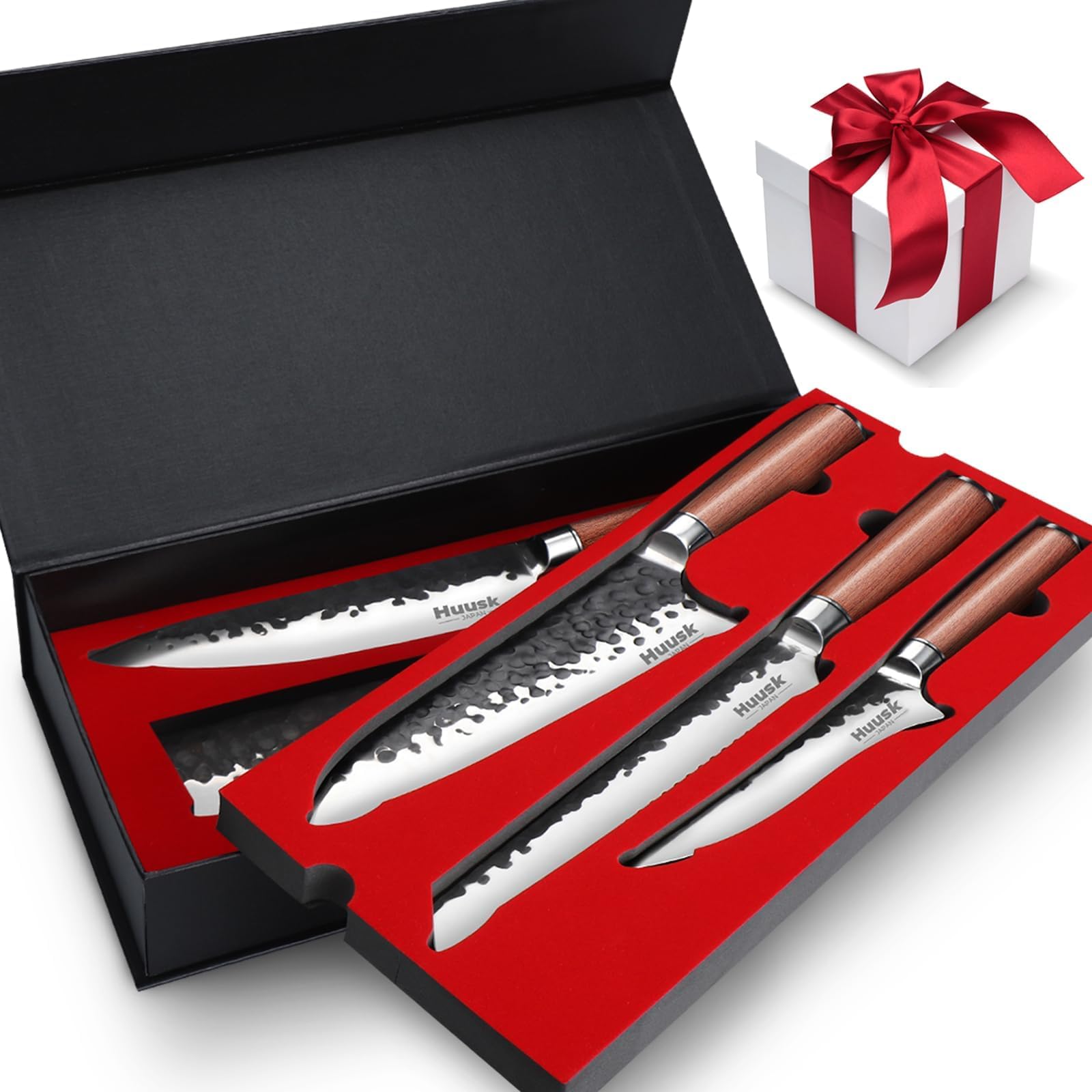
The Huusk Japanese Chef Knife Set is not a single bread knife, but a six-piece collection that includes a bread knife alongside a chef’s knife, paring knife, boning knife, nakiri, and gyuto. For someone building a kitchen from scratch or upgrading a starter set, this offers a cost-effective entry into Japanese-style cutlery. The blades are forged from high-carbon steel with a hand-honed edge, and the signature hammered texture reduces food sticking, making the set versatile for a range of tasks beyond bread slicing.
The bread knife in the set features a 7-inch blade with a plain edge — not serrated. This means it is designed for cutting bread that is already sliced or for softer loaves where a serrated edge is unnecessary. The absence of serrations makes it less effective on crusty artisan bread, but the high-carbon steel allows for a very sharp, straight edge that can handle bagels and soft breads cleanly. The ergonomic triangular wood handles are comfortable and provide good control.
The set comes in an elegant black gift box, making it a strong gifting option. The hammered finish is attractive and functional, reducing drag through food. While the bread knife in this set is not a dedicated serrated bread knife, the overall value of the set for the price is excellent. If you need a complete set and are willing to sacrifice some bread-specific performance for versatility, this is a strong choice.
Why it’s great
- Six-piece set covers most kitchen tasks
- High-carbon steel blades with hammered finish
- Comfortable ergonomic wood handles
- Elegant gift box packaging
Good to know
- Bread knife has a plain edge, not serrated
- Not ideal for very crusty artisan loaves
- Hand wash only — wood handles not dishwasher safe
3. HOSHANHO 10″ Bread Knife

The HOSHANHO 10″ Bread Knife is designed for those who regularly tackle large, wide loaves or long baguettes. The extra length — two inches longer than the Shun Classic — allows you to slice across a full boule in a single pass without needing to saw back and forth excessively. The blade is forged from Japanese 10Cr15CoMoV high-carbon stainless steel, a steel similar to VG-10, and is vacuum heat-treated for improved corrosion resistance. The edge is sharpened to 15 degrees, which is acutely sharp for a serrated blade, ensuring clean bites into crusts.
The handle is made from dark Pakkawood, shaped with a slight finger groove for comfort. The serrations are consistent and well-defined, cutting through sourdough and rye with minimal crumblin.
One practical advantage of the 10-inch length is that it works well for cutting large watermelons or layer cakes for those who use their bread knife for tasks beyond bread. The Pakkawood handle has a pleasant, smooth finish that feels secure in hand. The knife comes in a protective box, but no sheath is included, so storage on a magnetic strip is recommended.
Why it’s great
- 10-inch blade handles wide loaves in one pass
- Japanese 10Cr15CoMoV steel for good edge retention
- 15-degree edge angle for clean cuts
- Comfortable Pakkawood handle with finger groove
Good to know
- No blade sheath included
- Longer blade requires more storage space
- Hand wash only
2. HOSHANHO 8″ Damascus Bread Knife

The HOSHANHO 8″ Damascus Bread Knife pairs a striking aesthetic with functional performance. The blade is constructed from 67 layers of Damascus steel with a Japanese 10Cr15CoMoV inner cutting core, hardened to 62-64 HRC — notably harder than the Shun’s 61 HRC. This extreme hardness allows the edge to be sharpened to 12-15 degrees, producing an acutely sharp serration that slices through crusts with minimal pressure. The feather-like Damascus pattern is visually impressive and unique to each knife.
The handle is made from G10, a glass-fiber composite known for its corrosion resistance, dimensional stability, and non-slip grip even when wet. This is a significant upgrade over wood handles in terms of durability, as G10 will never crack, swell, or rot. The ergonomic shape provides a secure pinch grip, and the knife is lightweight at 0.48 pounds, reducing fatigue during extended use. The included gift box presentation adds perceived value for gifting.
One caveat: the extreme hardness (62-64 HRC) means the blade is more brittle than a softer steel knife. It should not be used on hard surfaces like glass or ceramic cutting boards, and it should be stored on a magnetic strip or in a knife block to protect the edge. For those who appreciate traditional Damascus aesthetics with modern handle materials, this HOSHANHO delivers a lot of performance at a compelling price point.
Why it’s great
- 67-layer Damascus steel with 62-64 HRC hardness
- G10 handle is durable, non-slip, and waterproof
- 12-15° edge angle for exceptional sharpness
- Lightweight and well-balanced at 0.48 lbs
Good to know
- Hard steel is more brittle — avoid hard cutting surfaces
- No blade sheath included
- Hand wash and dry immediately
1. Misen Serrated Bread Knife 5″
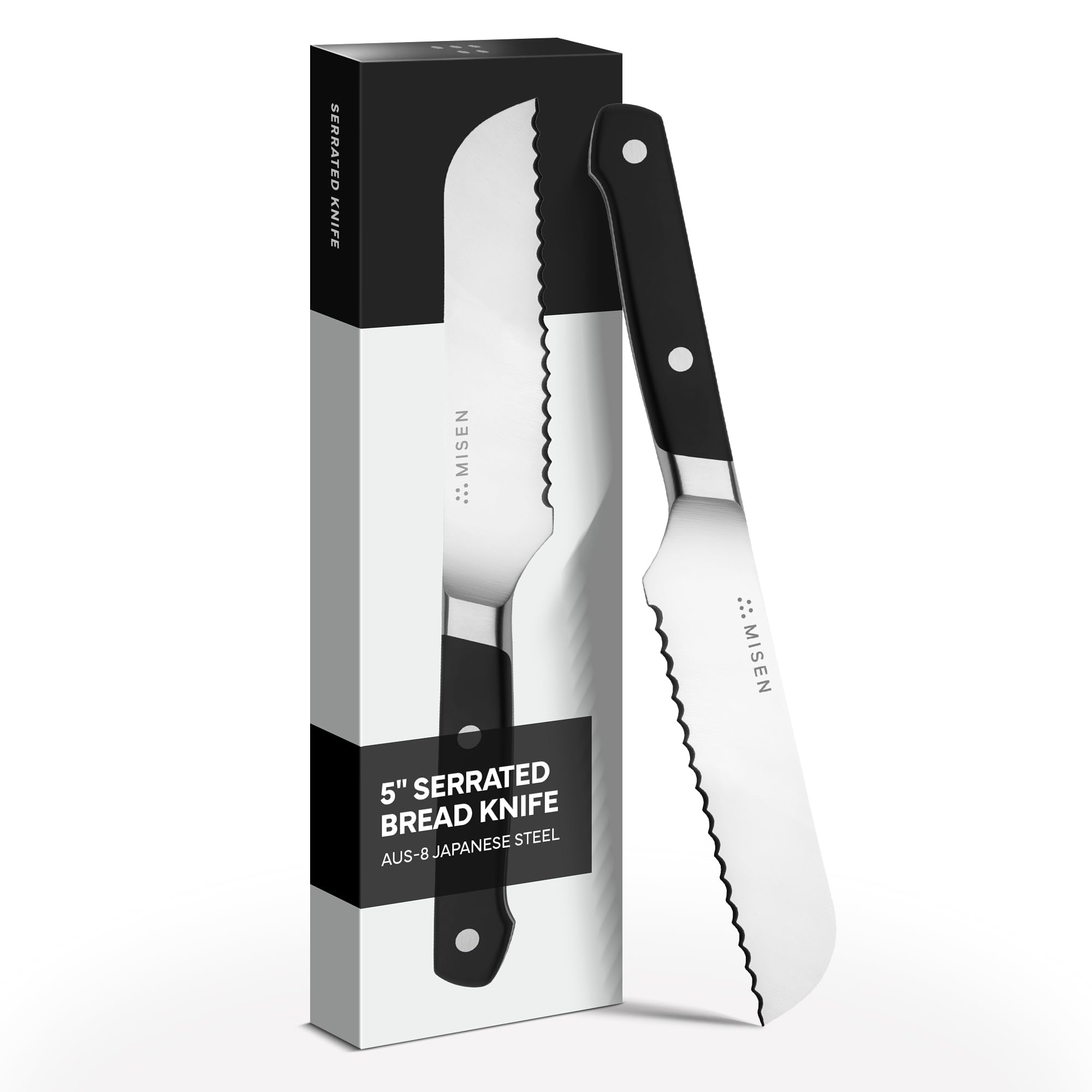
The Misen Serrated Bread Knife is a compact 5-inch blade designed for precision slicing of smaller items — bagels, croissants, rolls, and soft fruits like tomatoes. The blade is made from Japanese AUS8 high-carbon stainless steel, which offers a good balance of hardness, corrosion resistance, and ease of sharpening. The serrations are gently rounded, which minimizes tearing on soft breads and pastries, making it an excellent choice for delicate baking projects.
The handle features a slope design that encourages a pinch grip, with an ergonomic shape that reduces hand fatigue. The steel handle is coated with a textured black finish for grip, though it can feel cold in the hand initially. The knife is stamped rather than forged, which keeps the weight low and the cost accessible. At 5 inches, this knife will not replace a 9-inch bread knife for large loaves, but it excels as a secondary knife for quick breakfast tasks.
Misen’s direct-to-consumer model allows them to offer AUS8 steel at a competitive price point. The knife feels well-made for its class, with a consistent grind and no visible defects. For a small household that primarily bakes rolls or buys pre-sliced bread, this compact knife may be all you need. For larger loaves, pair it with a longer option from this list.
Why it’s great
- Compact 5-inch blade ideal for bagels and rolls
- AUS8 steel provides good edge retention
- Rounded serrations reduce tearing on soft breads
- Ergonomic handle reduces fatigue
Good to know
- Too short for large artisan loaves
- Stamped construction, not forged
- Steel handle can feel cold
FAQ
Can a Japanese bread knife be sharpened at home?
Why is a Japanese bread knife thinner than a Western one?
Final Thoughts: The Verdict
For most users, the best japanese bread knife winner is the Shun Classic 9″ Bread Knife because it combines proven VG-MAX steel, a comfortable D-shaped handle, and a free sharpening service into one reliable package. If you want a lighter, more modern alternative, grab the Global G-9 8.5″ Serrated Bread Knife. And for a complete kitchen upgrade on a budget, the Huusk Japanese Chef Knife Set 6 pcs offers impressive value with its high-carbon steel blades and hammered finish.