A honing steel doesn’t sharpen your knife—it realigns the microscopic edge that folds over during normal cutting. That single distinction separates cooks who get months of peak performance from a blade and those who wonder why their expensive chef’s knife feels dull after a week. Getting the right rod means understanding the difference between steel, ceramic, and diamond-coated surfaces, and choosing a length and grit that matches the steel you own.
I’m Mohammad Maruf — the founder and writer behind AirfryerBite. I’ve analyzed hundreds of kitchen edge-maintenance tools, comparing rod hardness, grit ratings, handle ergonomics, and build quality across dozens of product listings to isolate what actually preserves a knife’s factory edge.
This guide breaks down the material science and practical use of five carefully selected rods. If you want to stop chasing sharpeners and start keeping your knives ready with a few quick passes, you need the best honing steel for your specific blade hardness, steel type, and daily routine.
How To Choose The Best Honing Steel
Selecting a honing steel involves more than grabbing the cheapest rod. The material composition, grit rating, rod length, and handle safety features all determine whether you maintain a sharp edge or gradually damage your blade’s geometry. Match the rod to your knife’s hardness and your typical steel type.
Material: Steel vs. Ceramic vs. Diamond-Coated
Traditional smooth steel rods (like the WÜSTHOF and F. DICK models) work best for European-style knives with softer steel, typically measuring around 56-58 HRC. The smooth surface realigns the edge without removing metal. Ceramic rods (Shenzhen Knives and Sharpeak) feature a higher hardness rating—often 68 HRC or above—making them effective for harder Japanese steels that resist a standard steel rod. Diamond-coated rods (LEVINCHY) offer an abrasive surface at roughly 600 grit, which removes a tiny amount of metal to refresh an edge that has started to dull.
Grit Rating and Abrasiveness
Smooth steels have no measurable grit—they simply realign. Ceramic rods typically fall between 1000 and 3000 grit. The lower the grit number, the more aggressive the cut. A 1000-grit ceramic rod like the Shenzhen Knives model removes material faster, while a 3000-grit rod like the Sharpeak polishes the edge to a finer finish. Diamond-coated rods at 600 grit provide a faster cut but leave a slightly coarser edge that benefits from a subsequent polishing pass.
Rod Length vs. Blade Length
A good rule of thumb: the rod should be at least two inches longer than the longest blade you plan to hone. An 8-inch chef’s knife pairs comfortably with a 10 or 12-inch rod. The 9-inch WÜSTHOF rod works well for smaller blades but leaves larger cleavers and long slicing knives partially unaddressed in a single pass.
Handle and Safety Features
Look for a wide, non-slip handle that fills your palm and a guard that separates your hand from the rod. All five products here include some form of protective bolster. The Sharpeak adds a hexagonal guard that prevents the rod from rolling off the counter.
Quick Comparison
On smaller screens, swipe sideways to see the full table.
| Model | Category | Best For | Key Spec | Amazon |
|---|---|---|---|---|
| WÜSTHOF 9″ Honing Steel | Premium Steel | European chef’s knives 56-58 HRC | 9-inch grooved steel rod | Amazon |
| Shenzhen Knives Ceramic Honing Rod | Ceramic | Harder steels, rust-free maintenance | 12-inch ceramic, ~1000 grit | Amazon |
| Sharpeak Ceramic Sharpening Rod | Ceramic | Refined polishing at 3000 grit | 12-inch ceramic with angle guides | Amazon |
| LEVINCHY Diamond Coated Steel | Diamond-Coated | Restoring slightly dulled edges | 12-inch diamond-coated, ~600 grit | Amazon |
| F. DICK Orange Smooth Steel | Steel | Professional kitchen high-visibility | 10-inch smooth polished German steel | Amazon |
In‑Depth Reviews
1. WÜSTHOF 9″ Honing Steel

WÜSTHOF’s honing steel is forged from a single block of high-carbon stainless steel tempered to 58 HRC, matching the hardness of most European knives in the WÜSTHOF, Zwilling, and Henckels families. The grooved surface provides micro-friction that realigns the edge more effectively than a perfectly smooth rod, pulling loose metal fibers away from the blade during each pass.
The 9-inch rod length suits 8-inch chef’s knives and smaller utility blades, though taller cleavers and long slicers require multiple passes. The textured plastic handle includes a full protective bolster, and the steel rod is magnetic, catching stray filings that can scratch a blade if left on the surface. Backed by a lifetime warranty against manufacturing defects, this rod is the gold standard for owners of mid-to-premium German knives.
At roughly 6.4 ounces, the rod feels balanced and light in hand. The grooved pattern does require occasional cleaning with a damp cloth to remove accumulated metal residue, but that minor maintenance keeps the rod performing consistently for years.
Why it’s great
- Grooved steel surface improves edge realignment efficiency
- Magnetic rod attracts loose metal fibers
- Lifetime warranty from a seven-generation German manufacturer
Good to know
- 9-inch rod requires multiple passes on blades over 8 inches
- Smooth steel does not remove material for duller edges
2. Shenzhen Knives White Ceramic Knife Sharpener Honing Rod

The Shenzhen Knives ceramic rod uses white alumina ceramic rated at 68 HRC—harder than any steel rod and second only to diamond. At roughly 1000 grit, the rod is mildly abrasive, meaning it removes a small amount of metal while realigning the edge. This makes it effective for harder Japanese steels (60-64 HRC) that a traditional smooth steel rod cannot properly realign.
The 12-inch rod gives you enough length to hone a 10-inch chef’s knife in a single sweep. The rectangular nylon handle includes a zinc-alloy-reinforced blade guard that protects fingers during the stroke. Because ceramic does not rust, this rod is safe for use in humid environments and requires only hand washing with mild soap to remove gray metal buildup.
The rod is breakable if dropped onto a hard floor—a trade-off for the extreme hardness that makes it effective on hard steels. Users with softer European knives may find the 1000-grit surface slightly too aggressive for daily use, but it works beautifully as a weekly maintenance tool.
Why it’s great
- 68 HRC ceramic works on extremely hard blade steels
- 12-inch rod accommodates larger knives
- Rust-proof and non-toxic ceramic material
Good to know
- Ceramic is brittle and may chip or break if dropped
- 1000 grit may be too abrasive for daily use on soft steel
3. Sharpeak 3000-Grit Ceramic Sharpening Rod

Sharpeak differentiates its ceramic rod with built-in 20-degree angle guides molded into the handle—a practical feature for anyone who struggles to maintain a consistent angle during honing. The 3000-grit ceramic surface is significantly finer than the Shenzhen rod, making this a polishing tool rather than a material-removal tool. It refines and straightens the edge without stripping away steel.
The rod measures a true 12 inches from tip to handle base, with a total length of 17.5 inches including the handle. The hexagonal hand guard prevents the rod from rolling on the counter and keeps fingers safe during the stroke. A removable rubber cap protects the rod tip from chipping when stored upright or laid flat.
At 229 grams, the rod is lighter than a comparable steel rod. Sharpeak backs the product with a 3-year warranty and maintains support centers in California, Germany, and Australia. The fine ceramic surface works best on knives that are already reasonably sharp—thoroughly dull blades still need a trip to a stone or diamond plate first.
Why it’s great
- Built-in 20-degree angle guides consistent honing
- 3000-grit ceramic delivers a polished, razor-sharp finish
- Hexagonal guard prevents rolling and improves safety
Good to know
- Fine grit does not effectively restore a truly dull edge
- Angle guides add bulk to the handle
4. LEVINCHY Diamond Knife Sharpening Steel

The LEVINCHY rod uses diamond particles electroplated onto a high-carbon steel core, rated at approximately 600 grit with 22-micron particle size. This is an abrasive rod, not a pure honing steel—it actually removes metal to restore an edge that has started to round over. That makes it closer to a sharpening tool than a maintenance rod.
The 12-inch rod accommodates most kitchen blades, and the large polypropylene handle provides a secure grip even with wet hands. A steel patch guard separates the hand from the abrasive surface, reducing the risk of accidental contact during the stroke. The rod weighs only 4.8 ounces, making it one of the lightest options in this list.
Because the diamond coating is aggressive, frequent use will shorten the lifespan of a knife’s edge by removing material faster than a ceramic or smooth steel rod. Use this rod sparingly—once a knife feels noticeably dull rather than just misaligned—and follow up with a fine ceramic rod or strop to polish the edge.
Why it’s great
- Diamond coating restores edges that steel and ceramic cannot
- Lightweight design at 4.8 ounces reduces fatigue
- Steel guard provides reliable hand protection
Good to know
- 600 grit removes metal, shortening blade life if overused
- Leaves a coarser edge that benefits from secondary polishing
5. F. DICK Orange Knife Sharpener – 10″ Smooth Polished Steel
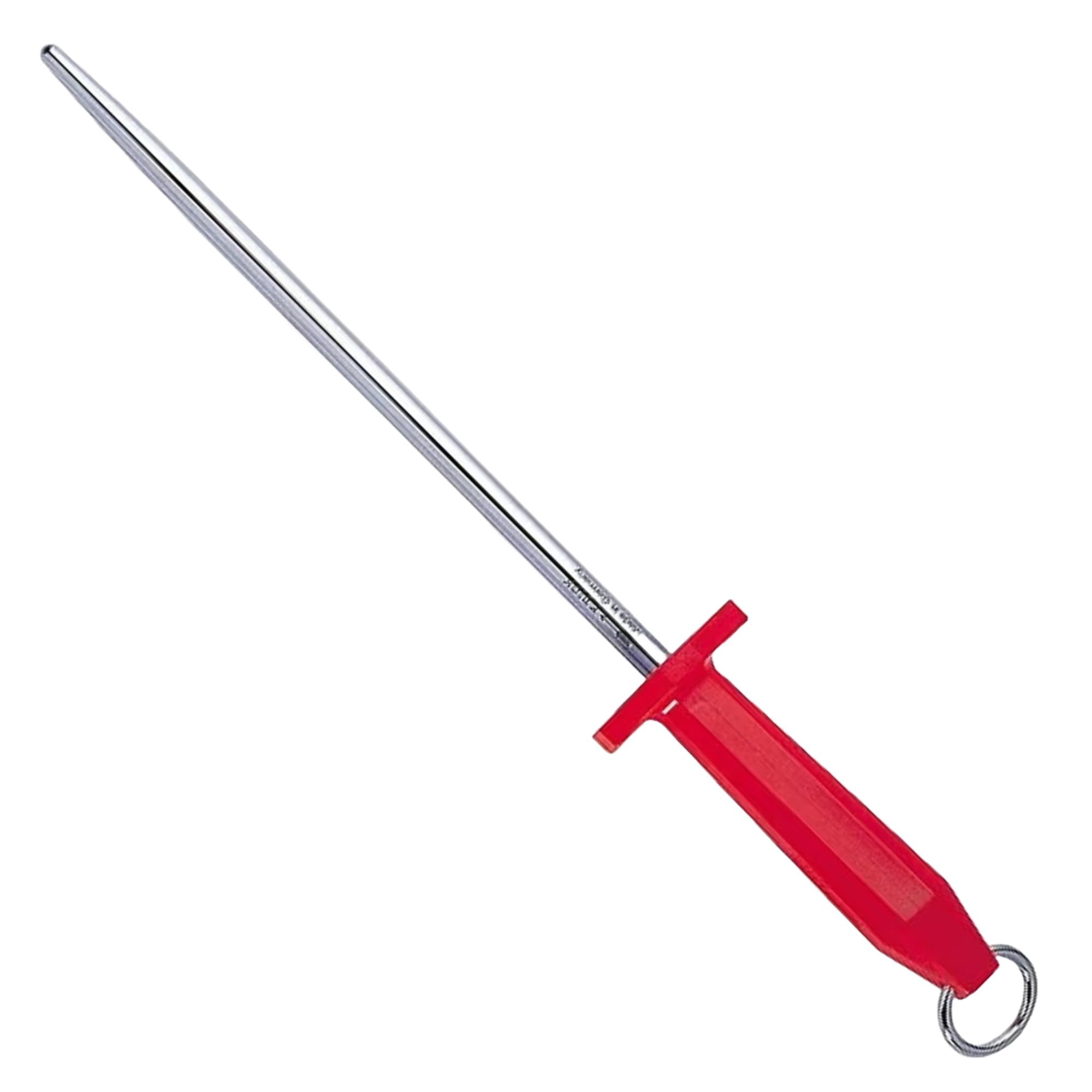
F. DICK builds its reputation in professional butcher and fish-processing kitchens, and the orange handle is a deliberate safety feature—high-visibility yellow-orange stands out on crowded prep counters and busy line stations. The rod is made from polished German steel with a smooth surface, meaning it realigns the edge without removing any metal.
The 10-inch rod length is a practical compromise—long enough for standard 8-inch chef’s knives, short enough for smaller utility blades and paring knives. The steel is tempered to match the hardness of European-style blades, providing consistent friction that realigns the edge without chatter. At 8.16 ounces, it feels more substantial than the ceramic alternatives.
F. DICK does not provide a warranty explicitly in the product listing, but the brand’s professional kitchen reputation suggests durable construction. The smooth surface does not accumulate metal filings as readily as a grooved steel, which reduces cleaning frequency. This rod works best as a daily-use tool for cooks who maintain their knives with frequent honing rather than letting them go dull.
Why it’s great
- High-visibility orange handle ideal for professional kitchens
- Smooth polished steel works gently on European blades
- Durable German construction from a trusted commercial brand
Good to know
- 10-inch rod limits single-pass use with longer blades
- Smooth steel may not realign extremely hard Japanese steels effectively
FAQ
Does a honing steel actually sharpen my knife?
How often should I use a honing steel on my chef’s knife?
Can I use a ceramic honing rod on any knife steel?
What rod length do I need for an 8-inch chef’s knife?
Final Thoughts: The Verdict
For most users, the best honing steel winner is the WÜSTHOF 9″ Honing Steel because its grooved steel construction, magnetic surface, and lifetime warranty make it the most reliable daily-use rod for European knife owners. If you want a ceramic rod that works on harder steels and resists rust, grab the Shenzhen Knives White Ceramic Rod. And for restoring edges that have started to dull, nothing beats the LEVINCHY Diamond Coated Steel.