The difference between a forgettable morning cup and a shot that stops you mid-sip comes down to pressure, temperature, and grind consistency — three variables that a home espresso machine under $500 must manage without a second mortgage. That line has shifted. The current generation of semi-automatic and fully-featured machines delivers 15 to 20 bars of pump pressure, PID temperature control, and integrated burr grinders in packages that fit on a standard countertop and stay comfortably inside that budget ceiling. The catch is that not every machine under that threshold actually pulls a balanced shot. Some skimp on steam power; others pair a good boiler with a mediocre grinder. Knowing which spec trade-offs actually matter — and which are marketing noise — is the only way to walk away with a machine that rewards you every morning.
I’m Mohammad Maruf — the founder and writer behind AirfryerBite. I’ve spent years breaking down appliance specifications, comparing extraction curves, and separating durable builds from short-lived gimmicks in the espresso machine category, specifically for buyers working within a defined budget.
This guide cuts through the jargon to focus on the pump specifications, boiler types, and grind precision that actually determine whether your best home espresso machine under $500 delivers a rich, repeatable shot of espresso or leaves you frustrated with a machine that looks good but pulls sour.
How To Choose The Best Home Espresso Machine Under $500
The machines in this bracket fall into three camps: semi-automatic with a separate grinder, all-in-one with a built-in grinder, and super-automatic (rare under $500 but present). To get the most out of your budget, you need to evaluate the pump, the thermal system, the grinder quality, and the steam capability as a package — because a weak link in any one of those areas will show up in the cup.
Pump Pressure and Pre-Infusion: More Than a Number
A 15-bar or 20-bar pump rating is standard, but what matters is how the machine applies that pressure. Pre-infusion — a low-pressure soak before full extraction — allows coffee grounds to bloom evenly, reducing channeling and producing a more balanced shot. Machines that skip pre-infusion often pull sour or bitter shots, especially with lighter roasts. Look for a model that explicitly mentions low-pressure pre-infusion, regardless of whether the pump is rated 15 or 20 bars.
Thermal Stability: PID vs. Thermoblock
Temperature fluctuation of even a few degrees can turn a well-dialed shot into a mess. PID (Proportional-Integral-Derivative) controllers maintain water temperature within a narrow range, typically ±1°F, during the entire extraction. Thermoblock heating systems heat water on demand and are faster to warm up, but they lack the precise stability of a PID system. If you value consistency across multiple shots — say, brewing for two people back to back — prioritize a machine with PID or NTC + PID temperature control.
Grinder Integration: Separate vs. Built-In
A built-in grinder saves counter space and simplifies the workflow, but not all integrated grinders are created equal. Conical burr grinders with at least 8 to 10 grind settings are the minimum for espresso. Stepless or micro-adjustable grind settings give you finer control over extraction. If the built-in grinder uses ceramic burrs that are prone to slipping or clogging, you’re better off buying a separate grinder and a machine that focuses on brew performance. In the – range, integrated grinders are a convenience feature; at -$500, they can be genuinely effective.
Steam Wand Performance: Microfoam vs. Simple Froth
A single-hole steam wand with a manual articulation joint allows you to position the tip for proper milk stretching and texturing. Machines with a fixed, panarello-style wand inject air automatically and produce coarser foam that is fine for a basic cappuccino but unsuitable for latte art. If you plan to make lattes or flat whites, a commercial-style, adjustable steam wand is a must-have. Check whether the machine’s boiler can maintain steam pressure while pulling a shot — some single-boiler setups force you to wait between brewing and steaming.
Quick Comparison
On smaller screens, swipe sideways to see the full table.
| Model | Category | Best For | Key Spec | Amazon |
|---|---|---|---|---|
| De’Longhi La Specialista Arte Evo | Premium All-in-One | Cold brew & daily espresso | 15-bar pump, 8 grind settings, cold extraction | Amazon |
| Breville Barista Express BES870BTR | Premium All-in-One | Third-wave specialty coffee | PID control, conical burr grinder, 54mm portafilter | Amazon |
| Gevi Dual Boiler | Premium All-in-One | Simultaneous brew & steam | Dual boiler, NTC & PID, 31 grind settings | Amazon |
| COWSAR 20 Bar | Mid-Range All-in-One | Precision grind & temp control | 30 grind sizes, PID, pre-infusion, 58mm portafilter | Amazon |
| Electactic 15 Bar with Grinder | Mid-Range All-in-One | Anti-clog grinding for oily roasts | 15-bar pump, 58mm portafilter, 2.3L tank | Amazon |
| QJA Espresso Machine | Mid-Range Semi-Auto | Compact counter & touchscreen | 20-bar pump, touchscreen, 57.5oz tank | Amazon |
| De’Longhi Classic | Entry-Level Semi-Auto | Simple daily operation | 15-bar pump, thermoblock, adjustable steam wand | Amazon |
| AIRMSEN with Burr Grinder | Entry-Level All-in-One | Budget all-in-one convenience | 20-bar pump, 10 grind settings, touchscreen | Amazon |
| CASABREWS Ultra | Entry-Level Semi-Auto | Adjustable brew temperature | 20-bar pump, LCD display, 73oz water tank | Amazon |
In‑Depth Reviews
1. De’Longhi La Specialista Arte Evo

The De’Longhi La Specialista Arte Evo sits at the top of the under-$500 bracket because it solves two problems that most machines in this price tier ignore: making cold brew concentrate without a separate carafe and delivering a commercial-style steam wand that actually textures microfoam. It uses a 15-bar Italian pump with low-pressure pre-infusion and Active Temperature Control with three infusion settings, so you can dial in the water temperature for different roast levels. The integrated conical burr grinder offers eight grind settings, which is enough granularity for espresso and a step into filter-coarse territory.
What sets this machine apart is the Cold Extraction Technology developed in collaboration with the Specialty Coffee Association. It uses measured water flow and pressure at specific temperatures to produce a single cold brew shot in under five minutes — no overnight steep, no messy filtration. The commercial-style steam wand produces consistent steam pressure for microfoam, and the included barista kit (dosing funnel, tamping mat, adjustable tamper) reduces mess during the puck prep. The water tank is 67.6 ounces, so refills are infrequent even with multiple drinks per day.
On the downside, the plastic housing on certain components and the lack of a shot timer for tracking extraction yield are minor compromises at this price. The grinder, while effective, does produce some retention with very light roasts. For a home user who wants one machine that handles hot espresso, cold brew, and milk-based drinks without needing a separate grinder or brewer, this is the most versatile option currently available under $500.
Why it’s great
- Cold extraction produces cold brew in under 5 minutes
- Three infusion temperatures for different roast profiles
- Commercial-style steam wand creates true microfoam
- Mess-free barista kit included
Good to know
- No built-in shot timer or pressure gauge
- Plastic construction on some external parts
- Grinder retains a small amount of grounds with light roasts
2. Breville Barista Express BES870BTR
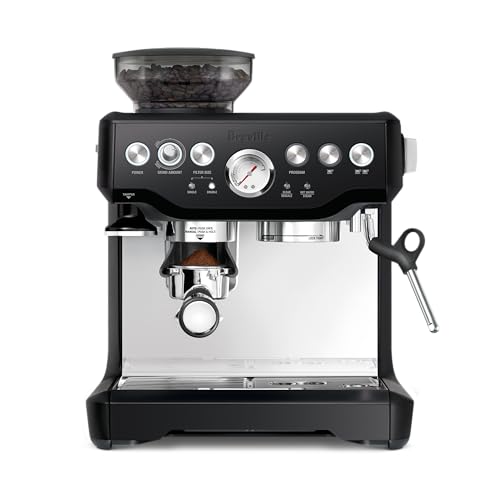
The Breville Barista Express BES870BTR is the reference design for an all-in-one espresso machine under $500. It integrates a precision conical burr grinder with a dose-control system that grinds directly into the 54mm portafilter, a low-pressure pre-infusion cycle, and digital PID temperature control for stable extraction temperatures. The 15-bar Italian pump, combined with the PID, ensures that water hits the coffee puck at a consistent temperature throughout the shot, which is critical for repeatable results. The machine has been on the market long enough that its reliability is well-documented across thousands of user reports.
The manual steam wand is powerful and articulating, allowing you to position the tip for proper milk stretching. The included Razor dose trimming tool helps level the puck after tamping, removing excess grounds for consistent headspace. The bean hopper holds half a pound, and the 67-ounce water tank is easily accessible from the front. The machine also supports single and double shots with adjustable grind amount and manual override, giving you full control over every variable. The package includes single and dual wall filter baskets, so you can use either freshly ground beans or pre-ground coffee.
The main drawbacks are the grinder retention with oily beans and the learning curve for beginners. Dosing and tamping require practice to achieve consistent extraction, and the integrated grinder has a narrow espresso range — you cannot grind coarse enough for pour-over or French press without switching to a separate grinder. The build quality is solid but relies on some plastic internals, though the stainless steel exterior holds up well. For anyone willing to invest a week learning the workflow, this machine delivers café-quality shots that rival machines costing twice as much.
Why it’s great
- PID controller maintains extraction temperature within ±1°F
- Dose-control grinding reduces waste and mess
- Manual steam wand produces silky microfoam for latte art
- Included Razor tool ensures consistent puck prep
Good to know
- Grinder prone to retention with dark, oily roasts
- Steeper learning curve than super-automatic machines
- Grind range too narrow for non-espresso brew methods
3. Gevi Dual Boiler Espresso Machine

The Gevi Dual Boiler is one of the few machines under $500 that separates the brewing and steaming boilers, allowing you to pull a shot and steam milk simultaneously without waiting for temperature recovery. This is a feature typically reserved for machines priced hundreds of dollars higher. The brew boiler is paired with an NTC and PID temperature control system that regulates water temperature with precision, while the steam boiler maintains consistent pressure for the commercial-style wand. The integrated conical burr grinder offers 31 grind settings, giving you fine control over particle size for dialing in different beans.
The 58mm commercial-grade portafilter is another notable inclusion — standard café size means you can use aftermarket baskets and accessories. The steam wand is fully articulating and produces microfoam suitable for latte art. The stainless steel construction covers the main body, and the drip tray is removable for cleaning. The machine also includes four interchangeable filter baskets, a milk frothing pitcher, tamper, and cleaning tools. The 67-ounce water tank is detachable and easy to refill.
The biggest compromise is the build quality of the grinder adjustment mechanism, which feels less refined than the Breville’s or De’Longhi’s. Some users report that the grinder needs periodic recalibration. The dual-boiler design also means the machine consumes more power during warm-up. For a home barista who wants to brew and steam without wait times, this is the best value proposition in the dual-boiler category under $500.
Why it’s great
- Dual boiler allows simultaneous brewing and steaming
- NTC & PID control for precise temperature stability
- 58mm commercial portafilter with aftermarket compatibility
- 31 grind settings for precise dial-in
Good to know
- Grinder adjustment can drift over time
- Higher power draw during warm-up
- Plastic components on the grinder housing
4. COWSAR 20 Bar Espresso Machine
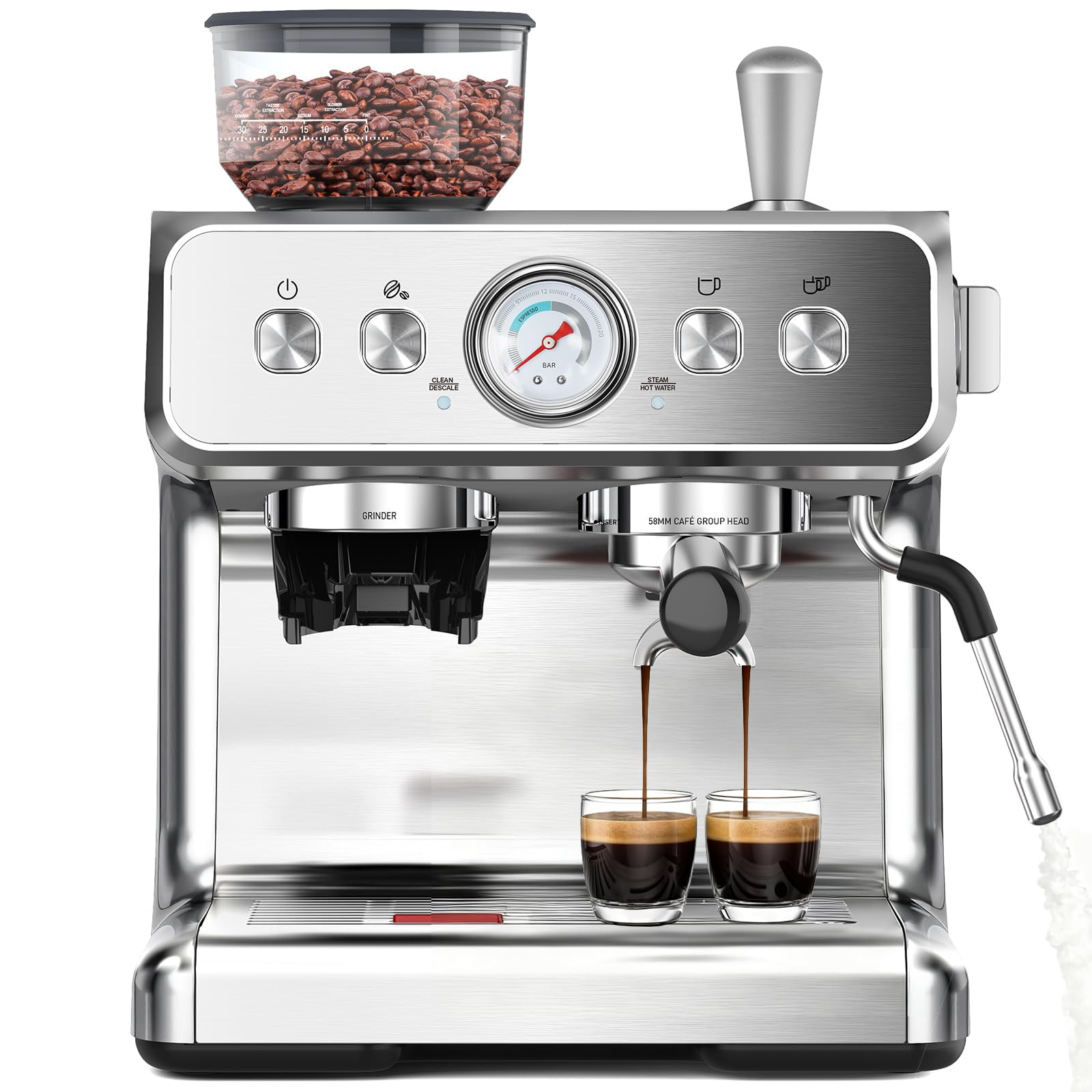
The COWSAR 20 Bar Espresso Machine targets home users who want commercial-level adjustability without leaving the sub-$500 bracket. It features a built-in conical burr grinder with 30 preset grind sizes — that level of granularity is rare at this price and allows you to dial in everything from a fine espresso grind to a coarser setting for a single-cup pour-over. The machine uses low-pressure pre-infusion to saturate the coffee grounds before ramping up to full pressure, reducing channeling and producing a more even extraction. PID technology maintains stable brewing temperature throughout the shot cycle.
The steam wand is commercial-style with a single-hole tip, delivering consistent steam pressure for microfoam. The package includes a milk frothing pitcher, four precision filter baskets (single and double, pressurized and non-pressurized), a 58mm portafilter, tamper, and cleaning kit. The stainless steel body and chrome accents give it a professional look that fits most kitchen aesthetics. The water tank holds enough volume for several drinks before needing a refill.
The main drawbacks are the learning curve associated with the 30 grind settings — beginners may find it overwhelming — and the occasional reports of steam wand durability issues after several months of daily use. Customer feedback also notes that the drip tray is slightly shallow, requiring more frequent emptying. For a dedicated home barista who values fine grind adjustment and PID stability, this machine offers exceptional control per dollar spent.
Why it’s great
- 30 grind settings allow precise dial-in for any bean
- Pre-infusion reduces channeling and improves extraction
- PID controller ensures stable brew temperature
- Includes both pressurized and non-pressurized filter baskets
Good to know
- Steam wand may need service after extended daily use
- Drip tray is shallow and requires frequent emptying
- Grind adjustment dial is not stepless
5. Electactic 15 Bar Espresso Machine with Grinder
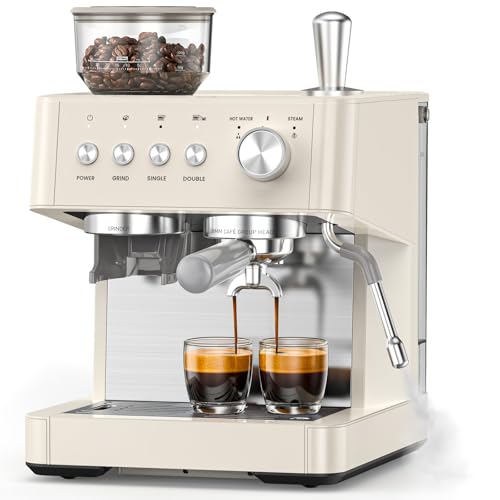
The Electactic 15 Bar Espresso Machine with Grinder is designed to address the most common frustration with budget all-in-one machines: grinder jams caused by oily dark roasts. Its upgraded grinding path features a wider polished chute and a reinforced helical auger that ejects grounds instantly, reducing clogging compared to competitors that rely on narrow, straight channels. The machine uses a 15-bar pump with pre-infusion, extracting a balanced shot with decent crema. The steam wand produces microfoam for lattes and cappuccinos, though it requires some technique to avoid large bubbles.
The 2.3-liter removable water tank is generous for this price tier, and the detachable drip tray makes cleaning straightforward. The 58mm portafilter is a welcome inclusion — it is the industry standard size, so you can upgrade the basket later. The package includes a tamper, milk jug, single and dual wall filter baskets, a cleaning needle, and a brush. The ETL certification adds a layer of electrical safety reassurance. The metallic almond finish is a refreshing alternative to the standard silver or black.
The main compromises are the grinder’s limited adjustment range (fewer steps than the COWSAR or Gevi) and the steam wand’s performance, which peaks adequately but doesn’t match the microfoam consistency of the De’Longhi or Breville. Some users report that the machine’s internal plastic components feel less robust over time. For a budget-conscious buyer who regularly uses dark roasts and wants a grinder that won’t clog, this is a smart pick.
Why it’s great
- Upgraded chute and auger prevent grinder clogging with oily beans
- 58mm commercial portafilter for aftermarket upgrades
- Large 2.3L water tank reduces refill frequency
- ETL certified for electrical safety
Good to know
- Grinder has fewer adjustment steps than premium competitors
- Steam wand requires practice for consistent microfoam
- Plastic components in the brew group may wear over time
6. QJA Espresso Machine

The QJA Espresso Machine prioritizes a small footprint and intuitive touchscreen operation without sacrificing the core espresso specs. It measures just over 10 inches deep and 8 inches wide, making it one of the most counter-friendly machines in this guide. The 20-bar pressure pump and 57.5-ounce water tank are respectable for its size, and the touchscreen interface simplifies shot selection and steam activation. Users report that initial setup requires a few cycles to prime the system, but after that, the machine delivers consistent extraction.
The steam wand is capable of producing microfoam, though the small boiler means you need to wait a few seconds between brewing and steaming. The stainless steel finish is durable and matches most kitchen decors. Customer reviews highlight that once you dial in the grind size and dose, the espresso quality is impressive for the price — especially for dark roasts. The machine is semi-automatic, so you control the shot length by pressing the touchscreen.
The main drawbacks are the unresponsive touchscreen reported by a small number of users and the lack of a built-in grinder, meaning you need a separate grinder for whole beans. The steam wand also lacks the articulation joint found on higher-end models, making positioning less flexible. For someone with limited counter space who already owns a good grinder, this machine delivers high pressure and a modern interface in a compact package.
Why it’s great
- Compact 10.2″ depth fits tight countertops
- Touchscreen interface simplifies operation
- 20-bar pump produces rich crema with dark roasts
- 57.5-ounce tank is generous for the size
Good to know
- No built-in grinder requires a separate purchase
- Steam wand is fixed, not articulating
- Touchscreen can be unresponsive on some units
7. De’Longhi Classic Espresso Machine

The De’Longhi Classic brings the reliability of a 15-bar Italian professional pump and Thermoblock heating to an entry-level price. Thermoblock technology heats water on demand, so there is no boiler warm-up time — you can pull a shot within 30-40 seconds of turning the machine on. The adjustable two-setting steam wand lets you switch between silky steamed milk and thick microfoam, though the panarello-style tip means the foam is coarser than what a commercial wand produces. The stainless steel body and compact footprint (11.14 inches deep) make it a good fit for smaller kitchens.
The machine includes customizable single and double espresso presets, so you can set your preferred dose and let the machine handle the shot volume. The reusable filter reduces ongoing costs, and the 3.6-pound weight makes it easy to move or store. The water tank slides out from the top for easy refilling. For a beginner who wants a no-fuss machine that produces drinkable espresso without requiring a deep learning curve, this is a solid entry point.
The main limitations are the lack of a built-in grinder and the steam wand’s inability to produce latte-art-grade microfoam. The Thermoblock system, while fast, does not maintain as stable a temperature as a PID-controlled boiler, so shot consistency can vary between back-to-back extractions. The plastic housing on some internal components also reduces long-term durability. For a user on a tight budget who prioritizes speed and simplicity over advanced control, this machine is a reliable starter.
Why it’s great
- Thermoblock heats up in under a minute
- 15-bar Italian pump delivers adequate pressure for most home roasts
- Adjustable steam wand with two frothing settings
- Customizable preset recipes for hands-off operation
Good to know
- No built-in grinder — requires separate grinder or pre-ground coffee
- Panarello-style wand limits microfoam precision
- Temperature stability is less consistent than PID-controlled machines
8. AIRMSEN Espresso Machine with Burr Grinder
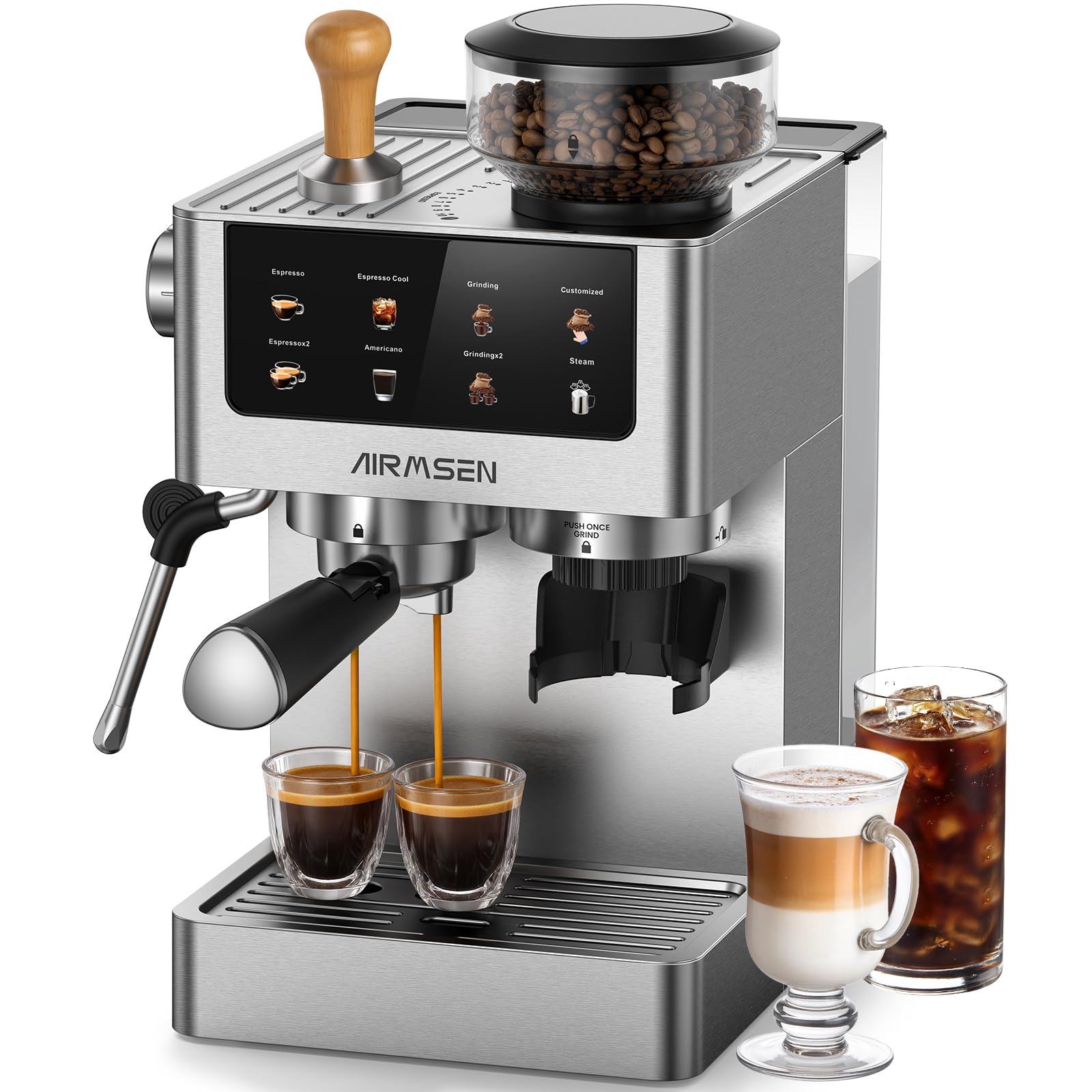
The AIRMSEN Espresso Machine combines a 20-bar pump, a conical burr grinder with 10 grind settings, and a full touchscreen interface into a single package that consistently undercuts most competitors in its feature class. The grinder uses 3Cr13 stainless steel burrs designed for over 10,000 cups, and the dual anti-static technology (ionizer plus ring) reduces coffee dust and clumping during grinding. The 20-bar pump, paired with pre-infusion, extracts a full range of flavors from the coffee grounds, resulting in a shot with decent body and crema.
The manual steam wand is detachable and rinses clean quickly, producing microfoam that is serviceable for basic latte art with practice. The compact dimensions (7.9 inches wide, 12 inches tall) save counter space while still accommodating cups up to 4.1 inches tall. The removable 61-ounce water tank is easy to clean and refill. The four-sided stainless steel casing gives the machine a durable, modern look. User reviews consistently praise the ease of use and the customer service response for troubleshooting.
The main concerns are the long-term reliability of the pump and grinder — a few reviews mention pump failure after several months of daily use — and the steam wand’s performance ceiling, which is adequate but not comparable to the De’Longhi Arte Evo or Breville. The 10 grind settings are sufficient for espresso but lack the fine adjustment needed for very light roasts. For the price, this machine offers an impressive feature set that is hard to beat on value.
Why it’s great
- Stainless steel burr grinder rated for 10,000+ cups
- Anti-static technology reduces mess during grinding
- 20-bar pump with pre-infusion for balanced extraction
- Touchscreen panel simplifies drink selection
Good to know
- Long-term pump reliability is inconsistent based on user feedback
- Steam wand performs adequately but not at a pro level
- 10 grind settings limit fine-tuning for light roasts
9. CASABREWS Ultra Espresso Machine

The CASABREWS Ultra is an entry-level semi-automatic machine that stands out for its adjustable brewing temperature — a feature rarely found at this price point. You can select from four temperature settings that apply during espresso brewing, allowing you to compensate for different roast levels. The 20-bar Italian pump and 1350-watt boiler deliver consistent pressure for extraction, and the LCD display guides you through steam, hot water, and pre-programmed shot functions. The brushed stainless steel finish gives it a clean, appliance-store look that fits most kitchens.
The steam wand produces barista-level microfoam — users report being able to create latte art after some practice. The 73-ounce water tank is the largest in this guide, meaning fewer refills during heavy use. The machine includes two portafilter baskets (single and double), along with a cleaning needle. The side-loading water tank is easy to remove and refill without moving the machine. CASABREWS also provides instructional videos for perfecting your brew technique, which is helpful for beginners.
The main limitations are the lack of a built-in grinder and the plastic construction of certain external components, including the steam wand knob and drip tray grate. The LCD screen, while informative, is not a full-color touchscreen — it is a monochrome segmented display. Some users wish the steam wand was articulating rather than fixed. For a user who already owns a burr grinder and wants the flexibility of adjustable brew temperature at the lowest possible entry cost, this machine is a practical choice.
Why it’s great
- Adjustable brewing temperature with four settings for different roasts
- 73-ounce water tank is the largest in its price bracket
- 20-bar pump and 1350W boiler for consistent extraction
- LCD display simplifies operation for beginners
Good to know
- No built-in grinder — requires separate grinder
- Steam wand is fixed, not articulating
- Plastic components on the drip tray and knob
FAQ
How does a 15-bar pump compare to a 20-bar pump for home espresso?
Do I need a machine with a built-in grinder or should I buy separately?
Can I make latte art with a machine under $500?
What does PID temperature control actually improve in my espresso?
How much counter space do I need for a home espresso machine under $500?
Final Thoughts: The Verdict
For most users, the home espresso machine under $500 winner is the De’Longhi La Specialista Arte Evo because it combines an effective built-in burr grinder, a commercial-style steam wand, Active Temperature Control, and a unique cold extraction feature that adds versatility without sacrificing espresso quality. If you want a more hands-on, third-wave experience with precise PID control and dose-management tools, grab the Breville Barista Express BES870BTR. And for the budget-conscious buyer who needs an all-in-one machine with a reliable grinder that handles dark roasts without clogging, nothing beats the Electactic 15 Bar with Grinder.