Whether you are preserving a bumper crop of garden herbs, turning flank steak into protein-packed jerky, or drying apple rings for a chewy snack, a machine that runs cold in the center and hot at the edges ruins the entire batch. The difference between leathery fruit leather and a crisp, flavorful result comes down to airflow architecture, tray material, and temperature stability — three specs that the best food dehydrators get right from the start.
I’m Mohammad Maruf — the founder and writer behind AirfryerBite. I have spent years analyzing the hardware, fan placement, and heating-element designs of countertop drying appliances to help home preservers separate serious machines from plastic toys.
Below I compare seven models that span quiet motors, digital precision, and high tray counts so you can confidently choose a best food dehydrator that matches your drying volume and kitchen noise tolerance.
How To Choose The Best Food Dehydrator
A food dehydrator is a simple appliance — a heating element, a fan, and stacked trays. But small differences in fan placement, tray material, and temperature control determine whether your beef jerky turns out perfectly dry or dangerously under-dried in the middle. Focus on these three factors first.
Fan Placement: Rear-Mounted vs. Bottom-Mounted
Bottom-mounted fans push heat upward through the center of the trays, which forces you to rotate trays every few hours because the bottom dries faster than the top. Rear-mounted fans blow horizontally across every tray simultaneously, delivering uniform drying from the first hour. If you value set-and-forget convenience, a rear-fan dehydrator is the smarter investment.
Tray Material: Stainless Steel vs. Plastic
Stainless-steel trays conduct heat better, resist warping after repeated use, and are less likely to absorb food odors. Plastic trays can crack over time and may contain BPA unless explicitly labeled BPA-free. For long-term durability and food safety, stainless steel wins every time — especially if you dry acidic fruits like pineapple or citrus.
Temperature Range and Timer Length
Herbs need low temperatures around 95°F to preserve volatile oils, while jerky requires 160-165°F to kill pathogens. A unit that starts at 95°F and goes up to 165-176°F covers both extremes. A 48-hour timer is useful for long, slow batches of fruit leather or thick cuts of meat. Models with digital controls let you dial in exact degrees rather than guessing with a knob.
Quick Comparison
On smaller screens, swipe sideways to see the full table.
| Model | Category | Best For | Key Spec | Amazon |
|---|---|---|---|---|
| Magic Mill Pro | Premium | Even drying with rear fan | 600W, rear fan, 7 trays | Amazon |
| Cosori (6.5 ft²) | Premium | Large batch capacity | 600W, 6.5 ft² drying space | Amazon |
| HOPERAN 12-Tray | Mid-Range | High tray count for heavy loads | 12 stainless-steel trays | Amazon |
| OSTBA | Mid-Range | Digital precision on a budget | 650W, 8 trays, digital timer | Amazon |
| PSIIDAN | Mid-Range | Quiet operation, viewing light | 650W, 8 stainless steel trays | Amazon |
| Cosori 5-Tray | Mid-Range | Compact, 176°F max temp | 5 trays, 176°F max temp | Amazon |
| NESCO FD-75A | Budget | Entry-level value | Top-mounted fan, expandable | Amazon |
In‑Depth Reviews
1. Magic Mill Pro Food Dehydrator Machine
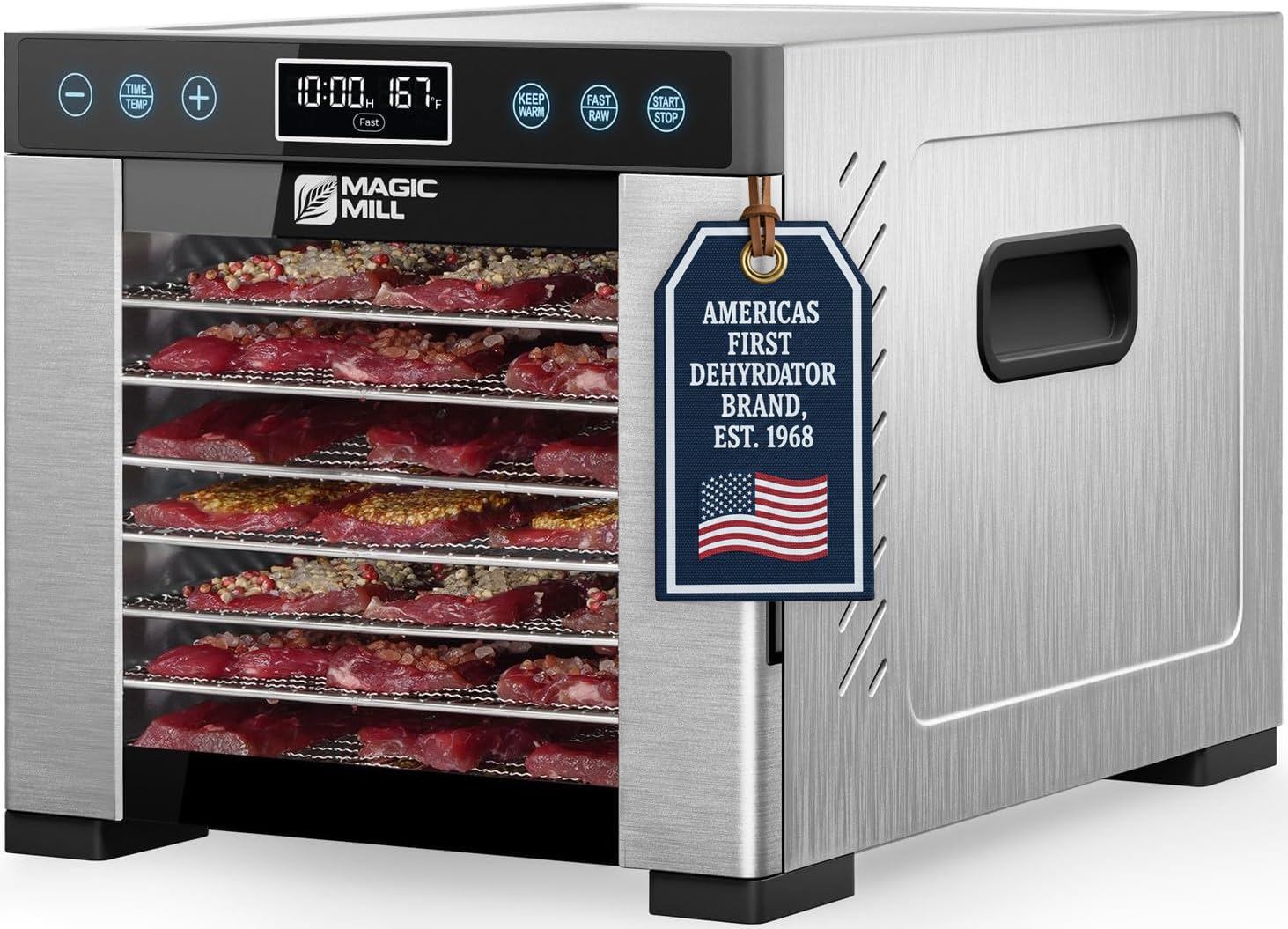
The Magic Mill Pro stands out because of its rear-mounted fan and 600W motor, which push hot air horizontally across each of the seven stainless-steel trays rather than forcing heat up through a single center column. That horizontal airflow eliminates the need to rotate trays mid-cycle, saving you from checking progress every two hours. The temperature range of 95°F to 176°F covers delicate herbs at the low end and reaches the 165°F mark that jerky makers need for safe moisture removal.
Digital controls let you set the timer up to 48 hours and include a Keep Warm function that holds the temperature after the drying cycle ends — useful for overnight runs when you want the unit to stop gently rather than coasting on residual heat. The build quality feels solid, with an ETL listing indicating it passed independent safety testing, which is rare at this price tier.
One nuance to note: the rear fan design makes the dehydrator slightly deeper than front-loading units, so measure your counter depth before buying. The stainless-steel trays are dishwasher safe, making cleanup much faster than scrubbing mesh screens by hand.
Why it’s great
- Rear horizontal fan provides even drying without tray rotation
- 176°F max temp reaches jerky-safe zone
- ETL certified for safety
Good to know
- Deeper footprint may not fit shallow counters
- Higher price point than entry-level models
2. Cosori Food Dehydrator (6.5 ft²)

Cosori markets this model as “bigger than 7 trays,” and the numbers back it up: six stainless-steel trays yield 6.5 ft² of drying space, roughly 27% larger than the typical 7-tray competitor. The 600W rear-mounted fan operates below 48 dB, which is quiet enough to run overnight in an open kitchen without disturbing sleep. That noise level matters if you plan to dry jerky for 8-10 hours while the household is resting.
Temperature adjustment goes from 95°F up to 165°F in single-degree increments, and the digital timer extends to 48 hours. Included accessories — a mesh screen and a fruit roll sheet — expand your options for small seeds and fruit leather without additional purchases. The entire set of trays is dishwasher safe, which after a sticky mango batch is a genuine time saver.
The only trade-off is that the unit is heavier than expected at over 18 pounds, so it is not a machine you want to move back and forth from a cabinet regularly. Plan to keep it on the counter during peak drying season.
Why it’s great
- 6.5 ft² of drying space fits large or multiple batches
- Quiet rear fan under 48 dB
- Dishwasher-safe trays and included fruit roll sheet
Good to know
- Heavy at 18 lbs — not easily portable
- Front door design reduces vertical clearance for tall items
3. HOPERAN Food Dehydrator Machine
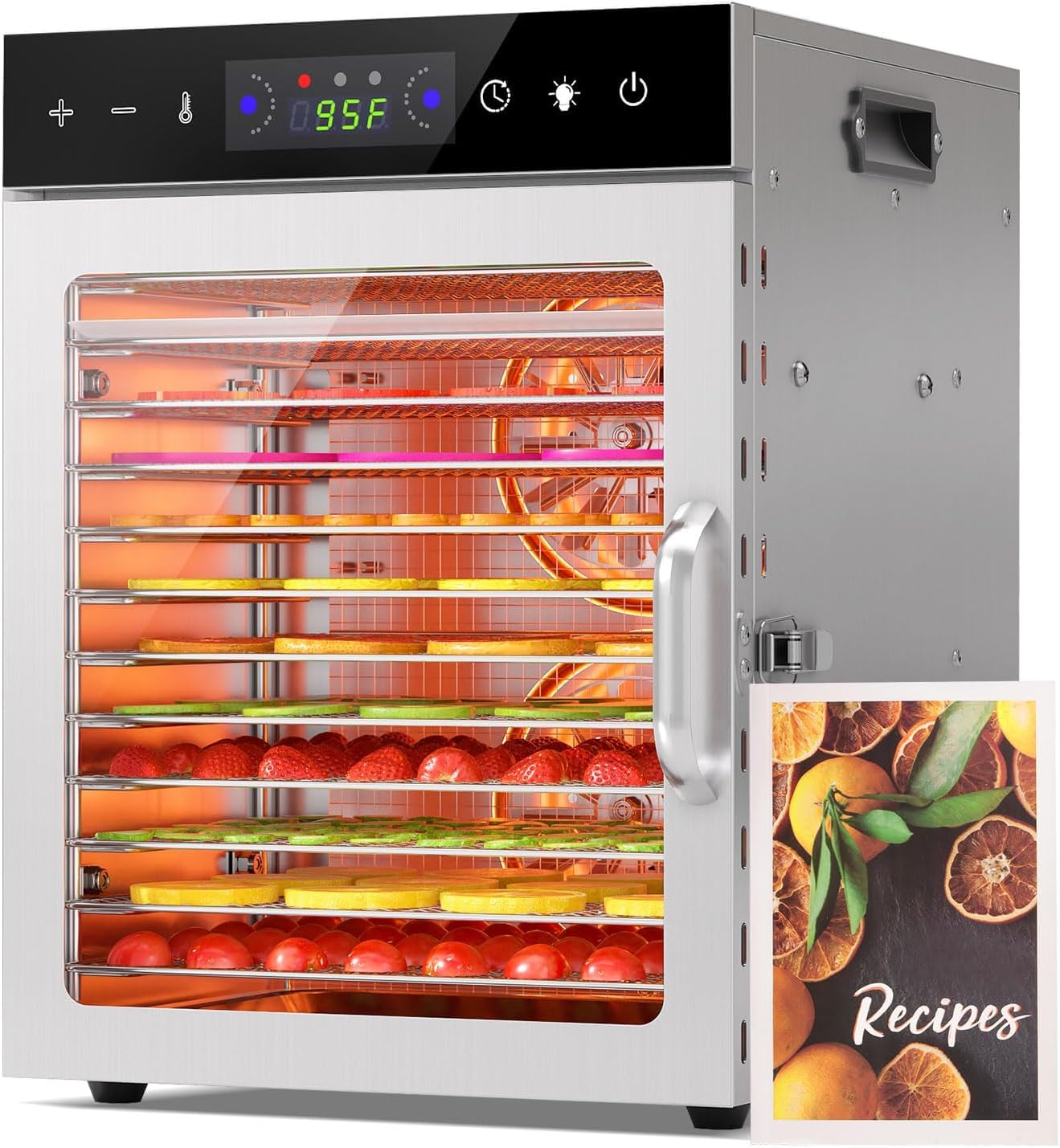
With twelve stainless-steel trays, the HOPERAN dehydrator is built for serious volume — drying multiple batches of herbs, fruit slices, and jerky strips simultaneously without running the machine twice. The digital timer and adjustable temperature control let you set precise drying parameters up to 48 hours, and the overheat protection system adds a safety layer for unattended overnight runs.
The BPA-free construction is a strong selling point for health-conscious users who want to avoid plastic leaching, especially when drying acidic foods like pineapple or citrus that can interact with lower-grade materials. The included recipe book helps beginners get started with suggested times and temperatures for common foods.
The main consideration is that twelve trays require more vertical space than typical countertop dehydrators, so ensure your cabinet clearance or shelf height can accommodate the stack. The fan system is adequate for even drying, but the large tray count means loading and unloading takes more time.
Why it’s great
- 12 trays for high-volume drying sessions
- BPA-free materials for safe food contact
- Overheat protection for unattended use
Good to know
- Tall design may not fit under upper cabinets
- More trays means longer loading/unloading
4. OSTBA Food Dehydrator
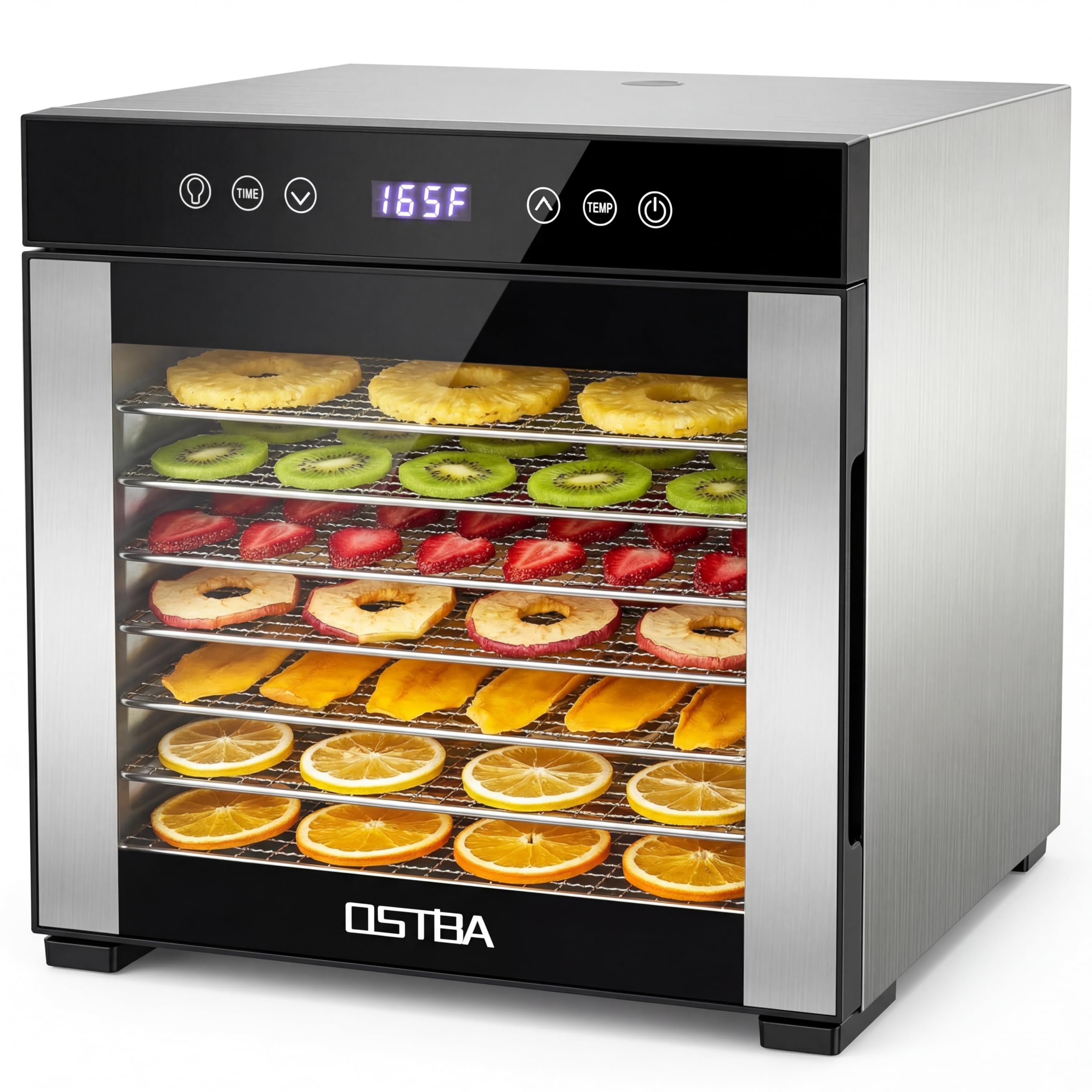
The OSTBA dehydrator brings an 8-tray stainless-steel configuration combined with a 650W motor, which is slightly higher wattage than many comparably priced units. The temperature range of 95°F to 165°F and the 48-hour digital timer give you the same control found on premium models, but at a mid-range price point. The double-layer insulation keeps the exterior cooler to the touch during extended drying cycles.
One useful design choice is the inclusion of both a mesh tray for small items and a drip tray for fruit roll-ups, so you can start experimenting with different food types immediately without ordering separate accessories. The digital display shows remaining time and current temperature, which reduces the guesswork that comes with analog dial dehydrators.
Be aware that the unit is designed for both home and commercial use, meaning it runs continuously for long periods without overheating, but it also has a slightly larger footprint than compact models. The trays are not dishwasher safe, so you will need to hand-wash them after sticky batches.
Why it’s great
- 8 stainless-steel trays with digital timer and temp control
- Includes mesh and drip trays for diverse foods
- Double-layer insulation for cooler exterior
Good to know
- Trays are not dishwasher safe
- Larger footprint than compact models
5. PSIIDAN Food Dehydrator Machine
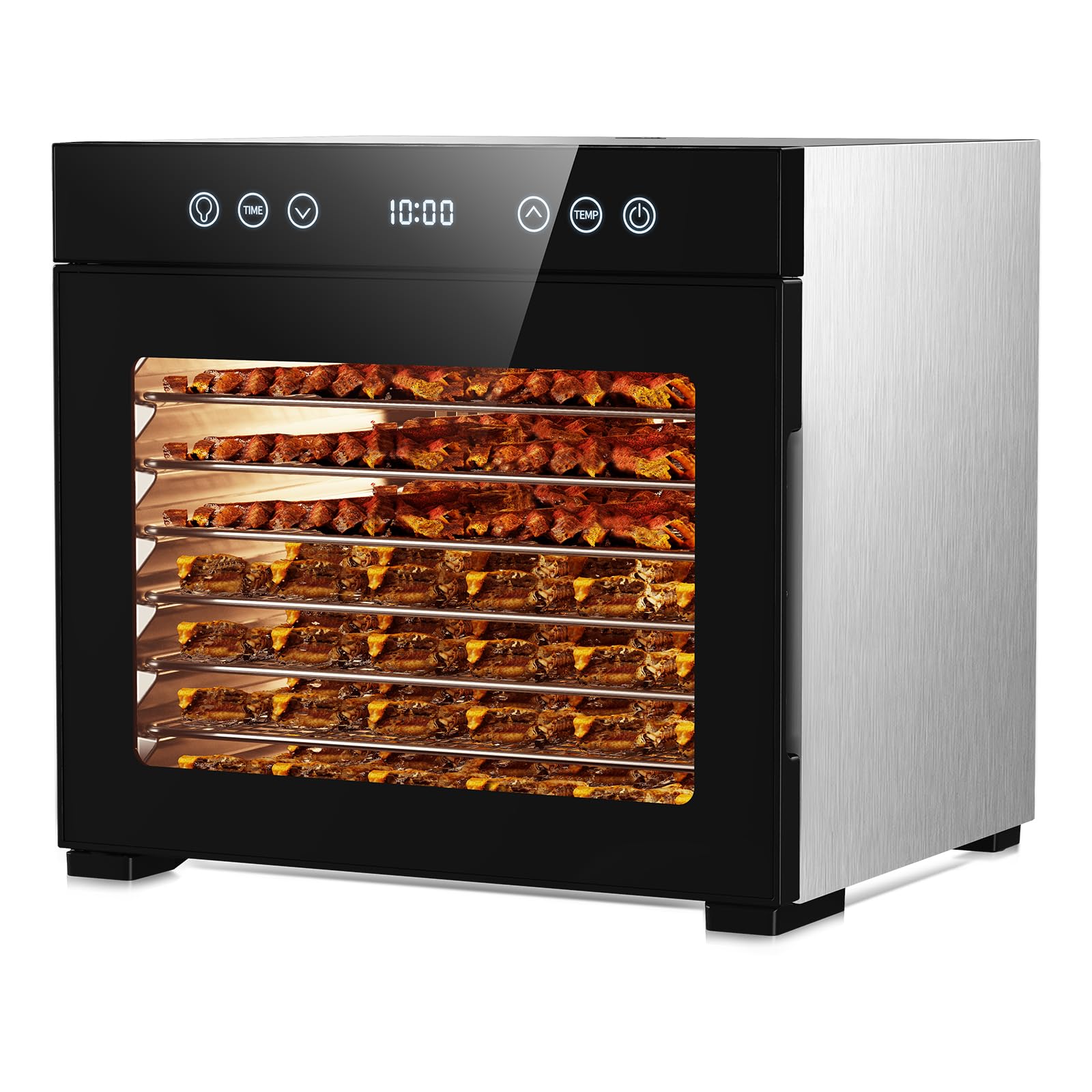
The PSIIDAN dehydrator is designed with quiet operation as a priority — its motor runs silently enough that you can place it on the counter without it becoming a background hum. The 650W motor drives an 8-tray setup, and the adjustable temperature goes up to 167°F with a 48-hour timer. The built-in interior viewing light lets you check drying progress without opening the door, which saves heat loss and keeps the drying cycle consistent.
Dual-layer insulation keeps the exterior cool during extended runs, a consideration for households with children who might accidentally brush against the machine. The one-touch controls and auto shut-off simplify operation: set the time and temperature, press start, and walk away. The stainless-steel trays wipe clean quickly, though they are not dishwasher safe.
The mesh tray and drip tray are included for small seeds and fruit leather, and the compact footprint (13.00″ x 13.31″ x 12.01″) fits well on standard countertops without overhang. The 167°F max temperature is adequate for jerky but slightly lower than the 176°F ceiling some users prefer for faster drying.
Why it’s great
- Quiet motor suitable for overnight operation
- Interior viewing light reduces heat loss from door opening
- Compact size fits smaller kitchens
Good to know
- Trays not dishwasher safe — hand wash only
- Max temp 167°F, lower than some premium models
6. Cosori Food Dehydrator (5-Tray)
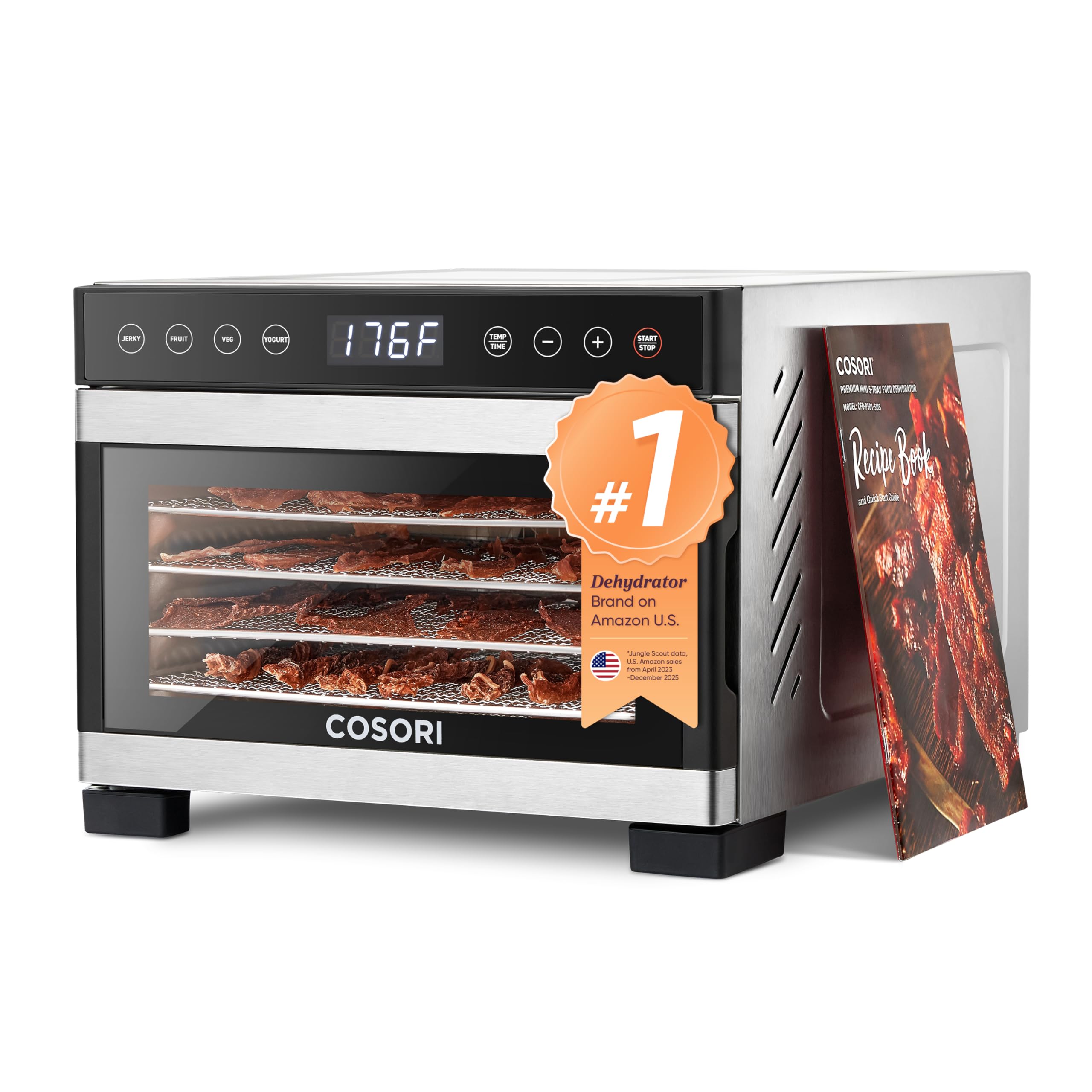
The 5-tray Cosori model is the smaller sibling of the 6.5 ft² unit, offering 5.1 ft² of drying space across five stainless-steel trays. Its 176°F maximum temperature is the highest in this roundup, making it particularly effective for jerky makers who want the fastest safe drying speed. The four preset programs simplify operation for common foods like meat, fruit, vegetables, and herbs, so you do not need to memorize recommended times.
The 48-hour timer and digital temperature control give you the same precision as the larger Cosori model, but the smaller footprint makes it easier to store or fit on tight countertops. The unit is also noticeably lighter than its big brother, so moving it from storage to counter is less of a chore.
The trade-off is obvious: fewer trays mean smaller batches. The trays are not dishwasher safe.
Why it’s great
- 176°F max temp for faster jerky drying
- 4 preset programs for one-touch operation
- Compact and lighter than larger models
Good to know
- 5 trays limit batch size for heavy users
- Trays not dishwasher safe
7. NESCO FD-75A Snackmaster Pro

The NESCO FD-75A is a classic round dehydrator with a top-mounted fan that pushes air down through the center column and across the trays. This design has been around for decades because it works reliably for jerky and fruit, though it does require rotating the trays every few hours to compensate for uneven drying. The unit comes with four trays but is expandable to up to 12 trays if you purchase additional rings, giving you flexibility to scale up batch size later.
The analog temperature control is less precise than digital models — you get a dial with approximate settings rather than exact degrees — but for many home users, that simplicity reduces the learning curve. The top fan design also means the unit runs louder than rear-fan models, which is something to consider if you plan overnight drying runs.
The NESCO is the most budget-friendly option in this lineup, and its long history in the market means replacement parts and trays are widely available. However, the plastic trays are less durable than stainless steel and may warp over time. If you are just starting out with dehydration, this machine is a low-risk entry point.
Why it’s great
- Expandable from 4 to 12 trays
- Proven design with wide parts availability
- Low entry price for beginners
Good to know
- Top fan requires tray rotation for even drying
- Analog controls lack precise temperature setting
FAQ
How many trays do I need for jerky versus herbs?
Can I leave a food dehydrator running overnight?
What is the difference between a top-fan and rear-fan dehydrator?
Are stainless steel trays worth the higher price?
How do I clean a dehydrator with non-dishwasher-safe trays?
Final Thoughts: The Verdict
For most users, the best food dehydrator winner is the Magic Mill Pro because the rear-mounted fan delivers consistently even drying across all seven trays and the temperature range covers herbs at 95°F all the way to jerky-safe 176°F. If you need maximum batch capacity and prefer a quiet overnight operation, grab the Cosori (6.5 ft²). And for high-volume drying on a budget, nothing beats the tray count of the HOPERAN 12-Tray without stretching into a higher price bracket.