Dull knives are a kitchen hazard and a workflow killer, but mastering a whetstone takes years of practice that most home cooks don’t have. A fixed angle knife sharpener removes the variable of human error by locking the blade and guiding the abrasive at a precise, repeatable angle, delivering a consistent edge every time without the guesswork.
I’m Mohammad Maruf — the founder and writer behind AirfryerBite. I’ve spent hundreds of hours analyzing the engineering, abrasive media, and clamping mechanics of guided sharpening systems to separate the tools that deliver razor edges from those that waste your counter space.
Whether you are restoring a neglected chef’s knife or refining a hunting blade to hair-whittling sharpness, the right fixed angle knife sharpener can transform your cutting experience with speed and precision that freehand methods simply cannot match.
How To Choose The Best Fixed Angle Knife Sharpener
Selecting a fixed angle system is about balancing precision, abrasive quality, and ease of use. The wrong choice can leave you with a system that wobbles, jumps grits, or fails to reach the heel of a curved blade.
Angle Range and Adjustment Mechanism
The core of any fixed angle sharpener is its ability to hold a consistent angle from blade start to tip. Look for systems offering a range from at least 15° to 30°. Continuous adjustment via a threaded rod or notched base gives you control for different blade geometries — low angles for delicate Japanese knives, higher angles for tough outdoor blades.
Abrasive Media and Grit Progression
Diamond plates cut faster and last longer than bonded stones for coarse work, while ceramic and natural whetstones provide a finer finish. A good system should offer at least four stages: a coarse diamond stone (220–320 grit) for edge repair, medium diamond (600–1000 grit) for sharpening, fine ceramic or stone (3000 grit) for honing, and a leather strop with compound for a polished, razor edge.
Clamp Design and Blade Compatibility
The clamp must hold the blade securely without marring the finish, and it must allow the sharpening rod to reach the entire edge, including the heel near the handle. Look for rotating or sliding clamps that accommodate both wide chef knives and narrow pocket knives. A dual-sliding clamp or pivoting yoke provides more flexibility for different blade profiles.
Quick Comparison
On smaller screens, swipe sideways to see the full table.
| Model | Category | Best For | Key Spec | Amazon |
|---|---|---|---|---|
| SHARPAL 202H | Premium System | Full grit progression from repair to mirror finish | 7 abrasives: 220–6000 grit diamond & whetstone + strop | Amazon |
| Work Sharp Professional Precision Adjust | Pro Precision | Digital angle indication for repeatable setup | 7 abrasives: 220–800 diamond, ceramic & strop | Amazon |
| KME Precision System | Manual Precision | Consistency with spherical bearing rod guide | 4 Gold diamond hones: 140–1500 grit | Amazon |
| Work Sharp Ken Onion Mk.2 | Motorized Belt | Fast belt-driven sharpening with variable speed | Flexible abrasive belts with precision guides | Amazon |
| XARILK GEN3 | Aluminum Guide | Durable aluminum frame with 3 diamond plates | 320, 800, 2000 grit diamond plates | Amazon |
| Warthog V-Sharp A4 | Dual Rod | Simultaneous sharpening of both edges | Spring-loaded diamond & hardened steel rods | Amazon |
| Homly Professional Electric | Electric Slot | Quick electric sharpening for straight & ceramic knives | 100% diamond abrasives in 3-stage slots | Amazon |
| Lansky Deluxe 5-Stone | Classic Kit | Controlled angle with five stone options & oil | 5 stone grits: coarse to ultrafine + honing oil | Amazon |
| Arbenefe Rolling Sharpener | Roller Guide | Entry-level guided sharpening with magnetic base | 400 grit diamond + ceramic, 4 angle options | Amazon |
In‑Depth Reviews
1. SHARPAL 202H Precision Knife Sharpening System
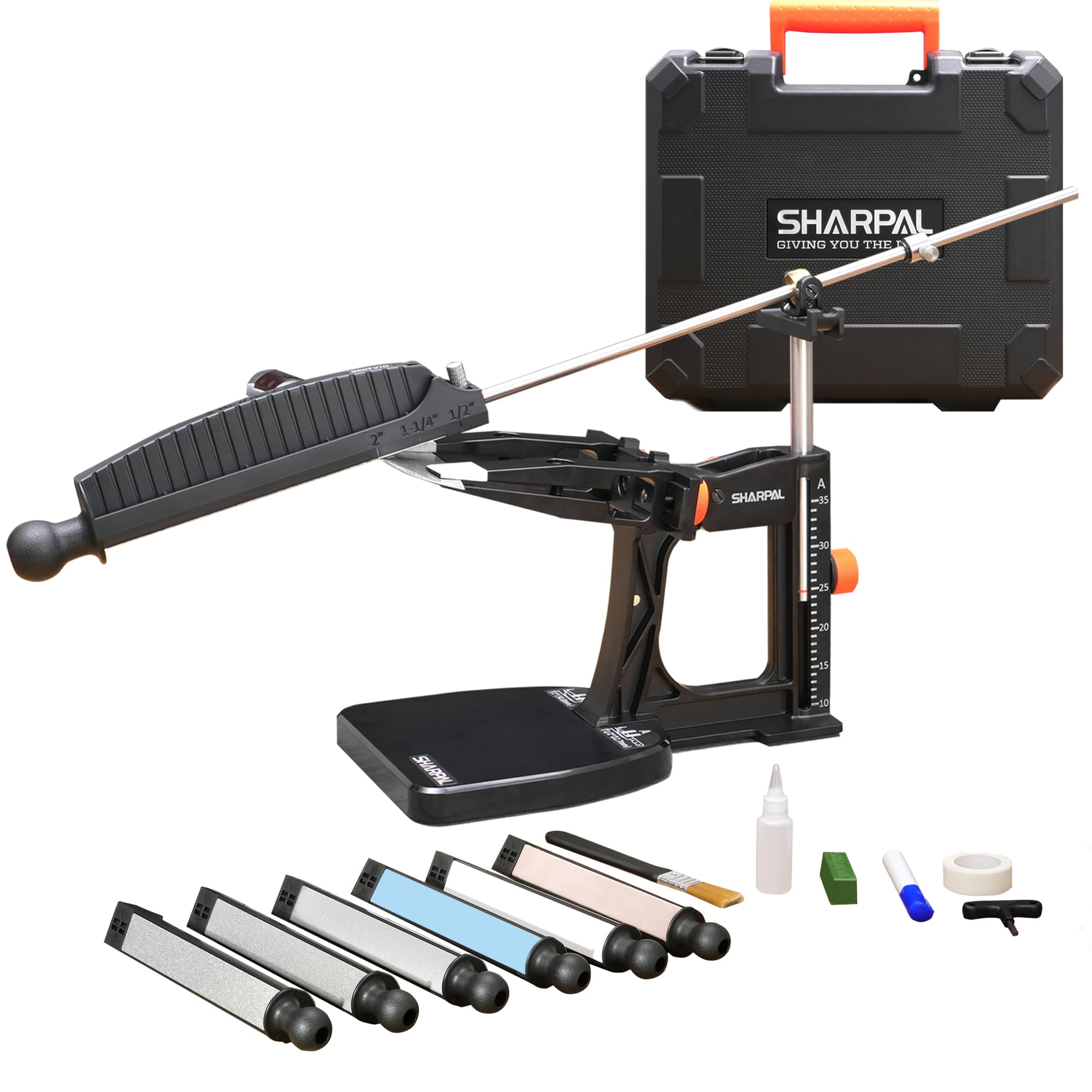
The SHARPAL 202H delivers the most complete fixed angle experience out of the box, with seven abrasives spanning from 220-grit monocrystalline diamond to 6000-grit whetstone and a leather strop. This progression lets you repair a chipped edge, sharpen it to a working burr, and then hone to a mirror polish without purchasing additional stones.
The distance-based angle setting is a genuine innovation — it keeps the edge-to-clamp distance fixed, so the angle remains accurate regardless of the blade width. The heavy-duty metal base provides stability during aggressive sharpening sessions, and the dual sliding clamps hold blades from tiny pocket knives to wide cleavers securely.
User feedback consistently highlights how quickly the diamond stones raise a burr, and the storage case keeps everything organized for transport. For anyone serious about maintaining a collection of kitchen, hunting, or EDC blades, this system offers the best balance of grit range and build quality at a mid-premium price point.
Why it’s great
- Complete grit progression from 220 to 6000 plus strop
- Innovative distance-based angle setting ensures accuracy across blade widths
- Robust metal construction with non-slip base
Good to know
- Heavier than other portable systems at 4.4 kg
- Learning curve for initial setup of angle clamping
2. Work Sharp Professional Precision Adjust Knife Sharpener Kit

The Work Sharp Professional Precision Adjust kit raises the bar with a digital angle indicator that removes any guesswork from setup — you dial in the angle to the exact degree within the 15° to 30° range. The all-metal construction gives it a premium feel and long-term durability that plastic-based systems cannot match.
With seven abrasives — 220, 320, 400, 600, and 800 diamond, fine ceramic, and a leather strop — you have the full spectrum for repair, sharpening, and finishing. The clamping system accepts everything from small pen knives to full-size chef knives, and the included small blade holder is a thoughtful addition for narrow blades.
Users upgrading from older guided systems consistently report that the digital indicator eliminates the trial-and-error of angle estimation, delivering repeatable results with minimal effort. If your priority is absolute angle precision and you are willing to invest in a premium system, this is the most user-friendly option available.
Why it’s great
- Digital angle indicator for exact repeatable setup
- Full metal build for stability and longevity
- Includes small blade holder for narrow knives
Good to know
- Premium price point near the top of the category
- Leather strop requires compound for best results
3. KME Precision Knife Sharpener System with 4 Gold Series Diamond Hones

The KME system is a benchmark in manual guided sharpening, known for its spherical bearing rod guide that eliminates angle deviation during the stroke. The four Gold Series diamond hones — 140 extra-coarse, 300 coarse, 600 fine, and 1500 extra-fine — provide a solid foundation for edge repair through refinement.
Continuous angle adjustment from 17° to 30° in one-degree increments allows fine-tuning for different blade tasks. The clamp rotates and pivots, making it easier to follow the curve of a blade without lifting the edge off the stone. The included hard carry case keeps the compact system portable for field use.
Long-time users who also own more expensive systems like the Wicked Edge often comment that the KME is easier to set up and delivers comparable results for a fraction of the cost. It strikes an excellent balance between precision engineering and accessibility, though the grit range is narrower than the SHARPAL 202H out of the box.
Why it’s great
- Spherical bearing rod guide ensures zero angle deviation
- Continuous angle adjustment in 1° increments
- Rotating clamp follows curved blade profiles
Good to know
- Only four grit stones included — extra stones cost more
- Wood base may slide without a non-slip mat
4. Work Sharp Ken Onion Knife Sharpener Tool Mk.2

The Work Sharp Ken Onion Mk.2 takes a different approach to fixed angle sharpening by using flexible abrasive belts with precision guides, making it one of the fastest guided sharpeners on the market. The electronic speed control lets you dial in the belt speed for different blade steels, reducing the risk of overheating thin edges.
It handles knives, scissors, serrated blades, and even tools like garden shears, making it a versatile workshop tool. The belt-driven system removes material quickly, so a dull blade can be restored to working sharpness in minutes rather than the 15–30 minutes typical of manual systems.
Designed in partnership with knife maker Ken Onion, the ergonomics and guide system are refined for consistent results even on longer blades. The 3-year warranty from Work Sharp adds confidence. This is the best choice if you value speed and have a high volume of knives to maintain, though it does require replacement belts over time.
Why it’s great
- Fast belt-driven sharpening saves significant time
- Variable speed control prevents edge overheating
- Handles knives, scissors, serrated and tools
Good to know
- Requires ongoing purchase of replacement belts
- Less portable than manual systems
5. XARILK GEN3 Guided Knife Sharpening System
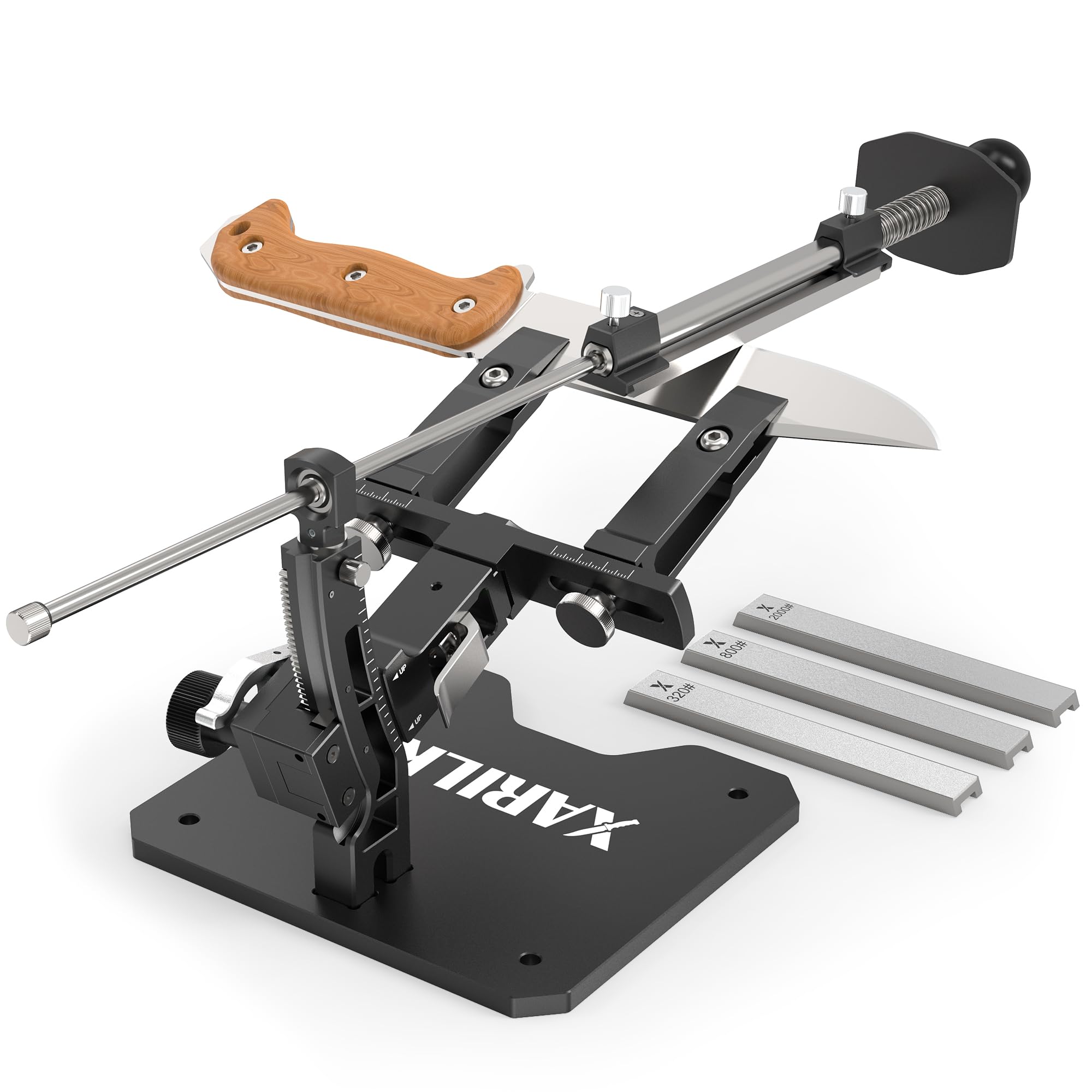
The XARILK GEN3 offers an impressive metal construction at a mid-range price, using a high-strength aluminum alloy frame that feels far more substantial than plastic alternatives. The three included diamond plates — 320, 800, and 2000 grit — cover the essential stages from coarse sharpening to fine honing.
The simple clamp-and-guide design is easy to set up and intuitive for both beginners and experienced sharpeners. Users note that the diamond stones cut fast and maintain their flatness over multiple sessions. The compact footprint makes it suitable for small countertops or workshop benches.
While the grit selection is more limited than the SHARPAL or Work Sharp kits, the GEN3 performs admirably for its price tier. The foldable design and included Allen wrench for adjustments add convenience. This is a strong contender for anyone who wants the durability of an all-metal system without stepping into the highest price brackets.
Why it’s great
- Solid aluminum alloy frame for long-term durability
- Three diamond plates cover sharpening and honing
- Intuitive design suitable for beginners
Good to know
- No ceramic or strop for final polish out of the box
- Clamp may require adjustment for very thick blades
6. Warthog V-Sharp A4 Knife Sharpener

The Warthog V-Sharp A4 uses a patented V-Sharp mechanism with spring-loaded diamond and hardened steel rods that sharpen both sides of the blade simultaneously. This design drastically reduces sharpening time because you complete a pass for both edges in one motion, making it a favorite for home cooks and hunters who want quick results.
Four angle settings (15°, 20°, 25°, and 30°) cover the spectrum from delicate filet knives to thick bushcraft blades. The metal frame and rubber base provide stability during use, and the powder-coat finish resists rust in humid environments.
While it lacks the adjustable-angle granularity of the KME or Work Sharp systems, the simultaneous-edge approach is genuinely faster for most users. The 325-grit natural diamond rod cuts aggressively, and the hardened steel rod provides a fine finish. This system is ideal for those who prioritize speed and simplicity over micro-adjustability.
Why it’s great
- Sharpens both sides simultaneously saving time
- Four discrete angle settings from 15° to 30°
- Metal frame and rubber base for stability
Good to know
- No continuous angle adjustment between presets
- Diamond rod may wear faster than plate systems
7. Homly Professional Electric Knife Sharpener

The Homly electric sharpener uses 100% diamond abrasives in three stages — coarse sharpening, fine honing, and polishing — making it one of the more effective electric slot sharpeners for straight-edge and ceramic knives. The flexible spring guide rod maintains a consistent angle automatically as you pull the blade through each slot.
The double-layer shell finish reduces noise, and the powerful motor handles multiple knives in a single session without slowing down. Users report that ceramic knives from brands like Costco, which are notoriously difficult to sharpen on stones, come back to life quickly with this unit.
At its mid-range price point, the Homly offers a good alternative for those who prefer a hands-free, pull-through electric method but want diamond abrasives instead of generic grinding wheels. It is not a substitute for a precision manual system for high-end Japanese knives, but for everyday kitchen maintenance it is highly effective.
Why it’s great
- 100% diamond abrasives in all three slots
- Works on both straight steel and ceramic knives
- Quieter operation than many electric sharpeners
Good to know
- Fixed angle guides — no user angle adjustment
- Removes more metal than guided manual systems
8. Lansky Deluxe 5-Stone Controlled-Angle System

The Lansky Deluxe 5-Stone system is a long-standing favorite in the fixed angle community, offering five ceramic stones from coarse to ultrafine plus a bottle of honing oil. The controlled-angle guide clamps onto the blade and uses a series of preset angle holes to maintain consistency across the edge.
The kit includes a storage case that keeps all stones organized, and the system is small enough to pack for camping or field use. The ceramic stones produce a fine edge but require more passes than diamond systems, which some users prefer for the control it offers on harder steels.
As a budget-friendly entry into the fixed angle category, the Lansky system has proven its reliability over decades. It lacks the angle fine-tuning of more modern systems, and the preset angle holes limit flexibility, but for the price it remains a solid choice for beginners and occasional sharpeners.
Why it’s great
- Five grit ceramic stones from coarse to ultrafine
- Portable case for storage and transport
- Proven design with decades of positive user feedback
Good to know
- Preset angle holes limit adjustment granularity
- Ceramic stones cut slower than diamond plates
9. Arbenefe Rolling Knife Sharpener Tool Kit

The Arbenefe rolling sharpener offers an entry-level guided experience with a magnetic base that holds the knife steady while you roll the diamond and ceramic wheels along the edge. It provides four angle settings — 12°, 15°, 20°, and 25° — covering precision work and standard kitchen edges.
The 400-grit diamond side handles sharpening, while the smooth ceramic side polishes the edge. Users with arthritis or hand fatigue find the rolling motion significantly easier than traditional stones or even some clamp-based systems, as shown by feedback from an older user who could no longer use whetstones.
This is the most budget-friendly option in this list, and it delivers surprisingly sharp results for the price. The 12° and 15° angles are rare in this price tier and make it suitable for fine sushi knives. However, the diamond plate is coarser than what most guided systems offer, so it works best for maintenance sharpening rather than heavy edge repair.
Why it’s great
- Low-angle options (12° and 15°) for fine blades
- Rolling motion reduces hand fatigue
- Includes gift-box packaging and magnetic support
Good to know
- 400 grit diamond is coarse for fine finishing passes
- Magnetic base may not hold all blade shapes securely
FAQ
What angle should I use for my kitchen knives on a fixed angle sharpener?
Can a fixed angle sharpener handle serrated or ceramic blades?
How often should I replace the diamond plates on my sharpener?
Final Thoughts: The Verdict
For most users, the fixed angle knife sharpener winner is the SHARPAL 202H because it offers the most complete grit progression from 220 to 6000 plus a strop, combined with a durable metal base and an innovative distance-based angle setting. If you want digital angle readout and absolute repeatability, grab the Work Sharp Professional Precision Adjust. And for those who need speed and versatility with a belt-driven system, nothing beats the Work Sharp Ken Onion Mk.2.