Nothing derails a busy weeknight dinner like a screeching smoke alarm triggered by a little bit of sizzling oil or steam from a boiling pot. Kitchen-specific detection is about balancing two critical needs: catching a real fire emergency quickly and ignoring the normal cooking events that happen every day. The right unit does this without sacrificing safety or forcing you to disconnect it permanently.
I’m Mohammad Maruf — the founder and writer behind AirfryerBite. My research focuses on matching home safety hardware to real cooking environments, analyzing sensor types, false-alarm rejection rates, and installation requirements to help you avoid the frustration of nuisance tripping.
A dedicated kitchen unit is a targeted safety investment. Whether you need a heat-based device near a stovetop or a smoke and CO combo with advanced nuisance reduction, choosing the best fire detector for kitchen ensures reliable protection without the kitchen chaos.
How To Choose The Best Fire Detector For Kitchen
Picking a kitchen detector is different from choosing one for a hallway or bedroom. The constant presence of heat, steam, and cooking byproducts means you need a device designed to tolerate those conditions without going into alarm mode unnecessarily. Understanding the key differentiators helps you avoid both constant nuisance alerts and, worse, a detector that you disable permanently.
Heat vs. Smoke Detection — The First Major Decision
Heat detectors use rate-of-rise or fixed-temperature triggers to signal danger, making them almost immune to steam and cooking fumes. These are ideal for placement within six feet of a range or oven where smoke detectors would false alarm constantly. Standard smoke alarms, even photoelectric ones, are better suited for general kitchen-area placement but will still trigger on toast or searing meat.
Sensor Type and False Alarm Resistance
Ionization sensors are highly sensitive to fast-flaming fires but are notorious for nuisance alarms from cooking. Photoelectric sensors respond better to smoldering fires and are less prone to reacting to cooking particles. Some modern units incorporate precision detection or advanced sensing to distinguish real smoke from steam or burnt food, a feature worth paying extra for in a kitchen zone.
Power Source and Interconnect Capability
Hardwired units with battery backup provide the most reliable protection and are often code-required for new construction. Battery-only models are simpler to install but risk being disabled when batteries run out. Interconnectivity — where one triggered unit signals all others in the home — is critical for whole-house safety, especially if the kitchen is located far from sleeping areas.
Quick Comparison
On smaller screens, swipe sideways to see the full table.
| Model | Category | Best For | Key Spec | Amazon |
|---|---|---|---|---|
| First Alert SMI105-AC | Smoke Alarm | Precision Detection near kitchen | 10-Year battery backup | Amazon |
| Kidde 20SA10-V | Smoke Detector | Voice alerts for clear warnings | Enhanced false-alarm reduction | Amazon |
| Kidde 900-CUDR-V | Smoke & CO Combo | 2-in-1 safety with voice alerts | AA battery powered combo | Amazon |
| Kidde P3010K-CO | Smoke & CO Combo | Kitchen-specific sealed battery | 10-Year sealed lithium | Amazon |
| First Alert BRK SC9120B | Smoke & CO Combo | Hardwired with battery backup | Dual ionization + CO sensor | Amazon |
| First Alert HD6135FB | Heat Alarm | Direct stovetop/oven placement | Rate-of-rise heat sensing | Amazon |
| First Alert SMI100 (3-Pack) | Smoke Alarm | Budget multi-room coverage | Battery-operated 3-pack | Amazon |
In‑Depth Reviews
1. First Alert SMI105-AC

The First Alert SMI105-AC uses Precision Detection technology specifically engineered to comply with new industry standards aimed at reducing cooking nuisance alarms. This means it can sit in a kitchen-adjacent hallway or kitchen area and tolerate moderate cooking events without triggering a false alert, while still providing early warning for real fires. The hardwired design with a sealed 10-year battery backup ensures uninterrupted protection during power outages.
Interconnect capability is a major plus here — when one unit detects smoke, all compatible alarms throughout the home sound together. The alarm indicator light also identifies which unit initiated the alert, saving you from hunting through the house during an event. The form factor is compact at 5.6 inches in diameter and just 2 inches deep, fitting neatly into standard junction boxes.
For a primary living area or kitchen-zone smoke alarm that prioritizes false-alarm resistance without compromising on fire detection speed, this is the most balanced pick available. The end-of-life warning removes guesswork about when to replace the unit, solving the common problem of expired detectors silently failing.
Why it’s great
- Precision Detection dramatically cuts nuisance cooking alarms
- Hardwired with 10-year battery backup for outage protection
- Interconnectable with other First Alert units
Good to know
- Requires existing hardwiring for installation
- Single pack — add more for full home coverage
2. Kidde 20SA10-V
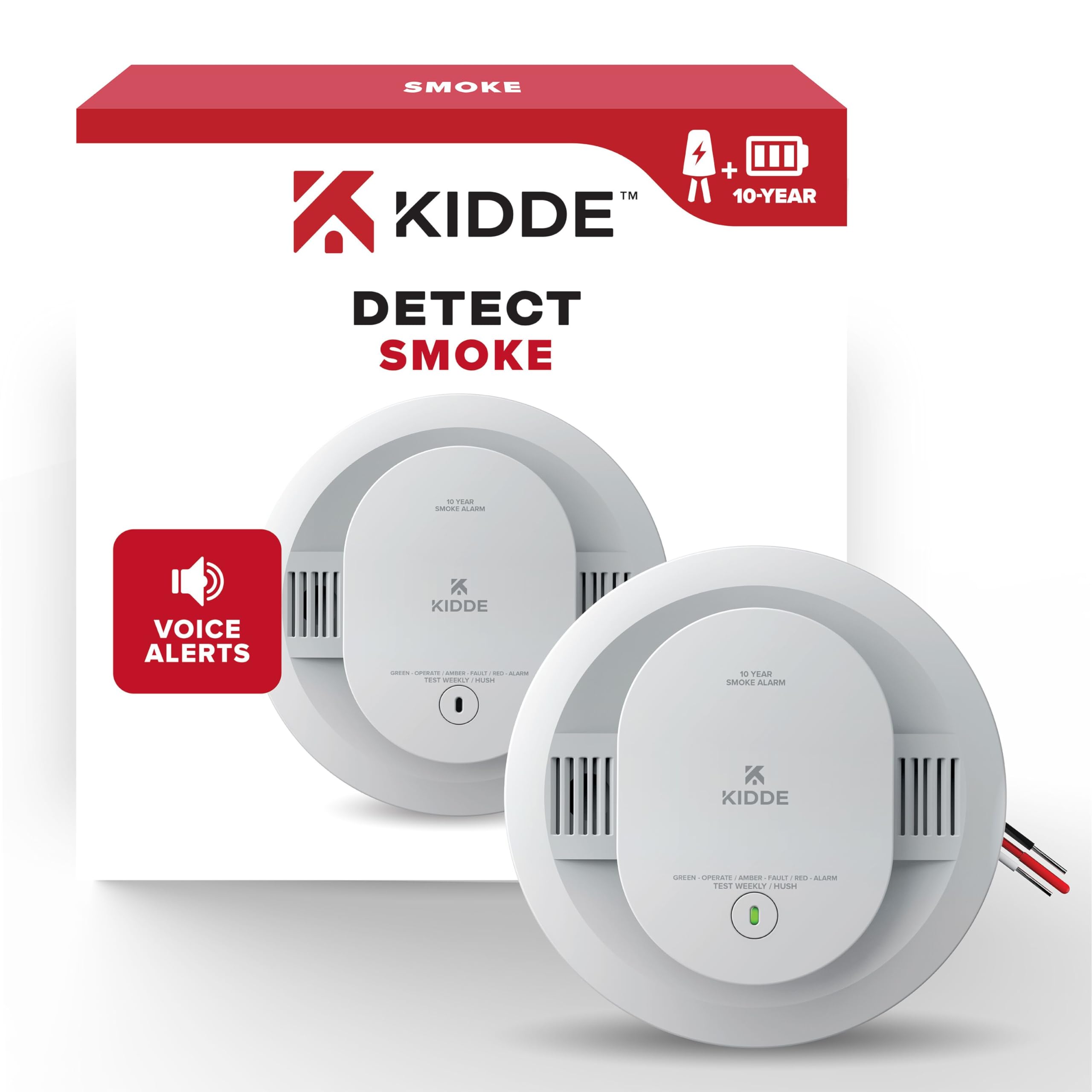
Kidde’s 20SA10-V brings voice alerts into the kitchen safety equation, announcing “Fire” clearly when smoke is detected. This auditory distinction helps differentiate a real emergency from the standard beeping that might be ignored during cooking. The enhanced sensing technology claims over 25% faster smoke detection than standard units while simultaneously reducing false alarms from steam and everyday cooking.
The hardwired design includes a 10-year built-in battery backup, and Kidde estimates this saves roughly the cost of battery replacements over the life of the alarm. The 85-decibel alarm is paired with a red LED light for visual confirmation, and interconnectivity ensures that if one unit triggers, every connected Kidde alarm in the home follows suit. The unit meets UL 217 10th Edition standards and carries a 10-year limited warranty.
User feedback consistently highlights the ease of installation — mounting it onto existing wiring is straightforward — and the loudness of the alarm. The voice feature is particularly valued by families with children or elderly members who may not immediately associate a standard beep with danger. If you want a modern, code-compliant smoke alarm with a distinct user alert, this Kidde delivers that extra layer of communication.
Why it’s great
- Voice alerts announce “Fire” for clearer hazard recognition
- Enhanced sensing reduces cooking-related nuisance alarms
- Claims over 25% faster smoke detection
Good to know
- Hardwired installation required, not battery-only
- Some users report occasional sensitivity to very smoky cooking
3. Kidde 900-CUDR-V

The Kidde 900-CUDR-V combines smoke and carbon monoxide detection in a single battery-operated unit, making it a versatile option for kitchens where gas ranges or combustion appliances are present. The photoelectric smoke sensor handles slow-smoldering fires well, while the electrochemical CO sensor provides critical protection against odorless carbon monoxide. Voice alerts differentiate between “Fire” and “Warning Carbon Monoxide,” removing confusion during an alarm event.
24/7 self-testing components continuously verify the device’s functionality, though manual push testing is still recommended. LED status lights — green for normal, amber for error, red for alarm — offer at-a-glance health checks. Installation is simple with the included mounting bracket, and the AA battery power means no hardwiring is needed, perfect for renters or spots without existing wiring. The 10-year limited warranty covers the alarm itself.
Early user reports are very positive regarding build quality and alarm reliability. A small number of users experienced false alerts after several months, but the majority highlight the convenience of not having to change hardwiring. If you need a dual-threat detector for a kitchen with a gas stove and want clear voice differentiation, this Kidde combo packs premium features into a battery-powered form factor.
Why it’s great
- 2-in-1 smoke and carbon monoxide detection
- Voice alerts identify the specific hazard type
- Battery-powered for easy, wire-free installation
Good to know
- Occasional false alarm reports from some units
- Battery changes required over the alarm’s lifespan
4. Kidde P3010K-CO

The Kidde P3010K-CO is explicitly designed and marketed as a “Kitchen” alarm, featuring a sealed 10-year lithium battery that eliminates the need for annual battery swaps. The photoelectric sensor is inherently more resistant to cooking fumes than ionization types, and the combination smoke and CO detection makes it a significant upgrade for kitchens with gas appliances. The alarm activates automatically when attached to the mounting bracket, simplifying installation to a single step.
The sealed battery is the standout feature here — no low-battery chirps in the middle of the night, no forgetting to replace batteries, and full code compliance for battery-backup requirements. The end-of-life warning chirps when the entire unit needs replacement, which occurs at the 10-year mark. At 5.22 inches in diameter and just 1.6 inches deep, this is a low-profile design that fits comfortably on a ceiling or wall near the kitchen area.
This unit bridges the gap between a dedicated heat alarm and a general smoke detector. Its photoelectric sensor handles the smoldering fires common in kitchens while resisting nuisance alerts from toasting or frying. For those who want a set-it-and-forget-it solution specifically for the kitchen zone, the P3010K-CO is hard to beat in terms of convenience and targeted design.
Why it’s great
- Sealed 10-year battery eliminates annual battery changes
- Photoelectric sensor reduces cooking-related false alarms
- Explicitly designed for kitchen placement
Good to know
- Single unit — multi-pack not available in this model
- Sealed battery means full replacement at 10 years
5. First Alert BRK SC9120B

The First Alert BRK SC9120B is a hardwired smoke and carbon monoxide combo that uses both an ionization sensor for fast-flaming fires and an electrochemical sensor for CO detection. This dual-sensor approach makes it a comprehensive safety device for any kitchen environment, though the ionization element means it is more prone to false alarms from cooking than a photoelectric-only unit. The 9-volt battery backup ensures continued operation during power failures.
Indicator lights on the face of the unit display the presence of smoke or carbon monoxide separately, and the 85-decibel siren provides a clear, loud warning. The interconnect capability links with other compatible BRK or First Alert detectors so the entire house is alerted when danger is detected in the kitchen. Tamper-resistant locking brackets and a side-load battery compartment are thoughtful installation details that pros and DIYers appreciate.
First Alert’s reputation in home safety is backed by decades of market presence. This model is a strong choice for new construction or renovations where hardwiring is already in place, and where dual-threat detection is valued. For kitchens specifically, you may want complementary photoelectric or heat units nearby to reduce the chance of nuisance alarms from routine cooking.
Why it’s great
- Combined smoke and carbon monoxide detection in one unit
- Hardwired with battery backup for power outage protection
- Interconnectable with other First Alert alarms
Good to know
- Ionization sensor may false-alarm near cooking areas
- Requires hardwiring for installation
6. First Alert HD6135FB

The First Alert HD6135FB is a hardwired heat alarm that uses advanced rate-of-rise sensing technology, detecting both high absolute temperatures and rapid temperature increases. This design makes it virtually immune to false alarms from cooking fumes, steam, or smoke from toast — it only triggers when actual dangerous heat levels are present. For kitchen placements directly above a range or near an oven, this is the gold standard for nuisance-free fire detection.
The 85-decibel alarm is loud enough to be heard throughout the home, and the microprocessor control dramatically reduces the chance of false alerts. The unit can be remotely tested and muted using almost any household remote control (sold separately), adding a layer of convenience for confirmed installations. The compact 2-inch cube design is unobtrusive and fits into tight ceiling or wall spaces near ventilation hoods.
While a heat alarm does not detect smoke or carbon monoxide, it is the ideal solution for areas where those detectors would be unreliable. Pairing this heat alarm with a separate smoke/CO detector just outside the kitchen area gives you complete coverage without the headache of constant false triggers. For anyone serious about kitchen fire safety without the noise, this is the specialized tool.
Why it’s great
- Zero false alarms from cooking steam or smoke
- Rate-of-rise + fixed temperature detection
- Ultra-compact form factor for tight spaces
Good to know
- Does not detect smoke or carbon monoxide
- Hardwired installation required
7. First Alert SMI100 (3-Pack)
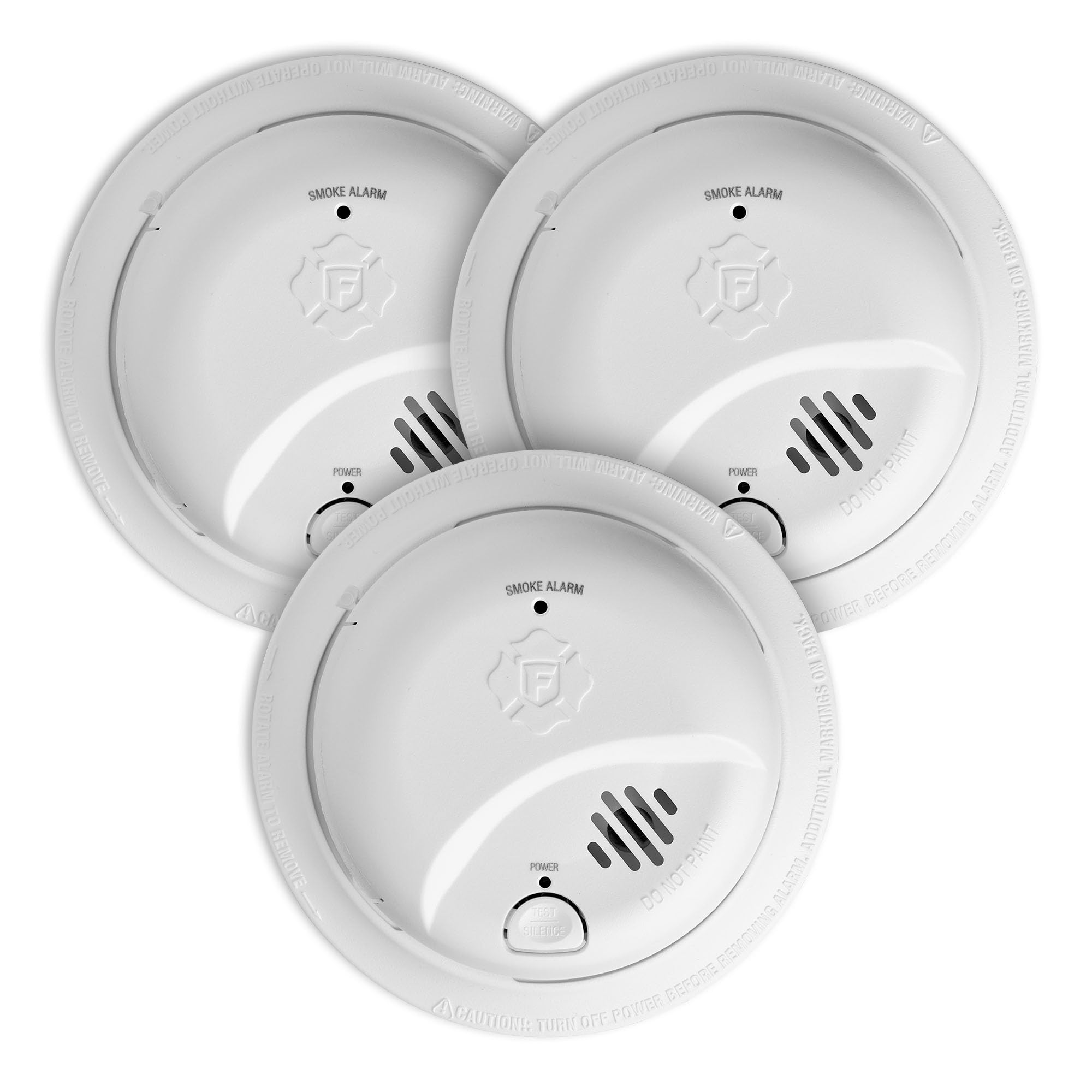
The First Alert SMI100 3-Pack offers Precision Detection technology at an accessible price point, making it a strong entry-level choice for budget-conscious buyers looking to protect multiple rooms. The ionization sensor is sensitive to fast-flaming fires, though users should be aware that this sensor type is more reactive to cooking particles than photoelectric alternatives. For kitchen-adjacent placement (hallway leading away from the cooking area), this unit still delivers solid fundamental detection.
Battery operation means no wiring is needed — simply mount and activate. The front-access battery compartment makes replacements quick, and the test/silence button allows easy functionality checks. The end-of-life warning ensures you know when the detector needs replacing, solving the common problem of expired but silent detectors. At 0.6 pounds each, these are lightweight and easy to install in various locations.
For the price of a three-pack, you can cover a small home or apartment with basic smoke detection. While the ionization sensor is not ideal for direct kitchen placement, these units are perfectly adequate for bedrooms, hallways, and living areas away from the stovetop. If you are outfitting a rental or need a quick, low-cost solution, this pack gets the job done reliably.
Why it’s great
- Three units in one pack for multi-room coverage
- Precision Detection technology reduces nuisance alarms
- Battery-operated for simple installation
Good to know
- Ionization sensor may false alarm near stovetops
- No carbon monoxide detection
FAQ
Can I place a smoke alarm directly above my gas stove?
What does the Precision Detection technology in First Alert units do?
How often should I replace a kitchen fire detector?
Final Thoughts: The Verdict
For most users, the fire detector for kitchen winner is the First Alert SMI105-AC because its Precision Detection technology balances kitchen-tolerant false alarm resistance with reliable fire detection and convenient hardwired installation. If you want a dedicated heat alarm that will never false-alarm from cooking, grab the First Alert HD6135FB. And for combined smoke and carbon monoxide protection in a battery-powered voice alert package, nothing beats the Kidde 900-CUDR-V.