Slicing onions on a board that slips, absorbs odors, or dulls your knife within weeks is the fastest way to kill the joy of cooking. The right everyday cutting board balances knife protection, ease of cleaning, and surface durability so prep feels deliberate rather than frustrating.
I’m Mohammad Maruf — the founder and writer behind AirfryerBite. I spend my days breaking down the raw hardware specifications, material science, and real-world durability of kitchen gear to help home cooks make confident, category-specific buying decisions.
After reviewing dozens of models across material types and price tiers, I’ve narrowed the field to five boards that stand up to daily chopping, scrubbing, and heavy use. This roundup of the best everyday cutting boards focuses on what actually matters: edge-grain hardness, juice groove depth, thermal tolerance, and knife-friendliness.
How To Choose The Best Everyday Cutting Boards
The ideal everyday board disappears into your routine — it holds steady, protects your blade edge, and cleans up without extra effort. Three material families dominate this category, and each delivers a different compromise between weight, maintenance, and cost.
Material Matters: Wood, Composite, or Plastic
Solid acacia and bamboo offer natural antimicrobial properties and a warm aesthetic but require hand washing and occasional oiling to prevent cracking. Wood-composite boards like Belwares’ compressed fiber blend skip the oiling routine entirely while remaining knife friendly and heat tolerant up to 350°F. High-density polypropylene (HDPP) boards, such as the Thirteen Chefs model, are the most dishwasher-friendly option and resist warping under commercial-grade hot water, though they will scar more visibly under serrated knives.
Thickness, Weight, and Board Stability
A board that shifts mid-chop is both annoying and dangerous. Heavier boards (5 pounds and above) with 0.75-inch thickness stay planted on the counter without a damp towel underneath. Lightweight boards under 2 pounds are easier to lift and store but may slide more on smooth granite or quartz surfaces — look for silicone or rubber non-slip edges if you prefer a thin profile.
Size and Juice Management
The “everyday” sweet spot sits between 14 x 11 inches and 18 x 12 inches — large enough for a full meal prep without crowding the board edges. A perimeter trench or juice groove is non-negotiable if you frequently slice proteins or juicy fruits; shallow grooves (under 3 mm) drain too easily, while deeper wells catch runoff without pooling onto the countertop.
Quick Comparison
On smaller screens, swipe sideways to see the full table.
| Model | Category | Best For | Key Spec | Amazon |
|---|---|---|---|---|
| Belwares Composite Wood Board | Wood Composite | Dishwasher-safe wood feel | Heat resistant to 350°F | Amazon |
| KitchenAid 2-Piece Plastic Set | Plastic Set | Multi-board color coding | Non-slip edges, perimeter trench | Amazon |
| Keechee Bamboo Board | Bamboo | Lightweight serving & prep | Reversible with juice groove | Amazon |
| Ayiaren Acacia Wood Board | Solid Wood | Heavy-duty butcher block | 0.8″ thick, reversible | Amazon |
| Thirteen Chefs HDPP Board | Commercial Plastic | High-heat dishwasher cycles | 0.75″ commercial-grade HDPP | Amazon |
In‑Depth Reviews
1. Belwares Composite Wood Cutting Board

This compressed wood-fiber board is the closest you can get to a real butcher block without the hassle of oiling or seasoning. At 0.25 inches thick, it is noticeably slim — easy to slide into a cabinet or lean against a backsplash — yet the composite structure holds up against heavy knife work without bowing. The 18 x 12 inch surface accommodates whole chicken breakdowns and full vegetable prep in one pass.
The heat resistance rating of 350°F is a rare spec for non-plastic boards, meaning you can rest a hot sauté pan on it briefly during plating without surface damage. Cleanup is straightforward: rinse under hot water or place directly on the top rack of a standard dishwasher. Unlike solid wood, this composite does not absorb moisture or develop dark water spots over repeated washes.
Knife drag feels smooth but not slippery — the surface has just enough micro-grip to keep ingredients from skating around during fine dicing. The natural beige tone hides light staining better than pale plastics, though deep beet or turmeric discoloration may require a quick lemon-salt scrub to restore the original shade.
Why it’s great
- Heat resistant to 350°F for multi-use platter duty
- Dishwasher safe without the cracking risk of solid wood
- Lightweight enough to carry with one hand
Good to know
- Thin profile — not ideal for heavy cleaver work
- Brightly colored produce may temporarily stain the finish
2. KitchenAid Classic Nonslip 2-Piece Plastic Cutting Board Set
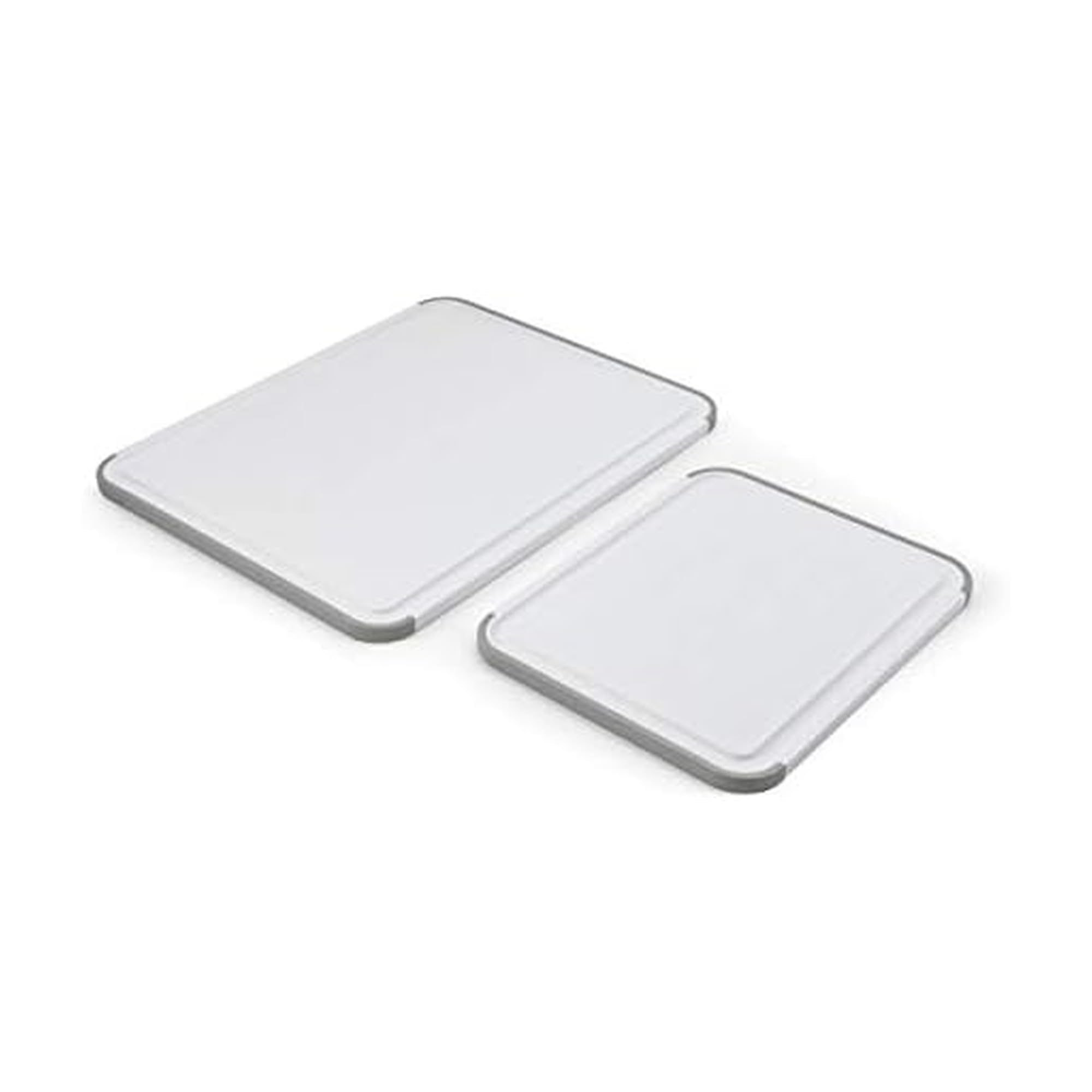
KitchenAid’s two-board set gives you a white board for produce and a gray board for proteins, helping you follow basic HACCP-style separation without buying four separate boards. Each board measures 14 x 11 inches with a 0.8-inch thickness that feels substantial yet still slides into a standard dishwasher rack. The non-slip edges are rubberized strips along the perimeter — they grip wet countertops silently without suction-cup marks.
A raised perimeter trench circles each board to catch runaway juices from sliced tomatoes, melons, or raw chicken. The trench depth is modest at roughly 2 mm, enough for moderate liquid build-up but not deep enough to double as a carving well for a full roast. The polypropylene material is BPA-free and nonabsorbent, so odors from garlic or fish rinse off completely with hot soapy water.
Knife feel is average for a plastic board — the surface is soft enough to avoid chipping fine-edge blades but will accumulate thin scoring lines over weeks of heavy use. The gray board masks these scars better than the white one, which develops a patina of fine cuts faster. Both boards are warp-resistant up to 200°F dishwasher cycles, though they should never contact hot pans or oven surfaces.
Why it’s great
- Two boards for color-coded raw/cooked separation
- Rubber non-slip edges hold steady on slick counters
- Perimeter trench contains moderate juice runoff
Good to know
- White board shows knife scars quickly
- Juice groove is shallow for heavy roasts
3. Keechee Dishwasher Safe Bamboo Cutting Board
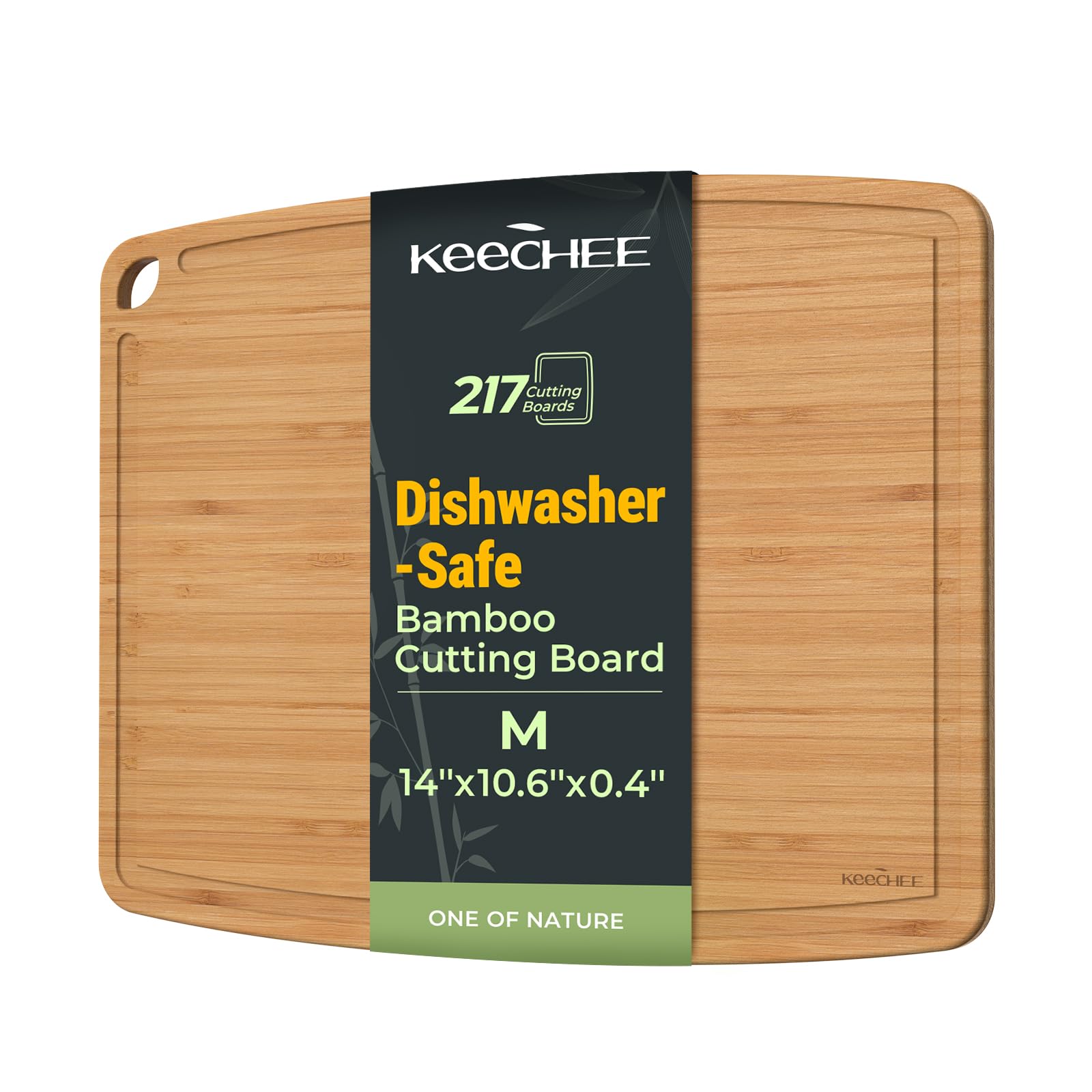
Bamboo boards have a reputation for splitting or shedding splinters, but Keechee’s engineered version is lab-tested to resist both issues. At 1.6 pounds, this is one of the lightest wood boards at this size — easy to grab from a drawer, use for a quick prep, and carry to a counter for serving. The carbonized brown finish gives it a richer tone than natural bamboo and hides light staining well.
The reversible design offers two working surfaces: one side features a juice groove for protein prep, while the flat side is ideal for slicing bread or arranging cheese boards. At 0.4 inches thick, the board is thin enough to store vertically in a narrow cabinet slot but retains enough rigidity to resist bending under heavy chopping. The manufacturer specifically certifies it as dishwasher safe — a rare claim for bamboo — though repeated high-heat cycles may still darken the surface over time.
Knife action on bamboo is harder than on acacia or composite wood, meaning your edge will require slightly more frequent honing. The trade-off is a surface that resists deep gouges and stays smooth for years. The included gift-ready box makes this an easy present for new homeowners, but for everyday solo use the weight and size work well in small kitchens, RVs, or picnic setups.
Why it’s great
- Splinter-resistant bamboo construction
- Two-sided use — juice groove on one side, flat on the other
- Extremely lightweight for carrying or storing
Good to know
- Bamboo is harder on knife edges than acacia or composite
- Very thin profile may slide on glossy countertops
4. Ayiaren Solid Acacia Wood Cutting Board

Acacia is one of the hardest domestic hardwoods available at an entry-level price point, and the Ayiaren board makes full use of that density. At 0.8 inches thick, it has real heft — enough to stay planted under a cleaver or a heavy meat mallet without shifting. The 17 x 12 inch surface is slightly narrower than the Belwares board but the extra thickness provides a satisfying, solid thud with each chop.
A deep juice groove runs around one side at roughly 5 mm depth — noticeably deeper than the KitchenAid trench — and captures runoff from a large roast or melon effectively without spilling over the edges. The reverse side is flat and smooth, suitable for serving charcuterie or as a cheese board during gatherings. The natural acacia grain shows a striking blend of light tan and dark brown streaks that darken slightly with mineral oil application.
Wood care is required: hand washing only, with occasional food-grade mineral oil treatment to prevent the end grain from drying out and splitting. The board weighs about 2 pounds, which is moderate for its size, and the flat edges make it easy to grip when flipping. Over time, the surface develops a beautiful patina of small knife marks that add character without compromising hygiene.
Why it’s great
- Thick 0.8″ acacia handles cleaver blows without flex
- Deep 5 mm juice groove contains heavy runoff
- Reversible for dual-purpose prep and serving
Good to know
- Hand wash only — not dishwasher safe
- Requires periodic mineral oiling to prevent cracking
5. Thirteen Chefs Large Poly Cutting Board

If your priority is maximum dishwasher durability and zero maintenance, the Thirteen Chefs board delivers the most heat-tolerant plastic surface in this lineup. Made from high-density polypropylene (HDPP) instead of standard polyethylene, it withstands commercial dishwasher temperatures up to 200°F without warping or softening. At 5 pounds with a 0.75-inch thickness, this board sits rock-steady on any counter and will not slide even during aggressive chopping.
The black color is a deliberate design choice: it hides knife scars and staining far better than white or light-colored boards, making it a practical choice for heavy daily use. The 18 x 12 inch surface matches the largest board in this review, giving you ample room for meal prep. The non-porous plastic surface does not absorb juices or odors, so a simple rinse and dishwasher pass is enough between raw chicken and vegetable prep.
Be aware that serrated knives and cleavers will cut visible grooves into HDPP over time — the material is tough but not scratch-proof. The board is not meant for hot pans or oven use; plastic will melt at direct contact above 212°F. For home cooks who prioritize hygiene and easy cleanup above aesthetic warmth, this is the most utilitarian choice in the roundup.
Why it’s great
- HDPP plastic withstands high-heat dishwashers without warp
- 5-pound weight stays planted without non-slip mat
- Black color hides knife marks and stains effectively
Good to know
- Serrated knives leave visible grooves over time
- Not heat-safe for hot pans or direct oven contact
FAQ
Can an everyday cutting board go in the dishwasher?
Does a thicker board really protect my knives better?
What size cutting board is best for a small kitchen?
Final Thoughts: The Verdict
For most users, the everyday cutting boards winner is the Belwares Composite Wood Board because it combines the warmth of wood, dishwasher-safe convenience, and heat resistance to 350°F in a slim, lightweight package. If you want color-coded separation for raw and cooked foods, grab the KitchenAid 2-Piece Set. And for heavy-duty butcher block performance with a deep juice groove, nothing beats the Ayiaren Acacia Wood Board.