Manual grinding for espresso is a ritual that forces you to slow down and engage with the coffee-making process, but without the right burr set and adjustment resolution, your shot will taste sour or bitter before it even hits the cup. An espresso hand grinder must deliver fine, uniform particles across a narrow adjustment window — anything less produces channeling and a messy extraction.
I’m Mohammad Maruf — the founder and writer behind AirfryerBite. My research focuses on burr geometry, bearing tolerances, and grind consistency across dozens of mechanical coffee grinders to identify the models that actually deliver repeatable results for demanding espresso recipes.
Whether you are upgrading from a blade grinder or building your first manual espresso setup, the right tool makes dialing in effortless. This guide evaluates the top contenders for the best espresso hand grinder based on measurable performance specs and real-world durability.
How To Choose The Best Espresso Hand Grinder
Espresso demands a grind particle distribution that is both fine and tight. Wide particle variation leads to uneven extraction, so your grinder’s burr quality and adjustment mechanism are non-negotiable. Focus on three pillars: burr material and geometry, step size of the adjustment collar, and bearing stability under load.
Adjustment Resolution: Microns Per Click
Most entry-level hand grinders offer steps of 30 microns or larger, which is too coarse for espresso where a single step can push your shot from 25 seconds to 35 seconds. Look for an adjustment system that delivers 16 to 18 microns per click. The finer the step, the more control you have over flow rate.
Burr Material and Geometry
Stainless steel conical burrs with multi-axis CNC machining produce sharper cutting edges and maintain consistency over thousands of grinding cycles. Ceramic burrs wear faster and create more fines, which clog espresso baskets. High-carbon or proprietary steel alloys like the S2C890 in the TIMEMORE S3 offer measurable improvements in particle uniformity at espresso settings.
Bearing System and Grind Speed
Double bearing support at both ends of the shaft prevents wobble during grinding. A burr that shifts under pressure creates uneven particles. Premium models use customized high-precision bearings with tolerance ratings as low as 5 microns. Faster grinding (around 1.5 to 2 grams per second) reduces arm fatigue and helps you maintain a consistent rotation speed for even extraction.
Quick Comparison
On smaller screens, swipe sideways to see the full table.
| Model | Category | Best For | Key Spec | Amazon |
|---|---|---|---|---|
| TIMEMORE S3 | Premium | High‑precision espresso dialing | 0.015mm per step with S2C890 burr | Amazon |
| 1Zpresso J | Premium | Versatile brew methods | Numerical internal adjustment | Amazon |
| Comandante C40 MK4 | Premium | Pour over and espresso | 40g capacity, Nitro Blade burr | Amazon |
| KINGrinder K6 | Mid‑Range | Fine adjustment on a budget | 16 microns per click, 25-35g capacity | Amazon |
| TIMEMORE C2S | Mid‑Range | Durable full‑metal build | 38mm S2C burr, 36 adjustment levels | Amazon |
| KINGrinder K2 | Entry | Budget espresso entry point | 18 microns per click, 20-25g capacity | Amazon |
| Vivaant Manual | Entry | Portable travel grinder | 6 grind settings, 32g capacity | Amazon |
In‑Depth Reviews
1. TIMEMORE S3 Manual Coffee Grinder

The TIMEMORE S3 is the flagship manual grinder from the brand, built around their patented S2C890 steel burr. This burr geometry delivers noticeably higher particles uniformity at espresso settings compared to the standard S2C burr, and the external point-to-point digital adjustment ring lets you change grind size with 0.015mm precision. You can track your exact position on the numbered dial without counting clicks — a massive convenience when you are dialing in a new coffee bean.
Customized high-precision bearings reduce axial tolerance from 7 microns to 5 microns, which translates to less wobble during grinding and more consistent particle size from the first gram to the last. The foldable spring-assisted handle collapses against the body for compact storage and prevents the grinder from tipping over on the counter. The full metal unibody feels dense and premium without being unnecessarily heavy.
Capacity sits around 25 to 30 grams, which is sufficient for a double espresso shot. The grinding speed is fast enough that a 18g dose takes about 30 seconds with moderate effort. The S3 is the only model in this list with an external digital adjustment ring, making it the most user-friendly option for anyone who switches between brew methods frequently.
Why it’s great
- 0.015mm per step external adjustment feels intuitive and repeatable
- S2C890 burr produces excellent particle uniformity for espresso
- High-precision bearings minimize grind inconsistency
- Foldable handle adds portability and storage convenience
Good to know
- Retains some grounds after each use — requires brush cleaning
- Price point is higher than mid-range competitors
- Not ideal for very coarse grinding methods like cold brew
2. 1Zpresso J Manual Coffee Grinder

The 1Zpresso J series has earned a loyal following among espresso enthusiasts for its rock-solid build and internal numerical adjustment system. The dial collar clicks through marked numbers so you can note your exact setting and reproduce it weeks later without guessing. The stainless steel conical burr is machined from high hardness steel and produces very few fines at espresso settings.
Dual bearing support at the top and bottom of the shaft keeps the burr stable during rotation. The catch cup threads securely and includes a rubber ring to reduce static buildup, which is a common complaint with manual grinders. The whole unit is compact enough to fit in a kitchen drawer but substantial enough to handle daily use without any wobble.
Grinding 18g of espresso beans takes around 35 to 40 seconds with steady effort. The handle ergonomics are decent, though some users find the grip a little narrow for extended sessions. Overall, the 1Zpresso J delivers championship-grade grind consistency without the premium price tag of the top-tier flagships.
Why it’s great
- Numerical adjustment makes dialing in repeatable
- High hardness steel burr resists wear over time
- Minimal static and fines retention
- Dual bearing system provides excellent stability
Good to know
- Handle may feel slightly short for larger hands
- Internal adjustment requires removing the collar to change settings
- Not ideal for very coarse grinding due to narrower adjustment range
3. Comandante C40 Hand Grinder MK4

The Comandante C40 MK4 is one of the most recognized manual grinders in the specialty coffee world. Its Nitro Blade burr is a proprietary stainless steel design that produces an exceptionally narrow particle distribution across all grind sizes. For espresso, this means you can push into finer ranges without generating the excessive fines that cause astringency and clogged baskets.
The MK4 includes two catch jars — one brown glass and one clear polymer-glass — both holding around 40 grams. The internal tri-fan axle support has been redesigned to eliminate the friction that caused binding in previous versions. The adjustment mechanism uses an audible click system with a stepped collar that rotates inside the body.
Grinding speed is moderate; an espresso dose takes around 40 seconds. The perceived build quality is outstanding, and the grinder feels like a precision instrument in hand. The main trade-off is that the C40 uses a proprietary burr geometry that requires official replacement parts, and the price is at the premium end of the spectrum.
Why it’s great
- Nitro Blade burr delivers elite particle uniformity
- 40g capacity handles large single doses easily
- Redesigned axle support eliminates binding issues
- Two included jars offer flexibility for storing different beans
Good to know
- Proprietary burr design limits aftermarket upgrade options
- Adjustment collar is internal — you must open the body to change settings
- Premium price bracket restricts budget-conscious buyers
4. KINGrinder K6 Manual Hand Coffee Grinder

The KINGrinder K6 punches far above its price point with a 16 microns per click adjustment system — the same resolution you see on grinders that cost twice as much. The interior adjustment ring uses a numbered collar with 60 clicks per full rotation, giving you granular control over the espresso grind window. The stainless steel conical burr set is paired with dual bearing positioning to keep the shaft stable.
The full metal body is machined from aluminum with a durable coating that resists scratches. The straight handle provides good leverage, and the hopper holds 25 to 35 grams per fill. Disassembly for cleaning requires no tools — you can pull the burr and shaft out in a few seconds to brush away retained grounds.
Grinding speed is roughly 1.5 grams per second, which places it on the faster side of manual grinders. The main limitation is that the adjustment is internal, meaning you need to open the lid and rotate the collar, which is less convenient than the external ring on the TIMEMORE S3. For the price, the K6 offers the best adjustment resolution in its class.
Why it’s great
- 16 microns per click gives espresso‑grade precision
- Dual bearing system maintains burr alignment
- Fast grinding speed reduces arm fatigue
- Easy tool‑free disassembly for cleaning
Good to know
- Internal adjustment collar is less intuitive than external designs
- Metal body can feel cold to the touch in cool environments
- Catch cup threads could be slightly smoother
5. TIMEMORE Chestnut C2S Manual Coffee Grinder

The TIMEMORE C2S is the upgraded version of the popular C2, replacing the plastic top cap with a full metal unibody that eliminates the common breakage point. The 38mm S2C conical burr is machined from stainless steel with 55-58 HRC hardness and provides even grinding with minimal fines. The 36 level adjustment range is wide enough to cover espresso through French press, though the click resolution is not as fine as the K6 or S3.
Double bearing central axis positioning keeps the burr stable even when you apply uneven downward pressure. The compact body diameter is 52mm, which makes it easy to grip for users with smaller hands. The handle continues rotating for a few rotations after you release it, which indicates low friction in the bearing system.
Total weight is 700 grams, giving it a dense feel without being heavy. Grinding speed is competitive, and the catch cup has minimal static cling compared to many budget grinders. The C2S is a reliable daily driver for espresso drinkers who want a durable build and don’t need the microscopic adjustment steps of premium models.
Why it’s great
- Full metal unibody fixes the common C2 top cap failure
- 38mm S2C burr produces consistent particle sizes
- Dual bearing system reduces shaft wobble
- Compact 52mm diameter fits small hands comfortably
Good to know
- 36 adjustment levels are wider steps than premium options
- Not ideal for very fine espresso dialing
- Some retention between grind sessions
6. KINGrinder K2 Manual Hand Coffee Grinder
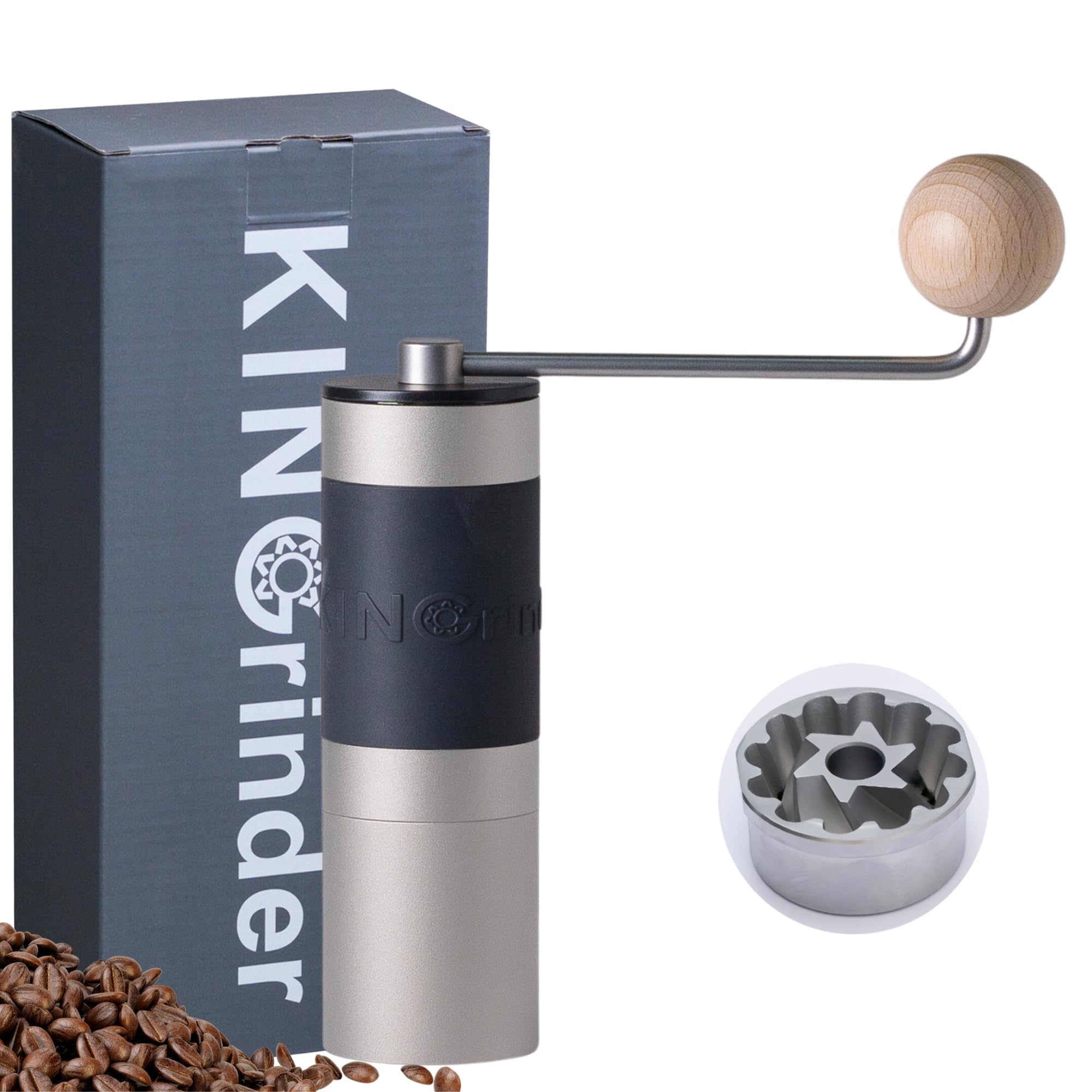
The KINGrinder K2 is an entry-level hand grinder that still delivers a respectable 18 microns per click adjustment resolution — enough for espresso once you find the right range. The silver aluminum body with a stainless steel conical burr set feels premium for the price bracket. The dual bearing design helps maintain alignment even though the burr is smaller than higher-end models.
Capacity is limited to 20 to 25 grams per fill, which is tight for a double espresso dose. You can fit 18g, but you have to be careful not to overfill. The straight handle provides adequate leverage, and the entire unit disassembles by hand for cleaning. The interior adjustment collar uses an audible click system with 40 clicks per full rotation.
The K2’s grind quality at espresso settings is decent, though you will see slightly more particle variation than on the K6 or S3. This grinder works well for travelers who need something compact and for espresso beginners who are not ready to invest in a high-end manual grinder. It is also great for pour over and AeroPress brews.
Why it’s great
- 18 microns per click is acceptable for entry-level espresso
- Full metal body with dual bearing support
- Easy to disassemble and clean without tools
- Compact size is ideal for travel and camping
Good to know
- Capacity is limited to 20-25g, tight for double espresso
- Burr geometry yields more fines than premium options
- Adjustment collar is slightly stiff initially
7. Vivaant Coffee Grinder Manual Capacity 32g

The Vivaant manual grinder uses a dragon tooth stainless steel conical burr that grinds faster than ceramic competitors, but the adjustment system is limited to 6 stepped settings. For espresso, you will typically find one or two settings in the right range, but the wide step increments make fine tuning difficult. If your shot runs too fast, you might not have a finer setting to move to.
The 32g glass catch jar is marked with measurement lines, which is helpful for dosing. The grinder body is lightweight and portable, and the glass jar helps reduce static compared to plastic cups. Assembly and disassembly are straightforward, though the plastic components in the adjustment mechanism do not inspire the same confidence as the all-metal builds higher on this list.
The Vivaant works best as a travel grinder or as a starter unit for someone who drinks predominantly pour over and wants to occasionally try espresso. The burr geometry is adequate for the price, but the limited adjustment resolution and plastic parts mean it will not deliver the consistent results that espresso enthusiasts demand.
Why it’s great
- Stainless steel burr grinds faster than ceramic alternatives
- 32g capacity is generous for the price
- Glass jar reduces static retention
- Very affordable entry point to manual grinding
Good to know
- Only 6 grind steps limits espresso adjustability
- Plastic components reduce long-term durability
- Wide step increments make fine tuning nearly impossible
FAQ
Can a hand grinder really produce fine enough particles for espresso?
What does internal versus external adjustment mean for espresso dialing?
How many grams of beans should an espresso hand grinder hold?
Final Thoughts: The Verdict
For most users, the best espresso hand grinder winner is the TIMEMORE S3 because its external 0.015mm adjustment ring and S2C890 burr deliver the best balance of convenience and grind quality for espresso. If you want a more budget-conscious option with excellent 16-micron resolution, grab the KINGrinder K6. And for the purist who values iconic design and proprietary burr performance, nothing beats the Comandante C40 MK4.