The gap between a mediocre morning cup and a café-quality experience is often a single wrong purchase decision. An espresso and coffee machine that delivers consistent pressure, stable temperature, and freshly ground beans can transform your kitchen counter into a legitimate bar station, but most machines promise that and fail on execution because of weak pumps, cheap grinders, or steam wands that can’t produce real microfoam.
I’m Mohammad Maruf — the founder and writer behind AirfryerBite. I’ve spent years analyzing the hardware specifications that separate true home-barista tools from glorified drip makers, focusing on pump pressure ratings, boiler types, burr grinder materials, and temperature stability systems like PID and NTC.
Whether you are a latte-art beginner or a shot-pulling perfectionist, this guide breaks down nine models built for real results. If you want to cut through the marketing noise and find a genuinely capable espresso and coffee machine, the detailed reviews and spec breakdowns below are exactly what you need to make that call.
How To Choose The Best Espresso And Coffee Machine
The market is flooded with machines that look the part but cut corners on the components that actually control shot quality. Before you click buy, understand the three pillars that define every real espresso and coffee machine: the pump, the grinder, and the temperature control system.
Pump Pressure: The 9-Bar Extraction Myth
Commercial espresso machines extract at a stable 9 bars of pressure. Consumer machines advertise 15, 19, or even 20-bar pumps, but those numbers represent the pump’s maximum output, not its consistent working pressure. What matters is whether the machine uses an over-pressure valve (OPV) to regulate flow down to the ideal 9 bars during extraction. A 15-bar pump that lacks OPV adjustment often over-extracts and produces bitter, hollow shots. Machines like the CASABREWS Ultra use a 20-bar Italian pump with careful pre-infusion to avoid that pitfall, while the Breville Barista Express relies on a 15-bar vibe pump paired with low-pressure pre-infusion to maintain balance.
Grinder Integration: Conical vs Flat Burr and Step Sizes
Built-in grinders save counter space, but not all integrated grinders are equal. Conical burrs, found in models like the Chefman Crema Supreme and the Ninja Luxe Café Pro, produce a more rounded flavor profile and are generally quieter. Flat burrs are rare in integrated home units. The critical spec is the number of grind settings — 8 settings (De’Longhi Arte Evo) offer coarse adjustments, while 30 to 31 settings (Chefman, Gevi Dual Boiler) give you the granularity to dial in beans from light-roast Ethiopians to dark oily Sumatra blends. Also check the chute design: wider polished chutes, like the Electactic’s “clog-crushing” path, prevent jams with oily beans.
Temperature Stability: PID, NTC, and Single vs Dual Boilers
Temperature drift is the number one killer of shot consistency in budget machines. A basic thermostat-based machine can swing 10°F during a single extraction. PID (Proportional-Integral-Derivative) controllers, found on the Breville Barista Express and Gevi Dual Boiler, lock the water temperature within ±2°F. The Gevi unit adds an NTC sensor for the steaming circuit, which is rare at its price point. Dual boilers — like the Gevi model — let you pull shots and steam milk simultaneously without any temperature sag. Single-boiler machines require a 30-60 second recovery period between steaming and brewing, which slows down workflow when making multiple milk-based drinks.
Quick Comparison
On smaller screens, swipe sideways to see the full table.
| Model | Category | Best For | Key Spec | Amazon |
|---|---|---|---|---|
| Breville Barista Express BES870XL | Premium Semi-Auto | Shot consistency with PID control | 15-bar pump, PID, 67 oz tank | Amazon |
| Ninja Luxe Café Pro ES701 | 4-in-1 Versatile | Espresso, drip, cold brew all-in-one | Weight-based dosing, 25 grind settings | Amazon |
| Philips 4400 Series EP4447/90 | Fully Automatic | Quick-clean milk system, silent brew | LatteGo, SilentBrew, 12 recipes | Amazon |
| De’Longhi La Specialista Arte Evo | Bean-to-Cup | Cold brew in 5 minutes | Cold Extraction, 8 grind settings | Amazon |
| Gevi Dual Boiler | Dual Boiler | Simultaneous brew & steam | 31 grind settings, NTC & PID | Amazon |
| Chefman Crema Supreme | Mid-Range All-in-One | 30 settings burr grinder, large tank | 30 grind settings, 3 L tank | Amazon |
| Electactic Anti-Clog (2026) | Value Bean-to-Cup | Clog-free grinding with oily beans | 15-bar, 20% wider chute | Amazon |
| Electactic 15 Bar Almond | Budget Bean-to-Cup | Entry-level integrated grinder machine | 15-bar, 2.3 L tank, ETL cert | Amazon |
| CASABREWS Ultra | Entry Level | 20-bar pump with adjustable temperature | 20-bar, 73 oz tank, LCD | Amazon |
In‑Depth Reviews
1. Breville Barista Express BES870XL
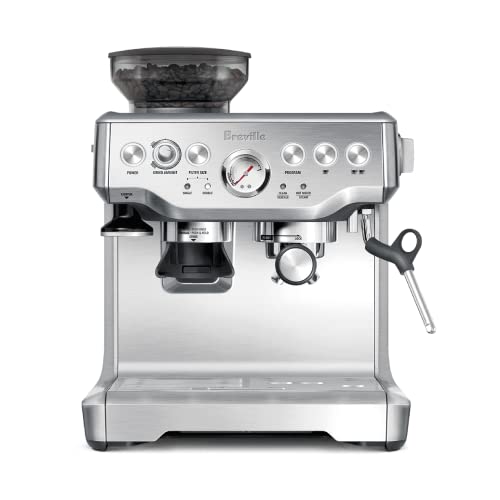
The Barista Express has been the benchmark for home espresso for years because it nails the critical engineering triad — a 15-bar Italian pump with pre-infusion, a digital PID controller that locks water temperature within ±2°F, and a 1/2-pound bean hopper feeding an integrated conical burr grinder that doses directly into the 54mm portafilter. The grinder uses a stepped collar adjustment with micro-adjustable rings, giving you the range to dial in anything from light-roast single origins to darker blends without swapping burrs.
The manual steam wand on this unit is a dual-hole tip that produces a rolling vortex rather than chaotic bubbling, which allows rapid microfoam texturing for latte art. The Razor Dose Trimming Tool is a clever addition — it levels the puck to the exact basket depth, eliminating the guesswork in dose volume. The 67-ounce water tank is rear-mounted and removable, and the drip tray covers the full footprint to catch drips during purge.
The trade-off is that the grinder, while consistent, has a stepped adjustment range that some third-wave enthusiasts find limited when switching between drastically different roast profiles. The lack of a dual boiler means you wait about 45 seconds between steaming and brewing. For one or two drinks per session, that delay is negligible. For back-to-back milk drinks, it slows the workflow.
Why it’s great
- PID temperature controller delivers ±2°F stability for consistent extraction
- Integrated conical burr doses directly into the portafilter with minimal mess
- Razor trimming tool ensures consistent puck depth every shot
- Dual-hole steam tip creates professional microfoam for latte art
Good to know
- Stepped grinder adjustment may feel limited when switching roast profiles frequently
- Single boiler requires a recovery pause between steaming and brewing
- Bean hopper is not sealed, so beans degrade faster if left for days
2. Ninja Luxe Café Pro ES701

The Luxe Café Pro is a genuine 4-in-1 — espresso machine, drip coffee maker, cold brewer, and hot water dispenser — but what makes it stand out is the integrated scale and weight-based dosing system. Most machines grind for a set duration; this one grinds until the basket hits the target weight, then stops. That eliminates a variable that even experienced baristas struggle with: dose inconsistency from bean density changes. The conical burr has 25 grind settings, and the Barista Assist system tracks previous brew outcomes to recommend grind size adjustments.
The integrated tamper uses a lever mechanism that compresses the puck with repeatable force, removing the human variability in tamp pressure. The Dual Froth System Pro has a steam wand plus a whisking element that spins simultaneously, creating microfoam from dairy and plant-based milks without requiring any pitcher angle technique. The machine also has a dedicated cold-pressed espresso mode that drops the brew temperature and extends the contact time for a smoother, less acidic shot.
At 27 pounds, this is a heavy, footprint-dominant machine. The drip coffee carafe uses a separate thermal system from the espresso boiler, which means the drip function has its own dedicated heating path — a genuine engineering choice, not a gimmick. The XL milk jug is insulated and fits under the wand, but the machine’s height (nearly 15 inches) may be an issue under cabinets with low clearance.
Why it’s great
- Weight-based dosing eliminates the guesswork in grind quantity
- Lever-integrated tamper applies consistent pressure every time
- Dual Froth System handles plant-based milks without gymnastics
- Cold-pressed espresso mode delivers a unique, smooth flavor profile
Good to know
- Heavy unit at 27 pounds limits placement mobility
- Height can conflict with low upper cabinets
- Dedicated drip carafe system adds complexity for those who only drink espresso
3. Philips 4400 Series EP4447/90
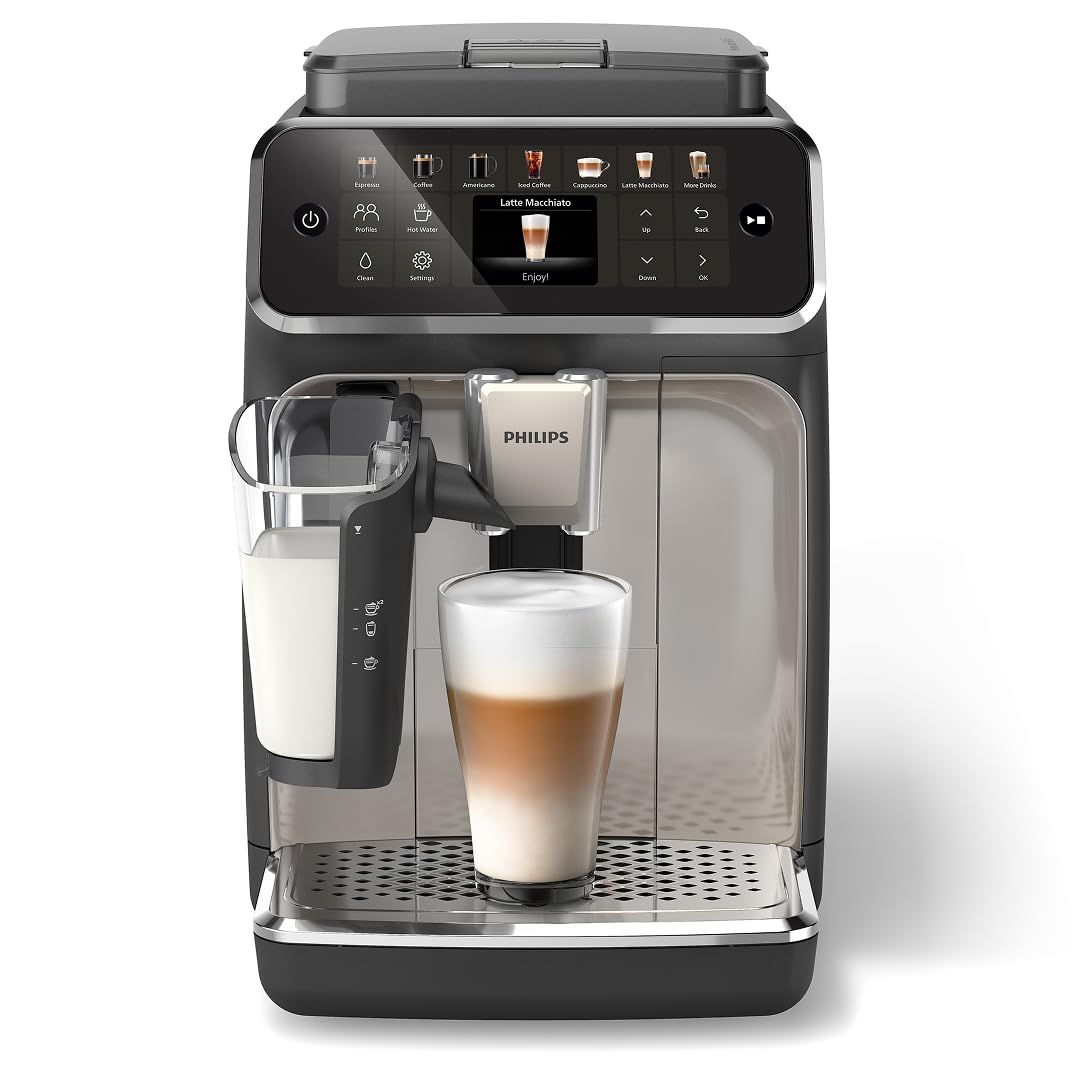
The Philips 4400 is a fully automatic bean-to-cup machine with 12 programmed recipes including iced variants, and its standout engineering feature is the LatteGo milk system — a two-part assembly that froths milk using a centrifugal disc rather than a traditional steam wand. That design means you rinse the entire milk path under running water in about 10 seconds, which is a legit productivity win for households that make multiple milk drinks daily. The system works with oat, almond, and soy milks without clogging.
The SilentBrew technology reduces grinding noise by 40% compared to earlier Philips models, which translates to roughly 55 decibels during operation — quieter than a normal conversation. The ceramic burr grinder produces fewer fines than steel burrs at the same setting, which reduces bitterness in the cup. The AquaClean filter system allows up to 5000 cups before descaling, assuming you replace the filter at the recommended interval. The 1.8-liter water tank is front-accessible for easy refills.
The fully automatic nature means you have limited control over extraction parameters. You can adjust grind size and coffee strength, but there is no OPV adjustment for pre-infusion or brew pressure profiling. If you’re the kind of user who wants to tweak individual shot variables, this machine will feel restrictive. It is built for convenience-first drinkers who want quality without workflow friction.
Why it’s great
- LatteGo milk system rinses clean in under 10 seconds with no disassembly
- SilentBrew reduces grinding noise to conversational volume
- Ceramic burrs minimize fines for cleaner-tasting shots
- AquaClean filter stretches maintenance intervals to 5000 cups
Good to know
- Fully automatic design limits manual brew pressure and pre-infusion control
- No OPV adjustment for dialing in extraction profiling
- Milk system uses a disc frother rather than a wand, limiting latte art potential
4. De’Longhi La Specialista Arte Evo EC9255M

The Arte Evo is the only consumer machine on this list with dedicated Cold Extraction Technology that produces cold brew concentrate in under 5 minutes, as opposed to the traditional 12-24 hour steep. The process uses a lower brew temperature combined with a precisely metered flow rate and a higher pressure ramp to extract solubles from ground beans without heat-driven bitterness. The Specialty Coffee Association collaborated on the calibration, which gives it legitimate third-party validation beyond a marketing claim.
The Active Temperature Control system gives you three infusion temperatures — low, medium, high — that adjust the brew water for light, medium, and dark roasts respectively. The commercial-style steam wand has a dual-hole tip and reaches steam temperature quickly, allowing you to texture milk while the shot is pulling if you time it right.
The dosing and tamping guide is a physical plastic funnel and mat system that helps new users apply consistent pressure. The machine is compact at 14.37 inches deep, fitting under standard cabinets. The grinder, however, uses a stepped adjustment that cannot be micro-adjusted infinitely, so finding the perfect setting for a specific bean may require a bit of hopping between adjacent steps. The drip tray is small and needs emptying after 3-4 back-to-back rinses.
Why it’s great
- Cold Extraction Technology delivers cold brew in under 5 minutes
- Active Temperature Control with three infusion settings for different roast levels
- Commercial-style dual-hole steam wand creates consistent microfoam rapidly
- Compact footprint fits well under standard cabinets
Good to know
- Only 8 stepped grind settings limit fine-tuning for specific beans
- Drip tray capacity is small and requires frequent emptying
- No dual boiler means some wait time between steaming and brewing
5. Gevi Dual Boiler Espresso Machine

The Gevi Dual Boiler is the most spec-dense option in the sub- range, and it earns that distinction primarily because of its separate heating circuits — one boiler dedicated to brew water at 200°F and another dedicated to steam at 275°F. This dual boiler architecture eliminates the single-boiler compromise entirely: you can steam milk and pull a shot simultaneously without any temperature sag in either circuit. The NTC sensor monitors the steam boiler and the PID regulates the brew boiler, giving you ±2°F stability on both paths.
The integrated conical burr grinder offers 31 stepped grind settings, which is among the widest ranges available on a machine at this tier. The 58mm commercial portafilter is the same diameter used by professional espresso machines, meaning you can use aftermarket competition baskets and distribution tools. The pressure control system regulates water flow through the puck using a pre-infusion phase that starts at low pressure and ramps up, reducing channeling on lighter roasts.
At 15 pounds, the unit is lighter than the Breville or Ninja, but the stainless steel housing feels solid. The detachable 1.8-liter water tank is rear-mounted and accessible. The package includes four interchangeable filter baskets — single, double, dual-wall pressurized, and a blank disc for backflushing. The learning curve is real: the 31 grind settings and dual boiler workflow require some experimentation, and the instruction manual is dense. For users willing to invest a few sessions into dialing in, the output is remarkable for the price tier.
Why it’s great
- True dual boiler design allows simultaneous brewing and steaming
- 31 grind settings provide granular control for any roast level
- 58mm commercial portafilter accepts third-party accessories
- NTC and PID deliver ±2°F stability across both circuits
Good to know
- Learning curve is steeper due to the number of adjustable parameters
- Instruction manual could be clearer for first-time dual-boiler users
- Water tank is rear-mounted and slightly awkward to access on a tight counter
6. Chefman Crema Supreme RJ54-G-SS-AM

The Chefman Crema Supreme is built around a conical burr grinder with 30 stepped grind settings, which places it at the same granularity level as the Gevi unit but at a slightly lower entry point. The 15-bar pump feeds a 58mm brass portafilter, and the pressure gauge on the front panel gives you real-time visual feedback on whether you’re in the ideal extraction zone — a feature usually reserved for machines that cost double. The 3-liter removable water tank is the largest capacity on this list, easily handling a weekend brunch session without refilling.
The machine includes a single and double shot basket, and the touchscreen interface cycles through shot volume and temperature customization. The steam wand is a traditional single-hole design that produces moderately textured foam; it is effective but not as fast as the De’Longhi or Breville wands when making large volumes of microfoam. The included milk pitcher, tamper, funnel, and cleaning brush are housed inside the detachable drip tray, which keeps the counter tidy.
The unit is heavy at 21.8 pounds, and at 16.34 inches tall it may not fit under shallow cabinets. The plastic housing around the grinder burr can feel less premium than the full stainless steel builds on the Breville and De’Longhi. The machine uses a single boiler with a thermoblock assist for steam, which means there is a brief pause between pulling a shot and switching to steam mode — typically 15-20 seconds — rather than true simultaneous operation.
Why it’s great
- 30-step conical burr grinder provides detailed grind size control
- 3-liter water tank reduces refill frequency during heavy use
- Analog pressure gauge offers real-time extraction feedback
- Accessories store inside the drip tray for a clean counter
Good to know
- Single boiler with thermoblock assist creates a short pause between brew and steam
- Plastic grinder housing feels less robust than full-steel machines
- Height may not fit under low upper cabinets
7. Electactic Anti-Clog Espresso Machine (2026 Gloss Black)
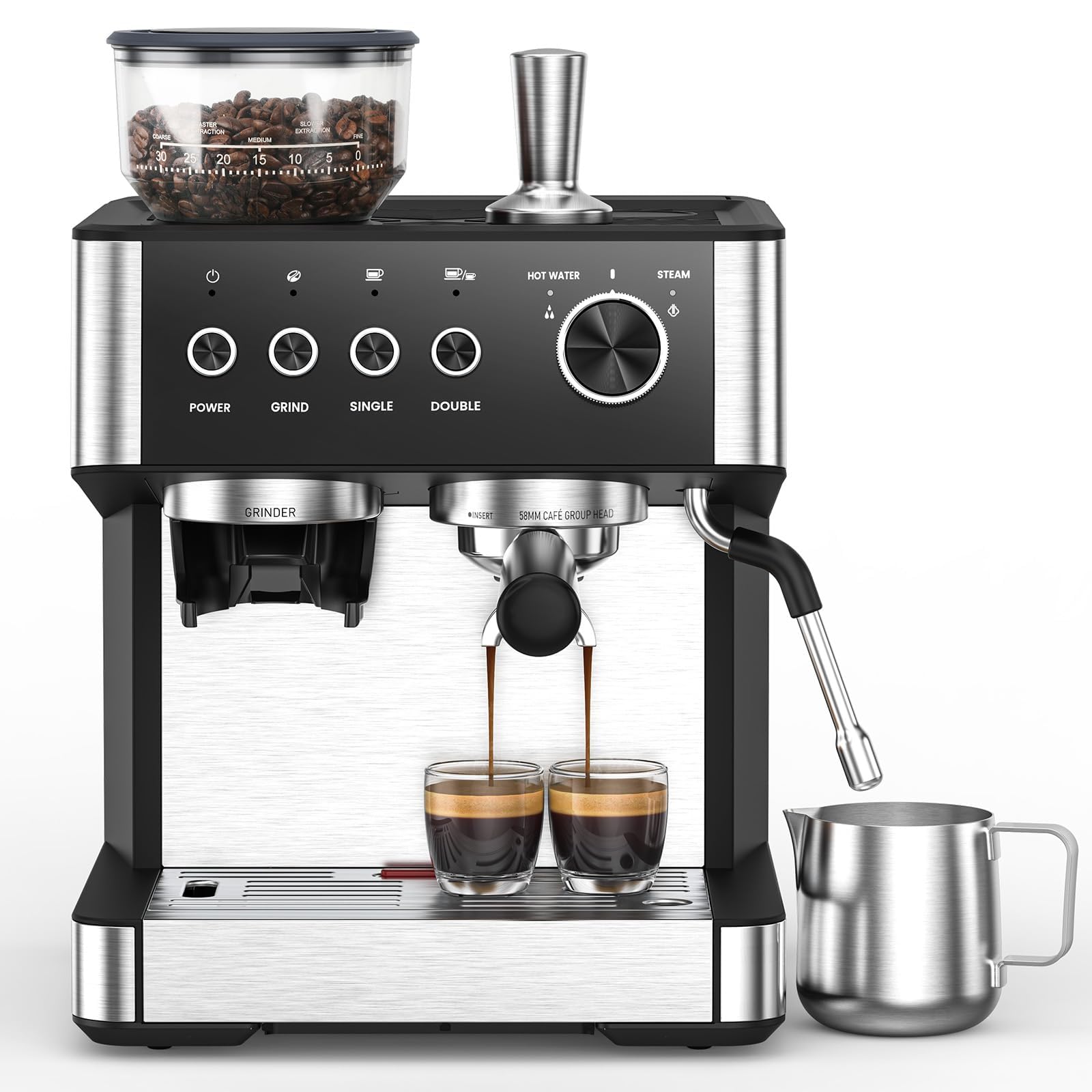
The Electactic addresses the single most common complaint about integrated-grinder espresso machines: jams caused by oily dark roast beans. Its upgraded grind path uses a chute that is 20% wider than standard designs, paired with a reinforced helical auger that physically pushes grounds through rather than relying on gravity and air flow. This is a tangible engineering fix rather than a software tweak — the auger geometry and chute diameter are hard changes that reduce the friction surface where clogs typically form.
The 15-bar pump is standard for the price tier, and the machine includes a 58mm portafilter with both single and dual wall baskets, giving beginners the option to use pressurized baskets for pre-ground coffee. The steam wand produces passable microfoam for lattes and cappuccinos, though the tip is a single-hole design that requires careful angle management to avoid large bubbles. The 2.3-liter water tank is removable and fits easily in most sinks for refilling.
The build quality is what you expect at this price point — mostly plastic with metallic trim, weighing 18 pounds. The machine lacks any form of PID or NTC temperature control, so extraction temperature is regulated by a basic thermostat that can drift by 8-10°F during back-to-back shots. For users who drink predominantly milk-based drinks where the espresso flavor is masked by milk, this drift is less noticeable. For straight espresso drinkers, the inconsistency will be apparent. The ETL certification is a plus for safety compliance.
Why it’s great
- Wider grind chute and helical auger significantly reduce clogging with oily beans
- 58mm portafilter with dual-wall baskets offers flexibility for pre-ground coffee
- Removable 2.3-liter water tank simplifies refilling and cleaning
- ETL certified for electrical safety
Good to know
- Basic thermostat temperature control leads to 8-10°F drift during extraction
- Plastic-heavy construction with metallic trim feels less premium
- Single-hole steam wand requires technique to avoid large bubbles
8. Electactic 15 Bar Espresso Machine (Almond)
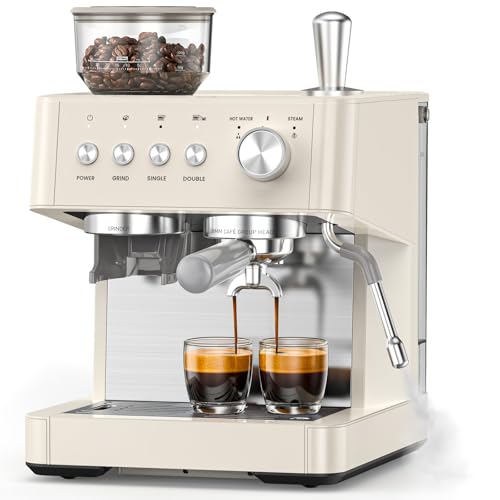
This Electactic variant shares the same core architecture as the Gloss Black model — the anti-clog grind path, 15-bar pump, 58mm portafilter, and 2.3-liter water tank — but in an Almond finish that blends into lighter kitchen color schemes. The upgraded grind path with the wider polished chute and helical auger is the same design, so the clog-resistance benefit carries over directly. The machine includes a stainless steel milk jug, tamping tools, and cleaning needle in the box.
The steam wand produces similar results to its sibling — adequate for lattes and cappuccinos but not capable of the dense microfoam needed for advanced latte art. The portafilter accepts both single and dual wall baskets, and the dual-wall option is genuinely useful for users who buy pre-ground coffee or want a more forgiving extraction while learning. The user interface uses simple buttons for steam, hot water, and shot volume, which keeps the learning curve flat.
The same thermostat-driven temperature control limitation applies here: expect temperature drift of 8-10°F across multiple shots. The exterior finish is metallic-coated plastic rather than brushed stainless steel, which means it can show fingerprints more readily than the CASABREWS or Chefman. The machine is ETL certified and weighs 18 pounds. For someone on a tight budget who wants a bean-to-cup experience without dealing with grinder clogs, this is the most reliable entry point available above the threshold.
Why it’s great
- Same effective anti-clog grind path design as the higher-priced sibling
- Almond finish works well in lighter kitchen environments
- Dual-wall basket option helps beginners achieve better extraction
- Complete accessory kit included — jug, tamper, cleaning tools
Good to know
- Thermostat temperature control limits shot-to-shot consistency
- Metallic-coated plastic exterior shows fingerprints easily
- Steam wand struggles to produce latte-art-quality microfoam
9. CASABREWS Ultra Espresso Machine

The CASABREWS Ultra is the only machine in the entry-level price tier that equips a 20-bar Italian pump and a four-setting adjustable brew temperature system. The pump pressure is high enough that even with a coarser grind or less-than-perfect tamp, the machine can generate the 9 bars needed at the puck for adequate extraction — the extra headroom compensates for user error. The four temperature settings let you switch between a cooler extraction for light roasts (around 195°F) and a hotter one for dark roasts (around 205°F), which is a feature rarely seen at this price point.
The LCD display cycles through steam, hot water, and pre-programmed shot modes with a clear readout. The 73-ounce (2.16-liter) water tank is among the largest in its class, and the brushed stainless steel finish gives the machine a genuinely premium visual that does not betray its price tier. The steam wand is a single-hole design with a manual control knob, capable of producing aerated milk for cappuccinos but not dense enough for latte art pours.
There is no integrated grinder, so you will need a separate burr grinder if you want to use whole beans. The machine accepts ground coffee only, which means you control freshness by grinding immediately before brewing but also adds an extra device to your workflow. The portafilter is 58mm, which is good for future accessory upgrades. The lack of a PID controller means temperature stability is not as tight as the Breville or Gevi, but the four presets offer at least some targeted control that a basic thermostat machine does not provide.
Why it’s great
- 20-bar Italian pump provides pressure headroom for forgiving extractions
- Four adjustable brew temperature settings improve roast-specific extraction
- 73-ounce water tank reduces refill frequency significantly
- Brushed stainless steel finish looks more expensive than the price suggests
Good to know
- No integrated grinder requires a separate grinder for whole bean use
- Steam wand cannot produce the dense microfoam needed for latte art
- Temperature control is preset-based, not PID-regulated, so drift still occurs
FAQ
Can I use pre-ground coffee in a machine with an integrated grinder?
How many bars of pressure do I really need for good espresso?
What is the difference between a single boiler, dual boiler, and thermoblock?
Final Thoughts: The Verdict
For most users, the espresso and coffee machine winner is the Breville Barista Express BES870XL because it combines PID temperature control, an integrated conical burr grinder, and a dual-hole steam wand in a package that produces consistently excellent shots without requiring a separate grinder. If you want the versatility of a 4-in-1 system with weight-based dosing and guided brew adjustments, grab the Ninja Luxe Café Pro ES701. And for a fully automatic experience with the fastest clean-up in the category, nothing beats the Philips 4400 Series with LatteGo.