A good chef’s knife glides through a tomato like it’s not there. A dull one crushes the flesh, tears the skin, and every meal prep becomes a battle. An electric knife sharpener removes the guesswork, restoring a factory-fresh edge with a few passes through precision-guided slots. Choosing the right unit depends on the abrasive material, the number of stages, and the sharpening angle it delivers.
I’m Mohammad Maruf — the founder and writer behind AirfryerBite. I analyze the build quality, abrasive technology, and motor stability of kitchen sharpening systems to help home cooks pick a unit that preserves blade life and delivers consistent results.
Whether you own a set of German steel chef knives or a mix of stainless and ceramic blades, the best electric knife sharpener must match your blade type, offer a reliable diamond or sapphirite abrasive, and use a stable angle guide to prevent over-grinding.
How To Choose The Best Electric Knife Sharpener
Selecting the right electric sharpener means matching the abrasive material, stage count, and angle guide to the knives you actually use. Ignoring any of these three factors can leave you with a sharpener that either wastes steel, fails to cut, or damages expensive blades.
Abrasive Material — Diamond vs Sapphirite
The abrasive wheel does the actual cutting of metal. Diamond abrasives are the hardest natural substance and work efficiently on both standard stainless steel and harder ceramic blades. Sapphirite wheels, used by Presto and some professional shops, are nearly as hard and provide a smooth grinding action that reduces heat buildup. For home users who sharpen multiple knives monthly, either material works, but diamond systems typically last longer before replacement.
Stage Count — Two vs Three
A two-stage sharpener grinds a new edge and then hones it to a polished finish. A three-stage system adds an intermediate fine-sharpening step and often a separate stropping or polishing stage. For knives that are regularly maintained, a quality two-stage unit is sufficient. If your knives have been neglected for months or you own ceramic blades, the extra stage of a three-stage sharpener recovers the edge more safely and produces a longer-lasting result.
Sharpening Angle — 15° vs 20°
The angle at which the abrasive meets the blade determines cutting aggressiveness and edge durability. A 20-degree edge is standard for Western-style chef knives and offers good edge retention for heavy chopping. A 15-degree edge is finer and cuts more aggressively, but it is more delicate and better suited for Japanese-style blades or slicing tasks. Some premium sharpeners allow you to convert a 20-degree edge to a 15-degree edge over time, giving you flexibility to match your cutting style.
Quick Comparison
On smaller screens, swipe sideways to see the full table.
| Model | Category | Best For | Key Spec | Amazon |
|---|---|---|---|---|
| Chef’sChoice 15XV | Premium | Professional daily use | 3-stage, 15° Trizor XV edge | Amazon |
| Chef’sChoice UltraHone | Premium | Straight & serrated blades | 2-stage, 20°, diamond abrasives | Amazon |
| Homly Professional | Mid-Range | Multi-kitchen use | 3-stage, diamond, 120V | Amazon |
| VIDOME 3-Stage | Mid-Range | Straight & ceramic knives | 3-stage, 15°, diamond abrasives | Amazon |
| Enutogo 3-Stage | Mid-Range | Metric & ceramic blades | 3-stage, 20°, diamond, magnetic box | Amazon |
| dskiley 3-Stage | Value | Everyday home cooks | 3-stage, 20°, diamond system | Amazon |
| Presto EverSharp 08800 | Budget | Entry-level sharpening | 2-stage, Sapphirite wheels | Amazon |
In‑Depth Reviews
1. Chef’sChoice 15XV Professional Electric Knife Sharpener

The Chef’sChoice 15XV sits at the top of the category with a brushed metal upper housing that adds durability and keeps the unit stable during sharpening — it weighs five pounds, noticeably heavier than any plastic competitor. Its three-stage EdgeSelect system uses 100-percent diamond abrasives on the first two stages and a patented flexible stropping disk on the third to polish the blade. The design converts standard 20-degree factory edges into a high-performance Trizor XV 15-degree edge, ideal for cooks who want aggressive slicing ability.
Spring-loaded guides hold the blade at the correct angle automatically, which eliminates the most common cause of uneven sharpening. First-time sharpening takes roughly one minute per knife, and re-sharpening only about ten seconds. The noise level stays between 65 dB and 75 dB, quieter than many budget models thanks to the dampening effect of the metal housing.
All straight-edge and serrated knives can go through this system, though the 15-degree edge is best suited for Western-style chef knives and Japanese blades rather than heavy cleavers. Cleaning is straightforward — the removable shavings tray catches metal dust, and the housing wipes down with a damp cloth.
Why it’s great
- Metal housing provides stability and longevity for daily professional use
- Three-stage diamond system delivers a sharper, longer-lasting 15-degree edge
- Automatic spring guides prevent uneven sharpening
Good to know
- Heavier footprint at five pounds — less portable
- Higher initial investment than entry-level models
2. Chef’sChoice Professional UltraHone 2-Stage Sharpener

The Chef’sChoice UltraHone is a two-stage unit that handles both straight-edge and serrated knives, a versatility that many three-stage sharpeners do not offer. Stage one uses 100-percent diamond abrasives to grind a new edge, while stage two applies advanced micron-size diamonds for fine honing. The precision angle guide holds the blade at a 20-degree angle, which matches the factory edge on most Western kitchen knives.
At just one pound, this is one of the lightest electric sharpeners available, making it easy to store in a drawer or move between kitchens. The white plastic body is compact — 11.8 inches long and under four inches wide — so it fits on small countertops without consuming space. Users report that the UltraHone restores serrated bread knives and straight chef knives alike, returning them to better-than-factory sharpness after a few passes.
The limitation of a two-stage system becomes apparent if you own very dull or damaged blades — it will sharpen them, but it lacks the intermediate fine stage that three-stage units provide for gradual edge rebuilding. The unit works with 120-volt outlets and comes with a one-year manufacturer warranty.
Why it’s great
- Sharpens both straight-edge and serrated knives in the same unit
- Ultra-lightweight and compact for easy storage
- Advanced micron diamonds in stage two produce a polished edge
Good to know
- Two-stage system is less forgiving for severely neglected knives
- Plastic housing less durable than metal-body alternatives
3. Homly Professional 3-Stage Electric Knife Sharpener

The Homly Professional sharpener brings a three-stage diamond abrasive system to a mid-range price point, covering coarse sharpening, fine honing, and blade polishing. Its design uses flexible spring guide rods that maintain consistent contact between the blade and the diamond wheels, producing a uniform arch-shaped edge along the full length of the blade. The double-layer shell construction combines paint and electroplating for a finish that resists corrosion and looks more premium than the price suggests.
This unit accepts all metal steel knives — chef knives, santoku, slicing, ham, butcher, boning, and even pocket knives — giving it one of the widest application ranges in this list. The motor runs with reduced noise thanks to dampening design choices, and the overall profile measures 12.2 inches long by 4.8 inches wide, keeping the footprint manageable for most countertops. Homly backs the sharpener with a two-year manufacturer warranty and offers lifetime customer service.
One trade-off is the lack of specific ceramic knife support — owners of ceramic blades should verify before purchase. The plastic housing, while adequately constructed, does not match the stability of metal-bodied sharpeners during aggressive sharpening passes.
Why it’s great
- Three-stage diamond system covers dull, maintained, and polished edges
- Flexible spring guides create an even edge across the entire blade
- Two-year warranty exceeds the industry standard
Good to know
- Not designed for ceramic knife sharpening
- Plastic housing may slide on slick counters during use
4. VIDOME Professional 3-Stage Electric Knife Sharpener

The VIDOME sharpener distinguishes itself with explicit support for ceramic knives, a category most electric sharpeners avoid. Its three-stage system uses 100-percent diamond abrasives in stages one and two, with a safe stropping disk in stage three that polishes the blade without chipping ceramic edges. The sharpening angle is preset to 15 degrees, which gives a very fine cutting edge suitable for both Japanese-style steel knives and ceramic blades.
German-imported motor technology provides energy-efficient operation, and the elastic constant-force spring design holds the blade firmly at the correct angle throughout the stroke. The magnetic chip collection system captures metal shavings from steel knives and keeps the workspace clean. First-time sharpening requires about 30 seconds, while re-sharpening takes roughly ten seconds. For ceramic knives, the recommended pull time is six to ten seconds — significantly longer than steel pulls, but still fast compared to manual ceramic sharpening.
Users should note that the 15-degree edge may not suit heavy Western-style cleavers or knives used for bone cutting. The unit measures 9.46 inches long by 2.91 inches wide, making it one of the narrowest electric sharpeners, which helps with storage in tight drawers.
Why it’s great
- Designed specifically for both steel and ceramic knife sharpening
- German imported motor operates efficiently with consistent torque
- Magnetic shavings tray prevents metal dust from scattering
Good to know
- 15-degree edge is less durable for heavy chopping tasks
- Narrow footprint may cause tipping if not placed on a stable surface
5. Enutogo 3-Stage Electric Knife Sharpener
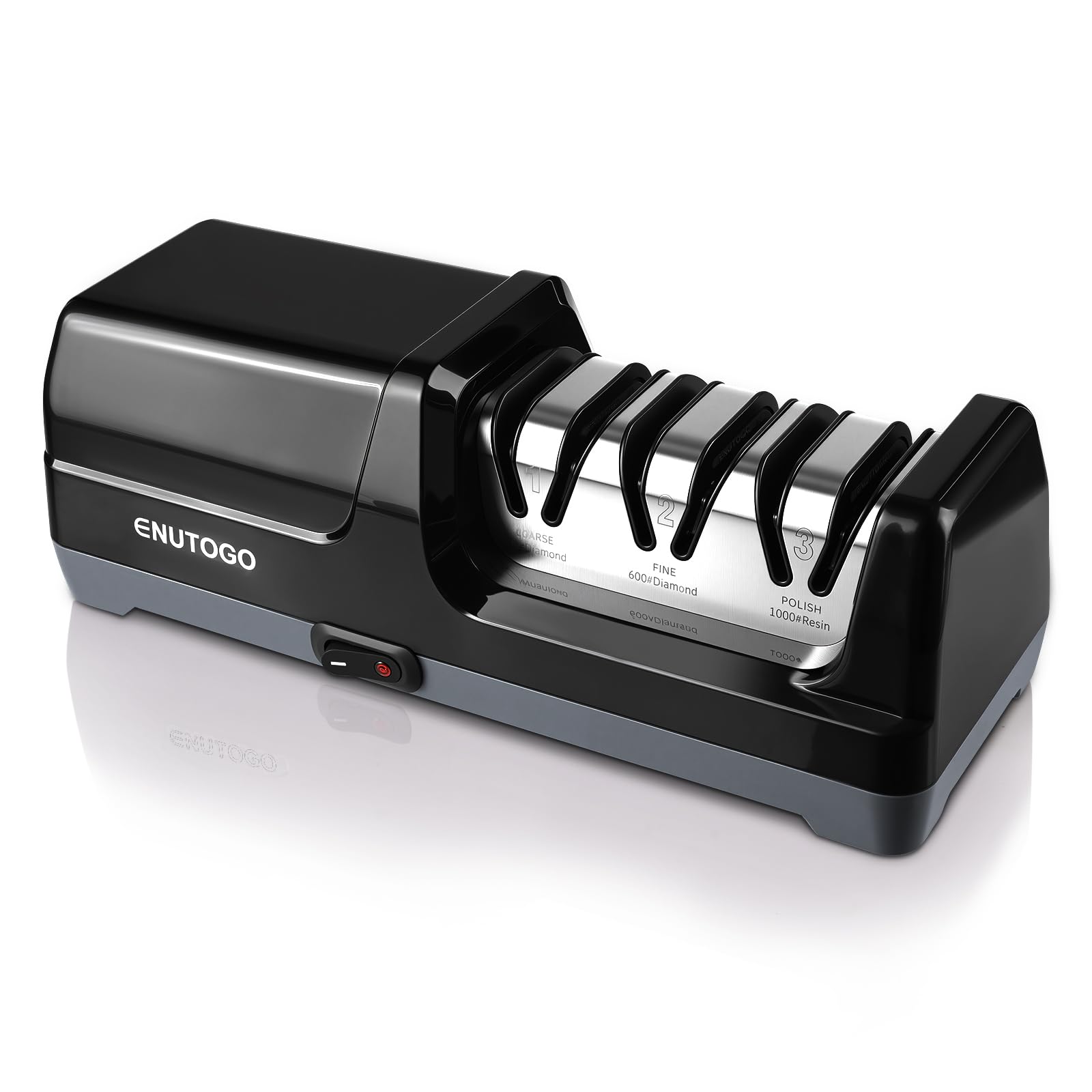
The Enutogo sharpener delivers a three-stage diamond system with a removable magnetic dust collection box at the bottom, a thoughtful addition that eliminates the need to brush metal filings off the counter after each session. Stage one uses coarse diamond abrasives to revive dull blades, stage two fine-sharpens for daily maintenance, and stage three polishes the edge for a smooth finish. The fixed 20-degree sharpening angle is compatible with most Western-style kitchen knives, including chef knives, slicing knives, santoku, and ceramic knives.
Construction uses ABS plastic with a stainless steel accent, keeping the weight to 2.5 pounds while maintaining structural rigidity. The motor runs smoothly without overheating, and the pull-through design requires no skill or angle adjustment — just draw the blade through each slot a few times. Enutogo claims the diamond components maintain their effectiveness for years, addressing a common complaint about abrasive wheels wearing out after limited use.
The unit’s dimensions — 10.51 inches long by 3.94 inches wide — place it in the mid-size range. One potential drawback is that the magnetic box collects only metal particles, so owners of ceramic knives will still need to brush away small dust fragments manually.
Why it’s great
- Magnetic chip collection box keeps the counter clean during sharpening
- Three-stage diamond system handles very dull knives effectively
- Fixed 20-degree angle is safe for most Western kitchen knives
Good to know
- Ceramic knife sharpening produces dust not captured by the magnetic box
- ABS plastic body feels less premium than metal alternatives
6. dskiley 3-Stage Diamond Electric Knife Sharpener
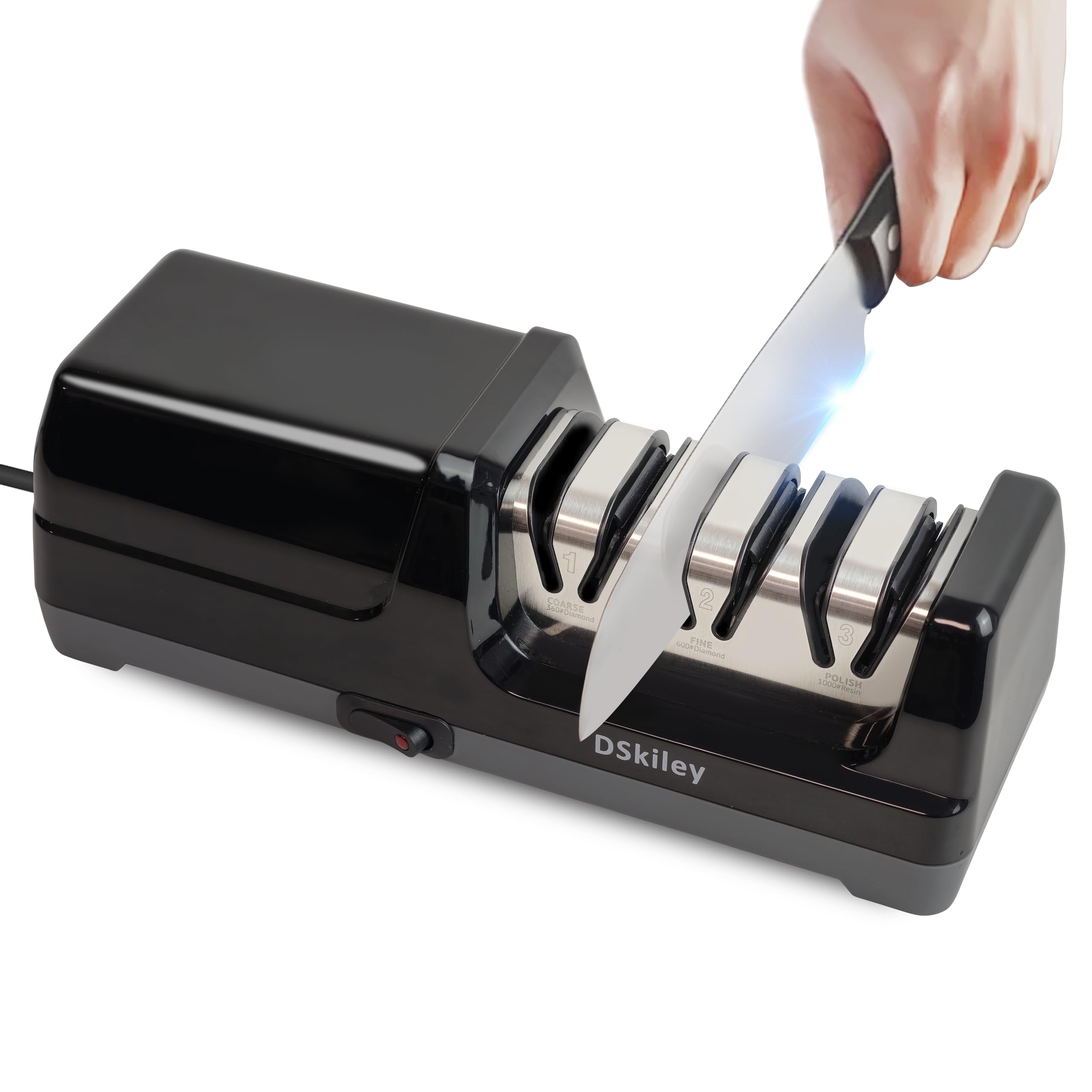
The dskiley sharpener offers a three-stage 100-percent diamond abrasive system at an approachable price point, making it a strong candidate for home cooks who want professional-level stages without the premium investment. Stage one repairs and restores the edge, stage two sharpens, and stage three polishes. The preset 20-degree angle guide holds knives at a chef-recommended angle that prevents over-grinding — a common problem with low-end pull-through sharpeners that have no angle control.
A powerful yet stable motor drives the diamond wheels without overheating, and the built-in magnetic collector captures metal shavings for mess-free cleanup. The design is straightforward: a simple on/off switch and clearly marked slots for each stage. The unit weighs 2.4 pounds and measures 12 inches long by 4.92 inches wide, giving it a stable base for repeated passes. It comes in gift-ready packaging, which is a practical bonus for giving it to parents or seniors who need an easy-to-use sharpener.
The carbon steel and plastic construction means the unit is not as rugged as metal-body alternatives, but the trade-off in weight makes it easier to store. Users with ceramic knives should note that the manual does not specify ceramic support, so this unit is best kept for standard steel kitchen knives.
Why it’s great
- Three-stage diamond system at an entry-level price
- 20-degree preset angle prevents blade damage for beginners
- Magnetic shavings collector simplifies post-sharpening cleanup
Good to know
- Not recommended for ceramic knives
- Plastic construction may not withstand heavy daily commercial use
7. Presto EverSharp 08800 Electric Knife Sharpener

The Presto EverSharp 08800 is a two-stage sharpener that uses Sapphirite wheels — the same ultra-hard abrasive material found in professional sharpening shops. Stage one precision-grinds a new edge, and stage two fine-hones and polishes to a razor finish. The precision blade guides position the knife at the ideal angle automatically, so there is no guesswork and no risk of holding the blade at the wrong angle manually.
This model works on most non-serrated blades, including kitchen knives and sporting knives, and it handles blades up to a reasonable length. Made in the USA from high-impact plastic, the unit weighs three pounds and measures 9.9 inches long by 7.2 inches wide. The Sapphirite wheels are bonded to the motor shaft and do not require alignment or adjustment, which keeps maintenance to a minimum. A one-year limited warranty covers the unit against manufacturing defects.
The two-stage system lacks the intermediate polishing stage that three-stage sharpeners provide, so knives that are extremely dull may require more passes to achieve a refined edge. Additionally, the plastic housing, while durable, does not provide the same mass and stability during operation as metal-bodied units.
Why it’s great
- Sapphirite wheels match professional shop abrasive quality
- Automatic angle guides eliminate user error during sharpening
- Made in the USA with a proven track record of reliability
Good to know
- Two-stage system requires more passes for very dull knives
- Does not support serrated or ceramic blades
FAQ
Can an electric knife sharpener handle ceramic blades?
Is a 15-degree or 20-degree sharpening angle better for home kitchens?
How often should I sharpen my kitchen knives with an electric sharpener?
Final Thoughts: The Verdict
For most users, the best electric knife sharpener winner is the Chef’sChoice 15XV because it combines a three-stage diamond system, a durable metal housing, and the ability to convert standard 20-degree blades into a finer 15-degree edge that stays sharp longer. If you want a versatile unit that handles both straight and serrated knives at a lighter weight, grab the Chef’sChoice UltraHone. And for a budget-friendly entry-level option that uses professional-grade Sapphirite wheels, nothing beats the Presto EverSharp 08800.