Hand-piping intricate logos and names onto dozens of cookies is a slow, unforgiving process that most bakers simply don’t have time for. A dedicated edible printer changes that equation by transferring digital artwork directly onto icing sheets or frosting surfaces with photographic consistency, turning a custom cookie order from a day-long project into a repeatable, high-volume workflow.
I’m Mohammad Maruf — the founder and writer behind AirfryerBite. I’ve spent years analyzing the hardware specifications of specialty food-printing equipment, studying how thermal dye-sublimation and edible ink cartridge systems differ from standard office printing to deliver safe, vivid results on edible paper and fondant.
Whether you run a home bakery or produce decorated cookies for events, the right machine saves hours of labor and eliminates guesswork. This guide breaks down the key specs, common pitfalls, and top-rated models so you can confidently select the best edible printer for cookies for your business or creative kitchen.
How To Choose The Best Edible Printer For Cookies
Selecting the right edible printer involves more than just looking at the price tag. You need to match the printer’s output size, resolution, and ink delivery system to the specific demands of cookie decorating — where fine text, bright colors, and food-safe materials are non-negotiable.
Print Technology: Thermal Dye-Sublimation vs. Inkjet
Edible printers use either thermal dye-sublimation or modified inkjet systems. Dye-sublimation printers fuse edible dyes into a polyester-coated icing sheet, producing waterproof, smudge-proof prints that resist moisture from buttercream. Inkjet-based systems (like those using Canon or Epson cartridges refilled with edible ink) are more common for home bakers, but the print may run if the icing sheet gets damp. For professional cookie decorating with long shelf life, dye-sublimation is the preferred standard.
Resolution Matters: DPI for Fine Text and Logos
Cookie faces are small — typically 2 to 4 inches across. A printer with 300 DPI (dots per inch) or higher can reproduce tiny fonts, brand logos, and intricate patterns without pixelation. Machines listed at 600 DPI are ideal if you regularly print serial numbers, QR codes, or multi-line text on round cookies. Anything below 200 DPI will produce blurry edges that look unprofessional.
Edible Cartridge Compatibility and FDA Compliance
Not all edible cartridges are created equal. Look for cartridges that explicitly state FDA-compliant or food-grade certification. The ink should be PFOA- and BPA-free, with no heavy metals. Some printers use proprietary cartridge designs (like EVEBOT’s FancyBox) that are sealed to prevent contamination, while others rely on refillable tanks that require careful handling. For high-volume bakeries, sealed cartridges reduce the risk of clogging and cross-contamination.
Quick Comparison
On smaller screens, swipe sideways to see the full table.
| Model | Category | Best For | Key Spec | Amazon |
|---|---|---|---|---|
| EVEBOT PrintPen | Handheld | Direct frosting printing | 7000 prints per FancyBox | Amazon |
| Canon Megatank G3290 | Inkjet | Budget-friendly edible sheets | 6000 b&w pages per ink set | Amazon |
| Arkscan 2054K-WF | Thermal | High-volume label printing | 5 inches per second speed | Amazon |
| Liene PixCut S1 | Dye-Sublimation | Sticker-style cookie toppers | 300 DPI, 16.7M colors | Amazon |
| DNP RX1 DS-RX1HS | Dye-Sublimation | Professional photo-quality prints | 12.4 sec per 4×6″ print | Amazon |
| HP DesignJet T210 | Large Format | Oversized edible sheets | 24-inch wide media support | Amazon |
| Canon PRO-310 | Photo | Gallery-grade edible prints | 9-color pigment ink system | Amazon |
| Creality K2 Pro | 3D Printer | 3D cookie molds and stencils | 300x300x300mm build volume | Amazon |
| HP DesignJet T650 | Large Format | Commercial high-volume runs | 36-inch wide media, 1GB RAM | Amazon |
In‑Depth Reviews
1. EVEBOT Handheld Food PrintPen
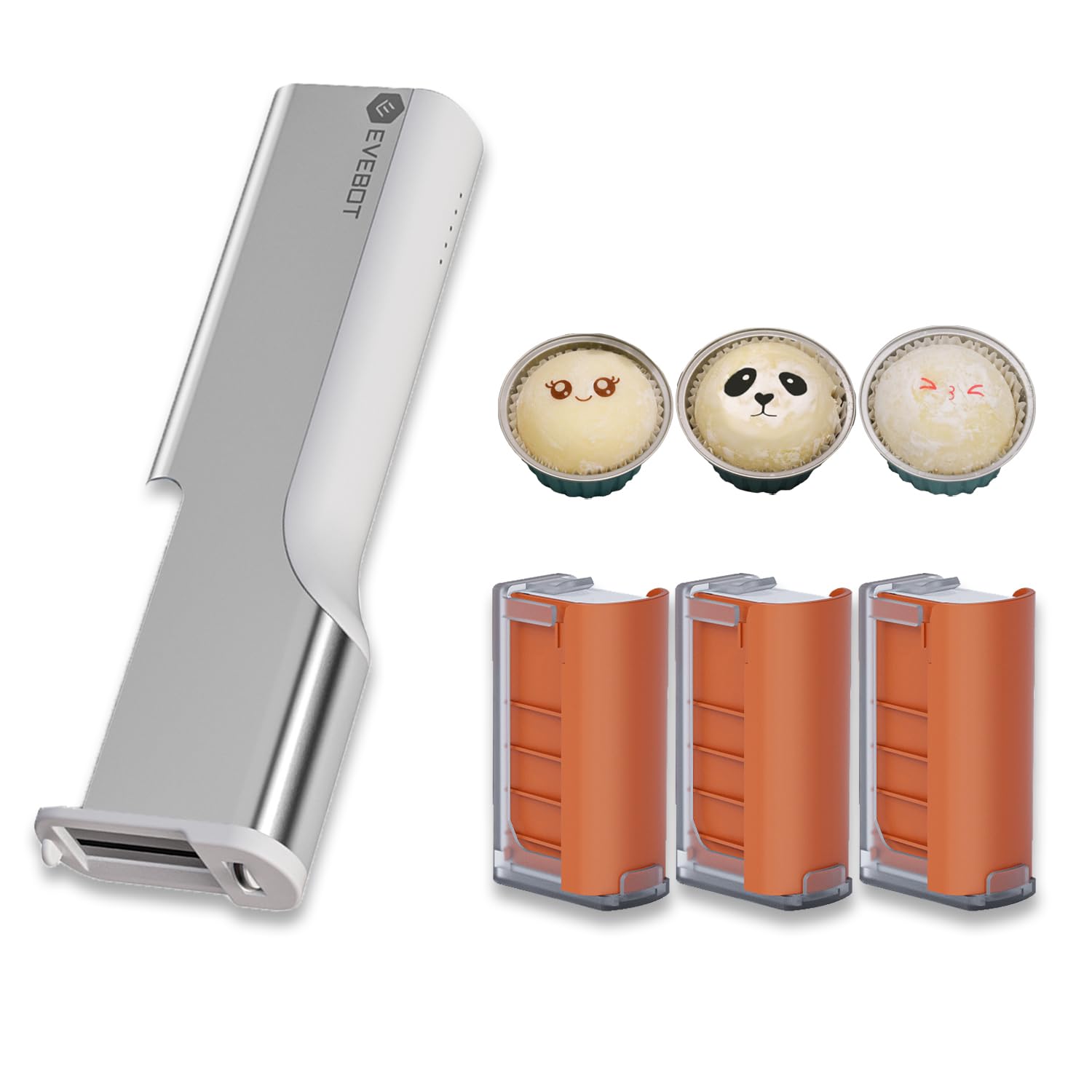
The EVEBOT PrintPen is a handheld portable printer designed specifically for applying edible ink directly onto cookie frosting, macarons, and foam drinks. Its roller sensor technology prints on curved surfaces, allowing you to move the pen across a cookie dome without distortion. The ergonomic design paired with an auxiliary ruler ensures straight lines even on rounded cookie tops, a common pain point for bakers using traditional edible sheets.
This pen uses sealed FancyBox cartridges that deliver approximately 7,000 prints per cartridge at a 26mm x 50mm print area. Each unopened cartridge can be stored for 12 months, and once opened, it remains viable for 6 months — a generous window for small bakeries. The Bluetooth 4.2 connection pairs with the EVEBOT SNAP app, where you can upload logos, text, QR codes, and barcodes. The memory function allows you to power down the pen and resume printing the previous pattern without re-uploading, saving time on repeated orders.
The primary limitation is surface compatibility. For best results, the frosting needs to be fine, dense, and level with the rim of the cookie or cup. Shallow or uneven surfaces cause blurred prints. If you produce large batches of custom cookies with a consistent flat icing surface, this pen offers the fastest per-unit decoration time of any device on this list. The 1-year warranty and US-based support make it a low-risk investment for a commercial kitchen.
Why it’s great
- Direct printing on frosting eliminates edible paper transfer step
- Curved surface sensor works on domed cookies
- Memory function repeats jobs without app reconnection
Good to know
- Requires flat, dense foam or thick frosting for crisp prints
- FancyBox cartridges must be used within 6 months after opening
2. Canon Megatank G3290
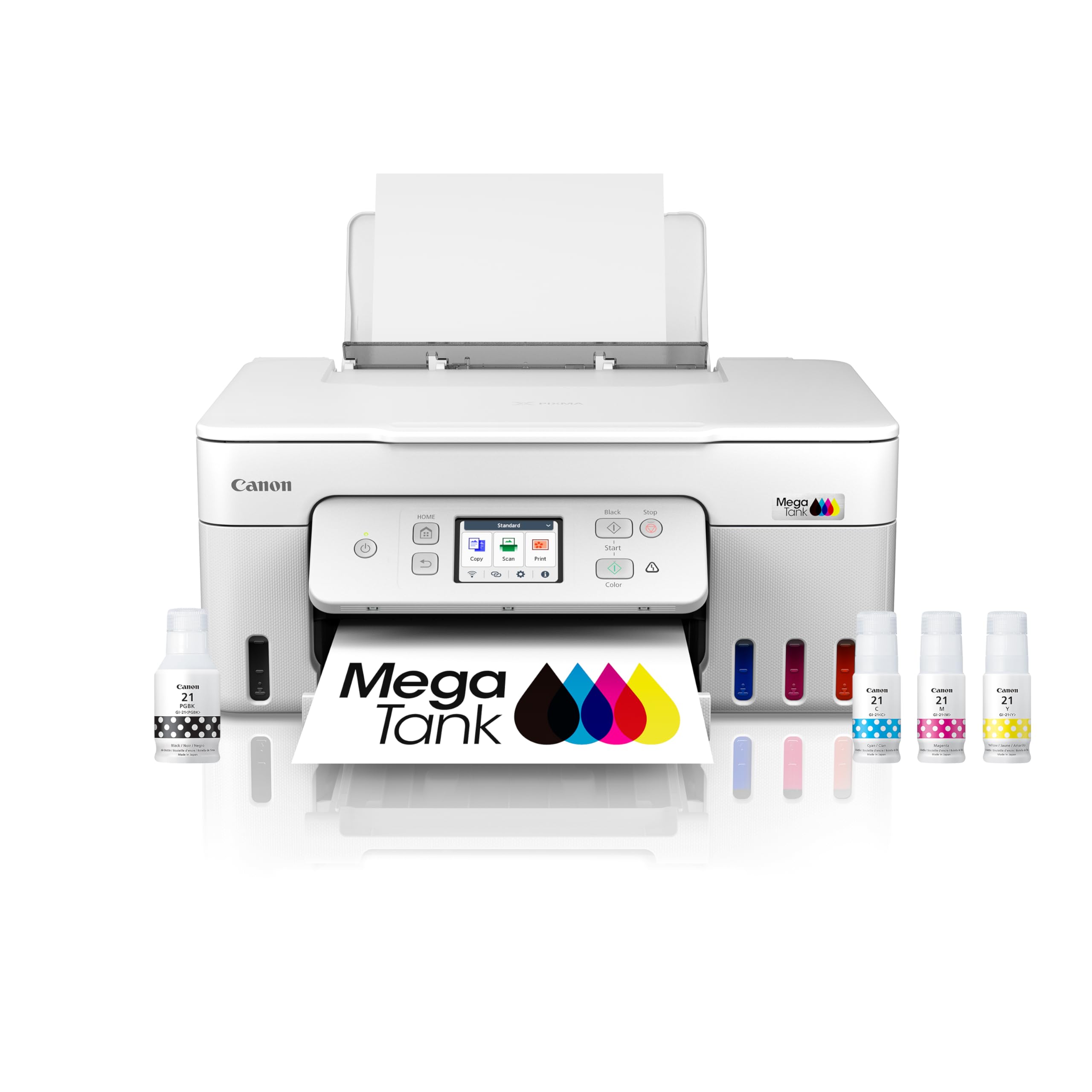
The Canon Megatank G3290 is a refillable ink tank all-in-one that is frequently converted for edible ink use by bakers who replace the standard dye inks with food-grade edible cartridges. This model includes a 2.7-inch color touchscreen and wireless connectivity supporting iOS, Android, and Windows. Print speeds of 11 pages per minute for black and 6 pages per minute for color make it fast enough for small- to medium-batch cookie sheet production.
Out of the box, the G3290 ships with enough ink to produce up to 6,000 black-and-white or 7,700 color pages, which translates to roughly two years of moderate usage. The automatic duplex printing is a rare feature for an edible-converted printer, reducing paper waste when printing on edible sheets. Setup via the Canon PRINT app is straightforward, though some users report initial Wi-Fi pairing issues. Once connected, the printer reliably processes 4×6 and 8.5×11 edible frosting sheets.
The biggest downside is the conversion process itself — you must manually flush the factory ink system before introducing edible ink, which requires a cleaning kit and some technical comfort. For bakers who are willing to invest that one-time effort, the Megatank G3290 offers the lowest per-print cost of any edible-capable printer due to its massive tank capacity. It also functions as a standard document scanner and copier, making it a versatile kitchen office tool.
Why it’s great
- Extremely low cost per page after edible conversion
- Auto duplex printing saves edible sheet material
- Touchscreen LCD simplifies menu navigation
Good to know
- Requires manual ink system conversion for edible use
- Wi-Fi setup can be finicky with some router configurations
3. DNP RX1 DS-RX1HS

The DNP RX1 DS-RX1HS is a professional dye-sublimation photo printer that outputs 290 4×6 prints per hour, or roughly 4.8 prints per minute. That speed is critical for bakeries fulfilling wedding or corporate cookie orders where dozens of identical edible toppers need to be produced in a single shift. The printer supports multiple sizes including 2×6, 4×6, and 6×8, which means you can print strips for photobooth cookies or individual 4×6 sheets for larger designs.
Resolution options of 300×300 DPI (high speed) and 300×600 DPI (high quality) give you flexibility. At 300×600 DPI, fine serif fonts and hairline details print without jagged edges, a must for logos containing small text. The dye-sublimation process bakes the edible ink into the coating of the paper, resulting in a waterproof, smudge-proof finish that withstands the condensation from refrigeration. The printer ships with a CD containing drivers for Windows 7 and 8.1, but newer OS drivers are available online.
On the downside, the printer is heavy for its class at 31 pounds, and the paper rolls must be loaded carefully to avoid jams. The DNP RX1 also requires proprietary media rolls; you cannot use third-party edible sheets without risking print quality or voiding the warranty. For a dedicated cookie decorating business that needs consistent, salon-quality prints, the speed and durability justify the premium. It is not a casual purchase, but it is the most reliable edible print engine at this price point.
Why it’s great
- Industrial speed — 12.4 seconds per 4×6 print
- Waterproof, smudge-proof prints from dye-sublimation
- Multiple paper size support in one roll
Good to know
- Heavy at 31 pounds; not portable
- Requires proprietary DNP media rolls
4. Liene PixCut S1
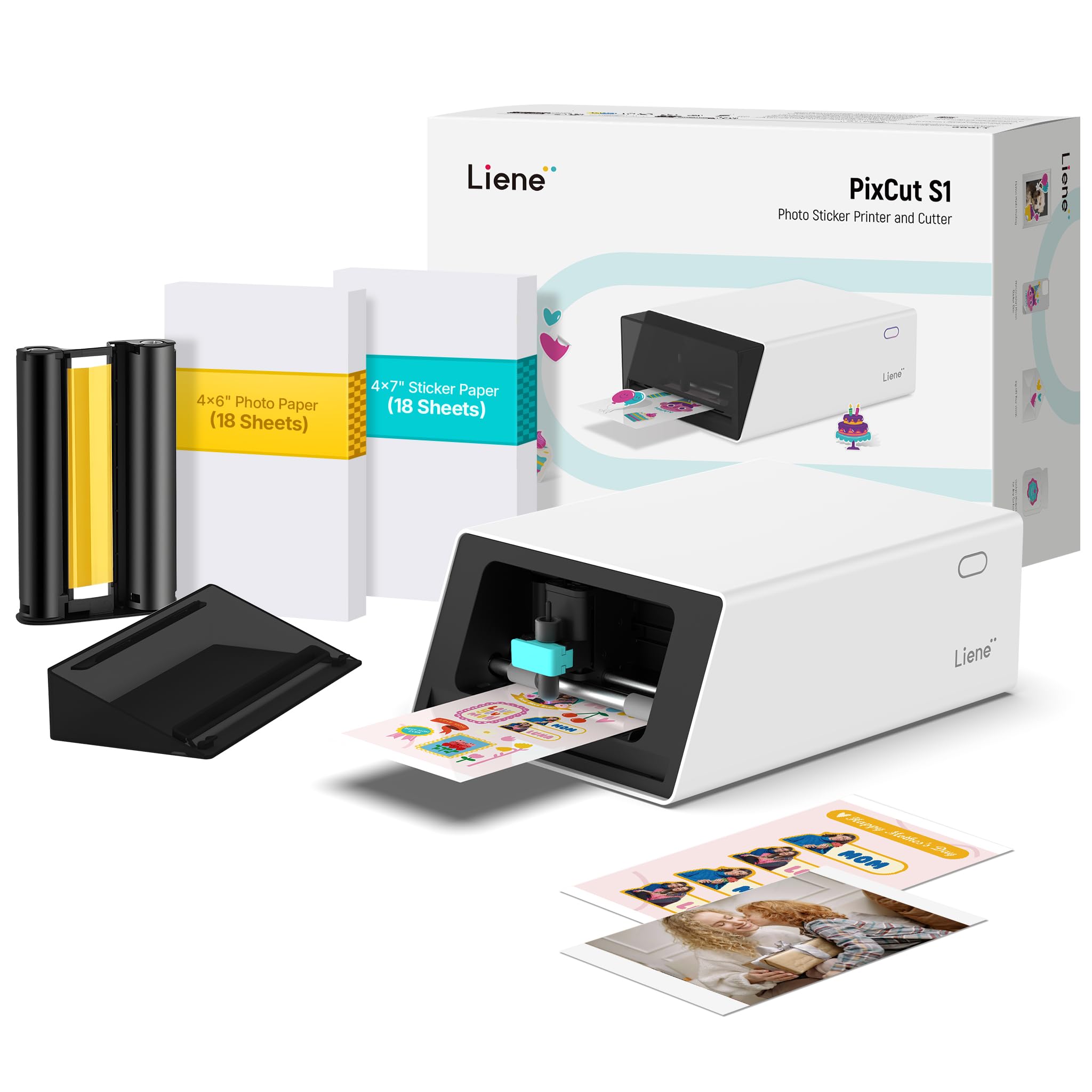
The Liene PixCut S1 combines a 300 DPI thermal dye-sublimation printer with an AI-guided precision cutting system in one compact unit. It prints on 4×6 and 4×7 sticker paper, and the integrated cutter automatically traces the outline of your design, producing kiss-cut or die-cut edible stickers that can be placed directly onto cookies. The printer supports 16.7 million colors via CMY cartridges, and the four-layer lamination process makes each sticker waterproof and scratch-resistant.
The AI image extraction feature automatically recognizes subjects in your photos and creates a cutting path around them, which is a huge time saver for bakeries creating character-themed cookies for kids’ parties. The accompanying Liene app provides over 40,000 free images, fonts, and 2,000+ ready-to-use templates. There is no subscription — you pay once for the hardware and get full access to the creative library. The Bluetooth connection allows direct printing from a smartphone or tablet, removing the need for a computer.
The print speed is slow — approximately one print per minute — which makes it unsuitable for high-volume orders. Additionally, one reviewer noted that the print quality, while vibrant, can feel “toy quality” compared to professional-grade dye-sublimation machines like the DNP RX1. For small bakeries or home-based cookie decorators who want to produce unique toppers without owning a separate plotter cutter, the PixCut S1 delivers excellent versatility at a mid-range investment.
Why it’s great
- All-in-one print and cut removes manual trimming
- AI subject detection for complex shapes
- No subscription — full creative library included
Good to know
- Slow print speed — about 1 page per minute
- Cut quality can be inconsistent on intricate designs
5. Arkscan 2054K-WF

The Arkscan 2054K-WF is a direct thermal label printer designed primarily for shipping labels, barcodes, and product labels. It uses heat instead of ink to print, which means the labels are monochrome (black on white) and cannot produce color images. That limitation rules it out for decorative cookie prints, but it is worth mentioning for bakers who need a durable, inexpensive way to print waterproof ingredient labels, allergen warnings, or storage instructions for packaging.
Printing at 5 inches per second and supporting media widths from 0.75 to 4.25 inches, this machine can churn through label rolls quickly. It supports USB and WiFi connections and works with Windows, Mac, Chrome OS, and Android. The included BarTender UltraLite software lets you design custom barcodes and text labels. The direct thermal technology means you never buy ink or toner — you only purchase thermal label rolls.
The printer excels in logistics, not decoration. If your cookie business needs a companion label maker for boxes, bags, and shipping, the Arkscan 2054K-WF is a solid budget addition. It is not an edible printer for cookies in the decorative sense, but it can streamline the packaging side of a bakery operation. The 5-star US-based tech support via phone and live chat is a strong plus for non-technical users.
Why it’s great
- No ink or toner costs — thermal printing
- Fast 5 ips label output for packaging
- Broader compatibility with Windows, Mac, and Chrome OS
Good to know
- Monochrome only — not for colorful cookie toppers
- Maximum width of 4.25 inches limits larger labels
6. HP DesignJet T210
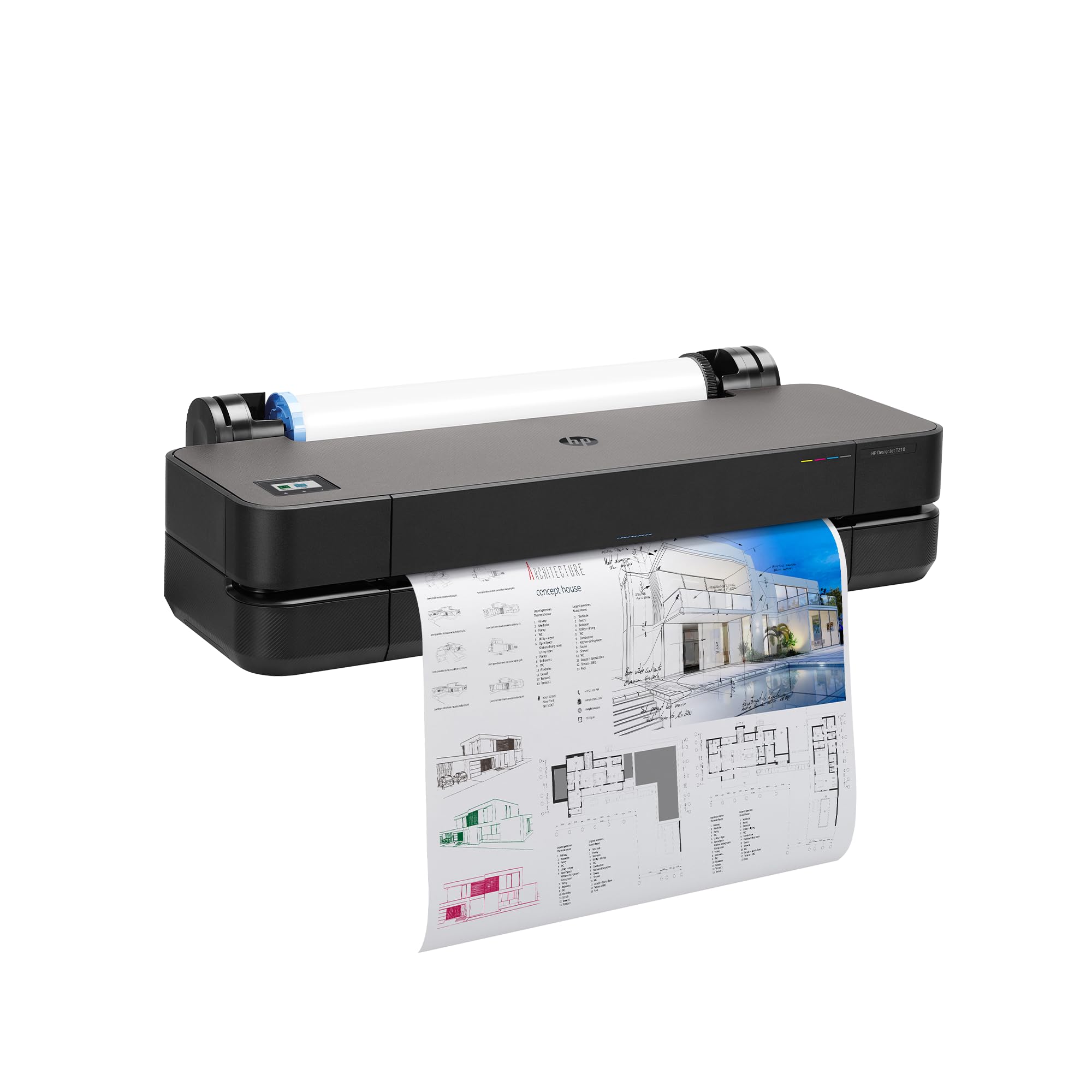
The HP DesignJet T210 is a 24-inch wide-format plotter designed for CAD drawings, posters, and sewing patterns. In the context of edible printing, its oversized carriage allows you to print on large edible sheets that can cover entire cookie platters or be cut into dozens of individual toppers from a single print run. It supports media up to 24 inches wide on rolls, plus sheets up to 13×19 inches via an optional feeder.
The T210 prints up to 45 seconds per A1/D page, which equates to about 59 prints per hour. The HP Click software predefines print settings and supports PDF error checking, nesting multiple designs on one sheet to reduce edible paper waste. Connectivity includes Gigabit Ethernet, USB 2.0, and Wi-Fi, plus HP Smart app support for remote printing from a smartphone or tablet. The 500MB memory buffer handles complex vector files without choking.
This machine is overkill for a single-cookie operation. It is built for bakers who supply grocery chains, hotel chains, or large event venues where a single cookie run requires hundreds of identical toppers. The HP DesignJet T210 uses HP 712 ink cartridges and a separate HP 713 printhead, which are available through standard office supply channels. The one-year hardware warranty and phone-based support from HP make it a safe bet for a commercial kitchen that needs a large-format edible sheet printer.
Why it’s great
- 24-inch roll support for large-format edible sheets
- Auto-nesting software minimizes edible paper waste
- HP Smart app prints remotely from any device
Good to know
- Large footprint — needs dedicated counter space
- Does not support duplex printing
7. Canon imagePROGRAF PRO-310

The Canon imagePROGRAF PRO-310 is a 13-inch professional photo printer with a 9-color Lucia Pro II pigment ink system plus a Chroma Optimizer. This system produces gallery-quality prints with enhanced black density, gloss uniformity, and scratch resistance — properties that translate directly to high-end edible sheet printing where color fidelity and luster are paramount. The 3.0-inch color LCD monitor displays ink levels, printer status, and skew correction options.
What differentiates the PRO-310 from standard inkjets is the anti-clogging system and the pigment-based inks, which resist smudging when applied to fondant or icing sheets. The matte black ink specifically increases the dynamic range of dark areas, making deep shadows and rich blacks pop on edible media. The printer supports paper sizes up to 13×19 inches, giving you room to print multiple cookie toppers per sheet in precise registration.
The PRO-310 is expensive and deliberately single-purpose — it prints only — so you lose the scanning and copying functionality of an all-in-one. The 9-color system also means cartridge replacement costs add up quickly if you print frequently. For a bakery that specializes in incredibly detailed, photo-realistic cookie designs (such as portraits, landscapes, or branded packaging for premium products), this Canon delivers a level of color accuracy that no sub- edible printer can match.
Why it’s great
- 9-color pigment system delivers true photographic color
- Enhanced black density for crisp, dark details
- Anti-clogging system reduces maintenance for occasional use
Good to know
- Print-only function — no scan or copy
- 9 cartridges mean higher per-print supply cost
8. Creality K2 Pro Combo
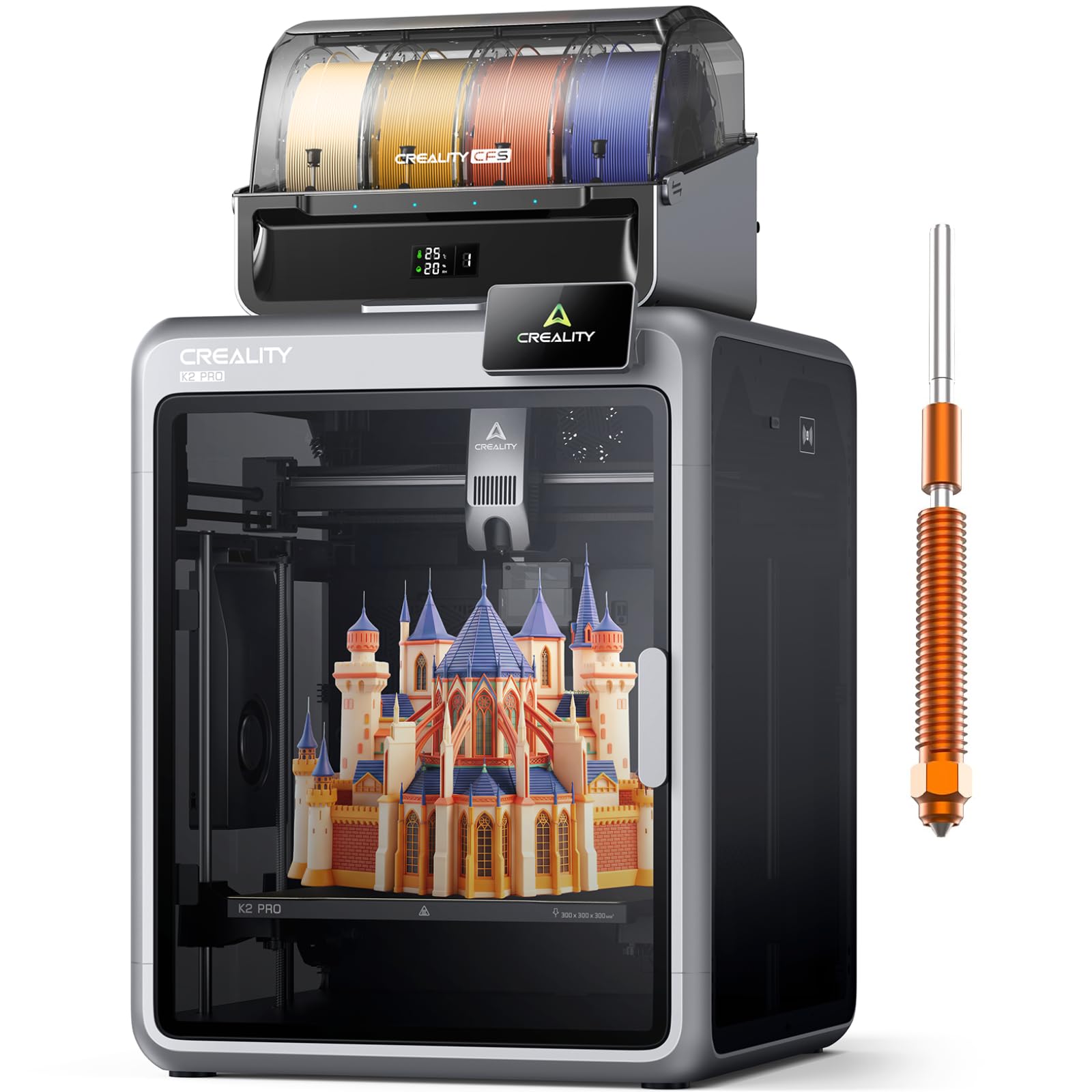
The Creality K2 Pro Combo is a 3D printer, not a 2D printer, but it earns a place in this guide because it creates custom cookie stamps, embossing tools, and silicone molds that transfer designs onto cookie dough or fondant. With a 300x300x300mm build volume, it can produce large stencils for powdered sugar designs or multi-cavity molds for uniform cookie shapes. The included CFS (Creality Filament System) supports up to 16 colors in a single print, though for food-safe molds you would use a dedicated food-grade silicone or PETG filament.
The printer reaches speeds of 600mm/s with 20,000mm/s² acceleration thanks to FOC step-servo motors and linear rails. The active chamber heating maintains up to 60°C, preventing warping when printing with PA (nylon) or carbon-fiber filaments used for durable cookie stamps. Dual AI cameras monitor the print bed and nozzle for failures, pausing automatically if a layer shifts — a godsend for overnight mold production runs.
Understanding that this is a 3D printer, not a printer that applies edible ink, is important. If your cookie decorating workflow involves pressing designs into dough rather than printing on icing, the K2 Pro is the most capable tool in this roundup. It is also the most complex to operate: slicing software, filament swapping, and bed leveling all require a learning curve. For a bakery willing to invest that time, the payoff is custom-shaped cookies that no edible sheet can replicate.
Why it’s great
- Creates custom cookie stamps and food-safe silicone molds
- High-speed 600mm/s reduces print time for tooling
- Large build volume handles oversized molds
Good to know
- Not a 2D edible ink printer — requires 3D modeling skills
- Software and setup have a steeper learning curve
9. HP DesignJet T650

The HP DesignJet T650 is a 36-inch wide-format plotter that is the largest printer on this list. It processes 82 A1/D prints per hour — approximately 25 seconds per page — and supports media rolls up to 36 inches wide. For a high-volume cookie decorating operation, this width allows you to lay out hundreds of 2-inch topper images on a single edible sheet, maximizing yield per print cycle and minimizing manual cutting time.
The T650 includes a 2-year onsite warranty with next-business-day service, which provides serious peace of mind for a bakery where printer downtime directly means lost revenue. The 1GB memory buffer handles complex vector artwork without slowing down, and the HP Click software supports auto-nesting, PDF error checking, and batch printing from a single drag-and-drop interface. Connectivity includes Gigabit Ethernet, USB 2.0, and Wi-Fi, plus full HP Smart app control.
The main drawback is size — the T650 is a floor-standing unit that requires a dedicated space. It also consumes HP 712 ink cartridges and HP 713 printheads, which are commercial-grade but not cheap. Some users have reported that the printer only accepts HP-branded paper rolls, which limits third-party edible sheet sourcing. This printer is best suited for a baker who supplies bulk cookie orders to multiple retail locations or runs a high-volume custom cookie factory.
Why it’s great
- 36-inch roll width for massive edible sheet output
- 2-year onsite warranty with next-business-day support
- Auto-nesting software cuts edible paper waste significantly
Good to know
- Floor-standing unit — requires significant floor space
- May restrict third-party edible sheet brands
FAQ
Can I use any standard inkjet printer for edible prints on cookies?
What is the difference between edible icing sheets and frosting sheets?
How do I clean and maintain an edible printer to prevent clogging?
Do edible printers require a specific type of cookie or icing surface?
Final Thoughts: The Verdict
For most users, the edible printer for cookies winner is the EVEBOT Handheld Food PrintPen because it eliminates the edible paper transfer step and prints directly onto frosting, reducing material costs and per-cookie time. If you want photographic-quality edible toppers that are waterproof and smudge-proof, grab the DNP RX1 DS-RX1HS. And for a budget-friendly entry point that converts standard ink tanks to edible use, nothing beats the Canon Megatank G3290.