A dull knife isn’t just frustrating—it’s dangerous. Slipping off a tomato skin or forcing a blade through a carrot demands extra pressure that increases the risk of injury. The market is packed with complicated stones, electric grinders, and gimmicks, but most home cooks just want a system that delivers a sharp edge in seconds without a steep learning curve.
I’m Mohammad Maruf — the founder and writer behind AirfryerBite. I’ve spent years analyzing small-kitchen hardware specs, from motor wattage to grit composition, and I evaluate pull-through sharpeners by their carbide hardness, ceramic rod density, and suction stability to separate real results from marketing fluff.
Whether you are maintaining a set of German stainless steel chef knives or reviving a thrifted find, the right tool keeps your blades cutting clean. The goal is simple: find the best easy knife sharpener that fits your drawer, your budget, and your schedule without sacrificing blade life.
How To Choose The Best Easy Knife Sharpener
Not every sharpener works for every blade. Western-style knives with a 20-degree edge need a different treatment than Asian-style blades sharpened to 15 degrees. Understanding the abrasive material, the number of stages, and the base stability is the key to buying the right tool once.
Abrasive Material: Carbide, Ceramic, or Diamond
Tungsten carbide blades are aggressive and excel at setting a new edge on a very dull knife, but they remove more metal per pass. Ceramic rods refine that edge by honing and polishing, leaving a smoother cutting surface. Diamond-coated rods combine aggression with a finer finish, offering the best of both worlds for mid-range and premium price points. For a simple home sharpener, a two-stage system with carbide and ceramic is the most practical arrangement.
Stage Count: One, Two, or Three
A single-stage tool only sharpens, leaving a rough burr on the edge. Two-stage models add a honing step to clean up that burr, resulting in a sharper, longer-lasting edge. Three-stage sharpeners add a final polishing step, often using a ceramic or diamond wheel. For most kitchens, a two-stage pull-through system strikes the best balance between speed and outcome without requiring any skill.
Base Design and Stability
A sharpener that slides on the counter is dangerous and ineffective. Look for a non-slip rubber base, a suction cup mechanism, or a weighted body. Suction-base models like the SHARPAL 191H offer exceptional stability on smooth surfaces, allowing you to pull the blade through with consistent pressure and angle every time without holding the unit down by hand.
Quick Comparison
On smaller screens, swipe sideways to see the full table.
| Model | Category | Best For | Key Spec | Amazon |
|---|---|---|---|---|
| Work Sharp Pull Through | Premium | Quick kitchen maintenance | Diamond & Ceramic wheels | Amazon |
| AccuSharp 039C | Premium | Multi-blade households | Diamond-honed carbide + ceramic | Amazon |
| Edgemaker Pro 331 | Mid-Range | Rotating rod longevity | Crossed rotating carbides | Amazon |
| ZWILLING 2-Stage | Mid-Range | Western-style chef knives | Coarse & Fine ceramic slots | Amazon |
| SHARPAL 191H | Mid-Range | Stability & scissors | Suction base, 3-stage | Amazon |
| Smith’s Pull-Thru | Value | Budget home kitchens | Replaceable carbide & ceramic | Amazon |
| Gatco Edgemate | Value | Camping & pocket knives | 8.25-inch length, ergonomic | Amazon |
| Dexter-Russell M906 | Value | Commercial kitchens | Tungsten carbide cutting heads | Amazon |
| Norpro Aladdin | Value | Ultra-simple, wall-mount | Single carbide slot, 1.36 oz | Amazon |
In‑Depth Reviews
1. Work Sharp Pull Through Kitchen Knife Sharpener

Work Sharp built its reputation on powered sharpening systems, and this pull-through model distills that expertise into a compact, drawer-friendly package. The diamond-coated sharpening wheel sets a fresh edge quickly, while the ceramic wheel refines and polishes it, creating a razor finish that transforms how a dull chef knife glides through produce. The 8.25-inch body includes a large rubber handle and a rubber base that stays planted on the counter during each pull.
This unit handles chef knives, paring knives, serrated blades, and even scissors with consistent results. The 3-year warranty provides confidence that the abrasive wheels will hold up through regular weekly use. Users who previously struggled with electric sharpeners report that this manual system is faster and more precise for mid-week touch-ups.
The design is deliberately simple: no dials, no angles to guess, and no parts to replace after a few uses. The diamond wheel removes metal aggressively enough to sharpen a neglected knife in three passes, then the ceramic wheel smooths away the burr. For any home cook looking for a single tool that does not require practice or patience, this is the standard.
Why it’s great
- Diamond wheel sets a fresh edge in 3 passes
- Rubber base and handle provide slip-free control
- Works on serrated blades and scissors
Good to know
- Premium price tier for a manual pull-through
- Not designed for very thin Asian-style blades
2. AccuSharp Pull-Through Knife Sharpener 039C

AccuSharp has a decades-long reputation among outdoor enthusiasts and culinary professionals, and the 039C model delivers commercial-grade output in a handheld format that weighs just 1.6 ounces. The diamond-honed tungsten carbide blades provide aggressive sharpening for badly dulled edges, and the fine ceramic rods follow up to hone and polish the blade. The ergonomic handle with a rubber over-molded grip offers secure control even with wet hands.
Former chefs and long-time home cooks consistently note that this sharpener produces results that rival electric models without the bulk or cord management. The vivid orange/green color scheme makes it easy to spot in a crowded utensil drawer. Users with expensive German steel knives report that the AccuSharp restores factory sharpness without introducing micro-chips when used with light pressure.
The diamond-coating technology ensures that the sharpening surfaces last longer than standard carbide-only tools. Each pull re-angles the edge to a consistent 20 degrees, which is ideal for most Western-style kitchen knives. For households that own a mix of high-carbon, stainless, and serrated blades, this single tool covers the full range without any learning curve.
Why it’s great
- Diamond-honed carbide aggressively sets new edges
- Ultra-light at 1.6 oz, fits any drawer
- Ergonomic rubber grip stays secure when wet
Good to know
- Coarse side removes more metal per pass
- Not ideal for single-bevel Japanese blades
3. The Edgemaker Knife Sharpener Pro 331

The Edgemaker Pro 331 takes a unique approach by using crossed carbide steel rods that you rotate to expose a fresh surface. This design effectively extends the life of the sharpener long after most single-stage units have worn out. The high-impact plastic handle is virtually unbreakable, and the entire tool weighs only 0.26 pounds, making it easy to store in a narrow drawer or a knife block.
Users report that this sharpener resembles a butcher’s steel in its action but requires less skill. Drawing the blade through the crossed rods with mild pressure hones the edge on one side and sharpens on the other. The Pro 331 works on wavy serrated blades and standard straight edges, giving it broad utility for kitchens with mixed knife sets. Long-term owners have used the same unit for 8 to 35 years by simply rotating the rods and flipping them end to end.
The two-sided design means you can select a more aggressive pass or a finer honing action depending on the blade’s condition. The orange handle is easy to spot, and the tool’s simple mechanics make it ideal for anyone who wants a low-maintenance sharpener that does not require replacement cartridges or spare parts.
Why it’s great
- Rotatable carbides provide years of use
- Works on serrated and wavy blades
- Lightweight, easy to store
Good to know
- Requires dipping plastic in hot water to rotate rods
- Single-stage action, no separate polishing step
4. ZWILLING 2-Stage Pull-Through Sharpener

From the same Solingen-based manufacturer trusted by professional chefs worldwide, the ZWILLING 2-Stage Pull-Through Sharpener brings German precision to a simple manual tool. It is engineered specifically for Western-style blades with a 20-degree edge angle, which covers the vast majority of German and French chef knives. The first slot uses coarse tungsten carbide to restore a dull blade, and the second slot uses fine ceramic to hone the edge to a clean finish.
The non-slip rubber bottom keeps the sharpener stable on any counter material, and the comfortable handle protects fingers from accidental contact with the blade edge during use. At 0.75 pounds, it has enough mass to resist sliding without being cumbersome. The compact footprint fits easily into a utensil drawer alongside the knives it maintains.
ZWILLING designed this model to work best as a maintenance tool for knives that are already in decent condition. Severely chipped or neglected blades may require multiple passes through the coarse slot before the ceramic stage can polish effectively. For regular weekly sharpening, the two-stage system delivers consistent results with zero technique required.
Why it’s great
- Designed for 20-degree Western-style edges
- Non-slip rubber base stays planted
- Protective handle keeps fingers away from blade
Good to know
- Not suitable for Asian 15-degree blades
- Best for maintenance, not heavy restoration
5. SHARPAL 191H 3-Stage Knife Scissors Sharpener
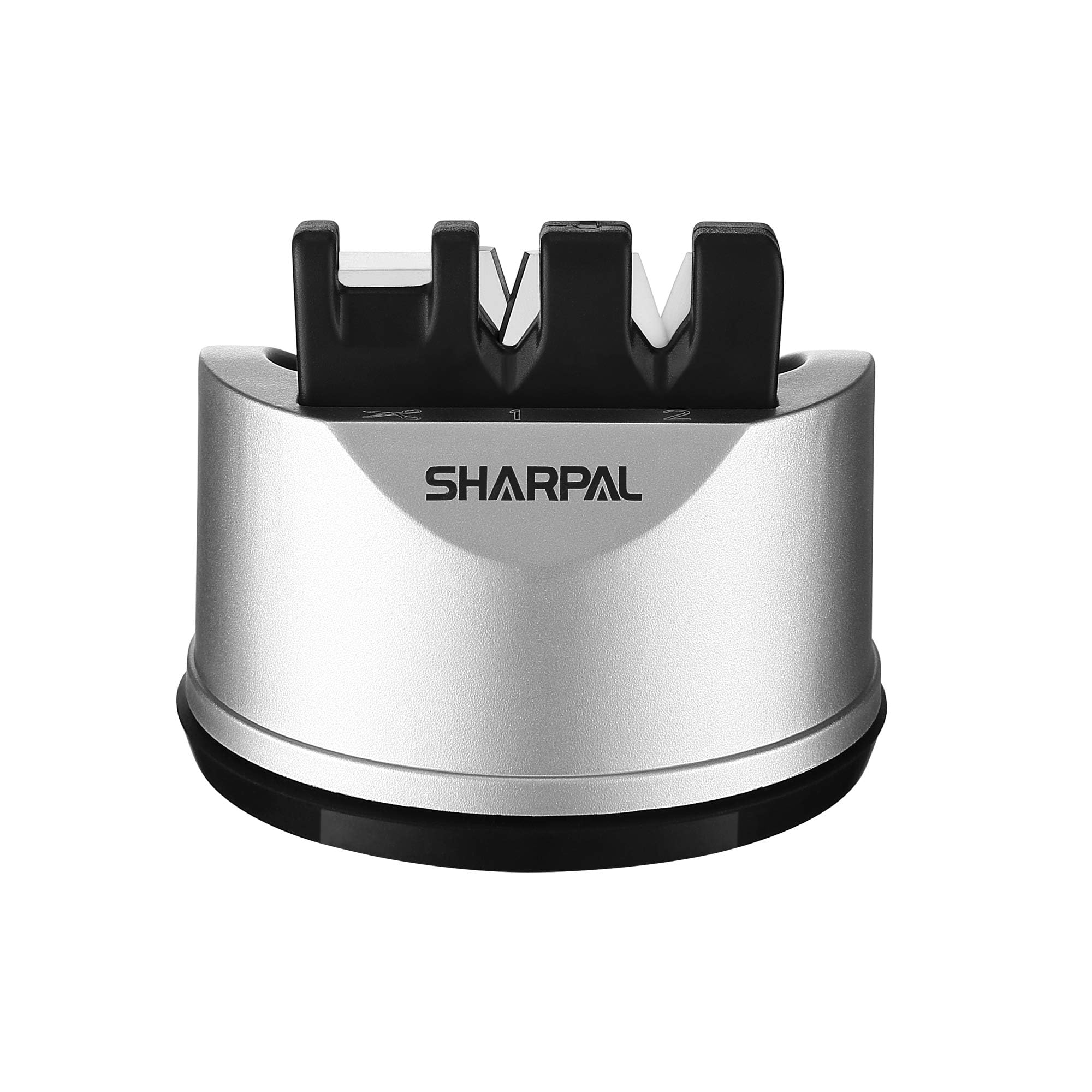
The SHARPAL 191H stands out for its enhanced suction base, which provides twice the holding force of comparable products. Press the black lever on a smooth countertop, and the sharpener locks in place, allowing you to pull the knife through one-handed without any shifting. This stability is critical for consistent sharpening angle and safety. The compact cube design measures just 2.76 inches per side, making it one of the most space-efficient sharpeners in this category.
The three-stage system includes tungsten carbide blades for edge setting, ceramic blades for honing, and a dedicated tungsten carbide slot for scissors. Having a scissor-specific sharpening stage is rare in a tool this small and saves you from owning a separate scissors sharpener. California-based SHARPAL backs the unit with a 3-year warranty and has distribution in Germany and Australia, reflecting global confidence in the build quality.
Left-handed users will appreciate the symmetrical design that does not favor a dominant hand. The black switch mechanism is intuitive, and the suction holds even after dozens of pulls. For anyone with limited counter space who wants a sharpener that does not require hand-holding, the 191H delivers a uniquely stable sharpening experience.
Why it’s great
- Suction base provides exceptional stability
- Dedicated scissor sharpening slot
- Compact 2.76-inch cube fits anywhere
Good to know
- Suction base requires a perfectly flat surface
- Small size means less leverage for long blades
6. Smith’s Pull-Thru Knife Sharpener
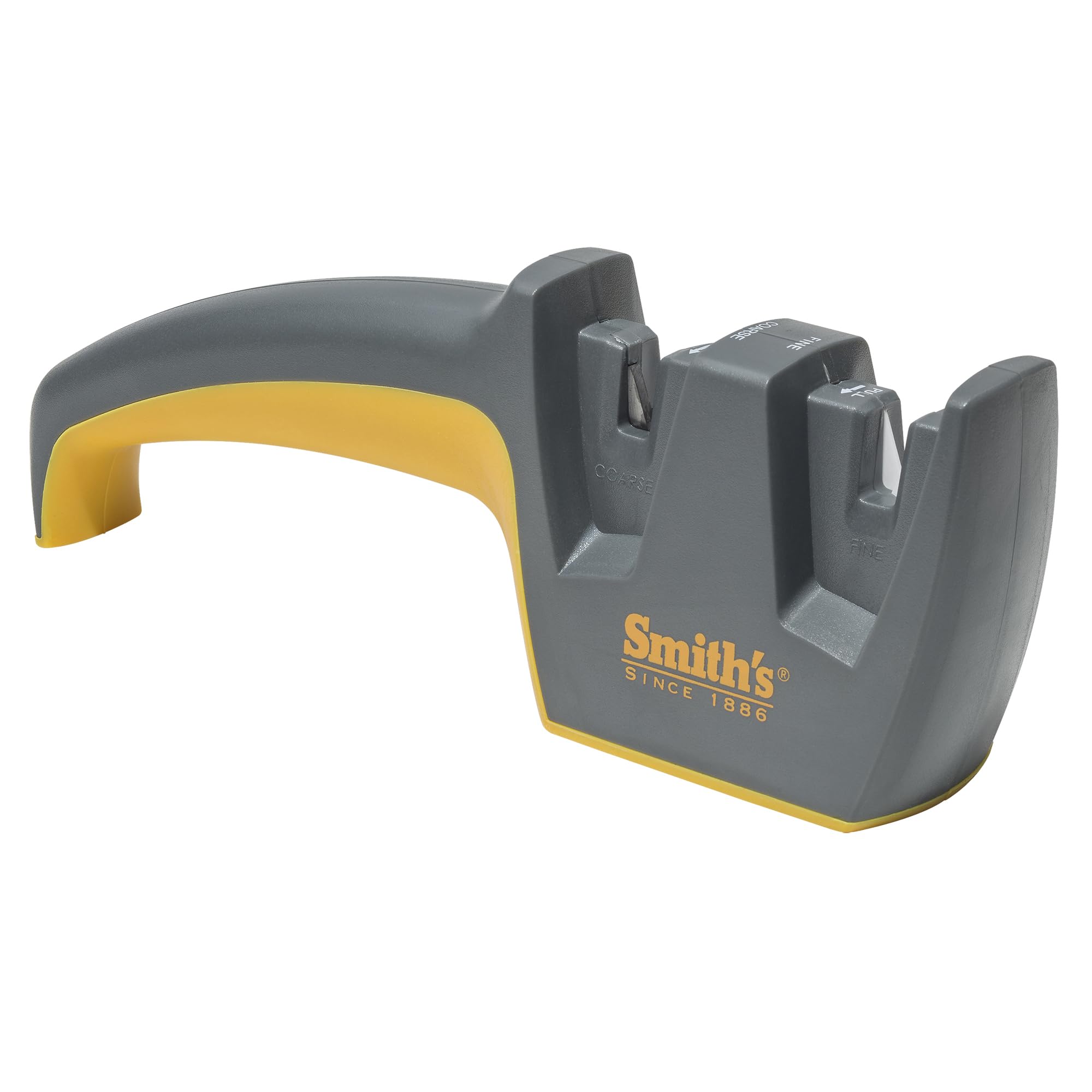
Smith’s has been a household name in sharpening for decades, and the Pull-Thru model 50090 offers a two-stage solution at an accessible price point. The coarse carbide slot handles dull or damaged straight-edge knives, while the ceramic rods refine the edge and can also lightly hone serrated blades. The non-slip rubber base and ergonomic soft-grip handle provide comfortable control during each pass.
One of the strongest features of this model is the replaceable sharpening components. When the carbide or ceramic elements wear out after heavy use, you can swap them instead of replacing the entire unit. This extends the lifespan significantly compared to disposable sharpeners. Users frequently report buying multiple units to keep one in the kitchen, one in the garage, and one in their camping gear.
The pre-set sharpening angles ensure consistent results regardless of experience level. While it struggles with severely damaged blades requiring significant edge restoration, it excels as a weekly maintenance tool that keeps knives slicing cleanly. The compact 6-inch profile slides easily into a drawer without hogging space.
Why it’s great
- Replaceable carbide and ceramic elements
- Non-slip rubber base for stable operation
- Pre-set angles provide consistent results
Good to know
- Not designed for heavy edge restoration
- Ceramic slot is best for honing, not sharpening
7. Gatco Edgemate Pocket Knife Sharpener
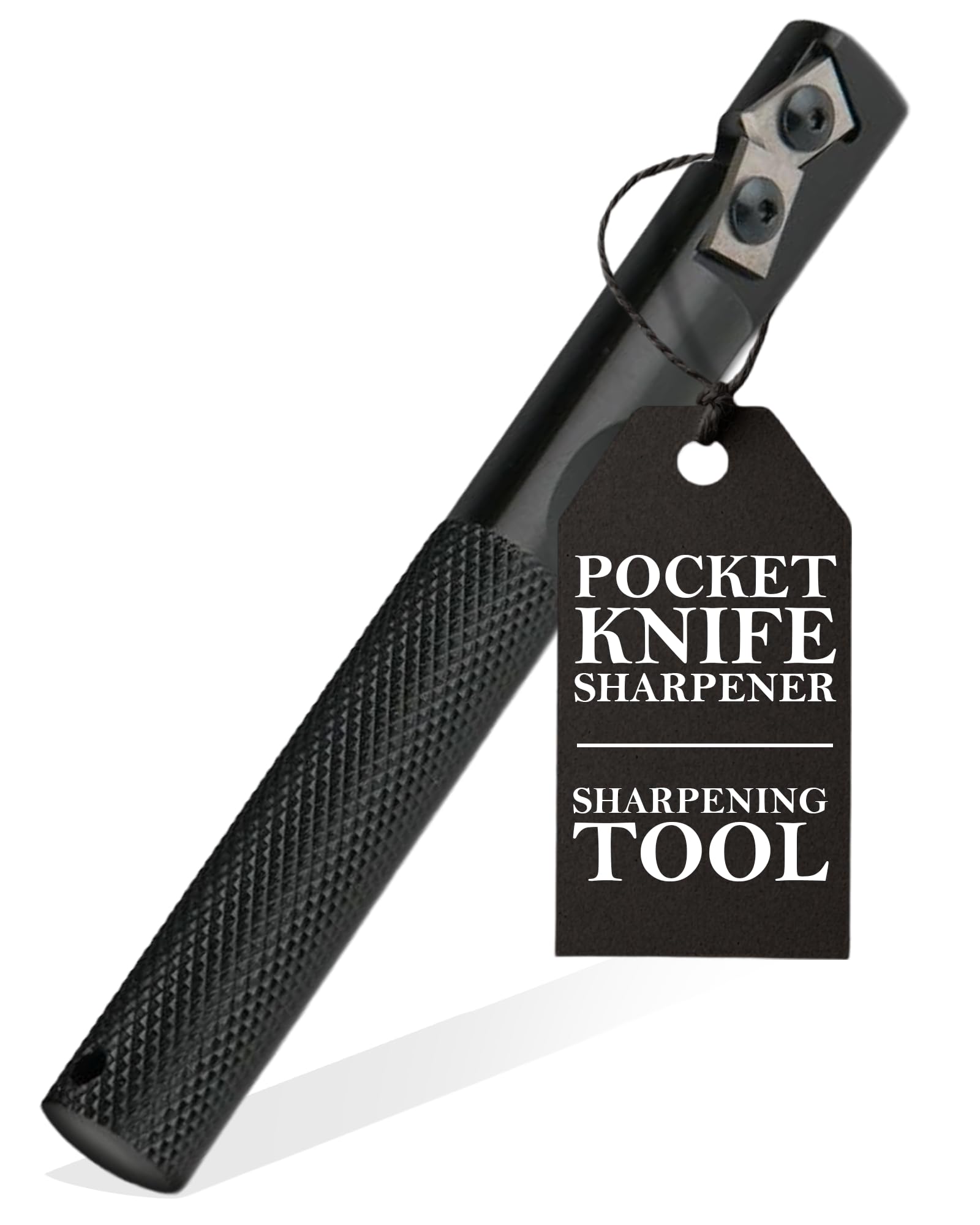
The Gatco Edgemate is designed for on-the-go use, whether that means a camping trip, a fishing vest, or a kitchen junk drawer. The 8.25-inch length provides a comfortable grip, and the tungsten carbide sharpening surface quickly restores edges on pocket knives, kitchen knives, hunting tools, garden shears, and scissors. It weighs virtually nothing at 0.01 ounces, making it the most portable option in this lineup.
Users consistently praise how fast the Edgemate brings a dull blade back to life. The carbide surface removes metal aggressively, so three to four strokes are usually enough to revive a neglected edge. That aggression does come with a caveat: applying too much pressure can remove more metal than necessary, so a light touch is recommended. The ergonomic handle ensures good control even during field use.
For a dedicated home kitchen that sharpens weekly, the Edgemate may be too aggressive for fine finishing. But for anyone who needs a sharpener that fits in a backpack or tackle box and can handle a variety of blade types, the portability and speed of this tool are unmatched at its tier.
Why it’s great
- Extremely portable at 0.01 oz
- Sharpens any blade type in seconds
- Ergonomic handle for comfortable control
Good to know
- Aggressive carbide removes metal quickly
- No honing stage for final edge polish
8. Dexter-Russell EZ Edge Hand-Held Sharpener M906

Dexter-Russell is a trusted name in commercial kitchens, and the EZ Edge M906 carries that professional lineage into a simple, economical handheld sharpener. The tungsten carbide cutting heads are set at the correct factory angle, so every stroke removes metal precisely without guesswork. The compact design measures 6 by 4 by 1 inches and weighs 0.31 pounds, making it easy to store on a magnetic strip or in a chef’s roll.
The claim of “just 3 or 4 strokes and it’s sharp” holds up in practice for moderately dull knives. The carbide heads are aggressive enough to establish a new edge quickly but are less effective for fine polishing.
The white plastic body is unobtrusive and easy to wipe clean. While the tool lacks a dedicated honing stage, you can follow up with a ceramic rod or steel separately if you want a finer edge. For raw sharpening power in a budget-conscious package, the Dexter-Russell M906 delivers exactly what it promises with no distractions.
Why it’s great
- Factory-set sharpening angle for consistency
- Compact and lightweight for storage
- Economical price for commercial-grade build
Good to know
- No ceramic honing stage for smooth finish
- Single-sided carbide wears faster than multi-stage
9. Norpro Aladdin Knife Sharpener

The Norpro Aladdin Knife Sharpener is a testament to enduring design—users have been buying this exact model for over 20 years and reporting consistent satisfaction. Made in the USA, it features a single tungsten carbide slot designed to handle hollow-ground and stainless steel blades. At just 1.36 ounces with dimensions of 7.4 by 3.3 by 4 inches, it can sit in a drawer or be wall-mounted to save counter space entirely.
The simplicity is the draw. There is no 2-stage or 3-stage system, no ceramic rods, and no rubber base. You pull the blade through a few times, and it sharpens. That straightforward action appeals to users who want the lowest possible friction in their kitchen workflow. Long-term owners frequently comment that while they own more elaborate sharpeners, the Aladdin is the one they actually reach for week after week.
The trade-off is that the single coarse carbide slot does not hone or polish, so the edge will have a slight burr that may diminish slightly after the first few cuts. It also cannot sharpen serrated blades or scissors. For a home cook who just wants to revive a dull chef knife without thinking, the Aladdin is a reliable, time-tested choice that has earned its place in countless kitchens.
Why it’s great
- Made in USA with proven 20-year track record
- Wall-mountable for zero counter footprint
- Extremely simple operation
Good to know
- Single carbide slot lacks honing/polish stage
- Not suitable for serrated blades or scissors
FAQ
Will a pull-through sharpener damage my expensive chef knives?
How many pulls does it take to sharpen a very dull knife?
Can I use a pull-through sharpener on serrated bread knives?
Final Thoughts: The Verdict
For most users, the best easy knife sharpener winner is the Work Sharp Pull Through because its diamond-and-ceramic wheel system delivers a razor edge in seconds with no technique required. If you want unmatched counter stability and a scissor slot in a tiny footprint, grab the SHARPAL 191H. And for a time-tested, no-fuss sharpener that has proven itself for two decades, nothing beats the Norpro Aladdin.